Tax Lien Search: How to Check Federal and State Liens
Learn how to run a tax lien search across county records, federal notices and releases, and avoid the gaps that hide an active tax claim.

In this article
The most popular advice about a tax lien search is to pull a credit report, run one free county lookup, and treat a clear result as clearance. Both halves fail. A credit file isn't a lien record, and one county lookup covers one office, one index, and often one recording year. If the taxpayer owns property in two counties, holds title through an LLC, or filed under a name that changed, that "clear" result is clear about nothing.
A tax lien search isn't a lookup. It's a stack of jurisdiction-by-jurisdiction searches, and the only status you can act on comes from the latest recorded instrument in the chain, with its recording date attached. Everything that follows is about finding that instrument and reading it correctly.
Where Federal and State Tax Liens Are Recorded
A clean result in one office does not establish that no lien exists. Federal, state, and local tax liens can appear in different records, so identify the relevant filing offices for each asset and type of tax.
A federal income-tax lien is recorded as a Notice of Federal Tax Lien. Depending on the property and filing, the notice may appear with a county recorder or register of deeds, or in a state filing office. Search by the taxpayer's legal name and check the relevant filing office. A state tax lien may be recorded by the state tax authority and, for real property, with the county recorder. County property-tax liens are generally tracked by the local tax collector, treasurer, or assessor, often by parcel identification number. For more on the recording of a Notice of Federal Tax Lien, see the federal notice's role in the public record.
The lien and its recorded notice are different things. A federal tax lien arises when the IRS assesses tax, demands payment, and the taxpayer fails to pay in full. The recorded notice alerts purchasers, lenders, and other creditors to the claim, as the IRS explains in its overview of tax liens and levies. A federal lien can attach to property the taxpayer owns when it arises and property acquired later, so the recording jurisdiction matters when reviewing an asset.
| Lien type | Where it is recorded | Search by | Watch for |
|---|---|---|---|
| Federal income-tax lien (NFTL) | County recorder or register of deeds, or a state filing office, depending on the filing | Taxpayer legal name and relevant filing office | Refiles and releases filed separately |
| State tax lien | State tax authority and, for real property, the county recorder | Taxpayer name, entity name, and parcel number | State-specific release procedures |
| County property-tax lien | County tax collector, treasurer, or assessor | Parcel identification number | Sold, redeemed, or converted liens |
| Federal lien against a business | State filing office and, for real property, county recorder | Entity name and prior names | Filings under an LLC rather than an individual |
| Any lien on real property | County recorder's records | Legal description and parcel number | Name-only indexes that may miss filings |
Notices of Federal Tax Lien no longer appear on major credit reports, but they remain public records at the relevant recording office. A credit report therefore cannot establish whether a notice was filed or released.
Start by identifying every jurisdiction connected to the asset. Then evaluate the latest recorded instrument in each relevant record chain. A clean result in one office is only a finding about that office's records, not clearance of the property.
How to Run a Tax Lien Search Step by Step
A tax lien search is a sequence of checks across the offices connected to the taxpayer and the property. A clean result from one index is not a final status. The latest recorded instrument is what you need to review before acting.
Map the jurisdictions first. List the county recorder for every parcel, the state filing office for business records, and the local tax collector or assessor for delinquencies. A search in the wrong county can look clean while missing a relevant filing.
Search every version of the name. Check the full legal name, aliases, prior names, entity names, and spelling variants. An index may file a record under a prior name or business entity.
Run the parcel number as a second pass. Name searches can miss records indexed against a property. Searching by parcel number adds a separate way to find documents tied to the asset.
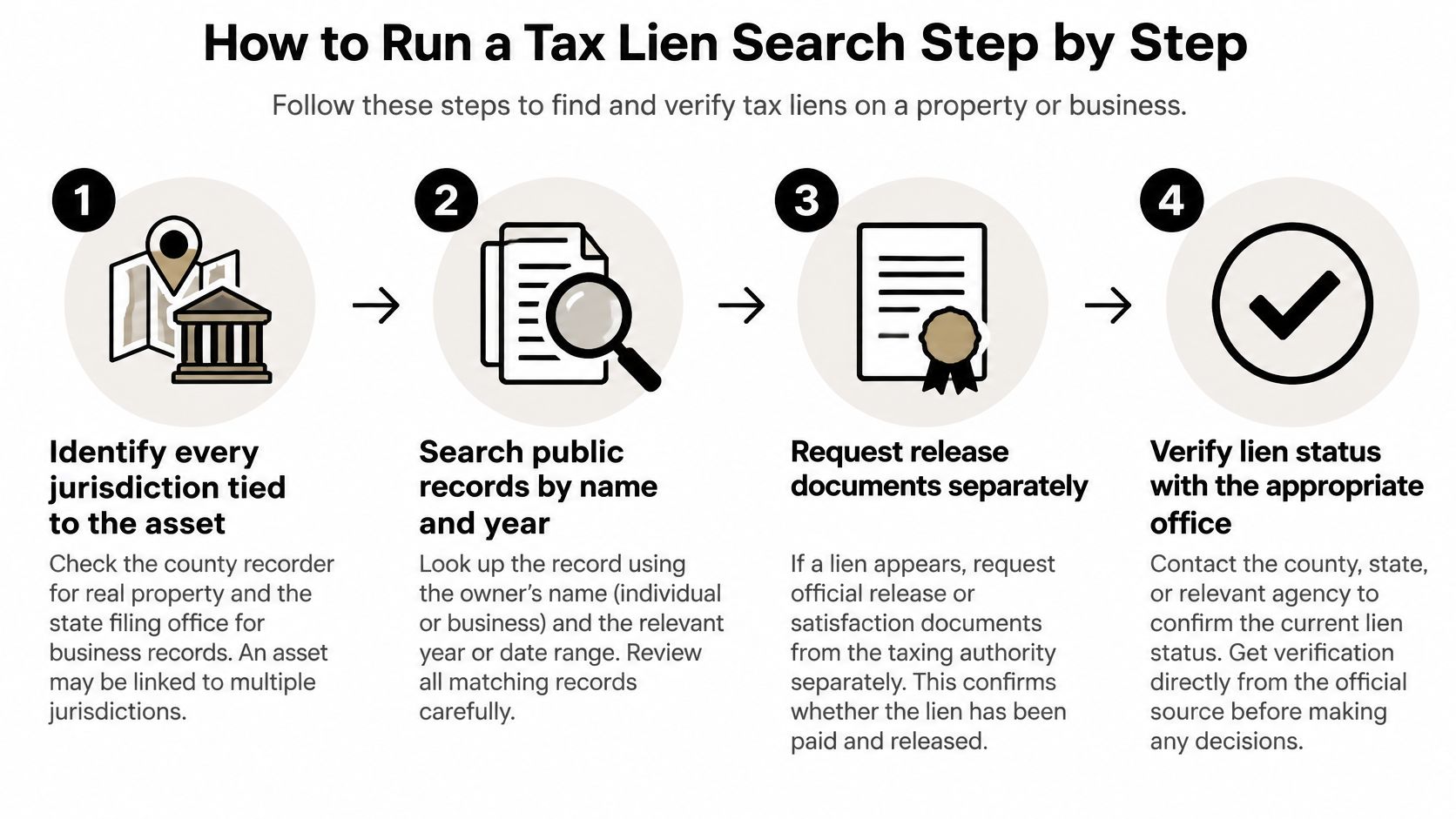
Pull the documents, not just index rows. Request the Notice of Federal Tax Lien, Form 668(Y), and any amended notices, refiles, releases, withdrawals, or subordinations. An index entry confirms that a document was recorded. It does not show the document's terms.
Record four details for each document: filing date, tax periods covered, taxpayer identity, and the property or collateral described. Compare these details across records, especially when names or dates differ.
Search for later documents that change the status. Look for releases, withdrawals, and other later filings. A missing document in an index does not establish that a lien remains in effect, and it does not establish that the lien has ended.
Compare the recorder's records with the tax office account. Check whether the county index, IRS documentation, and local tax collector's account align. Treat a mismatch as unresolved until you identify the document that controls the current status.
A “paid” notation in a servicing file, an email from a borrower, or a database status field is not a substitute for reviewing the recorded instrument.
For a closing or refinance, obtain certified copies where available. Confirm that the legal description and taxpayer identity match across the records, and get written payoff or release instructions before relying on the search. Under IRC 6325, the IRS is generally required to release a federal tax lien within 30 days after the liability is satisfied or becomes legally unenforceable.
What Each Lien Record Actually Means
The most consequential error in this work is treating the lien and the notice as the same thing. The lien can arise by statute; the Notice of Federal Tax Lien is the recorded notice that alerts competing creditors and buyers, and it stays public until it's released under IRC 6325 or withdrawn under IRC 6323(j). Filings move in both directions too, with more than 214,000 notices recorded in fiscal 2025, which is exactly the climate in which a stale title snapshot does real damage (IRS guidance on NFTL processing).
| Document | What it does | What to check |
|---|---|---|
| Notice of Federal Tax Lien (Form 668(Y)) | Public notice that the federal government claims an interest in the taxpayer's property | Filing date, recording office, tax periods and property scope |
| Refiled or amended notice | Extends or changes an earlier notice | Confirm it is later than the original and names the same taxpayer |
| Certificate of release | Extinguishes the lien for the liability named | Matching taxpayer, tax period and property |
| Withdrawal | Removes the notice from the public record | The debt may still be owed; check the transcript |
| Subordination | Lets a later lender take priority over the lien | The property scope and conditions |
| Self-releasing notice (filed after December 1982) | Lapses unless timely refiled | Whether a refiling appears in the index |
Notice what the table forces you to confront. A withdrawal clears the public record and leaves the taxpayer liable for the debt. A certificate of release extinguishes the lien for the liability it names. A self-releasing clause on a notice filed after December 1982 does the work automatically unless someone refiled in time. Three documents, three different outcomes, and they all look like "resolved" to someone reading a summary.
On any record you pull, confirm five things:
- The recording date, not the date stamped on the IRS letter.
- The taxpayer's exact legal name, compared character by character against the deed or entity filing.
- The tax periods listed, since one notice can cover several quarters.
- The property or collateral scope, because a lien that names nothing specific reaches more than you'd assume.
- Whether anything later supersedes it, including refiles, amendments, subordinations and withdrawals.
That last item is where clean-looking indexes betray people. The recorder's system shows the original notice; the release was recorded but never indexed, or returned to the IRS instead of scanned. Before you decide what a lien record means for a transaction, understand how a lien differs from a levy, because the two produce very different consequences and very different records.
Why a Clean Search Can Still Miss a Lien
A clean result is not evidence that no lien exists. It means the index you queried returned nothing for the key you used, which is a much smaller statement.
County systems enforce that limitation openly. Sacramento County runs recorded-document searches on an individual's name and year and requires releases to be located as separate documents, so a search that skips either element can come back empty on a property that has a lien recorded against it (Sacramento County Clerk/Recorder tax lien search).
Here's where searches fail in practice.

- The wrong name went in. A search under a personal name misses a lien filed against the owner's LLC, and a search under the LLC misses a lien filed before the entity existed.
- A former name was never searched. Married names, maiden names and prior legal names are the single most common gap in an otherwise careful search.
- The asset sits in joint names. If the deed is held by two owners and the lien was recorded against one, the index may not connect them unless you search both.
- The parcel was searched in the wrong county. Property near a county line, or an owner who moved, sends people to the wrong recorder's office more often than you'd expect.
- The index covers one recording year. Federal notices stay public until released or withdrawn, so a search window that stops years back will miss the live filing.
A national database is a starting point. It is not proof of absence, and no title professional should treat it as one.
When a gap appears, pull the underlying document rather than accepting the summary row. An unclear result is a reason to keep searching, never a reason to assume the property is clear. Pay for a certified title or public-record search when the property is about to be sold, refinanced or pledged as collateral, and whenever the owner holds several entities or has a history of federal assessments.
Property-Tax Liens and the Sales That Create Them
A property-tax lien sale is not the same as a federal or state income-tax lien filing. Counties sell claims for unpaid property taxes through their own processes, so buyers and owners need to check the relevant county records.
Morgan County, Colorado reported 187 liens offered and 187 purchased at its November 14, 2024 sale. The county reported $271,851.19 in taxes offered, 27 purchasers, and a 15% rate of return for the 2024 sale, matching 2023 and rising from 12% in 2022 and 9% in both 2021 and 2020 (Morgan County tax lien sale statistics).
The figures in the table describe different stages of a sale. Parcels published for sale are not the same as liens sold, and a deed issued is a separate outcome.
| Jurisdiction | Parcels or liens | Dollar amount | Other result |
|---|---|---|---|
| Morgan County, Colorado (sale of November 14, 2024) | 187 offered; 187 purchased | $271,851.19 in taxes offered | 27 purchasers; 15% rate of return |
| Pima County, Arizona (2024) | Parcels published and liens sold | Amount sold | Deeds issued |
A lien record must be read in context. Check the jurisdiction and lien type, then identify the recorded date and claimed amount. Confirm whether the claim was sold, redeemed, released, or converted into another enforcement instrument. Those distinctions determine what the record shows.
A county property-tax lien, a state tax lien, and a federal income-tax lien involve different taxing authorities and recording systems. A search result in one system does not establish the status of a claim recorded in another. For the federal layer, review how federal tax liens attach to property.
Confirm Lien Status Before You Close or Buy
A clean search result does not establish that a tax lien is resolved. Before a sale, refinance or loan, check three separate questions: Is the debt still owed? Is the statutory lien still effective, based on release, lapse or timely refiling? Does the public index show the latest recorded notice or release?
Paying a debt, releasing a lien, withdrawing a notice, discharging property from a lien and subordinating a lien have different effects. Match your conclusion to the latest recorded instrument, not to a verbal description or a credit report. A missing entry in one search does not establish that no claim exists.
For a California asset, search the state records separately from federal records. A federal release does not, by itself, resolve a state tax lien. See this guide to the California state tax lien for information about state recording and release procedures.
Before signing, confirm the latest recorded instrument and its date. Compare the legal description and taxpayer identity across the records you found, then obtain written payoff or release instructions from the creditor. Proceed only after the property's lien status and the debt position are confirmed in writing.
Get legal help if a lien appears, records conflict, an IRS revenue officer is involved, or the asset or finances are complex. A recorder's index cannot establish the full debt history. The attorney obtains IRS and state transcripts to review every penalty and payment, how long the debt may remain collectible, and the most immediate levy, garnishment and lien threats.
Tax Attorney Stephen A Weisberg's Tax Debt Analysis is a paid service. After reviewing the transcripts, the attorney identifies the most immediate threats. If you decide to proceed with services after receiving the analysis, enforced collections are stopped. The next step is a Tax Debt Resolution Plan, an attorney-led investigation and personalized roadmap for resolving the tax debt. Use the Tax Debt Resolution Plan request to get started.


