California State Tax Lien: Payoff, Priority, and Release
See how a California state tax lien attaches, ranks against other claims, and gets released so a sale, refinance, or business deal can still close.

In this article
- When a California State Tax Lien Appears Before Closing
- Gather the file before choosing a remedy
- How a California State Tax Lien Is Created and Kept Alive
- Read the legal dates in sequence
- Don't confuse lien duration with collection limits
- How California Lien Priority Works Against Other Claims
- Identify which attachment rule applies
- Compare documents, not assumptions
- What the Lien Changes for Property Credit and Payroll Debt
- Payroll liabilities follow specific milestones
- Bankruptcy timing requires coordinated advice
- Payoff and Escrow Examples That Keep a Deal Moving
- Match the request method to the closing calendar
- Handle a paid-but-still-showing lien differently
- Choosing Release Subordination or a Tax Debt Analysis
- Match the remedy to the obstacle
- Get an analysis before paying for a strategy
- What to Do After the Lien Is Paid or Still Showing
- Track agency action and county recording separately
- Treat an old lien as a verification question
Your escrow officer emails a title report, and a California state tax lien appears where you expected a clear path to closing. You're already planning the move, the refinance, or the business transfer. Don't cancel the transaction or send payment based on an old notice. First, identify the claim, establish what the state requires, and find out what the closing professionals need in writing.
When a California State Tax Lien Appears Before Closing
A lien discovery creates an urgent question, but it isn't automatically the question most owners ask. Instead of “Is my deal dead?” ask, “What must happen before escrow can disburse funds and the buyer or lender will proceed?”
Treat the lien as a claim at the escrow table, not a padlock on the property. Someone must identify the correct taxing agency, establish the amount and legal status of its claim, and coordinate the documents needed to address it. The answer may involve a payoff, a different form of relief, or closer examination of whether the recorded claim is still effective.
Gather the file before choosing a remedy
Ask the title officer for the actual lien document, not just the exception listed in the report. Then assemble:
- Taxing agency and taxpayer: Identify who asserted the claim and whether it names you, your business, or another taxpayer.
- Tax periods: Match the lien to the notices and assessments in your records.
- Recording or filing office: Note the county recorder or Secretary of State filing information.
- Property and transaction: Collect the property address, proposed transfer documents, and scheduled closing date.
- Current correspondence: Include payment confirmations, agency letters, and any claimed release or extension.
Keep the seller's disclosure work moving separately. Edinhart Realty and Property Management's resource on required disclosure forms for California sellers is a useful companion checklist, not a substitute for resolving the title exception.
Closing rule: Don't let a conversation about what you owe replace a written plan for what escrow must receive.
Also identify whether the agency correspondence concerns a lien or a separate collection action. If the terminology is confusing, review this explanation of what a state tax levy means before discussing the file with your advisors.
Your immediate objective is clarity: whether the claim attached, whether recording affects a buyer or lender, and whether the transaction has a workable resolution path. Those are separate decisions. Trying to answer them with the balance printed on an old notice invites mistakes.
How a California State Tax Lien Is Created and Kept Alive
A California state tax lien is a legally enforceable claim against a taxpayer's property for an unpaid state liability. Don't assume the state needs a later lawsuit before a lien can exist. For covered liabilities, the legal trigger may be the amount becoming due and payable.
The useful way to read a lien file is to separate creation, notice recording, and extension. Those events can occur on different dates, and each date answers a different question.
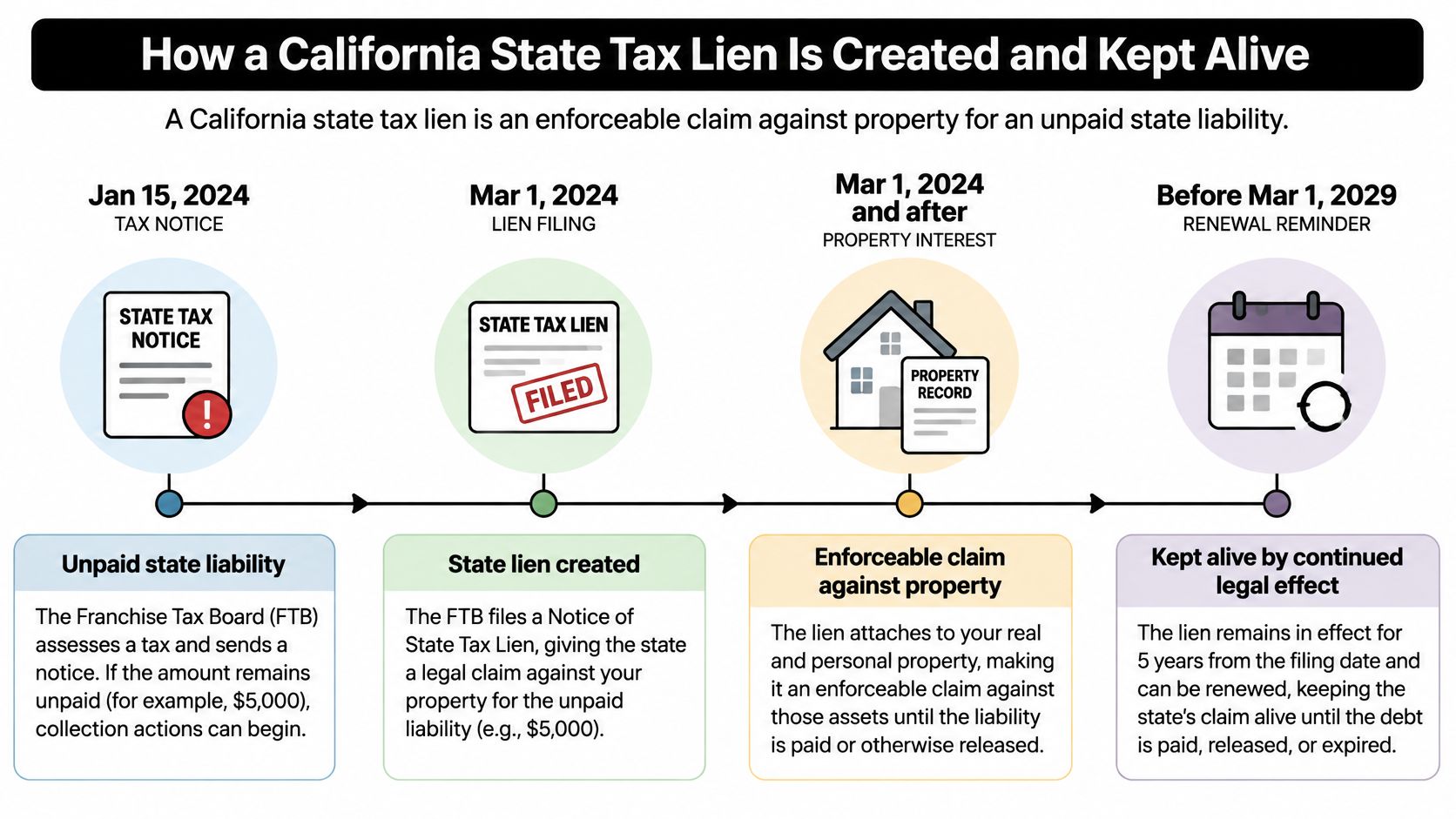
Read the legal dates in sequence
Under California Government Code section 7172, a state tax lien generally remains effective for 10 years from creation; a notice recorded or filed before that period expires continues the lien for 10 years from that recording or filing, and timely extensions can preserve it for additional 10-year periods.
That framework defeats a common shortcut: subtracting the tax year from today and declaring the lien expired. The tax period identifies the liability. It doesn't, by itself, establish the controlling recording or extension date.
Build a chronology from the documents:
- Creation event: Identify the statutory event that made the lien effective.
- Notice date: Obtain the recorded or filed notice, including its official identifying information.
- Extension history: Look for later recordings or filings before treating the original notice as the whole story.
- Termination evidence: Check for a release or other discharge rather than assuming the lien must run its full term.
The statute permits the lien to end sooner through release or discharge. Conversely, timely extensions mean an old liability can remain secured for successive decades.
Don't confuse lien duration with collection limits
Whether a lien remains effective and whether the state may pursue a particular collection action are related but distinct legal questions. An age calculation alone doesn't resolve both.
My recommendation is straightforward: don't advise a sale, refinance, or restructuring from an old search. Obtain the current record and have counsel connect the statutory creation event to the recorded notice and any extensions. If someone says the lien has expired, ask for the document chronology supporting that conclusion.
That review is especially important when the taxpayer remembers paying something years ago but can't identify which assessment, tax period, or agency received the payment.
How California Lien Priority Works Against Other Claims
A valid lien doesn't necessarily outrank every other claim. Attachment concerns the state's claim against the taxpayer's property. Third-party effect concerns when that claim becomes enforceable against particular purchasers or security-interest holders.
The distinction matters because the date tax became owed isn't always the date that decides a buyer's or lender's position.
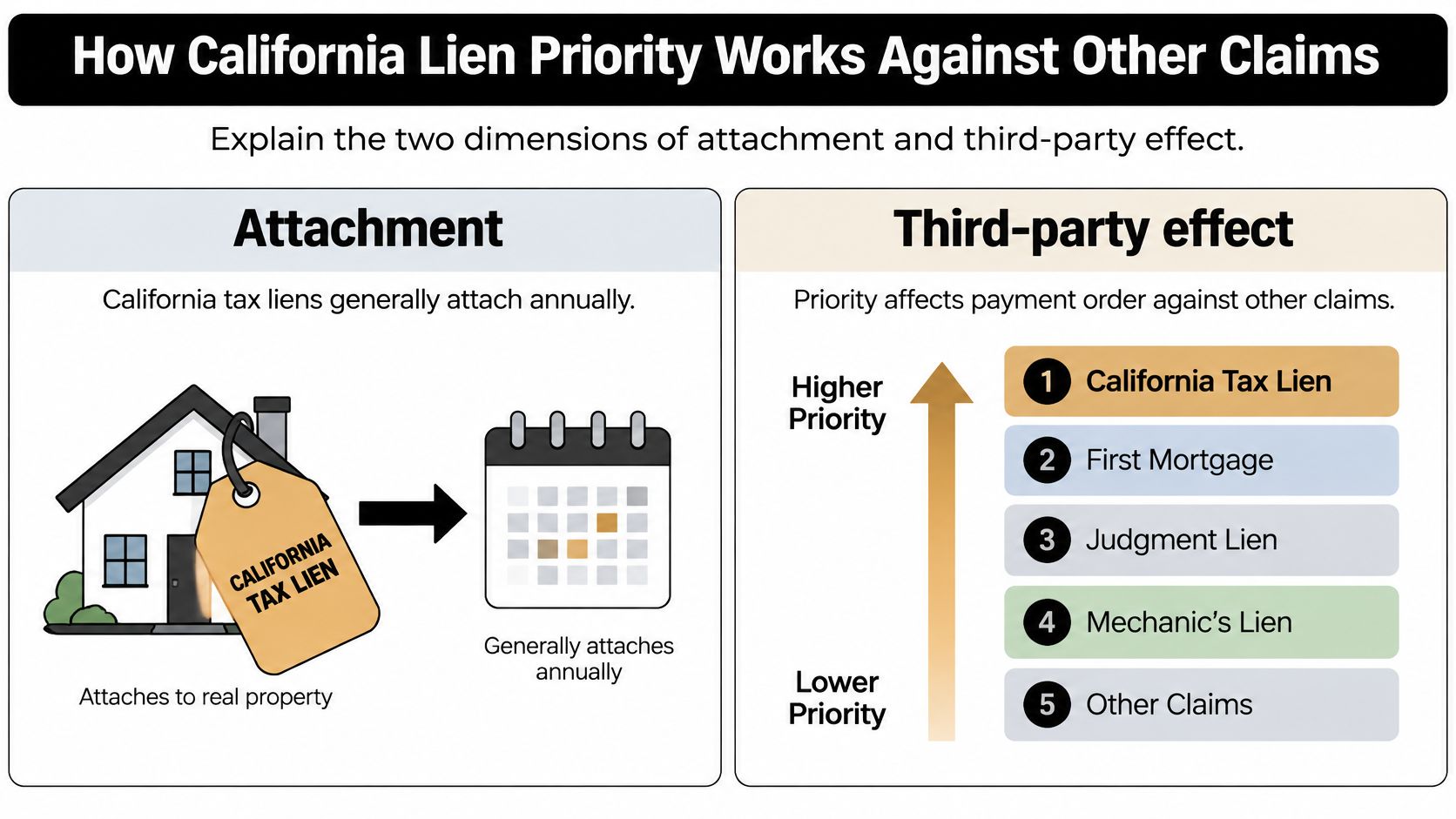
Identify which attachment rule applies
For taxes governed by the annual attachment rule, California Revenue and Taxation Code section 2192 establishes attachment at 12:01 a.m. on January 1 preceding the fiscal year for which the tax is levied.
Don't apply that annual date indiscriminately to every state liability. Identify the tax involved and its governing statute before assigning a creation date.
For real property, recording the notice in the county where the property sits generally determines effectiveness against certain purchasers and security-interest holders. A successor who acquired or perfected an interest before recording, without knowledge of the lien, may have protection. That makes both the transaction documents and the parties' knowledge relevant to the review.
| Question | Date or evidence to examine |
|---|---|
| When did the statutory claim attach? | The applicable tax statute and liability history |
| When did the notice affect protected third parties? | County recording and the competing interest's acquisition or perfection |
| Which competing claim has priority? | Recording history and any applicable special priority rules |
| Is a federal tax lien involved? | Statutory creation dates, not just notice-recording order |
Compare documents, not assumptions
FTB's general priority approach uses recording order for competing liens, while federal-versus-state priority can depend on when the respective liabilities were created. Don't reduce either inquiry to “the government always gets paid first.”
For broader background on claims that may appear in a property file, the LendingXpress guide to property liens provides useful context. The actual priority opinion still needs the transaction's documents.
Have counsel obtain current county and Secretary of State searches, identify tax periods and statutory lien dates, and compare them against deeds, mortgages, and UCC filings. Ask for a written explanation of any disputed ranking before approving a distribution of proceeds.
The practical trade-off is time versus certainty. A quick assumption may preserve the scheduled closing on paper, but a documented priority analysis gives escrow and the lender a defensible basis to proceed.
What the Lien Changes for Property Credit and Payroll Debt
For a business owner, the most dangerous assumption is that the lien equals the original unpaid tax. Covered employment-tax liabilities can include penalties, interest, and costs, so a principal-only calculation may leave the actual exposure unresolved.
A thin business bank balance doesn't answer the lien question either. The relevant inquiry concerns the taxpayer's property and rights to property, the liability involved, and the legal event that made the claim enforceable.
Payroll liabilities follow specific milestones
Under California Unemployment Insurance Code section 1703, covered unpaid amounts become a perfected and enforceable state tax lien when due and payable; reported amounts generally follow agency notification, specified penalties follow notice, and other liabilities arise when the assessment becomes final.
That structure calls for more than reviewing payroll returns. Counsel should match the return, agency notice, assessment status, and payment history.
- For the business: Determine which entity owes the assessed liability and which assets belong to it.
- For the owner: Don't assume a company assessment settles the separate question of personal exposure.
- For the transaction professional: Ask which taxpayer's property is being sold, refinanced, or transferred.
- For the accountant: Provide the assessment correspondence, not just a general-ledger balance.
Owners concerned about their own exposure should also review the distinct issues addressed in this discussion of payroll tax debt and business-owner personal liability. A business lien and an owner's liability shouldn't be treated as interchangeable.
A payroll-tax problem needs an assessment review, not just a payment estimate.
Bankruptcy timing requires coordinated advice
The employment-tax statute also provides that the lien doesn't arise during a period when the federal Bankruptcy Code's automatic stay applies to the affected employer or person. That limitation concerns lien creation during the protected period. It isn't a blanket answer to every related tax issue.
If bankruptcy counsel is involved, give tax counsel the filing information and relevant notices before recommending a payment or transfer. The sequence may matter.
The same discipline applies to a divorce transfer or owner refinance. Identify whose liability is at issue, whose property is involved, and what event made the lien enforceable. Don't let the pressure to complete another legal matter replace that analysis.
Payoff and Escrow Examples That Keep a Deal Moving
Consider a hypothetical homeowner who learns about an FTB lien shortly before a scheduled sale. The homeowner finds an old notice and offers to pay that amount. The escrow officer should request the transaction payoff instead of treating the old notice as a current demand.
An authorized escrow, title, or mortgage company can request an FTB payoff. The package needs the property address, buyer and seller information, lien documents, and taxpayer authorization on Form FTB 3518.
Match the request method to the closing calendar
FTB lists the following processing expectations in its property-transaction payoff request instructions, including 3–5 business days online, 10 business days by fax, and 21 or more business days by mail.
FTB Payoff Request Timing
| Request channel | Typical processing time | What must already be ready |
|---|---|---|
| Online eDemand | 3–5 business days | Transaction details, lien documents, and taxpayer authorization |
| Fax | 10 business days | A complete request package and signed authorization |
| 21 or more business days | Complete documentation and sufficient mailing lead time |
Those are processing expectations, not a closing guarantee. Build room for questions, document corrections, and coordination with the lender or title officer. My recommendation is to start the request when the lien is identified, not when everyone is ready to sign.
The same FTB instructions require a business to be in good standing for a bulk-sale or liquor-license transaction payoff. A business buyer should have the seller check that requirement early rather than discovering it after the request is submitted.
Handle a paid-but-still-showing lien differently
In another hypothetical, the seller already paid the liability, but the title report still lists the lien. Don't reflexively send another payment. Ask for proof of payment, the agency's release status, and confirmation of what title needs to resolve the exception.
That file needs record-clearance coordination rather than a guess at another payoff. Assign responsibility for obtaining the release evidence and delivering it to the closing team.
For perspective on why a lien doesn't automatically end a home sale, this discussion of selling a home with an IRS lien addresses a related federal situation. Keep the agency procedures separate.
The operational lesson is simple: complete authorization, an accurate request, and an assigned follow-up person are more useful than repeated assurances that the lien “should be handled.”
Choosing Release Subordination or a Tax Debt Analysis
Choose the remedy by the result you need. Clearing the claim, changing its position for a transaction, correcting an error, and testing the underlying debt aren't the same assignment.
For an FTB payoff, the full liened liability generally includes tax, penalties, accrued interest, and applicable fees. Paying only the amount you recognize from the original assessment may not satisfy the release requirements.
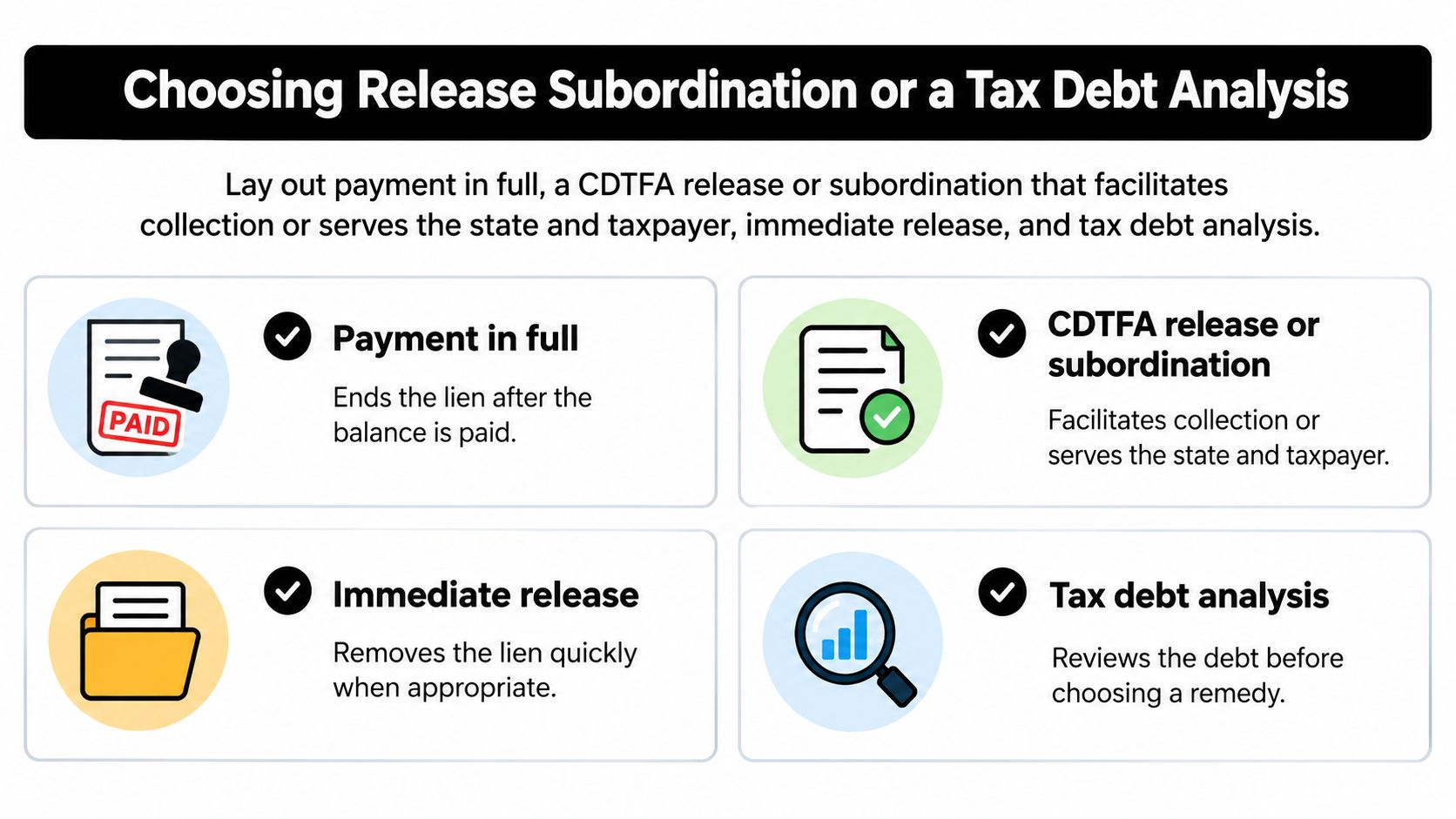
Match the remedy to the obstacle
| Option | When to evaluate it | What to obtain |
|---|---|---|
| Full payment and release | The liability is accepted and funds are available | Current payoff, payment evidence, and release confirmation |
| CDTFA release or subordination | Transaction-focused relief could facilitate collection or serve the state and taxpayer | Written agency approval addressing the proposed transaction |
| Correction of an erroneous lien | The claim is wrong and obstructs a lawful transaction | Supporting records and a specific release request |
| Counsel-led debt analysis | Liability, ownership, priority, or feasibility remains uncertain | A document-based assessment before committing funds |
FTB describes its full-payment and release requirements in its state tax lien guidance. For CDTFA liabilities, release can follow full payment or an adjustment of the billing to zero; certified funds may be required when an immediate release is needed.
CDTFA may also release or subordinate a lien when doing so facilitates collection or serves the interests of the state and taxpayer. An erroneous lien blocking a lawful transaction may warrant immediate release. Don't assume that identifying a possible remedy means the agency has approved it.
Get an analysis before paying for a strategy
A homeowner with an accepted payoff may primarily need escrow coordination. An owner disputing a payroll assessment, or a buyer facing uncertain priority, needs a legal review before selecting the remedy.
The W Tax Group offers a free Tax Debt Analysis to determine whether and how it can help before charging to resolve IRS or California tax debt. That's an option for individuals, business owners, and payroll-tax businesses, as well as referring CPAs, realtors, lenders, bankruptcy counsel, and family lawyers.
Decision point: Ask what the proposed work will establish before agreeing to a resolution engagement.
Bring the assessment notices, lien documents, transaction deadline, and payment history. A useful analysis should identify the unresolved questions and the documents needed to answer them, rather than promise that every lien can be removed on demand.
What to Do After the Lien Is Paid or Still Showing
Payment is an event you can document. Public-record clearance is a separate result you must verify. Keep a resolution file containing payment evidence, the agency name, recording jurisdiction, lien identification, and written release correspondence.
Don't close that file merely because an account screen shows no balance. The title officer, lender, or other professional needs evidence responsive to the recorded claim.
Track agency action and county recording separately
FTB states that it issues a certificate of release no later than 40 days after payment, while its lien-help guidance tells taxpayers to allow at least three months for the county recorder to record the release.
Those timelines address different administrative steps. The agency's release action and the county's recording or indexing process shouldn't be treated as a single deadline.
- Preserve payment proof: Keep the confirmation and supporting account correspondence.
- Confirm the destination: Identify the county recorder and any applicable Secretary of State filing.
- Search by resolution date: FTB directs taxpayers to use the date the lien was resolved, not the original recording date.
- Follow up with the correct office: Contact the county where the lien was recorded if the record still appears unresolved after the stated waiting period.
Treat an old lien as a verification question
FTB generally won't issue a release for an already expired lien. Before requesting routine release paperwork, confirm the notice and extension history discussed earlier and determine what evidence the transaction professional will accept.
For a broader federal comparison, this guide to removing an IRS tax lien can help frame questions, but California record-clearance work must follow the state file and the relevant recording office.
Assign someone to follow the matter through to a current search. If a closing, payroll assessment, bankruptcy, or divorce depends on the answer, gather the lien notice and taxpayer authorization now. Don't assume payment alone has cleared the public record.
Tax Attorney Stephen A Weisberg offers a free Tax Debt Analysis to determine whether and how he and The W Tax Group can help with your California state tax lien before charging for resolution work. Gather your lien notice, assessment correspondence, payment records, and closing deadline, then visit Tax Attorney Stephen A Weisberg to request an analysis before committing to a payoff or legal strategy.


