New York State Tax Debt: Collections and Your Options
New York State tax debt explained: how it grows, which collection actions apply, and the payment plans or offers in compromise that can resolve it.

In this article
- How New York Tax Debt Escalates and Where You Can Act
- The stages, and what each one closes off
- Finding the stage you're actually in
- Collection Actions That Can Reach Your Pay and Property
- Refunds and other government payments leave first
- What an income execution takes from a paycheck
- What a Filed Warrant Does to Your Property
- The distinction most taxpayers miss
- A four-step check before any transaction
- Checking Your Eligibility and Balance Before You Choose
- The seven-item check
- Applying the result
- Ways to Resolve Your Balance Compared
- Full payment ends the balance
- An installment agreement spreads payments
- An offer in compromise has specific eligibility rules
- Ask about sales-tax relief programs
- Bankruptcy and Business Tax Exposure
- Where personal exposure comes from
- Confirm Your Balance and Talk to a Tax Attorney
New York's Civil Enforcement Division collected about $2.0 billion in tax debt in fiscal year 2024-2025, up from $1.3 billion in 2020-2021, a 53.8% increase, according to New York State Department of Taxation and Finance statistics. That isn't a single-year enforcement push. Collections climbed every fiscal year from 2021-2022 through 2024-2025, and the 2024-2025 total also ran 25% higher than the $1.6 billion collected in 2019-2020. Those figures measure tax debt collection, not ordinary current-year receipts.
The practical lesson sits in a distinction often missed. A payment plan and a tax warrant are separate legal tools. Clearing the pressure of collection calls doesn't clear the lien, doesn't fix title on a property, and doesn't restore your credit picture on its own.
That gap is where New York State tax debt gets expensive. A taxpayer signs a monthly agreement, feels the relief, then discovers at a closing table or a refinance review that the state's claim is still recorded against the property. Understanding which tool does what, and in which order the state reaches for them, is how you keep your options open.
How New York Tax Debt Escalates and Where You Can Act
Every New York State tax debt begins the same way. A return reports tax due and the payment never leaves the account, an audit produces an assessment, or a notice of deficiency arrives with a figure you dispute. From that point the balance stops behaving like a line on a form.
Penalties and interest get layered on, and the department's billing cycle keeps running whether or not you answer it. The state doesn't jump from a first bill to a wage levy in a week. It works through stages, and each stage removes remedies that were available at the one before.
Here's the sequence as it unfolds from the department's side.
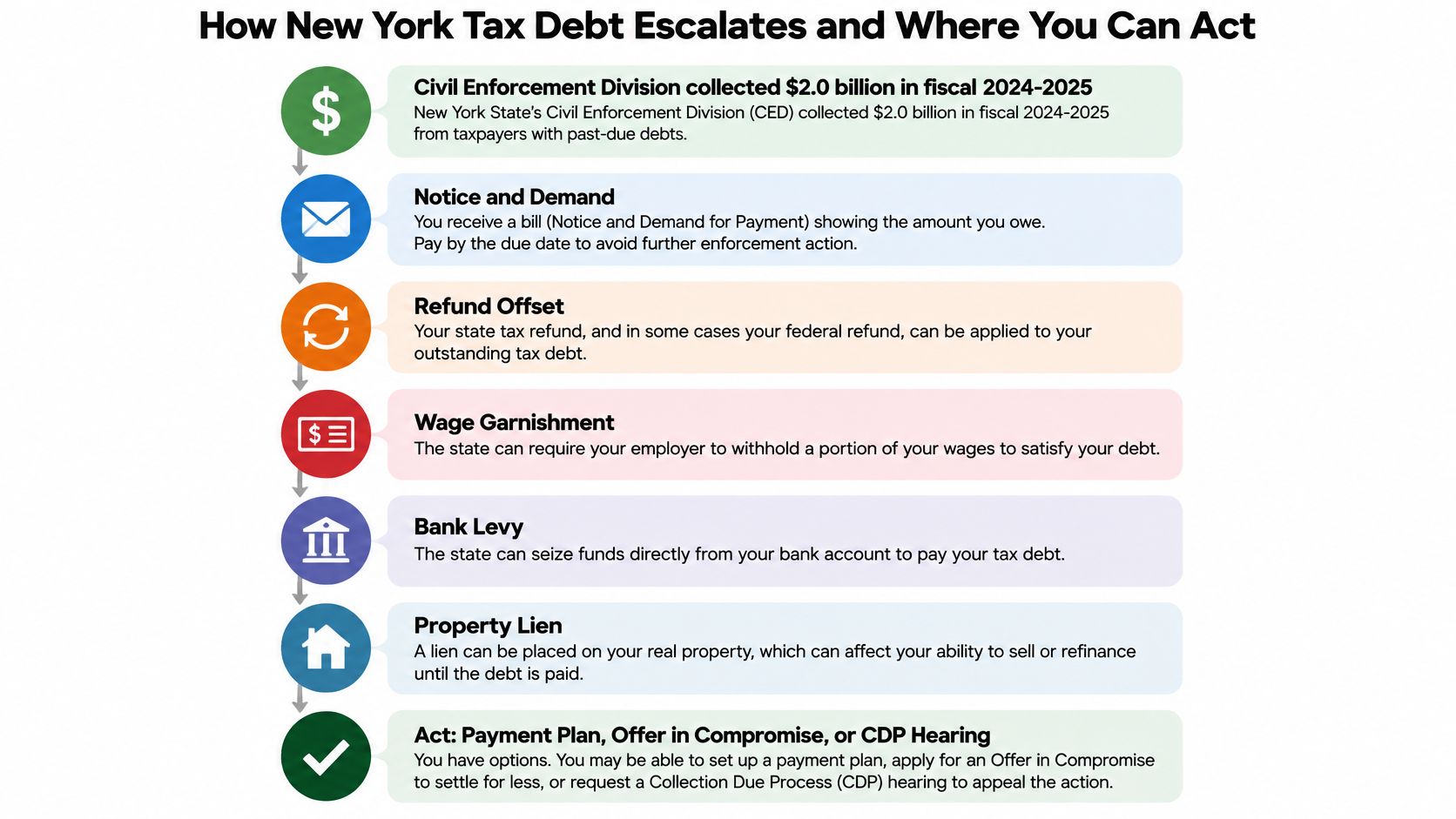
The stages, and what each one closes off
| Stage | What the State Sends or Does | Your Best Response |
|---|---|---|
| Return filed, tax unpaid | Balance billed with penalty and interest | Pay or request a payment agreement early |
| Billing reminders | Repeated balance statements | Confirm the amount and every period owed |
| Assessment or notice of deficiency | Formal notice with a response deadline | Respond or petition by the date printed on the notice |
| Formal demand | Final demand for payment | Set up an agreement before enforcement starts |
| Tax warrant | Warrant filed, acting as a lien | Verify the warrant and plan for title and refinancing |
| Enforced collection | Levies, income executions, refund offsets | Resolve through full payment or an approved agreement |
A first bill is the cheapest moment to act, because the available tools are widest. You can pay it, request an installment agreement, or correct the underlying return if the number is wrong. By the time a formal demand lands, the department has already concluded the balance is real and uncollected. The conversation shifts from "is this right" to "how does this get paid."
The warrant stage is where the cost of waiting becomes visible to other people. A filed warrant attaches to property and appears in the searches that lenders, buyers' attorneys, and title companies run as routine diligence. Enforcement follows, and it pulls money from a paycheck or a bank account instead of waiting for you to send it.
Finding the stage you're actually in
Read the most recent notice, not the oldest one in the drawer. Note its date and the response deadline printed on it. Then write out every tax type and period it covers, because one envelope can carry an income tax balance, a sales tax balance, and a penalty from three different years.
The date on the notice sets your clock. A response that arrives after the deadline printed on it usually gets treated as though it never arrived.
Once you have the stage, the deadline, and the periods listed side by side, you can tell which remedies are still live and which have already passed you by.
Collection Actions That Can Reach Your Pay and Property
New York doesn't rely on a single enforcement tool. It uses a stack of them, and each one reaches something different. The Department of Taxation and Finance names refund offsets, tax warrants, levies, income executions, seizures, driver's-license suspension, and private debt collection among the actions it can take, as listed in its collection enforcement guidance.
The income execution is the one that catches people off guard, because it involves an employer and a paycheck rather than a bank balance.
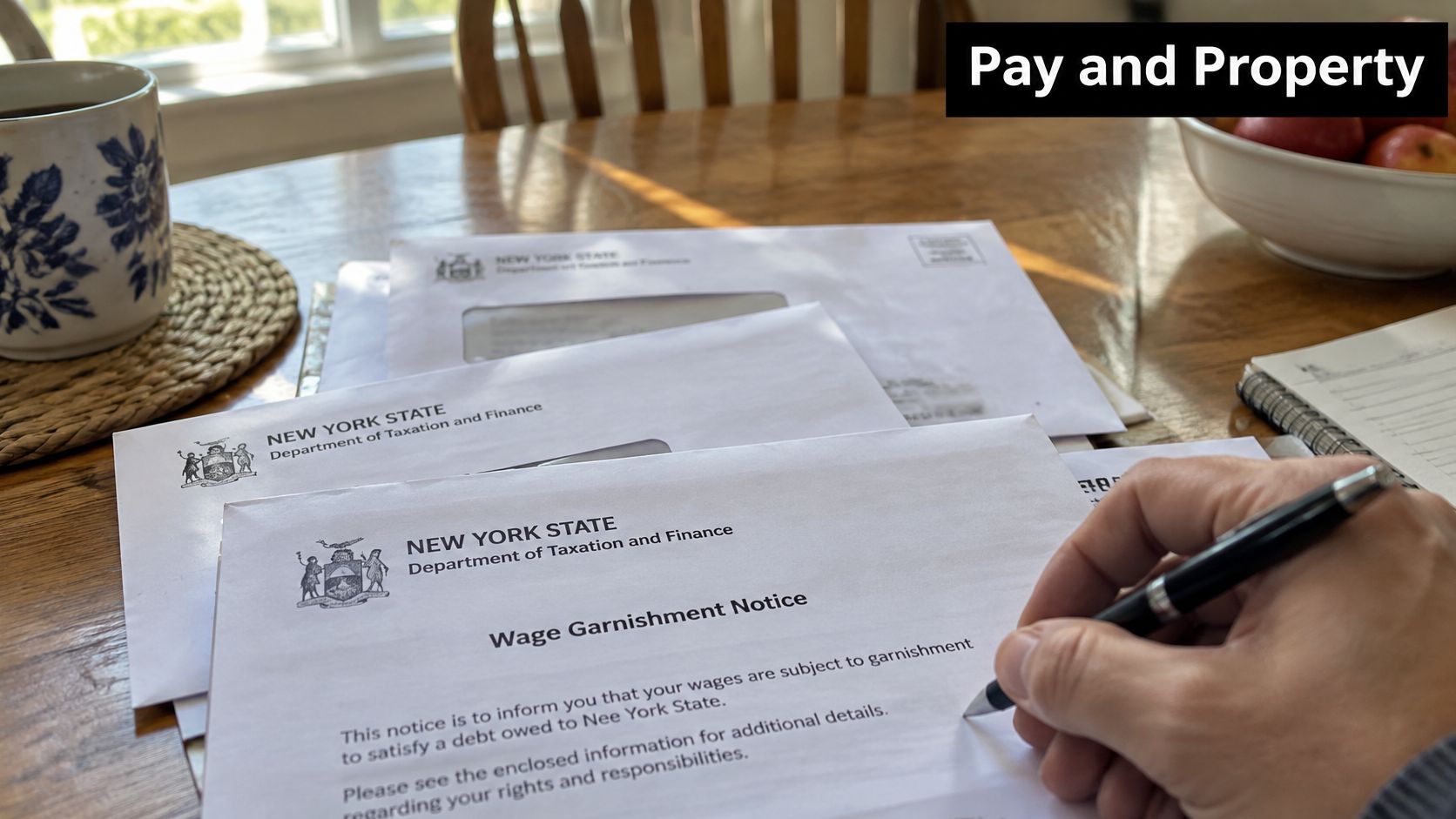
Refunds and other government payments leave first
An offset is the quietest tool in the set. It captures a New York tax refund before you ever see it, and through reciprocal arrangements it can also reach certain payments owed by the federal government or another state. If the intercepted amount doesn't clear the liability, the remainder stays collectible. Treating a refund as money in the bank while a balance is open is a planning error, and it's worth checking whether any refund you're counting on is already exposed before you file.
What an income execution takes from a paycheck
The state says it may first seek voluntary payments of up to 10% of gross wages. If you don't make them, the employer may be required to deduct up to 10% of gross wages or 25% of disposable earnings, and the execution generally continues until the liability, including added penalties and interest, is paid in full, per the Department of Taxation and Finance's income execution page.
| Action | What It Reaches | How It Can Be Stopped |
|---|---|---|
| Refund offset | New York refunds and some federal or other-state payments | Resolve the balance; any remainder stays collectible |
| Tax warrant | Real and personal property through a lien | Full payment, then satisfaction of the warrant |
| Levy | Funds and property held by third parties | Payment or an approved agreement |
| Income execution | Part of wages paid by the employer | Payment in full, since the execution continues until the balance is paid |
| Driver's-license suspension | Driving privileges | Payment or an agreed payment arrangement |
| Seizure | Physical property and other assets | Full resolution before the seizure or sale date |
| Private debt collection | Debt assigned to a private agency | Verify the debt, then pay or set up a plan |
A levy is the step most often confused with a warrant, and the two work differently. Our explanation of how a state tax levy actually works covers the bank restraint side of that difference.
Read the notice for the action it names and respond to that action, not to the balance in general. If the letter mentions an execution or a levy, the window is measured in days rather than in billing cycles.
What a Filed Warrant Does to Your Property
A New York State tax warrant is not a reminder letter with a case number on it. The Department of Taxation and Finance treats it as equivalent to a civil judgment, which is how the state protects its priority in collecting what you owe, as described in its guide to the state tax warrant search.
Once docketed, the warrant can function as a lien against real and personal property. That consequence reaches past the balance itself. It can stall a refinance, consume sale proceeds at closing, surface during credit underwriting, and prevent a transfer of assets free of the state's claim.
The distinction most taxpayers miss
An installment agreement is a cash-flow tool. A warrant is a title tool. Entering an agreement generally does not remove the encumbrance; the warrant remains on file and continues as a lien until the total warranted balance is paid.
Practical rule: never assume a payment arrangement clears title. Verify it, in writing, before a closing date.
The practical consequence is that affordability and title have to be analyzed separately. A monthly amount you can live with solves the collection problem. It doesn't solve the property problem. For more on how the recorded claim behaves, see our breakdown of what a state tax lien means for your property.
A four-step check before any transaction
- Search both names. Run the state's public warrant search under your personal name and every business name connected to the filing.
- Get the exact figures. Request the balance, the tax types, and the periods the warrant covers, not a rounded total from a phone call.
- Compare against the date. Put the payoff figure and any agreement next to the closing date and see whether the money clears before then.
- Confirm the release. After payment, request written confirmation that the warrant is satisfied, then search again. The public search is updated twice weekly, and a warrant comes off it once the debt is paid in full and the warrant is satisfied.
That fourth step is the one people skip. A payment posted is not the same as a warrant satisfied, and a lender reading a stale record will treat the file as still encumbered.
Checking Your Eligibility and Balance Before You Choose
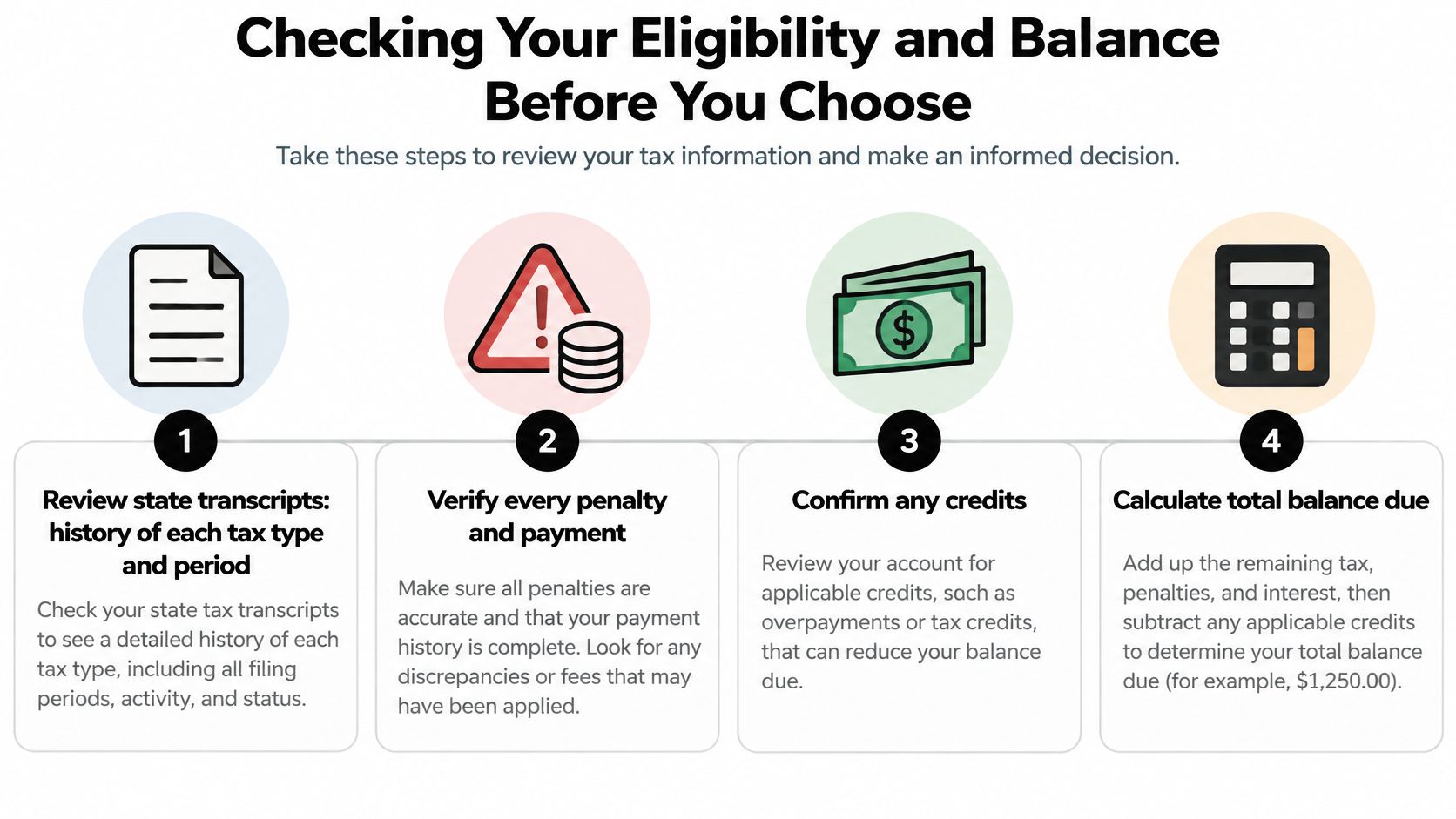
A notice gives you a balance and a deadline, but the total alone may not show what you owe or which options fit. Before choosing a resolution, check the tax periods, the debt history, and what you can realistically pay.
IRS and state transcripts provide a record of the debt, including penalties, payments, and how long the liability can be pursued. Comparing that history with the notice helps establish whether its balance reflects the full account.
Use this seven-item checklist to organize the information before weighing your options.
The seven-item check
- List every tax type and period shown on the notice or transcript. Income, sales, withholding, and penalty assessments may affect which resolution options apply.
- Add penalties and interest to the total. The principal alone is not the amount you need to evaluate.
- Record monthly income and reasonable living expenses using bank and card statements, rather than estimates.
- List assets, bank balances, and property equity. Available equity can change which options are realistic.
- Check that required returns are filed and current taxes are being paid. A missed return or new unpaid tax can put an approved agreement at risk.
- Note irregular income, including refunds. A refund may be intercepted before it reaches you, so do not count on it as available cash without checking.
- Flag sales tax and withheld payroll tax liabilities. These debts can raise questions about personal responsibility beyond the business entity.
Applying the result
A payment plan may fit when the monthly payment is affordable after living costs and leaves room for ordinary expenses. A payment plan and a tax warrant are separate legal tools: an arrangement may address collection pressure without clearing a warrant or a problem affecting property title.
An offer in compromise may merit review when available monthly funds cannot pay the balance within a reasonable period. Compare the likely payment with the debt and your finances before choosing; a plan that cannot finish may only defer the decision.
Write down two dates beside the balance: the date of the latest notice and its response deadline. The deadline shows how much time you have to act, while your budget helps determine which choices are practical.
Ways to Resolve Your Balance Compared
Each option addresses a different part of the problem. Full payment clears the balance; an installment agreement spreads payments over time; an offer in compromise may settle eligible tax debt for less than the full amount. A payment plan and a tax warrant are separate tools, so arranging payments does not automatically clear the warrant or resolve a title issue.
| Option | Best For | What It Does | Key Requirement |
|---|---|---|---|
| Full payment | Taxpayers who can pay the balance now | Pays the liability and allows the warrant to be satisfied | Pay the total, including penalties and interest |
| Installment payment agreement | Taxpayers who can pay monthly over time | Sets a payment schedule; the warrant may remain until the debt is resolved | File required returns and pay new tax on time |
| Offer in compromise | Taxpayers in financial distress who may be able to pay a reasonable portion | May settle the liability for less than the full amount | Meet eligibility requirements and stay current with filings |
| PAID program | Eligible sales-tax vendors with qualifying unpaid bills | May provide time-limited penalty and interest relief | Check current eligibility and deadlines with the state |
Full payment ends the balance
Paying the total, including penalties and interest, clears the liability and allows the warrant to be satisfied. This is the most direct route when the funds are available. Before using savings or borrowing, compare the cost of that choice with the cost of continuing to carry the debt.
An installment agreement spreads payments
An agreement can suit a taxpayer with steady income who needs time to pay. It sets a recurring amount, making the debt easier to budget for, but it does not necessarily remove a filed warrant or clear a title issue. The agreement also depends on continued compliance: file required returns and pay new taxes as they come due. A missed return or new unpaid balance can put the arrangement at risk.
For details on payment terms and compliance, see how a New York State tax payment plan is structured. The monthly amount must be manageable alongside current obligations, or the plan may be difficult to maintain.
An offer in compromise has specific eligibility rules
New York describes its offer in compromise program as an option for taxpayers in financial distress who can pay a reasonable portion of overwhelming tax liabilities. The state directs taxpayers who do not qualify toward installment agreements, according to the Department of Taxation and Finance's offer in compromise page.
Eligibility depends on factors including income, assets, reasonable living expenses, future earning capacity, filing compliance, and the type of liability. Businesses need a separate review because sales-tax debt may also create personal exposure for responsible individuals. An offer is not just a request for a discount; the taxpayer must meet the program's requirements and be able to support the proposed resolution.
Ask about sales-tax relief programs
New York has offered time-limited penalty and interest relief for some sales-tax vendors. Eligibility and deadlines can change, so check the Department of Taxation and Finance's current guidance before relying on this option. Do not assume that relief for penalties or interest settles the underlying tax or clears a warrant.
A waiting strategy can be costly if it depends on a settlement that may not be available. Compare any current relief program with the amount owed, the terms of an installment agreement, and the effect each choice has on collection pressure and the warrant.
Bankruptcy and Business Tax Exposure
Two beliefs cost taxpayers real money. The first is that old tax debt eventually disappears. The second is that a business owner carries no personal exposure for what the company owes.
Start with the first. Many tax debts are not discharged in bankruptcy, especially more recent liabilities and trust fund amounts such as withheld payroll taxes, as our guide to filing bankruptcy on tax debt explains. That means the tax type and the date of the liability decide the outcome far more than the filing itself does. Confirm both before you build a plan around a discharge. Waiting doesn't dissolve a filed warrant either, since the lien survives until the balance behind it is paid.
Where personal exposure comes from
Sales tax collected from customers and income tax withheld from employees are trust-fund amounts. They were never the business's money. Because of that, the state can pursue personal responsibility against officers and others who had control over collecting, accounting for, or paying those amounts, which puts exposure on individuals even after a company closes.
Run this check before deciding anything:
- Identify each tax type on the notice and mark which ones are trust-fund or sales tax.
- List every person with signing authority or control over payments during the periods at issue.
- Check whether a business warrant names an individual as well as the entity.
- Decide with counsel whether a payment agreement or a bankruptcy filing fits that specific tax type.
The check that matters most: read the warrant for names, not just amounts. A business balance that reaches an individual is a different problem with a different timeline.
A time-limited program such as PAID rewards acting before its published cutoff, not after it. Waiting for a better deal has a cost curve, and on trust-fund debt it rises faster than most owners expect.
Confirm Your Balance and Talk to a Tax Attorney
The first move this week is information, not commitment. Search the state warrant database under your own name and every business name you're connected to. Request transcripts for each tax type and period. Work through the seven-item check so the balance and the deadlines sit in front of you in one place.
Then decide whether this is a do-it-yourself file. Professional help earns its cost in specific situations: tax debt over $5,000, a criminal investigation, an IRS revenue officer already assigned, complex financial circumstances, foreign account issues, valuable assets at risk of seizure, or liability exposure over $1,000,000.
Our Tax Debt Resolution Plan is an attorney-led investigation of the debt followed by a personalized roadmap for resolving it, built from the transcripts, the financial analysis, and the tax types in play. It's one route to the next step, and a consultation is a reasonable place to test it against your own file.
Whichever way you go, ask two questions in that first conversation. How would this firm handle an active levy or income execution if one arrives mid-process, and which documents do you need from me to start. The answers tell you whether the help matches the problem.
The goal right now isn't to pick a solution. It's to see the balance clearly enough that the choice becomes obvious.
When New York State tax debt has moved past the notice stage, the difference between a manageable resolution and a filed warrant comes down to how quickly someone reads the file properly. Tax Attorney Stephen A Weisberg provides an attorney-led review of your state and IRS transcripts, the collection actions already in motion, and the deadlines you're working against, then lays out a written plan for resolving the balance before enforcement decides the timeline for you. Start with a conversation at Tax Attorney Stephen A Weisberg and get the balance, the deadlines, and the options in front of you in one place.