Your Guide to Understanding a State Tax Levy
Facing a state tax levy? Our guide explains how levies work, the impact on your assets, and your options for resolution. Take control of your tax debt today.
In this article
- What a State Tax Levy Actually Means for You
- How a Tax Debt Beems a State Levy
- The Warning Before the Storm
- From Notice to Enforcement Action
- The Real-World Impact on Your Finances and Business
- The Consequences for Individuals
- How a Levy Can Paralyze Your Business
- Your First Steps After Receiving a Levy Notice
- Step 1: Immediately Acknowledge the Notice
- Step 2: Open a Line of Communication
- Step 3: Verify the Debt and Levy Details
- Step 4: Clarify All Deadlines and Next Steps
- Navigating Your State’s Specific Tax Levy Rules
- Key Differences in State Levy Laws
- Why State Budgets Influence Collection Tactics
- When to Call a Tax Resolution Professional
- The Value of an Expert Advocate
- Common Questions About State Tax Levies
- Can a State Tax Levy Take My Entire Paycheck?
- How Long Does a State Tax Levy Last?
- Can I Stop a State Tax Levy After It Starts?
- Is a State Tax Levy the Same as an IRS Levy?
A state tax levy is the government's legal right to seize your property to cover an unpaid state tax bill. This isn't just a sternly worded letter; it's an aggressive collection action that can freeze your bank accounts, garnish your wages, and even take physical assets.
What a State Tax Levy Actually Means for You
Getting a notice from a state tax agency is always a bit jarring, but a levy notice is in a completely different league. Think of the earlier bills and reminders as warning flags on the beach. A state tax levy is the hurricane hitting the shore—the state is now actively taking your property to settle the debt.
This is a crucial point that trips up a lot of people. A tax levy is not the same as a tax lien. A lien is a public claim against your property that secures the government's interest in what you owe. A levy is the actual seizure of that property.
To put it simply, a lien is a passive claim on your assets, while a levy is an aggressive action to take them.
A tax lien is like a padlock the state puts on your property, making it difficult to sell or refinance until you pay up. A tax levy is the state showing up with a key—or a battering ram—to take what's inside.
Understanding this difference is the first step toward getting your financial life back on track. This guide will cut through the confusing legal-speak and give you a clear, practical plan.
We’re going to cover:
- How a seemingly manageable tax debt can quickly escalate into a full-blown levy.
- The real-world impact a levy has on your personal finances and your business.
- The immediate, concrete steps you must take the moment you receive a levy notice.
- Your options for getting a levy released and finally resolving the tax debt for good.
Our goal here is to replace your anxiety with a clear plan of action. While a state tax levy is one of the most powerful tools a state has, it doesn't have to be the end of the story. Once you understand the process, your rights, and the available solutions, you can start making smart, strategic moves to protect what's yours and work toward a final resolution.
How a Tax Debt Beems a State Levy
A state tax levy doesn’t just show up out of the blue. It’s actually the last—and most serious—move in a very predictable series of events that starts with a simple unpaid tax bill. Knowing how this process unfolds is key, because it gives you several chances to step in and prevent your assets from being seized.
The whole thing kicks off when you file a tax return but don't pay what you owe, or when the state decides you owe more than you paid, usually after an audit. That creates the tax debt. From there, the state sends its first piece of mail: a tax bill or an assessment notice. This letter officially puts a number on what you owe, including the initial penalties and interest.
But that first notice is just a warm-up. If you don't pay, you'll start getting more letters, each one a bit more serious than the last. Think of them as reminders of your debt and warnings about what’s coming if you continue to ignore them.
The Warning Before the Storm
The one letter you absolutely cannot ignore is the Final Notice of Intent to Levy. This isn't just another bill. It's a formal, legally required warning shot, letting you know the state is gearing up to take your property. It will give you a firm deadline—often 30 days—to either pay up or work something out before they can legally start seizing your assets.
Doing nothing after receiving this final notice is the worst mistake you can make. It tells the state you're not willing to cooperate, which gives them the green light to move forward with the levy. This is your last real chance to sort things out before your bank accounts, wages, and other assets become their primary target.
The process generally follows three main stages, moving from those initial warnings to the actual seizure and, hopefully, a final resolution.
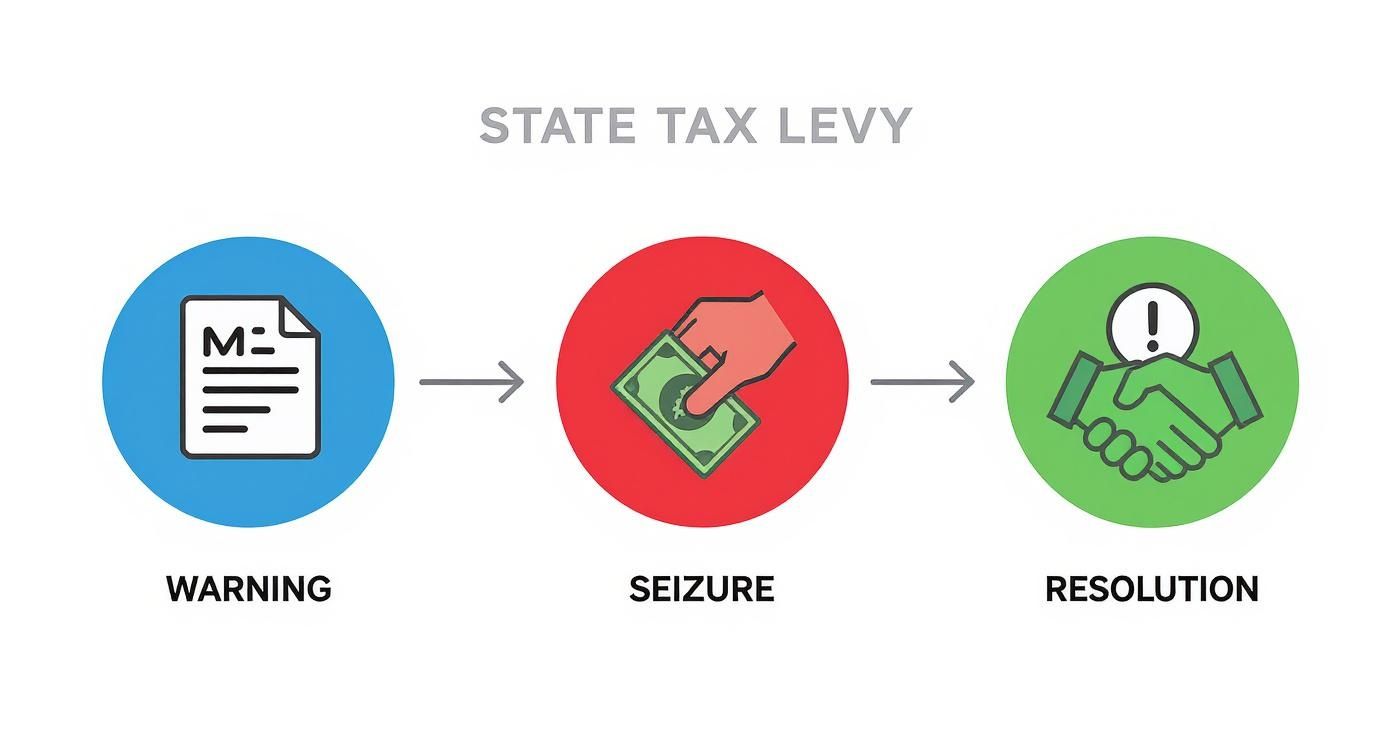
As you can see, what starts as a manageable problem can quickly get out of hand if those early notices are tossed aside, leading directly to the state taking what’s yours.
From Notice to Enforcement Action
Once the deadline on that Final Notice comes and goes without a resolution, the state now has the legal power to act. They’ll start locating your assets and sending levy notices to the third parties holding them for you.
And make no mistake, those third parties have to comply by law. Here’s what that looks like in the real world:
- Bank Levies: Your bank gets a levy notice and is required to freeze your accounts for the amount you owe. After a short holding period, they cut a check and send the money straight to the state.
- Wage Garnishments: A notice goes to your employer, who must then start withholding a chunk of your paycheck and sending it to the state. This happens every single payday until the debt is gone.
- Property Seizure: In more extreme situations, the state can go after physical property. They can seize vehicles, real estate, or business equipment, then sell it all at auction to pay off your tax bill.
How aggressive a state might be can depend on its tax structure. In the U.S., most states have progressive income tax systems. Some, like South Carolina, have rates that go up to around 7%, while others have a flat tax or no income tax at all. These differences play a big role in how debts are calculated and collected. You can find more information about how state income tax systems differ across the country and what that means for taxpayers.
The most important thing to remember is that a state tax levy isn't random. It's a methodical, step-by-step legal process. The state must follow the rules, which includes giving you proper notice and a chance to respond before they can touch your property.
Understanding this timeline gives you the power to act. Every notice you receive is an opportunity to open a line of communication and find a solution before your financial life gets turned upside down.
The Real-World Impact on Your Finances and Business
A state tax levy is where the rubber meets the road. It’s the moment a tax problem moves from a stack of ignored letters on your desk to an urgent, real-world financial crisis that demands immediate action.
For individuals, the impact is often swift and deeply personal. Imagine you’re at the grocery store, and your debit card is declined. You pull up your banking app, only to see a zero balance—not because you overspent, but because the state just froze your account. This isn't just a worst-case scenario; it's the most common way people discover a bank levy has hit.

From there, things can spiral quickly. That single action sets off a disastrous chain reaction. Your automatic bill payments start failing, racking up late fees and damaging your credit. The rent check you just wrote is about to bounce, putting your housing in jeopardy. A state levy doesn't just take your money; it pulls the rug out from under your entire financial life.
The Consequences for Individuals
When a state levy hits your personal finances, it targets the assets you depend on to live. The two most disruptive forms of a state tax levy are by far the most common:
- Bank Levies: The state orders your bank to freeze all funds in your account, up to the amount you owe. After a short holding period—usually around 21 days—the bank is required to send that money directly to the state, no matter what bills you have coming due.
- Wage Garnishments: Your employer gets a legal order to withhold a hefty chunk of your earnings from every single paycheck. This isn't a one-time event like a bank levy. It's a continuous drain on your income that stays in place until the tax debt is paid in full, which can sometimes mean months or even years of significantly reduced take-home pay.
In more extreme cases, states can also go after physical property like cars, boats, or real estate. While less common for smaller debts, it’s a powerful tool they won’t hesitate to use when the situation calls for it.
How a Levy Can Paralyze Your Business
If you're a business owner, a state tax levy is nothing short of an operational nightmare. It goes straight for the financial jugular—the cash flow that keeps your doors open, your team paid, and your customers happy. A levy can bring a healthy business to a screeching halt almost overnight.
The most damaging blow is often a levy on the business bank account. Suddenly, you have no access to your operating capital. You can't make payroll. You can't pay your suppliers. You can't run your business. The shockwave doesn’t just hit you; it directly impacts your employees and their families who are counting on that paycheck.
A state tax levy on a business is not just a financial setback; it's an existential threat. It can instantly transform a liquidity issue into an insolvency crisis by cutting off access to the funds needed for basic survival.
It gets worse. States can also place a levy on your accounts receivable. This means they legally order your customers to send the payments they owe you directly to the state tax agency instead. Not only does this choke off your revenue stream, but it can do serious, lasting damage to your business relationships and professional reputation.
This is why understanding the principles of sound business finance is so critical for preventing these kinds of crises. It's also important to remember that tax debt is a serious threat at all levels; as we've covered before, business tax debt is not just an IRS issue.
Whether you're an individual trying to keep a roof over your head or a business owner fighting to make payroll, the message is the same: a state tax levy is a powerful tool designed to force you to act. Ignoring it simply isn't an option, and a fast, strategic response is the only way to protect what you've worked so hard to build.
Your First Steps After Receiving a Levy Notice
The moment you discover a state tax levy—whether it’s a letter in the mail or the gut-punch of seeing a zero balance in your bank account—can be terrifying. It's easy to freeze up, but this is the most critical window you have. Your actions right now will set the stage for everything that follows.
Ignoring the problem is the worst thing you can do. It won’t go away; it will only get worse. The key is to take immediate, measured steps to regain control.

This isn’t the time to panic. It’s time to execute a plan. Let’s walk through the exact steps to move from crisis mode to actively working on a solution.
Step 1: Immediately Acknowledge the Notice
First things first: read the notice. All of it. Don't toss it on a pile of mail or assume you already know what it’s about. This single document is your road map.
It contains crucial details like the exact amount the state says you owe, the name of the agent or department handling your case, and a specific reference number. These aren't just administrative details; they are the keys you'll need for every conversation going forward.
Step 2: Open a Line of Communication
Your next move is to pick up the phone and call the state taxing authority. I know this can be intimidating, but proactive communication instantly changes the dynamic. You're no longer someone they are chasing; you're someone trying to fix the problem.
Have the notice in front of you when you call. Be ready with your name, taxpayer ID, and case number.
The goal of this first call is simple:
- Confirm the Levy: Let them know you received the notice and you understand what's happening.
- Ask Questions: Get clarity on anything you don't understand.
- State Your Intent: Tell them clearly, "I want to resolve this."
This one simple act can sometimes put a temporary hold on further collection actions. It gives you a little breathing room and shows the state you're not trying to run, which goes a long way in getting them to work with you.
Step 3: Verify the Debt and Levy Details
Mistakes happen. Before you agree to pay a dime, you need to be certain the debt is actually yours and the amount is correct. Is it the right tax period? Does the total make sense?
Ask the state agency for a complete breakdown of the debt—the original tax, plus every penalty and all the accrued interest. Compare this against your own records. If you find a discrepancy, that could be grounds to dispute the levy or at least adjust the amount you owe.
Responding to a state tax levy is a sprint, not a marathon. The initial 24 to 48 hours are the most critical for protecting your assets and setting the stage for a successful resolution. Procrastination is the levy’s best friend.
Step 4: Clarify All Deadlines and Next Steps
Finally, you absolutely have to know the timeline you're up against. If your bank account was levied, there's a holding period—often 21 days—before the bank is required to send your money to the state. This is your hard deadline to get the levy released before the cash is gone for good.
Ask the state agent two direct questions: "What is my exact deadline to stop this transfer?" and "What are the specific steps I need to take to get this levy released?"
This is also when you can start floating potential solutions, which we'll cover in more detail later. You might hear them mention options like an Installment Agreement or an Offer in Compromise. While a bank levy is an aggressive move, understanding the rules of engagement gives you a path forward, much like knowing what to do when the IRS freezes your client's bank account on the federal side.
By taking these four initial steps, you shift from being a passive target to an active participant. You'll have the facts, you'll have opened a dialogue, and you'll know your deadlines. That's the foundation you need to fight back and resolve your state tax levy.
Navigating Your State’s Specific Tax Levy Rules
If you’re facing a state tax levy, it's tempting to look for a simple, universal solution. But that’s a dangerous path. The IRS operates under one set of federal tax laws, but when it comes to state taxes, there are 50 different rulebooks. Each state writes its own laws for collecting taxes, meaning the process, your rights, and the available solutions can change completely just by crossing a state line.
What works for a tax problem in California is often useless for someone in Texas. The amount of your paycheck that's protected from garnishment in Florida isn't the same as it is in New York. This patchwork of state laws is exactly why generic advice you find online can do more harm than good.
To successfully resolve a state tax levy, you absolutely have to understand the specific rules your state’s revenue department plays by.
Key Differences in State Levy Laws
The differences between state laws aren't just minor technicalities—they're fundamental distinctions that will shape your financial future. Getting a handle on these is your first step toward a real solution.
Here are a few of the most critical areas where state laws differ:
- Wage Garnishment Exemptions: Every state agrees you need some of your income to live on, so they exempt a portion from seizure. But how they calculate that amount is all over the map. Some states tie it to the federal minimum wage, while others have their own formulas based on how many dependents you have.
- Statute of Limitations: There’s a deadline for how long the state can legally chase you for a tax debt. This window can be as short as a few years or stretch out for more than 20 years, depending on the state. Knowing your state’s deadline is crucial because it tells you how long you're on the hook.
- Unique Resolution Programs: Most states offer the basics, like installment agreements. But many also have their own special programs. For instance, a state might have a one-time penalty forgiveness program or a state-specific Offer in Compromise with its own unique rules for qualifying.
Ignoring these local rules is like trying to find your way around Boston with a map of Chicago. You’re going to get lost, fast.
The biggest mistake people make is thinking their experience with the IRS applies to a state tax problem. They are completely different animals, run by different laws, and demand entirely different strategies.
Why State Budgets Influence Collection Tactics
State tax agencies are under constant pressure to bring in money, especially when state budgets are tight. Unlike the federal government, state revenue can swing wildly from year to year, which often dictates how aggressively they come after unpaid taxes.
Recent research really drives this point home. A study covering the 15 years leading up to fiscal 2023 found that state tax revenue volatility averaged a score of 7.4, meaning collections saw significant ups and downs. That instability jumped by nearly 40% in the five years ending in 2023, hitting a score of 10.3. Some states, like Alaska, which depends on oil prices, see massive swings. As you can see in the full analysis of state tax revenue volatility from Pew, this economic pressure often leads directly to more aggressive collection tactics, including levies.
This is why understanding your state’s specific collection climate matters so much. For example, a closer look at Michigan’s state agency revenue management shows a system with its own procedures and quirks that are completely unique to Michigan taxpayers.
Given this complexity, the best move you can make is to work with a professional who has hands-on experience dealing with your specific state’s tax agency. They know the local laws, they know what programs are actually available, and they can build a strategy based on the reality on the ground—not on generic advice. That local expertise can be the difference between a resolution and a disaster.
When to Call a Tax Resolution Professional
Trying to handle a state tax levy by yourself is a bit like trying to perform your own dental work after watching a few online videos. It's technically possible, I suppose, but the risks are enormous, and a small mistake can lead to a world of pain. Sure, if you have a small, straightforward tax bill, you can probably manage it. But some situations are clear signals that it's time to call in a professional.
If the amount you owe is substantial, or if a levy is threatening your home, your business operations, or your family's financial stability, you are officially in expert territory. These are not simple collection matters. You're dealing with complex state laws, non-negotiable deadlines, and collection agents who are trained to be aggressive. A tax resolution specialist steps in to be your advocate, your negotiator, and your legal shield.
The Value of an Expert Advocate
A good tax professional does a lot more than just make phone calls on your behalf. They bring years of experience and a deep understanding of the specific resolution programs and negotiation tactics that work in your state.
Here’s what they really do:
- Negotiate with the State: They know exactly who to call and how to build a compelling case to get you the best possible result, whether that's a levy release, a manageable payment plan, or an Offer in Compromise.
- Protect Your Rights: You have rights as a taxpayer, but you can bet the state agency won't go out of its way to explain them to you. An expert makes sure those rights are front and center and fiercely protected.
- Leverage Tax Law: Their deep knowledge of state tax codes allows them to uncover solutions and strategies you would almost certainly overlook on your own.
Think of it this way: the state has a team of professionals whose entire job is to collect money from you. Going up against them alone is an unfair fight. A tax professional levels the playing field.
State tax laws are always evolving and getting more complex. For example, some states are looking into policies like mandatory Worldwide Combined Reporting for corporations. This intricate policy change alone is projected to boost state tax revenues by an estimated $18.7 billion annually by cracking down on how multinational companies shift profits. This analysis of state corporate tax policies highlights how states are constantly sharpening their collection tools, making expert guidance more crucial than ever. For a broader view on navigating these issues, you can explore tax professional insights from other experts.
Don't wait until your bank account is empty or your business assets have been seized. If a state tax levy feels overwhelming, trust that instinct—it probably is. Much like with federal tax problems, knowing how to settle tax debt with the IRS almost always requires professional help, and the same principle absolutely applies to state-level issues.
Contact us today for a free, no-obligation Tax Debt Analysis. We’ll take a look at your specific situation and give you a clear, honest assessment of the best way to move forward.
Common Questions About State Tax Levies
When you're hit with a state tax levy notice, your mind probably starts racing with questions. It's a stressful situation, to say the least. Getting clear, straightforward answers is the first step toward regaining control. Let’s walk through some of the most urgent questions we hear from people in your exact position.
Can a State Tax Levy Take My Entire Paycheck?
The short answer is no, a state can't legally take all of your paycheck. But the amount they can take is often shocking and can feel just as devastating. Every state has laws on the books to protect a certain portion of your income, making sure you have enough left over for basic living expenses.
This protected amount isn't a random number; it's usually calculated based on things like:
- Your tax filing status (single, married, head of household)
- How many dependents you claim
- How often you get paid (weekly, bi-weekly, etc.)
Everything left over after these exemptions is considered "disposable income," and that's what the state can go after. Because these rules vary so much from one state to the next, it's critical to know your local wage garnishment laws to understand exactly how much of your hard-earned money is on the line.
How Long Does a State Tax Levy Last?
This really depends on what the state is seizing. It’s best to think of levies as two different kinds of actions with very different lifespans.
A bank levy is usually a one-and-done event. The state sends the notice, your bank freezes the funds in your account at that specific moment, and that's it for that particular levy. If the money in the account doesn't cover your entire tax bill, the state can (and likely will) issue another levy later, but the immediate action is over once the funds are sent.
On the other hand, a wage garnishment is a completely different animal. It’s a continuous, ongoing levy that latches onto your income. It stays in place, taking a piece of every single paycheck until the entire tax debt—including all the painful penalties and interest—is paid off. The only way to make it stop is to resolve the underlying tax problem.
Can I Stop a State Tax Levy After It Starts?
Yes, you absolutely can stop a levy even after it's started, but you have to move fast. Time is not on your side here. With a bank levy, for example, you typically have only about 21 days before the bank is legally required to send your money to the state, and then it’s gone for good.
The best way to get a levy released is to contact the state taxing authority right away and work out a solution. The most common ways to do this are:
- Pay the debt in full: If you have the funds, this is the quickest way to end it.
- Set up an installment agreement: This involves formally agreeing to make manageable monthly payments.
- Prove economic hardship: You can argue that the levy is preventing you from covering basic necessities like food, rent, or utilities.
In some situations, an Offer in Compromise—where you negotiate to settle the debt for less than you owe—might be on the table. Having an experienced tax professional in your corner can make all the difference in quickly negotiating a release.
Is a State Tax Levy the Same as an IRS Levy?
While they work on the same basic principle—the legal seizure of your property to pay off a tax debt—a state levy and an IRS levy are two completely separate things. An IRS levy is for unpaid federal taxes, and it’s managed by the federal government under federal laws. A state tax levy is for unpaid state taxes (like income or sales tax) and is enforced by your state's revenue department under state law.
You can't fix a state tax problem by talking to the IRS, and you can't fix a federal problem by talking to the state. They are different government agencies with their own distinct rules, procedures, and taxpayer rights. You have to tackle each debt with the correct agency.
Facing a state tax levy is overwhelming, but you don’t have to go through it alone. Attorney Stephen A Weisberg has spent over a decade helping individuals and businesses find their footing and resolve complex tax issues with both state agencies and the IRS. We don’t ask for a large retainer to get started. Instead, we begin with a FREE, no-obligation Tax Debt Analysis to map out the best path forward for your unique situation.


