Offer in Compromise NYS: Who Qualifies and How to Apply
Offer in Compromise NYS explained: eligibility rules, required forms, key dollar thresholds, and how New York sets the settlement amount.

In this article
- Who Qualifies for a New York Offer in Compromise
- The condition that sits under every row
- What undue economic hardship actually means
- Run this self-check today
- Thresholds That Change Your Application Path
- The rules that catch people after approval
- How New York Calculates Your Settlement Amount
- What gets valued, and where taxpayers guess
- Where hardship and valuation meet
- Documents and Forms You Must Submit
- Why New York asks for each one
- Reconcile every number before you send
- File Step by Step and Avoid Rejection
- Where the file usually fails
- Confirm Whether an Offer Fits Your Case
New York State collected $2.0 billion from taxpayers in debt during fiscal year 2024–2025, according to the Department of Taxation and Finance's department operations statistics. That single number tells you more about the state's offer in compromise program than any advertisement promising "pennies on the dollar." The agency running the program is a well-funded collector, and it treats a settlement as a business decision about what it can realistically recover.
So an offer in compromise NYS is not a discount rack. There's no published schedule, no bracket, no percentage that converts a large balance into a small one. New York asks a different question entirely: if we take what this person can pay from assets and future income, what do we end up with, and when do we get it?
Answer that question accurately and the paperwork becomes manageable. Guess at it and the application dies in review.
Who Qualifies for a New York Offer in Compromise
New York doesn't approve an offer because a balance feels impossible. The Department of Taxation and Finance's offer in compromise guidance lists three doors into the program, and each asks for evidence rather than sympathy: insolvency, a bankruptcy discharge, and undue economic hardship. The first two are open to individuals and to businesses. The third is open to individuals only.
The table below is the whole eligibility map. Read it by row, not by hope.
| Situation | Who New York May Consider | Key Condition |
|---|---|---|
| Individual, insolvent | Individuals whose liabilities exceed realizable assets | All required New York returns filed |
| Individual, undue economic hardship | Individuals who cannot pay reasonable basic living expenses if collection proceeds | Full payment would prevent basic living expenses |
| Individual with bankruptcy discharge | Individuals who have received a bankruptcy discharge | All required New York returns filed |
| Business, insolvent or discharged | Businesses that are insolvent or have received a bankruptcy discharge | All required New York returns filed |
| Business, undue hardship | Not considered; the hardship route applies to individuals only | Not applicable |
The condition that sits under every row
Filing comes first. One unfiled return and the state stops reading before it reaches your financial statement, which is the cheapest problem in the whole process to fix and the most common reason a deserving file never gets a hearing.
The scope is wider than most taxpayers assume. The program can cover liabilities the Tax Department administers, including tax, interest, additions and penalties. On old balances, penalties and interest are frequently the largest component, and they're negotiable in a way a straight payment plan never makes them.
Practical rule: if the entity that owes the money isn't insolvent and hasn't been discharged in bankruptcy, the hardship door doesn't open for it, no matter how badly the owners are squeezed.
What undue economic hardship actually means
Hardship isn't "this hurts" or "I'd have to change my lifestyle." The published standard asks whether paying the liability in full would leave the taxpayer unable to cover reasonable basic living expenses. Shelter, food, utilities, transportation to work, ordinary medical costs.
A taxpayer with home equity and thin cash flow can look collectible on paper and still fit here. That gap between the balance sheet and the bank account is where nearly every hardship argument is won or lost.
Nothing about eligibility is automatic. Even a qualifying taxpayer has to show the proposed number matches what New York realistically expects to collect within a reasonable period, which is an estimate built from evidence.
Run this self-check today
- Inventory the debts. Write down each New York tax type owed with the period, the tax, and the penalties and interest attached to it.
- Confirm every return is filed. Check each year and each tax type separately, because a single missing filing ends review.
- Classify the liability. Individual or business decides which row applies, and an owner personally liable for a business debt needs to know which balance sits where.
- List the assets with real values. An insolvency argument requires a defensible list, not a rough memory of what things are worth.
If the file is messier than one balance, start with how New York State tax debt is collected, then return to the offer question with the full picture.
Thresholds That Change Your Application Path
Before the Department weighs a single dollar of your offer, a few gatekeeping rules decide which application you file and who has to sign off on it.
| Threshold | Rule | What It Changes |
|---|---|---|
| Online application limit | Individuals owing personal income tax only, with no open protest or bankruptcy, and a balance below the online filing limit | Eligible for the online route; larger or more complex cases need paper forms |
| Court approval | Fixed and final amount above $100,000, excluding interest and penalties | Requires approval from a New York State Supreme Court justice |
| Payment timetable | Compromised amount falls due shortly after final approval | Periodic payments may be authorized for taxpayers who need more time |
| Compliance period | Accepted taxpayers must remain compliant for a set period after approval | Filing and payment obligations continue throughout that period |
| Offer amount rule | Offer must be greater than zero and exclude amounts already paid or collected | Prior payments cannot count toward the offer |
The online route is narrow by design.
It exists for the simplest cases: one taxpayer, one tax type, no protest pending, no bankruptcy, and a balance modest enough for a faster review. The cap makes sense once you see what the offer is. New York is estimating what it could realistically collect from your assets and future income, and a small balance doesn't justify the full workup. Anything more complicated uses the prescribed paper forms with the complete financial documentation attached, because that's where the Department tests its collection math.
The court approval line is the one taxpayers underestimate. Where the fixed and final amount owed exceeds $100,000, excluding interest and penalties, a New York State Supreme Court justice must approve the compromise, as the Tax Department's published explanation of the offer process sets out. Budget weeks, not days, for that step.
The rules that catch people after approval
Payment timing runs tight. The compromised amount generally falls due soon after approval, though the Department can authorize periodic payments when a taxpayer shows a genuine need for more time. Treat the approved number like a closing date on a house: you should know where every dollar of it is coming from before you sign.
Two amount rules also trip up prepared filers. The offer must be greater than zero, and it cannot include amounts already paid or collected against the liabilities. Those payments don't reduce the offer. They're already counted.
Timing check: a file with an approved number and no funding plan behind it can still fail at the payment stage.
New York may also apply payments toward liabilities in an order the Department specifies unless agreed otherwise in writing, which matters if you're juggling more than one tax type. Ask for the allocation in writing before you send money, because a payment applied to the wrong period can leave the debt your offer was meant to cover still open.
A taxpayer can clear every financial test and still face extra review because of debt size, a bankruptcy filing, an unresolved protest, or the need for extended installments. Identify which threshold your balance and status hit before you choose a route, then weigh the available tax debt solutions against it.
How New York Calculates Your Settlement Amount
Think of the offer as an appraisal for a forced sale, not a clearance-rack discount. An appraiser doesn't ask what you'd like to get. An appraiser asks what a buyer would pay, net of the costs of getting the thing sold.
The worksheet behind that number looks like the desk below, and every line on it has to survive a question.
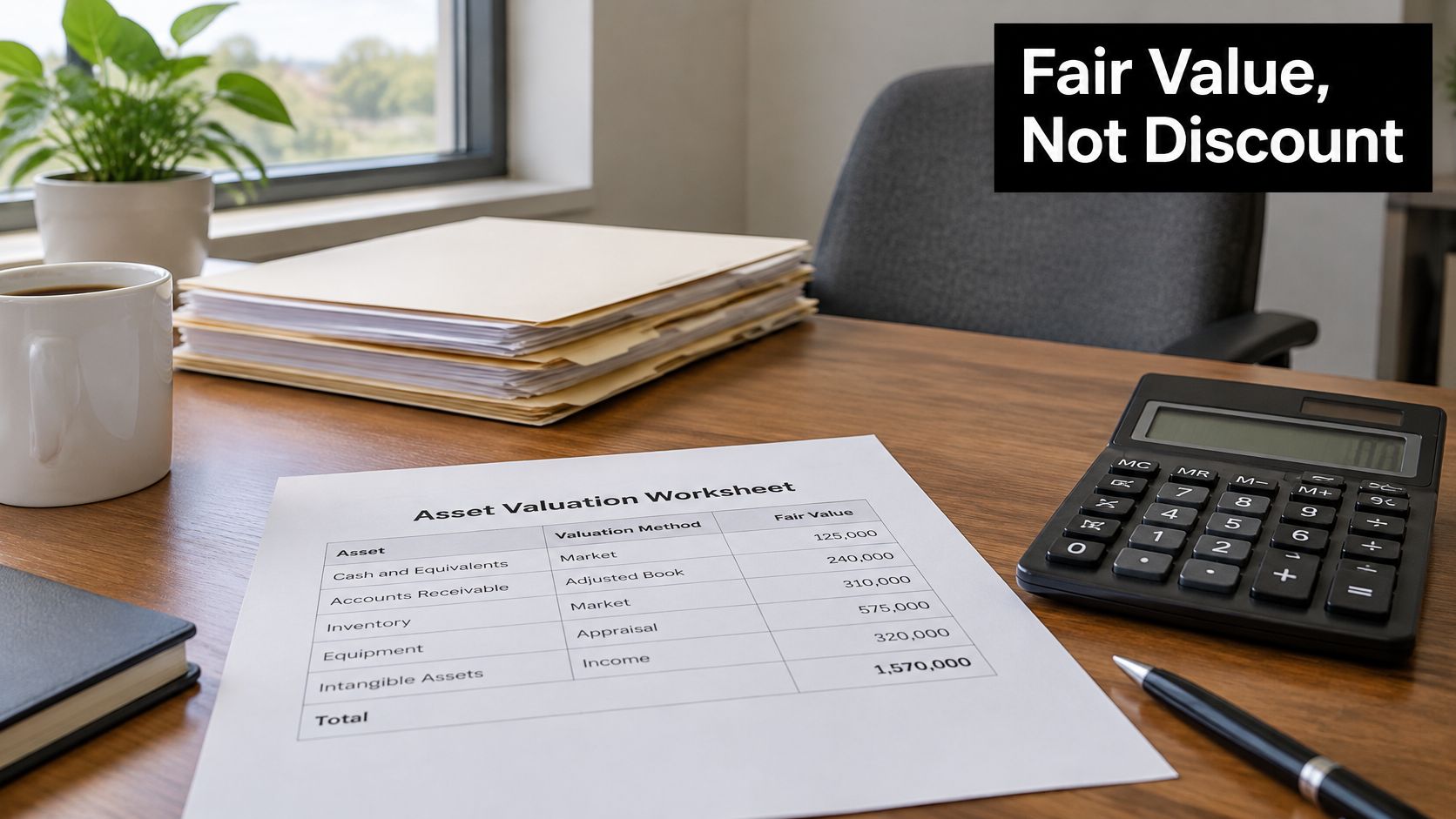
New York evaluates reasonable collection potential using the total realizable value of your assets plus your anticipated future income, while also weighing statutory collection priorities and applicable limitations periods, per the Tax Department's rulemaking summary on offers in compromise. Future earning capacity and asset liquidity both move the figure, and that's the part public explanations skip. Two taxpayers with identical balances can receive wildly different answers because one has a sellable second car and the other has a pension.
What gets valued, and where taxpayers guess
- Closely held businesses. Value what the business generates after necessary expenses, and what a buyer would pay for that stream. Revenue is not value, and a business that exists mostly to pay the owner's salary is often worth less than the owner imagines.
- Home equity. Gross value minus mortgage balance, selling costs, and any share owed to a co-owner or a spouse under an agreement.
- Retirement assets. What's accessible, net of the tax and penalties triggered by reaching for it. Treating a retirement account at full face value overstates what the state can touch.
- Contingent income. Unpaid commissions, pending fees, a contract that may or may not renew. Document the probability, not the optimistic version.
- Expected sale proceeds. A signed contract or a listed property with a realistic timeline carries more weight than a plan to sell "sometime."
Valuation test: if you can't explain the number to a skeptical stranger in two sentences, it isn't ready for a financial statement.
Where hardship and valuation meet
An individual may hold assets that look collectible at first glance and still qualify, because liquidation would strip away housing, business continuity or basic support. That's the bridge between the valuation worksheet and the hardship route. It isn't enough to say selling would be inconvenient; the file has to show what disappears if the asset goes.
Recent transfers get scrutinized for the same reason. New York may reject an offer when assets were conveyed for less than fair market value after the taxpayer knew about the liability. In practice, the state reads the timeline: a transfer dated after the first notice is a different fact than one dated three years earlier for a genuine reason.
Say a homeowner has $90,000 in equity after selling costs and $1,400 a month of disposable income over a reasonable collection window. A hypothetical offer built on that math would reflect net equity plus a projection of what the income stream produces, not a round percentage of the assessment. Run the same numbers with a mortgage that eats the equity and the answer changes completely.
Before filing, answer one question: which financial facts will New York treat as collectible, and what documentation proves hardship without looking like sheltering?
Documents and Forms You Must Submit
The offer package consists of two forms and a stack of records behind them. Form DTF-4 or DTF-4.1 is the application, where you state the amount you're proposing. Form DTF-5 is the financial statement, and it carries the weight, because the Department uses it to calculate what it could realistically collect from your assets and income. Taxpayers tend to obsess over the offer number on the application. Reviewers spend their time on the financial statement, because that is where the collectible number comes from.
Everything else in the file exists to prove the financial statement is accurate.
| Document | What It Shows | Requirement |
|---|---|---|
| Form DTF-4 or DTF-4.1 | Offer application stating the proposed amount | Typically required for every offer |
| Form DTF-5 | Financial statement the Department uses to judge collection potential | Figures that match supporting records |
| Federal income-tax returns | Income history | Recent filed returns |
| Credit report | Debts and liens on record | Current when the package is submitted |
| Bank and financial-account statements | Cash flow against declared expenses | Recent statements for every account you hold |
Why New York asks for each one
The returns establish income history, so the state can see whether the year you describe was typical or a one-off collapse. The credit report surfaces debts and liens the Department will weigh against your ability to pay, including obligations you may not have mentioned. Bank statements are the honesty test: they show whether the expenses on Form DTF-5 match money leaving an account.
Timing matters more than taxpayers expect. A credit report pulled early in a slow document hunt can go stale before the package ships, so order it once the rest of the file is nearly ready. The same logic applies to account statements: collect them after you know roughly when you'll file, not months before.
Filing discipline: the package is judged as a whole, so one document that contradicts another costs more than a missing page.
Reconcile every number before you send
- Gather first, draft second. Pull statements and reports before you open Form DTF-5, so figures come from records instead of recollection.
- Tie each expense to a bank line. If rent, insurance or a car payment appears on the statement, the same number belongs on the form.
- Check every account once. A forgotten savings account or payment-app balance is easy to miss and hard to explain later.
- Keep a complete copy. You'll need it when questions arrive, and again at the compliance stage.
Form versions and filing instructions change, so confirm both on the Department's site before you send anything. If hardship is part of your case, see how to prove financial hardship to the Tax Department so the story your documents tell matches the numbers in the boxes.
File Step by Step and Avoid Rejection
The sequence matters, because each step feeds the next one. Skip ahead and you'll be rebuilding the file from scratch.
Here's the order, from eligibility to acceptance.
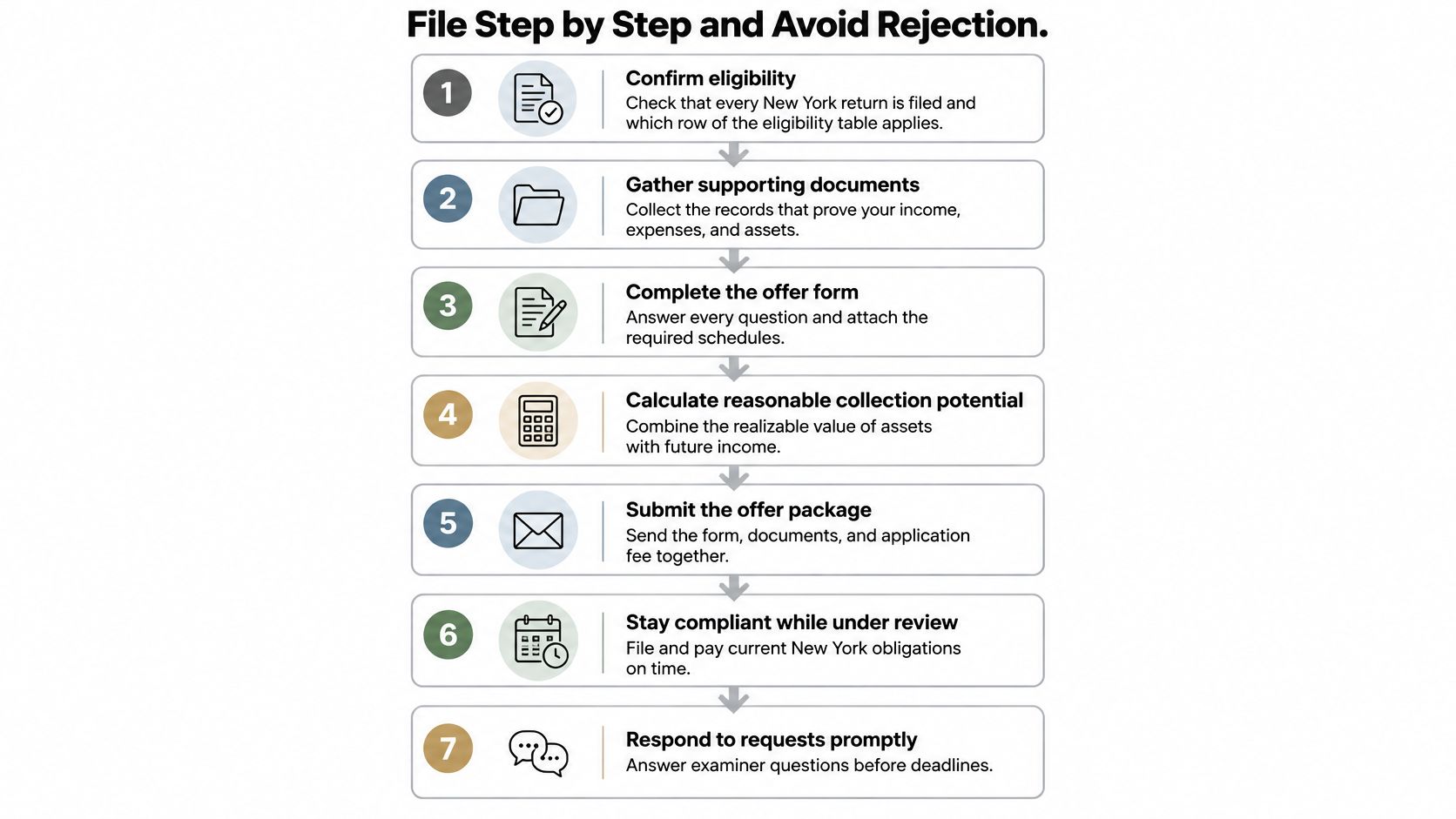
- Confirm eligibility and the route. Check that every New York return is filed and decide which row of the eligibility map applies to you. The usual slip is filing a package with an old return still outstanding, which stalls review before it begins.
- Build the document file first. Collect the returns, a fresh credit report and a full year of account statements before you draft anything. The usual slip is ordering the credit report early and submitting it stale.
- Value the assets at defensible numbers. Home equity, business interests and retirement accounts each need a real figure and a reason behind it. The usual slip is a business value pulled from instinct instead of a cash-flow calculation.
- Complete Form DTF-5 against the records. Match income, expenses, assets and debts line by line to the documents. The usual slip is an expense figure that no statement supports.
- Complete Form DTF-4 or DTF-4.1 with a real number. Propose an amount above zero and leave out anything already paid toward the balance. The usual slip is proposing zero, or building an offer that credits payments the state has already collected.
- Submit, then answer questions quickly. Examiners ask for follow-up records, and each slow reply adds weeks. The usual slip is treating an information request as optional.
- Meet the schedule after acceptance. Pay on the approved timetable and stay current on filing and payment afterward. The usual slip is assuming the offer closes the relationship with the Department.
Where the file usually fails
Most rejections trace to documentation, not to the merits of the case. A taxpayer with a strong hardship story can lose it by presenting an asset value that doesn't hold up, a bank account nobody listed, or a package that reads like a request for a discount.
Reconcile every figure line by line before it goes out. Read the expense column against the statements. Read the asset column against the credit report. Read the proposed amount against both.
One more habit worth building: write a short cover narrative that ties the numbers together. Three paragraphs explaining the income drop, the asset picture and why the proposed amount is what collection would realistically yield do more for a file than another attachment.
Confirm Whether an Offer Fits Your Case
The decision rule is short. An offer fits when three things line up: you meet one row of the eligibility map, you can document every figure in the package, and the state's realistic collection expectation lands below what you owe. Miss any one of those and the application becomes an expensive way to learn nothing.
The comparison that decides it:
- A payment plan spreads the full balance over time and keeps enforced collection on hold while you stay current. It solves timing, not amount.
- An offer asks the state to accept less than the full balance because collecting more isn't realistic. It solves amount, and only when the evidence supports it.
- Neither fits a case with unfiled returns, because compliance comes before everything else.
If your income supports the whole debt across a few years, the plan is the honest answer, and New York State tax payment plan options are worth reading before you file an offer you'll lose.
Our approach starts with the numbers rather than the forms. We consider every available option, from Offers in Compromise to Currently Not Collectible status, to identify the best possible outcome, because an offer isn't the right tool for every file. Prospective clients can request a Tax Debt Resolution Plan and receive a clear, actionable roadmap suited to the situation, showing how to become compliant and obtain the most favorable resolution.
Before contacting anyone, list every balance by tax type, confirm whether all New York returns are filed, and note any open protest or bankruptcy on the file.
Tax Attorney Stephen A Weisberg works with individuals, businesses and their owners on IRS and New York tax debt, including whether an offer in compromise is realistic based on your numbers. The work starts with a Tax Debt Analysis that reviews your balances, your filed returns and your financial picture before anything goes to the Department, so you know which resolution fits before you commit to one. Visit Tax Attorney Stephen A Weisberg to start that review and get a straight answer on your file.