Your Guide to a New York State Tax Payment Plan
Struggling with NY tax debt? Learn how to set up a New York State tax payment plan with our guide on eligibility, applications, and managing your agreement.
In this article
- How a NYS Tax Payment Plan Can Provide Immediate Relief
- Who Benefits Most From an IPA?
- The Strategic Advantage of a Payment Plan
- Key Features of a NYS Installment Payment Agreement (IPA)
- Figuring Out if You Qualify for a Payment Plan
- The Golden Rule: Be Current on Your Filings
- What Happens When Your Situation is More Complicated?
- A Quick Real-World Example
- A Practical Walkthrough of the Online Application
- Getting into the NYS Online Services Portal
- Making Your Payment Offer
- Locking in Your Payment Method
- Dealing With Complex Payroll and Trust Fund Debts
- Understanding the Trust Fund Recovery Penalty
- How to Negotiate a Plan for Payroll Tax Debt
- A Real-World Business Scenario
- Managing Your Agreement to Avoid Default
- The High Cost of Defaulting on Your Plan
- Strategies for Staying on Track
- Long-Term Financial Implications
- Common Questions About NYS Tax Payment Plans
- What If I Can’t Afford the Monthly Payment NYS Proposes?
- Can I Get a Payment Plan with Unfiled Tax Returns?
- Will an IPA Stop a Bank Levy or Wage Garnishment?
- Does a NYS Tax Payment Plan Affect My Credit Score?
Getting a large tax bill from New in New York State can be incredibly stressful. The good news is you have a clear, structured path forward: an Installment Payment Agreement (IPA). This isn't just about kicking the can down the road; it's a formal arrangement with the state that lets you pay what you owe in manageable monthly installments. It’s a powerful tool for getting back in control of your finances and stopping aggressive collection actions in their tracks.
How a NYS Tax Payment Plan Can Provide Immediate Relief
An Installment Payment Agreement, or IPA, is much more than a simple payment delay. It’s a formal resolution that immediately stops the clock on escalating enforcement actions. Once that tax bill arrives and you realize you can't pay it all at once, the fear of a bank levy, wage garnishment, or property lien is very real. A New York State tax payment plan is specifically designed to head off those nightmares by setting up a predictable payment schedule that you can actually stick to.
This is a lifeline for anyone whose financial situation isn't always stable. Think about a freelancer with inconsistent income or a small business that fell behind on payroll tax withholdings. An IPA gives them the stability to manage their debt without the constant threat of having their assets seized out of the blue.
Who Benefits Most From an IPA?
While pretty much anyone with a qualifying tax debt can apply, these agreements are particularly helpful for certain people:
- Self-Employed Individuals and Freelancers: Gig workers and contractors often have income that goes up and down, making it tough to handle a big, unexpected tax bill. An IPA helps smooth that liability out over a longer period.
- Small Business Owners: A slow month or a few unexpected expenses can easily lead to payroll tax problems. A payment plan helps a business get caught up on these critical trust fund liabilities without having to shut down.
- Individuals with Unexpected Tax Debt: Life happens. Cashing out a 401(k) or getting a one-time bonus can trigger a surprisingly large tax bill. An IPA breaks that overwhelming amount down into something you can handle.
The Strategic Advantage of a Payment Plan
Setting up a payment plan isn't a sign of failure; it's a proactive move that shows the NYS Department of Taxation and Finance you intend to comply. They tend to look very favorably on this kind of cooperation, and it’s the single best way to halt more severe collection tactics. It gives you the breathing room you need to get your finances in order without constant pressure and threats.
The core function of a New York State tax payment plan is to transform an unmanageable lump-sum debt into a series of predictable, affordable payments. This simple shift provides immediate relief and a clear path toward resolving your tax liability.
Let's take a quick look at the core components of these plans.
Key Features of a NYS Installment Payment Agreement (IPA)
| Feature | Description |
|---|---|
| Halt to Collections | Once approved, it stops most enforcement actions like bank levies and wage garnishments. |
| Manageable Payments | The debt is divided into smaller, monthly payments based on what you can afford. |
| Flexible Terms | Payment plans can often extend from 36 to 72 months, depending on the situation. |
| Interest & Penalties | While interest and penalties continue to accrue, the plan prevents further failure-to-pay penalties. |
| Formal Agreement | Provides a legally binding structure that protects both you and the state. |
This table highlights just how beneficial an IPA can be, turning a crisis into a manageable financial task.
In New York, these plans are a crucial lifeline, especially for small business owners and the self-employed who are staring down a mountain of tax debt. For sole proprietors and single-member LLCs, who often get tripped up by payroll tax liabilities, an IPA can spread the debt over 36 to 72 months. This is often the difference between staying in business and having the state levy your accounts.
There are many ways to tackle tax debt, and an IPA is just one of them. To see how it fits into a broader strategy, you can learn more about comprehensive tax debt relief options in our detailed guide. Many experienced tax attorneys focus on negotiating these plans and can assess your situation without the massive upfront retainers you see at larger firms. For more on the state's fiscal health and how it might affect taxpayers, the NYC Comptroller's office offers some valuable insights.
Figuring Out if You Qualify for a Payment Plan
Before you even start an application for a New York State tax payment plan, you need to know where you stand. The NYS Department of Taxation and Finance has its own set of rules, but I've found they're often more flexible than people think. Getting a handle on these requirements from the get-go will make the entire process smoother and boost your chances of getting approved.
The easiest way to get a payment plan is by falling under the state's automatic approval threshold. If you owe less than $20,000 and can realistically pay it off within 36 months, you can usually set up an Installment Payment Agreement (IPA) online without much back-and-forth. This is the fast track—it generally doesn’t require you to hand over a mountain of financial documents.
This flowchart gives you a bird's-eye view of the first few questions you should ask yourself when you're staring down a New York tax bill.
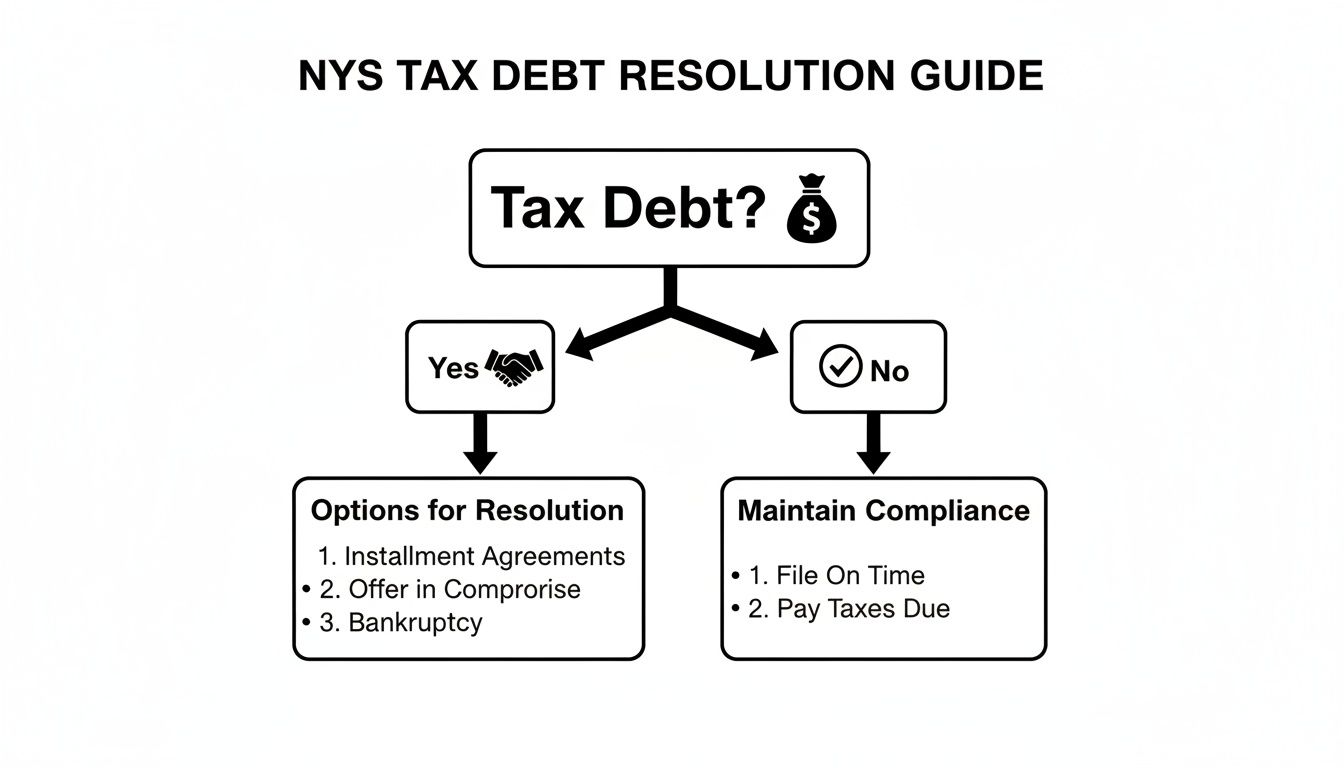
It really boils down to this: recognizing you have a debt is the first step toward fixing it with something like a payment plan. If you're all paid up, you're already in compliance.
The Golden Rule: Be Current on Your Filings
Here's a non-negotiable part of the deal: you absolutely must be caught up on filing all your past-due tax returns. New York State will not even consider a payment plan for someone with unfiled returns. I've seen this trip up countless people, but it’s a hurdle you can definitely clear.
Your first order of business is to get any and all delinquent returns prepared and sent in. If you discover you owe more tax on those returns, don't panic. That new balance will just get rolled into the total amount you need to set up a payment plan for. The key is not to let unfiled returns paralyze you.
What Happens When Your Situation is More Complicated?
So, what if you owe more than the $20,000 magic number, or you know you’ll need longer than three years to pay it all back? A payment plan is still very much a possibility, but the process just gets a bit more hands-on. In these situations, the state is going to want to take a closer look at your finances.
You'll need to be ready to provide documents that paint a clear picture of your financial health, such as:
- Recent pay stubs or other proof of your income.
- Bank statements from every account you have, both personal and business.
- A detailed list of your monthly living expenses.
- Information on major assets you own, like your home or car.
The state isn't doing this to be difficult. They use this information to figure out a monthly payment that you can actually afford without going under. They want a plan that works, not one that's doomed to fail.
The state’s goal with financial disclosure is to establish your "ability to pay." It's not about penalizing you but about creating a sustainable repayment structure based on your actual income and essential living costs.
A Quick Real-World Example
Let's imagine a self-employed graphic designer who had a slow year. She fell behind on her quarterly estimated tax payments and now owes $28,000. Since her debt is over the automatic approval limit, the simple online application isn't an option.
So, she gets her paperwork in order—bank statements, income records, a list of her business and personal expenses—and applies for a 60-month repayment plan. The state reviews everything and agrees that her proposed monthly payment is fair and manageable. It took a little more legwork, but she successfully negotiated a plan that fit her budget.
This just goes to show that a New York State tax payment plan is within reach even if your situation isn't straightforward. These plans are designed to be flexible. Taxpayers who qualify can get IPAs for debts up to $20,000 over 36 months, but longer terms are available for larger amounts if you provide financial details. For businesses, including S-corporations and multi-member LLCs, these plans are a lifeline for dealing with income or payroll tax debts and preventing asset seizures. Historically, filers who are otherwise compliant see approval rates in the 70-80% range, as noted in a report from the New York State Assembly.
Of course, this guide is all about New York State, but many people find themselves dealing with federal tax issues at the same time. The IRS process is similar in spirit but has its own unique set of rules. You might find our guide on how to make payment arrangements with the IRS helpful for tackling the federal side of things.
A Practical Walkthrough of the Online Application
The quickest way to get a New York State tax payment plan in place is by using their online portal. It's surprisingly straightforward, especially for folks who owe less than $20,000 and can clear the debt within 36 months.
Let's walk through it with a real-world example. Meet Mark, a freelance photographer from Albany. He had a great year—maybe a little too great—and now owes $12,000 in state income tax. He’s already filed his return, so the next logical step is getting on a payment plan, which New York calls an Installment Payment Agreement (IPA).
Getting into the NYS Online Services Portal
First things first, you need to log into your New York State Online Services account. If you’ve ever filed your taxes online in NY, you probably have one. If not, you'll need to create one now. Keep your most recently filed tax return handy; you'll need it to verify who you are.
This is the login page where you'll get started.

Think of this portal as your tax command center. It’s where you handle everything from payments to setting up an IPA, so it's a good idea to get comfortable with it.
Once Mark logs in, he’ll head over to the "payments, bills, and notices" section. From there, he’ll see an option to request an Installment Payment Agreement. The system will pull up his account and show his outstanding balance of $12,000. This is a critical moment. Always double-check that the amount on the screen matches what you believe you owe before you go any further.
Making Your Payment Offer
Now comes the important part: proposing what you can pay each month. The online system will automatically calculate a minimum payment for you, typically based on that standard 36-month timeline. For Mark's $12,000 debt, the state will likely suggest a minimum of around $333 a month, plus any interest and penalties that continue to build up.
You've got some wiggle room here. If your budget allows for more, paying it down faster saves you money on interest in the long run. The most important thing, however, is to be realistic. Don't promise a payment you can't consistently make every single month.
I see this all the time: someone owes a lot and proposes a tiny payment, like $50 on a $12,000 debt. That's an almost guaranteed rejection from the online system. It's programmed to automatically accept reasonable offers, so stay close to the suggested minimum. If your finances are truly dire, the online portal isn't the right path—you'll need to get on the phone with them.
After looking at his budget, Mark figures he can swing $350 per month. He enters that number. It shows he's serious and, by offering slightly more than the minimum, it can sometimes be seen as a sign of good faith.
Locking in Your Payment Method
The last piece of the puzzle is setting up how you'll pay. For online IPAs, New York State requires you to set up a direct debit from your bank account. It’s their way of making sure payments are on time, every time.
To do this, Mark will need to enter:
- His bank’s routing number
- His account number (checking or savings)
- The name listed on the account
He'll want to triple-check those numbers. A simple typo can cause a payment to bounce, which could put his entire agreement at risk. Once the banking info is in and he gives the terms one final review, he hits submit. For a straightforward case like his, the approval usually comes through almost instantly.
The logic behind figuring out an affordable monthly payment is pretty universal, whether you're dealing with New York State or the IRS. If you're also staring down a federal tax bill, you might find this guide on using an IRS payment plan calculator to find your best options to be a big help.
By following these steps, you can confidently get through the online application for a New York State tax payment plan. It's a huge step toward getting your finances back on track. The key is to be prepared with your information, realistic about what you can pay, and careful when entering the details.
Dealing With Complex Payroll and Trust Fund Debts
Not all tax debts are created equal in the eyes of New York State. An income tax problem is serious, for sure, but a payroll tax issue is in an entirely different league. Why? Because the money you failed to pay was never really yours. You were just holding it in trust for your employees and the state.
When you withhold taxes from an employee’s paycheck—for state income tax and other deductions—that money is legally known as a trust fund tax. Your business is simply the middleman, the fiduciary responsible for handing those funds over. Failing to do so is one of the most severe tax violations you can commit, and NYS pursues these cases with a vengeance.
This is where a business problem can quickly spiral into a personal financial catastrophe for owners and anyone else with financial authority.
Understanding the Trust Fund Recovery Penalty
To make sure these critical taxes get collected, both the IRS and New York State wield a powerful legal tool: the Trust Fund Recovery Penalty (TFRP). This penalty is a game-changer. It allows the state to pierce the corporate veil and hold individuals personally responsible for the unpaid trust fund taxes.
This means if your business falls behind, NYS can come after your personal assets—your home, your car, your savings account—to pay the company's debt. The TFRP can be slapped on anyone deemed a "responsible person" who willfully failed to pay. That net can be cast surprisingly wide.
It often includes:
- Business owners and partners
- Corporate officers (CEOs, CFOs, etc.)
- Members of the board
- Even key employees with financial control, like a bookkeeper who has the authority to sign checks
A corporate liability has now become your personal crisis. The state isn't just looking for a New York State tax payment plan from the business anymore; it's targeting the people behind it. For a much deeper dive into this, I recommend reading our comprehensive article on the Trust Fund Recovery Penalty, which explains exactly how it’s assessed and how you can defend against it.
How to Negotiate a Plan for Payroll Tax Debt
Forget the simple online application. Securing a payment plan for trust fund debt is a far more involved and scrutinized process. These cases are almost always assigned to a specific Revenue Officer whose sole job is to collect that money as fast as humanly possible.
The negotiations are tougher. You'll be required to provide a mountain of financial documents for both the business and any individuals they're targeting as responsible parties. They will pore over every detail of your cash flow, assets, and expenses to figure out the absolute maximum you can afford to pay each month. Their goal is typically to get the full amount paid in 24 months or less—a much more aggressive timeline than the standard 36-month-plus plans for income tax.
In my experience, Revenue Officers are laser-focused on two things: pinning down who is personally on the hook and locking in an aggressive repayment schedule. Successfully navigating this requires a proactive defense that presents a clear path to paying off the old debt while staying perfectly current on new obligations.
A Real-World Business Scenario
Let me give you a real-life example. A small construction company in Syracuse hit a major cash flow problem. The owner had a tough choice: make payroll for his crew or remit the withholding taxes to the state. He chose to pay his employees, thinking he'd catch up on the taxes later. But "later" never came, and the business quickly fell $80,000 behind.
A Revenue Officer was assigned and immediately started the process to assess the TFRP against the owner personally. We had to act fast. We compiled detailed financial statements for both the company and the owner, building a case that a structured payment plan would ultimately collect more for the state than killing the business and seizing its assets.
After some intense negotiations, we managed to secure a plan that kept the business alive and shielded the owner's personal assets from seizure. A key part of the deal was implementing rock-solid procedures to ensure the company stayed current on all new tax deposits. This is why knowing how to set up payroll for small businesses correctly is so critical from day one.
Managing Your Agreement to Avoid Default
Getting your Installment Payment Agreement (IPA) approved is a huge weight off your shoulders. It’s a major win. But it’s crucial to remember this is the starting line, not the finish. Successfully managing your New York State tax payment plan is every bit as important as getting it in the first place—one misstep can unravel everything you've worked for.
Your primary job is simple: make every single payment, on time and in full. Just as critical, you have to stay 100% current on all your future tax obligations. That means filing every return on schedule and paying any new taxes you owe by the deadline. The state views your IPA as a conditional second chance, and strict compliance is non-negotiable.
The High Cost of Defaulting on Your Plan
Falling behind on your agreement has swift and serious consequences. If you miss a payment or fail to file a future return, New York State can terminate your IPA, often without any warning. The moment that happens, aggressive collection actions are back on the table.
This isn't just a slap on the wrist. The state can immediately restart its collection efforts, which could mean:
- Bank Levies: Freezing your bank accounts and seizing the funds inside.
- Wage Garnishments: Ordering your employer to send a portion of every paycheck directly to them.
- Property Liens: Filing a tax warrant, which creates a public lien against your property. This crushes your credit and makes it nearly impossible to sell or refinance.
Defaulting essentially puts you right back where you started, only now you've lost credibility. The state is far less likely to grant you a second payment plan after the first one fails.
A common misconception I see is people thinking the payment plan freezes the financial clock. It absolutely does not. Interest and some penalties continue to accrue on your unpaid balance throughout the entire life of the agreement. This is why paying a little extra whenever you can is a smart move—it directly reduces the total amount you'll pay in the long run.
Strategies for Staying on Track
Your best defense against default is simple organization. A proactive approach is key to meeting your obligations without the last-minute stress.
First off, automate your payments if you haven't already. Most online agreements actually require direct debit, which is the most foolproof method anyway. If you're paying manually for some reason, set up multiple calendar alerts on your phone for a few days before each due date. It also helps to understand all your options, including secure telephone payment options, to ensure you can always pay on time.
If you see trouble on the horizon—maybe a job loss or an unexpected medical bill—you need to contact the state immediately. Don't wait until after you've missed the payment. Explaining your situation beforehand shows you’re acting in good faith. While it's never a guarantee, they may be willing to temporarily modify your agreement.

Long-Term Financial Implications
Making that final payment and completing your IPA is a massive financial accomplishment. While the payment plan itself doesn't directly show up on your credit report, any underlying tax lien certainly does. Once you've paid the debt in full, that lien can be released, which is a critical step in rebuilding your credit.
For small businesses or individuals with larger debts, especially those over $50,000, the state can structure longer-term plans. These arrangements will still have an ongoing interest rate, but they can stop new penalties from piling up. This is a more complex area where getting professional guidance can make a real difference, potentially leading to a much better outcome.
Staying on top of your New York State tax payment plan takes diligence, but the reward—true freedom from tax debt—is well worth the effort. Stay organized, communicate proactively, and you can see this agreement through to the end.
Common Questions About NYS Tax Payment Plans
Even with a clear path forward, it’s completely normal to have questions pop up when you're dealing with a New York State tax payment plan. Over the years, I've helped countless people through this exact process, and I've heard just about every concern imaginable. Let's talk through the most common ones—the real-world issues that often trip people up.
What If I Can’t Afford the Monthly Payment NYS Proposes?
This happens all the time. You go through the online application, and the system spits out a monthly payment that would completely break your budget. Take a deep breath. This isn't a final, take-it-or-leave-it demand.
If the state’s number is too high, you have to push back with proof. This means submitting a detailed financial statement, which is usually Form DTF-5. Think of it as a complete financial X-ray: you’ll list all your income, essential living expenses, and any assets you have. The goal is to clearly demonstrate why you can't meet their initial terms.
The state uses this information to figure out what you can actually afford to pay. But how you fill out that form is crucial. It’s easy to miscategorize an expense or leave out something important, which can lead to the state demanding more than you can handle. This is where a tax professional can be invaluable—we know how to present your situation accurately to negotiate a payment that won’t set you up for failure.
Can I Get a Payment Plan with Unfiled Tax Returns?
Let me be perfectly clear on this one: absolutely not. New York State won't even entertain the idea of an Installment Payment Agreement (IPA) until you're fully caught up on all your filing obligations. If you have any outstanding returns, your application is dead on arrival.
So, your first and only job is to get those delinquent returns prepared and filed. If it turns out you owe even more tax after filing them, don't worry—that new balance just gets rolled into the total amount covered by your payment plan.
I’ve seen so many people get stuck at this stage. They're paralyzed because they don't have the W-2s or 1099s from years ago. A good tax expert can help reconstruct your income and expense history from old bank statements and other records to get you compliant. It’s the non-negotiable first step.
Getting current on your filings is your ticket to the negotiating table.
Will an IPA Stop a Bank Levy or Wage Garnishment?
Yes, it will, but timing is everything. As soon as your Installment Payment Agreement is officially approved, New York State is legally barred from hitting you with new bank levies or wage garnishments. It basically puts up a protective shield.
Now, what if there's already a levy or garnishment in place? Getting the IPA approved is the key to getting it released. But there's a catch: the state usually won't lift an existing enforcement action until you've made your first payment under the new agreement.
This means you can't afford to wait. If you've received a notice threatening a levy, you need to get a New York State tax payment plan in place immediately. It’s the single best way to stop that action before it ever starts.
Does a NYS Tax Payment Plan Affect My Credit Score?
This is a bit of a "yes and no" answer. The payment agreement itself—the contract between you and New York State—is not reported to the credit bureaus like Experian, Equifax, or TransUnion. So, in that sense, no, it won't directly lower your score.
The real danger comes from the underlying tax debt. If the state has already filed a Notice of State Tax Lien against you, that’s a different story. A tax lien is a public record, and it can absolutely show up on your credit report, where it can do some serious damage to your score for years.
Entering into an IPA is a fantastic way to prevent a lien from being filed in the first place. However, it won't automatically remove a lien that's already there. That lien will typically stick around until the tax debt is paid in full, making it much tougher to get a mortgage, car loan, or any other line of credit.
At Attorney Stephen A Weisberg, we know every tax situation has its own unique wrinkles. We skip the high-pressure sales calls and start with a FREE Tax Debt Analysis to see exactly how we can help. If you're dealing with a New York State tax issue and need a clear plan, visit us at https://weisberg.tax to get started.


