Federal Tax Liens on Property What Happens Next
Learn how federal tax liens on property attach, affect sales and financing, and how to resolve them with IRS remedies and practical next steps.

In this article
- When a Tax Lien Threatens Your Property Plans
- How Federal Tax Liens Attach to Your Property
- The lien and the public notice are different
- Notice of Federal Tax Lien and Priority Rules Explained
- Why timing controls the leverage
- What can remove the public problem
- Lien Versus Levy What the IRS Can and Cannot Do
- The filing count doesn't equal the seizure count
- Proven Ways to Resolve and Remove a Federal Tax Lien
- Match the remedy to the property problem
- Property-specific relief solves a narrower problem
- How Tax Liens Impact Home Sales Refinancing and Loans
- Your Next Steps and When to Contact a Tax Attorney
You're at the closing table, the buyer has signed, and the title company finds a federal tax lien attached to your name. Or perhaps your refinance has stalled because the lender sees an IRS filing and wants to know whether its loan will have priority. You may fear that the government is about to take your home, car, business property, or bank account.
That fear is understandable, but a federal tax lien on property isn't the same thing as an IRS seizure. A lien is a legal claim that gives the government a place in line among creditors. A levy is the act of taking property. Understanding that difference can help you protect a sale, refinance, divorce settlement, bankruptcy strategy, or business loan from avoidable confusion.

When a Tax Lien Threatens Your Property Plans
A homeowner named Daniel learns about his lien from a title company, not from an IRS agent at his front door. He's under contract to sell his house, and the buyer has already arranged financing. The title search shows a filed Notice of Federal Tax Lien. The transaction doesn't automatically disappear, but the closing team can't treat the property as though the IRS has no interest in the seller's proceeds.
The same problem can surface during a refinance. A lender wants a first-priority security interest in the property. If the IRS has already filed its public notice, the lender needs to understand whether the IRS claim will be paid, removed from that property, or moved behind the new loan in priority. Until someone answers those questions, underwriting may pause.
Practical rule: A filed lien usually creates a transaction problem before it creates an immediate possession problem.
The issue can affect more than an individual homeowner. Small business owners may discover a lien when they apply for working capital, pledge real estate as collateral, or try to transfer business assets. Startup founders and managers should also understand the common tax traps for startups because unpaid employment, income, or filing obligations can grow into collection problems that surface at the worst possible time.
This guide is for homeowners, sole proprietors, business owners, real estate professionals, lenders, and advisors who need a clear answer without panic. You'll learn:
- What creates the lien: The legal sequence that allows the IRS claim to attach.
- Why the public notice matters: How recording affects purchasers, lenders, and other creditors.
- What the lien does not mean: Why a lien isn't the same as a levy or immediate property seizure.
- How deals can be preserved: The roles of payoff, discharge, subordination, and other relief.
- When to get help: The warning signs that make timing and professional representation especially important.
The central question isn't always, “Will the IRS take my house?” In many property cases, the more useful question is, “What does the IRS have over this transaction, and what action will remove or reposition that factor?”
How Federal Tax Liens Attach to Your Property
A federal tax lien begins with a sequence, not with a surprise visit. The IRS describes the process in its Internal Revenue Manual guidance on federal tax liens as follows:
- The IRS assesses a tax liability. An assessment formally records the amount the IRS says is due.
- The IRS sends a notice and demand for payment. This tells the taxpayer that payment is required.
- The taxpayer doesn't fully pay within 10 days. At that point, the federal tax lien arises by law.
The statutory lien is like an invisible blanket over the taxpayer's property interests. It can attach to current and future property and rights to property, including a home, car, wages, and bank accounts. The lien isn't limited to the asset the taxpayer owned when the IRS assessed the liability. It can follow property acquired later while the debt remains enforceable.
That distinction matters because people often assume the IRS must identify and file a separate claim against every asset. The underlying legal lien and the public filing serve different purposes.
The lien and the public notice are different
The federal tax lien arises by operation of law after the required assessment, demand, and nonpayment sequence. The Notice of Federal Tax Lien, often called an NFTL, is the public filing that alerts third parties and helps establish the government's priority against competing creditors.
One filing can address multiple statutory liens. IRS guidance says a single notice can list as many as 15 individual statutory liens. That means the public record may look like one notice even though it relates to several tax periods or legal liens.
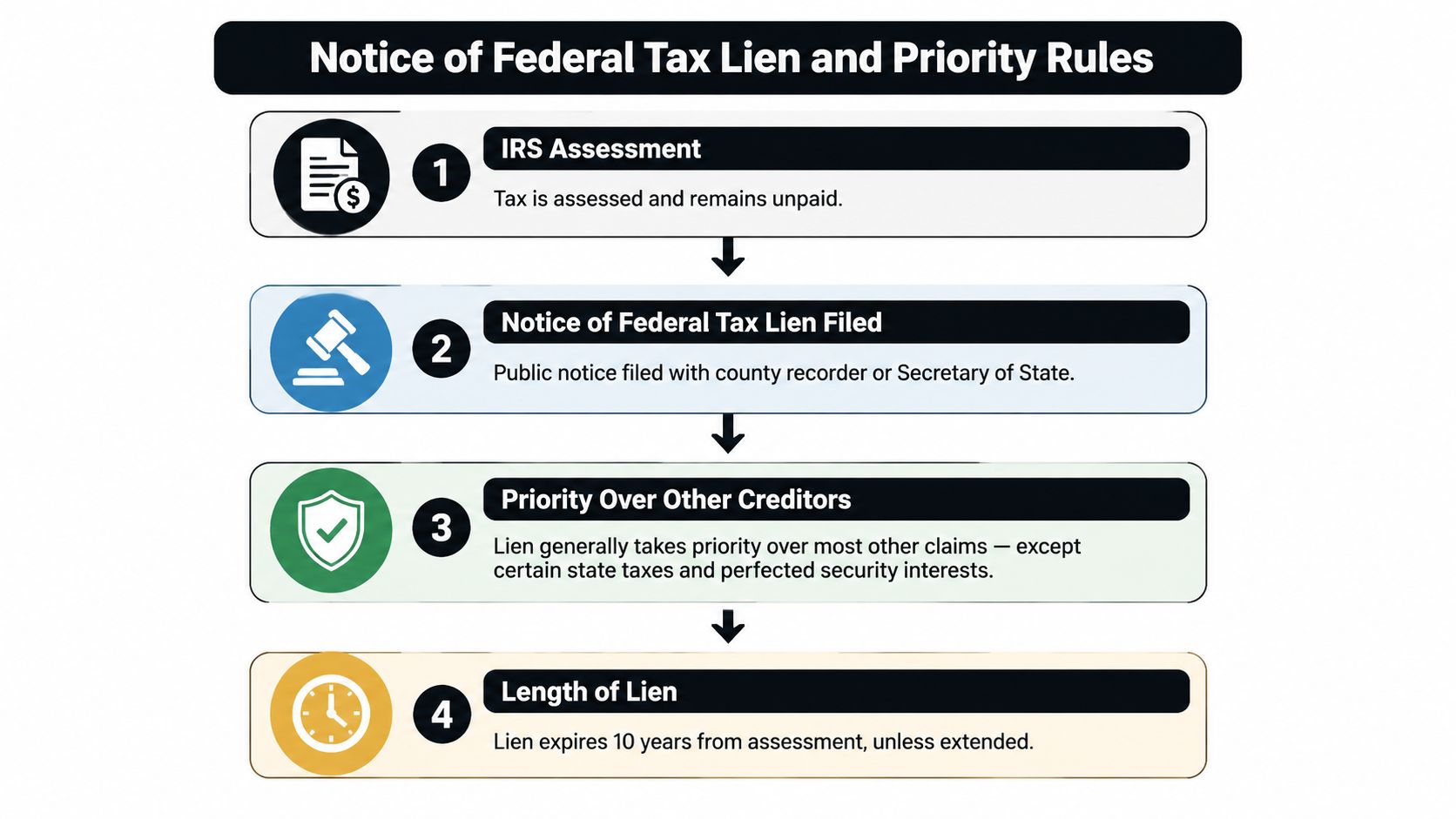
The lien generally continues until the debt is fully paid or the lien becomes legally unenforceable. Because the claim can remain connected to property rights over time, a taxpayer may feel little immediate disruption until a title search, loan application, or asset sale forces the issue into the open.
Think of the statutory lien as the government's legal claim and the NFTL as the public signpost. The signpost doesn't take the property, but it tells buyers, lenders, and other creditors that the government claims an interest that must be addressed.
Notice of Federal Tax Lien and Priority Rules Explained
The NFTL changes the problem from a private account balance into a public priority issue. Before a buyer, mortgage lender, or other creditor completes a transaction, that party wants to know whether someone else has a legally superior claim to the property or proceeds.
Under IRS guidance on understanding a federal tax lien, filing the NFTL protects the government's priority against certain third parties. If the IRS files before competing claims arise, the federal lien generally has priority over later-acquired interests, subject to rules and exceptions that can depend on the type of claimant and the facts.
Why timing controls the leverage
Suppose a homeowner owns a property free of a mortgage and later tries to refinance. The lender plans to record a new mortgage and expects its security interest to be protected. If the NFTL was already filed, the lender can't assume it will move ahead of the IRS. The parties may need to arrange payment, request a discharge of the property, or seek subordination so the new lender can proceed with an acceptable priority position.
A sale raises a related issue. The buyer may receive the property, but the title company needs to determine how the federal claim will be handled. In many cases, the transaction can proceed only after the IRS interest is addressed through the closing documents and proceeds.
For professionals handling renovation or investment transactions, how subordination affects fix-and-flip loans offers useful background on why creditor priority matters when a new lender needs protection.
What can remove the public problem
A taxpayer may resolve the issue by paying the liability in full, obtaining a discharge of a specific property, or securing another form of IRS-approved relief. Subordination doesn't erase the lien. It changes the order in which creditors are paid, which can make a refinance or other financing possible while preserving the government's claim in the agreed structure.
The IRS states that a lien release generally must occur within 30 days after full payment or another statutory satisfaction of the liability, as explained in the agency's guidance. The release is different from a discharge or subordination, so the document and requested remedy must match the transaction.
For a closer look at the filing itself, review this explanation of a Notice of Federal Tax Lien. A title company should receive the resolution plan early, not days before closing.
Lien Versus Levy What the IRS Can and Cannot Do
A lien is a claim. A levy is a seizure. That simple contrast answers the question that causes the most anxiety.
A lien gives the IRS a legal interest in the taxpayer's property and helps protect the government's position against competing creditors. It can cloud title, complicate financing, and require attention before a sale closes. But the taxpayer generally still possesses and uses the property.
A levy is different. It's the IRS action of taking property, such as funds in a bank account, wages, a vehicle, or real estate. IRS materials explain that the agency generally must provide notice before levying and give the taxpayer an opportunity to respond. The exact procedure depends on the type of property and the collection circumstances.

The filing count doesn't equal the seizure count
A recent analysis cited 214,099 lien notices in FY2025 and only 50 physical seizures, as reported in the IRS Tax Topic 201 materials. That comparison supports an important practical conclusion: the IRS often uses liens as a collection and priority instrument rather than immediately taking property outright.
That doesn't make a lien harmless. A person in foreclosure, divorce, bankruptcy, or a deal closing may face a serious deadline even if no levy is pending. The lien can affect the distribution of sale proceeds, the ability to refinance, or the allocation of property between spouses.
The mistake is going in either direction. Panic can lead someone to abandon a viable transaction. Complacency can lead someone to ignore the filing until a lender or title company stops the deal.
For a more detailed comparison, see lien versus levy. Then ask two separate questions:
- Possession risk: Has the IRS issued levy-related notices or taken steps toward seizure?
- Transaction risk: What must happen before a buyer, lender, or title company will accept the property?
The first question concerns enforcement. The second concerns leverage. Many property owners encounter the second problem long before the first.
Proven Ways to Resolve and Remove a Federal Tax Lien
There isn't one universal remedy. The right path depends on whether you can pay, whether the property must move quickly, and whether you need to eliminate the debt, free one asset, or change creditor priority.
Match the remedy to the property problem
| Remedy | What It Does for Property | Best When |
|---|---|---|
| Pay in full | Resolves the underlying liability and supports a lien release after statutory satisfaction | You can fund the payment or use transaction proceeds |
| Installment agreement | Creates an accepted payment structure, but may not remove the filed notice | You need time and can make sustainable payments |
| Offer in compromise | May settle the underlying liability for less than the full amount if the IRS accepts the offer and its terms are met | Full payment isn't realistic and your financial facts support settlement |
| Discharge of property | Removes the federal lien from a specific property while the broader liability may remain | You need to sell or transfer one asset |
| Subordination | Places another creditor ahead of the IRS for a defined transaction or interest | A refinance or new secured loan can improve the repayment position |
| Withdrawal of the NFTL | Removes the public notice, but doesn't erase the underlying tax debt | The filing qualifies for withdrawal and public-record relief is the main goal |
| Collection limitation | May end the government's ability to collect once the liability becomes legally unenforceable | The account history supports that defense |
Full payment is the cleanest resolution when it's financially possible. In a sale, the title company may coordinate payment from the seller's proceeds, but the parties should confirm the required payoff information and release process before relying on that route.
An installment agreement can stabilize collection, but don't assume it automatically removes the NFTL. A taxpayer may remain current on payments while the public claim continues to affect property transactions.
An offer in compromise can address the underlying debt when the taxpayer's financial circumstances justify accepting less than the full amount. It requires accurate financial disclosures and doesn't work as a shortcut for every taxpayer.
Property-specific relief solves a narrower problem
A discharge is transaction-focused. It can free one property from the lien while the IRS retains its claim against other assets or proceeds as permitted by the approved arrangement.
Subordination also has a limited purpose. It doesn't forgive the debt or wipe away the lien. It changes priority so a new lender can lend with the protection it requires.
Withdrawal addresses the public filing rather than the liability itself. That distinction prevents a common mistake: assuming that removal of the notice means the tax debt no longer exists.
Before choosing, gather the NFTL, IRS account records, tax returns, property valuation, mortgage statements, purchase or sale contracts, and a current financial snapshot. A tax professional can help compare the options, and this guide to how to remove a tax lien provides additional context.
How Tax Liens Impact Home Sales Refinancing and Loans
A filed NFTL becomes practical at the moment another party needs clean priority. Consider three common situations.
Home sale: A title company discovers the notice while preparing the closing package. The buyer isn't necessarily prohibited from buying, but the transaction must account for the IRS claim. The parties may use sale proceeds to pay the required balance, or the seller may pursue a discharge if the transaction needs a specific property released.
Cash-out refinance: The homeowner wants new financing to access equity or improve cash flow. The lender doesn't want its mortgage interest placed behind an existing federal claim without protection. A subordination request may be relevant if the refinance gives the taxpayer a workable way to address the debt, while a payoff or discharge may fit better in other circumstances.
Business loan secured by real estate: A business owner offers a building as collateral. The lender evaluates the NFTL alongside mortgages, judgments, and other claims. Even if the business is profitable, the lender may delay funding until the IRS position is documented and resolved.
A lien may not stop ownership, but it can stop a transaction from moving at the speed the parties expected.
The filing trend also provides context about IRS collection activity. Historical data shows nearly 1 million lien filings in FY2009 and about 1.096 million in FY2010, followed by 515,247 in FY2015 and 410,220 in FY2018, according to Taxpayer Advocate historical lien data. Filings reached 157,323 in FY2022, then rose to 179,019 in FY2023, 196,996 in FY2024, and 214,099 in FY2025. The FY2025 total was 36% higher than FY2022 and 9% higher than FY2024, though still below the FY2010 peak, according to the same source.
For realtors, lenders, and advisors, the lesson is operational. Ask about federal tax liens before a contract becomes urgent, request a title search early, and bring tax counsel into the conversation before the closing date is near. A discharge or subordination package takes coordination, and late discovery reduces the available room to maneuver.
Your Next Steps and When to Contact a Tax Attorney
Start with verification, not assumptions. Confirm whether the IRS assessed the liability, review the tax periods and amounts, and obtain a copy of any NFTL. Then ask the recorder, title company, or closing attorney how the filing affects the specific property and transaction.
Use this checklist:
- Confirm the record: Verify where the NFTL was filed and whether it identifies you and the relevant tax periods.
- Map the transaction: Identify the sale, refinance, loan, divorce, foreclosure, or bankruptcy deadline.
- Check competing claims: Gather mortgages, judgment liens, security interests, and ownership documents.
- Choose the objective: Decide whether you need payment, a property discharge, subordination, withdrawal, or a broader debt solution.
- Protect compliance: Keep required returns filed and avoid promises to the IRS that your records can't support.
Contact counsel promptly if a closing is scheduled, several creditors claim the property, the debt involves payroll taxes, the IRS is considering trust fund recovery liability, or divorce and bankruptcy issues overlap. A tax attorney can review account transcripts, test the accuracy of the lien, coordinate with the title company, and prepare the remedy that fits the deal rather than treating every lien as a simple payoff.
You can also review when to hire a tax attorney if you're unsure whether the matter has reached the point where representation is worthwhile.
Tax Attorney Stephen A Weisberg offers a free Tax Debt Analysis to determine whether help is available and which strategy may address the lien, the underlying tax debt, or a pending property transaction. Visit Tax Attorney Stephen A Weisberg to discuss your federal tax lien and identify practical next steps before a closing or financing deadline passes.


