Tax Lien vs Tax Levy What Each Means and How to Fix It
Confused about tax lien vs tax levy? Learn how each works, legal effects, timelines, and how to resolve or remove them before property is seized.

In this article
- Introduction Why Confusing a Lien and a Levy Costs You Time
- What a Tax Lien and Tax Levy Are
- How the two tools fit together
- Tax Lien vs Tax Levy Side by Side Comparison
- The property transaction difference
- How Liens and Levies Affect Your Property Wages and Credit
- Effects of a lien
- Effects of a levy
- Federal vs State Rules and When Each Action Happens
- A practical federal timeline
- How to Resolve and Remove a Tax Lien or Levy
- Resolving a lien
- Releasing a levy
- Which Situation Calls for a Tax Attorney and Next Steps
You open an IRS notice after a difficult year and see language about unpaid taxes, a federal tax lien, or a levy. Your first thought is understandable: “Are they taking my house or draining my account?” The answer depends on which collection tool the IRS is using, and confusing the two can lead you to spend precious time solving the wrong problem.
The distinction is direct. A tax lien is a legal claim against your property that secures the government's interest in the debt. A tax levy is the legal seizure of property or rights to property to satisfy that debt. The lien clouds ownership and affects transactions. The levy takes action against a particular asset, such as money in a bank account, wages, or business property. The IRS explains the difference between a federal tax lien and levy in those terms.
| Question | Tax lien | Tax levy |
|---|---|---|
| What is it? | A legal claim securing unpaid tax | A legal seizure satisfying unpaid tax |
| What does it do? | Protects the government's interest in property | Takes property or rights to property |
| Is it public? | A filed Notice of Federal Tax Lien is public record | An IRS levy isn't public record in the same way |
| Immediate effect | Can complicate sales, refinancing, and title | Can restrict access to money, wages, or assets |
| Primary response | Address the debt and the lien's filing status | Stop the seizure and resolve the collection action |
This guide separates the claim from the seizure, places each action on the federal enforcement timeline, and gives you a practical resolution path. By the end, you'll know which notice you're holding, what it can affect, and when professional representation is justified.
Introduction Why Confusing a Lien and a Levy Costs You Time
A self-employed owner receives an IRS letter while preparing to sell a rental property. The letter mentions a federal tax lien. The owner assumes the IRS has already taken the property, so attention shifts to finding a buyer or arranging emergency financing. Meanwhile, a separate notice warns of a possible levy against a business bank account. The actual emergency is the threatened seizure of operating funds, not the recorded claim affecting the property.
That mistake is common because both tools arise from the same unpaid tax balance. They also appear in the same stressful collection context, but they don't perform the same job. The lien secures the government's claim. The levy enforces that claim by taking property or rights to property.
A lien can create a serious transaction problem without removing your control of the asset. A levy can interfere with cash flow immediately, even when you still hold title to your home or equipment. Treating a lien like a levy may cause unnecessary panic. Treating a levy like a lien can leave you without access to funds while you continue gathering paperwork.
The practical distinction: A lien protects the government's interest. A levy takes the taxpayer's property.
Your next step should match the notice. A filed Notice of Federal Tax Lien calls for a review of the underlying balance, filing status, ownership, and any pending sale or refinance. A final notice of intent to levy calls for a deadline-focused response, because the IRS is moving toward collection against identified property or rights to property.
Both situations have defined resolution paths. Payment, an approved arrangement, a collection appeal, hardship documentation, or a transaction-specific remedy may change the outcome, but the right option depends on the facts and the stage of enforcement.
The rest of this article gives you a decision framework. You'll learn how each tool arises, what it blocks, how federal and state processes differ, and which actions should be handled by you, your accountant, or a tax controversy attorney.
What a Tax Lien and Tax Levy Are
A federal tax lien is the IRS's legal claim against a taxpayer's property after the tax is assessed, payment is demanded, and the balance remains unpaid. The lien secures the government's claim. It does not, by itself, take the property. Because it can attach to property and rights to property, it may affect real estate, business assets, and transactions involving those assets.
The lien may arise automatically under federal law after the first bill goes unpaid. The IRS may also file a Notice of Federal Tax Lien, placing the government's claim in the public record. That filing alerts creditors, purchasers, lenders, and title professionals that the government asserts an interest in the taxpayer's property.
A federal tax levy is the next enforcement step. It is the legal seizure of property or rights to property to satisfy the unpaid tax. Depending on the assets and collection circumstances, the IRS may levy a bank account, wages, accounts receivable, or physical property. A levy can restrict access to funds or control over an asset while the debt remains unresolved.
The IRS treats seizure and levy as legally equivalent. Operationally, the distinction is clear: a lien records and protects the government's claim, while a levy takes control of property or rights to property for collection.
How the two tools fit together
The enforcement timeline matters. A lien addresses the government's interest in the unpaid balance. A levy acts against identified property or rights to property. You may continue possessing and using property after a lien arises, but a levy can change your access, control, or ownership of the targeted asset.
Visibility also differs. A filed lien is placed in the public record. An IRS levy is not public record in the same manner. That difference can affect how a lender, title company, or buyer evaluates a proposed transaction.
If you are researching property-related financing or private-market responses to tax liens, tax lien loans with INTELLI may explain transaction considerations. Financing does not automatically resolve the IRS debt or release a levy. Treat it as a transaction resource, not a substitute for collection analysis.
For a focused explanation of the seizure process, review what an IRS levy is and how it operates. First identify the stage: has the IRS secured its claim through a lien, or has it begun taking the asset through a levy? Your resolution strategy depends on that answer.
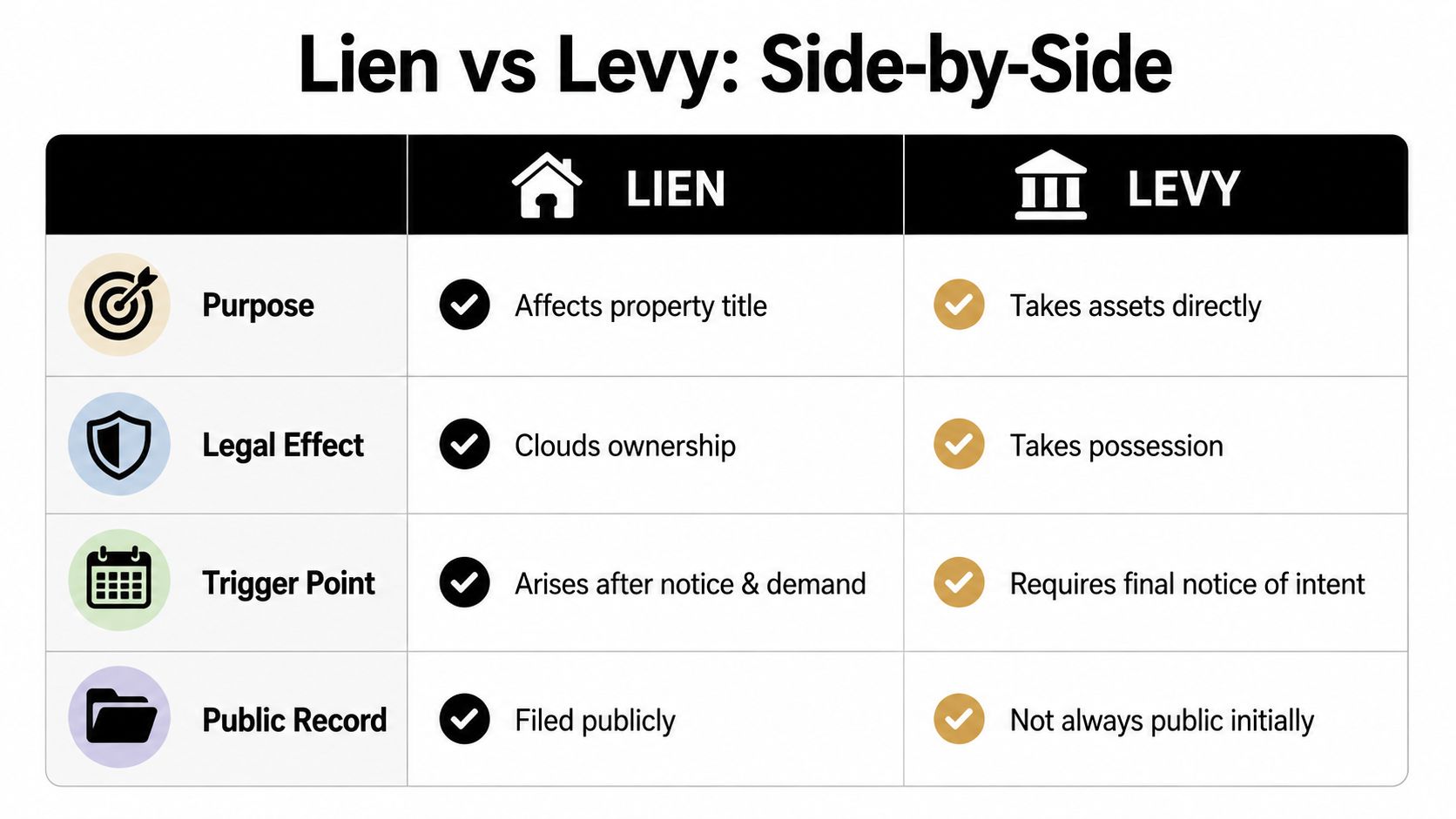
Tax Lien vs Tax Levy Side by Side Comparison
The cleanest way to compare a tax lien vs tax levy is to ask what changes after the IRS acts. A lien changes the government's legal position in relation to your property. A levy changes your ability to access, use, or retain the property targeted by the collection action.
| Criteria | Tax lien | Tax levy |
|---|---|---|
| Purpose | Secures the unpaid tax debt | Satisfies the debt through seizure |
| Legal effect | Creates a government claim against property and rights to property | Takes property or rights to property |
| Trigger point | Can arise after assessment, billing, and nonpayment; a notice filing makes the claim public | Follows collection notices and a final notice of intent to levy |
| Public record status | A filed Notice of Federal Tax Lien is public record | An IRS levy isn't public record in the same way |
| Effect on a sale or refinance | Can create title and closing obstacles | Can prevent access to sale proceeds or seize targeted funds |
| Does property change hands? | No, not merely because the lien exists | The IRS takes the targeted property or rights to property |
A lien generally reaches the taxpayer's property interests broadly. It protects the government's claim against property owned now and, subject to the applicable rules, property acquired later. That broad legal reach is why a lien can affect a transaction even when the IRS hasn't identified one specific asset for seizure.
A levy is more targeted in operation. The IRS identifies property or rights to property and takes steps to obtain them. A bank levy targets funds held by a financial institution. A wage levy reaches earnings through the employer. A levy against accounts receivable can redirect money owed to a business.
A lien can obstruct a transaction without taking possession. A levy can disrupt possession or access without waiting for a voluntary sale.
The property transaction difference
Suppose you're selling a home with a filed Notice of Federal Tax Lien. The title company may require the lien to be addressed before closing, often by arranging payment from proceeds or obtaining an appropriate discharge or other release. You still have the property, but the government's recorded claim complicates the transfer.
A levy creates a different problem. If the IRS has levied sale proceeds, a bank account, or another right to payment, the money may be directed toward the tax balance. You need to address the levy itself, not merely explain that a lien exists.
For more detail about the filing that creates a public-record issue, see the Notice of Federal Tax Lien and its practical consequences. Don't assume that removing or resolving one automatically resolves the other. Each action has its own procedural and transaction consequences.
How Liens and Levies Affect Your Property Wages and Credit
A lien and a levy reach different parts of your financial life. The lien follows the value and ownership of property. The levy reaches money or assets that can be collected directly.
Effects of a lien
A filed Notice of Federal Tax Lien can complicate ownership records for real estate. A buyer may hesitate, a lender may require payoff arrangements, and a title company may refuse to insure a transfer until the government's claim is addressed. The lien doesn't mean the IRS has taken the house, but it can make selling or refinancing difficult.
Business owners face similar friction with equipment, accounts, and other assets. A lien can also affect how creditors evaluate the taxpayer's financial position because the filing is public record. Its practical effect is often transactional rather than immediate cash deprivation.
Consider a sole proprietor who owns a home and operates from a business account. The lien may create a title issue for the home while the business account remains available. The owner can still make payroll or pay vendors, but a planned refinance may stall until the tax claim is handled.
Effects of a levy
A levy is the direct cash-flow threat. The IRS may levy a bank account, wages, accounts receivable, or physical property. A bank levy can restrict funds needed for ordinary expenses. A wage levy can reduce the income available to support a household. A business levy can interfere with payments from customers or access to operating assets.
A W-2 employee should treat a wage-levy notice as urgent because the employer may become involved. A self-employed contractor should review bank accounts and incoming receivables, not just real estate records. A small business with payroll tax debt must consider both the company's operating funds and the potential personal exposure of individuals assessed with the Trust Fund Recovery Penalty.

If money is already frozen or your employer has received levy instructions, stop treating the matter as a paperwork problem. It's a collection emergency.
Credit consequences require careful wording. A public filing can affect how lenders and transaction professionals view the taxpayer's obligations, but the practical outcome depends on the lender, the transaction, the property, and the current status of the filing. Don't promise that paying the balance instantly restores access to credit or clears every underwriting concern.
For a focused discussion of wage and account seizure issues, review levy and garnishment consequences. Gather the notice, account statements, payroll information, property records, and proof of essential expenses before asking the IRS to release or modify the action.
Federal vs State Rules and When Each Action Happens
A federal case usually moves from claim to seizure. The IRS assesses the tax, sends a bill and demand for payment, and obtains a federal tax lien when the balance remains unpaid, as explained in its federal tax lien guidance. If the IRS files a Notice of Federal Tax Lien, its claim becomes part of the public record and can affect transactions involving the taxpayer's property.
A levy is the enforcement stage that can take property or rights to property. Before levying, the IRS generally sends a final notice of intent to levy and explains the right to request a hearing. Treat that notice as a deadline, not a routine bill. Review whether to request a Collection Due Process hearing, propose a collection alternative, challenge an error, or submit financial information supporting hardship.
A practical federal timeline
- Assessment: The IRS determines the tax liability.
- Notice and demand: The IRS bills the taxpayer and requests payment.
- Lien stage: The lien can arise by law, and the IRS may file a public Notice of Federal Tax Lien.
- Final levy notice: The IRS warns of an intended levy and describes hearing rights.
- Levy action: The IRS seizes identified property or rights to property if the matter remains unresolved.
This sequence is a working framework, not a guaranteed schedule. Filed returns, assessments, prior agreements, bankruptcy issues, appeals, and collection history can change the next step. Read the actual notice, confirm the response deadline, and address the specific tax periods listed.
State authorities operate under separate statutes, forms, deadlines, and administrative procedures. A state tax lien may be filed through a state or county system. A state levy may reach wages, bank funds, or other property under state authority. The labels and notice sequence vary, but the distinction stays consistent: a lien secures the government's claim, while a levy takes property.
Keep the records organized by tax period:
- Assessment and billing notices: Confirm the periods assessed and the balance claimed.
- Notice of Federal Tax Lien: Determine whether a public filing affects property or a pending transaction.
- Final notice of intent to levy: Identify the response deadline and hearing rights.
- State notices: Check the issuing authority, procedure, and deadline separately.
Federal enforcement activity demonstrates why the distinction matters. IRS annual enforcement reporting lists 214,099 Notices of Federal Tax Lien in FY2025 and 339,137 third-party levy notices for that fiscal year. The same reporting shows lien filings rising from 157,323 in FY2022 to 214,099 in FY2025, while levy notices rose from 273,286 to 339,137. These figures describe agency activity, not the likely result in your case. Your notice, assets, income, and response deadline control the immediate strategy.
How to Resolve and Remove a Tax Lien or Levy
The correct remedy depends on whether you're dealing with a claim, a seizure, or both. Start by obtaining an account transcript, every notice, and a period-by-period balance. Confirm that required returns are filed and that current tax obligations are being handled, because an arrangement can fail if new liabilities continue to accumulate.
Resolving a lien
Full payment generally addresses the underlying debt and allows the IRS to release its lien under the applicable procedures. If full payment isn't immediately possible, a property transaction may require a discharge, subordination, or another targeted resolution so the sale or refinance can proceed while protecting the government's position.
A withdrawal is different from a release. It concerns the public filing and may be available only when specific legal and administrative requirements are met. Don't tell a lender that a payment plan automatically removes a filed Notice of Federal Tax Lien. It may resolve collection pressure without erasing the public filing.
For a practical discussion of lien removal options, review how to remove a tax lien. If real estate is involved, property-specific information such as Arizona tax lien solutions can provide transaction context, but it shouldn't replace advice about the federal claim.
Releasing a levy
A levy requires faster action. Possible paths include:
- Payment: Paying the balance can eliminate the basis for continued collection, subject to processing and release procedures.
- Payment arrangement: An approved installment agreement may stop future enforcement when its terms are satisfied, but don't assume every levy ends automatically without confirming release.
- Offer in compromise: A qualifying settlement proposal can provide a formal path for resolving the balance when the taxpayer meets the IRS requirements.
- Economic hardship: Financial records may support a request to release or prevent a levy when seizure prevents necessary living or business expenses.
- Procedural appeal: A timely hearing request may allow you to challenge the collection action or propose an alternative.
Prepare bank statements, payroll records, receivable schedules, monthly expenses, asset information, filed returns, and proof of any prior agreement. Contact the IRS through the channel listed on the notice, and document every conversation. If funds are already frozen, act before the institution transfers them, because prevention is usually more effective than trying to recover property after seizure.
Which Situation Calls for a Tax Attorney and Next Steps
Not every lien requires immediate attorney involvement. If you have one filed lien, no threatened levy, complete tax returns, and a straightforward ability to pay, your CPA or enrolled agent may help you verify the balance and communicate with the IRS. You still need to address a pending sale or refinance early, because title and closing requirements can take time.
Call a tax controversy attorney promptly if your bank account has been levied, your employer received wage-levy instructions, or a final notice of intent to levy is approaching its deadline. These situations require a response aimed at stopping collection, protecting essential funds, or presenting a defensible collection alternative.
Business owners need specialized review when payroll taxes are involved. The company's liability may not be the only issue. Individuals connected to payroll decisions can face a Trust Fund Recovery Penalty assessment, so the analysis should identify responsible persons, payment history, and the periods at issue.
A pending property sale also justifies early representation. The attorney can coordinate with the title company, lender, realtor, accountant, and IRS collection personnel to determine whether payoff, discharge, subordination, or another remedy fits the transaction. A bankruptcy attorney may also need tax counsel when bankruptcy won't resolve the tax obligations or when collection activity affects the filing strategy.
Tax Attorney Stephen A Weisberg offers a free Tax Debt Analysis before charging clients to resolve IRS or state tax problems. That review can help determine whether the issue is a lien, a levy, an underlying filing problem, or a broader collection case, and can clarify the next practical step.
Don't wait for a levy to force the decision. Assemble your notices and financial records now, identify the exact deadline, and choose the professional whose skills match the action threatening your property or cash flow.
Tax Attorney Stephen A Weisberg helps individuals, business owners, and professionals' clients analyze IRS and state tax liens, levies, audits, and tax debt before choosing a resolution path. Visit Tax Attorney Stephen A Weisberg to request a free Tax Debt Analysis and discuss what can be done about your specific notice.


