S Corporation Late Filing Penalty: 2026 Rates and Relief
Understand the S Corporation Late Filing Penalty for 2026: per-shareholder rates, worked examples, and relief options that can reduce it.
In this article
- How Much the S Corporation Late Filing Penalty Costs
- Reading the rate table
- The Formula Behind Every S Corporation Penalty Notice
- Worked Examples From Three Owners to Fourteen Months
- What Counts as Late or Incomplete
- Relief Options and When Each One Fits
- Steps to Take Now and Avoid Costly Relief Mistakes
The return was supposed to go out in March. In April the bookkeeper asks whether the K-1s were ever signed, and you realize the 1120-S never left the desk. The first question in that moment is what the delay costs, and the answer runs on headcount and calendar, not income.
An S corporation that files Form 1120-S late owes $245 per shareholder for each month, or part of a month, that the return is late when it was due in 2025, and $255 per shareholder per month when it was due in 2026, with the charge capped at 12 months (IRS notice on penalty amounts). Multiply the rate by the shareholder count and the result is the base penalty, owed even for a year the company reported no income tax at all.
That formula produces a mismatch owners rarely expect. A loss year feels harmless, at worst a rounding error, yet a two-owner company with zero profit pays more for an identical delay than a one-owner company that earned far more. Profit never enters the calculation. People and months do.
Two further points decide the actual exposure. An incomplete return is a separate problem from a late one, and it can carry the same monthly charge, so a filing that reaches the IRS on time can still cost money if it arrives unfinished. Once the notice lands, relief turns on documentation rather than good intentions: the IRS weighs what the record shows about why the deadline was missed or the return left short.
How Much the S Corporation Late Filing Penalty Costs
For an S corporation the late filing charge is a flat monthly fee per shareholder rather than a percentage of income, so the amount depends on two variables before anything else: how many people held stock during the year, and how many months the return stayed unfiled.
| Return due in | Monthly rate per shareholder | Maximum months | Minimum if more than 60 days late |
|---|---|---|---|
| Earlier framework cited by IRS | $220 | 12 | Smaller of tax due or $450 |
| 2025 | $245 | 12 | Smaller of tax due or $510 |
| 2026 | $255 | 12 | Smaller of tax due or $525 |
Reading the rate table
Match the rate to the return year, not the filing year. A 2025 Form 1120-S filed in July 2026 still uses the $245 rate, because the IRS sets the amount by inflation adjustment for the year the return is required to be filed. The IRS notice on penalty amounts shows the movement plainly: an earlier framework charged $220 per shareholder per month, returns due from January 1 through December 31, 2025 carry $245, and the rate rises to $255 for returns required in 2026, each running up to 12 months.
That same per-shareholder structure explains why a delay with more owners costs more than a delay with more income. A four-owner corporation one month late owes $980 on a 2025 return even in a loss year, while a single-owner corporation with healthy profit owes $245 for the same delay.
Older notices still arrive with the $220 figure. If you're holding one, check the return year printed on it before assuming the number is wrong or that the IRS has recalculated it.
The notice also sets a separate floor for a badly delayed return: when a return required in 2026 is filed more than 60 days late, the minimum penalty is the smaller of the tax due or $525, with $510 applying to returns required in 2025. Owners sometimes read that floor as a cap on a small company's exposure. It isn't, and in practice it rarely applies at all, because the floor is limited to the tax shown on the return and a typical S corporation passes income through to its shareholders rather than owing entity-level tax. The monthly per-shareholder math is almost always what you owe.
The dates themselves are simple. A calendar-year corporation files Form 1120-S by March 15, and a valid extension moves the deadline to September 15. Neither date bends for a bookkeeping backlog, and only a properly requested extension protects you. A return that goes out missing a K-1 or a required statement can also be treated as unfiled, which keeps the meter running even after you thought you were done.
Do the multiplication once, before any notice arrives: monthly rate for the return year, times shareholders, times months late. That figure is your exposure floor, and it's usually larger than owners expect.
The Formula Behind Every S Corporation Penalty Notice
For an S corporation, the federal late filing penalty runs on the number of shareholders and the length of the delay rather than the corporation's income tax liability alone, as the IRS failure to file penalty guidance sets out. Think of a taxi meter with a passenger count attached: every month the return sits unfiled adds another fare for every passenger, whether or not the taxi is carrying any freight.
The sequence below is the whole calculation, and it takes about ten minutes with a stock ledger and a calendar in front of you.
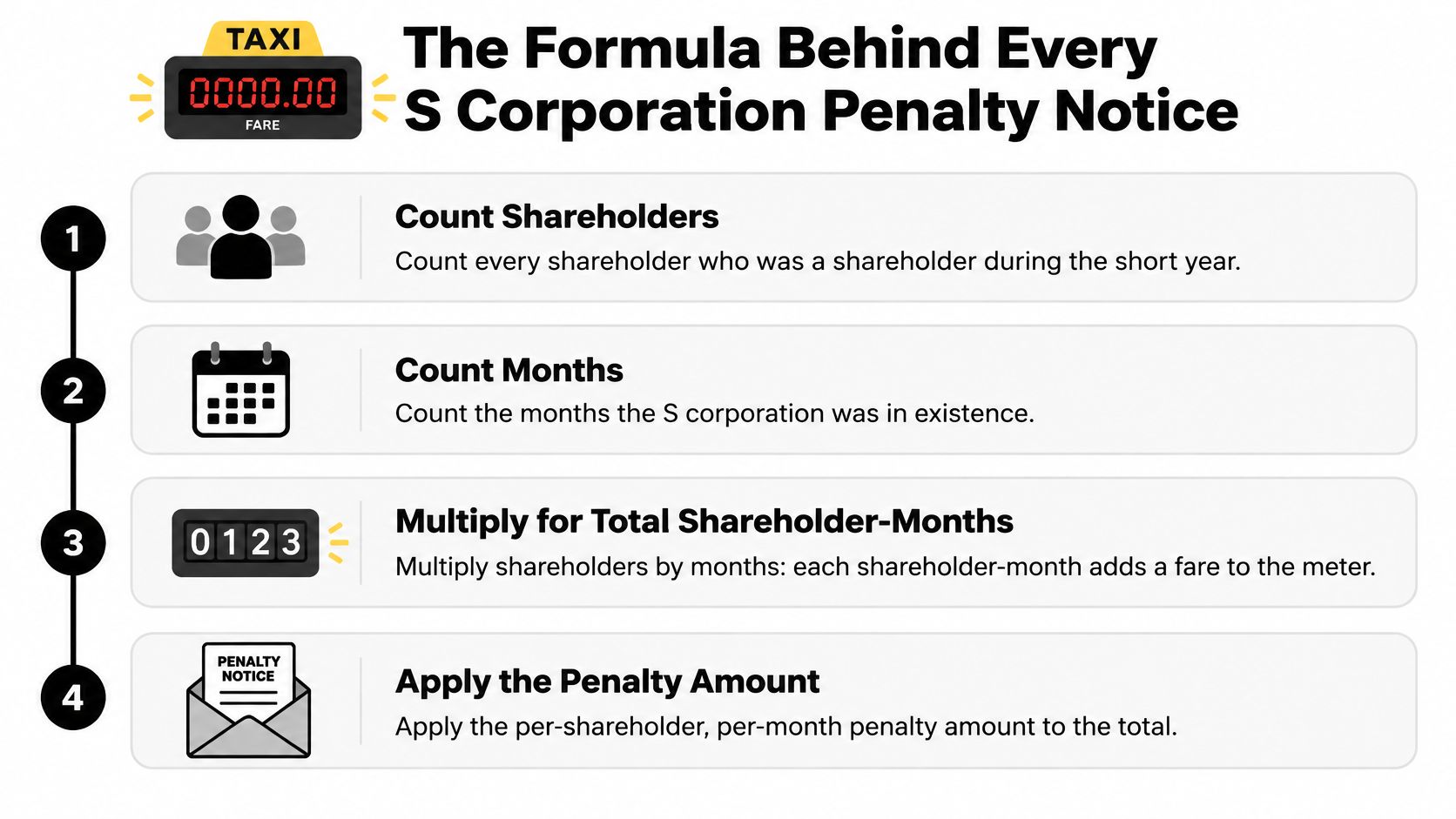
- Count the owners from the stock ledger. Not from memory, and not from the signature page of last year's return. Every person or entity that held shares during the tax year belongs in the count, and a name that appears for one week still counts.
- Count the months. Start at the due date or the extended due date and stop the day the complete return is filed. A partial month counts as a full one, which is why a return filed a day after the deadline costs the same as one filed four weeks later.
- Apply the rate for the return year. The 2025 rate is $245 per shareholder per month. Using the wrong year's rate is a common arithmetic error in owner-prepared estimates.
- Multiply the two together. Rate times shareholders times months. Write the figure down, because it becomes the benchmark you measure any IRS notice against.
- Add the tax-based piece if the corporation owed tax. The IRS instructions provide an additional penalty of 5% of unpaid tax for each month or part of a month, capped at 25% of that unpaid tax. A late filing can therefore carry both a shareholder-based information-return charge and a tax-based charge.
- Confirm the return was complete. An incomplete return can carry the same base calculation as a late one, so the date the IRS treats the return as complete matters more than the date you dropped it in the mail.
The reason this bites companies with no profit is structural. Form 1120-S is generally an information return that reports each shareholder's pass-through items, so the obligation exists whether the corporation shows a gain or a loss. A zero on the tax line does not stop the meter.
The one number owners get wrong: the shareholder count, not the tax due. Recount it before you estimate anything.
The formula gives you a base figure. Whether it survives contact with the IRS is a separate question, and it turns on reasonable cause documented with records, which the failure to file penalty relief process treats as a facts issue rather than a form letter.
Worked Examples From Three Owners to Fourteen Months
Take a consulting firm with three equal owners, calendar year, return due in 2025, filed four months late. Under IRC §6699, the monthly failure-to-file penalty applies for each month or part of a month the failure continues, capped at 12 months, which the Form 1120-S instructions describe. The base here is $2,940: $245 times three shareholders times four months.
| Scenario | Shareholders | Months late | Monthly rate | Base penalty |
|---|---|---|---|---|
| Calendar-year S corp, due 2025, filed 4 months late | 3 | 4 | $245 | $2,940 |
| Two owners, due 2026, filed 4 months late | 2 | 4 | $255 | $2,040 |
| Two owners, due 2025, filed 6 months late | 2 | 6 | $245 | $2,940 |
| Two owners, due 2026, filed 6 months late | 2 | 6 | $255 | $3,060 |
| Four owners, due 2026, filed 3 months late | 4 | 3 | $255 | $3,060 |
| Five owners, due 2026, filed 14 months late | 5 | 12 (capped) | $255 | $15,300 |
Read the rows in order and the mechanics become obvious. Owner count and months late multiply the rate, so each extra month adds one full month's charge for every owner, not one charge for the company.
Row two is the one that surprises people. A two-shareholder S corporation filing four months late on a 2026 return faces $2,040 even though S corporations generally pass income through to shareholders and may owe no entity-level income tax. The penalty counts owners, not profit.
Rows three and four compare the same delay across two years. The same two-owner, six-month delay costs $2,940 under the 2025 rate and $3,060 under the 2026 rate, before any tax-based addition. That $120 gap is pure inflation adjustment, and it's why the return year printed on a notice matters more than the date you open the envelope.
Same dollars, different cause: two owners six months late and four owners three months late both land on $3,060 under the 2026 rate. One is a delay problem, the other is a headcount problem, and they call for different arguments.
Row six shows the cap doing its job. Five owners, fourteen months late: the months stop at 12, so the base is $15,300 rather than the roughly $17,850 that fourteen months would produce. The tax-based addition described in the formula above can still sit on top of that figure when tax was due for the year.
Run your own numbers: owner count, return year, months late. Compare the result with any notice in your file, and if the notice is higher, the difference is usually the tax-based component or a shareholder the IRS counted that you didn't.
What Counts as Late or Incomplete
A return can be penalized in two distinct ways, and owners tend to plan for only one of them. The first is filing after the due date. The second is filing on time with required information missing, which can carry the same base calculation as a late return.
Extensions cause their share of trouble. A valid extension moves the due date, but only if it was requested on time and the corporation qualified. An extension filed after the deadline changes nothing, and neither does one the IRS never accepted. Keep the acceptance record with the return file so you can prove the date rather than describe it.
Ownership timing is the other trap. A share transfer in June adds an owner to the count even if that person was out of the company by December 31, and the charge for that owner runs from the original due date. Redeeming a shareholder early in the year doesn't shrink the count either. Build the count from the stock ledger for the whole year.
Before anything goes out the door, run this review:
- Shareholder schedule: every owner listed with legal name, address, taxpayer identification number, and ownership percentage, matching the ledger exactly.
- Schedule K-1 data: each shareholder's pass-through items computed before filing, not reconstructed afterward when someone chases a personal return.
- Attachments: all required schedules and statements present, including anything the form instructs you to attach rather than summarize.
- Officer and ownership block: complete, with the business activity codes and officer compensation figures filled in.
- Reconciliation: tie the shareholder count on the return to the stock ledger, and note any mid-year transfers with dates.
A return missing a schedule can be treated as incomplete, and correcting it after filing can extend the months the IRS counts. The review belongs before submission, when a fix costs an hour instead of a penalty month.
If the same year has wage reporting problems, the cleanup overlaps with S corporation payroll taxes, and both get easier when one reconciled shareholder list serves both filings.
Relief Options and When Each One Fits
Most owners reach for a letter the week a notice arrives. The routes below are not interchangeable, and picking the wrong one costs months you don't get back.

| Relief route | Best fit | What you submit | Main limit |
|---|---|---|---|
| Reasonable cause | Illness, disaster-related records loss, or incorrect professional advice | Written explanation covering each late month, with supporting records | IRS must accept the facts; generic letters rarely succeed |
| First-time abatement | Clean prior filing history for the return type | Abatement request under current IRS rules | Confirm eligibility for Form 1120-S and the tax year |
| Automatic exemption (scheduled summer 2026) | Clean prior three years, tax paid when due | Eligibility check against published requirements | Published list does not include Form 1120-S |
| CP162C written explanation | Response to an IRS CP162C notice | Written explanation mailed to the IRS office where the return was filed | Must address the reasonable cause facts |
| Late S election relief | Election filed late, not a return penalty | Request under IRS procedures in Rev. Proc. 2013-30 | Addresses S status, not the return penalty |
Reasonable cause is the workhorse for S corporations, and it covers the ordinary disasters: a stroke, a hurricane that took the records, a bookkeeper who gave advice the corporation relied on in good faith. Penalty abatement can reduce or eliminate IRS penalties, including reasonable cause relief when illness or incorrect professional advice led to noncompliance, but the file has to show the sequence of events rather than assert it. A statement that says "our accountant was slow" without the engagement letter, the emails, and the dates carries almost no weight.
The penalty abatement analysis starts with the return type, not the sympathy of the story. That matters because newer administrative relief has a coverage limit many owners miss. The IRS says its Automatic Exemption from Penalty is scheduled to begin in summer 2026 and generally requires the same return type to have been timely filed for the prior three years, with tax paid when due, according to its administrative penalty relief page. The listed forms include Forms 1040, 1065, and 1120, but the published page does not list Form 1120-S. A clean filing history is therefore not a safe assumption for an S corporation.
First-time abatement is worth testing whenever the prior three years are clean, but confirm it applies to Form 1120-S and to the specific tax year before you build a response around it. If a CP162C notice is in hand, the corporation may mail a written explanation to the IRS office where it filed the return, and that explanation should answer each late month in order.
Late S election relief is a different animal entirely. It addresses whether the S election itself was valid, which is a status question, and it does nothing for a late return penalty. Use it when the election was late, not when the 1120-S was.
A broad relief announcement never replaces an analysis of your specific return. Test eligibility first, then argue the facts.
Steps to Take Now and Avoid Costly Relief Mistakes
Pull the IRS account transcript for the late return year before drafting anything. Confirm which penalties are assessed, which are proposed, and which have already been paid or adjusted. Owners routinely write an abatement request for a figure that no longer exists.
Then work in this order:
- Set your expected range. Owner count times the monthly rate for the return year, times months late, capped. The charge runs per shareholder, so a return with more owners racks up the penalty faster than a return with more income. Knowing the range tells you what a reasonable resolution looks like before anyone responds.
- File a complete return immediately. Each month the return stays unfiled adds another per-shareholder charge. Filing stops the meter; arguing about the amount does not.
- Assemble the reasonable cause file. Records, correspondence, and a dated timeline of what happened and when the corporation acted. Names, dates, and what was done to catch up.
- Respond before the notice deadline. Answer month by month, because an explanation that skips late months invites a partial or full denial.
- Confirm whether the tax-based addition applies. If tax was due, the calculation includes a second component, and a payment plan may be the practical answer while relief is decided.
Mistakes cost more than the penalty itself, and each one has a fix:
- Letting a notice date pass. Options narrow with every week. Calendar the response date the day the envelope is opened.
- Writing one paragraph for six late months. The reviewer needs to see why each month was missed. A month-by-month account reads as credible; a summary reads as an excuse.
- Asking for relief on lateness while the return is still incomplete. A late return and an incomplete return are separate problems, and the completeness charge survives an argument aimed only at timing. File the complete return and address both issues in one response.
- Blaming a preparer with no paper behind it. Keep the engagement letter, the emails, and the advice itself. Reliance on incorrect professional advice is a recognized ground, but only if the record shows you relied on it.
- Sending a generic hardship letter. Attach the calendar, the reminders, and the filing history. Ordinary business care and prudence is a documentation standard, not a tone of voice.
- Assuming a broad IRS announcement covers Form 1120-S. Coverage lists are form-specific, so confirm the return type is included before you build a request around the announcement.
Calendar rule: the response date on the notice, not your convenience, sets the window. Everything else is negotiable.
If the delay traces back to a missed extension, fix that habit first. The rules around the business tax extension deadline explain what a valid extension protects and where that protection stops.
There is a point where doing this yourself stops being economical. Owing more than $5,000 to the IRS is a listed situation in which an attorney is needed for IRS tax matters, and once a power of attorney is filed the IRS cannot contact the client directly, with all communication directed to the attorney. That single change removes the risk of an offhand phone answer becoming the record. The attorney also obtains IRS and state transcripts covering every penalty, every payment, and how long until the debt is written off, which is the difference between guessing at exposure and knowing it.
If you are holding a notice for a late Form 1120-S and the arithmetic above says you are exposed, Tax Attorney Stephen A Weisberg can pull the transcripts, test every relief route against the actual return type, and answer the IRS on your behalf under a power of attorney. The practice handles penalty abatement for failure-to-file penalties, including the reasonable cause arguments that depend on records rather than apologies. Start with a paid Tax Debt Analysis at Tax Attorney Stephen A Weisberg to find out whether relief is realistic before you commit to representation.


