Tax Penalty Abatement: How to Get IRS Penalties Reduced
Learn how tax penalty abatement works, who qualifies, and the steps to request IRS penalty relief through First Time Abate, reasonable cause, and appeals.
In this article
- What Tax Penalty Abatement Actually Solves
- The Three Doors to Penalty Relief
- First Time Abate
- Reasonable cause
- Statutory exceptions
- Building a Reasonable Cause Claim That Holds Up
- Start with the triggering event
- Prove timing and causation
- Document remedial action
- Documents and Records You Need Before Requesting Relief
- Requesting Abatement Through the Right IRS Channel
- Use the phone for clean administrative cases
- Use Form 843 when a written claim fits
- Appeals, Deadlines, and When Representation Pays Off
- Decide whether the case is suitable for self-help
- Common Pitfalls and Your Next Steps
You've opened a notice and found several penalties stacked on top of the tax you already owe. The failure-to-file charge looks severe, the failure-to-pay amount keeps changing, and interest continues to accrue. The notice may not explain which penalty should be challenged first, what evidence the IRS expects, or whether a phone call is enough.
That confusion is common. Tax penalty abatement can reduce or eliminate a penalty, but it doesn't erase the underlying tax liability, and the correct strategy depends on the penalty type, your compliance history, and the evidence available. The IRS's most common administrative waiver is First Time Abate, while reasonable-cause relief requires a more detailed factual showing. The IRS administrative penalty relief guidance describes the core requirements and available request methods.
What Tax Penalty Abatement Actually Solves
Consider a self-employed consultant who receives a CP161 notice showing a $4,800 failure-to-file penalty and a $2,100 failure-to-pay penalty, with interest still accruing. The consultant has filed the missing return and wants to know whether the larger filing penalty should be attacked first, whether paying the balance will destroy the right to seek relief, and whether an installment agreement solves the problem.
The answer starts with the nature of abatement. An abatement is an IRS decision to reduce or remove a penalty charge. It doesn't reduce the income tax, self-employment tax, or any other underlying liability. If the IRS grants relief, the tax remains due unless another collection or settlement option applies.
That distinction matters because several IRS remedies address different problems:
- Penalty abatement addresses a civil penalty assessed for a compliance failure.
- An installment agreement addresses how you pay an established balance over time.
- An offer in compromise may settle eligible tax debt for less than the full amount, subject to separate eligibility and financial analysis.
- Innocent spouse relief addresses certain joint-liability situations where one spouse seeks relief from tax or penalties attributable to the other spouse.
A granted First Time Abate request or reasonable-cause request can remove penalties that otherwise inflate the account. Relief from the failure-to-pay penalty can also stop that penalty from continuing to accrue once the balance is paid in full, although interest generally requires separate attention. The Taxpayer Advocate Service explanation of First Time Abate explains that a taxpayer may qualify for this relief before the tax is fully paid, while the failure-to-pay penalty continues until the balance is fully paid.
Practitioner's warning: Don't treat an installment agreement as a substitute for abatement. A payment plan can make the balance manageable, but it doesn't by itself remove penalties already assessed.
The practical challenge is often framing rather than eligibility. Taxpayers submit a sincere hardship story, but they fail to identify the exact penalty, connect the event to the deadline, or prove what they did afterward. The IRS evaluates the request against specific administrative and legal standards, not against how stressful the situation felt.
The Three Doors to Penalty Relief
First Time Abate, reasonable cause, and statutory exceptions are separate routes. Each has a different standard, and using the wrong one can waste time or produce an avoidable denial.
First Time Abate
FTA is the most standardized option. It generally requires a clean compliance history for the prior three years, filing all required returns, and paying or arranging to pay any tax due. The IRS says taxpayers may request it for failure-to-file, failure-to-pay, and failure-to-deposit penalties through a phone request or, in some circumstances, Form 843. The IRS commonly checks eligibility through its account systems rather than deciding whether your personal explanation sounds persuasive.
FTA isn't a general forgiveness program. It doesn't apply to every penalty, and a taxpayer who has already used a disqualifying penalty waiver may not have this door available for the relevant period. Before preparing a detailed narrative, review the First Time Penalty Abatement requirements and confirm that the penalty and compliance history fit the program.
Reasonable cause
Reasonable cause is broader, but it demands proof. The IRS generally looks for evidence that the taxpayer exercised ordinary business care and prudence but still couldn't comply. Serious illness, natural disasters, death in the family, and incorrect professional advice may support a claim, but the label alone isn't enough.
A reasonable-cause request should establish the event, show how it prevented timely compliance, and document prompt corrective action. The request must also match the penalty being challenged. A compelling medical event may explain a late filing, but it may not explain why payment remained delinquent after the taxpayer recovered.
Statutory exceptions
Statutory exceptions arise from specific provisions of law. They can include qualifying military deferments, federally recognized disaster circumstances, and certain casualty-related situations. These provisions may impose their own definitions, dates, forms, and proof requirements.
| Criterion | First Time Abatement | Reasonable Cause | Statutory Exception |
|---|---|---|---|
| Core test | Qualifying compliance history and current filing and payment status | Ordinary business care and prudence despite circumstances preventing compliance | Requirements written into a specific statute or regulation |
| Evidence emphasis | IRS account history and filing record | Event, causal connection, timing, and corrective action | Proof that each statutory condition applies |
| Typical scope | Selected failure-to-file, failure-to-pay, and failure-to-deposit penalties | Penalties covered by the applicable reasonable-cause authority | Only the penalties and circumstances covered by the specific rule |
| Best first move | Verify eligibility before drafting a hardship narrative | Build a documented factual statement | Identify the governing provision before requesting relief |
Identify the door before writing the explanation. A clean FTA case should be handled efficiently. A reasonable-cause case needs a record. A statutory exception requires precision.
Building a Reasonable Cause Claim That Holds Up
The IRS doesn't grant reasonable-cause relief because a taxpayer had a difficult year. The request must prove a specific causal chain. The strongest files show what happened, when it happened, why compliance became impossible or impracticable during the relevant window, and what the taxpayer did once the obstacle ended.
The IRS reasonable-cause penalty abatement guidance reflects the evidence model practitioners use when preparing these cases.
Start with the triggering event
Use a dated, verifiable occurrence. A hospitalization record is stronger than “ongoing health problems.” A death certificate is stronger than “a family emergency.” A fire department report, court order, or disaster declaration can establish an event that a personal narrative cannot prove by itself.
The event must be relevant to the taxpayer's ability to comply. A medical record showing admission and discharge dates can establish the period of incapacity. It doesn't automatically explain every later month of noncompliance.
Prove timing and causation
The second question is whether the event coincided with the filing or payment deadline. A hospital discharge on March 15 may be relevant to an April 15 filing deadline, but the submission should explain the taxpayer's condition, recovery demands, access to records, and available assistance during that period.
Many borderline requests fail at this point. The taxpayer identifies a real event, but the records don't show that it prevented compliance when the penalty arose. The statement should connect the dates, the required action, and the practical obstacle without exaggeration.
Document remedial action
The final piece is diligence after the obstacle cleared. Evidence may include the date the return was filed, the date payment was made or arranged, an IRS contact record, or a CPA engagement letter obtained after recovery. Prompt corrective action helps demonstrate that the problem was temporary rather than a continuing disregard of the obligation.
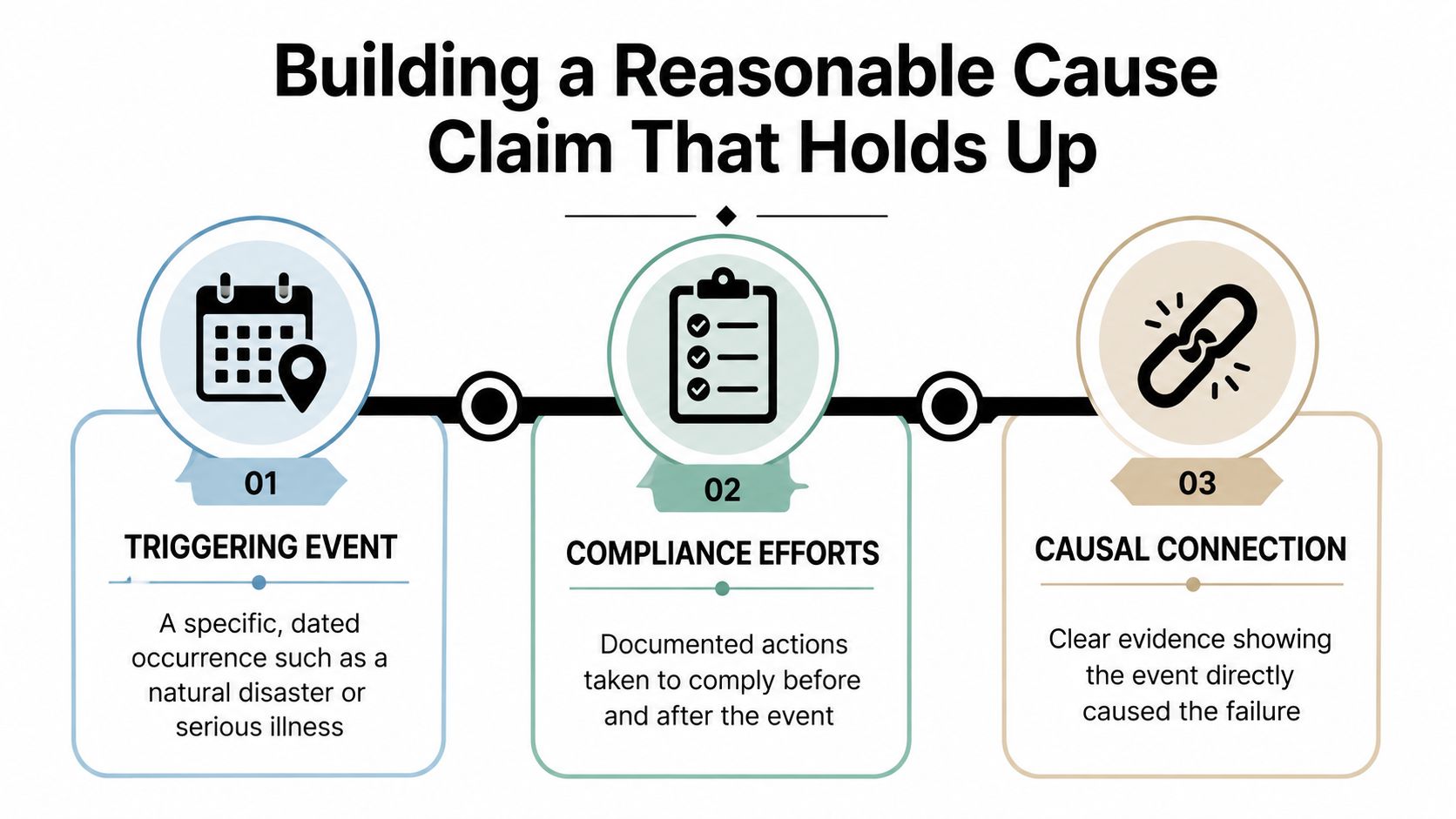
A single document may prove that something happened. It rarely proves that the event caused the specific tax failure and that the taxpayer acted diligently afterward.
A credible request uses corroboration. Medical records should align with the timeline. Bank records should support payment efforts. Engagement letters should show when professional assistance began. Generic hardship language without supporting records is one of the clearest paths to denial.
Documents and Records You Need Before Requesting Relief
Prepare the evidence packet before contacting the IRS or mailing a request. The file should identify the penalty, establish eligibility where applicable, and expose any conflict between the account history and the explanation.
For an FTA request, obtain the account transcripts and review the relevant compliance history. Confirm that required returns were filed and that any balance is paid or covered by an arrangement the taxpayer is maintaining. Keep the notice, tax period, filing date, payment information, and account history together.
A reasonable-cause file should answer three factual questions:
- What happened: Medical records, a death certificate, disaster documentation, a court order, an insurance claim, or a fire report can establish the triggering event.
- When it happened: Notices, discharge dates, bank statements, employer letters, medical bills, and correspondence should connect the event to the applicable deadline.
- What happened afterward: A filed return, payment confirmation, CPA engagement letter, IRS contact record, or request for replacement records can show corrective action.
Pull the IRS account transcript showing the penalty assessment date and specific tax period. Retain the original return, amended returns if any, notices, prior requests, and IRS responses. A serious event will not cure a mismatch between the penalty code and the stated reason for noncompliance.
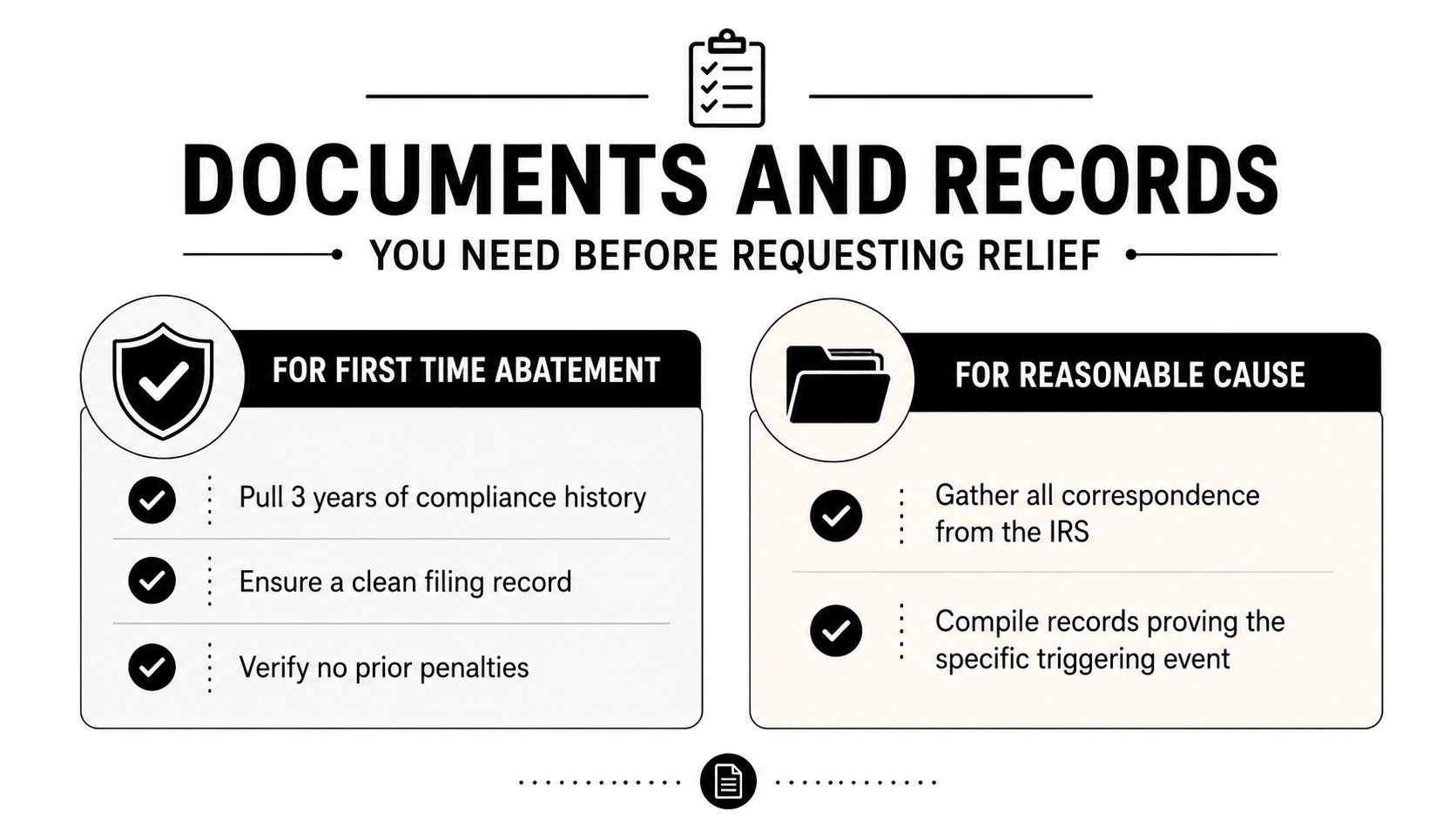
Add a short chronology to the file. List the deadline, triggering event, period of incapacity or disruption, first corrective action, filing date, payment date, and IRS communications. Missing dates often reveal the weakness in a reasonable-cause claim before submission.
Do not attach every record without explaining its purpose. Match each exhibit to a factual statement. A claim that financial records were inaccessible needs evidence of that access problem. A claim that payment was attempted needs the dated bank record. The documents should show both the obstacle and the taxpayer's response after it ended.
For broader collection cases, financial records may also matter. The Form 433-F guidance helps distinguish collection disclosures from penalty-abatement evidence.
Requesting Abatement Through the Right IRS Channel
Channel selection affects both speed and the quality of the record. A phone request can work well for a straightforward FTA case, especially when the account clearly shows eligibility. It's usually a poor vehicle for a fact-heavy reasonable-cause claim because the taxpayer can't fully present medical, disaster, employment, or professional-reliance evidence during a call.
Use the phone for clean administrative cases
The IRS's general taxpayer line or practitioner line may be appropriate for FTA and some single-period failure-to-pay matters. Have the notice, tax period, return filing date, payment or arrangement information, and account transcript available. Ask the representative to identify the penalty being considered and document the call details.
A phone concession isn't the same as a complete written determination. Request confirmation and monitor the transcript afterward. Written confirmation may take 30 to 90 days, depending on the request and IRS processing conditions. That timeline is a practical expectation, not a guarantee.
Use Form 843 when a written claim fits
Form 843, Claim for Refund and Request for Abatement, is commonly used for paid penalty refund claims and documented reasonable-cause requests. Complete the form for the correct tax period and penalty, then attach a factual statement and organized exhibits. Mail it to the address on the latest notice or the instructions applicable to the claim.
Written processing may take 90 to 180 days. A request that merely says “I had reasonable cause” is not a substitute for evidence. Explain the event, the deadline connection, the corrective action, and the legal basis for relief.
A written letter may be appropriate when the penalty or procedure doesn't fit Form 843. The letter should identify the taxpayer, tax period, notice number, penalty type, requested relief, and supporting documents. Keep proof of mailing and a complete copy.
| Channel | Best For | Typical Timeline | Documentation Method |
|---|---|---|---|
| Phone | Straightforward FTA and limited single-period cases | Often immediate handling, with written confirmation potentially taking 30 to 90 days | Account details, eligibility answers, call record |
| Form 843 | Paid-penalty refund claims and documented written requests | Commonly 90 to 180 days | Form 843, signed statement, organized exhibits |
| Written letter | Cases where Form 843 isn't the applicable route | Varies by IRS campus and account workload | Notice-specific letter and supporting records |
Don't route every request through Form 843. An eligible FTA request may move more efficiently by phone, while a reasonable-cause claim generally needs a written record. If the first channel denies relief, review the transcript, obtain the explanation, correct the factual or procedural defect, and use the available reconsideration or appeal route.
Appeals, Deadlines, and When Representation Pays Off
A denial doesn't always end the matter. Read the notice carefully and identify whether it is a Notice of Determination, Letter 1058, Letter 3193, or another collection document. The appeal rights and deadline depend on the notice, and a taxpayer who waits may lose an important review opportunity.
For a Notice of Determination, Letter 1058, or Letter 3193, the relevant appeal period may be 30 days. Form 12203 can request an Appeals conference in appropriate cases, while a written protest may be required for larger or more complex matters. The IRS tax appeals process provides context for choosing the correct procedure.
Decide whether the case is suitable for self-help
Self-help is reasonable when the request is a routine FTA matter, the penalty is clearly eligible, the account history is clean, and the taxpayer has filed all required returns. A simple reasonable-cause case may also be manageable when the triggering event is well documented and the timeline has no meaningful gaps.
Representation becomes more valuable when the IRS has already denied relief, the penalty is substantial, or the facts require credibility judgments. It can also help when multiple penalty types are assessed, payroll tax exposure exists, or the taxpayer must defend the causal connection between an event and a compliance failure.
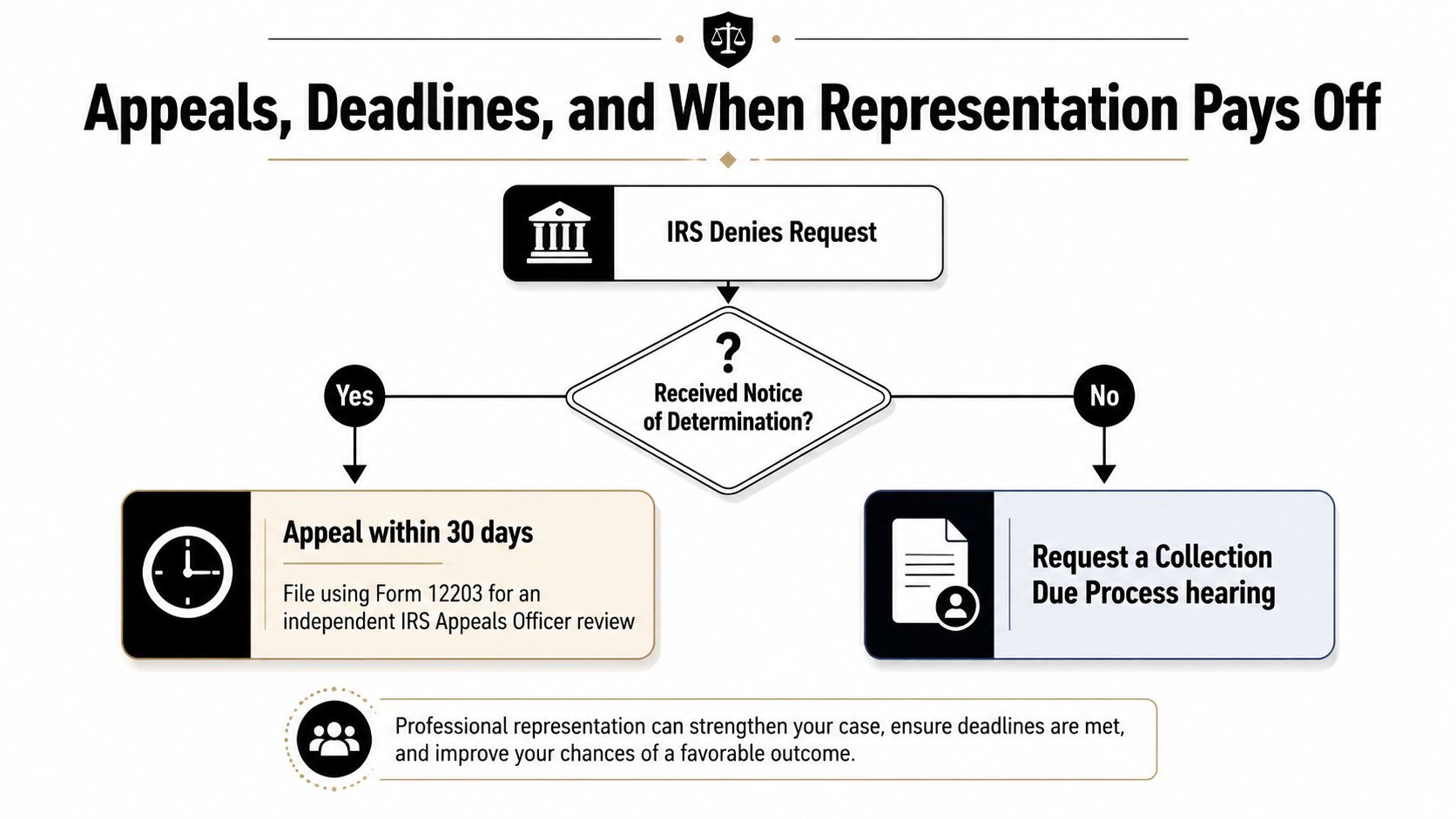
A representative can separate the legal theories, prepare the administrative record, and address the reason for denial instead of repeating the original request. That distinction matters. Appeals is not an opportunity to send the same unsupported narrative again.
Decision rule: If the denial identifies missing evidence, cure the evidence gap. If it disputes the legal standard or credibility of the facts, professional representation is often more useful than another general letter.
The cost-benefit analysis should be practical. Compare the penalty and likely interest exposure with the cost of competent representation, and consider whether a denial would create collection pressure or affect a related transaction. Don't hire someone based only on a promised result. Ask who will handle the file, what records they need, which channel they recommend, and how they will respond if the first request fails.
Tax Attorney Stephen A Weisberg offers a free tax debt analysis before charging clients to resolve IRS issues, which can help determine whether penalty abatement is a realistic part of the broader strategy.
Common Pitfalls and Your Next Steps
Most failed requests fall into recognizable patterns. The taxpayer may use the wrong form, submit an FTA request despite a disqualifying compliance history, or describe a serious event without proving its dates and effect. Another common mistake is combining unrelated penalty types into one vague request when separate procedures would present the facts more clearly.
Reliance on a tax professional also needs evidence. Saying “my CPA made a mistake” doesn't establish that the taxpayer provided information, followed up, reviewed filing obligations, or acted reasonably. Include engagement records, emails, payment instructions, delivery evidence, and the steps taken after discovering the error.
Don't ignore IRS correspondence while preparing an abatement request. A pending request doesn't automatically suspend every collection deadline or make a phone statement binding. Read each notice, preserve the envelope and attachments, and track the response date.
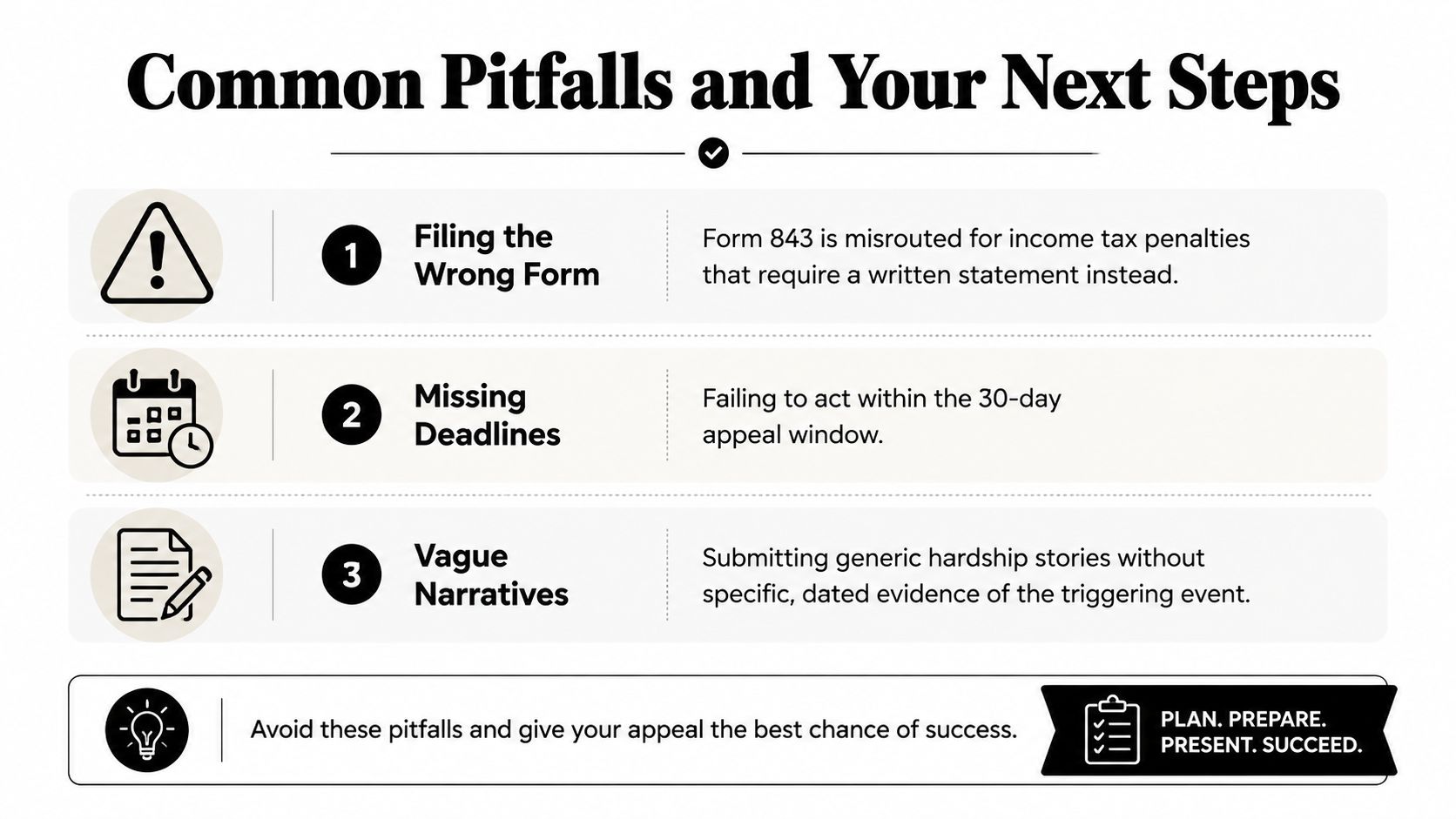
Use this decision framework:
- Small balance, one tax year, clear FTA eligibility: Verify the account history, file all required returns, and make the phone request with the notice and transcript available.
- Documented illness, disaster, death, or similar event: Prepare a written reasonable-cause request with a chronology and corroborating records.
- Multiple years, concurrent penalties, or a prior denial: Have the account and denial reviewed before submitting another request.
- Appeal deadline approaching: Protect the deadline first, then improve the evidence and legal framing.
Your immediate action is to obtain the latest notice and account transcript, identify every penalty by tax period, and mark the earliest response deadline. That information determines whether you should make an FTA request, prepare a documented reasonable-cause submission, or seek representation before your appeal rights narrow.
Tax Attorney Stephen A Weisberg helps individuals and businesses evaluate IRS penalty exposure, prepare First Time Abate and reasonable-cause requests, and respond when the IRS denies relief. Visit Tax Attorney Stephen A Weisberg to request a free tax debt analysis and determine the right next step for your IRS penalty case.


