IRS Failure to File Penalty Explained (2026)
Understand the IRS failure to file penalty, how it's calculated, and your options for relief. Learn about abatement, reasonable cause, and when to seek help.

In this article
- The Unopened Letter and the Start of Your Tax Problem
- What clients usually get wrong first
- Why this problem still has solutions
- How the IRS Calculates the Failure to File Penalty
- The part taxpayers underestimate
- A simple way to think about it
- What actually helps
- Failure to File vs Failure to Pay A Critical Distinction
- Why the filing side gets the sharper response
- Side by side comparison
- The practical takeaway
- The Domino Effect Consequences Beyond the Penalty
- Why unfiled returns create leverage for the IRS
- The practical consequences I see most often
- What doesn't work
- How to Get IRS Penalty Relief The Abatement Process
- The three paths that matter most
- What a proper request should include
- Form 843 and when it comes up
- What usually works best
- Building a Winning Reasonable Cause Argument
- Arguments that tend to carry weight
- Arguments that usually fail
- How to draft the narrative
- A better and worse version
- Your Next Steps and When to Call a Tax Attorney
- When handling it yourself may be reasonable
- When professional help becomes important
The envelope usually sits unopened for a few days first.
It lands on the counter, then moves to a desk, then under a stack of papers. You know it's from the IRS. You also know there's a return you didn't file, or a balance you meant to deal with later. Individuals in that position aren't reckless. They're overwhelmed, embarrassed, busy, or worried they can't pay.
That's when the IRS failure to file penalty starts doing real damage. It isn't a minor nuisance. It's one of the fastest ways a tax problem gets more expensive and harder to control. The good news is that late filing problems can often be contained, and in some cases penalties can be reduced or removed. But the order of operations matters, and some arguments work far better than others.
The Unopened Letter and the Start of Your Tax Problem
A common version of this problem looks like this: a self-employed taxpayer had a rough year, records got messy, the filing deadline came and went, and now an IRS notice arrives. By the time that letter shows up, the issue usually isn't just the missing return. It's the uncertainty that comes with it. How much does the IRS think is owed? Has a penalty already been assessed? Is this still fixable?
In practice, the first mistake is rarely the late return itself. The bigger mistake is silence after the IRS starts sending notices. Once that cycle begins, people often make decisions from fear instead of strategy. They avoid the mailbox, ignore online account access, and tell themselves they'll deal with it after the next busy week. That delay is what turns a manageable filing problem into a tax controversy matter.
Practical rule: Open every IRS notice the day it arrives, even if you're not ready to solve the whole problem yet.
The notice may be the first clue about what the IRS has on file, what year is involved, and whether the agency has already processed a return substitute or assessed penalties. If you're unsure how to read the notice, it helps to start with a plain-English breakdown of IRS letters and notices so you know what demands immediate attention.
What clients usually get wrong first
It's often assumed the IRS is mainly focused on whether taxpayers can pay. That's not usually the first priority. The IRS wants the return filed. Filing gives the agency a formal number to work from and tells it whether the taxpayer agrees with what's owed.
That's why I tell clients to separate two questions. First, is the return filed? Second, if tax is due, what's the best resolution for payment and penalties? When those questions get blended together, people delay filing because they can't afford to pay. That's exactly backward.
Why this problem still has solutions
Late filing is serious, but it isn't hopeless. The IRS has procedures for penalty relief. Some taxpayers qualify for administrative relief based on prior compliance. Others have a strong reasonable cause argument if something disruptive kept them from filing. What works is acting quickly, documenting the facts, and making the right request in the right form.
How the IRS Calculates the Failure to File Penalty
The IRS failure to file penalty is tied to unpaid tax, not just the fact that a return is late. If you're due a refund, this penalty generally isn't the issue. If you owe and the return is late, the meter starts running fast.
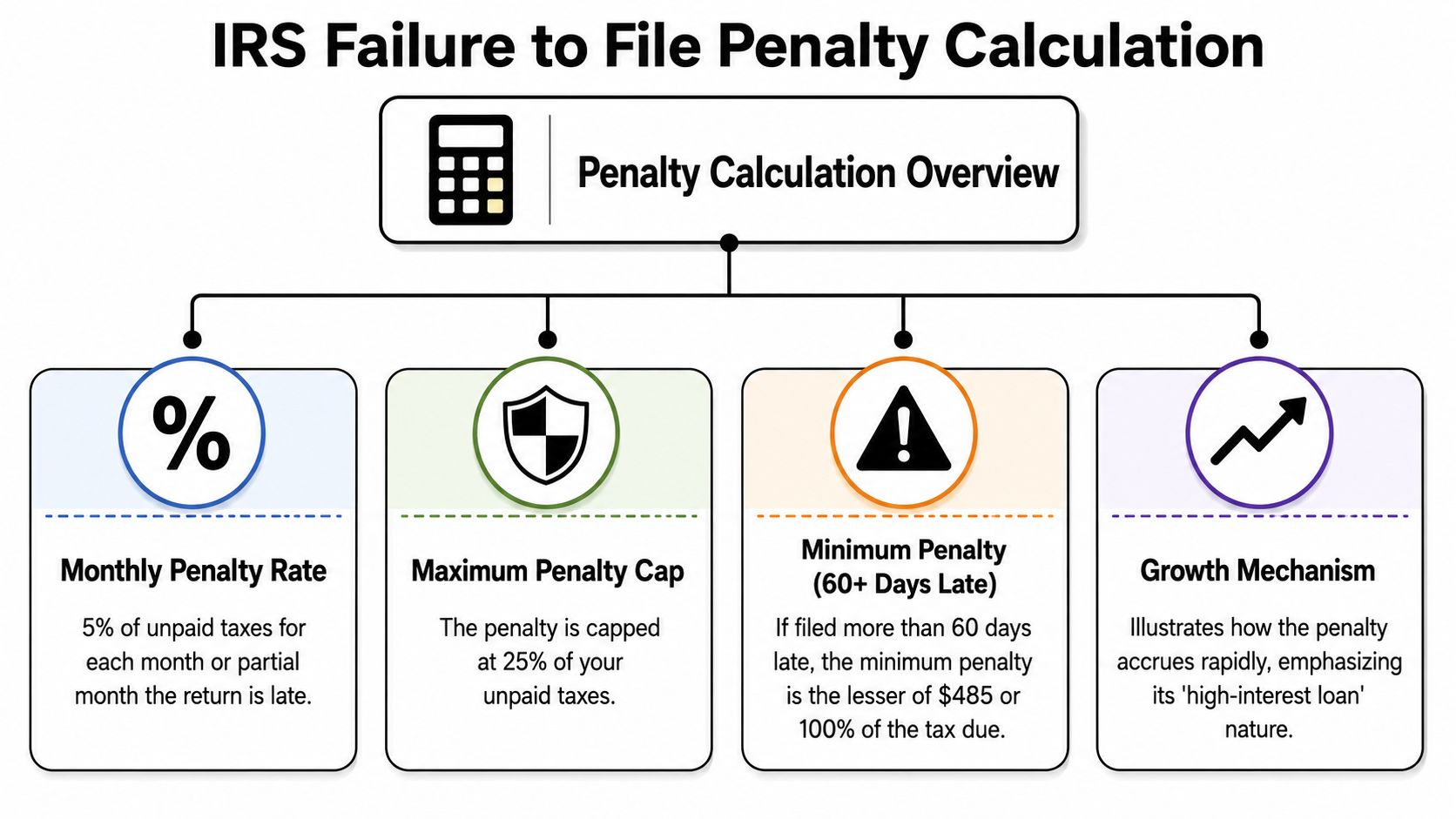
Under IRS rules, the penalty is 5% of the unpaid tax for each month or partial month the return is late, and it can continue for up to 12 months, but the penalty itself caps at 25% of the tax due. In practical terms, that means it usually hits its maximum after about 5 months. If the return is more than 60 days late, a minimum penalty applies. For returns required to be filed in 2026, that minimum is the lesser of $525 or 100% of the tax owed, according to the IRS failure-to-file penalty rules.
The part taxpayers underestimate
The phrase “each month or partial month” matters. If you miss the deadline by a short period that crosses into a new monthly period, the IRS can still treat that as another month for penalty purposes. That's why I describe this penalty as behaving more like an aggressive meter than a one-time late charge.
A good compliance primer is this tax penalties playbook for staying ahead of avoidable IRS issues. It's useful because many filing problems start earlier than people think, with delayed bookkeeping, estimated tax confusion, or a business owner treating tax notices as low priority.
A simple way to think about it
Use this mental model:
- If you owed tax and didn't file, the IRS failure to file penalty starts accruing monthly.
- If the delay continues, that charge builds until the cap is reached.
- If the return sits for long enough, the minimum penalty rule can create a harsh result even when the underlying balance isn't large.
Filing late is expensive. Filing nothing is usually worse.
Taxpayers who are trying to understand their options often look for practical discussion around requesting penalty reduction or waiver, especially when they're comparing formal relief requests with simple payment arrangements. That distinction matters. A payment plan may help with collections, but it doesn't erase a filing penalty by itself.
What actually helps
What works is filing the missing return as soon as possible, even if full payment isn't available. What doesn't work is waiting until you have the money. The IRS treats filing compliance and payment compliance as related but separate issues, and the filing side is the one that becomes punitive quickly.
Failure to File vs Failure to Pay A Critical Distinction
Clients often use these phrases interchangeably, but they describe different problems.
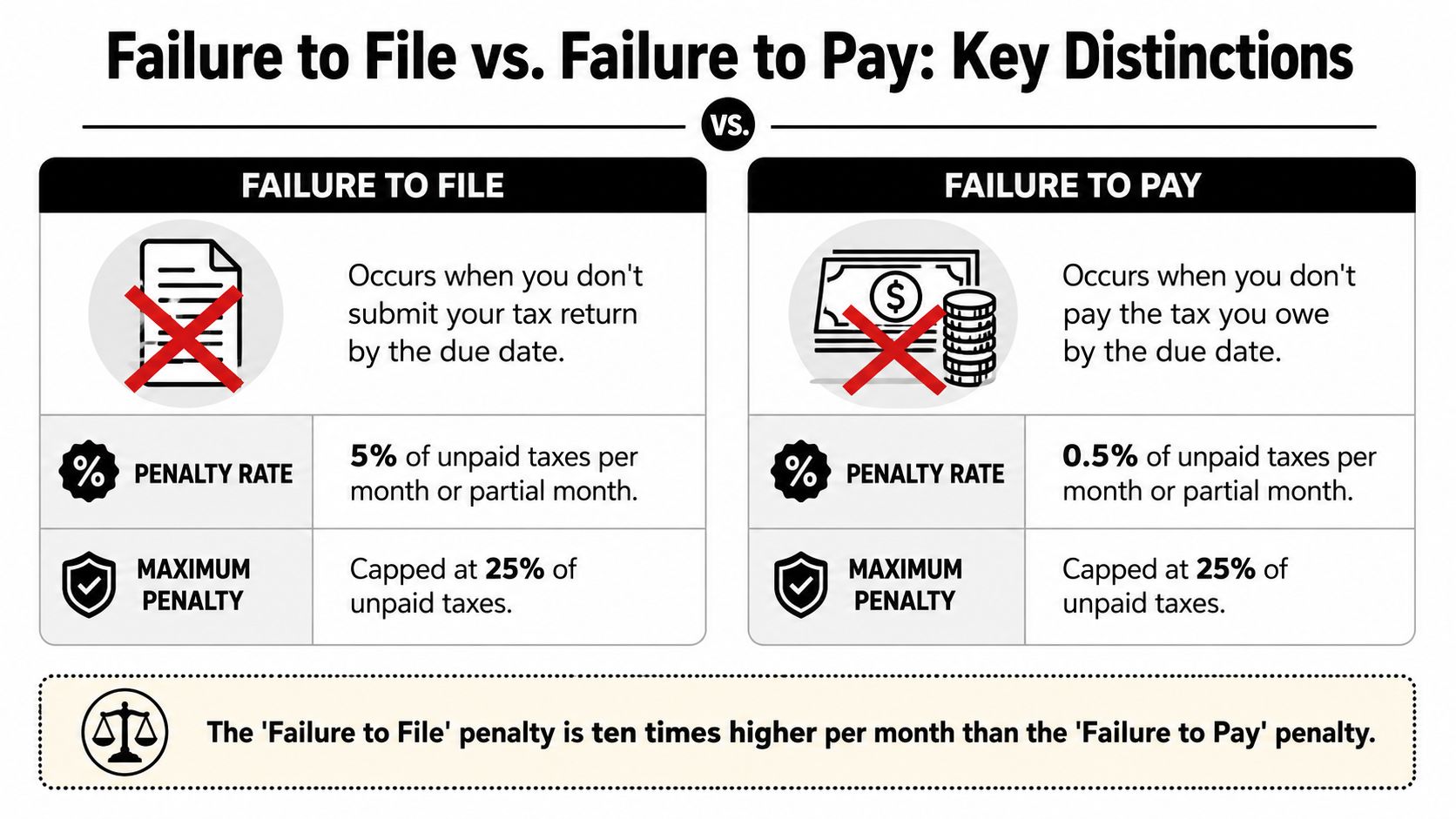
Failure to file means the return itself wasn't submitted by the deadline.
Failure to pay means the return may be filed, but the tax due wasn't paid on time.
That difference drives strategy. If you can only solve one problem today, filing usually deserves priority.
Why the filing side gets the sharper response
The IRS can work with an unpaid balance once it has a filed return. It knows the tax period, the reported liability, and whether the taxpayer is engaging with the system. An unfiled return leaves the IRS without that baseline, so the agency treats non-filing as a more serious compliance breakdown.
In practice, this is why taxpayers who say, “I didn't file because I couldn't pay,” often make the situation worse. If the return had been filed, there would still be a tax debt problem, but the most punishing filing issue would have been stopped.
Side by side comparison
| Issue | What triggers it | Why it matters |
|---|---|---|
| Failure to file | Missing the filing deadline without a filed return | Signals noncompliance at the return level |
| Failure to pay | Owing tax after the payment deadline | Creates a balance due and collection exposure |
This distinction also matters when you ask for relief. The explanation that might support payment relief often won't justify late filing. Financial strain, for example, may explain why you couldn't pay. It usually doesn't explain why you couldn't submit the return.
If money is tight, file first and solve the balance second.
The practical takeaway
A taxpayer with limited bandwidth should think in this order:
- Get the return filed
- Confirm what the IRS shows as due
- Evaluate penalty relief
- Address payment through whatever collection option fits
People get into trouble when they reverse that order. They spend months worrying about the balance before fixing the missing return. During that delay, the filing problem keeps getting harder to unwind.
The Domino Effect Consequences Beyond the Penalty
By the time someone calls my office about an unfiled return, the penalty itself usually isn't the only concern. The deeper issue is what follows.
A missing return can trigger a chain reaction. The IRS keeps sending notices. Internal records may reflect estimated liability measures the taxpayer never intended to accept. Collections become more likely because the agency reads long periods of silence as ongoing noncompliance, not a temporary lapse.
Why unfiled returns create leverage for the IRS
When a return isn't filed, the taxpayer loses control over the narrative. Instead of presenting actual income, deductions, and context, the taxpayer is reacting to whatever the IRS has already put in motion. That's a bad posture in any tax controversy.
A filed return creates a platform for negotiation. An unfiled year leaves the case unstable.
The practical consequences I see most often
- Notice pressure increases: IRS correspondence tends to become more urgent as the case remains unresolved.
- Collection risk grows: The longer the silence continues, the more likely the IRS is to move toward enforced collection tools.
- Resolution options narrow: Some relief paths become harder to pursue cleanly when multiple years remain unfiled.
- Other financial goals get blocked: Mortgage underwriting, business sales, licensing issues, and settlement discussions often stall when tax filing compliance is incomplete.
For business owners, delayed filing can overlap with a broader risk profile, especially when payroll taxes are involved. If you're a director or owner trying to understand how tax enforcement concepts can affect people responsible for company obligations, this guide for company directors gives useful context from another system that also treats noncompliance seriously.
An unfiled return rarely stays a filing problem. It becomes a collections problem, a records problem, and often a negotiation problem.
What doesn't work
Waiting for the IRS to “figure it out” doesn't work. Neither does assuming the issue will fade if enough time passes. In practice, unresolved filing years tend to resurface at the worst possible time, such as when a taxpayer applies for financing, tries to sell property, or receives a more serious collection notice.
The better move is to get current enough to regain procedural footing. Once the return is filed, there's something concrete to challenge, defend, amend, or negotiate around. Before that, every conversation is weaker.
How to Get IRS Penalty Relief The Abatement Process
Penalty relief is real, but it works best when it's approached like a formal case, not a casual request for mercy. The IRS usually wants a legal or administrative basis to remove a penalty. Saying you meant to file, intended to catch up, or had a stressful year isn't enough by itself.
The three paths that matter most
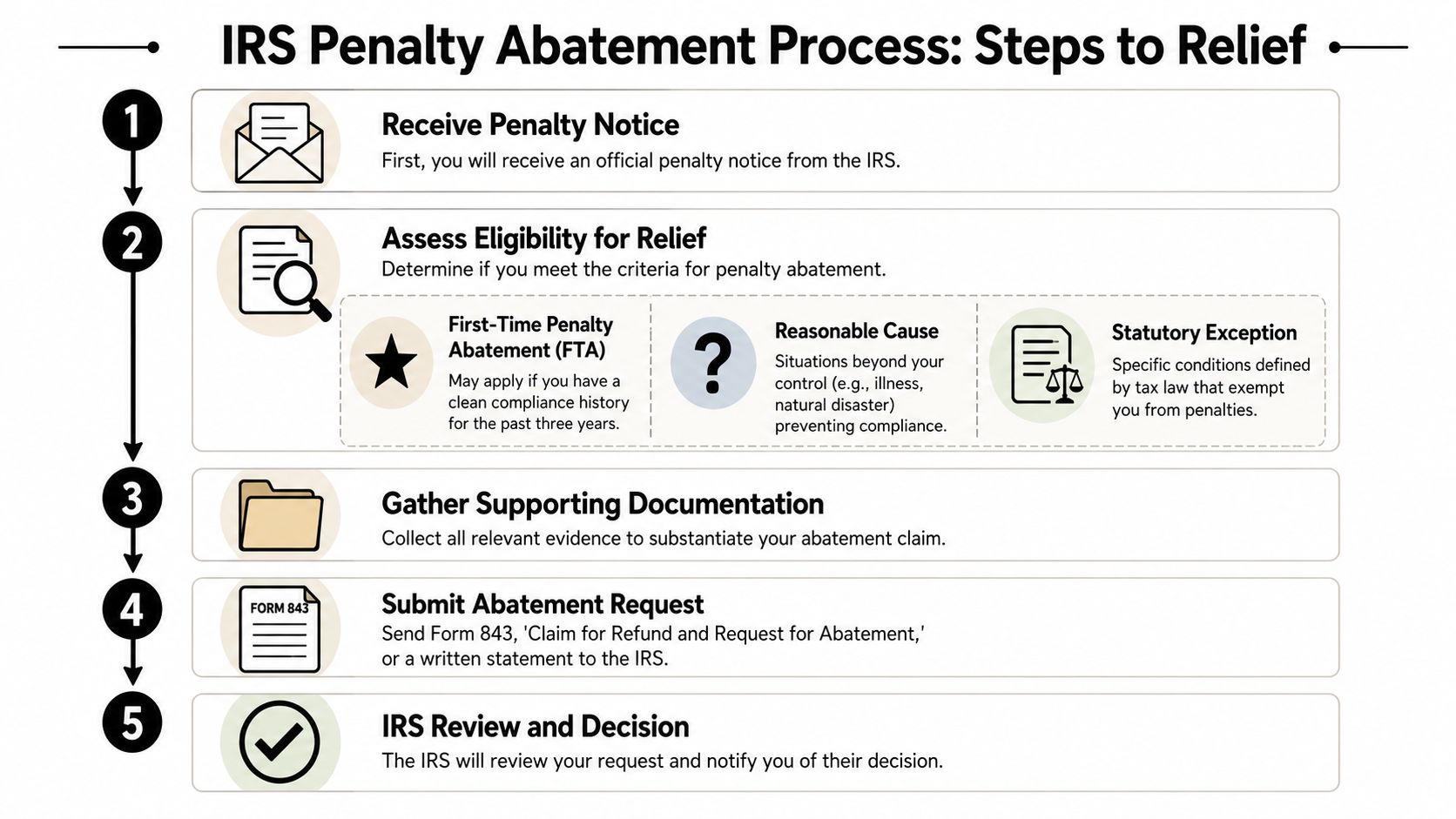
The first path is First-Time Abatement. This is often the cleanest option for taxpayers who had a solid compliance history and then had one bad year. It's administrative relief, not a sympathy exercise. If the record supports it, it can be very effective.
The second path is reasonable cause. Most contested failure-to-file cases fall under this category. The taxpayer has to show that ordinary business care and prudence were exercised, but something outside normal control prevented timely filing.
The third path is a statutory exception. These situations are narrower and more technical. They usually turn on specific legal rules rather than general hardship or disruption.
What a proper request should include
A good abatement request is organized, restrained, and documented. It should identify the tax period, the penalty involved, the relief requested, and the basis for that relief. It should also avoid emotional overstatement. IRS reviewers respond better to a supported timeline than to a long statement of frustration.
Here's the structure I prefer:
Identify the year and penalty clearly
State exactly which period is at issue and that you are seeking relief from the failure-to-file penalty.Choose one primary basis for relief
Don't throw every theory into the request. If First-Time Abatement applies, lead with that. If it doesn't, build a focused reasonable cause argument.Attach proof that fits the story
Medical records, insurance records, death certificates, evacuation orders, professional correspondence, or other third-party documents matter more than general statements.Show what happened once the obstacle ended
The IRS wants to see that you acted promptly after the disruption was removed.
For taxpayers preparing a request, penalty abatement guidance from Attorney Stephen A. Weisberg outlines the practical use of First-Time Abatement and reasonable-cause submissions, including the role Form 843 can play in the process.
Form 843 and when it comes up
Form 843 is commonly used for certain penalty relief requests. It isn't a magic form, and using it doesn't automatically make the case stronger. The strength comes from the legal basis and the documentation behind it. In some matters, a written protest or penalty explanation letter may also be part of the submission strategy.
What usually works best
In straightforward one-year cases, First-Time Abatement is often the most efficient route if the taxpayer qualifies. In more fact-heavy matters, reasonable cause can work well when the record shows a genuine interruption and a prompt return to compliance.
What usually fails is a request that says, in effect, “I was overwhelmed and hoped to catch up later.” The IRS hears that every day.
Building a Winning Reasonable Cause Argument
A strong reasonable cause argument reads like a verified timeline, not a confession and not a rant.
The IRS wants to know what prevented filing, when it happened, how it affected the taxpayer's ability to comply, and what the taxpayer did once the obstacle was gone. The best submissions answer those questions with documents, dates, and a narrow theory.
Arguments that tend to carry weight
Serious illness can work when it directly interfered with the ability to gather records, communicate with a preparer, or manage basic financial affairs. A death in the immediate family can also support relief when the disruption was immediate and substantial. Record loss from fire, flood, or similar events can be persuasive if the submission explains both the destruction and the reconstruction effort. Incorrect professional advice may help in some cases, but only when the facts are documented carefully and the taxpayer's reliance was reasonable.
A practical reference point is this discussion of reasonable cause for IRS penalty abatement, which tracks the kind of fact pattern the IRS is more likely to respect.
Arguments that usually fail
Some explanations almost never work on their own:
- Being busy: Workload, travel, or general business pressure won't usually justify a late return.
- Not having the money: That may explain nonpayment, but it usually does not excuse nonfiling.
- Not knowing the law: Ignorance is rarely a successful filing defense.
- Hoping to fix it later: Delay by choice is still delay.
The IRS is more receptive to documented disruption than to unsupported hardship.
How to draft the narrative
I usually want the letter to answer five points in a disciplined order:
| Question | What the IRS is looking for |
|---|---|
| What happened | A specific event, not a vague bad period |
| When it happened | A clear timeline |
| Why it blocked filing | Direct connection to the missed return |
| What proof exists | Third-party records and correspondence |
| What happened next | Prompt action once filing became possible |
Keep the tone factual. Don't overstate. Don't accuse the IRS. Don't add weak backup excuses that dilute a stronger main argument.
A better and worse version
A weak letter says the taxpayer had personal issues, financial problems, and a stressful year.
A stronger letter says the taxpayer was hospitalized unexpectedly, was under active treatment during the filing window, could not access records during that period, and filed shortly after regaining the ability to organize the return, with medical support and preparer emails attached.
That's the difference between asking for sympathy and proving reasonable cause.
Your Next Steps and When to Call a Tax Attorney
If you're dealing with the IRS failure to file penalty right now, the first move is simple. File the return. Even if you can't pay in full, filing puts a stop to the late-filing problem getting worse and gives you a real starting point for the next decision.

When handling it yourself may be reasonable
A single late year with otherwise clean history is sometimes manageable without full representation, especially if the facts support First-Time Abatement and the account is otherwise straightforward.
When professional help becomes important
Call a tax attorney if any of these are true:
- Multiple years are unfiled
- The IRS has already escalated collection activity
- You're a business owner with payroll tax exposure
- Your facts for reasonable cause are real, but need to be framed correctly
- You're reacting to notices without a clear account strategy
At that stage, the issue usually isn't just the penalty. It's the sequence, documentation, and representation.
If you want a clear assessment before deciding what to do next, Attorney Stephen A Weisberg offers a free, confidential Tax Debt Analysis to review your filing status, penalty exposure, and practical options for resolving the matter.


