How Does Garnishment Work? Wages, Banks and Tax Levies
How Does Garnishment Work for wages, bank accounts and IRS levies? See the limits, the step-by-step process and ways to stop it.

In this article
- How Much Can Be Taken From Your Pay
- The three weekly bands
- Match the debt on the notice
- How Garnishment Moves From Court Order to Payday
- How Bank Account Levies Take Funds
- How IRS Tax Levies Differ From Garnishment
- What has to happen before the levy
- The bankruptcy assumption
- Options to Stop or Reduce an IRS or State Levy
- The form that drives the negotiation
- Confirm Your Next Step Before the Next Payday
Thursday night, the deposit is short. Your pay stub has a line you never signed up for, and a notice on the counter names a court, a state agency, or the IRS. You need a plain answer to how garnishment works before the next payday, because the deadline on that paper may be days, not months.
Garnishment puts three people in one transaction. You owe the money. A creditor or a government agency is collecting it. Your employer or your bank has to send funds once a valid order or levy arrives. A store-card judgment, a child-support order, and a tax levy do not share one percentage. Match the sender on the notice before you trust any calculator.
How Much Can Be Taken From Your Pay
Run one number first: 25% of $300 in weekly disposable earnings is $75, yet that same paycheck can lose a very different amount to a child-support order or an IRS levy. The debt named on the notice decides which formula applies, and each formula protects a different slice of your pay.
For an ordinary consumer debt such as a credit card or a medical judgment, the federal ceiling is the lesser of 25% of disposable earnings or the amount by which those earnings exceed 30 times the federal minimum wage. At the federal minimum of $7.25, that floor is $217.50 for a weekly pay period. Title III of the Consumer Credit Protection Act created that national minimum.
Disposable earnings means gross pay minus only legally required deductions: federal and state income tax, Social Security, and Medicare. Health insurance you elected, a 401(k) contribution, and union dues you could stop all stay in the base. Figuring the 25% off take-home pay makes the allowed deduction look smaller than the order permits.
Say weekly disposable pay is $300. Twenty-five percent of $300 is $75. The amount above $217.50 is $82.50. The employer withholds the lesser figure, so $75 is the federal ceiling that week for an ordinary consumer debt.
The three weekly bands
Weekly disposable earnings fall into three bands under the federal formula.
- $217.50 or less: an ordinary garnishment takes nothing.
- $217.51 to $290: the employer may withhold only the dollars above $217.50. At $250, that excess is $32.50, which is less than 25%.
- $290 or more: the employer may withhold up to 25%.
The ceiling stays fixed no matter how many consumer orders the employer is holding, so stacking two credit-card judgments does not double the percentage. States may set a tighter limit than this federal floor, and a few restrict consumer-debt garnishments sharply. The order in your hand still has to be read against your state's rule.
Practical rule: If weekly disposable earnings are $217.50 or less, an ordinary consumer garnishment should take nothing under the federal formula. Ask payroll which base it used before you assume the stub is right.
Match the debt on the notice
Child support is not an ordinary consumer debt. Withholding can reach 50% of disposable earnings when the worker supports another spouse or child, and 60% when the worker does not. An additional 5% may apply when support is more than 12 weeks overdue, which is how the no-other-family case can reach 65%. The ADP Research Institute white paper walks through those Department of Labor limits and reports that 7.2% of employees had wages garnished in 2013.
Tax levies leave the consumer formula behind entirely. A federal IRS levy does not take a percentage at all. The statute protects a set amount based on your filing status and the number of dependents, and the IRS takes whatever remains above it. The law fixes the amount you keep rather than the amount taken, so plugging $300 into the 25% math cannot predict what an IRS levy leaves in your check. A state tax levy follows that state's own limits, which differ from the federal consumer ceiling and often from each other.
| Debt type | Maximum withheld | Key condition |
|---|---|---|
| Ordinary consumer debt (credit cards, medical bills, judgments) | Lesser of 25% of disposable earnings or the amount above $217.50 per week (30 times $7.25) | Applies no matter how many orders an employer receives |
| Child support, worker supports another spouse or child | Up to 50% of disposable earnings | Applies when the worker supports another spouse or child |
| Child support, worker supports no other spouse or child | Up to 60% of disposable earnings | Up to 65% when payments are more than 12 weeks overdue |
| Federal student loan (administrative wage garnishment) | Up to 15% of disposable pay | Written notice must come before the first deduction |
| Federal tax levy (IRS) | Not limited by the 25% rule | Protected amount follows filing status and the number of dependents |
| State tax levy | Set by each state | Read the state agency's own levy rules |
Find the agency or court name, the notice heading, and the case number, then match the debt to a row. A heading that says "wage garnishment" can still carry a support order, a student-loan order, or a levy underneath it. After you know the row, check whether your state protects more of the paycheck than federal law, and run the same math on a current stub.
How Garnishment Moves From Court Order to Payday
The short deposit is the last step, not the first. Somebody has to win the right to collect, serve your employer, and give you a window to object. Miss that window and the deduction starts even when part of the pay should have stayed with you.
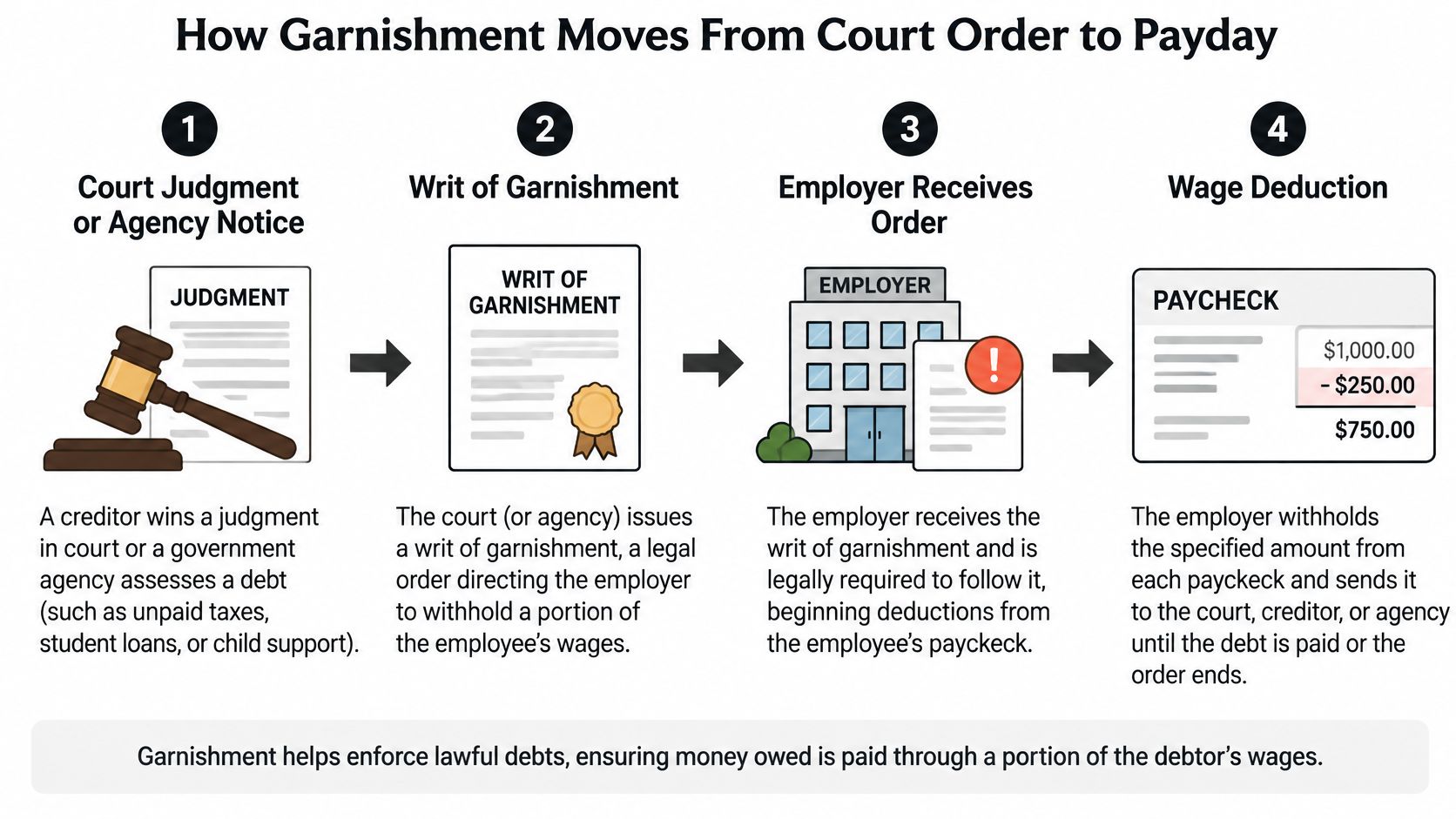
- The debt becomes collectible. A creditor sues and wins a judgment, or an agency assesses the tax or the student loan and mails a notice. Without that trigger, payroll has nothing to honor. The slip is ignoring certified mail because the case "doesn't sound like yours."
- The order reaches the employer. The creditor gets a writ of garnishment, or the agency serves a levy. Your boss is now the person who must calculate and send the money. Treating the packet as junk mail at the front desk can make the company late, and late companies sometimes withhold a round number instead of the legal one.
- You get a copy, a deadline, and an exemption form. This is the step people lose. The packet usually includes a date to claim that some of the pay is protected. Write that date on a calendar the day the envelope arrives. Waiting until payday is how a valid exemption dies.
- You ask for a hearing or file the exemption claim inside that window. Say what is protected and attach the stub. The order often keeps running while the claim is pending unless a judge says otherwise. Call the issuing court or agency and ask whether withholding pauses in your case. Practice is not the same everywhere.
- Payroll runs the formula. The employer uses the order plus the federal or state limit, not a guess from a coworker. Hand over the stub and the exemption papers so the math uses the right debt type.
- Money leaves each paycheck and goes to the creditor or agency. The company should keep a record of every dollar sent. You should keep the stubs. A line such as "Garnishment," "Wage levy," or "Income withholding" sitting beside the tax lines is the deduction. Compare that dollar figure with the cap for your debt.
- Withholding stops only when the balance is paid, the order is released, or the debt can no longer be enforced. Your request to payroll is not a release. Federal law bars an employer from firing you solely because of one garnishment. A second debt can be a different story under some state rules, so don't assume the job protection grows with every new order.
A notice of garnishment is the paper that starts the clock. If the company takes more than the order allows, send the employer and the creditor a written objection with the stub attached, and ask the issuing court or agency to correct the amount. Keep a copy of everything you send.
How Bank Account Levies Take Funds
You put a card in the ATM and the screen shows a zero balance that was fine yesterday. The account isn't empty because you spent it. A levy or garnishment order told the bank to freeze it.
A wage order takes a slice of future pay. A bank levy takes what is in the account on the day the bank acts, often after a short hold, and then sends that balance to the creditor or agency. Pay you deposited last week can be captured even though it came from a paycheck. The protection you had on wages does not automatically follow every dollar into the account.
Say the account holds $3,200, and $2,000 of that is recent Social Security deposits. Federal benefit payments are generally protected from ordinary creditor levies. The bank should identify those deposits and release them. The other $1,200 can still go to the creditor if no other exemption covers it. Mixed deposits are where people get stuck, because a protected deposit and ordinary pay landed in the same account.

Act on the freeze, don't try to outrun it.
- Write the bank. Say which deposits are benefits, and attach statements that show the source and the dates.
- File an exemption claim with the court or agency that issued the order, before the hold expires.
- Leave the money where it is. Moving funds after you know about the levy can create a separate problem with the court. It does not erase the order.
Whether a bank levy can take all your money turns on what was deposited, not on the balance alone. Keep recent statements, benefit award letters, and the original notice in one folder so you can prove which dollars were protected.
How IRS Tax Levies Differ From Garnishment
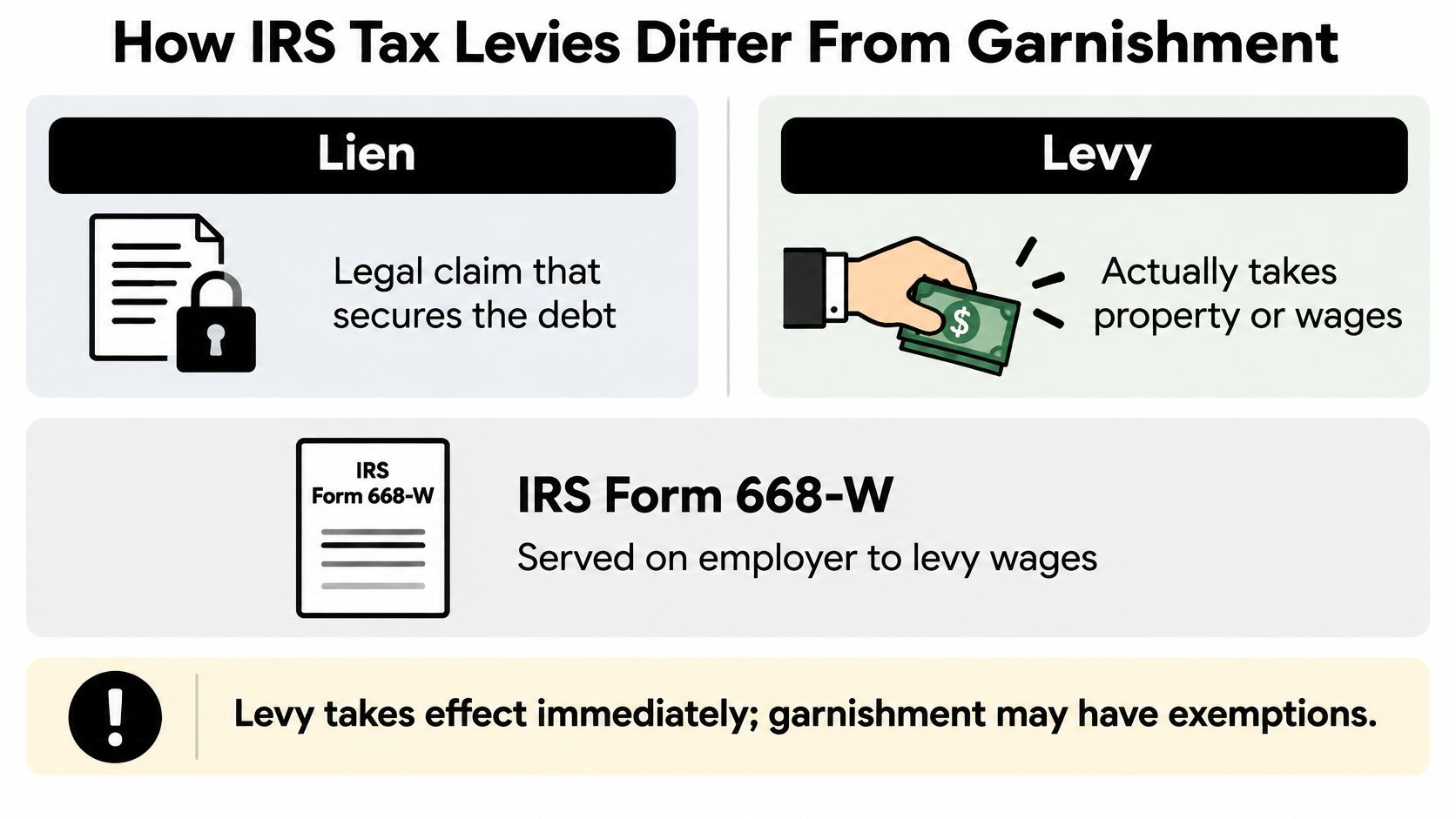
People plug a tax debt into an ordinary garnishment calculator and expect a quarter of the check. That math does not govern an IRS wage levy. The amount follows statutory exemptions, your filing status, and your dependents. It can be far more than a quarter of disposable pay, and it can also leave a protected amount for basic living costs. There is no single IRS percentage to memorize.
A lien is a legal claim that secures the debt against property. It does not, by itself, pull dollars from a paycheck. A levy is the taking. For wages, the IRS serves Form 668-W on the employer. As the IRS levy overview explains, that levy is continuous. It attaches to later wages, salary, commissions, and bonuses until the tax is paid, the debt can no longer be enforced, or the IRS releases it. The employer figures the nonexempt portion from the levy instructions each pay cycle. Federal tax claims are outside the consumer percentage cap, and Internal Revenue Code section 6334 supplies the wage exemptions instead.
What has to happen before the levy
Before it levies, the IRS generally must send a final notice and give you 30 days to request a Collection Due Process hearing. That hearing is where you can dispute the liability in some cases and propose a way to pay. Missing the 30 days does not erase later options, but it removes the easiest pause.
An approved payment arrangement can lead to a release. Filing the request does not release the levy by itself. Employers keep withholding until they receive formal release instructions, typically Form 668-D. If you tell payroll to stop early, the company is still on the hook to the IRS.
The bankruptcy assumption
Filing bankruptcy does not automatically wipe the tax that caused the levy. Many tax debts are not discharged, especially more recent ones and trust fund taxes such as payroll taxes. A levy or garnishment tied to that kind of debt can survive a bankruptcy case that cleared credit cards. Check the age and the type of tax before you count on a discharge to stop the paycheck hit.
Options to Stop or Reduce an IRS or State Levy
Paying the entire balance is not the only way to get a levy released. The IRS has to leave a protected amount for basic living expenses, and a levy can stop through a payment arrangement, an offer in compromise, or a documented hardship claim. The IRS explanation of a levy makes that distinction. What you qualify for follows your income, assets, and the kind of tax, not a slogan on a letter.
Most readers start with an installment agreement. You pay a set amount each month. While the agreement stays active, assets generally stay protected from new levies. If the full balance can't be cleared on a schedule that also pays the debt off, a partial payment installment agreement sets a lower monthly figure based on what you can pay.
An offer in compromise settles the debt for less than the full amount when you can't pay it in full. Currently not collectible status pauses collection when paying would cause serious hardship, and it is aimed at people with very limited income and assets. Penalty abatement removes eligible penalties and can shrink the balance before you pick a payment path. A clean compliance history or a documented reasonable cause is what that request rests on.
The form that drives the negotiation
For most of these paths, income, expenses, assets, and debts go on Form 433-A (individuals) or Form 433-B (businesses), the Collection Information Statement. That statement is the basis for the numbers the IRS will discuss. We look across the full set of options, from an offer in compromise to currently not collectible status, and match the path to the debt and the household budget rather than defaulting to the largest payment.
| Option | What it does | What you must provide |
|---|---|---|
| Installment agreement | Sets monthly payments and generally holds levies while it stays active | Collection Information Statement and a payment you can sustain |
| Partial payment installment agreement | Sets a lower payment when paying the debt in full on a standard plan is not possible | Collection Information Statement and proof of ability to pay |
| Offer in compromise | Settles the balance for less than the full amount owed | Full financial statement and an ability-to-pay analysis |
| Currently not collectible | Pauses collection when payment would cause serious hardship | Proof of very limited income and assets |
| Penalty abatement | Removes eligible penalties and reduces the total balance | Clean compliance history or documented reasonable cause |
| State tax levy | The state agency sets payment plans and hardship rules | State financial form and the notice of levy |
State levies use the state's own forms. A federal installment agreement does not automatically stop a state wage levy. Read the state notice for its hardship and payment-plan rules, and use the state's financial form rather than assuming the IRS package covers both. Our guide on how to settle state tax debt walks through that separate track.
Confirm Your Next Step Before the Next Payday
The date on the notice matters more than the balance on the first page. A missed exemption window or a missed hearing request is what turns a fixable levy into a smaller paycheck.
- Read the sender, the debt type, and the deadline. A court judgment, a student-loan letter, and an IRS final notice do not share a response form.
- Compute disposable earnings and compare them with the stub. If payroll is taking more than the order allows, object in writing with the stub attached.
- Pull IRS account transcripts and the matching state records. They list each penalty, each payment, and how long until the debt is written off. That history shows which balance is being collected.
- File a Power of Attorney with the IRS, the state, or both. Once it is on file, the IRS can't contact you directly, and agency calls and letters go to the representative.
- Gather three to six months of bank statements and pay stubs so the Collection Information Statement matches real deposits, not a single good week.
- Have the options reviewed before you pick one. The right path for a payroll-tax assessment is often different from the right path for an older income-tax balance.
Tax attorney Stephen A. Weisberg and our firm can review the notice, the deadlines, and the available options for a tax situation regardless of how much is owed. That review is meant to show which option fits before the date on the letter passes. Write the deadline on a calendar today, and act before the next payday, not after the deduction has already posted.
If a wage order or a tax levy is already aimed at your pay, Tax Attorney Stephen A Weisberg reviews the notice, the deadlines, and the resolution options before the next deduction hits. The work covers IRS and state tax debt, including garnishments and bank levies, and starts by sorting out whether a payment plan, a settlement, or a hardship status fits your facts. Visit Tax Attorney Stephen A Weisberg to get that review underway.


