How to Settle State Tax Debt: Routes, Steps and Relief
Learn how to settle state tax debt with payment plans, offers in compromise, hardship relief and a balance audit that protects your options.

In this article
- Settlement Routes at a Glance
- How to Audit Your State Balance Before You Negotiate
- The Seven-Step Audit
- Penalty Abatement and Appeals Before the Deadline
- Penalty Abatement
- Appeals and Protests
- Payment Plans and What They Do Not Fix
- How Long and on What Terms
- Run the Affordability Test
- Offers in Compromise and How the State Negotiates Them
- The Three Questions the State Asks
- Eligibility Gates You Must Clear First
- The Financial Statement Is the Negotiation
- Tactics That Actually Help
- Hardship Relief and Evidence That Holds Up
- Three Outcomes People Confuse
- Evidence a Reviewer Can Actually Use
- Choose Your Settlement Route and Act This Week
A state notice arrives with a balance you don't recognize, a deadline you didn't expect, and a phone number that puts you on hold. You want to know how to settle state tax debt, but the notice itself doesn't tell you whether the amount is right, whether you can pay it over time, or whether the state will reduce it at all. Those are three separate questions, and mixing them up is how taxpayers agree to payments they can't sustain or chase discounts they'll never get.
Settlement Routes at a Glance
You open the envelope, see a balance larger than the tax you thought you owed, and assume you need a settlement program. There usually isn't one program. The South Carolina unemployment-tax collection guidance identifies three principal routes, paying the assessed balance in full, appealing the assessment, or entering an installment payment agreement, and other states work from the same basic menu, with compromise and hardship options layered on top.
Ignoring the notice doesn't pause anything. States can file tax liens, issue levies, garnish wages, and seize and sell property. For businesses, that reach extends to vehicles, equipment, and inventory. The scale runs beyond your state, too, because in fiscal year 2024 the U.S. Treasury's Treasury Offset Program collected $720.9 million in delinquent state income-tax debt for participating states.
| Route | Best when | What it requires | Main effect |
|---|---|---|---|
| Full payment | The assessment is correct and cash is available | Payment of the full balance | Clears the balance; a filed lien may still need a release request |
| Installment agreement | Income covers monthly payments but not the full balance | Financial disclosure and current filing compliance | Pauses enforced collection while active; interest and penalties keep accruing |
| Offer in compromise | The balance is larger than the taxpayer can realistically pay | Full financial statement, all returns filed, current on new taxes | Settles for less than owed; often slow and frequently denied |
| Penalty abatement | Penalties arose from reasonable cause or a first-time issue | Written request explaining the reason | Removes penalties; interest usually remains |
| Hardship or uncollectible status | Fixed income, medical costs or no reachable assets | Evidence of hardship and current finances | Pauses or stops collection; the balance can still remain on record |
| Appeal or audit challenge | The assessment is wrong or missing returns were filed in error | Records supporting the correct figures and a timely protest | Corrects the balance before collection begins |
Before you call, match your balance, cash, and documentation against these rows. If you're in Michigan, Michigan state agency collections shows how one state structures that process, and a tax debt guide for Minnesota filers covers how bankruptcy interacts with a Minnesota balance, which is a different question from settlement entirely.
How to Audit Your State Balance Before You Negotiate
Don't negotiate a number you haven't verified. A state balance can include a year you never filed, a payment that never posted, or penalties calculated on the wrong base. I would audit first, every time, because every route above prices off this figure.
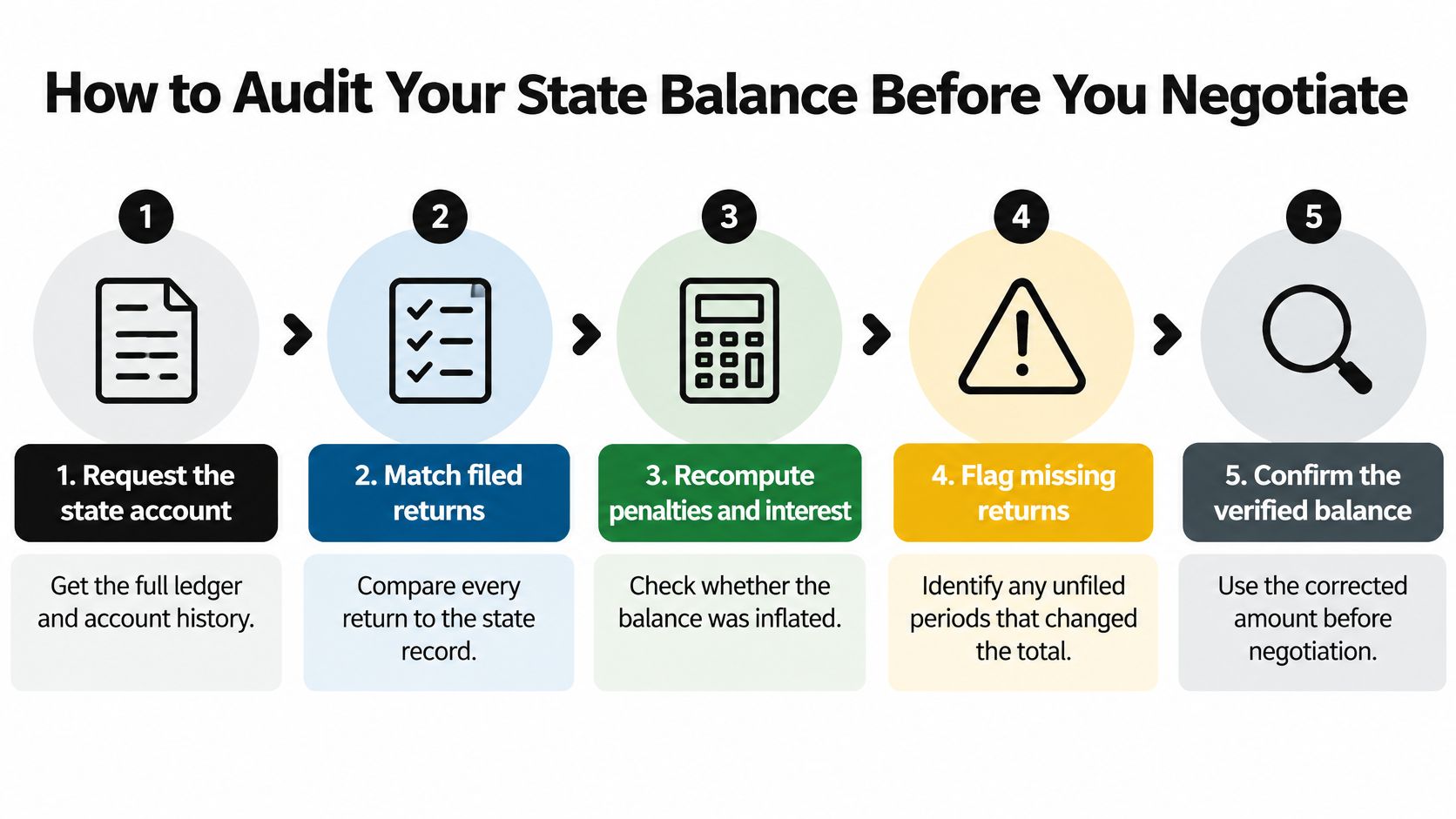
The Seven-Step Audit
- Request the full account transcript and every notice. You need the state's own ledger, not just the latest bill, because the latest bill rarely explains how the total was built. The common mistake is arguing from memory while the state argues from its transcript.
- Confirm every return was filed and accepted. An unfiled period can block a plan or an offer before anyone reviews your finances. If a year is missing, prepare it from wage, bank, and payment records rather than accepting a substitute assessment built without your deductions.
- Reconcile payments against source records. Match cancelled checks, portal confirmations, and withholding statements line by line. Payments applied to the wrong year or tax type are routine, and fixing them costs nothing but documentation.
- Recompute penalties and interest by period. Check which penalty applies, when it started, and whether it was charged on tax you'd already paid. Taxpayers often accept a lump sum that includes a disproportionate penalty layer.
- Find the collection deadline for each year. States limit how long they can collect, so identify the statute-of-limitations date for each assessment. A year close to expiring changes your negotiating posture and your payment priority.
- Identify active liens, levies, and warrants. Confirm what's filed and against what. The New York tax warrant guidance warns that a warrant generally remains filed and continues as a lien on real and personal property until the warranted balance is paid in full, even when collection activity pauses.
- Separate trust-fund taxes from everything else. Withholding and sales taxes collected from others can produce a responsible-person assessment against an owner personally, even inside an LLC or corporation. That exposure needs its own strategy, not a footnote in the business plan.
Practical rule: If you can't explain how the state built the balance, period by period, you aren't ready to propose anything.
The output of this audit is a verified balance plus a filing record that's current. Bring proof of income, assets, expenses, and compliance with it, because that's the package every later decision runs on.
Penalty Abatement and Appeals Before the Deadline
Two routes change the balance itself rather than the payment schedule, and both have clocks on them. Decide them before you submit a plan or an offer, because a reduced base makes every later number smaller.
Penalty Abatement
- List each penalty from the transcript and sort by cause. Late filing, late payment, and underpayment penalties have different triggers, so don't ask for blanket relief.
- Build the reasonable-cause record. Serious illness, a records failure outside your control, or a documented bank error can support relief, but only with proof dated near the event, not a summary written years later.
- Check for a first-time relief rule. Some states waive a first penalty for taxpayers with a clean prior record for that tax type. If the term itself is unfamiliar, INTELLI's guide to tax abatement explains what abatement means in plain terms.
- Send a written request naming each penalty and its reason. Vague hardship language gets denied. And don't waste the letter asking to remove interest, which usually stays even when penalties come off.
Appeals and Protests
- Read the notice for the protest deadline and calendar it today. The most damaging mistake in state tax work is trying to negotiate informally while a formal deadline expires, leaving an incorrect assessment final and collectible.
- Assemble the proof of the correct figure. Returns, payment confirmations, bank statements, and payroll records, organized by the item in dispute.
- File a written protest item by item. State what the state assessed, what it should be, and which document proves it. A protest that just asks for another look rarely survives.
A successful appeal or abatement doesn't just save money. It shrinks the base that interest accrues on and the amount any plan must retire.
Payment Plans and What They Do Not Fix
You owe a verified balance, your income is steady, and you cannot clear the total this month. An installment agreement is the route designed for that situation. For most taxpayers with repayment capacity, it is the practical outcome of learning how to settle state tax debt. It lowers immediate cash pressure. It does not freeze the debt.
The Michigan installment agreement guidance makes the trade-off plain: penalties and interest continue accruing until the balance is paid in full, and an approved plan can still involve a tax lien and diversion of a state tax refund to the balance. You will disclose income and expenses so the state can confirm you cannot pay in full. That review is also where a plan reveals its limits: it addresses timing, not the underlying liability.
How Long and on What Terms
Plan lengths vary by state and balance. Short-term plans are meant for amounts you can retire quickly. Long-term agreements stretch across several years, and longer terms commonly require a lien or acceptable security. Default rules matter as much as the monthly figure. Miss a minimum payment, skip a required return, leave a new liability unpaid, or pay late, and the plan can collapse into renewed collection. If you are unsure what enforcement looks like after default, an explanation of a state tax levy covers that step in detail.
A payment plan is a compliance contract, not a promise to try. One new unpaid balance can undo it.
Run the Affordability Test
Take a hypothetical $12,000 verified balance. Your budget shows $400 a month after rent, food, current taxes, and payroll deposits, so you propose $350 and keep $50 as reserve. Over 36 months that is $12,600 in payments. Interest keeps running on the unpaid portion, so the true payoff stretches past month 36 unless you add refund offsets or extra principal. The arithmetic is not the lesson. A payment chosen to divide neatly into the balance fails once accruals and a slow month hit.
- Subtract current-year taxes first: Estimated payments and payroll deposits come before old debt, or you will default the plan with a new liability.
- Test a bad month: If income drops for 60 days, can you still pay without missing rent?
- Keep a small cash reserve: One car repair should not trigger default and levy risk.
Before you sign, ask whether the payment is sustainable for the full term, not just this quarter. If it is not, propose less, lengthen the term, or evaluate compromise. A plan never corrects a wrong balance and never reduces principal. Those are separate fights.
Offers in Compromise and How the State Negotiates Them
An offer in compromise isn't a request for a discount because the balance feels unfair. It's a financial-eligibility calculation, and the state runs it from your verified numbers, not your narrative.
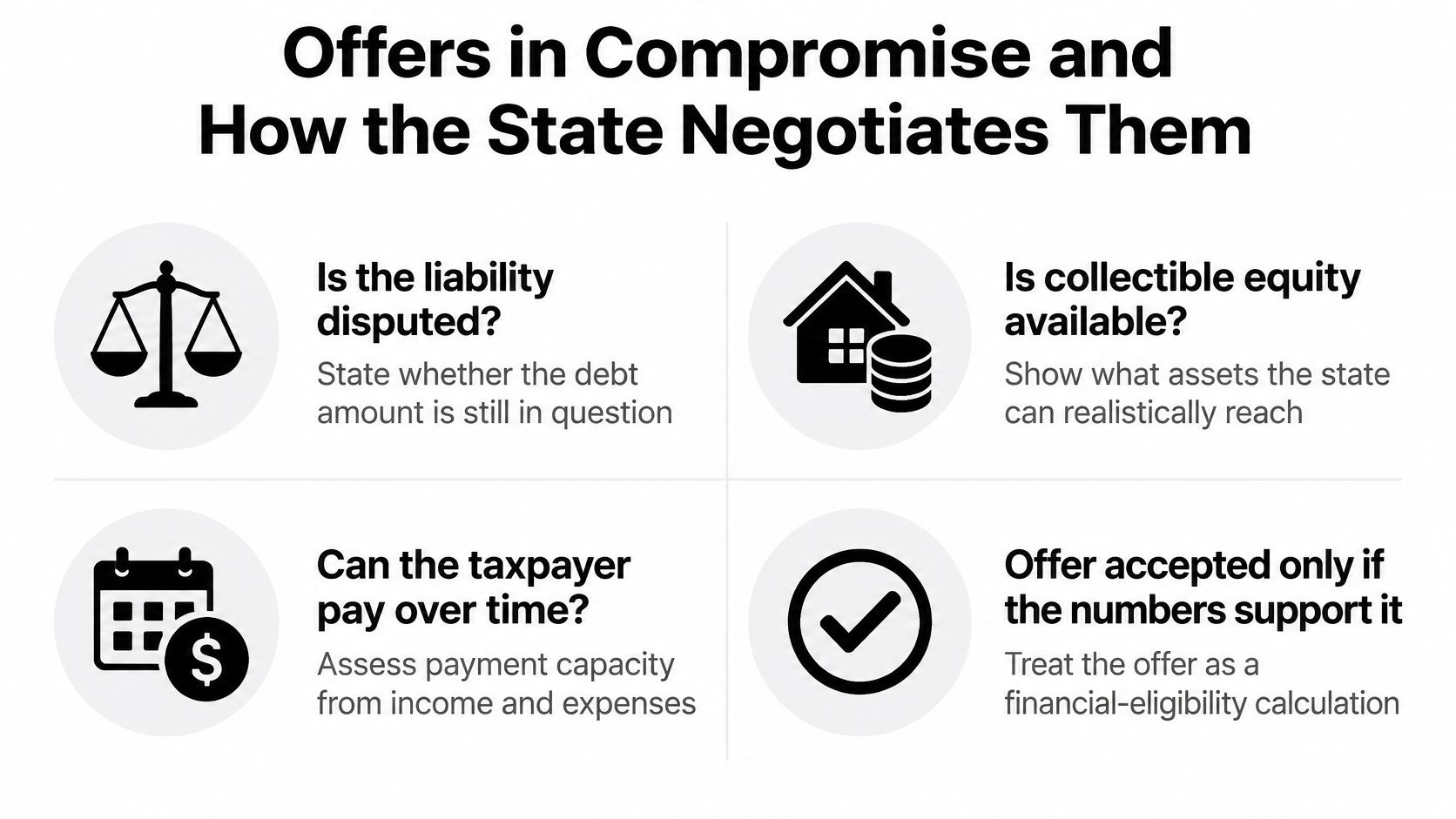
The Three Questions the State Asks
First, is the liability itself disputed? If it is, that's an appeal, not an offer. Second, can your collectible equity and future income support full payment over the remaining collection period? If yes, the state has no reason to compromise, and a payment plan is the honest answer. Third, does extraordinary hardship or an inequitable result justify accepting less even where some capacity exists?
The New York offer in compromise guidance names insolvency, bankruptcy discharge, and undue economic hardship as potential eligibility pathways, and it limits certain online applications to individuals with personal income-tax debt of $15,000 or less and no open protest or bankruptcy. Michigan has its own version, and Michigan's state offer in compromise is worth reviewing before assuming federal rules carry over. They don't, and one state's approval never binds another state.
Eligibility Gates You Must Clear First
- All required returns filed: An offer generally isn't considered while returns are missing.
- Current payments current: Estimated taxes and required deposits must be up to date, or the state assumes the hole keeps deepening.
- No open bankruptcy: Administrative offers aren't considered while a case is pending, so timing matters if bankruptcy is on the table.
The Financial Statement Is the Negotiation
An Offer in Compromise application requires Form 656 and Form 433-A for individuals or Form 433-B for businesses on the federal side, and state forms ask for the same substance. In step 3 of the process, your income, expenses, assets, and debts are listed on Form 433-A/B, the Collection Information Statement, which forms the basis for negotiations. Model liquidation value, reasonable collection potential, and monthly disposable income before you pick an offer amount.
Omitting an asset or a recent transfer is the fastest route to rejection, and understating realizable equity invites the state to recalculate against you. List everything, value it defensibly, and document debts against each asset.
Tactics That Actually Help
- Keep a dated call log: Names, badge or reference numbers, what was promised, and the deadline given.
- Get needs in writing: Ask the examiner to state exactly which documents are missing.
- Respond before every deadline: Late supplements read as weak finances or weak credibility.
- Ask for supervisor review when the math is wrong: Point to the specific line item, not the outcome.
Offers are slow and frequently denied. If your verified numbers show measurable repayment capacity, submit the plan and start retiring the balance instead of spending months proving a compromise the state won't accept.
Hardship Relief and Evidence That Holds Up
A retiree living on fixed benefits receives a state bill for an old unfiled tax year, then faces a hospital stay. Paying in full is out of reach, a payment plan would strain her budget, and she has no assets worth selling. The practical question is whether the state can pause collection, not whether it will accept a discounted settlement.

Three Outcomes People Confuse
A permanent compromise settles a balance for less than the amount owed. A temporary hardship suspension pauses collection while the taxpayer's finances are reviewed or improve, but the debt remains on the account. Cancellation as uncollectible means the state concludes there is no realistic way to collect. These routes serve different situations, so match the request to the financial evidence and the relief available under state rules.
Some states offer hardship programs that can temporarily pause collection when a compromise is unavailable. Eligibility and requirements vary, so check the rules for your own state.
More lasting relief may be possible in cases of extreme hardship. The Oregon 2025 Taxpayer Advocate report.pdf) describes cases in which the Department of Revenue canceled balances after reviewing hardship involving elderly or ill taxpayers on fixed incomes. It also describes a later process change intended to make it easier for similarly situated taxpayers to qualify.
Evidence a Reviewer Can Actually Use
| Evidence | Documents to gather | Why it counts |
|---|---|---|
| Fixed income | Award letters and monthly benefit statements | Shows the limited, predictable income available for the balance |
| Medical costs | Itemized bills, insurance denials and prescription records | Shows necessary spending that may not be reduced |
| Housing instability | Lease, mortgage statement or eviction or foreclosure notice | Shows housing costs and the risk of losing a home |
| Dependent care | Childcare invoices and records of dependents | Shows household support expenses |
| Imminent loss of essential funds | Shutoff, repossession or garnishment notices | Shows urgency and the potential harm from collection |
Sort records by category, total expenses by month, and compare them with actual income. A clear monthly shortfall is more useful than a pile of bills without context. Self-employed taxpayers should include profit and loss records that show the decline in income, rather than relying on a general statement that business is slow.
File every outstanding return before requesting hardship relief. Nonfiling creates new liabilities, weakens the case for relief, and may make the taxpayer ineligible. A strong file is current, complete, and supported by documents that let the reviewer see how the household's income is spent.
Choose Your Settlement Route and Act This Week
Start with enforcement, not preference. Check for an active levy, garnishment, or lien deadline, because enforced collection can outrun any plan you're drafting. If wages are already being taken, how to stop state tax garnishment should be your first read.
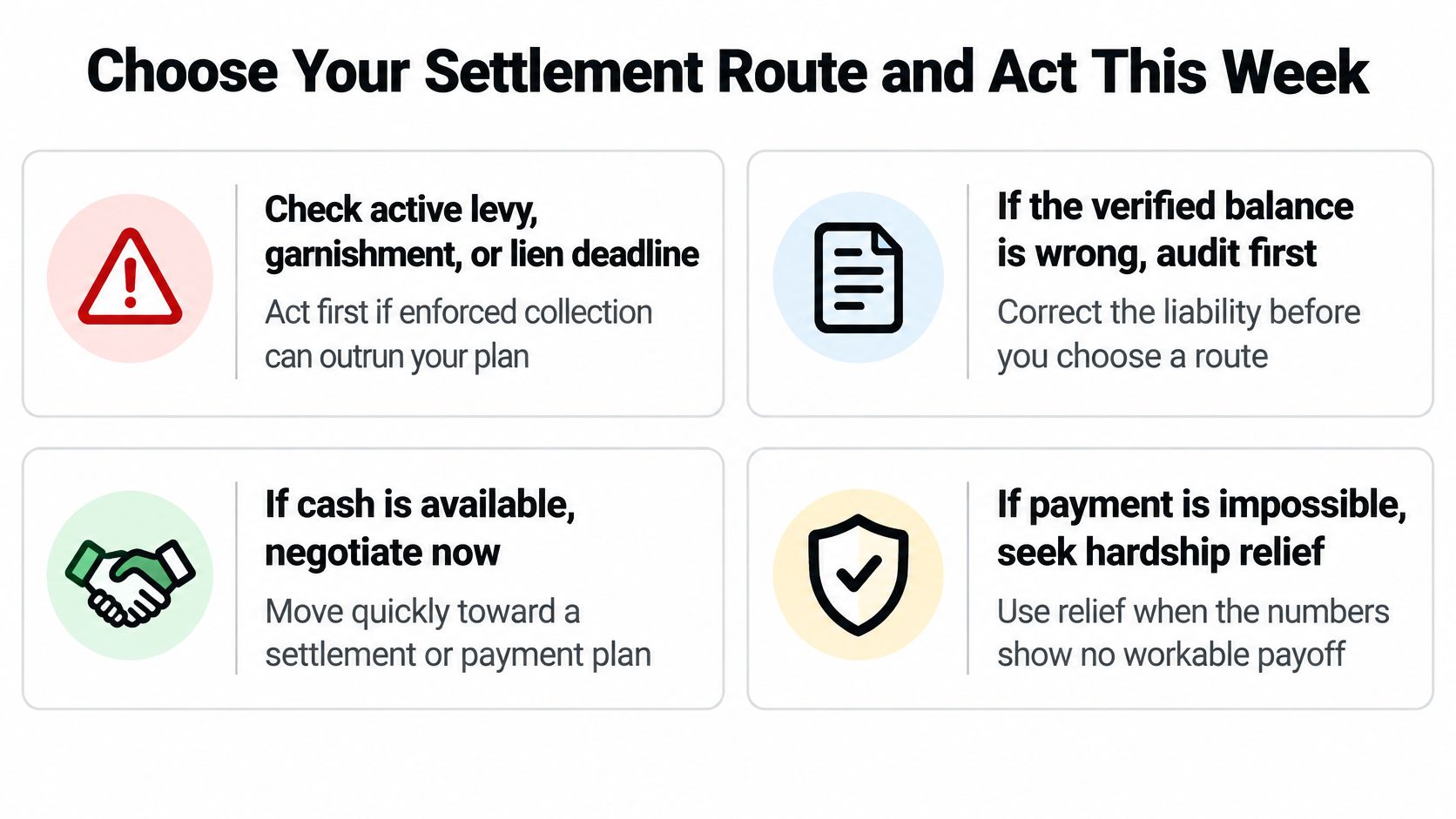
Then apply the decision rule. If the verified balance is wrong, protest before the deadline. If it's correct and affordable, pay in full or take the installment agreement. If it's correct and can't be paid over time, evaluate an offer or hardship. Penalty relief can ride alongside any of these.
Three actions can't wait. Confirm every return is filed, finish the affordability test with real numbers, and submit the chosen request while logging every contact with date, name, and reference number.
Bring in a tax attorney for an active levy or asset seizure, a criminal investigation, an assigned revenue officer, foreign accounts, trust-fund exposure, a pending bankruptcy, tax debt over $5,000 you can't verify alone, or liability exposure over $1,000,000. We obtain transcripts, negotiate directly, and request manager review where the state gets the math wrong. Stephen A. Weisberg, a tax attorney, offers a free eligibility analysis as the first step before any paid work, and the Tax Debt Resolution Plan turns that analysis into an attorney-led investigation and a personalized roadmap.
If a state notice is sitting unopened or a garnishment is already running, don't guess which route fits your numbers. We review your state transcripts, verify the balance, and negotiate the arrangement your finances can support, whether that's a plan, an offer, or hardship relief. Start with a free eligibility analysis from Tax Attorney Stephen A Weisberg and get a clear answer before the next deadline hits.


