Can a Bank Levy Take All Your Money? Your Guide to Protections
Can a bank levy take all your money? Discover which funds are legally protected from seizure and learn the exact steps you can take to stop a levy now.

In this article
- The Moment a Bank Levy Hits Your Account
- Bank Levy Quick Facts
- Who Is Behind a Bank Levy?
- Can They Do It Again?
- What a Bank Levy Really Is and How It Works
- Lien vs. Levy: A Quick Comparison
- The Legal Path to a Bank Levy
- What Kinds of Debt Can Trigger a Levy?
- Protected Funds and Legal Exemptions
- The Federal “Two-Month Look-Back” Rule
- What Funds Are Federally Protected?
- The Critical Role of State-Level Exemptions
- Retirement Accounts and Other Exemptions
- The Bank Levy Process, Day by Day
- The Critical 21-Day Holding Period
- IRS Bank Levy Timeline at a Glance
- What Happens to New Deposits and Outgoing Payments
- The Complication of Commingled Funds
- How to Stop a Bank Levy and Reclaim Your Funds
- Your First Move: Contact the Creditor Immediately
- Negotiate a Resolution to Release the Levy
- File a Claim of Exemption
- Conditions for an IRS Levy Release
- When You Absolutely Need a Tax Attorney
- The Problem Is Too Big to Handle Alone
- You Need Complex Resolution Strategies
- Your Top Bank Levy Questions, Answered
- How Long Does a Bank Levy Last?
- Will I Get a Warning Before a Levy Happens?
- Can They Take Money from a Joint Account?
It’s one of the most jarring financial shocks you can experience. One day your account has a healthy balance, and the next, it’s wiped out. So, can a bank levy really take all your money?
The short answer is yes. A levy can seize every last dollar in your account, right up to the total amount you owe. When a levy hits, the bank is legally required to freeze the funds available at that exact moment. It happens instantly, without any final warning.
The Moment a Bank Levy Hits Your Account
Imagine checking your business account to make payroll, only to be confronted with a zero balance. That’s not a system error—it’s the stark reality of a bank levy in action. It’s a powerful and aggressive collection tool used by creditors to satisfy a debt.

Think of it less like a hold and more like an ambush. A levy doesn’t just put a claim on your money; it’s the legal seizure of it. The goal is to get your immediate attention and force you to resolve the debt.
To get a quick overview of what's happening, here are the core facts about a bank levy.
Bank Levy Quick Facts
| Key Aspect | What It Means for You |
|---|---|
| Who Can Levy? | The IRS, state tax agencies, and private creditors who have won a court judgment against you. |
| What Is Seized? | All available funds in your account at the moment the levy is received, up to the debt amount. |
| Is There a Warning? | Creditors must follow legal notice requirements, but the levy itself happens without prior notice. |
| Immediate Impact | Your account is frozen. You cannot access the funds, and pending transactions may bounce. |
As you can see, the process is designed for maximum impact, leaving you with little room to maneuver once it's underway.
Who Is Behind a Bank Levy?
Knowing who initiated the levy is your first step toward fighting back, as the rules change depending on the creditor.
- The Internal Revenue Service (IRS): The IRS is the most common and powerful entity to issue a levy. Due to their administrative authority, they don't need to go to court first. Unpaid federal taxes are the direct trigger.
- State Tax Agencies: Like the IRS, state tax authorities can also levy accounts for unpaid state income, sales, or payroll taxes.
- Judgment Creditors: These are private creditors, like a credit card company or a former supplier. They can't levy you on their own—they must first sue you in court, win, and be awarded a judgment.
The purpose of a levy is to be sudden and severe. It’s designed to bring you to the negotiating table by seizing your most liquid asset: cash. The shock of a frozen account is often what it takes to get a debtor to finally address the problem head-on.
The strategy for dealing with an IRS levy is very different from handling one from a judgment creditor. For a deeper dive into the IRS process, it’s worth understanding the specific triggers for IRS levies on bank accounts.
Can They Do It Again?
Many people mistakenly believe a levy is a one-and-done event. Unfortunately, that's not the case. A creditor, especially the IRS, can levy your account repeatedly until the debt is paid in full.
In the years leading up to 2023, the IRS issued over 500,000 levies annually, and a huge portion of those were bank account seizures. If one levy clears out your account but doesn't cover the full debt, any new deposits you make are fair game for the next one.
Seeing your account balance drop to zero is terrifying, but panicking won’t solve the problem. It’s time to take strategic action. The next sections explain what the bank does after the freeze and how you can start working to get your money back.
What a Bank Levy Really Is and How It Works
So, you’ve been hit with a bank levy. To fight it, you first need to get a handle on what it is—and just as importantly, what it isn't. The term itself sounds scary, but it’s really just a legal tool that lets a creditor take money right out of your bank account to pay off a debt you owe.
Here’s a simple way to think about it. A lien is like a claim sticker. When the IRS files a lien, it’s putting the world on notice that you owe them money and they have a legal claim to your property. A levy, on the other hand, is the tow truck actually showing up to take your car. It’s the act of seizing the asset, which in this case is the cash sitting in your bank account.
Lien vs. Levy: A Quick Comparison
People mix these up all the time, but they are two very different collection tools. Knowing the difference is the first step toward figuring out your next move.
| Aspect | Lien | Levy |
|---|---|---|
| Action | A legal claim against your property. | The actual seizure of your property. |
| Purpose | Secures the government's interest and alerts other creditors. | Satisfies the debt by taking possession of assets (like cash). |
| Impact | Wrecks your credit and makes selling property a nightmare. | Drains your bank account, leaving you unable to pay your bills. |
A levy is a much more aggressive and immediate threat. It means the creditor has stopped just making claims and has started actively taking what they're owed.
The Legal Path to a Bank Levy
A bank levy doesn't just happen out of the blue. It’s the final stop on a legal journey that looks different depending on who you owe.
- IRS and State Tax Agencies: These government agencies have a special power called an administrative levy. This means they don't have to sue you or get a judge's permission. After sending a series of legally required notices—including the critical "Final Notice of Intent to Levy"—they can simply order your bank to freeze your account and hand over the money.
- Private and Business Creditors: For everyone else, like a credit card company or a supplier, the road is longer. They have to take you to court first. Only after they sue you and win a judgment can they ask the court for permission to levy your bank account.
It's really important to understand how creditors enforce judgments to collect what they're owed. That court judgment is the golden ticket that gives them the power to go after your assets.
What Kinds of Debt Can Trigger a Levy?
While tax debt is the most common reason for a levy, it's not the only one. Several other kinds of unpaid bills can end with a creditor cleaning out your account.
- Federal and State Tax Debt: This is the big one, mainly because the IRS can act so quickly and directly.
- Unpaid Child Support: State agencies have powerful enforcement tools to collect child support, and bank levies are high on their list.
- Defaulted Student Loans: For federal student loans, the Department of Education can also levy accounts without first getting a court order.
- Unpaid Creditor Judgments: This covers almost everything else. If a business or person has sued you and won—for credit card debt, a personal loan, medical bills, you name it—they can get a levy.
A levy is the predictable end of the line for unresolved debt and ignored notices. For the IRS, it’s a tool they pull out after months of trying to communicate have gone nowhere. By the time a levy hits, they’ve decided that asking nicely isn't working anymore.
Knowing exactly who you owe is crucial because the rules—and your options—are completely different for each type of creditor. For example, the steps to stop an IRS levy are very specific. You can learn about the key notices the IRS sends before a levy in our ultimate guide for taxpayers. Spotting one of those letters early gives you a fighting chance to act before your account is frozen solid.
Protected Funds and Legal Exemptions
When a bank levy hits, it can feel like a financial tsunami is about to wipe out everything you have. But it's not quite that absolute. Both federal and state laws create a kind of financial safety net, putting a fence around certain types of funds to keep them safe from seizure. Knowing what these protections are is your first and best line of defense.
Even though a levy seems all-encompassing, it doesn’t give a creditor a blank check to grab every last penny. Think of these exemptions as a financial shield—certain assets are legally off-limits, even when your accounts are under attack.
The Federal “Two-Month Look-Back” Rule
One of the most important protections you have comes from a federal banking rule that automatically shields certain benefit payments. When your bank gets a levy order, the first thing it’s required to do is perform a “two-month look-back” on your account.
During this review, the bank must identify any federal benefits that were directly deposited into your account within the last two months. These funds are automatically considered exempt and cannot be frozen. The bank has to leave this protected amount available for you to use.
The key phrase here is direct deposit. If you get your benefits via a paper check and then deposit it, this automatic protection doesn’t kick in. You’ll have to step in and file a claim of exemption yourself to protect that money.
What Funds Are Federally Protected?
This automatic protection covers a specific list of government benefits. As long as they are directly deposited, they are generally safe from a levy by a private creditor.
- Social Security Benefits: This includes retirement, survivor, and disability (SSDI) payments.
- Supplemental Security Income (SSI) Benefits: Payments for low-income individuals who are elderly, blind, or disabled.
- Veterans' Benefits: This covers disability compensation, pensions, and educational assistance from the VA.
- Railroad Retirement Benefits: Annuities and unemployment for railroad workers.
- Federal Employee Retirement Benefits: Pensions managed by the Office of Personnel Management.
It's critical to understand that while these funds are protected from most creditors, the federal government itself can still levy them for debts like back taxes or federal student loans. The rules change when you owe Uncle Sam.
The Critical Role of State-Level Exemptions
While federal law sets a baseline, state laws often add another, more powerful layer of defense. This is where your physical location becomes incredibly important, as the protections can vary dramatically from one state to the next.
Shockingly, federal law offers no cap on how much a private creditor can take from a bank account. This is a huge contrast to wage garnishments, which are limited to 25% of your disposable income. This gap, left open by the 1968 Consumer Credit Protection Act, makes your state's laws your best hope for protecting your bank account. Some states offer strong protections, while others leave you far more exposed.
Retirement Accounts and Other Exemptions
Beyond federal benefits and state-specific rules, other funds might also be protected, especially retirement savings. In most cases, money held in qualified retirement accounts is shielded from creditors.
- ERISA-Qualified Plans: This covers most 401(k)s and employer-sponsored pension plans. They have strong federal protections against levies from private creditors.
- IRAs (Individual Retirement Accounts): Protections for IRAs usually fall under state law, and they can be all over the map. Some states offer full protection, while others only protect up to a certain dollar amount.
Be warned, however: the IRS has unique authority here. If you're dealing with back taxes, it's worth learning more about whether the IRS can take your 401(k), because their power often goes far beyond that of a normal creditor. And for anyone using fintech or online-only banks, it's a good idea to know whether an online bank account can be garnished to fully understand your risk.
The Bank Levy Process, Day by Day
Once a levy notice from the IRS lands at your bank, a strict, non-negotiable clock starts ticking. This isn't a suggestion; it's a legal order the bank is obligated to follow to the letter. Getting a handle on this timeline is absolutely critical, because it dictates the very small window you have to act before your money is gone.
The moment your bank processes the levy, it’s like a switch is flipped. The bank identifies the total amount you owe and immediately freezes all available funds in your account, right up to that levy amount. It’s instantaneous. One minute you’re paying bills, the next you’re locked out.
The Critical 21-Day Holding Period
For an IRS bank levy, this initial freeze kicks off a mandatory 21-day holding period. You can think of this as a legally required "grace period" designed to give you one last shot at fixing the problem before your funds are sent to the government for good.
During these 21 days, your money is stuck in a kind of financial purgatory. It's technically still in your account, but you can't touch it. Any checks you wrote will bounce, and automatic payments will fail, which can trigger a cascade of additional fees from both your bank and the people you were trying to pay.
This 21-day window is your final chance to negotiate a release with the IRS. If you can prove the levy is causing an immediate economic hardship or if you can work out another solution like a payment plan, you might be able to stop the transfer.
The timeline below shows the key moments in how your bank handles a levy and what protections might apply to some of your funds.
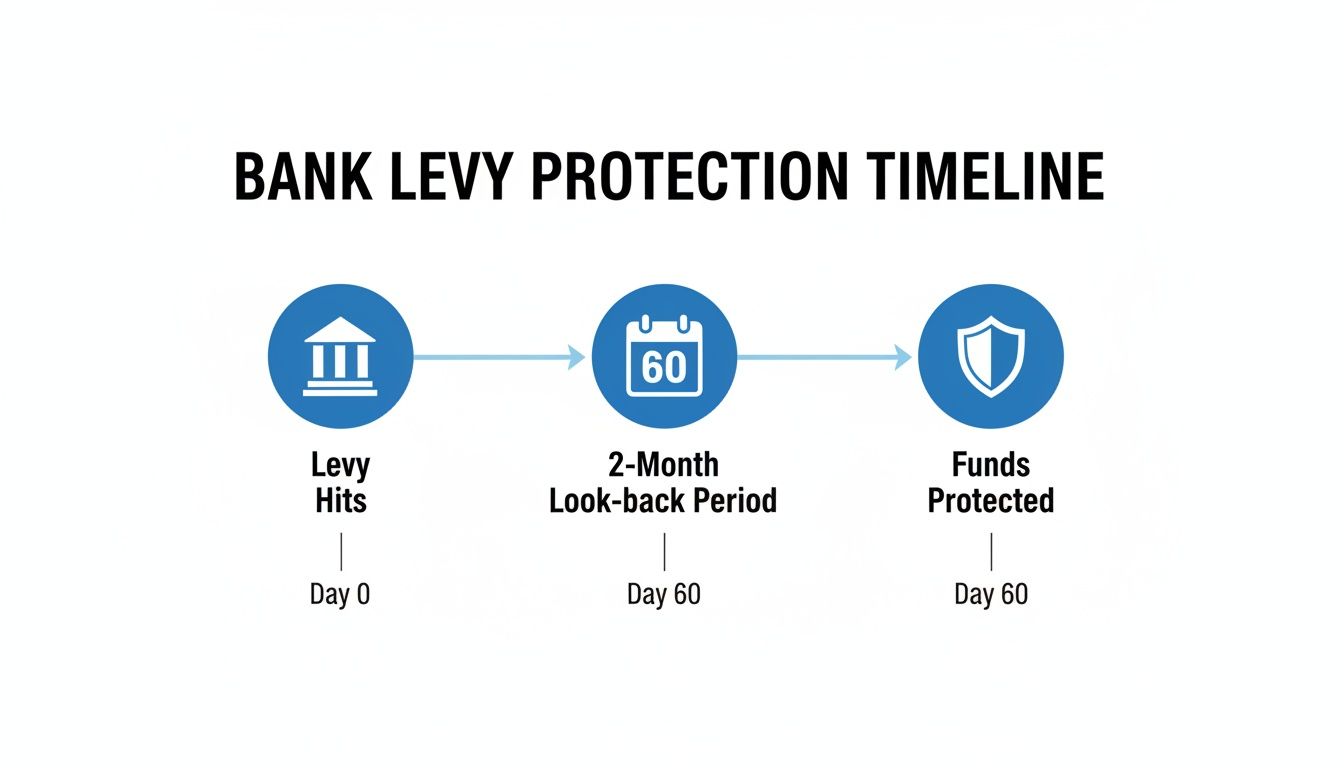
As the graphic shows, one of the first things a bank does is run a two-month "look-back" to identify and protect any recent federal benefit payments before freezing the rest of your money.
To make this clearer, let's break down the 21-day holding period into its key phases.
IRS Bank Levy Timeline at a Glance
| Phase | What Happens | Your Action Window |
|---|---|---|
| Day 1: The Freeze | Your bank receives the IRS levy notice and immediately freezes the funds in your account, up to the amount you owe. | This is when you must spring into action. Contact the IRS or a tax professional immediately. |
| Days 2-20: The Holding Period | The frozen funds sit in your account, but you can't access them. Any pending transactions will likely be returned unpaid. | This is your window to negotiate a levy release, set up a payment plan, or file a Claim of Exemption for any protected funds. |
| Day 22: The Point of No Return | Your bank is legally required to send the frozen funds to the IRS. | Once the money is sent, getting it back is incredibly difficult and rarely successful. The window has closed. |
This timeline underscores why you can't afford to wait. Every single day counts.
What Happens to New Deposits and Outgoing Payments
It’s a common and costly mistake to think a levy freezes your account forever. An IRS levy is more like a snapshot in time—it only captures the funds that were sitting in the account at the exact moment the bank processed the notice.
- New Deposits: Any money you deposit after the levy hits is not subject to that specific levy. You can use those new funds normally. But don't get too comfortable. If the tax debt isn't resolved, the IRS can—and often will—just issue another levy to grab the new money.
- Outgoing Payments: If you had checks or automatic payments pending when the levy hit, they will probably be returned unpaid if those funds were needed to satisfy the levy. This can create a messy domino effect of financial problems for your business.
Once that 21-day holding period is over, the process is done. On day 22, your bank must send the money to the IRS. Game over for those funds.
The Complication of Commingled Funds
Things get tricky when your account has a mix of exempt and non-exempt money. This is what we call commingled funds. For example, maybe you have direct-deposited Social Security benefits (which are exempt) mixed in with revenue from your business (which is not exempt).
The good news is that banks automatically protect two months' worth of direct-deposited federal benefits. The bad news? Any exempt funds beyond that aren't automatically safe. If you have older exempt funds stashed away or money from a source that isn't covered by automatic protection, the bank will freeze it along with everything else.
To save that money, you have to act fast. You'll need to contact the IRS (or have your representative do it) and prove that specific funds in the account are legally exempt from seizure. This usually means gathering documents and making your case quickly. Navigating these complexities is a huge part of resolving an IRS collection case, and it all starts with a clear picture of your finances. You can see how this information is organized in our guide to IRS Form 433-F, which is used to show your financial standing to the IRS.
How to Stop a Bank Levy and Reclaim Your Funds
That feeling when you discover your bank account is frozen is gut-wrenching, but it’s not the end of the road. You have a very narrow window to act, and what you do next is critical. Think of this as your action plan—the immediate, concrete steps you can take to stop a levy and potentially get your money back.

The clock is ticking, especially with an IRS levy that has a 21-day holding period. Ignoring the problem guarantees the worst possible outcome. But if you take immediate, strategic action, you have a fighting chance to regain control of your finances.
Your First Move: Contact the Creditor Immediately
Your very first step, whether you're dealing with the IRS or a private creditor, is to get them on the phone. Hiding or hoping it will blow over simply doesn't work. You have to open a line of communication to start negotiating a way out of this.
When you call, be ready to explain your situation calmly and clearly. This isn’t the time for anger; it’s the time for negotiation. The goal is to show them you’re serious about resolving the debt and to find a better alternative to them seizing your funds.
This first call is your best shot at halting the process. For the IRS, that means calling the number on your levy notice. For a private creditor, you’ll be contacting the law firm or collection agency that won the judgment against you.
Negotiate a Resolution to Release the Levy
Once you have the creditor on the line, your main objective is to convince them to release the levy. They won't do this out of the kindness of their hearts—you need to give them a better option. The key is to propose a formal payment arrangement that assures them they'll get their money.
Here are the most common solutions you can work out with the IRS:
Installment Agreement (IA): This is just a structured monthly payment plan. By setting up an IA, you commit to paying your tax debt over time. Once it’s approved, the IRS will usually release the bank levy.
Offer in Compromise (OIC): An OIC is a formal program that allows some taxpayers to settle their tax liability for less than what they originally owed. It's designed for people facing genuine financial hardship, and while the application is extensive, an accepted OIC will stop all collection actions.
Currently Not Collectible (CNC) Status: If you can prove the levy is causing an "economic hardship"—meaning you can't afford basic living expenses like rent, food, or medical care—the IRS may agree to release it. They’ll place your account in CNC status, which temporarily stops collections until your finances improve.
A bank levy is often the IRS's last-ditch effort to get your attention after months of ignored notices. Simply showing that you're now ready to cooperate and formally address the debt is often enough to persuade them to release the levy and work with you.
File a Claim of Exemption
Sometimes, a creditor takes money they have no legal right to touch. If your levied account held legally protected funds—like Social Security, VA benefits, or other exempt income—you need to act fast to protect them.
This involves formally notifying the creditor (and the court, for private debts) that the seized funds are exempt. You'll have to provide proof, such as bank statements that clearly show the direct deposit of federal benefits.
This isn’t an automatic process; you have to be proactive and file the correct paperwork. Each state has its own forms and procedures for claiming exemptions, so it’s crucial to look up the specific rules where you live.
Conditions for an IRS Levy Release
Beyond negotiations, the IRS is legally required to release a levy under a few specific circumstances. If any of these apply to you, you can demand an immediate release of your frozen funds.
- The tax debt has been paid in full.
- The legal timeframe for collecting the debt (the statute of limitations) has expired.
- You enter into a formal Installment Agreement.
- The IRS determines the levy is causing an immediate economic hardship.
- The value of the property they seized is more than the amount you owe.
Knowing these rules gives you leverage. If you meet any of this criteria, cite it when you contact the IRS. You aren't just asking for a favor; you're demanding that the IRS follow its own procedures. The key is to act quickly, provide clear proof, and lock in a formal resolution before that holding period runs out.
When You Absolutely Need a Tax Attorney
Look, you can probably handle a minor tax mix-up on your own. But some situations are different. They're in a whole other league of serious, and trying to go it alone is a recipe for disaster.
Knowing when to call in a professional isn't admitting defeat; it’s making a smart, strategic move to protect yourself. Think of it this way: you might fix a leaky faucet, but you’d call a plumber for a burst pipe that’s flooding your house. A bank levy is that burst pipe. If any of the following sound familiar, it’s time to pick up the phone.
The Problem Is Too Big to Handle Alone
Some tax problems come with such high stakes that a DIY approach is just too risky. In these cases, a tax attorney isn't just a good idea—they're a necessity.
Large Tax Debts: Is your tax bill north of $50,000? Once you cross that threshold, the IRS and state agencies get far more aggressive. An attorney is equipped to handle the high-stakes negotiations required to get you a workable resolution.
Trust Fund Recovery Penalty (TFRP): This is one of the scariest situations for a business owner. It’s when the IRS decides to hold you personally responsible for your business's unpaid payroll taxes. The TFRP can pierce the corporate veil, putting your personal bank accounts, your house, and other assets squarely in the crosshairs.
An Unresponsive or Aggressive IRS: If you're getting nowhere with the IRS or dealing with an agent who is overly aggressive, an attorney can step in immediately. They become your official representative, forcing the IRS to communicate through them and ensuring your rights are protected.
Hiring a tax attorney means you're bringing in a specialist who knows the IRS playbook inside and out. They become your shield, managing all communication and preventing you from making a costly mistake under pressure.
You Need Complex Resolution Strategies
Sometimes, a standard installment agreement just won't cut it. Your situation might call for a more sophisticated solution, and that's where an attorney’s expertise becomes absolutely critical.
For example, negotiating an Offer in Compromise (OIC)—where you ask the IRS to settle your debt for less than the full amount owed—is notoriously difficult. The paperwork is a minefield, and most OICs submitted without professional help are flat-out rejected. An experienced tax attorney knows precisely how to build a case that the IRS will actually consider, giving you the best possible shot at getting it approved and putting the problem behind you for good.
Your Top Bank Levy Questions, Answered
When you're hit with a bank levy, questions start flying fast. You need straight answers, and you need them now. Let's tackle some of the most common concerns I hear from clients every day.
How Long Does a Bank Levy Last?
This is one of the biggest points of confusion. An IRS bank levy isn’t a continuous drain on your account; it’s more like a snapshot in time. The levy captures whatever funds are in your account on the exact day the bank processes the order.
From that moment, the bank is legally required to freeze that amount and hold it for a 21-day period. After those 21 days are up, they send the money to the IRS. Once the funds are gone, the freeze lifts. But be warned: if you still owe the IRS, they can simply issue another levy down the road to capture new funds. Levies from private creditors work in a similar one-shot fashion.
Will I Get a Warning Before a Levy Happens?
Yes, but it's not always a flashing red light. The IRS has to send you a series of notices before they can take your money. The final, most critical one is the “Final Notice of Intent to Levy.”
Once that letter arrives, the clock starts ticking. You have 30 days from the date on that notice to make arrangements before the IRS has the green light to seize your assets. For private debts, the warning comes much earlier in the form of a lawsuit. A creditor can't just levy your account; they first have to sue you and win a court judgment.
Can They Take Money from a Joint Account?
This is a tough one, and the answer is almost always yes. If your name is on a joint bank account, a creditor can levy the entire balance, even if every penny was deposited by the other person on the account.
It then falls on the non-debtor to prove which portion of the funds are theirs—a process that can be incredibly difficult and stressful. This is why having a joint account can become a huge liability when one of the owners is dealing with serious debt.
Facing an IRS bank levy can feel like you're cornered, but you don't have to navigate it alone. Attorney Stephen A Weisberg offers a FREE Tax Debt Analysis to assess your situation and explain how to protect your assets. Contact us today to start resolving your IRS issues.


