Forms for Payment Agreement: Which IRS Form to File
Forms for payment agreement explained: which IRS form applies to you, what each requires and when to file it.
In this article
- Payment Agreement Forms at a Glance
- What Payment Agreements Cost and How to Request One
- Direct Debit and Payment Method Requirements
- What the Authorization Must State
- How to Complete Form 9465 Correctly
- The Fields in Order
- When Form 433-F or 433-H Is Required
- The Sequence From Request to Recorded Agreement
- Financial Disclosure Forms 433-A and 433-B
- What Each Section Asks For
- Documents to Gather Before You Start
- Special Cases and the Forms That Follow Approval
- A Representative-Led Sequence
- Compliance Rules and Common Mistakes to Avoid
- The Rules That Keep It in Force
- Confirm Your Form Path Before You File
Which IRS form do you file when you can't pay a tax bill in full? Nearly everyone answers Form 9465.
Form 9465 requests a monthly installment agreement. Filing it does not decide whether you get one, and it is rarely the last document involved. If your proposed payment falls short of what the automated system accepts, the IRS asks for financial disclosure on Form 433-F or 433-H, and more complex cases move to Form 433-A or 433-B. Once an agreement is approved, Form 433-D records the final terms.
The right form depends on which stage your balance is in, so the useful answer is a path, not a single number.
Payment Agreement Forms at a Glance
Eight forms sit between a balance you can't clear and an agreement the IRS records against your account. The table maps each one to the situation that brings it into play.
| Form | Purpose | When It Applies |
|---|---|---|
| Form 9465 | Request a monthly installment agreement | You can't pay the full balance shown on a return or notice |
| Form 2159 | Request a payroll-deduction agreement | You want payments taken from wages through your employer |
| Form 433-F | Financial disclosure for agreement review | The online minimum payment can't be met and the IRS requests financial detail |
| Form 433-H | Financial disclosure for agreement review | The IRS requests additional financial information alongside or instead of Form 433-F |
| Form 433-A | Collection information statement for individuals | Individuals and self-employed taxpayers need a detailed financial review |
| Form 433-B | Collection information statement for businesses | A business with payroll or income tax balances is under review |
| Form 433-D | Documentation of an approved agreement | The IRS records the terms after approval |
| Form 2848 | Power of attorney | A representative handles the request and IRS communication for the taxpayer |
Read the list as four stages instead of a menu. Request is Form 9465 for a monthly plan, or Form 2159 when wages will fund it. Disclosure begins when the online system won't take the payment you can afford, and the IRS asks for Form 433-F, Form 433-H, or a full collection information statement on Form 433-A or 433-B. Approval is where Form 433-D records terms already agreed. Representation is Form 2848, which lets someone else deal with the IRS for you.
The form you file is an offer. The form the IRS approves is the contract, and they aren't always the same document.
Filing a request with an affordable payment and a clean filing record often ends at approval. Filing one below what the system accepts starts the disclosure stage, and that's where most confusion begins.
What Payment Agreements Cost and How to Request One
A payment agreement turns a balance due in full into scheduled installments. It doesn't stop the clock. Penalties and interest generally keep accruing until the balance is paid off, so the monthly figure you commit to determines how fast the total falls.
People often arrive here holding a notice with a deadline on it.

You can apply online, by phone, by mail or in person, and the route changes the price. The IRS sets its user fee by whether you use the online application and which payment method you choose, so the charge attached to your request depends on how you file it and how you pay. Read the fee off the instructions in force when you file rather than quoting a figure from an older guide. The IRS prior-year forms and instructions archive lists Form 9465 revisions going back to 1993 alongside versions through 2020 and a 2024 revision, which shows how often the terms attached to this form have shifted.
Duration follows the same rule. The maximum term a simplified agreement can run has changed between instruction revisions, so write your proposed schedule from the current instructions, not a number copied out of an older summary.
Model the payment before you commit to it. If you want to see how different monthly amounts change the payoff timeline, work through the balance under several scenarios with an IRS payment plan calculator rather than guessing at a figure that feels safe.
A finished request is both an application and a structured statement of repayment terms, and the payment method is part of that statement.
Direct Debit and Payment Method Requirements
Bank details on an agreement have to match your records exactly. One wrong digit turns a scheduled payment into a missed one, and a missed payment is the trigger for default.
The routing number must be nine digits and carry an acceptable Federal Reserve prefix, and the account must accept ACH debits. Confirm both with the bank instead of reading them off a checkbook you haven't used in two years. The IRS Form 9465 instructions treat bank-draft language as a financial authorization, and that framing is the right one to work from.
What the Authorization Must State
- Account holder and account type: the name on the account and whether it's checking or savings, because a mismatch causes the bank to reject the debit.
- Debit amount or the method used to calculate it: a fixed monthly figure or a stated formula, so the amount can't drift.
- First debit date and recurring frequency: the date the withdrawals begin and how often they repeat.
- A change or revocation process: how the taxpayer stops or alters the authorization, documented in writing.
Before submission, compare the proposed debit date against the schedule the agreement permits, check the bank data against the taxpayer's own records, and keep a signed or otherwise authenticated authorization with the filed agreement. That file is your evidence if a debit is disputed later.
Electronic payment is usually the better choice where it's available, because it removes mailing risk and leaves a transaction trail. It also demands attention to liquidity. A debit that hits an account without enough in it gets rejected, and a rejected debit needs fixing the same week, not at the end of the quarter.
Checks, money orders, credit cards and debit cards are also accepted. Choosing among them means weighing processing time, card fees, posting risk, and what happens if a scheduled payment fails. A defaulted agreement puts the enforcement action you were avoiding back on the table.
Practical rule: keep the bank confirmation, the signed authorization and the filing confirmation together in one file, and check the first debit posted before you assume the plan is running.
How to Complete Form 9465 Correctly
Form 9465 works as an eligibility and payment-design document. It reads like a loan application in miniature: the IRS is deciding whether the balance is right, whether the payment is real, and whether you can be trusted to keep filing on time. Treated as a bare request for more time, it invites a rejection or a follow-up letter you could have avoided.
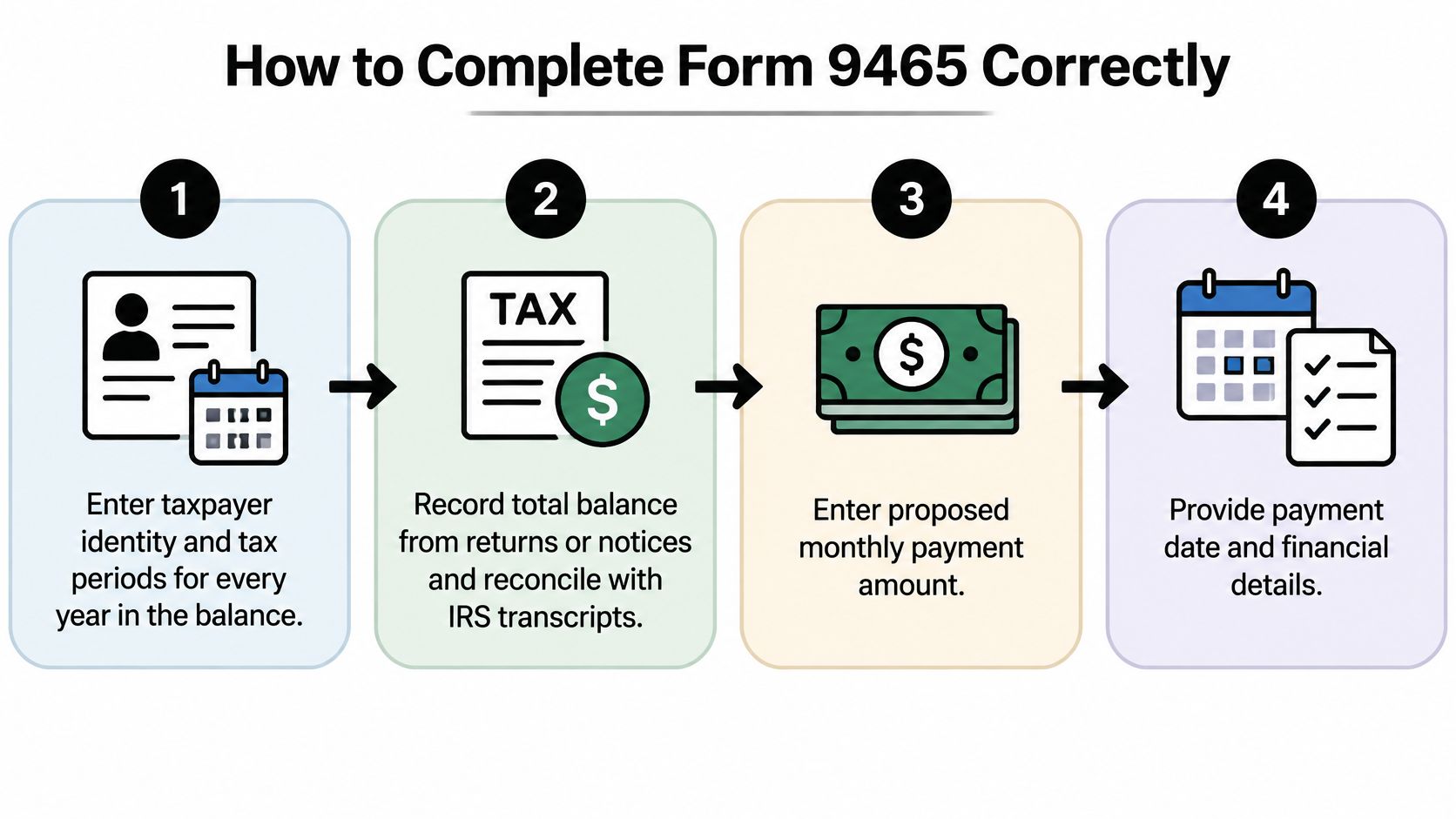
Eight fields carry that decision. The notes below explain what each entry is doing.
The Fields in Order
- Enter identity and every tax period in the balance. List each year or period you owe on. An agreement built around one year leaves the others exposed to collection while the plan runs.
- Record the total balance from returns or notices, then reconcile it to your IRS account transcripts. Transcripts show the assessed tax, penalty and interest the IRS currently has on file. A stated balance that doesn't match them stalls review at the first desk it reaches.
- Enter any payment submitted with the request. A payment sent now reduces the balance the plan has to amortize and shows the request is serious rather than a placeholder.
- Set the proposed monthly payment as high as you can realistically sustain. Interest and penalties generally keep running until the liability is gone, so a low figure costs more over time and risks falling below what the system will accept.
- Choose a preferred payment date from the 1st through the 28th. Any date up to the 28th avoids the calendar-month exceptions that come with a 29th, 30th or 31st.
- Confirm that all required returns are filed and that you can stay current this year. The IRS checks both, and an unfiled return stops the request before affordability is even considered.
- Check the threshold. For eligible taxpayers, the IRS generally identifies a long-term online payment plan where combined assessed tax, penalties and interest don't exceed $50,000, as the IRS payment plans guidance explains. Above that, expect a closer look at your finances.
- Anticipate the affordability question. If the payment you can afford falls below the online minimum, the IRS may redirect you to financial disclosure forms, and preparing those numbers early saves a round of correspondence. A field-by-field walkthrough of Form 9465 is useful here because the line order matters more than people expect.
What the form is really doing: It tells the IRS four things at once, that the liability is accurate, the payment is affordable, the mechanics are set, and the compliance record is clean.
A complete package shows all four. A bare monthly figure shows none of them convincingly, which is why the reconciliation in field two and the threshold check in field seven do more work than the payment line itself. Get the number the IRS already believes, prove you filed everything, and the form stops being a plea and starts being a proposal the reviewer can approve.
When Form 433-F or 433-H Is Required
The form you submit and the agreement that governs your account are two different documents. The distance between them is where most payment plans stall.
Form 9465 requests an installment agreement. Taxpayers may also need Form 433-F or Form 433-H when they can't meet the minimum payment the online system requires, and the IRS online payment agreement application guidance directs those applicants to additional financial-disclosure forms. The request didn't fail. It moved to a different track.
The Sequence From Request to Recorded Agreement
- You file the request with a proposed monthly amount.
- The proposed amount falls below the minimum the online system accepts.
- The IRS asks for detailed income, expenses, assets, liabilities and bank information on Form 433-F or 433-H.
- A reviewer tests the disclosure against the liability.
- Once approved, Form 433-D records the terms in IRS collection systems.
Three groups meet this most often. Self-employed taxpayers whose income swings month to month, businesses carrying payroll liabilities, and taxpayers already facing collection enforcement. For each, the request form is one input into an eligibility and collection analysis, not a resolution by itself.
Say a sole proprietor owes on two years of returns and offers $400 a month, which is all the business can carry. That offer lands under the online minimum. The follow-up request asks for every bank account and its balance, every recurring monthly expense, the value of the vehicle and any equity in it, and the other debts in line ahead of the IRS. Answering incompletely invites an escalated review rather than a faster approval.
Revenue officers also assess whether a request is intended to delay collection. An accurate, complete statement is what separates a genuine hardship case from one that reads as a stall.
Before you file, answer one question honestly. Does my payment match what the system accepts, or will the IRS come back for financial detail?
If the answer is the second, working through a Form 433-F request before you submit saves a correction cycle.
Financial Disclosure Forms 433-A and 433-B
Form 433-A is the collection information statement for individuals, including sole proprietors. Form 433-B is the business version. Both do one job, translating your finances into numbers an IRS employee can verify against your records.
In the third step of the resolution process, income, expenses, assets and debts go onto Form 433-A or 433-B, and those figures become the basis for negotiation. That's the practical weight of these forms. They aren't paperwork surrounding the negotiation. They are the negotiation.
What Each Section Asks For
Income comes first, listed by source with the frequency and amount, so a seasonal business and a salaried employee look appropriately different on the page. Monthly expenses follow, separated into living costs or business operating costs depending on the form, and each one has to be defensible.
Bank accounts come next with balances and account numbers, then real estate and vehicles with their current value and any loan against them, and finally every liability, including other tax debts, judgments and personal loans. Equity in an asset is what draws attention, because it's the first place a reviewer looks when deciding whether a payment is as high as it can go.
Documents to Gather Before You Start
- Recent bank statements for every account, covering at least the last three months.
- Pay stubs or business receipts that support the income figures you list.
- Asset valuations, whether a vehicle guide, a mortgage statement or a brokerage balance.
- Debt statements showing balances and monthly payments on everything you owe.
Every figure must match your records and the IRS transcripts at the same time. An inconsistency doesn't just slow review. It casts doubt on the entries around it, and reviewers notice.
Then there's the choice of form. A business with payroll-tax debt files Form 433-B. An individual, including a sole proprietor owing on a personal return, files Form 433-A. If the liability is partly personal and partly business, expect both. Start with the one that matches the entity named on the notice, and the Form 433-A walkthrough covers the individual version line by line.
Special Cases and the Forms That Follow Approval
Not every agreement runs through a bank account, and not every request is filed by the taxpayer.
Form 2159 requests a payroll-deduction agreement, with payments taken from wages through the employer rather than drafted from an account. It fits an employed taxpayer who wants automatic payments and a steady monthly amount, and its user fee is set on a different schedule from the online application fee. If your income is predictable and your employer will process the withholding, it removes the liquidity problem that sinks direct-debit plans.
Form 2848 is the power of attorney, and it authorizes a representative to receive IRS notices and negotiate on your behalf. It's usually the first thing filed when a professional takes over a case, because nothing else can proceed until the IRS recognizes who is speaking for the taxpayer. The negotiation sequence runs through filing Form 2848 for representation, reviewing the tax history, preparing the financial documentation, selecting the resolution strategy, and negotiating directly with IRS representatives.
Form 433-D is the record of what was approved. Once the IRS accepts terms, that document goes into collection systems and becomes the version that counts. Check it against your request before you accept it.
A Representative-Led Sequence
- File the power of attorney so the IRS will speak with your representative.
- Pull transcripts and confirm the liability, penalties and payment history.
- Prepare the financial statement, Form 433-A for an individual or Form 433-B for a business.
- Submit the request with the proposed terms.
- Compare the recorded agreement terms against what was requested.
That last step gets skipped and shouldn't. Verify the monthly figure, the due date, the term length and the remaining balance on the approval document. A plan approved for a different amount or a shorter term than you asked for is still a plan, but it's not the one you designed, and it's much easier to correct at the start than six payments in.
For the mechanics of the initial request, the field notes on Form 9465 apply unchanged here. A payroll-deduction or representative-led filing still depends on an accurate balance and an affordable monthly figure.
Compliance Rules and Common Mistakes to Avoid
An approved agreement is a promise with conditions, and the conditions run both ways. The IRS commits to taking the monthly payment instead of a levy. You commit to a short list of obligations that continue for the life of the plan.
The Rules That Keep It in Force
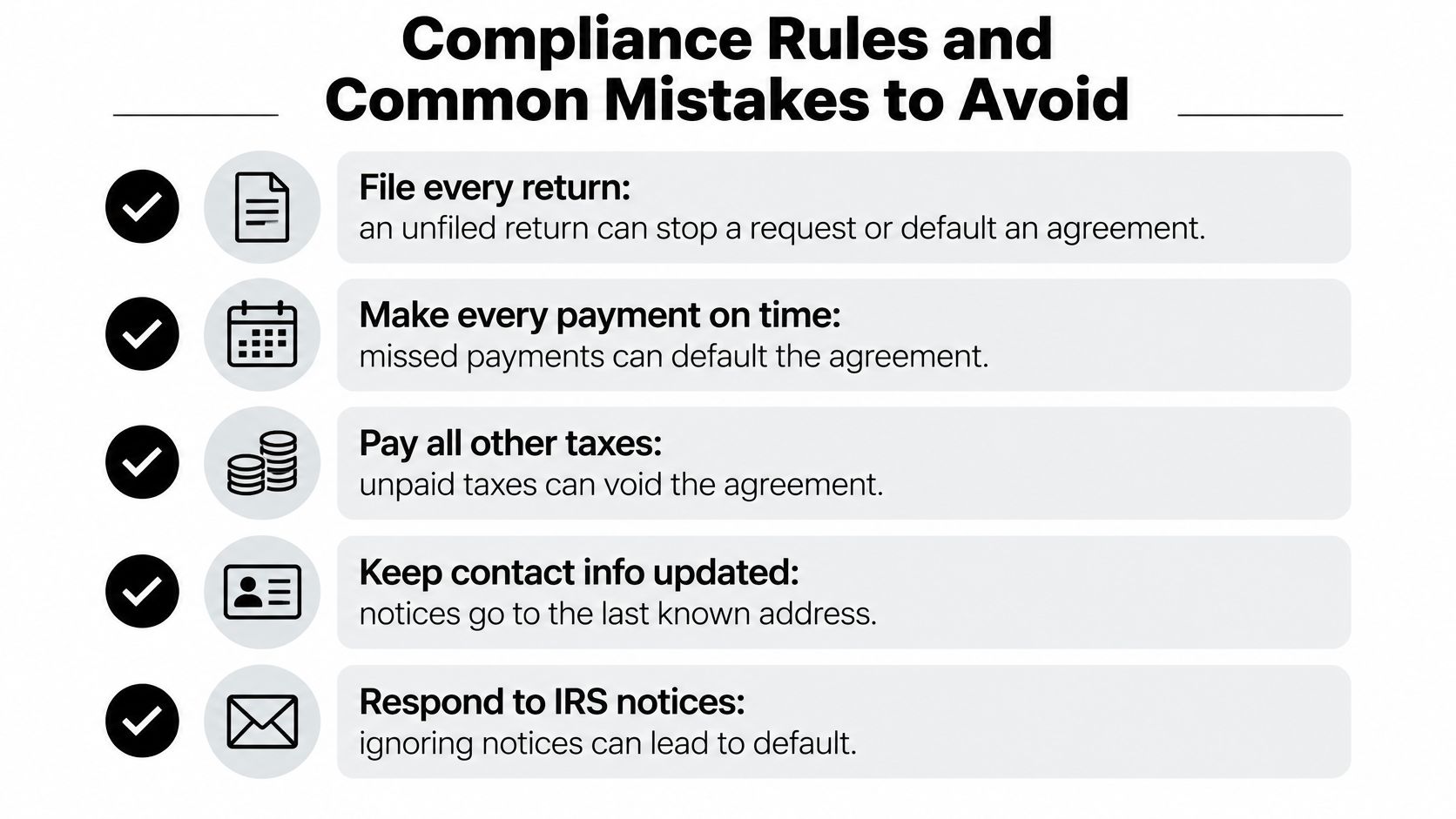
- File every required return. An unfiled return can stop a pending request or default a running agreement, because the IRS won't extend terms to a taxpayer who isn't filing.
- Make every payment in full and on time. A partial payment counts as a missed one in most reviews.
- Keep paying current-year taxes. An agreement covers the past. New balances that go unpaid while the plan runs put it at risk.
- Hold a buffer in the debited account. A rejected debit is treated as a failed payment, not a banking glitch.
- Update your contact details. Notices go to the last address the IRS has, and a notice you never saw still counts.
- Open every IRS letter. Most defaults start with correspondence that went unread for a month.
- Report a real change in income. If your circumstances shift, revisit the agreement instead of letting payments fail.
When an agreement defaults, the enforcement the plan was meant to prevent returns. A missed or rejected payment, a newly unfiled return or a fresh balance can all do it, and levies, wage garnishments and liens come back into play. Identifying which of those threats is most immediate is usually the first analytical step in a collection case, and it sets the order in which everything else gets fixed.
| Mistake | Result | Fix |
|---|---|---|
| Monthly payment set below what the taxpayer can afford | Online minimum not met and financial disclosure requested | Recalculate from actual income and expenses and complete Form 433-F or 433-H if required |
| Preferred payment date after the 28th | Calendar-month exception applies | Choose a date from the 1st through the 28th |
| Routing number not nine digits or lacking an acceptable Federal Reserve prefix | Direct debit fails | Verify routing and account details with the bank before submitting |
| Balance not reconciled to IRS account transcripts | Mismatch slows review | Compare the stated balance to each transcript |
| Required return left unfiled | Request cannot proceed until the return is filed | File all required returns before submitting the request |
| Financial statement left incomplete | Escalated review | Complete every section of Form 433-A, 433-B, 433-F or 433-H with supporting records |
| Scheduled payment missed or rejected | Default and renewed enforcement risk | Correct the payment quickly and contact the IRS about the agreement |
Run one test before anything goes out the door. Compare every figure against at least three sources, the return itself, the IRS transcript and the bank record. When all three agree, the entry is defensible. When two of three agree, find out why before you file.
Confirm Your Form Path Before You File
The forms for payment agreement follow a logic you can now run in order.
- Can you pay the full balance now? If yes, no installment form is needed.
- If not, check the ceiling and the minimum. Compare the combined assessed tax, penalties and interest against the limit for the long-term online plan, then test whether the monthly payment you can afford meets what the online system accepts.
- If both hold, file Form 9465. Add Form 2159 only when wages will fund the payments.
- If the affordable payment falls short, plan for disclosure. Expect a request for Form 433-F or 433-H, and prepare Form 433-A if you're an individual or Form 433-B if you're a business.
- Add Form 2848 when a representative will handle IRS contact, and check the recorded agreement terms against what you requested once approval arrives.
One honest note on when to bring in help. A simple request, one year, a modest balance, a payment you can meet, doesn't require professional representation. It requires accurate figures and a filed return. Owing more than $5,000 to the IRS is a listed situation in which an attorney is needed for tax matters, and it becomes more relevant when the case involves active collection enforcement, business payroll liabilities or disclosure figures you can't reconcile. That's the point where Form 2848 earns its place in the file.
Gather four things first: the balance, the transcripts, the bank statements and your income figures. With those in hand, the path above takes minutes to walk through, and you'll know which form you're filing before you file it.
A payment agreement is one of the most common ways we resolve a tax debt, and getting the form sequence right is what keeps the plan in force. If you're holding a notice and you're not sure whether you need Form 9465, Form 433-F or a full collection information statement, we'll start with a free Tax Debt Analysis to find out if we can help and how, before you commit to anything. Visit Tax Attorney Stephen A Weisberg to get that analysis started.


