A Practical Guide to Instructions Form 9465 for IRS Payments
Tackle your IRS tax debt with confidence. Our guide to instructions form 9465 simplifies the process, helping you set up a payment plan the right way.
In this article
- Do You Qualify for an IRS Installment Agreement?
- The Core Eligibility Requirements
- Understanding the Debt Thresholds
- Navigating Form 9465 Line by Line
- Part I: Information About You
- Part II: Proposing Your Payment Terms
- Calculating a Realistic Monthly Payment
- Choosing Your Payment Method: Direct Debit or Manual Payments
- The True Cost of an IRS Payment Plan
- First Up: The Setup Fees
- IRS Installment Agreement Setup Fee Structure
- The Big Picture: Ongoing Interest and Penalties
- A Real-World Cost Scenario
- Getting Your Form 9465 to the IRS
- The Digital Route: The Online Payment Agreement (OPA)
- The Old-School Way: Mailing Your Form
- Handling Tax Debt Over $50,000
- Introducing Form 433-F: The Collection Information Statement
- Gathering Your Financial Documentation
- Navigating the Complexities
- Tackling Common Questions About IRS Payment Plans
- What Happens After I Submit Form 9465?
- Can I Change My Installment Agreement Later?
- What if I Can't Afford the Minimum Payment?
- Does an IRS Payment Plan Hurt My Credit Score?
Before you even start looking at Form 9465, let's take a step back. The first and most important question to answer is whether an IRS installment agreement is actually the right move for your situation. It’s not a one-size-fits-all solution, and your eligibility depends on a couple of critical factors, mainly how much you owe and if you’re up-to-date on filing all your tax returns.
Getting this sorted out upfront can save you a ton of time and the headache of a rejected application.
Do You Qualify for an IRS Installment Agreement?
Seeing a tax bill you can't pay right away is a gut-wrenching feeling. The good news is the IRS has a formal process to help you manage it—the installment agreement. But let's be clear: this isn't a "get out of jail free" card. It’s a structured payment plan to settle your debt over a set period.
So, before you jump into the paperwork, you need to do a quick reality check on where you stand. The IRS has pretty clear rules and thresholds, and if you fit within them, your chances of getting approved are much, much higher. Think of it as a pre-screening to see if you qualify for the main event.
The Core Eligibility Requirements
At the heart of any successful request for a payment plan are two non-negotiable pillars: your filing history and the total amount you owe.
First off, the IRS won't even entertain a payment plan if you have unfiled tax returns hanging out there. From their perspective, it makes no sense to arrange a plan for this year's debt if you haven't even squared up your past obligations. This is the first hurdle, and it's a big one. If you have delinquent returns, your number one priority is to get them filed, even if you can’t pay a dime on them right now.
With that out of the way, the next piece of the puzzle is how much you owe. The IRS sorts taxpayers into different categories based on their debt, and that determines how they handle your application.
- Total Debt: Your entire balance—including the initial tax, plus all accrued penalties and interest—must be calculated.
- Filing Compliance: You absolutely must have filed all required tax returns.
- Future Compliance: You have to agree to stay current on all future tax filings and payments. Breaking this promise can torpedo your agreement.
Understanding the Debt Thresholds
The amount of tax you owe plays a massive role in how the IRS processes your request. The path forward looks very different depending on your balance.
If your total combined tax, penalties, and interest come in at under $50,000, you’ll likely qualify for what's called a streamlined installment agreement. This process is far less painful and usually doesn't require you to hand over detailed financial statements or a laundry list of your assets. As long as you meet the other basic criteria, the IRS is more likely to grant these requests automatically.
Here’s a real-world example: Sarah is a freelance graphic designer who owes the IRS $18,000 from last year. She’s a diligent filer and has all her past returns in, plus she's current on this year's estimated taxes. Because her debt is well under the $50,000 threshold, she can probably set up her payment plan entirely online without having to prove her financial situation.
Things get a bit more complicated if your tax debt tips over that $50,000 mark. You’ll still start with Form 9465, but the IRS will dig deeper. They'll require you to submit Form 433-F, the Collection Information Statement, which is basically a detailed snapshot of your entire financial life. This form gives the IRS a clear picture of your income, assets, and monthly expenses, which they use to figure out a payment amount they deem affordable for you.
Essentially, the more you owe, the more proof the IRS needs that your proposed payment is realistic and you aren't trying to hide assets. Their goal is to create a plan that lets you cover your basic living expenses while still chipping away at the tax debt.
To get a better handle on all the available routes, our guide on how to make payment arrangements with the IRS breaks down the options in more detail. Doing this prep work is key to a smooth process.
Navigating Form 9465 Line by Line
Staring at an IRS form can be intimidating, but Form 9465 is more manageable than you might think. The trick is to be methodical. Think of it less as a battle with the IRS and more as a straightforward business proposal where you lay out a clear, realistic plan to settle your tax debt.
Let's walk through the form, line by line, focusing on what really matters. I'll add some practical advice that goes beyond the official instructions to help you get it right the first time. To make sure you're catching all the details, you might find it helpful to use some effective reading comprehension strategies to break down the technical jargon.
Before you even start, the path to an approved payment plan has a few non-negotiable prerequisites. You need to get your tax filings up to date, know exactly how much you owe, and confirm you actually qualify.
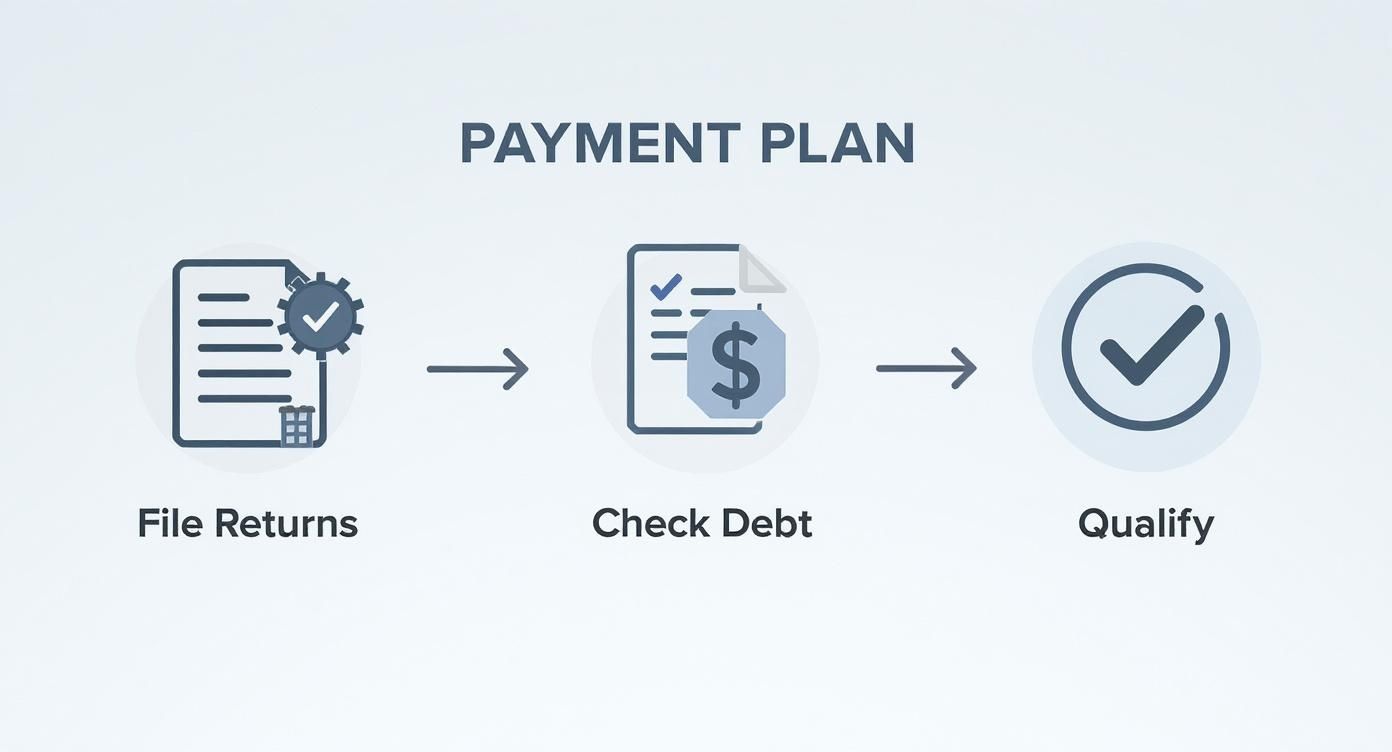
This process is sequential for a reason. Getting these steps in order is the key to having your request approved without hitting unnecessary roadblocks or delays.
Part I: Information About You
This first part seems simple, but don't rush through it. A tiny mistake here—like a typo in your Social Security Number (SSN)—is one of the fastest ways to get your request delayed or even rejected.
Lines 1a through 4: Your name, SSN, and current address need to match the tax return you're filing this form with. Exactly. If you're married and filing jointly, be sure to include your spouse's name and SSN. The address you list is where the IRS will send every piece of mail about your agreement, so check it twice.
Line 5: Be specific about the tax year(s) you need the payment plan for. If you owe for 2022 and 2023, list them both. Don't be vague.
Lines 6 and 7: List your best daytime phone number. If the IRS has a question, they might actually call you. Make sure it’s a number where they can reach you.
Part II: Proposing Your Payment Terms
Alright, this is where you make your pitch. The numbers you enter here are the heart of your application and will define the terms of your payment plan.
Line 8: The Total You Owe On this line, write the full tax amount you owe from your return. This is your total liability before any payments you might have already sent.
Line 9: The Amount You Can Pay Now If you can afford to make a down payment, this is where you put it. It’s not required, but sending some money upfront shows good faith. It also shrinks the principal balance that’s collecting penalties and interest, which is always a smart move.
Line 10: The Remaining Balance This one is just simple math: subtract line 9 from line 8. This is the core amount that your installment agreement will cover.
Pro Tip: The IRS generally wants the debt paid off within 72 months (that’s six years). To figure out a monthly payment the IRS will likely accept, divide the amount on line 10 by 72. This gives you a solid baseline for your offer.
Calculating a Realistic Monthly Payment
Now for the big one: line 11a, your proposed monthly payment. Proposing too little is a classic mistake and a common reason for rejection. Stick with the 72-month rule as your guide.
For example, if your remaining balance on line 10 is $14,400, a reasonable minimum offer would be $200 per month ($14,400 ÷ 72). If you propose less than that, you'll probably need to submit a full financial statement (like Form 433-F) to justify it, and the process gets much more complicated.
Next, on line 11b, you pick a payment date between the 1st and the 28th of the month. Be strategic here. Choose a date that’s a few days after you get paid to ensure the funds are always there. It’s a small detail that can save you a lot of headaches later.
Choosing Your Payment Method: Direct Debit or Manual Payments
Your final big decision, found on lines 13 and 14, is how you’ll actually send the money each month. This choice affects both your setup fees and your peace of mind.
Direct Debit (Line 13): This is the "set it and forget it" option. You provide your bank routing and account numbers, and the IRS automatically pulls the payment each month. Not only does this prevent missed payments, but it also comes with a much lower setup fee. For most people, this is the best way to go.
Manual Payments (Line 14): If you check this box, you're on the hook for making the payment yourself every month, either by mail or online. You get more control, but the setup fee is higher, and you run the risk of forgetting. One missed payment can put your entire agreement in default.
After you've made your choice, all that's left is to sign and date the form. Your signature is your word that everything you've entered is true. If you filed a joint return, both you and your spouse need to sign.
The True Cost of an IRS Payment Plan
Getting an IRS installment agreement approved brings instant peace of mind, but it’s crucial to go in with your eyes open. This solution isn't free. The monthly payment you propose on Form 9465 is just one piece of the puzzle; the total amount you repay will be higher than your original tax bill thanks to setup fees, interest, and penalties.
It helps to think of a payment plan as a loan from the IRS. Like any loan, you're paying for the convenience of spreading out the cost over time. Understanding these extra charges is the key to creating a realistic budget and avoiding nasty surprises down the road.

First Up: The Setup Fees
The first cost you’ll hit is the one-time setup fee. This is what the IRS charges to cover the administrative work of getting your plan on the books. The amount you'll pay depends on how you apply and how you choose to make your monthly payments.
- Online Application with Direct Debit: This is your cheapest option. Agreeing to automatic monthly withdrawals from your bank account gets you the lowest fee.
- Mail or Phone Application with Direct Debit: If you mail in Form 9465 or apply by phone but still opt for direct debit, the fee is a little higher.
- Manual Payments (No Direct Debit): If you plan to pay by check, money order, or online each month without automatic withdrawals, you'll face the highest setup fee. The IRS heavily incentivizes automated payments because they are more reliable.
The IRS charges a one-time fee to establish your installment agreement. The cost depends on how you apply and whether you set up automatic payments. Here's a quick breakdown:
IRS Installment Agreement Setup Fee Structure
| Application Method | Payment Type | Standard Fee | Low-Income Taxpayer Fee |
|---|---|---|---|
| Online Application | Direct Debit | $31 | $31* |
| Mail/Phone Application | Direct Debit | $107 | $43 |
| Online/Mail/Phone Application | No Direct Debit | $130 | $43 |
| Online/Mail/Phone Application | No Direct Debit | $225 | $43 |
Note: For low-income taxpayers, the $31 fee for an online application with direct debit may be reimbursed after the plan is established.
The good news is that if you meet certain low-income guidelines, the IRS may reduce your setup fee to just $43. You'll need to check a box on Form 9465 to request this consideration.
The Big Picture: Ongoing Interest and Penalties
The most significant costs of a payment plan are the interest and penalties that keep adding up on your outstanding balance. Even after your Form 9465 is approved, these charges don't stop. They are calculated on the unpaid portion of your tax debt and compound daily until it's paid in full.
Interest is charged on your underpayment, and the rate can change every quarter. On top of that, the IRS applies a Failure to Pay penalty, which is typically 0.5% of the unpaid taxes for each month (or part of a month) the debt goes unpaid. This penalty is capped at a maximum of 25% of your total tax liability.
This is where setting up a formal installment agreement really pays off. Once your plan is approved, the IRS cuts that Failure to Pay penalty in half, reducing it to 0.25% per month. While that might sound small, it can lead to substantial savings over the life of a multi-year agreement and is one of the best reasons to formalize a plan instead of just ignoring the debt.
A Real-World Cost Scenario
Let's say you owe $12,000 in back taxes. You get approved for a 60-month (5-year) payment plan of $200 per month.
Over those five years, interest and the reduced 0.25% Failure to Pay penalty will continue to be added to your balance. By the time you make that final payment, the total amount you've paid could easily top $14,000, and sometimes more, depending on the interest rates during that period.
This is exactly why it's always smart to pay as much as you can comfortably afford each month, even if it's more than the minimum required. A larger payment shrinks the principal faster, shortening the repayment period and minimizing the total interest and penalties you'll owe in the long run.
You can see how different payment amounts affect your total cost by using our IRS payment plan calculator guide. It's a great tool for finding the right balance for your budget.
Getting Your Form 9465 to the IRS
You’ve done the hard part and filled out Form 9465. Now, you need to get it in front of the right people at the IRS. This isn't just a final step; it's a critical part of the process. You can either go the digital route through the IRS website or stick with traditional paper and mail.
There’s no single “best” way—it really depends on your comfort level with technology, how complex your tax debt is, and whether you want immediate confirmation. Let's break down both paths so you can choose the one that makes the most sense for you.
The Digital Route: The Online Payment Agreement (OPA)
For most people, the quickest and cleanest way to set up a payment plan is by using the IRS’s Online Payment Agreement (OPA) tool. If your total combined tax, penalties, and interest is under $50,000, this is almost always the way to go.
There are some clear advantages to handling this online:
- No Guessing Games: You get an answer right away. The system will tell you immediately if your installment plan is approved, so you’re not left wondering for weeks.
- Save on Fees: As we've discussed, applying online and setting up a direct debit from your bank account gets you the lowest possible setup fee.
- It's Fast: The whole thing can be over in a few minutes. You can go from logging in to having an approved payment plan in place much faster than the mail-in process.
To get started, you'll need to create an account on the IRS website, which involves an identity verification process. Once you're in, the online tool walks you through the same basic questions you'd find on the paper Form 9465.
The Old-School Way: Mailing Your Form
While the online system is great, it’s not a perfect fit for every situation. You might need or prefer to mail a paper form if you owe more than $50,000, have a more complicated tax history, or simply want the security of having a physical paper trail.
If you’re filing Form 9465 with your current year's tax return, just attach it to the front of your Form 1040. There's no need to mail it separately. Send the whole package to the address listed in your 1040 instructions.
But what if you're filing Form 9465 for a tax bill you already have? In that case, you'll mail the form by itself to a specific IRS service center, and the right address depends on where you live.
A Pro Tip You Can't Ignore: Never send important documents to the IRS without proof of delivery. Using certified mail is a non-negotiable for me and my clients. Our guide on using certified mail for IRS success details why this small cost buys you incredible peace of mind and, more importantly, a legal record that proves when you filed.
Use the table below to find the correct mailing address for a standalone Form 9465.
| If you live in... | Mail Form 9465 to... |
|---|---|
| Alaska, Arizona, California, Colorado, Hawaii, Idaho, Nevada, New Mexico, Oregon, Utah, Washington, Wisconsin, Wyoming | Department of the Treasury, Internal Revenue Service, Ogden, UT 84201-0025 |
| All other states and U.S. territories | Department of the Treasury, Internal Revenue Service, Kansas City, MO 64999-0025 |
Take a second to double-check that address before you seal the envelope. Sending it to the wrong service center is an easy mistake to make, and it can cause frustrating delays that you definitely don't need.
Handling Tax Debt Over $50,000
When your tax debt climbs past the $50,000 mark, the rules of the game change. The simple, streamlined installment agreement process you might have heard about is suddenly off the table. Now, the IRS wants a much closer look at your finances before they'll even consider a payment plan.
This isn't a penalty. From the IRS's perspective, it's about managing risk. Once a balance gets this high, they need solid proof that the payment plan you're proposing is actually something you can stick to—and that it represents the most you can realistically afford to pay.
Just sending in Form 9465 by itself when you owe this much is a recipe for rejection. You'll almost certainly get a letter back asking for more information, which just kicks the can down the road and adds to your stress.

Introducing Form 433-F: The Collection Information Statement
To get your payment plan approved for a large tax debt, you’ll need to pair your Form 9465 with another critical document: Form 433-F, Collection Information Statement. Think of this form as a complete financial physical for the IRS. It gives them a detailed snapshot of everything you earn, own, and spend.
The whole point of Form 433-F is to help the IRS determine your "ability to pay." They comb through this information to see if the monthly payment you suggested on Form 9465 makes sense for your situation. If your debt is over $50,000, this isn't optional; it's the only way they'll assess your eligibility and approve an agreement that lets you avoid more severe collection actions. You can see the official requirements in the IRS's own published instructions for Form 9465.
Gathering Your Financial Documentation
You absolutely cannot wing it with Form 433-F. It requires careful preparation and a stack of financial documents. Being thorough here is non-negotiable—any missing or inconsistent information can get your entire application thrown out.
Here’s a quick checklist of what you'll need to pull together:
- Proof of Income: Your most recent pay stubs are a must. If you're self-employed, you'll need profit and loss statements. Don't forget any other income sources.
- Bank Statements: Plan on gathering at least the last three to six months of statements for every single checking and savings account you have.
- Asset Information: This includes statements for investment and retirement accounts (like your 401(k) or IRA) and any paperwork on real estate you own.
- Monthly Expenses: Collect your recent bills for housing, utilities, car payments, groceries, healthcare, and any other necessary living costs.
Be upfront and honest. The IRS has ways of cross-referencing this information, so accuracy is your best friend.
Key Takeaway: Your goal is to paint a clear, truthful picture of your financial reality. This isn't about hiding assets. It's about showing the IRS exactly what you can afford to pay each month after covering your essential living expenses.
Navigating the Complexities
Filling out Form 433-F is a different beast entirely compared to the relatively simple Form 9465. The IRS uses strict national and local standards for allowable living expenses, and they'll compare your spending against these numbers. If your reported expenses seem too high, it can sink your proposal.
This form has a lot of nuances. For a deeper dive into this critical document, I highly recommend reading our complete guide to resolving an IRS collection case with Form 433-F. Understanding these extra steps is what separates a successful high-balance payment plan from a rejected one, ultimately helping you avoid aggressive collection actions like liens or levies.
Tackling Common Questions About IRS Payment Plans
Once you've filled out Form 9465, a whole new set of questions naturally pops up. It's one thing to complete the paperwork, but it's another to know what to expect next. Let's walk through some of the most common concerns people have after they've asked the IRS for a payment plan.
Think of this as your field guide for what comes after you hit "send" or drop that envelope in the mail. We’ll cover everything from how long it takes the IRS to respond to what you should do if your financial situation suddenly changes.
What Happens After I Submit Form 9465?
Once your form is on its way, the IRS gets to work. You should expect to wait anywhere from 30 to 60 days for a response by mail, though it can take a bit longer during the chaos of tax season.
When that letter finally arrives, it will lay out one of three things:
- You're Approved: The best-case scenario. The notice will confirm your installment agreement is good to go, clearly stating your monthly payment and when the first one is due.
- You're Rejected: Don't panic. If your request is denied, the IRS has to tell you why. This gives you a road map to fix the problem or figure out your appeal options.
- They Have a Counteroffer: Sometimes, the IRS runs its own numbers and comes back with a different monthly payment amount. You can either accept their proposed payment or get back to them with more information to support your original request.
My Advice? Don't Just Wait. If you can swing it, send the IRS a voluntary payment while your application is under review. It shows you're serious about getting right with them and, more practically, it chips away at the balance that's collecting interest and penalties every single day.
Can I Change My Installment Agreement Later?
Absolutely. Life is unpredictable, and the IRS knows that a payment plan that's affordable today might be impossible a year from now. If your financial world gets turned upside down, you can request to modify your agreement.
I've seen clients need changes for all sorts of reasons—a sudden job loss, a medical emergency, or an unexpected pay cut. To get your payment lowered, you’ll have to be ready to show proof, like recent pay stubs or bank statements that back up your new situation. You can usually start this process right from your online IRS account or by giving them a call.
Keep in mind, this works both ways. If you land a much better-paying job, the IRS might review your agreement and ask you to pay more.
What if I Can't Afford the Minimum Payment?
Sometimes, even stretching the payments over the maximum 72 months just isn't enough. If you’ve looked at your budget from every angle and know you can't make the minimum payment work, you aren't out of options. But your other choices are more complicated.
Here are the two main alternatives:
- Offer in Compromise (OIC): This is an agreement to settle your tax debt for less than the full amount you owe. The OIC is reserved for people in serious financial distress, and the application process is incredibly thorough.
- Currently Not Collectible (CNC) Status: If you can prove to the IRS that you can't afford to pay your taxes and cover basic living expenses, they might place your account in CNC status. This puts a temporary hold on collections. Your debt doesn't go away—interest and penalties keep adding up—but it gives you breathing room.
Both of these are serious financial steps and involve a much deeper dive into your records than a standard payment plan.
Does an IRS Payment Plan Hurt My Credit Score?
This is the question I get most often, and for good reason. The short answer is no, not directly.
Your installment agreement is a private matter between you and the IRS. It is not reported to the big credit bureaus like Equifax, Experian, or TransUnion. So, the act of getting on a payment plan won't touch your credit score.
The real threat to your credit is a Notice of Federal Tax Lien. If your tax debt gets big enough, the IRS can file a public lien against your assets (like your house) to protect their claim. A tax lien is a public record and can absolutely wreck your credit score.
Getting an installment agreement is actually one of the best ways to prevent a lien from being filed in the first place. If a lien already exists, making consistent payments on an agreement can even help you get it withdrawn. The payment plan is the solution, not the problem.
Dealing with the IRS can be a stressful and confusing process, especially when your financial well-being is on the line. At Attorney Stephen A Weisberg, we start with a FREE Tax Debt Analysis to understand your specific situation and determine the best path forward. Instead of uncertainty, get a clear strategy from an experienced tax attorney. Visit us at https://weisberg.tax to schedule your complimentary consultation today.


