Worst Tax Relief Companies & How to Avoid Them (2026)
Fearing the worst tax relief companies? Learn to spot red flags, vet providers, and find trustworthy help. Our expert attorney guide protects your finances.

In this article
- The Two Paths for Every Taxpayer with Debt
- The panic path
- The informed path
- Anatomy of Predatory Tax Relief Scams
- The sale comes before the analysis
- Fake certainty is the product
- The red flags usually appear in clusters
- Why the model keeps working
- What predatory firms want you to miss
- Your Vetting Checklist for Finding a Trustworthy Professional
- Start with credentials, not branding
- Check whether the person is visible and accountable
- Read reviews like a lawyer, not a shopper
- Scrutinize the fee conversation
- Watch how they handle complexity
- The Crucial First Step Real Professionals Take
- A sales call is not an analysis
- JK Harris is the cautionary tale taxpayers should remember
- What an ethical first step should accomplish
- What you should demand before moving forward
- What to Do If You've Already Hired a Bad Company
- Step one, terminate the relationship in writing
- Step two, deal with IRS authorization
- Step three, report the conduct
- A short damage-control checklist
- Frequently Asked Questions About Tax Debt Relief
- Is pennies on the dollar relief real
- Are all tax relief companies scams
- Should I hire a tax attorney, CPA, or enrolled agent
- Can a company guarantee it will settle my debt
- What should happen in the first real consultation
- Can I get my money back from a bad tax relief company
- What are the biggest warning signs on the first call
- Is it a problem if they tell me to ignore IRS notices
- Why do bad companies focus so much on Offer in Compromise
- I’m a business owner with payroll tax problems. Is that different
- What if my spouse, divorce, or bankruptcy is part of the tax problem
- What’s the safest way to move forward right now
You open the mailbox and see the IRS logo. Maybe it’s a certified letter. Maybe it’s a notice that mentions balance due, intent to levy, payroll taxes, or missing returns. You feel the same thing almost every taxpayer I talk to feels first. Panic.
Then the ads find you.
Suddenly every radio spot, search result, and late-night commercial promises the same miracle. Settle your tax debt for pennies on the dollar. Stop the IRS today. One call fixes everything. If you’re scared, behind, and trying to protect your bank account, your business, or your family, that sales pitch can sound like a lifeline.
I’m Stephen Weisberg, a tax attorney, and I’ve spent years dealing with the aftermath of those promises. I’ve seen taxpayers pay large fees before anyone reviewed transcripts, before anyone checked filing compliance, and before anyone explained whether the relief program being sold even fit the case. By the time they call my office, they’re often in worse shape than when they started.
The worst tax relief companies don’t just waste money. They waste time you may not have. IRS problems usually get harder when ignored, delayed, or handled by a sales operation pretending to be a law firm.
There are two ways this usually goes. One is fast, emotional, and expensive. The other is slower at the beginning, but safer and far more honest. If you understand that difference, you can avoid a very costly mistake.
The Two Paths for Every Taxpayer with Debt
The first path starts in fear.
You get the notice, search online, and land on a polished website with patriotic colors, urgent headlines, and a phone number at the top. You call. Within minutes, someone tells you they’ve seen this a thousand times and they can probably get you into a special IRS program. They ask how much you owe, whether you own a home, how much cash you have, and how quickly you can put down a retainer.
That call feels reassuring because it’s designed to.
The panic path
The worst tax relief companies know exactly when you’re most vulnerable. They catch you in the gap between receiving bad news and understanding your real options. In that moment, confidence sounds like competence.
It usually isn’t.
What I hear from taxpayers later is painfully consistent:
- They were promised an easy fix: The company said the debt could likely be settled quickly.
- They paid before anyone analyzed the file: No one pulled transcripts first or checked whether all returns were filed.
- They rarely spoke with the person doing the work: After the sale, communication dropped.
- The IRS problem kept moving: Penalties, collection notices, and deadlines didn’t stop just because a company cashed a check.
Practical rule: If a company sounds certain before reviewing your IRS records, they’re selling, not advising.
The second path looks less exciting. That’s exactly why it’s better.
The informed path
A legitimate tax professional starts with questions that don’t feel like a sales script. Are all returns filed? What type of tax debt is involved? Is it income tax, payroll tax, or both? Has the IRS already assigned revenue officers or issued collection notices? Are you self-employed? Is there equity in property? Is bankruptcy part of the broader picture?
Those questions matter because tax resolution is not one product. It’s a diagnosis problem first.
Here’s the difference in plain English:
| Path | What happens first | Real goal |
|---|---|---|
| Sales-driven company | Fee collection | Close the deal |
| Qualified professional | File review and analysis | Find the right resolution |
I’ve represented people who came in convinced they needed an Offer in Compromise and needed an installment agreement. Others thought they could wait, but missing filings had to be fixed first. Small business owners with payroll tax debt often had a completely different level of risk than they realized.
The right first move isn’t excitement. It’s clarity.
When you’re facing the IRS, you need someone who will slow the process down enough to tell you the truth. Sometimes the facts are good. Sometimes they’re hard. But it’s always cheaper than buying a fantasy.
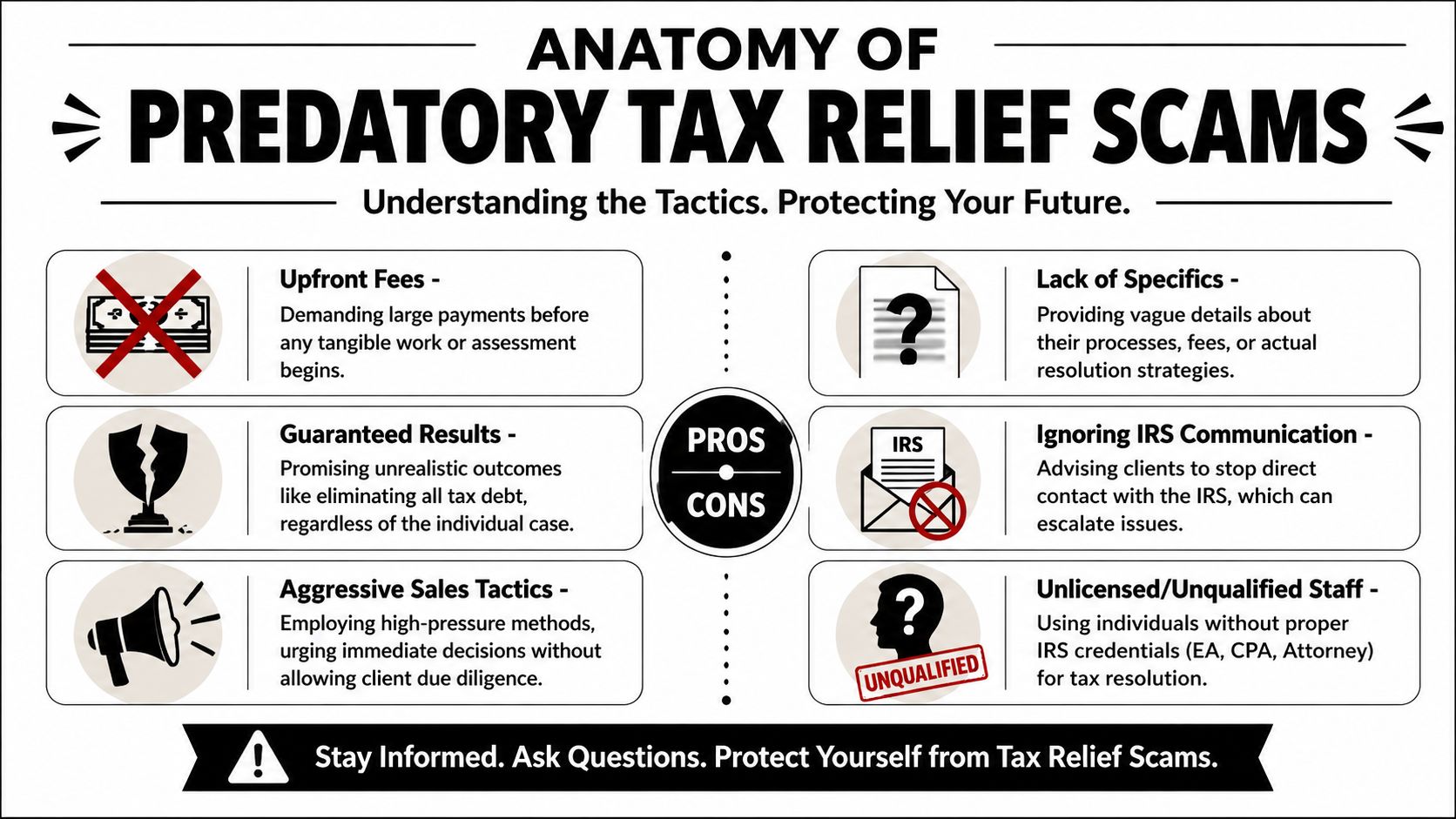
Anatomy of Predatory Tax Relief Scams
The worst tax relief companies all look different on the surface, but the business model is remarkably similar. They market hope, convert fear into urgency, and charge before they’ve earned trust.
That model works because many taxpayers don’t know how IRS resolution really works. The company does. It uses that information gap against you.
The sale comes before the analysis
Predatory firms usually don’t begin with transcripts, financial review, or filing compliance. They begin with a call center. The person on the phone may sound polished, but their job is to move you from frightened prospect to paying customer.
That’s why the conversation often jumps straight to emotional triggers. They tell you time is running out. They talk about programs that can wipe away debt. They imply you may qualify before they know enough to say that responsibly.
The pitch is built on one idea. Get the retainer now. Figure out the facts later.
Fake certainty is the product
One of the clearest warning signs is a company that talks as if qualification is almost automatic. It isn’t.
Documented cases show tax relief companies claimed 97-99% success rates while actual success ratios were 10-25% of clientele, and regulators treated that kind of conduct as material misrepresentation under FTC standards in cases involving lies about eligibility for offers in compromise and debt settlements, with enforcement actions resulting in civil penalties exceeding $195 million against major offenders, as described in this review of tax relief companies making false success claims.
That tells you something important. The deception isn’t incidental. It’s part of the sales process.
If a stranger on the phone says you’ll probably qualify before reviewing the underlying facts, assume the script matters more than your case.
The red flags usually appear in clusters
A legitimate firm can have a weak website or a rushed receptionist and still do good work. A scam operation usually shows multiple signs at once.
Look for combinations like these:
- Big promises tied to small details: They highlight “pennies on the dollar” but stay vague about what program they’d ultimately pursue.
- Pressure on the first call: You hear that acting today matters more than understanding the engagement.
- Credential fog: You can’t tell whether a tax attorney, CPA, or enrolled agent will personally handle the file.
- Front-loaded money demands: The largest conversation is about payment, not legal or tax strategy.
- Poor access to the professional: After signing, you get routed to intake staff, account managers, or unnamed departments.
Here’s the ugly truth. Many of these businesses are not built to resolve hard tax cases efficiently. They’re built to acquire clients at scale.
Why the model keeps working
The answer isn’t mystery. It’s psychology.
Tax debt carries shame. Business owners fear losing control. Employees fear wage levies. Parents fear drained bank accounts. A company that promises relief without discomfort has an advantage over a professional who says, “I need to review transcripts, filings, and finances before I can advise you.”
The honest answer loses the beauty contest. It wins in practice.
I’ve also found that many taxpayers don’t realize how narrow some IRS solutions really are. Offer in Compromise is not a coupon code. It requires facts, documentation, and eligibility. The IRS itself has warned taxpayers about so-called mills pushing OICs broadly, and I discussed that issue in this piece on IRS warnings about OIC mills that promise an Offer in Compromise for everyone.
What predatory firms want you to miss
They don’t want you comparing the promise to the process.
A real tax resolution engagement usually involves records, transcripts, filing history, financial disclosures, deadlines, and strategic decisions. It may also require telling a client something they don’t want to hear, such as:
- Missing returns must be addressed first
- Current compliance matters
- The cheapest-sounding option may not be available
- The IRS won’t accept a story when it requires documentation
Predatory firms flatten all of that into one easy narrative. Pay us, and we’ll make the problem go away.
That’s why I’m blunt about this industry. The worst tax relief companies are not just bad at communication or slow with paperwork. Many are structured to sell certainty first and confront reality later.
If you understand that model, their scripts stop sounding persuasive. They start sounding familiar.
Your Vetting Checklist for Finding a Trustworthy Professional
If you’re looking for help, don’t ask whether a company sounds confident. Ask whether you can verify what they are.
That one shift will save you a lot of grief.
A trustworthy tax resolution professional doesn’t need mystery, pressure, or grand promises. You should be able to identify who will handle your case, what their credentials are, how fees work, and what happens first.

Start with credentials, not branding
A slick company name tells you nothing. A real professional designation tells you where to start.
When you talk to a firm, ask who will be responsible for your matter. Not who signs you up. Not who answers intake. Who is doing the analysis and strategy.
Look for one of these:
- Tax attorney: Best when your case has legal exposure, serious collection issues, payroll tax problems, appeals, or broader financial consequences.
- CPA: Useful when accounting issues, books, amended returns, or business records are central.
- Enrolled agent: Often strong in IRS representation and administrative tax matters.
If the answer is vague, that’s a warning sign. If they avoid naming the professional, assume there’s a reason.
Check whether the person is visible and accountable
I’d rather see a modest firm with a clearly identified attorney or EA than a giant “national” company that hides the people behind the curtain.
Use this quick checklist:
- Look for named professionals on the website. You should see actual people, not generic departments.
- Verify licenses where applicable. A law firm should have attorneys you can identify. A CPA firm should have CPAs you can identify.
- Read what they write. Do they explain tax problems with specificity, or do they recycle slogans?
- Call and ask direct questions. Good firms answer them. Bad firms redirect.
A useful comparison point is this guide on finding expert help with tax debt relief companies, which focuses on how to separate actual professionals from sales-heavy operations.
Client-side test: Ask, “Who will review my IRS transcripts and explain my options?” If you can’t get a direct answer, keep moving.
Read reviews like a lawyer, not a shopper
Online reviews can help, but they are often read too casually. Don’t just count stars. Read the pattern.
Reviews are more useful when you look for specifics:
| Good sign | Bad sign |
|---|---|
| Mentions of clear communication | Lots of praise with no details |
| Discussion of realistic expectations | Repeated mention of pressure or surprise fees |
| References to named professionals | Complaints about never reaching the person who sold the case |
| Concrete descriptions of process | Stories about long silence after payment |
A review saying “they were amazing” doesn’t tell me much. A review saying “the attorney explained my filing issues before recommending any program” tells me more.
Also pay attention to what the firm does with criticism. A professional response sounds measured. A defensive or evasive response tells you how they’ll likely handle conflict once you’re a paying client.
Scrutinize the fee conversation
Many taxpayers get trapped.
A trustworthy professional should be able to explain what they’re charging for and why. The fee discussion should connect to actual work, not to your panic level. If the conversation feels like buying a used car, leave.
Questions worth asking include:
- What work happens before any resolution program is recommended?
- Is the initial phase analysis, compliance work, representation, or all of the above?
- What happens if the facts show I don’t qualify for the option you mentioned?
- Will I get a written engagement that describes scope clearly?
For people also evaluating whether tax debt intersects with insolvency concerns, I often recommend reviewing strong screening questions in other legal contexts too. This list of questions for a bankruptcy attorney is useful because it trains you to listen for clarity, accountability, and scope.
Watch how they handle complexity
Good professionals don’t oversimplify. They organize complexity.
A self-employed person with old unfiled returns, estimated tax problems, and a current IRS balance has a different case from a business owner facing payroll tax exposure. A divorced taxpayer with a joint liability issue has different concerns from an independent contractor with fresh notices. If a company treats all of those cases like the same product, it’s not doing real analysis.
Here are the best signs I know:
- They ask for records before making big claims
- They discuss compliance before settlement
- They tell you what they still need to know
- They resist giving a magic answer on day one
That last point matters. Straight answers are good. Premature certainty is not.
The Crucial First Step Real Professionals Take
The first serious question in any tax debt case is not, “How much can we settle this for?”
It’s, “What are the facts?”
That’s the line separating professionals from performers. A real tax resolution process starts with diagnosis. A bad one starts with a sales pitch disguised as a consultation.

A sales call is not an analysis
Many companies advertise a free consultation. That sounds harmless, but the phrase means very little by itself. In the worst setups, the “consultation” is really a qualification funnel for payment.
A genuine first step looks different. It involves gathering IRS information, understanding the type of debt, checking filing status, identifying deadlines, and reviewing your financial reality before anyone tells you which resolution path makes sense.
That’s not glamorous. It is necessary.
A proper review often includes IRS transcripts, return history, collection status, and the financial information needed to evaluate possible options. If an Offer in Compromise is even being considered, the financial disclosure framework matters, and taxpayers should understand what the IRS will scrutinize in forms like those discussed in this guide to IRS Form 433-A OIC.
JK Harris is the cautionary tale taxpayers should remember
The tax relief industry already has a famous example of what happens when sales outruns analysis.
JK Harris & Company, once the largest tax relief firm, faced lawsuits from over 20 state attorneys general for false advertising and charging exorbitant upfront fees before collapsing into bankruptcy in 2012, and its model left tens of thousands of clients with increased IRS penalties and unresolved debt after they were misled during “free consultations,” according to this account of the JK Harris collapse and taxpayer harm.
That story matters because it exposes the core problem. The free consultation wasn’t free advice. It was the front end of a volume business.
The most dangerous tax advice is certainty sold before the records are reviewed.
What an ethical first step should accomplish
When a professional begins the right way, three things happen.
First, you find out whether the IRS issue is exactly what you think it is. Many taxpayers focus on the balance and miss the underlying driver, such as unfiled returns, active collections, payroll exposure, or incomplete financial information.
Second, you get a realistic list of options. That might include an installment agreement, currently not collectible status, penalty relief arguments, compliance work first, or another resolution path. The right answer depends on facts, not slogans.
Third, you avoid paying for fantasy. A careful analysis can tell you that a heavily advertised option isn’t available in your case. That may be disappointing, but it’s far better than paying someone to chase an option that was never viable.
What you should demand before moving forward
Ask for substance before commitment.
- Ask what documents they need to review first
- Ask whether transcripts will be obtained
- Ask whether filing compliance must be fixed before resolution
- Ask what options they’re considering and why
- Ask what they still don’t know
If the person on the other end doesn’t seem interested in those questions, you’re not in a professional consultation. You’re in a closing room.
The worst tax relief companies hate a careful taxpayer. Careful taxpayers ask for analysis, and analysis ruins bad sales scripts.
What to Do If You've Already Hired a Bad Company
If you already paid a bad company, stop thinking about whether you were too trusting. That won’t help you now. Act quickly and cleanly.
Your job is to stop further damage, regain control of your IRS file, and create a paper trail.
Step one, terminate the relationship in writing
Call if you want, but don’t stop there. Send a written termination notice. Email is useful because it creates a timestamp. If you have a portal, upload it there too. If you have a mailing address, send a letter as well.
Keep it simple. State that you are terminating the engagement effective immediately, revoke any authority to act on your behalf, demand a copy of your file, and instruct them not to incur any further charges.
Save everything.
Step two, deal with IRS authorization
Many tax resolution companies have taxpayers sign forms that allow them to speak with the IRS. You need to know whether that happened and whether the authorization is still active.
Contact the IRS and ask what authorizations are on file. If a Power of Attorney was submitted, take steps to revoke it so the company can’t continue interacting with the IRS as though it still represents you. You need direct control over notices, deadlines, and communication.
If you’re unsure how to choose replacement counsel, read practical guidance on how to find a good tax attorney before signing anything else.
Don’t assume the bad company handled your IRS case just because it took your money. Verify what was actually filed.
Step three, report the conduct
Reporting won’t always get your money back quickly, but it can protect other taxpayers and strengthen your own record.
Consider filing complaints with:
- The Federal Trade Commission
- Your state attorney general
- The Better Business Bureau
Be factual. Don’t rant. List dates, names, promises made, fees paid, documents signed, and what did or did not happen afterward. If you were told you qualified for a specific program before analysis, include that. If communication stopped after payment, include that too.
A short damage-control checklist
Use this in order:
- Pull together the contract and payment records
- Save emails, texts, portal messages, and call logs
- Contact the IRS directly to confirm current status
- Check whether deadlines or missing returns still need attention
- Get a fresh review from a qualified professional
You can recover from hiring the wrong company. I’ve seen plenty of taxpayers do it. But speed matters, especially if collections, payroll issues, or unfiled returns are still in play.
Frequently Asked Questions About Tax Debt Relief
Tax debt relief is full of half-truths, especially online. These are the questions I hear most often from taxpayers who are trying to separate reality from marketing.

Is pennies on the dollar relief real
Sometimes, but not in the broad way advertisers imply.
The IRS does have settlement programs, including Offer in Compromise, but qualification depends on your facts. Income, assets, expenses, compliance, and documentation all matter. The problem is that many of the worst tax relief companies market the exception like it’s the rule.
If someone sells you on a settlement before reviewing the underlying facts, treat that as a warning.
Are all tax relief companies scams
No. Some firms do legitimate work.
The issue is that the industry includes both qualified professionals and aggressive sales organizations using tax fear as a lead source. You should judge the provider, not the category label. A good firm will act like a professional practice. A bad one will act like a closing department.
Should I hire a tax attorney, CPA, or enrolled agent
It depends on the case.
Here’s the practical version:
| Professional | Usually a strong fit when |
|---|---|
| Tax attorney | You have legal exposure, complex collections, payroll tax issues, appeals, or a messy fact pattern |
| CPA | The case turns heavily on accounting, books, business records, or return preparation issues |
| Enrolled agent | You need IRS representation in an administrative matter and the case is not heavily legal in nature |
The key isn’t just the title. It’s whether that person handles tax controversy and resolution work on a regular basis.
Can a company guarantee it will settle my debt
No legitimate professional should guarantee a specific IRS outcome before analysis and documentation.
They can tell you what options may exist. They can explain likely paths. They can discuss risks. But a guarantee at the front end usually means one of two things. Either the person doesn’t know enough to be careful, or they do know better and are choosing to say it anyway.
What should happen in the first real consultation
You should be asked smart questions.
A proper consultation usually explores filing history, notice history, type of tax debt, collection status, business structure, financial condition, and immediate deadlines. It should feel investigative, not theatrical.
If the call focuses more on your credit card than your IRS transcripts, leave.
Can I get my money back from a bad tax relief company
Sometimes, but you should be realistic.
Refunds depend on the contract, the payment method, what services were performed, how quickly you act, and whether the company still exists or responds. If you paid recently, document everything immediately. If the company made clear misrepresentations, that strengthens your position, but it doesn’t guarantee recovery.
Focus first on limiting the IRS damage. Then pursue the money issue with a clear paper trail.
What are the biggest warning signs on the first call
I’d watch for these:
- They predict qualification too quickly
- They use urgency instead of specifics
- They won’t identify the licensed professional on the case
- They push a large payment before reviewing records
- They sound annoyed when you ask detailed questions
A strong advisor won’t be threatened by a careful client.
Is it a problem if they tell me to ignore IRS notices
Yes.
You should never assume IRS mail stops mattering because you hired a company. Even when you have representation, notices can contain deadlines, status changes, and collection developments that need attention. Ignoring notices because a company told you not to worry can put you in a worse position fast.
Read your mail. Keep copies. Ask what each notice means.
Why do bad companies focus so much on Offer in Compromise
Because it’s marketable.
“Installment agreement after financial review” doesn’t sell well on the radio. “Settle your tax debt” does. The issue isn’t that OIC is fake. It’s that some companies use it as universal bait even when many taxpayers won’t qualify for it.
That’s one reason the first step has to be analysis, not enrollment.
I’m a business owner with payroll tax problems. Is that different
Yes, often very different.
Payroll tax cases can carry added risk because the government takes employment tax issues seriously, especially where withheld funds are involved. If you own or operate a business and payroll tax debt is part of the picture, don’t let a generic tax relief company treat it like an ordinary consumer balance due case.
Get advice from someone who deals with that kind of exposure directly.
What if my spouse, divorce, or bankruptcy is part of the tax problem
Then your tax issue may not be a stand-alone issue.
Tax debt often overlaps with family law, insolvency, business ownership, lending, and collections. That doesn’t mean the problem can’t be solved. It means you need someone who recognizes the overlap instead of pretending every case fits one canned IRS program.
What’s the safest way to move forward right now
Slow down enough to verify who you’re hiring.
Before you sign anything, confirm credentials, ask who will do the work, insist on a real case review, and get the scope in writing. Fear makes taxpayers rush. Bad companies count on that rush.
The better move is simple. Get clear facts before giving anyone authority over your IRS problem.
If you want a direct, experienced review of your IRS situation, contact Attorney Stephen A Weisberg. He works with individuals, business owners, and professionals dealing with tax debt, collections, payroll tax issues, and complex IRS problems, and starts with a free tax debt analysis so you can understand your options before paying for representation.


