Why Would the IRS Audit Me: 2026 Risk Guide
Why Would the IRS Audit Me. Discover why the IRS audits you and how to reduce your risk. Learn triggers, statistics, and what to do if selected

In this article
- The 2026 IRS Audit Landscape
- Income changes the baseline
- How the IRS Selects Returns
- Computer screening and statistical norms
- Third-party matching
- Related examinations
- Top Audit Triggers to Watch
- The patterns that create questions
- Understanding Audit Types
- Correspondence audits
- Office audits
- Field audits
- Steps to Take If You Are Audited
- Start with the notice, not the phone
- Build a controlled document file
- Decide when representation makes sense
- Reducing Your Audit Risk
- Make the return internally consistent
- Separate records by purpose
Less than 1% of individual tax returns are selected for audit each year, and the IRS audited 0.29% of individual returns with positive income for tax year 2019, compared with 0.89% in 2010. If you're asking, “Why would the IRS audit me?”, the practical answer is that your return may have triggered a mismatch, looked unusual against comparable returns, involved a related taxpayer, or fit a higher-priority income or business profile.
That distinction matters because an audit usually isn't a completely random event. In more than ten years representing taxpayers in IRS controversies, I've seen how quickly fear turns a manageable document request into a damaging conversation. The IRS isn't necessarily saying you've done something dishonest. It's asking whether specific numbers, deductions, credits, or reporting patterns can be supported.
Overall examination volume has fallen, but that doesn't make every taxpayer equally unlikely to face scrutiny. The agency has limited resources, and its selection systems direct attention toward returns that present compliance risks. High-income individuals, self-employed filers, partnerships, and businesses with third-party mismatches can receive more focused attention even while the broad audit rate remains low.
The 2026 IRS Audit Landscape
The current audit environment has two competing realities. Most individual taxpayers face a low statistical chance of examination, while certain categories receive substantially more attention. The Congressional Research Service reported that the IRS audited 0.29% of 2019 individual income tax returns with positive income, down from 0.89% in 2010, and noted that fewer than 1% of individual returns are selected annually (Congressional Research Service analysis of IRS audits).
That decline reflects reduced enforcement capacity and lower examination volume, not a promise that the IRS has stopped looking closely at unusual returns. Recent reporting also described a 35% decline in IRS audit revenue in fiscal 2025, to $6.5 billion, alongside workforce reductions, a 30% fall in audits of new business partnerships, and a 26% fall in audits of individuals earning above $400,000 (CBS News reporting on IRS audit revenue and workforce changes).
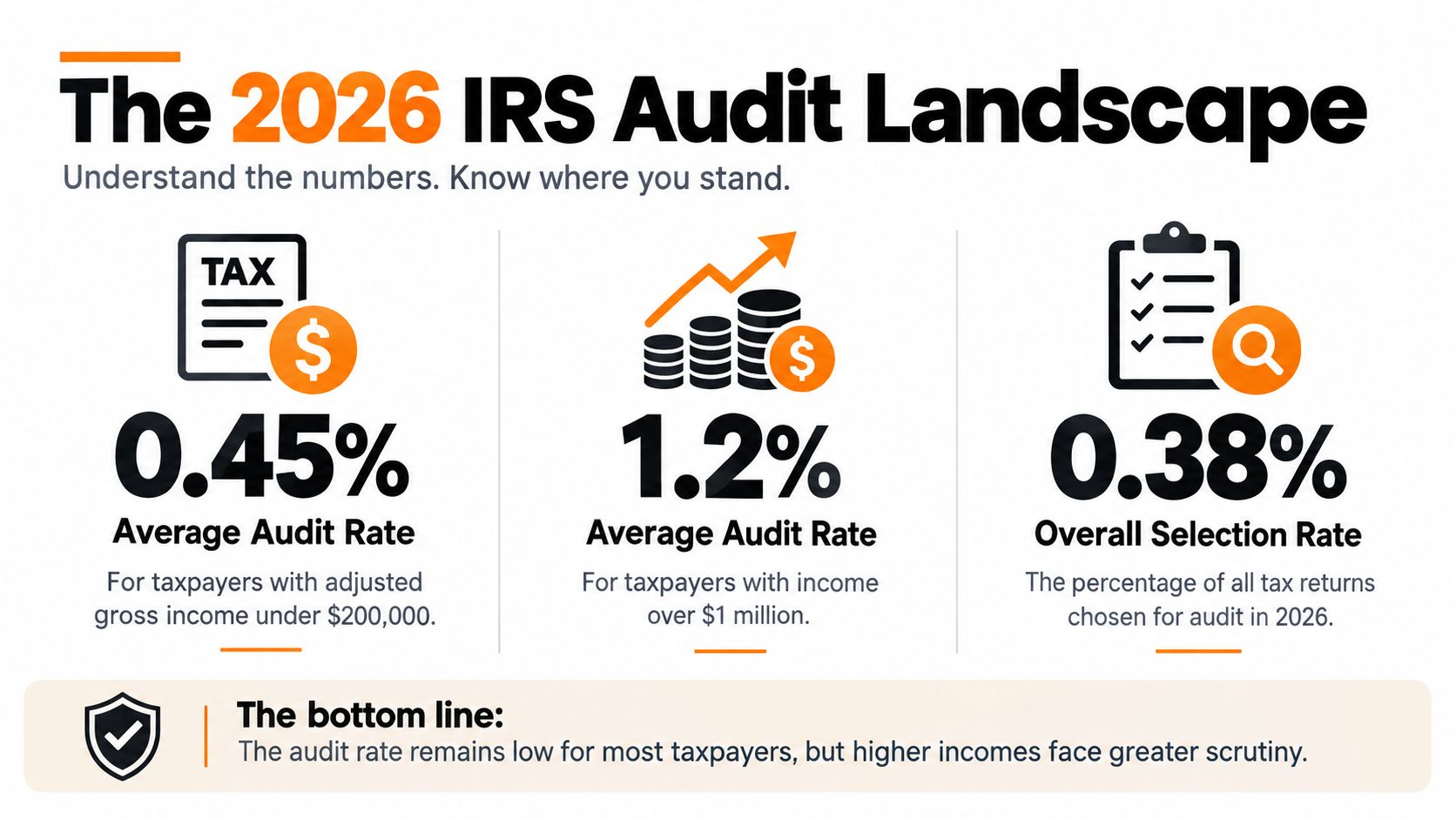
The important point is that fewer audits overall can coexist with sharper targeting. IRS selection channels focus on statistical outliers, reporting discrepancies, industry patterns, and relationships between connected returns. A multi-member LLC, partnership, S corporation owner, or high-wealth taxpayer may therefore face an examination that is narrower in volume but more demanding in substance.
Income changes the baseline
The IRS's compliance data show a pronounced difference by income level. For tax year 2021, examination coverage reached 6.6% for individuals reporting total positive income of $10 million or more, 3.9% for those reporting $5 million to $10 million, and 0.9% for those reporting $1 million to $5 million. Those figures contrast with the 0.29% rate for all positive-income individual returns in tax year 2019 (Congressional Research Service compliance data).
For taxpayers with more than $10 million in total positive income, the IRS projected audit coverage would rise from 11% in 2019 to 16.5% for tax year 2026. That's a projection, not a guarantee that every high-income return will be examined, but it shows where enforcement priorities are directed.
If you're looking for broader discussion about audit preparation and risk factors, this tax audit warning guide offers useful context. The takeaway is simple: your income, business structure, deductions, and reporting relationships all matter more than the idea of an equal-probability audit lottery.
How the IRS Selects Returns
The IRS uses several selection channels, and no single “red flag” explains every audit. The agency says returns can be selected through random selection, computer screening against statistical norms, related examinations, and data matching with third-party information returns such as W-2s and 1099s (IRS explanation of audit selection).
Computer screening and statistical norms
Computer systems compare returns with patterns drawn from statistically valid samples and other compliance information. The system isn't asking whether a particular deduction is automatically illegal. It's looking for combinations of income, expenses, credits, and reporting choices that differ from comparable returns.
A return can attract attention because its figures don't align with similar taxpayers in the same general category. That doesn't prove an error. It increases the likelihood that an IRS employee will ask for support.
Third-party matching
The IRS receives information from employers, financial institutions, brokerages, payment processors, and other reporting entities. If a W-2, 1099, interest statement, dividend statement, or partnership item doesn't reconcile with your return, the mismatch can generate correspondence or contribute to examination selection.
Common causes are mundane. A corrected 1099 arrives after the original return is filed. A spouse enters a document twice. A business reports income under a different name or tax identification number. A preparer omits a form while the IRS still has a copy. The explanation may be innocent, but the taxpayer still needs records that reconcile the difference.
Related examinations
The IRS can examine one taxpayer because of information involving another taxpayer. A partnership, S corporation, trust, spouse, shareholder, or business associate may be connected to the return under review. The IRS specifically recognizes related examinations as a selection channel.
Practical rule: Treat every information statement as a number that must match, not as paperwork you can check after filing.
You may also want to review this guide to automated IRS enforcement and tax debt, particularly if your concern involves system-generated notices rather than an announced field examination. Automated screening can identify a discrepancy, but it can't understand the business explanation behind it. That's where a clear reconciliation becomes valuable.
Top Audit Triggers to Watch
Consider a self-employed consultant who reports substantial gross receipts but claims expenses that appear unusually high for the work performed. The expenses may be legitimate, yet the return can still stand out when the deductions are large, poorly documented, or inconsistent with the business's reported activity.
Now consider a contractor who receives several 1099s but deposits payments into both personal and business accounts. Some receipts never reach the bookkeeping system, while personal purchases get coded as business expenses. The IRS doesn't need to prove intent before asking questions. A mismatch or unusual pattern is enough to create a compliance issue that the taxpayer must explain.

For business filers, government oversight materials identify high-error-probability characteristics, industry-specific patterns, and mismatches with third-party reporting as factors that can influence selection. In practical terms, underreported income, overstated expenses, and worker-classification problems deserve particular care (GAO review of IRS examination selection).
The patterns that create questions
- Income that doesn't reconcile: Your books, bank deposits, 1099s, payment processor records, and filed return should tell the same story. Differences need an explanation and supporting documents.
- Overstated or weakly supported expenses: A deduction isn't safe merely because it's plausible. The business purpose, amount, date, and connection to the activity should be documented.
- Personal and business spending mixed together: A single account used for everything makes legitimate deductions harder to prove and can expose unrelated transactions during an examination.
- Worker classification problems: Treating an employee as an independent contractor can affect payroll taxes, reporting, and deductions. Classification should follow the facts of the relationship, not the label in a contract.
- Industry patterns that don't fit: A return that differs sharply from comparable businesses may draw questions even when the taxpayer believes every line is technically defensible.
Transactions involving retirement accounts and precious metals also deserve precise reporting. If you hold or sell bullion through a retirement arrangement, this overview of Gold IRA Association reporting requirements can help identify the records and reporting questions that may arise. It shouldn't replace tax advice, but it can point you toward issues that need verification.
The practical trade-off is clear. Aggressive deductions may reduce tax today, but unsupported deductions increase the cost of defending the return later. Conservative reporting can reduce disputes, but it shouldn't mean abandoning deductions you're legally entitled to claim. The workable approach is accurate classification, consistent bookkeeping, and documentation created during the year rather than reconstructed under pressure.
Understanding Audit Types
An IRS audit can arrive in different forms, and the type tells you something about the expected scope and working method. A correspondence audit is handled through mail or another written response process. An office audit requires a meeting at an IRS office. A field audit generally involves an agent reviewing a business or complex return in person.
| Audit type | Typical setting | Practical focus |
|---|---|---|
| Correspondence audit | Mail or written submission | Specific items, such as income, credits, or deductions |
| Office audit | IRS office | A broader set of issues supported by requested records |
| Field audit | Business, home, or representative's office | Complex returns, business operations, books, and related issues |
Correspondence audits
A correspondence audit often begins with a letter asking for proof of a particular item. The narrow format can make it feel simple, but a careless response can create additional questions. Send a focused, organized response that addresses the notice, ties documents to the return, and avoids unnecessary personal or business records.
Office audits
An office examination requires more preparation because you'll likely discuss the return with an IRS employee. Bring only the requested records unless your representative determines that additional material is necessary. Practice answering factual questions briefly and accurately. Guessing is worse than saying you need to check the records.
Field audits
Field examinations are usually more involved, especially for businesses, complex returns, and high-income taxpayers. The agent may review accounting records, explain transaction flows, and ask about operations. A representative can often coordinate the meeting location and manage document production, which can prevent an unstructured review of your home or business.
This finance audit tag overview provides broader terminology for audit work across financial settings, although IRS examination procedure is governed by its own rules. For a practical explanation of what an IRS examination may involve, see what happens during an IRS audit.
The key mistake is treating every notice alike. A narrow correspondence request doesn't call for dumping your entire accounting file on the IRS. A field audit shouldn't be handled as if a quick form submission will settle everything.
Steps to Take If You Are Audited
An audit notice can make you feel as though the IRS has already decided you're wrong. It hasn't. The notice identifies the agency's question or proposed position, and your response should supply the facts, records, and legal explanation needed to evaluate it.
Start with the notice, not the phone
Read the tax year, notice number, issues listed, response deadline, and submission instructions. Confirm that the letter is genuine through official IRS channels before sending sensitive information. Don't call an examiner impulsively to explain your entire return. An unplanned conversation can introduce unrelated issues, create avoidable inconsistencies, or cause you to speculate.
Pull the filed return and its supporting schedules before gathering documents. Review the exact line items under examination, then identify how the original figures were calculated. If a preparer or accounting software created the return, request the workpapers or input records.
Build a controlled document file
Organize records by issue, not by the order in which you find them. A useful package usually includes a short index, a reconciliation to the return, and copies of the documents supporting each disputed item.
- Income records: Match W-2s, 1099s, K-1s, bookkeeping reports, bank deposits, and payment processor statements.
- Expense records: Tie invoices, receipts, canceled checks, and account statements to the business purpose and claimed amount.
- Classification records: Preserve contracts, timesheets, payment records, and evidence showing how you determined whether a worker was an employee or contractor.
- Communication records: Keep copies of the notice, your response, delivery confirmation, and every IRS communication.
Provide what the IRS requested, but don't volunteer unrelated material. More documents don't automatically make a response stronger. They can expose transactions, years, or entities that weren't part of the original question.
Decide when representation makes sense
A simple correspondence audit with a clear mismatch may be manageable if your records are complete. Professional representation becomes more valuable when the examination involves multiple years, a business, high income, potential penalties, related entities, or records you can't reconstruct easily.
The IRS projected that audit coverage for individuals with more than $10 million in total positive income could rise from 11% in 2019 to 16.5% in tax year 2026, making preparation particularly important for that group (IRS enforcement projections summarized by CRS). A tax attorney, CPA, or enrolled agent can communicate with the examiner, control the scope of document production, analyze proposed adjustments, and preserve appeal options.
Use this IRS audit preparation checklist before responding. If the deadline is approaching, request appropriate time through the proper channel, but don't assume every deadline can be extended. Some procedural rights depend on timely action.
Reducing Your Audit Risk
You can't guarantee that the IRS will never examine your return. You can make your return easier to understand, easier to reconcile, and easier to defend. That starts with treating tax compliance as a year-round process rather than a filing-season cleanup project.
Make the return internally consistent
Check that your filed return agrees with every information statement you received. If a 1099 is wrong, contact the issuer and retain evidence of the correction. If the mismatch can't be resolved before filing, disclose it through the appropriate tax process and preserve an explanation.
Review unusual items from the perspective of someone who doesn't know your business. A large deduction may be valid, but the file should show why it was incurred, how it relates to the business, and how the amount was calculated.
Separate records by purpose
Use distinct business and personal accounts where appropriate. Reconcile bank activity to the general ledger. Keep invoices, receipts, contracts, mileage records, calendars, and payment confirmations in a system that lets you retrieve them by tax year and issue.
- Document contemporaneously: Create records when the transaction occurs, not after an IRS notice arrives.
- Describe the business purpose: A receipt alone may not explain why an expense was deductible.
- Review worker relationships: Classification should reflect actual control, duties, and working arrangements.
- Reconcile before filing: Compare books, information returns, payroll reports, and the final tax return.
- Get a second review for complexity: A tax professional can identify inconsistencies that a preparer focused only on filing may miss.
Avoiding round numbers isn't a compliance strategy by itself. Real transactions can produce rounded amounts, and changing a number merely to look less noticeable is improper. Accuracy beats appearance. The same is true for deductions: don't abandon legitimate expenses because they might attract attention, but don't claim them without support.
Your response strategy should also reflect the structure of the taxpayer. A sole proprietor may need to reconcile business deposits and contractor forms. An S corporation owner may need to examine payroll, distributions, and shareholder records. A partnership or multi-member LLC may need to coordinate information across related returns. The right preparation is specific to the return, not based on generic audit folklore.
If you're already worried about an IRS notice, Tax Attorney Stephen A Weisberg offers audit representation, examination support, and assistance evaluating IRS issues before you respond. Visit Tax Attorney Stephen A Weisberg to review the available help and request a tax debt analysis.
If an IRS notice has arrived, calendar the deadline, preserve the envelope and every page, pull the filed return, and avoid an unprepared conversation with the examiner. Gather the records tied to the issues listed, then speak with a qualified tax attorney, CPA, or enrolled agent about the safest response for your facts.


