Where to Mail Form 843 to the IRS: A 2026 Guide
Confused where to mail Form 843 to the IRS? Our 2026 guide provides clear instructions, addresses by scenario, and tips for a successful claim. Get it right.
In this article
- Why Is Finding the Form 843 Mailing Address So Hard
- The form is not the routing key
- Why this matters in practice
- The Golden Rule for Locating Your Form 843 Filing Address
- Start with the notice, if there is one
- If there is no notice, tie it to the related return
- Special cases are real, but they are narrow
- One tax period means one form
- Common Scenarios and Their Correct Mailing Addresses
- Penalty abatement tied to an IRS notice
- Penalty or interest claim not tied to a notice
- Claim involving an individual income tax issue
- Claim involving a business return issue
- Special category matters
- Quick reference table
- A practical way to decide
- How to Assemble a Complete and Persuasive Claim Package
- What belongs in the envelope
- Part III is where many claims go wrong
- Packaging tips that actually help
- Protect Your Claim with Proof of Mailing
- Standard mail creates avoidable risk
- Better options than a stamp and hope
- What to keep after mailing
- Certified Mail versus private delivery service
- When You Should Stop and Get Professional Help
- Red flags that deserve a second look
- What professional help should actually do
You've got Form 843 completed, your explanation drafted, and the supporting papers clipped together. Then you hit the part that should be easy: where to mail it. The form doesn't give you a neat, universal IRS address, and that's where many good claims start to drift off course.
The confusion is understandable. Form 843 isn't routed by form number alone. It's routed by the reason for the claim. If you miss that, you can send a perfectly valid request to the wrong place and create delay before the IRS even looks at the substance.
That's the part most basic guides leave out. They tell you to “check the instructions” and stop there. What is helpful is understanding the routing logic, knowing what belongs in the envelope, and mailing it in a way you can later prove.
Why Is Finding the Form 843 Mailing Address So Hard
It's commonly assumed that one IRS form equates to one IRS address. That's a fair assumption. It just isn't how Form 843 works.
The usual scenario looks like this: a taxpayer is asking for penalty abatement, a refund of interest, or correction of a fee issue. The form is ready. The supporting documents are ready. Then the mailing question stalls everything because the address is not printed in the obvious place, and online answers often contradict each other.
The form is not the routing key
With Form 843, the IRS treats the reason for filing as the routing key. That's why generic answers about where to mail Form 843 to the IRS are often incomplete. The address can change depending on whether you are replying to a notice, tying the claim to a related return, or dealing with a special category the IRS has separately assigned.
That design frustrates taxpayers, but there is a logic behind it. Different IRS units handle different underlying issues. A claim tied to a notice may need to go back into the stream that produced that notice. A claim tied to an income tax or business return may need to go to the service center that handles that return type. Special issues can have their own dedicated destination.
The hardest part of Form 843 usually isn't the legal argument. It's making sure the paperwork enters the right IRS channel.
The result is that people search for a single answer that doesn't really exist.
Why this matters in practice
A wrong address doesn't always kill a claim, but it can create avoidable problems. Paper-filed submissions already move slowly, which is one reason IRS paper handling keeps getting so much attention. If you want a sense of how paper processing affects timing, this discussion of the IRS's zero paper initiative and paper filing delays is useful context.
There's also a professional angle here. People dealing with IRS confusion often start by asking their CPA, payroll provider, lawyer, or a trusted referral source where to turn next. That pattern isn't unique to tax matters. The broader way how clients discover lawyers works helps explain why clear, practical guidance matters so much when someone is stuck in an administrative process like this one.
The good news is that you do not need to memorize a list of addresses. You need a decision rule.
The Golden Rule for Locating Your Form 843 Filing Address
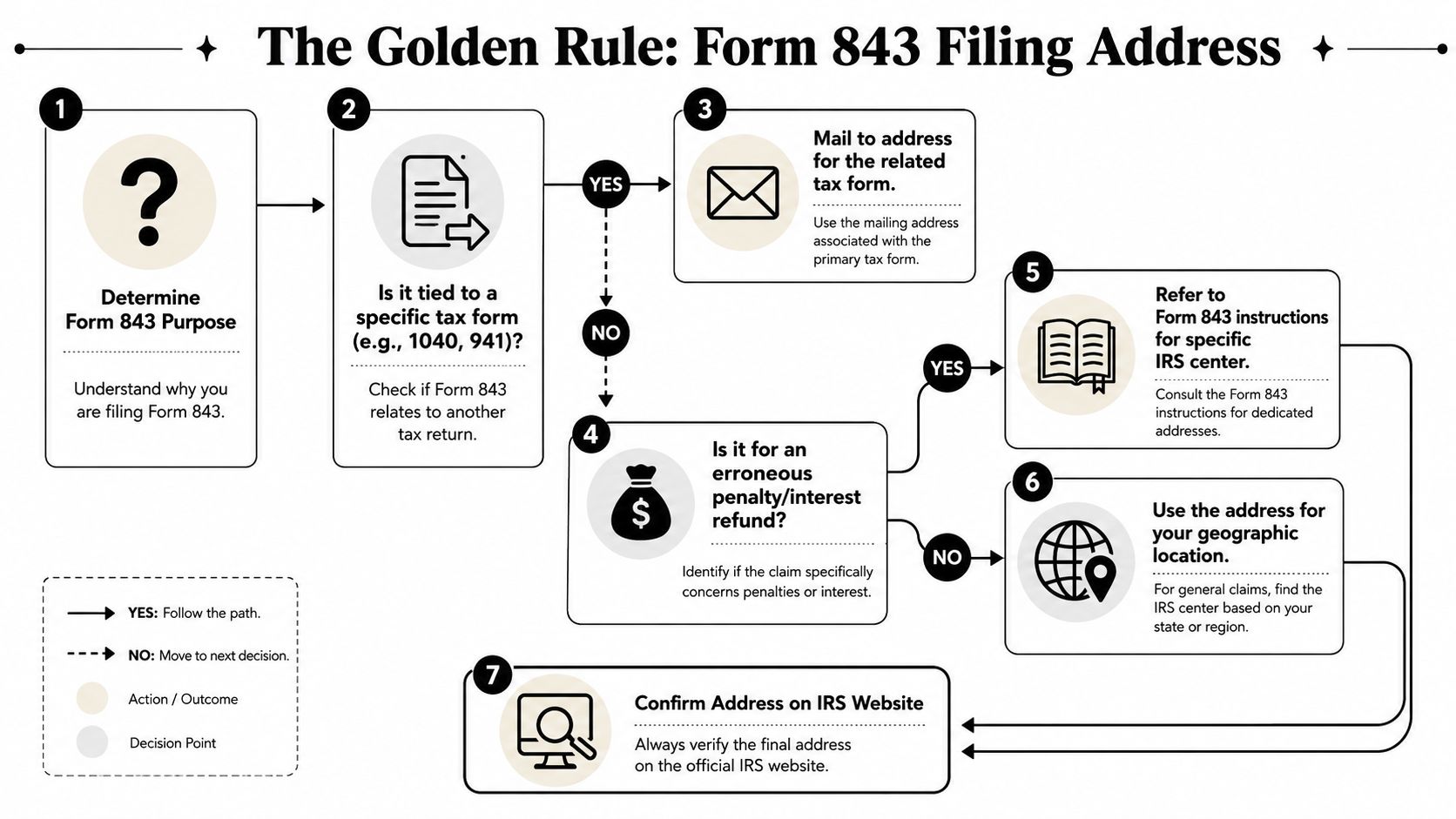
The IRS's current filing guidance for Form 843 makes one principle clear: the mailing address depends on why you are filing. If you are responding to an IRS notice, a common rule is to mail the form to the address on that notice. In other situations, the form generally goes to the service center where you would file the related current-year return. The IRS also identifies a special Ogden, Utah address for a branded prescription drug fee refund tied to Letter 4658, and the instructions require a separate Form 843 for each tax period or fee year, which makes routing more important when multiple periods are involved (IRS where to file guidance for Form 843).
Start with the notice, if there is one
If the IRS sent you a notice and your Form 843 is a response to that notice, start there. In practice, that's the cleanest routing path because the notice address is often tied to the unit already handling the issue.
Many taxpayers often overthink this step. They search online for a more “official” Form 843 address and ignore the notice sitting in front of them. Usually, that's a mistake.
If there is no notice, tie it to the related return
If you're not responding to a notice, think about the underlying tax matter. What return does the claim connect to? The default logic is to use the service center where you would file the related current-year return.
That means the answer often depends less on Form 843 itself and more on the tax return sitting behind it. If the issue relates to an individual income tax matter, look to the filing location for that return. If it relates to a business tax matter, look to the filing location for that business return.
Special cases are real, but they are narrow
Some filers get tripped up because they hear there are exceptions and assume every claim must have one. Usually it doesn't. Most cases follow the notice rule or the related-return rule.
A true special case is the branded prescription drug fee refund tied to Letter 4658. The IRS gives that category a specific Ogden, Utah mailing address at Mail Stop 4921, 1973 N. Rulon White Blvd., Ogden, UT 84201-0051 in its filing guidance. If your matter falls into a category like that, follow the special instruction exactly.
Practical rule: Don't hunt for a universal address. Work down the hierarchy. Notice address first, related-return address second, special instruction only if your issue clearly fits one.
One tax period means one form
This point matters more than people expect. The IRS instructions require a separate Form 843 for each tax period or fee year. If you are asking for relief across multiple years, each form needs to stand on its own.
That has two practical effects:
- Each envelope decision matters. You cannot assume one address choice solves every period.
- Your package needs clear labeling. If multiple periods are involved, mix-ups become more likely unless you organize the filing carefully.
The reason this system works, when it works, is that it matches the claim to the IRS function most likely to process it correctly. The reason it fails is usually simple. Someone uses a shortcut and treats Form 843 like a one-address form.
Common Scenarios and Their Correct Mailing Addresses
Most Form 843 filings fall into a few recurring patterns. The right way to answer the mailing question is to apply the routing logic to the facts in front of you, not to copy an address from someone else's situation.
Penalty abatement tied to an IRS notice
This is common. You received a notice assessing or discussing a penalty, and you want the IRS to remove it. In that situation, the first place to look is the notice itself.
If the Form 843 is your response to that notice, use the notice address. Don't override it because an online article lists a service center address for another taxpayer in another state.
What works:
- Matching the claim to the notice file: Include a copy of the notice and mail to the notice address.
- Keeping the issue narrow: If the request is about one assessed item for one period, present it that way.
What doesn't:
- Sending it to a generic IRS campus you found in a forum post
- Combining multiple periods into one submission without separating them
Penalty or interest claim not tied to a notice
Sometimes there's no active notice. The taxpayer has identified an assessed penalty or interest issue from transcripts, prior correspondence, or account review and wants to file Form 843 directly.
That's where the related-return rule comes in. The likely destination is the service center where the current-year return for that underlying tax matter would be filed.
Regarding mail destinations, people often ask for a city list. I understand why, but that shortcut can mislead. The likely IRS destination may be a service center such as Austin, Fresno, or Kansas City depending on the return type and filing geography, but the safer method is to identify the related return first and then confirm the current filing location for that return.
If there is no notice, your question is no longer “Where does Form 843 go?” It becomes “Where would the related tax return go?”
Claim involving an individual income tax issue
For an individual matter, the filing logic usually traces back to the Form 1040 filing location. If the Form 843 request concerns an individual account issue and no notice controls, use the service center where that current-year individual return would be filed.
That is often straightforward once you stop treating Form 843 as a standalone document.
Claim involving a business return issue
For a business matter, use the same reasoning but with the business return that sits underneath the claim. Payroll tax, corporate income tax, partnership issues, and other business matters can point to different filing streams.
This is one reason business owners should slow down before mailing. “It's an IRS form, so I'll send it where I send everything else” is not a reliable method.
Special category matters
If your claim falls into a category with dedicated IRS instructions, follow those instructions exactly. The branded prescription drug fee refund tied to Letter 4658 is one example the IRS expressly identifies in its current guidance.
That does not mean every unusual tax issue has a hidden specialty address. It means some do, and you should confirm before mailing.
Quick reference table
| Reason for Filing Form 843 | Primary Filing Logic | Likely IRS Service Center Destination |
|---|---|---|
| Responding to an IRS penalty or interest notice | Use the address shown on the IRS notice | The notice address controls |
| Penalty abatement with no current notice | Use the address for the related current-year return | The service center handling that return |
| Interest refund claim tied to an individual tax issue | Follow the current individual return filing location | The service center for the current Form 1040 filing address |
| Claim tied to a business tax return | Follow the current filing location for the related business return | The service center for that business return type |
| Branded prescription drug fee refund tied to Letter 4658 | Use the special IRS instruction for that category | Ogden, Utah, Mail Stop 4921 |
A practical way to decide
When clients ask where to mail Form 843 to the IRS, I tell them to work through three questions in order:
- Did the IRS send a notice about this exact issue? If yes, start with that address.
- If not, what return is this claim really attached to? Use that return's filing location.
- Is this one of the narrow categories with a dedicated IRS destination? If yes, follow the special instruction instead.
That framework avoids most mailing errors without requiring you to memorize IRS campuses.
How to Assemble a Complete and Persuasive Claim Package
The right address gets the package to the correct place. The contents decide whether the claim is understandable, reviewable, and credible.
What belongs in the envelope
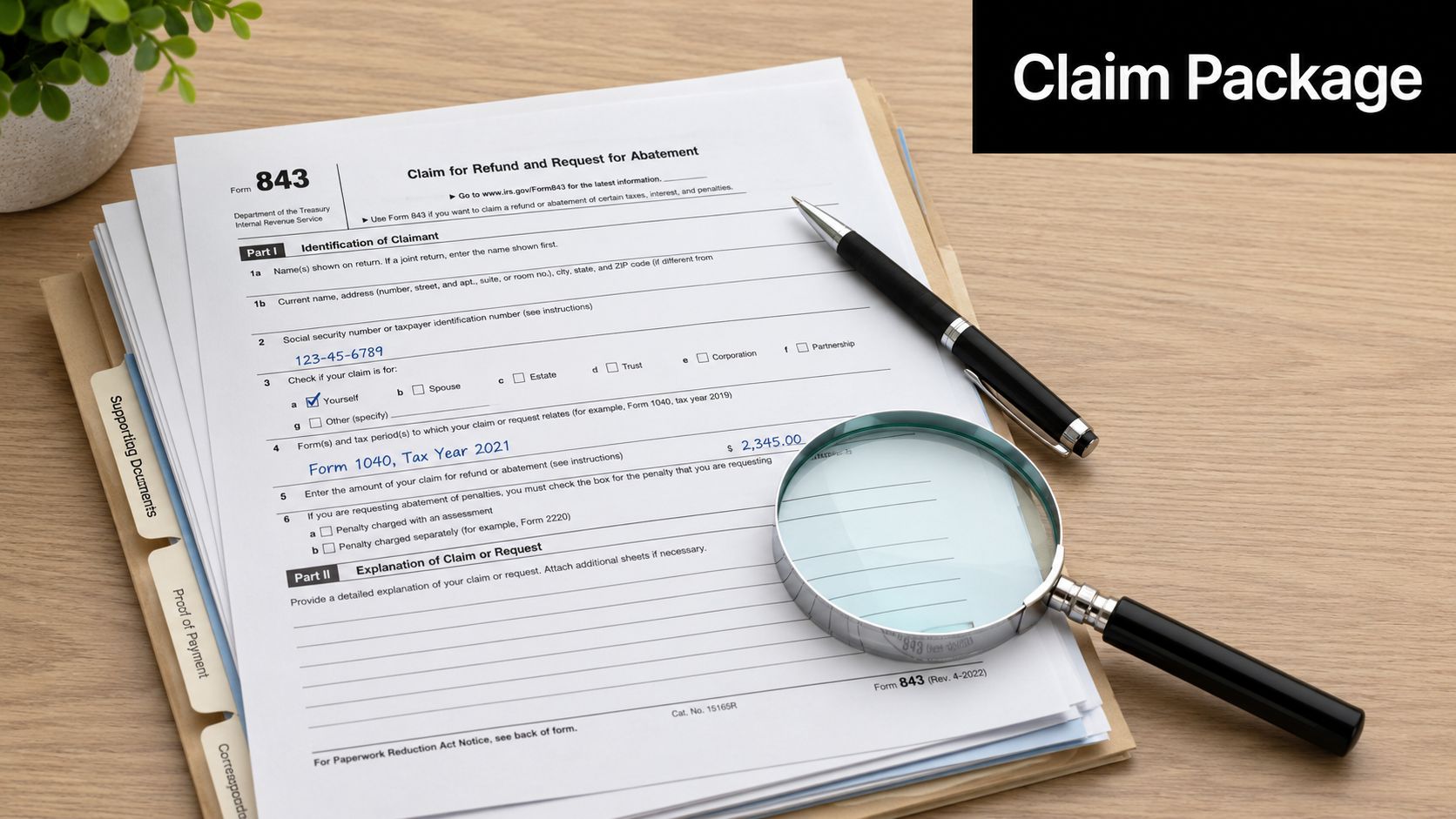
A good Form 843 package usually includes the form itself plus the documents that let an IRS employee understand the claim without guessing.
Include what applies:
- A copy of the IRS notice: If you're responding to one, put it in the package.
- Proof of payment: If you're asking for a refund of something already paid, include support showing payment.
- Account support: Transcripts, account records, or correspondence can help show what was assessed and when.
- Your calculation: If the amount is specific, show how you got there.
- Documents that support your explanation: Contracts, payroll records, prior filings, or written communications may matter depending on the issue.
The goal is not to bury the IRS in paper. The goal is to remove ambiguity.
Part III is where many claims go wrong
The explanation section matters. A weak explanation is often too vague, too emotional, or too long. A strong one states the facts, identifies the assessment or payment at issue, and tells the IRS exactly what relief you want.
Good explanations usually do three things well:
- State the timeline clearly
- Identify the tax period and type of issue
- Connect the facts to the reason relief should be granted
If you're writing a reasonable-cause explanation for penalty abatement, be factual. If the issue is an erroneous assessment, identify the error and support it. If you are replying to an IRS letter, this guide on responding to IRS letters is a useful companion because it helps you frame the response around the specific notice rather than around general frustration.
Short, organized explanations usually work better than long narratives. The IRS employee reading your form needs a path, not a memoir.
Packaging tips that actually help
A few practical habits reduce avoidable processing problems:
- Use a cover letter when the file is thick: It helps identify the tax period, the issue, and the enclosure list.
- Label attachments clearly: If you attach transcripts, notices, and proof of payment, make them easy to distinguish.
- Keep each tax period separate: Even if you mail multiple envelopes the same day, each claim should be internally complete.
- Copy everything before mailing: Keep a full PDF scan or paper copy of the exact submission.
If the issue is simple, you may not need professional help. If the issue is layered, involves multiple years, or depends on a technical legal position, one option is to have a tax controversy attorney review the package before filing. Attorney Stephen A. Weisberg's practice, for example, includes Form 843 guidance for abatement and refund requests. That kind of review can be useful when the mailing decision is only one part of a broader IRS strategy.
Protect Your Claim with Proof of Mailing
A lot of taxpayers put serious effort into preparing Form 843 and then mail it in the least defensible way possible. They use ordinary first-class mail, keep no receipt, and later have no clean way to prove what was sent or when.
That is a mistake.
Standard mail creates avoidable risk
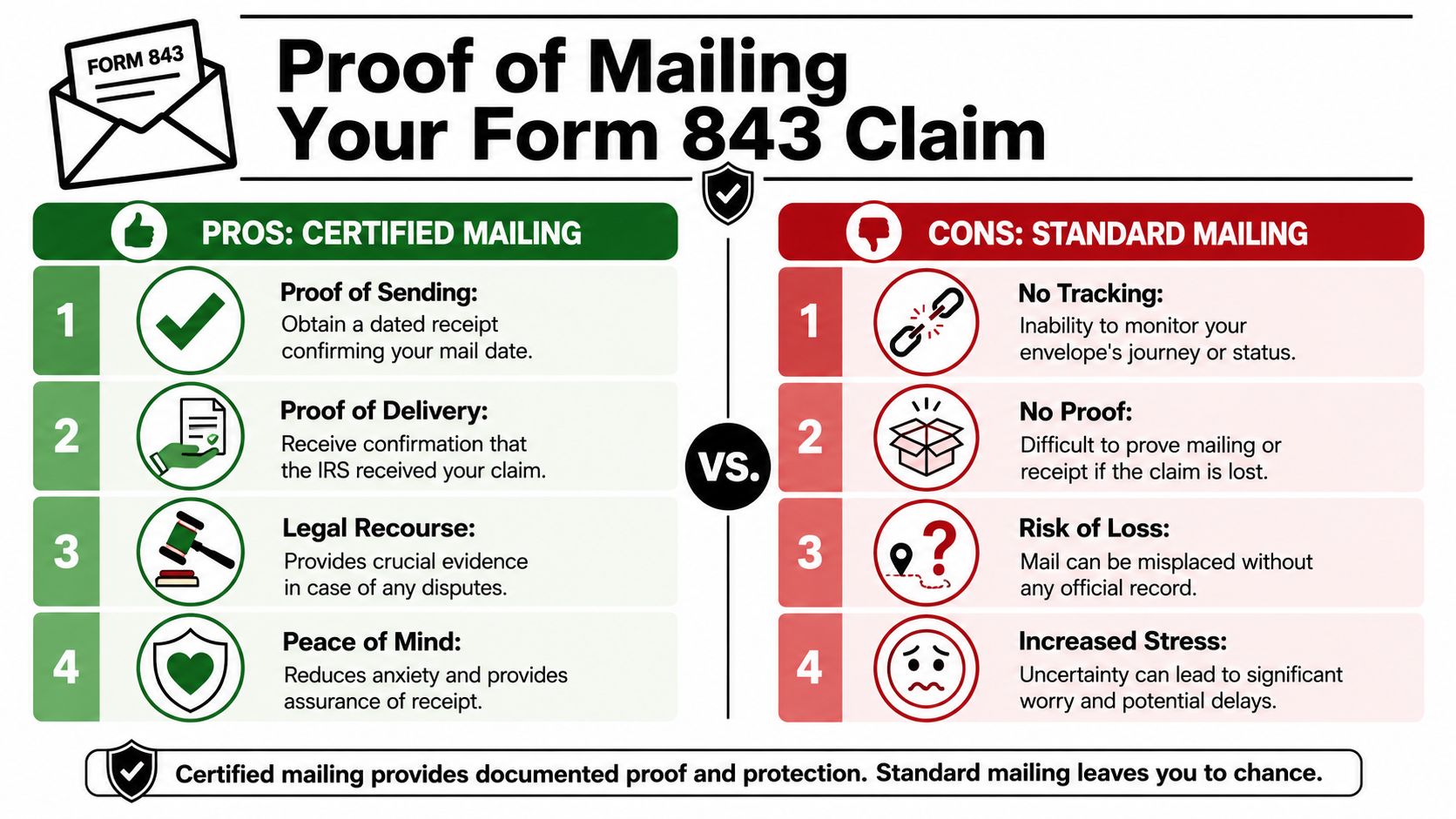
When the IRS says it never received a filing, the conversation changes immediately. You are no longer discussing the merits of your claim. You are discussing proof.
With ordinary mail, that proof may be weak or nonexistent. You may remember when you mailed it. You may have a copy of the form. But if you cannot show mailing and delivery in a reliable way, you've made a hard process harder.
Better options than a stamp and hope
For most Form 843 filings, I prefer one of two approaches:
- USPS Certified Mail with Return Receipt
- A designated private delivery service with tracking and delivery confirmation
Certified Mail gives you a dated mailing receipt. Return Receipt adds evidence that the item was delivered. A private delivery service can also work if it is an IRS-recognized delivery method and you keep the full tracking record.
The point is not to buy fancy shipping. The point is to create a record.
Your mailing method is part of your evidence file. Treat it that way.
What to keep after mailing
Don't just mail the envelope and move on. Build a small proof package for yourself.
Keep:
- The complete copy of what you mailed
- The mailing receipt
- The tracking history
- The delivery confirmation or return receipt
- Any cover letter or enclosure list
If you want a more detailed breakdown of what practitioners watch for, this guide to certified mail and IRS filing proof is worth reviewing before you send the package.
Certified Mail versus private delivery service
There isn't one perfect method for every filer.
| Mailing Method | Main Advantage | Main Limitation |
|---|---|---|
| USPS Certified Mail | Familiar, simple proof of mailing, strong paper trail | You still need to keep the receipt and delivery record |
| USPS Certified Mail with Return Receipt | Adds proof the IRS received the envelope | Slightly more paperwork and cost |
| Private delivery service | Detailed tracking and convenience | You must use an IRS-recognized delivery method and retain the records |
| Standard first-class mail | Cheap and easy | Weak proof if the IRS disputes receipt |
What does not work well is casual mailing with no record. That is the cheapest option on the front end and often the most expensive in time and frustration later.
When You Should Stop and Get Professional Help
Some Form 843 filings are straightforward. Others only look straightforward until you start unpacking what is being challenged.

Red flags that deserve a second look
You should slow down and consider professional help if any of these apply:
- Multiple tax periods are involved: Separate forms are required, and consistency across the filings matters.
- The IRS already denied a similar request: A repeat filing without a stronger legal and factual basis often goes nowhere.
- The issue affects a business with broader IRS exposure: Payroll, income tax, and collection issues can overlap.
- The claim turns on a technical legal position rather than a simple factual correction
- The matter could affect an ongoing collection case, lien, levy, or settlement discussion
A Trust Fund Recovery Penalty issue is another strong reason to stop and get advice. Those cases have their own procedural and substantive complications, and treating them like an ordinary penalty-abatement mailing problem can create real damage.
What professional help should actually do
Good help should bring clarity, not just paperwork. A tax attorney, CPA, or enrolled agent with IRS controversy experience should be able to tell you:
- whether Form 843 is the right vehicle,
- how the claim should be framed,
- what support is missing,
- where the filing should go,
- and what consequences the filing may have for the broader case.
If you are trying to decide who to trust, this practical guide on how to find a good tax attorney can help you evaluate credentials, experience, and fit before you hand over your file.
Sometimes the smartest move is to file on your own with confidence. Sometimes the smarter move is to have someone review the claim before it leaves your office. The difference usually comes down to complexity, history, and what else is riding on the outcome.
If your Form 843 issue involves multiple years, prior IRS denials, penalties that don't fit neatly into a simple explanation, or a business account with bigger exposure, a careful review can save time and avoid missteps. Attorney Stephen A Weisberg offers a free Tax Debt Analysis to evaluate whether he can help and what path makes sense before you commit to representation.


