What to Do When You Get Audited by IRS: Immediate Steps
Learn exactly what to do when you get audited by IRS. Step-by-step guide covering audit types, document prep, deadlines, and representation options.
In this article
- Understanding Your IRS Audit Notice
- Authenticate before you respond
- Identify the document and its legal effect
- Building Your Audit Response File
- Build the file around disputed issues
- Submit controlled copies
- Choosing Between Audit Formats
- Correspondence audits
- Office and field examinations
- When to Hire Tax Representation
- A preparer and controversy counsel serve different roles
- Look for practical controversy experience
- Navigating Post-Audit Deadlines
- Separate the two critical windows
- Consider audit reconsideration when appropriate
- Protecting Your Rights During an Audit
- Turn rights into operating rules
- Use the appeal process deliberately
The IRS must send written notice identifying the specific tax years, issues, and response deadline before the examination proceeds, and failing to respond can lead to an assessment based on incomplete information. Your first job is to authenticate the notice, calendar every deadline, and preserve the records tied to each disputed item.
That letter may be sitting beside your payroll reports, customer invoices, or unopened business mail. Don't call the examiner in a panic, send a box of unsorted receipts, or assume the IRS has already decided you did something wrong. An audit is a formal examination, not an automatic finding of misconduct, and your response strategy in the first 48 hours can shape everything that follows.
Your immediate priorities are simple: confirm the letter is genuine, determine exactly what the IRS is examining, protect the deadline, and build an issue-by-issue file before communicating substantively. The hidden danger isn't just missing a document request. It's confusing an ordinary audit deadline with a later statutory Tax Court deadline, then discovering that an important procedural option has expired.
Understanding Your IRS Audit Notice
When the IRS envelope arrives, put the phone down and read every page. Don't rely on a summary from a staff member, a tax preparer, or a family member. The notice controls the scope of the examination and tells you what the IRS expects next.
Authenticate before you respond
Start by checking whether the notice identifies you correctly. Look for your name, Social Security number or employer identification number, the tax year or years involved, the type of notice, the disputed items, the examiner or IRS contact information, and the permitted response method. Use contact information you independently verify when possible, rather than relying on an unfamiliar payment instruction or suspicious link.
A legitimate examination notice should tell you what records the IRS wants and when it wants them. The IRS Taxpayer Bill of Rights confirms that taxpayers should read the examination notice carefully, identify the years and issues under review, and respond by the deadline stated in the notice.
An audit doesn't mean the IRS has concluded that your return was improper. It means the agency is formally reviewing selected issues. Treat the notice seriously, but don't concede anything just because the letter sounds official.
Identify the document and its legal effect
Not every IRS letter creates the same obligation. A routine CP notice may ask you to correct or explain a specific issue. An examination letter may begin an audit and request substantiation. A proposed adjustment or closing letter may start a different response period. A statutory Notice of Deficiency creates a Tax Court petition deadline that must be handled differently from an ordinary document request.
Write the following on the first page of your audit file:
- Notice type: Record the exact title and form or notice number.
- Tax period: List every tax year covered.
- Issues: Identify each line item, deduction, credit, income item, or penalty under review.
- Response deadline: Calendar the date printed on the notice.
- Submission method: Note whether the IRS requires mail, upload, fax, an appointment, or another method.
- Contact details: Record the examiner's name, identification information, and telephone number.
Practical rule: A request for more time during an examination may be available, but it doesn't revive a missed statutory Tax Court deadline.
If the scope is unclear, ask for clarification before sending a substantive explanation. If you need additional time, contact the number on the notice before the deadline and request it. Keep a written record of the call, the person you spoke with, and any confirmation you receive. For a deeper discussion of handling IRS correspondence, see this guide to responding to IRS letters.
Building Your Audit Response File
An examiner should be able to open your submission and understand the answer without guessing. That requires more than collecting documents. It requires a controlled file that connects each document to a challenged figure on the return.
The IRS advises taxpayers to authenticate the notice, identify the tax year, audit type, disputed line items, response deadline, assigned examiner, and permitted submission method before preparing the response. Its examination guidance also emphasizes organizing records and tying challenged amounts to source documents such as ledgers, bank records, invoices, Forms 1099 and W-2, mileage logs, and deduction substantiation. See IRS Publication 3498-A for the agency's examination procedures.
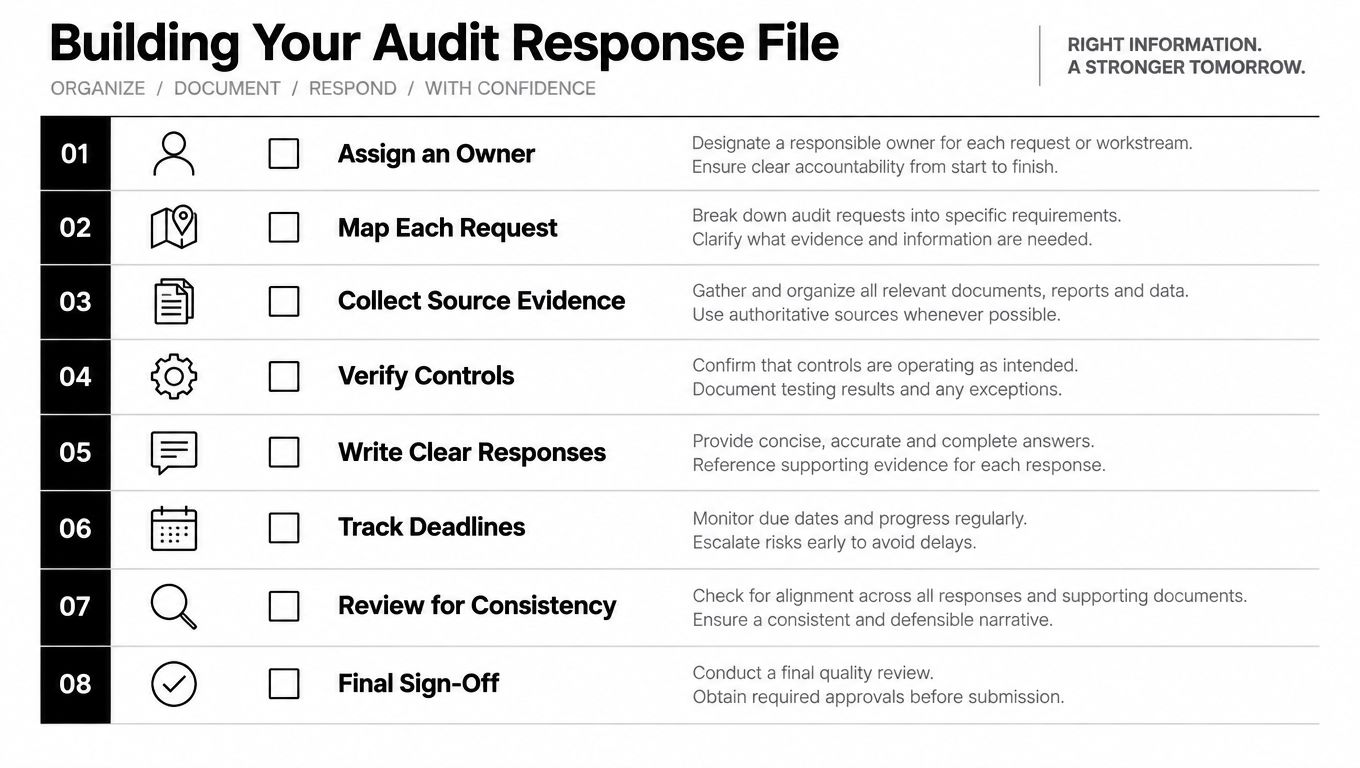
Build the file around disputed issues
Suppose the IRS questions a sole proprietor's vehicle deduction. Don't send every bank statement and receipt you can find. Create a reconciliation schedule showing the amount claimed on the filed return, the business mileage or expense records supporting it, the related payment records, and the precise explanation for why the deduction belongs on the return.
A useful schedule might contain these columns:
| Audit item | Return amount | Supporting records | Explanation |
|---|---|---|---|
| Vehicle expense | Amount reported on the filed return | Mileage log, invoices, payment records | Connects business trips and payments to the deduction |
The point isn't the table's format. The point is the direct line from the IRS question to your answer. If a record supports only part of an amount, say so. Credibility improves when your submission distinguishes documented amounts from estimates or missing records.
Organize separate folders for gross receipts, payroll, basis documentation, vehicle use, estimated-tax payments, and personal items that may affect the business return. For a self-employed person or pass-through business, separately reconcile gross receipts, owner distributions, payroll, shareholder or member basis, vehicle use, meals, home-office costs, and estimated-tax payments. Keep business and personal transactions distinct. Mixing them makes an examiner question the reliability of the entire file.
Submit controlled copies
Send copies, not irreplaceable originals. Add a short index, label exhibits consistently, and keep a complete duplicate of everything submitted. If the packet contains many separate files, a practical PDF merging guide can help you assemble a coherent submission rather than sending disconnected attachments.
Your written explanation should answer the notice directly. Avoid emotional arguments, irrelevant history, and unsupported conclusions. Explain what each exhibit proves and identify the line item or issue it addresses.
For more preparation guidance, use this resource on how to prepare for an IRS audit. Never allow document collection to become an excuse for missing the deadline. Submit what you can, request time if needed, and preserve proof of delivery.
Choosing Between Audit Formats
The format tells you how the IRS expects to examine the return, but it doesn't change your obligation to control the scope. A correspondence audit generally takes place through written requests and document submissions. An office audit requires you to attend a meeting at an IRS office. A field examination takes place at a business or another location arranged with the examiner.

Correspondence audits
A correspondence audit may focus on a defined discrepancy, such as income matching, basis, a deduction, or a credit. The notice usually tells you which records to submit and where to send them. Your advantage is control over the written record. Your risk is submitting an incomplete packet and allowing the IRS to decide the issue using the information already available.
Use a numbered exhibit system. Match each exhibit to a specific question in the notice, and write a concise explanation that helps the reviewer reach the correct conclusion.
Office and field examinations
An office audit demands preparation for questions as well as documents. Bring an organized file and avoid volunteering unrelated information. A field examination can be more intrusive because the examiner may review business operations, accounting systems, payroll records, and transaction practices at the business location.
| Format | Primary preparation | Main procedural risk |
|---|---|---|
| Correspondence | Written, indexed submission | Incomplete response |
| Office | Documents and controlled answers | Expanding questions |
| Field | Records, personnel, and business procedures | Unmanaged access and scope |
Self-employed taxpayers and small-business owners should identify the format before deciding whether to attend alone. The IRS's audit guidance explains that failure to respond can allow the examination to proceed and proposed changes to be issued. Review what happens during an IRS audit before agreeing to an appointment or submitting a broad narrative.
When to Hire Tax Representation
You don't need a lawyer for every simple document request. You do need to recognize when the audit has moved beyond routine substantiation and into an area where an incorrect answer can create wider exposure.
Hire representation early when the examination involves payroll taxes, a potential Trust Fund Recovery Penalty, S corporation or pass-through basis, foreign assets, self-employment records, several tax years, significant business deductions, or facts you can't explain cleanly. These matters often require legal judgment, not just return preparation.
A preparer and controversy counsel serve different roles
The CPA or enrolled agent who prepared your return may understand the accounting and be valuable in reconstructing records. That person may not routinely handle IRS examinations, administrative appeals, or disputed assessments. A tax controversy attorney focuses on the dispute itself, controls communications, frames factual arguments, and evaluates escalation options.
That distinction matters during an office or field examination. Examiners ask questions to determine whether additional issues warrant attention. You shouldn't guess, speculate, or answer from memory when a precise answer requires records. Your representative can help determine what the question means, what documents are responsive, and whether the answer risks expanding the examination.
Representation can also protect your time. A business owner who spends days answering scattered requests may still produce an incomplete file. Counsel can establish a communication channel, organize the response, and keep the submission tied to the notice.
Look for practical controversy experience
Ask a prospective representative:
- Relevant experience: Have they handled audits involving your business structure and disputed issues?
- Scope of work: Will they prepare the response, communicate with the examiner, attend meetings, and handle appeals?
- Fee structure: Do they explain what the initial engagement includes and what later stages cost?
- Case assessment: Will they review the notice and records before promising an outcome?
- Communication: Who will handle your file and explain decisions to you?
Tax Attorney Stephen A Weisberg works with individuals, businesses, and owners facing audits, tax debt, and other IRS or state tax problems. His practice also offers a free Tax Debt Analysis to determine whether assistance is appropriate and how the matter should be approached. You can read more about when to hire a tax attorney.
Don't hire someone because a sales call predicts an easy victory. Hire the person who can identify the disputed issues, explain the risks, and give you a disciplined response plan.
Navigating Post-Audit Deadlines
The examiner's proposed adjustment isn't the end of the case. It's the point where careless calendar management can erase your next remedy.
At closing, compare every proposed adjustment with the evidence you submitted. If the examiner made a factual or computational error, request a manager or supervisory conference and identify the precise mistake. Keep the discussion focused on the record, not on how unfair the process feels.
Separate the two critical windows
IRS materials describe a 30-day period to pursue an administrative appeal after an unresolved closing conference. If the dispute remains unresolved, a statutory Notice of Deficiency generally provides 90 days to petition the U.S. Tax Court without paying the disputed tax first. These are different deadlines with different consequences, as described in IRS guidance on audit appeals.
The 30-day administrative appeal period concerns the Appeals process. The 90-day period concerns a Tax Court petition after a statutory notice. Don't treat an extension for an examination response as though it extends the Tax Court period. It doesn't.
Create a written calendar with these fields:
- Case status: Examination, proposed adjustment, appeal, assessment, reconsideration, or collection.
- Assessment balance: Record the amount assessed and whether it remains unpaid.
- Collection activity: Note notices, liens, levies, or payment discussions.
- Appeal eligibility: Record whether an administrative appeal remains available.
- Statute dates: Calendar every response, appeal, petition, and payment-related deadline.
A calendar system or automated deadline calculation software can reduce clerical errors, but technology doesn't replace legal review. You still need to identify the correct trigger date and confirm what document started the period.
Consider audit reconsideration when appropriate
IRS audit reconsideration may generally be requested in writing while an examination assessment remains unpaid when you have new information, filed a return after the IRS prepared one, or believe a computational or processing error occurred. IRS guidance indicates that an initial response may be expected in roughly 30 days, while internal guidance lists an average processing period of 60 to 90 days. The case may remain open for a long time. IRS Publication 2104 reports an average audit-completion figure of 679.3 days, which is why you should preserve records and calendar dates throughout the matter.
Protecting Your Rights During an Audit
An IRS audit gives the agency authority to examine defined issues, not unlimited permission to disregard your procedural rights. The Taxpayer Bill of Rights recognizes your ability to raise objections, submit supporting documentation, receive consideration of timely materials, and obtain an explanation when the IRS disagrees with your position.

Turn rights into operating rules
Don't merely know that you have rights. Use them in writing and keep evidence that you used them.
If the examiner asks for information outside the stated scope, ask why it's relevant and request clarification. If you disagree with a proposed change, identify the documents and legal or factual basis supporting your position. If the IRS rejects the evidence, request a written explanation of the disagreement.
Submit timely materials through the permitted method and retain delivery confirmation. Keep a call log with the date, contact, subject, and promised follow-up. Never send irreplaceable originals, and never sign a waiver or agreement without understanding what rights it affects.
Use the appeal process deliberately
Taxpayers generally have the right to an administrative appeal of many IRS decisions, including numerous penalties, and to receive a written Appeals determination. That right works only if you protect the deadline and state your disagreement clearly.
Your response should separate three questions:
- What did the return report?
- What does the IRS propose to change?
- What evidence and explanation support your position?
That structure prevents an emotional letter from replacing a legal argument. It also gives an Appeals officer a usable record.
The strongest audit response is usually the one that makes the examiner's decision easier to evaluate, not the one that contains the most pages.
If the IRS issues an unpaid assessment, evaluate audit reconsideration when new evidence, a late-filed return, or a processing error supports that route. If the assessment has been fully paid, the IRS directs taxpayers toward a formal refund claim, subject to limitation periods generally tied to three years from filing or two years from payment, whichever is later, as described in the earlier IRS procedures. Don't assume reconsideration is the correct remedy for every dispute.
Tax Attorney Stephen A Weisberg helps individuals, small businesses, and business owners organize audit responses, communicate with the IRS, and evaluate appeal or reconsideration options. If you've received an IRS notice, visit Tax Attorney Stephen A Weisberg to request a focused review before a missed deadline or incomplete submission turns a manageable examination into a larger tax problem.


