What to Do in Tax Audit a Step-by-Step Playbook
Learn what to do in tax audit from notice to resolution. Get steps, checklists, and pro tips to handle IRS audits confidently.

In this article
- What Happens When You Get Audited and Why It Matters
- The financial stakes can be substantial
- Immediate Actions After Receiving an Audit Notice
- Decode the notice before gathering records
- Protect the deadline without expanding the scope
- How to Gather and Organize Your Audit Documentation
- Build the packet by issue
- Reconstruct missing records carefully
- How to Communicate With Auditors and Choose Representation
- Match the representative to the risk
- Common Audit Pitfalls Timeline Traps and How to Avoid Them
- Early-stage mistakes
- During questions and follow-up
- Keep a control log
- Understanding Audit Outcomes and Your Next Steps Forward
- Choose the next move by exposure
You open the mailbox after a long workday and find an IRS envelope. The return address is familiar, but the word examination turns an ordinary evening into a series of unanswered questions. You may be wondering whether to call the IRS immediately, send every receipt you can find, or ask your accountant to take over.
The right response is more deliberate. What to do in a tax audit depends on the audit type, the issues listed, the records available, and the potential exposure. An audit is a documentation and negotiation process. Treating it as a severity-based triage problem helps you avoid both panic and false confidence.
What Happens When You Get Audited and Why It Matters
An IRS audit begins with a notice, not a verdict. The letter usually identifies the tax year, the return items under review, the records requested, and the response method. From there, the examination may proceed by correspondence, at an IRS office, or in the field at a business, residence, or representative's office.
Correspondence audits are generally narrower and handled in writing. Office audits involve a meeting with an examiner. Field audits tend to require a broader review of business operations, books, assets, and supporting records. The format matters because it affects the amount of preparation, the pace of communication, and the risk that an apparently narrow issue expands into a wider examination.
Selection is also becoming more targeted. Recent reporting describes IRS audit selection as increasingly reliant on precise data analytics rather than a broad, random review of every taxpayer group, as discussed by the National Association of Tax Professionals. That means the examiner may already be looking at a specific mismatch, deduction pattern, income item, or complexity signal. Generic preparation isn't enough. You need to understand the exact issue the IRS has identified.
The financial stakes can be substantial
In fiscal year 2025, the IRS closed 497,621 tax return audits and recommended $26.8 billion in additional tax, an average of roughly $54,000 in recommended tax per closed audit. Of those closed examinations, 12,192 taxpayers, or 2.5%, disagreed with the examiner's determination, accounting for $12.6 billion in unagreed recommended additional tax. These figures come from the IRS compliance presence data.
Those figures don't mean every audit produces a large balance. They do show why an audit shouldn't be treated as a routine paperwork request. A proposed adjustment can affect income tax, deductions, penalties, interest, estimated payments, and sometimes related state filings.
Audit exposure is uneven. Across tax years 2015 through 2023, only 0.36% of individual income tax returns had been examined by the end of fiscal year 2025, compared with a 0.57% cumulative examination rate for corporation returns. Returns reporting $5 million to $10 million in total positive income had 7.9% cumulative examination coverage, and field examinations generated $19.1 billion in additional recommended tax in fiscal year 2025, according to the IRS Data Book.
Practical rule: An audit isn't an accusation of criminal conduct, but it is a formal dispute over the accuracy of a return. Respond as though every document and explanation may influence the final adjustment.
For a broader explanation of notice types, meetings, and examiner requests, review what happens during an IRS audit. Early triage tells you whether you need a clean document submission, a controlled negotiation strategy, or immediate professional representation.
Immediate Actions After Receiving an Audit Notice
If an audit notice arrives while your records are scattered and several people handle the business finances, pause before responding. The first task is triage. Classify the notice by deadline, audit format, and issue type, then decide whether a focused self-response is reasonable or representation should begin immediately.
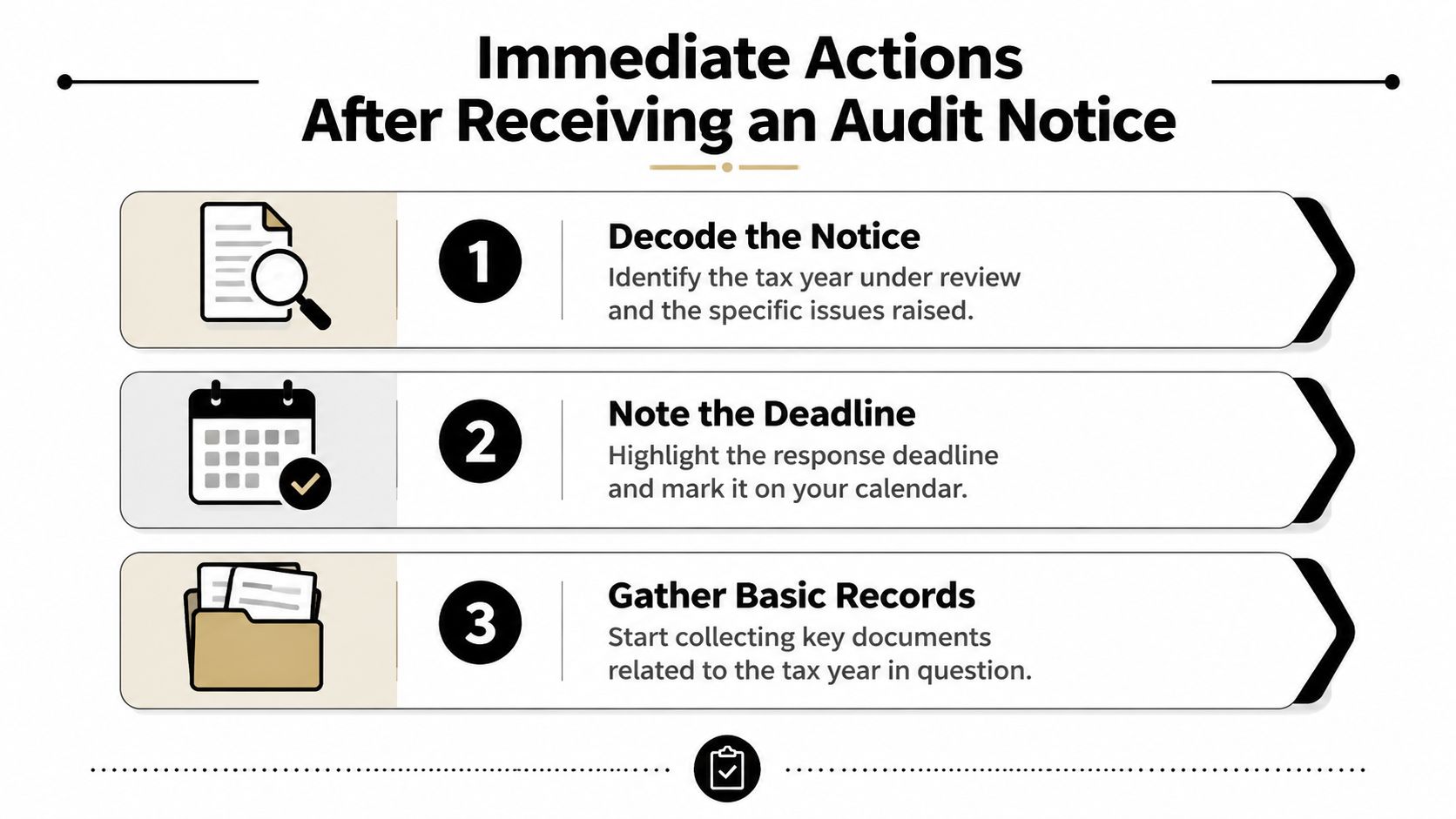
Decode the notice before gathering records
Read the notice and every attachment from beginning to end. Confirm:
- Tax year: Match the year under examination to the return you believe the IRS is reviewing.
- Audit format: Determine whether the IRS requests a mailed response, an office meeting, or access to records at a field location.
- Issues listed: Separate each item, such as income, business expenses, stock transactions, credits, or filing status.
- Deadline: Calendar the response date, then set internal dates for collecting records, reconciling figures, and reviewing the submission.
- Contact method: Use only the telephone number and correspondence address printed on the notice, rather than details from an unsolicited message.
Compare the notice with the filed return, transcript, and prior correspondence. If it refers to a return you did not file or includes unusual instructions, verify the notice through an official IRS channel before sending sensitive information. The IRS guidance on audit responses advises reviewing the letter and attachments, comparing proposed changes with the return, submitting photocopies instead of originals, and calling the number on the notice or requesting more time when necessary.
Analytics-driven selection can shape the examiner's focus. A notice centered on one document mismatch may call for a precise submission. Multiple issues involving business income, expenses, or related returns create more risk because an explanation in one area can affect another. Handle a narrow, document-based correspondence audit yourself if the records are complete and the tax treatment is straightforward. Bring a tax professional in before contacting the examiner if the notice involves several years, large business adjustments, unclear books, possible penalties, or facts that could expose other returns.
Protect the deadline without expanding the scope
If the deadline is realistic, work backward from it. Assign responsibility for locating records, reconciling totals, and reviewing the final packet. If you cannot meet the deadline, request additional time before it expires. The request is not automatically granted, so record when and how you made it.
Do not volunteer unrelated tax years because you are anxious or hope broader disclosure will end the audit sooner. The notice establishes the initial scope. Expanding that scope may be appropriate after a professional reviews the facts, but it should be a deliberate choice.
Do not send original receipts, contracts, ledgers, or identity documents. Submit readable copies or secure electronic copies, retain a complete duplicate, and preserve the original file in its existing order.
The safest first response is focused, timely, and limited to what the notice requests.
Before speaking with the examiner, write down the questions requiring answers and decide who will speak for the taxpayer. Practical guidance on responding to IRS letters can help with correspondence. The immediate objective is to preserve rights, confirm the scope, and avoid a procedural mistake, not to resolve every disputed issue in one call.
How to Gather and Organize Your Audit Documentation
Auditors don't need a storage box full of paper. They need a traceable connection between the return, the transaction, and the supporting evidence. Your packet should let an examiner start with the disputed line, follow the reconciliation, and reach the underlying records without guessing.

Build the packet by issue
Create a separate folder for each audit issue. Label the folders with plain descriptions, such as “Schedule C vehicle expenses,” “1099 income reconciliation,” or “home office calculation.” Put the notice and a copy of the relevant return page at the front of the master file.
For each issue, use this order:
- Summary sheet: State the amount reported, the amount supported by the records, and any difference you identified.
- Reconciliation: Tie the tax return figure to the general ledger, bank activity, invoices, payroll report, or brokerage statement.
- Source records: Include copies of receipts, canceled checks, mileage logs, contracts, account statements, and other requested evidence.
- Explanation of exceptions: Explain missing records, corrected entries, reimbursements, personal portions, or timing differences in direct language.
A business expense packet shouldn't contain every transaction in the company if the notice asks about one category. Pull the requested records, identify the business purpose, and show how the total reaches the amount claimed. For mileage, a contemporaneous log is stronger than a broad statement that the vehicle was “mostly for work.” For a home office, show the relevant calculation and records supporting the expenses, rather than sending unrelated household documents.
Reconstruct missing records carefully
Missing documentation doesn't justify inventing certainty. Start with secondary evidence, such as bank statements, credit-card records, merchant invoices, calendar entries, emails, appointment records, delivery confirmations, and accounting-system exports. Mark reconstructed records as reconstructed and explain the method used.
Inconsistent numbers create avoidable credibility problems. Before submission, compare the packet against the filed return, bookkeeping software, payroll reports, Forms 1099, bank deposits, and prior submissions. If your books show one amount and the return shows another, identify the reason before the examiner finds it.
Keep a submission index with document names, page ranges, dates sent, delivery confirmation, and the issue each document addresses. If you send materials in multiple batches, maintain a running record. A clean index helps you prove what the IRS received and prevents you from resending disorganized material.
Evidence principle: Give the examiner a clear path from the proposed adjustment to the supporting record. More paper isn't the same as better proof.
The IRS specifically instructs taxpayers responding to mail audits to send photocopies, not originals, and to follow the letter's instructions. That simple practice protects irreplaceable records while keeping the response within the agency's requested format.
How to Communicate With Auditors and Choose Representation
Self-representation can work when an audit is narrow, correspondence-based, and supported by records that reconcile. It becomes risky when the matter involves a business, multiple tax years, a field examination, unclear books, substantial proposed tax, possible penalties, or facts that could raise collection or criminal concerns. Triage the case by both severity and issue type before deciding who should speak for you.
The choice is not “CPA versus attorney.” A CPA or enrolled agent may fit a focused examination involving bookkeeping, return preparation, reconciliations, or reconstructed accounting records. A tax attorney brings controversy strategy, advice about privilege in appropriate settings, negotiation, and guidance when the dispute may proceed to appeals, collection, or allegations involving conduct rather than a calculation error.
Match the representative to the risk
| Audit Situation | Best Representation | Why It Fits |
|---|---|---|
| Narrow correspondence audit with complete records | Self-representation or tax preparer | The scope is defined, the communication is written, and the evidence can be submitted without a meeting. |
| Business audit involving bookkeeping or reconciliations | CPA or enrolled agent with controversy experience | The response may require accounting reconstruction and a clear explanation of how the return was prepared. |
| Office audit with disputed facts or several issues | Enrolled agent, CPA, or tax attorney | A representative can organize the response, control the meeting, and prevent casual answers from widening the dispute. |
| Field audit of a business or complex taxpayer | Tax attorney or experienced controversy professional | The examination may involve operations, books, assets, interviews, and broader issue management. |
| Potential fraud, unreported income, payroll-tax responsibility, or criminal exposure | Tax controversy attorney immediately | The consequences extend beyond correcting a return, so communication strategy matters from the start. |
| Proposed adjustment you disagree with | Representative familiar with appeals | The case needs legal and factual analysis, not another shipment of documents. |
If you represent yourself, answer only the question asked. Do not guess. Say that you need to review the records when you do not know, then respond through the agreed method. Avoid volunteering theories, unrelated transactions, or speculative explanations. A short, accurate answer protects credibility better than an improvised account.
Written communication gives you time to verify facts and preserve a precise record. A phone call may resolve a procedural question quickly, but an imprecise answer can be difficult to correct. In a meeting, bring an organized packet and use the notice's issue list as your agenda. If the audit selection appears tied to unusual deductions, income mismatches, or other analytics, address that specific issue first instead of offering a broad business history.
A power of attorney can allow a representative to receive IRS communications and handle examination discussions, subject to the authorization and applicable rules. Confirm the representative's credentials, scope of authority, fees, and who will attend meetings before signing. For help evaluating those factors, review how to find a good tax attorney.
Communication rule: Do not try to sound confident when the records are not in front of you. Accurate, limited answers are more useful than improvised explanations.
Representation costs money and does not guarantee a lower assessment. It can still be worthwhile when the potential tax, penalties, business disruption, or risk of an avoidable admission exceeds the cost of professional control. Choose based on the disputed issue and exposure, not the title alone.
Common Audit Pitfalls Timeline Traps and How to Avoid Them
Most avoidable audit damage happens after the notice arrives. Taxpayers miss a deadline, send an incomplete packet, answer questions from memory, or disclose information that wasn't requested. Each mistake can create another round of questions and make the examiner's job easier.
Early-stage mistakes
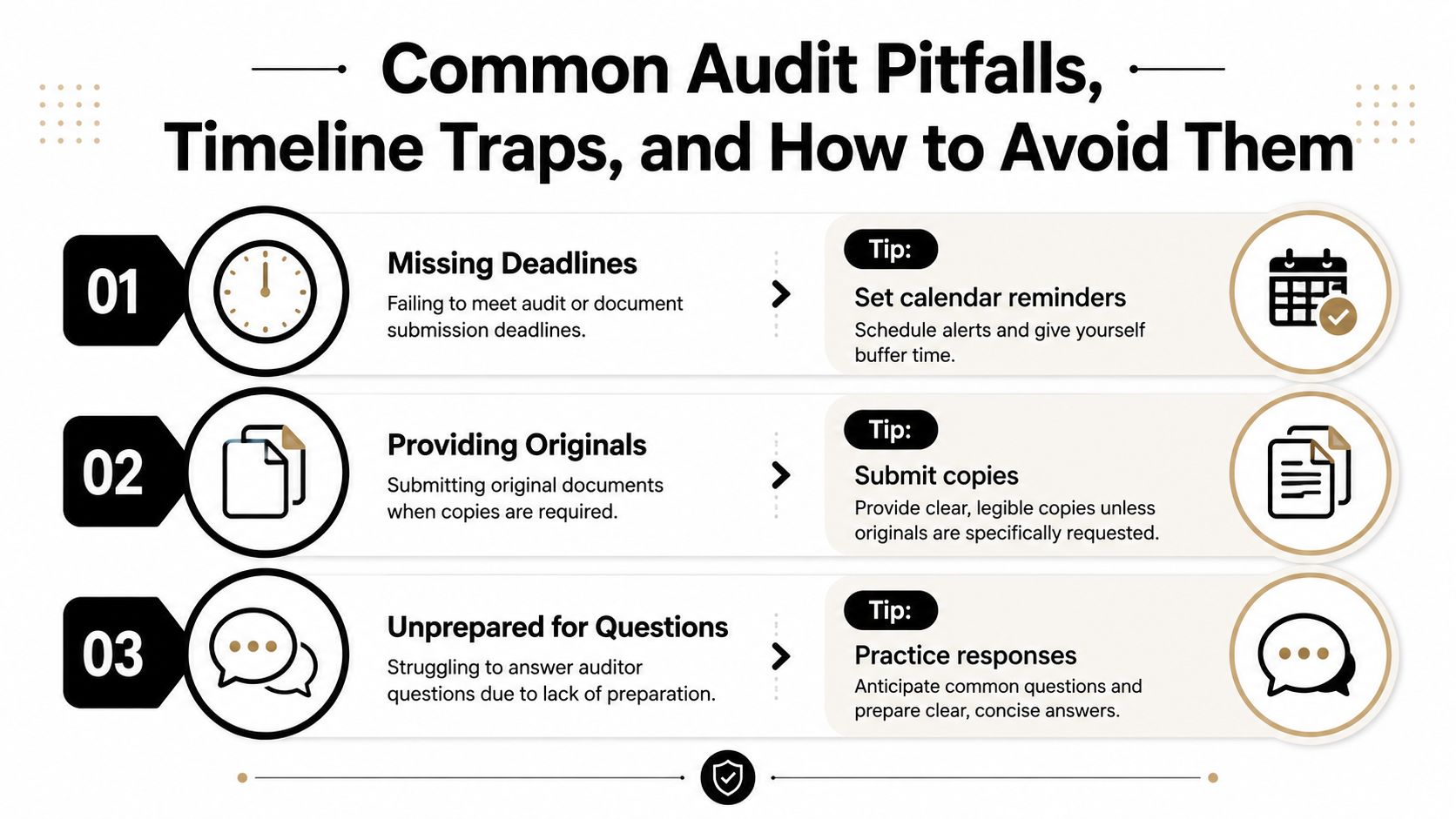
Missing the response date is the first preventable problem. Put the deadline on a calendar, create an earlier internal deadline, and keep proof of delivery or electronic transmission. If the records aren't ready, request more time before the original deadline and keep a copy of the request.
Sending originals creates unnecessary risk. The IRS's audit guidance instructs taxpayers to submit photocopies. Keep the originals, scan them, and send legible copies in the format requested.
Providing a data dump can obscure the answer and expose unrelated transactions. A focused index, issue summary, and reconciliation usually communicate more effectively than an unstructured bundle of statements.
During questions and follow-up
Over-explaining is another common trap. Taxpayers often try to establish good intentions by narrating the entire business history. The examiner still needs proof of the specific item, and a long explanation may introduce facts that require additional documentation.
Don't combine personal and business expenses in a single unexplained category. If an expense has both uses, identify the allocation method and support the business portion. If your bookkeeping contains personal items, correct the accounting treatment before presenting the records and explain the correction accurately.
State issues can follow federal issues, especially when an adjustment changes federal taxable income or exposes a separate state reporting concern. A federal audit doesn't automatically resolve state obligations. Review the relevant state filing position with a professional before assuming the matter ends with the IRS.
Keep a control log
Maintain a timeline with the notice date, every call, every request, each submission, extension discussions, meeting dates, and promised follow-ups. Record the examiner's name, badge or identification details when provided, and the substance of each conversation without editorializing.
Stop rule: Don't send a new explanation merely because you feel anxious. Send a response because it answers a documented request or advances a defined position.
A calm log also helps your representative see the full history. It prevents contradictory answers from different people inside the business and gives you a factual record if the case moves to a supervisor, appeals, or collection.
Understanding Audit Outcomes and Your Next Steps Forward
An audit usually ends in one of three practical positions. The IRS may accept the return with no change, propose an adjustment that you agree to, or issue a determination you don't accept. Each outcome requires a different decision.
A no-change result closes the examined issues, but retain the audit file with the return and supporting records. An agreed adjustment requires careful review of the tax, penalties, interest, payment instructions, and any amended or related filings. Don't sign or pay just because the examiner presents a number. Confirm that the calculation reflects the evidence you submitted and that you understand what remains open.
An unagreed adjustment calls for a structured review. Compare the examiner's factual assumptions with the records, identify legal or computational errors, and determine whether additional documentation could change the result. If disagreement remains, appealing an IRS decision may be appropriate, but deadlines and procedural requirements matter.
Choose the next move by exposure
If the proposed balance is manageable and the assessment is correct, payment or an installment arrangement may be more sensible than prolonged dispute. If you can't pay the balance, an offer in compromise or currently-not-collectible analysis may be relevant, but eligibility depends on your finances, compliance, and the IRS's evaluation of what it can collect.
If the proposed amount is large, the records are incomplete, or the adjustment affects future years, obtain a professional review before agreeing. FY 2025 IRS data reported average recommended additional tax of $1.60 million for corporate audits and $30.6 million for examinations involving taxpayers with more than $20 billion in assets, according to the IRS's Publication 55B. Those figures apply to particular examination groups, not to ordinary taxpayers, but they illustrate why audit severity should guide the response strategy.
Finally, fix the process that produced the issue. Update bookkeeping categories, separate accounts, improve receipt retention, document business purpose, review payroll and information returns, and establish a recurring tax review. A successful audit response isn't complete until the next return is less vulnerable.
Tax Attorney Stephen A Weisberg offers direct representation and strategic review for individuals, business owners, and professionals facing IRS audits, tax debt, and related state issues. If a proposed adjustment is large or the audit has become part of a broader IRS problem, visit Tax Attorney Stephen A Weisberg to request a free Tax Debt Analysis and determine what assistance fits your situation.


