What to Do If You Owe the IRS A Practical Guide
Feeling overwhelmed by tax debt? Learn what to do if you owe the IRS with our guide on payment plans, penalty relief, and resolving your tax issues for good.

In this article
- Your First Moves After an IRS Notice
- Confirm the Debt and Gather Your Documents
- Immediate Action Checklist for IRS Debt
- Finding the Right IRS Payment Plan
- Short-Term Payment Plans
- Long-Term Installment Agreements
- IRS Payment Plan Comparison
- Options When You Truly Cannot Pay
- The Offer in Compromise Explained
- When Collection Is Temporarily Paused
- A Real-World Hardship Scenario
- Getting Penalties Reduced or Removed
- Making a Case for “Reasonable Cause”
- Your One-Time Get Out of Jail Free Card: First-Time Abatement
- How Do You Actually Ask for Penalty Relief?
- Knowing When to Hire a Tax Professional
- Key Signs You Need an Expert
- Choosing the Right Kind of Help
- Answering Your Biggest Questions About IRS Tax Debt
- Will the IRS Actually Garnish My Wages or Seize My Property?
- Should I Just Pay My Tax Bill With a Credit Card?
- What if I Can't Pay and Just Don't File My Return?
- Does Tax Debt Eventually Go Away on Its Own?
Receiving an IRS notice can make your heart sink. It's an intimidating piece of mail. But the most important first step is simple: don't panic, and definitely don't ignore it. Taking a calm, methodical approach right away is the best way to keep penalties from snowballing and get yourself back on solid ground.
Your First Moves After an IRS Notice
That official IRS envelope is designed to get your attention, and for good reason. Ignoring it is the single worst decision you can make. From the moment that notice is issued, interest and penalties start adding up, quickly turning a manageable issue into a much larger financial headache. Your goal is to get ahead of the problem before it spirals.
Start by reading the notice carefully. What is it actually telling you? Is it a CP14, which is the standard, most common notice for a balance due? Or is it something more urgent, like a CP504? That one signals the IRS is gearing up to levy your assets. Knowing what they're saying is the crucial first step. If you've received that specific letter, you can learn more by decoding the IRS CP504 notice to understand exactly what's at stake.
Confirm the Debt and Gather Your Documents
Before you even think about how to pay, you need to be sure the amount is correct. Does the balance owed on the notice actually match your records? Believe it or not, the IRS does make mistakes. A payment could have been misapplied, or income might have been reported incorrectly by a third party. Pull out your copy of the tax return for the year in question and compare it line-by-line with the notice.
If the amount seems right, it's time to start gathering your financial documents. This simple organizational step puts you back in the driver's seat.
- Find the Tax Return: Have the specific tax return for the year in question ready.
- Grab Recent Pay Stubs: You’ll need these to prove your current income.
- List Your Monthly Expenses: A simple budget of essential living costs is a must.
This isn't about sending a check just yet. It's about being prepared for the conversation you're about to have with the IRS, which will make exploring your payment options much, much easier.
When you get an IRS notice, a few immediate actions can set you up for a much better outcome. Here’s a quick checklist to guide your initial response.
Immediate Action Checklist for IRS Debt
| Action Item | Why It's Important | Quick Tip |
|---|---|---|
| Do Not Ignore the Notice | Interest and penalties start immediately. Ignoring it leads to more aggressive collection actions like liens or levies. | Open the letter the day you get it. Mark the response deadline on your calendar. |
| Verify the Amount | The IRS can make errors. You don't want to pay more than you actually owe. | Compare the notice to your original tax return. Check for any missing payments or credits. |
| Gather Financials | Having your income and expense data ready helps you negotiate payment options from a position of knowledge. | Create a simple folder (physical or digital) for the notice, the related tax return, and recent pay stubs. |
Following these initial steps shifts the power dynamic. You're no longer just reacting; you're proactively managing the situation.
Keep in mind, you are far from alone in this. The IRS handles billions in unpaid taxes every year. The "tax gap"—the difference between what taxpayers owe and what they pay on time—was recently estimated to be a staggering $696 billion for a single tax year. You can learn more about these IRS tax gap statistics to see just how common these issues are.
Finding the Right IRS Payment Plan
Okay, so you've double-checked the numbers and the tax bill from the IRS is unfortunately correct. The big question now is, "How am I going to pay this?" The good news is the IRS has several structured payment options, and the goal is to find the one that actually fits your financial reality. This isn't about finding a secret loophole; it's about matching a formal plan to what you can realistically afford.
This infographic lays out a simple decision-making path for when that dreaded IRS notice shows up in your mailbox.
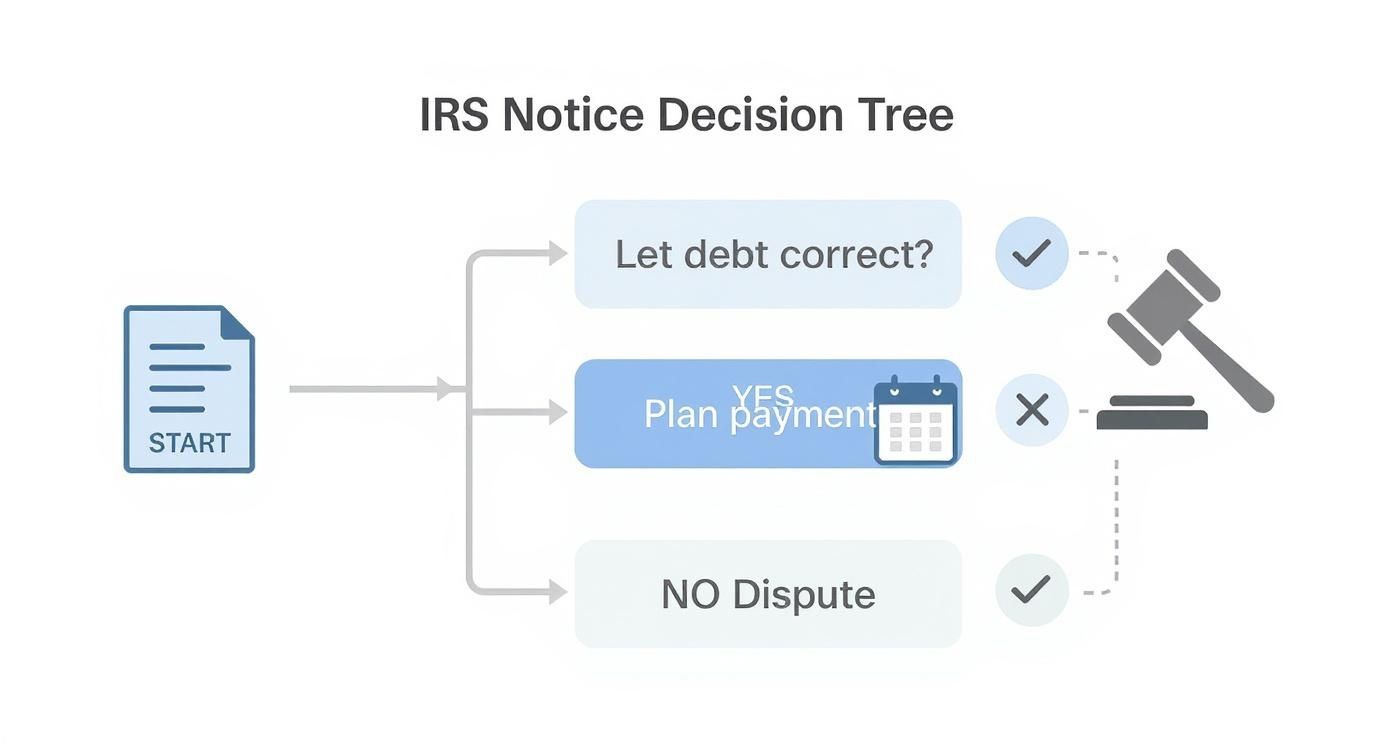
As you can see, once you confirm the debt is yours, it's time to build a payment strategy. Let’s break down what that looks like.
Short-Term Payment Plans
Think you can clear the debt relatively quickly? If so, a short-term payment plan is usually your best bet. The IRS gives you up to 180 days to pay your balance in full without needing a formal, long-term agreement.
The best part? There are no setup fees for this option. Just keep in mind that interest and penalties don't stop—they'll keep accumulating until the day you pay that final dollar. This is a perfect fit if you know you have money coming—maybe from a bonus, a client payment, or a stock sale—but you just don't have the cash on hand today.
Long-Term Installment Agreements
When paying the debt in six months is just not in the cards, you'll want to look into a long-term installment agreement. This is the most common path forward, formally breaking your tax bill into more manageable monthly payments.
The IRS collected more than $16 billion through installment agreements in a recent fiscal year alone, which was a 12% jump from the year before. It goes to show just how many people rely on this exact option to get right with the government.
To get into a streamlined installment agreement without a ton of paperwork, you typically need to owe less than $50,000 in combined tax, penalties, and interest.
Unlike the short-term plan, setting up a long-term agreement comes with some fees. The cost depends on your income and how you choose to apply.
- Apply Online: The cheapest and fastest way to get set up is through the IRS website.
- Use Direct Debit: Agreeing to have payments automatically withdrawn from your bank account often lowers the setup fee. Plus, it ensures you're never late.
- Check for Low-Income Status: If you meet low-income guidelines, the IRS may reduce or even waive the setup fee entirely.
Imagine a self-employed photographer who had a great year and now owes $15,000. A long-term agreement lets them pay that debt off steadily without draining the cash they need to run their business.
Figuring out what those monthly payments might look like can feel like a guessing game. Our guide on using an IRS payment plan calculator is a great resource for getting a clear, realistic estimate. These plans are a huge part of the $77.6 billion the IRS collected in unpaid assessments in a recent year. You can dig into the specifics by checking out the IRS fiscal year data book.
IRS Payment Plan Comparison
To make it easier to see which plan might be right for you, here’s a quick comparison of the most common options.
| Payment Option | Best For | Term Length | Associated Fees |
|---|---|---|---|
| Short-Term Plan | Individuals who can pay in full soon but need a little extra time. | Up to 180 days | None |
| Long-Term Plan | Those needing more than six months to pay off a debt under $50,000. | Up to 72 months | Setup fees apply; vary by application method and income. |
| Offer in Compromise | Taxpayers with significant financial hardship who cannot pay their full tax debt. | Lump-sum or periodic payments | $205 application fee (may be waived) |
| Currently Not Collectible | People who cannot afford to pay anything toward their tax debt due to hardship. | Indefinite (reviewed periodically) | None |
This table provides a high-level overview, but the best choice always depends on the specific details of your financial situation. The key is to find the most affordable, sustainable path to resolving your tax liability.
Options When You Truly Cannot Pay
Sometimes, even a long-term payment plan just isn't in the cards. Life happens. A sudden job loss, a serious medical diagnosis, or a family emergency can completely derail your finances, making any kind of monthly payment seem impossible. When you find yourself in this kind of bind, you need to look beyond the standard payment plans and explore the options designed for genuine financial hardship.

The IRS understands that these situations occur and has programs in place for taxpayers who simply cannot afford to pay. Let’s be clear: these aren’t easy to get, but they provide a critical safety net. The two main paths forward are the Offer in Compromise and Currently Not Collectible status.
The Offer in Compromise Explained
An Offer in Compromise (OIC) is exactly what it sounds like: you make an offer to the IRS to settle your tax debt for less than you actually owe. It can be a lifeline, but the IRS is incredibly strict about who qualifies. The application process is, frankly, a marathon.
To even be considered, you have to prove that paying the full debt would cause significant economic hardship. The IRS will put your finances under a microscope, looking at:
- Ability to Pay: What’s left over after you cover necessary living expenses?
- Income: Your current earnings and what you could realistically earn in the future.
- Asset Equity: The value of everything you own—your home, car, savings accounts, you name it.
You'll have to fill out a Form 433-A, which is an exhaustive financial disclosure. It requires you to lay everything out on the table, and you can bet the IRS will verify every last detail.
It’s important to have realistic expectations. OIC acceptance rates are notoriously low. The IRS rejects most applications, usually because they determine the taxpayer can actually afford a payment plan or has enough in assets to cover the debt.
When Collection Is Temporarily Paused
For some folks, the problem isn't just about settling for a lower amount—it's about not being able to pay anything at all right now. If your financial situation is so severe that you can't even cover basic living costs, you might qualify for Currently Not Collectible (CNC) status.
Putting your account in CNC status means the IRS agrees to temporarily stop trying to collect from you. The threatening letters will stop, and they won’t levy your bank accounts or garnish your wages while you’re in this status. It’s a pause button, not a stop button.
But here’s the catch: your debt doesn't go away. In fact, interest and penalties continue to pile up the entire time your account is on hold. The IRS will also check in on your finances periodically to see if things have improved. As soon as your income recovers, they’ll expect you to start paying again. To get a handle on all the nuances, it's worth exploring the specifics of the IRS Currently Not Collectible status to see how this temporary fix really works.
A Real-World Hardship Scenario
Let's look at a practical example. Imagine a freelance graphic designer who gets into a bad car accident and can't work for six months. With no income and medical bills piling up, they fall behind on their taxes and now owe $20,000. Their savings are gone, and their disability checks barely cover rent and groceries.
- An Installment Agreement is a non-starter; there’s simply no extra money each month.
- An Offer in Compromise could be an option down the road, but right now, they need immediate relief from collection efforts.
- Currently Not Collectible status would be the perfect first step. It would give them the breathing room to recover physically and financially without the constant threat of an IRS levy.
Both OIC and CNC are serious measures reserved for truly difficult circumstances. They require extensive documentation and a clear-eyed view of your finances, but they exist for a reason—to provide a way forward when you feel like you've run out of options.
Getting Penalties Reduced or Removed
That initial tax bill is bad enough. But the penalties and interest the IRS piles on top? That’s what can really make a manageable debt feel impossible. These extra charges can inflate what you owe dramatically, but here's the good news: they aren't always set in stone.
The IRS has specific programs for penalty relief, and if you know how they work, you have a real shot at lowering your total bill. Many people just assume they’re stuck, but that’s often not the case.
Making a Case for “Reasonable Cause”
One of the most common ways to get penalties waived is to argue you had Reasonable Cause for not filing or paying on time. This isn’t a get-out-of-jail-free card for simple forgetfulness. It’s a formal argument that you were hit with circumstances completely out of your control.
To make a successful claim, you have to prove you acted with what the IRS calls "ordinary business care and prudence" but were still physically unable to meet your deadline. Think of it this way: did you do everything a responsible person would do, but life just got in the way?
Some classic examples that the IRS often accepts include:
- A serious illness or death, either your own or that of an immediate family member.
- A fire, flood, or other natural disaster that destroyed your home, business, or financial records.
- You were unable to get the necessary records to file your return despite your best efforts.
- You received incorrect advice from a competent tax professional (and you have proof of it).
Just saying you were sick isn't going to cut it. You need documentation. If you were hospitalized, for example, you'd need to provide medical records showing the exact dates you were incapacitated. We cover the ins and outs of building a solid argument in our guide to IRS Reasonable Cause for penalty abatement.
Your One-Time Get Out of Jail Free Card: First-Time Abatement
There's another powerful tool that most taxpayers don't even know exists: the First-Time Penalty Abatement (FTA) waiver. It’s an administrative courtesy the IRS extends to people who have a great track record.
You’re generally eligible for the FTA if you have a clean three-year compliance history (no penalties), you've filed all your required returns, and you've paid or arranged to pay the underlying tax.
This is a fantastic opportunity. Let’s say a freelance graphic designer underestimated her quarterly tax payments for the first time and got hit with a Failure to Pay penalty. As long as her tax history was clean for the three years prior, she can often get that penalty wiped away completely, just by asking for it.
How Do You Actually Ask for Penalty Relief?
When it comes to making the request, you have a couple of options. The best path forward really depends on how complicated your situation is.
Pick Up the Phone: For a simple First-Time Abatement request, a call to the phone number on your IRS notice can work wonders. Be polite but direct. State that you're requesting penalty relief under the First-Time Abatement policy.
Put It in Writing: If you're building a case for Reasonable Cause, a formal letter is the way to go. You’ll want to attach a completed Form 843, Claim for Refund and Request for Abatement, along with copies of all your supporting documents. A clear, professional letter explaining your situation is crucial.
Whether you're dealing with the fallout from a tough life event or simply capitalizing on your history of good compliance, always explore penalty relief. It’s a critical step that can slash your debt and make the path to becoming square with the IRS a whole lot easier.
Knowing When to Hire a Tax Professional
You can handle a lot of IRS issues yourself, but some situations are clear signals that it's time to call for backup. Trying to tackle a serious tax problem without an expert is like performing your own surgery—it’s incredibly risky and can make a bad situation a whole lot worse. The key is knowing when you’re out of your depth.
Certain scenarios are just too complex or carry too much financial risk to go it alone. For instance, if the IRS is threatening aggressive collection actions, like a lien on your house or a levy on your bank account, you need a professional to step in immediately. These aren't just empty threats; they're signs the IRS is ramping up its efforts, and you need someone who knows how to navigate that battlefield.
Key Signs You Need an Expert
If your tax situation ticks any of the following boxes, investing in professional help isn't just a good idea—it's essential for protecting your financial future. A tax pro can advocate for you and find solutions you probably don't even know exist.
Think about hiring an expert if you:
- Owe more than $50,000 in combined tax, penalties, and interest.
- Are behind on multiple years of tax returns.
- Received a notice that you're facing an official IRS audit.
- Own a business and are struggling with complicated payroll tax issues.
A great tax professional does more than just fill out forms; they build a strategic defense for you. They live and breathe IRS procedures and can negotiate directly with revenue officers, often getting results that an individual taxpayer simply can't on their own.
Choosing the Right Kind of Help
Not all tax professionals are created equal. You need to understand the differences to make sure you're hiring the right expert for your specific problem. Exploring resources for accountants can give you a better feel for the kind of specialized services available.
Here's a quick breakdown of your main options:
- Enrolled Agent (EA): These are my go-to for most representation needs. EAs are licensed directly by the IRS and specialize purely in tax. They're fantastic for handling audits and resolving tough collection issues.
- Certified Public Accountant (CPA): While many CPAs are focused on tax preparation and planning, some specialize in representing clients before the IRS. They can be a great choice, especially if they already know your financial history.
- Tax Attorney: If your situation veers into legal territory—like potential criminal charges for tax evasion or a major dispute that's headed to Tax Court—a tax attorney isn't just an option, it's a necessity.
Deciding to hire someone is a big step, but when things get complicated, it's the smartest move you can make. It takes the pressure off you and puts a dedicated advocate in your corner.
Answering Your Biggest Questions About IRS Tax Debt
When that dreaded letter from the IRS arrives, your mind probably starts racing with questions. Getting straight answers is the first step toward getting things under control and finding a solution. Let’s walk through some of the most common worries people have when they find out they owe the IRS.
Will the IRS Actually Garnish My Wages or Seize My Property?
This is usually the number one fear, and for good reason. The short answer is yes, the IRS has the legal authority to do this, but it’s not their opening move.
A wage garnishment (which the IRS calls a levy) or a Notice of Federal Tax Lien against your property are serious collection tools, but they are typically the end of a long road. These actions only come after the IRS has sent you multiple notices in the mail, including a "Final Notice of Intent to Levy," which gives you a clear window to respond.
The absolute best way to prevent this from ever happening? Engage with them early. Responding to that very first notice to set up a payment arrangement is the most reliable way to keep these aggressive collection tactics off the table.
Should I Just Pay My Tax Bill With a Credit Card?
It’s tempting, isn’t it? You can technically wipe out your IRS debt in an instant by swiping your credit card through an approved third-party processor. But this quick fix usually comes at a steep price.
Think about these two major costs:
- Processing Fees: The payment processor tacks on its own convenience fee for the service.
- High Interest Rates: Let's be honest, your credit card's APR is almost guaranteed to be much higher than the interest and penalty rates on an IRS installment agreement.
In nearly every scenario I've seen, you'll save a significant amount of money in the long run by working directly with the IRS on a payment plan instead of shifting the debt to a high-interest credit card.
What if I Can't Pay and Just Don't File My Return?
This is one of the most financially damaging mistakes a taxpayer can make. When you don't file a return because you know you owe, the IRS doesn't just charge you for not paying—they penalize you for not filing, too. And the two penalties are worlds apart.
The Failure to File penalty is brutal. It can be 5% of your unpaid tax bill for each month you're late, capping out at 25% of your total debt. In contrast, the Failure to Pay penalty is just 0.5% per month. The takeaway is simple: Always, always file your tax return on time, even if you can't send a check with it.
Does Tax Debt Eventually Go Away on Its Own?
Yes, but it takes a while. The IRS generally has 10 years to collect a tax debt, starting from the date the tax was officially assessed. This is known as the Collection Statute of Expiration Date (CSED).
However, that 10-year clock isn't set in stone. Certain actions you take can pause it, effectively extending the time the IRS has to collect. Filing for bankruptcy or submitting an Offer in Compromise are two common examples that can stop the clock. For small business owners, the best strategy is avoiding debt in the first place, and meticulous tax prep is where it starts. Using a detailed small business tax preparation checklist can make all the difference in staying organized and compliant.
At Attorney Stephen A Weisberg, we know every tax problem has a unique story behind it. We don't believe in one-size-fits-all solutions or high-pressure sales. That's why we begin with a free, no-obligation Tax Debt Analysis to find the right strategy for your specific situation. If you’re ready for expert guidance, visit us at weisberg.tax and take the first step toward putting your IRS issues behind you.


