what to do if you owe irs: 5 simple steps to stop penalties
what to do if you owe irs: Learn practical steps, explore payment options, and protect yourself from penalties.

In this article
- What to Do When You Get an IRS Notice
- First, Figure Out What the Notice Actually Says
- Make Sure the Debt Is Real (and Correct)
- Your Immediate Action Plan
- How to Set Up an IRS Payment Plan
- Short-Term vs. Long-Term Plans: What's Right for You?
- Do You Qualify for an IRS Payment Plan?
- Getting Your Ducks in a Row Before You Apply
- Understanding the Costs and Fees Involved
- Exploring an Offer in Compromise to Settle Tax Debt
- Who Actually Qualifies for an OIC?
- Calculating a Realistic Offer Amount
- The Paperwork and Common Pitfalls
- When You Genuinely Cannot Pay Your IRS Debt
- Requesting "Currently Not Collectible" Status
- The High Cost of Ignoring the IRS
- When Your Debt Goes to a Private Collector
- Staying Out of Tax Trouble for Good
- Get Your Withholding Right
- Become a Master of Estimated Taxes
- Good Records Are Your Best Friend
- Always, Always File on Time
- Frequently Asked Questions About Owing the IRS
- Can the IRS Really Forgive Tax Debt?
- How Long Does the IRS Have to Collect Tax Debt?
- What Is the Difference Between a Tax Lien and a Tax Levy?
That official-looking envelope from the IRS can make your heart sink. But the absolute worst thing you can do is stick it in a drawer and hope it goes away. Trust me, it won't. The most important thing to do when you owe the IRS is to act immediately.
Taking that first step—opening the letter, figuring out what it says, and responding—is how you start taking control of the situation.
What to Do When You Get an IRS Notice
Receiving an IRS notice is stressful, no doubt about it. But it's a moment that calls for a calm, methodical approach, not panic. The IRS sends out millions of notices every year, and many are just simple requests for information or notifications of small adjustments.
Ignoring the notice is where the real trouble begins. A manageable balance can quickly spiral out of control with failure-to-pay penalties, which add up at 0.5% per month on whatever you owe, plus interest. By simply responding, you're showing the IRS you’re willing to cooperate, and that’s the key to finding a favorable solution.
First, Figure Out What the Notice Actually Says
Before you do anything else, you need to understand exactly what the IRS is telling you. Look in the top-right corner of the letter for a notice number, like CP14 or CP2000. This code tells you the letter's purpose.
A CP14, for example, is a straightforward "Notice of Tax Due and Demand for Payment." It means the IRS thinks you have unpaid taxes from the return you filed.
Don't just fixate on the total amount they say you owe. Comb through the notice for these key details:
- The tax year in question. Is it for the right year?
- The reason for the balance. The notice should explain if it’s from an math error, underpayment, or added penalties.
- A full breakdown of the charges. You should see separate lines for the original tax, penalties, and interest.
- The response deadline. This is non-negotiable. Missing this date can seriously limit your options and kickstart aggressive collection actions.
Make Sure the Debt Is Real (and Correct)
Before you even think about paying, you need to confirm the debt is actually yours and the amount is accurate. Mistakes happen. The IRS might have bad information, or maybe you made a simple mistake on your return that’s easy to fix.
Expert Tip: Never assume the IRS is 100% correct. Always double-check their notice against your own tax records. If something doesn't add up, you have every right to dispute it—but you must act before the deadline.
A great way to do this is to head over to the official IRS website and set up an online account. There, you can see your payment history, pull tax transcripts, and view your account balance for each tax year. Compare what you find there with the notice in your hand.
If the numbers don't match or you think the notice is wrong, your next move is to call the IRS using the phone number printed on the letter. To get a better handle on the different letters the IRS sends, our guide on IRS collection notices breaks down what each one means and what you need to do.
This decision tree gives you a clear path for what to do next.
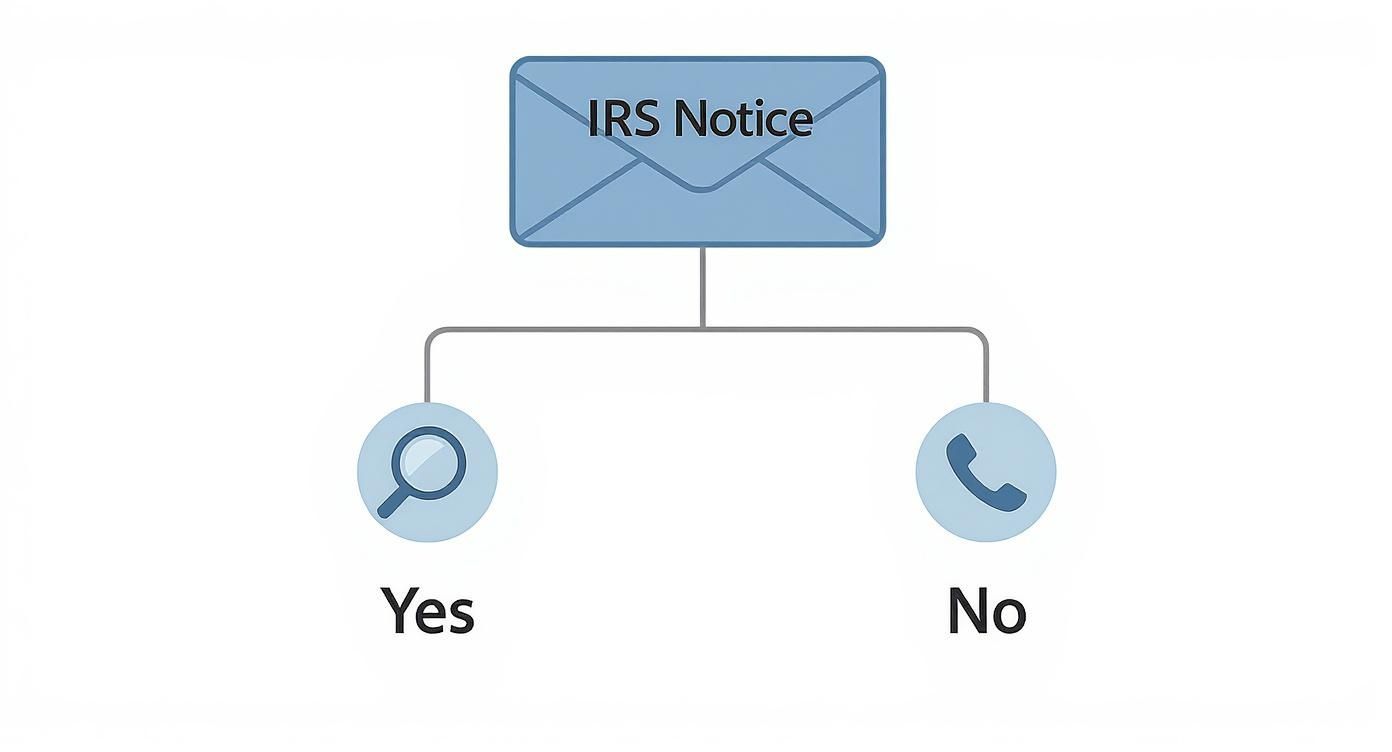
This chart helps simplify those first few moments, guiding you to either confirm the debt is yours or contact the IRS about a potential error or scam.
Your Immediate Action Plan
Once you’ve confirmed the debt is legitimate, you need a game plan.
When you receive that IRS notice, it's easy to feel overwhelmed. This quick-reference table breaks down your first crucial steps into a manageable plan.
Immediate Action Plan for an IRS Notice
| Action Step | Why It's Important | Where to Find Information |
|---|---|---|
| Open the Letter | Ignoring it will only lead to bigger penalties and more serious collection efforts. | The envelope from the IRS. |
| Identify the Notice & Deadline | The notice number (e.g., CP14) tells you the purpose, and the deadline is your final date to respond. | Top-right corner of the first page. |
| Verify the Information | Check the tax year, amount due, and reason against your own records. Mistakes happen. | Compare the notice to your filed tax return and your IRS online account. |
| Contact the IRS (If Needed) | If you spot a discrepancy or have questions, call the number on the notice immediately. | The phone number is listed on the IRS notice. |
Following these steps methodically ensures you stay in control of the process from the very beginning.
Don't feel pressured into paying the full amount on the spot if you can't afford it. The IRS is far more interested in getting you into a resolution plan than causing you financial ruin. At this stage, your proactive communication is what truly matters. You're shifting from just reacting to a scary letter to actively managing your tax situation.
How to Set Up an IRS Payment Plan

So, you've opened that dreaded IRS notice and confirmed the amount you owe is correct. The problem? You just don't have the cash on hand to pay it all right now. Take a breath—this is a common situation, and the IRS has a system for it.
The most straightforward way forward is usually an IRS Installment Agreement, which is just a formal term for a payment plan. This isn't about pleading your case; it's a structured process designed to get you back on track. Being proactive here is key. Setting up a plan can stop those intimidating collection notices and prevent more severe actions like bank levies or wage garnishments.
Short-Term vs. Long-Term Plans: What's Right for You?
Your first decision is about timing. The IRS generally offers two paths, and your financial situation will point you toward the right one.
A Short-Term Payment Plan gives you up to 180 days to clear your balance. This is a great fit if you're dealing with a temporary cash-flow issue. Maybe you’re waiting on a year-end bonus, a big commission check, or proceeds from selling an asset. If you know the money is coming, this is your best bet.
For larger debts that will take longer to chip away at, a Long-Term Installment Agreement is the way to go. These plans can stretch out for up to 72 months (that’s six years), breaking down a daunting balance into much more manageable monthly payments.
My Takeaway: The 180-day plan is simpler and has lower setup fees. But for bigger debts, the long-term plan provides critical breathing room. Be honest with yourself about what you can realistically afford each month before you commit.
Do You Qualify for an IRS Payment Plan?
The good news is that the eligibility rules are pretty clear, especially if you use the IRS's online system. While every case is a little different, the general guidelines are fairly simple.
For an online long-term agreement, you typically need to:
- Owe less than a combined $50,000 (this includes the original tax, penalties, and interest).
- Be up-to-date on filing all your required tax returns.
- Be an individual taxpayer. This gets more complicated for businesses with outstanding payroll taxes.
What if you owe more than $50,000 or have some unfiled returns? Don't worry, you aren't out of options. It just means you can't use the automated online portal. You'll have to contact the IRS by phone or mail to work out a plan, and they'll likely ask for more detailed financial information to make it happen.
Getting Your Ducks in a Row Before You Apply
A little prep work will make the application process much smoother. It’s far less stressful to have everything you need sitting in front of you before you even log on.
Here’s a quick checklist of what to have ready:
- Your name and address exactly as they appear on your last tax return.
- Your Social Security Number (SSN) or Individual Taxpayer Identification Number (ITIN).
- The exact amount you owe (grab your most recent IRS notice for this).
- A phone number and valid email address.
If you plan to set up automatic payments—which I highly recommend—you'll also need your bank's routing and account numbers. For a deeper look at the various options available, our guide on IRS back taxes payment plan strategies offers more detailed insights.
Understanding the Costs and Fees Involved
An IRS payment plan isn't free, so it’s important to know about the associated costs from the get-go. No one likes financial surprises.
First, remember that interest and penalties don’t stop. They will continue to build on your unpaid balance until it's paid off. The one bit of good news is that the failure-to-pay penalty is usually cut in half (from 0.5% to 0.25% per month) once your plan is approved.
Second, there are one-time setup fees. The amount you'll pay depends on how you apply and how you choose to make your payments.
IRS Installment Agreement Setup Fees
| Application Method | Payment Method | Standard Fee | Low-Income Fee |
|---|---|---|---|
| Online Application | Direct Debit | $31 | $31 (may be waived) |
| Online Application | Other Methods | $130 | $43 |
| Phone, Mail, In-Person | Direct Debit | $107 | $43 |
| Phone, Mail, In-Person | Other Methods | $225 | $43 |
As you can see, applying online and setting up a direct debit is by far the cheapest route. This is a popular and effective solution for millions of Americans. In a recent fiscal year, the IRS collected over $16 billion through installment agreements alone, a jump of over 12% from the year before. You can see these and other stats in their annual data book. This trend shows the IRS is more than willing to work with taxpayers who communicate openly and commit to a repayment plan.
Exploring an Offer in Compromise to Settle Tax Debt
Sometimes, even a long-term payment plan is just out of reach. If you're looking at your tax bill and can’t imagine a future where it's fully paid off, it might be time to consider a different route: the Offer in Compromise (OIC).
An OIC is a formal agreement with the IRS to settle your tax liability for a lower amount than what you originally owed. This isn't a giveaway; it’s the IRS making a practical decision that collecting the full debt from you is highly unlikely. Instead of chasing a number you’ll never be able to pay, they agree to a smaller, realistic sum.
But let's be clear—this isn't some hidden loophole. The OIC is a demanding process designed for people in genuine financial distress.
Who Actually Qualifies for an OIC?
The IRS is incredibly selective about who gets an OIC. They don't approve these agreements easily. The most common path to acceptance is under a category the IRS calls Doubt as to Collectibility. This is just their formal way of saying there’s serious doubt you could ever pay the full amount before the collection statute expires.
To make their case, the IRS will put your entire financial life under a microscope. They’ll dig into everything:
- Your Ability to Pay: This comes down to your current income minus your necessary living expenses.
- Your Assets: They want to know the equity in your home, cars, bank accounts, retirement funds, and other investments.
- Your Future Earning Potential: Your age, health, and profession all play a role in what the IRS thinks you might earn down the road.
You basically have to prove that the total amount they could ever hope to collect from you—what they call your reasonable collection potential—is less than the tax debt itself.
A Word of Caution: The OIC process demands total financial transparency. I've seen clients get into trouble for trying to hide assets or fudge numbers. The IRS verifies everything, so honesty is non-negotiable. This is a lifeline for serious hardship, not a tool to just get a discount on your taxes.
Calculating a Realistic Offer Amount
So, how much should you offer? The IRS isn't looking for an arbitrary figure. Your offer has to be equal to or greater than your reasonable collection potential (RCP).
They have a specific formula for this: the net value of your assets plus your future disposable income. It's a complicated calculation, but it all boils down to what you can realistically afford after covering your essential living costs.
For a deep dive into the nitty-gritty of preparing an offer, check out our complete guide to the IRS Offer in Compromise.
One of the biggest sticking points I see with clients is the IRS's national and local standards for allowable living expenses. If your actual housing or transportation costs are higher than their standardized amounts, you need rock-solid documentation to justify every single dollar.
The Paperwork and Common Pitfalls
Submitting an OIC involves a mountain of paperwork, starting with Form 656, Offer in Compromise, and either Form 433-A (OIC) for individuals or 433-B (OIC) for businesses. These forms require you to lay out your entire financial situation in excruciating detail.
It's heartbreaking, but many OICs get rejected for simple, avoidable mistakes. The most common traps are:
- Incomplete Forms: Leaving lines blank or providing vague answers is a fast track to rejection.
- Unfiled Tax Returns: The IRS won't even look at your offer unless you're completely caught up on all required tax filings.
- Missing Estimated Payments: If you're self-employed, you have to be current on your quarterly tax payments for the current year.
- A Lowball Offer: If your offer doesn't align with the IRS's own calculation of what you can pay, they will turn it down flat.
The numbers tell the story. In a recent fiscal year, taxpayers submitted 33,591 offers, but the IRS only accepted 7,199 of them. That's a 21% acceptance rate, which really drives home how tough this process is. Your case has to be compelling and perfectly documented. You can see more details in the IRS's official collections activities data.
When you're asking what to do if you owe the IRS and feel trapped, an OIC can truly be a fresh start. It’s a powerful tool, but it’s one that demands meticulous preparation and a firm grasp of the IRS’s rigid rules.
When You Genuinely Cannot Pay Your IRS Debt

Sometimes, even the most flexible payment plan or an Offer in Compromise is completely out of reach. What happens when your financial situation is so dire that you can't even cover basic living expenses like rent and food, let alone make a tax payment?
For those facing extreme financial hardship, there is a specific path forward. It’s a temporary solution, but it can be a lifesaver. This isn't about giving up; it's about being realistic and honest with the IRS about your inability to pay right now. In my experience, proactive communication—even when you have nothing to offer—is always better than silence.
Requesting "Currently Not Collectible" Status
If you truly cannot afford to pay anything, you can ask the IRS to place your account in Currently Not Collectible (CNC) status. This is an official designation that puts a temporary hold on all active collection efforts, which means no levies or garnishments.
Think of it as hitting the pause button. By granting CNC status, the IRS is formally acknowledging that trying to collect from you at this moment would cause significant economic hardship. To qualify, you’ll have to provide a detailed look at your finances, usually by completing Form 433-F, the Collection Information Statement.
It's critical to understand what CNC status is—and what it isn't.
- It is not forgiveness. Your tax debt doesn't disappear.
- Interest and penalties keep adding up. The total amount you owe will continue to grow while your account is on hold.
- The IRS will check in on you. They periodically review your financial situation and can restart collections if your income improves.
Requesting CNC is a serious step, but it can provide essential breathing room. You can get a much deeper dive into how this all works in our detailed explanation of the IRS Currently Not Collectible status.
The High Cost of Ignoring the IRS
The absolute worst thing you can do when you owe the IRS is stick your head in the sand. Radio silence is interpreted as willful defiance, and it triggers the agency’s most aggressive collection tools. The consequences can be financially devastating and turn your life upside down.
If you don't communicate, the IRS will assume you're refusing to pay, which can lead to:
- Federal Tax Lien: A public legal claim against all your property—your house, your car, everything. It demolishes your credit and makes getting a loan nearly impossible.
- Wage Garnishment: The IRS can legally command your employer to send them a hefty chunk of your paycheck before you ever see it.
- Bank Levy: The agency can freeze your bank accounts and simply take the money to apply toward your debt.
My Experience: I've seen clients come to me in a panic after their bank accounts were suddenly emptied. The shock is overwhelming. In almost every single case, it happened because they ignored a series of notices, hoping the problem would just go away. It never does.
When Your Debt Goes to a Private Collector
In certain situations, the IRS will transfer overdue tax accounts to private collection agencies (PCAs). This doesn't happen out of the blue. You will always get two letters from the IRS first—one letting you know your account is being transferred, and a second from the private firm itself.
That second letter is crucial because it contains a unique taxpayer authentication number. This is your key to verifying that the collection agency is legitimate and not a scammer trying to take advantage of you.
As of late 2021, the IRS was assigning these debts to three specific agencies: CBE Group Inc., Coast Professional, Inc., and ConServe. You can find more information on this program in the official IRS Data Book. Remember, even if you're working with a PCA, you have all the same taxpayer rights and payment options as you would if you were dealing directly with the IRS.
No matter how overwhelming your situation feels, taking action is the only way forward. Understanding your options, like CNC status, and the severe risks of inaction empowers you to protect yourself and begin the slow journey back to financial stability.
Staying Out of Tax Trouble for Good
Getting out from under tax debt is a huge relief. Seriously, take a moment to appreciate that. But the real win is making sure you never land in that spot again. The stress, the threatening letters, the constant worry—it’s a heavy burden, and one you can learn to avoid.
Think of this as a turning point. You can use what you've learned to build better financial habits and get control over your taxes for the long haul. Let’s walk through a few practical strategies that will help you stay on the right side of the IRS.
Get Your Withholding Right
One of the most common traps people fall into is having too little tax withheld from their paychecks. It feels great to have a bigger check week to week, but it sets you up for a nasty surprise when you file your return.
This all comes down to your Form W-4. It’s not something you fill out once when you start a job and then forget about. Life changes, and your W-4 should change with it. Did you get married? Have a kid? Pick up a side gig? All of these things affect how much tax you should be paying.
A Pro Tip: I always tell my clients to do a "paycheck checkup" at least once a year. The IRS has a great Tax Withholding Estimator on their website. It walks you through everything and helps you adjust your W-4 so you end up owing very little or getting a small refund—that’s the ideal target.
Become a Master of Estimated Taxes
If you’re self-employed, a freelancer, or earn a good chunk of your income outside of a regular job, you don't have an employer withholding taxes for you. That responsibility is all yours, and this is where quarterly estimated tax payments are non-negotiable.
Skipping these payments is a surefire way to end up with a massive tax bill and penalties. The IRS expects you to pay as you earn, which means sending them a payment four times a year:
- April 15
- June 15
- September 15
- January 15 (for the previous year's final quarter)
These payments need to cover both your income tax and your self-employment tax (that’s for Social Security and Medicare). A solid rule of thumb is to immediately move 25-30% of every single payment you receive into a separate savings account just for taxes. Don't touch it. This discipline is your best defense against accidentally spending the government's money.
Good Records Are Your Best Friend
Disorganization is a tax-payer's worst enemy. When you can't find receipts for business expenses, you're literally throwing away money by missing out on deductions. Keeping good records isn't just about being ready for an audit; it's about making smart financial decisions all year long.
You don’t need a complicated system. Just find something that works for you and stick with it.
- Go Digital: Use an app to snap photos of receipts and track expenses on the fly.
- Keep it Separate: Open a dedicated bank account and credit card exclusively for your business income and spending. This makes tracking everything incredibly simple.
- The Simple Spreadsheet: A basic spreadsheet where you log your income and categorize your expenses can be surprisingly powerful.
Making this a habit gives you a clear view of your finances and turns tax time from a frantic treasure hunt into a simple, routine task.
Always, Always File on Time
If you take only one piece of advice from this, let it be this: File your tax return by the deadline, even if you can't pay what you owe.
So many people make the costly mistake of not filing because they don't have the money to pay. The IRS hits you with two different penalties: one for failing to file and another for failing to pay.
The failure-to-file penalty is brutal—it can be 5% of your unpaid tax bill for every month you're late, up to a maximum of 25%. In contrast, the failure-to-pay penalty is just 0.5% per month. By filing on time, you avoid that much larger penalty. It also signals to the IRS that you’re not trying to evade your responsibilities, which keeps the door open for payment plans and other relief options. It's a simple act that can save you from a much bigger crisis.
Frequently Asked Questions About Owing the IRS
When you’re staring down a tax bill you can't pay, the questions start piling up fast. It can feel overwhelming, but getting straight answers is the first step toward finding a solution. Let's break down some of the most common—and most urgent—questions people have when they owe the IRS.
Can the IRS Really Forgive Tax Debt?
It’s a common question, and the answer is yes and no. The IRS doesn't really use the word "forgive," but they absolutely have programs that can reduce what you owe or make it more manageable.
The closest thing you'll find to true debt forgiveness is an Offer in Compromise (OIC). This is a formal agreement where the IRS accepts less than the full amount you owe to settle your tax debt for good. It's a powerful tool, but it's reserved for taxpayers in serious financial distress who can prove they can't pay the full amount.
Another avenue is penalty abatement, where the IRS agrees to remove certain penalties if you have a solid reason—like a serious illness or a natural disaster—for not paying or filing on time.
Here's the bottom line: While penalties can sometimes be waived, the original tax debt and the interest that's been piling up don't just disappear. An OIC is a path to a resolution, but it's not a get-out-of-jail-free card; you have to qualify for it.
How Long Does the IRS Have to Collect Tax Debt?
There's a clock on how long the IRS can chase you for back taxes. Generally, they have a 10-year window to collect a tax debt, which starts on the day your tax liability was officially assessed. This deadline is called the Collection Statute Expiration Date (CSED).
Now, a lot of people think they can just run out the clock and the debt will vanish. It's not that simple. Certain actions you take can actually pause—or "toll"—that 10-year timer, giving the IRS more time to collect.
What kinds of actions? Things like:
- Submitting an Offer in Compromise: The clock stops ticking while the IRS reviews your OIC.
- Requesting an Installment Agreement: The CSED can be paused while your application is pending.
- Filing for Bankruptcy: This triggers an automatic stay that pauses all collection efforts, including the CSED clock.
- Living Outside the United States: If you're out of the country for an extended period, that time might not count toward the 10 years.
Ignoring the problem won't speed up the CSED. In fact, it just invites more aggressive collection actions from the IRS during that ten-year period.
What Is the Difference Between a Tax Lien and a Tax Levy?
People mix these two up all the time, but they are worlds apart. Understanding the difference is critical, because one is a warning, and the other is the IRS taking action.
A Federal Tax Lien is a legal claim against all your current and future property.
- Think of it as the government putting a "dibs" on your assets, like your house, car, and bank accounts.
- It’s a public record that tells other creditors the IRS gets paid first if you sell anything.
- A lien absolutely wrecks your credit and makes it nearly impossible to get a loan or sell property.
A Tax Levy, however, is the actual seizure of your assets.
- This isn't a claim; this is the IRS actively taking your stuff.
- The IRS can levy your bank account (wiping it out), garnish your wages, or even seize physical property like your car.
- The easiest way to remember it: a lien secures the debt, while a levy collects the debt.
Navigating IRS debt is complex, but you don't have to do it alone. At Attorney Stephen A Weisberg, I start with a FREE Tax Debt Analysis to determine exactly how I can help resolve your specific IRS issues. To get a clear path forward, visit https://weisberg.tax and let's find the best possible outcome for your situation.


