What to Do If I Owe Taxes A Guide to Resolving Your IRS Debt
Feeling overwhelmed about what to do if I owe taxes? This guide breaks down IRS payment plans, penalty relief, and how to find a solution that works for you.
In this article
- Your First 24 Hours After an IRS Notice
- Initial Triage and Common Mistakes
- Immediate Action Checklist for a Tax Notice
- Creating a Calm Action Plan
- Understanding the True Cost of Your Tax Debt
- Federal vs. State Tax Debts
- The Alarming Growth of Penalties and Interest
- Unpacking Different Types of Tax Debt
- The Dangers of the Trust Fund Recovery Penalty
- How a Federal Tax Lien Impacts Your Life
- A Practical Breakdown of Your Resolution Options
- Short-Term Extensions and Installment Agreements
- Offer in Compromise: The "Fresh Start" Program
- Currently Not Collectible: A Temporary Reprieve
- Navigating Hardship and Other Complex Scenarios
- How to Handle Aggressive IRS Collection Actions
- Decoding the Most Common IRS Notices
- Using a CDP Hearing to Protect Your Assets
- A Real-World Business Scenario
- When to Call a Tax Attorney for Help
- The Clear Signals You Need an Expert
- Attorney vs. CPA vs. National "Tax Relief" Chains
- Why a Personalized Strategy Matters
- Common Questions I Hear About Owing the IRS
- Can the IRS Really Take My House for Unpaid Taxes?
- What Happens If I'm Self-Employed and Can't Pay?
- Does Tax Debt Just Go Away on Its Own?
- What's a Realistic Cost for a Tax Attorney?
So, you owe the IRS. The first thing to do is confirm the debt is real, then figure out your next move—whether that’s paying it off or getting in touch with the IRS to work something out. The absolute worst thing you can do is ignore it. Trust me, penalties and interest pile up faster than you can imagine. A solution is almost always within reach, but you have to take that first step.
Your First 24 Hours After an IRS Notice

Seeing that official IRS envelope in your mailbox is enough to make anyone's heart sink. But how you handle the next 24 hours is crucial for setting yourself up for success. Before you do anything else, just take a deep breath. The golden rule here is simple: face it head-on. IRS problems don't just vanish; they get bigger, more complicated, and a whole lot more expensive.
Your immediate mission is triage. First, carefully read the notice from top to bottom and make sure it's actually from the IRS. Scams are everywhere, so this is a non-negotiable first check. Once you've confirmed it's legit, pinpoint the exact tax year and the amount they say you owe. The IRS makes mistakes too, so you need to see if their numbers match what you have on your end.
Initial Triage and Common Mistakes
Understanding what the notice is telling you is everything. It will lay out the type of tax, the period in question, and a response deadline. Think of it less as a simple bill and more as the start of a formal conversation. Your job right now is to gather information, not to make panicked decisions you might regret later.
One of the biggest blunders I see people make is a knee-jerk financial reaction. Their first instinct is often to raid their 401(k) or take out a high-interest loan to make the problem disappear. These moves can create a much bigger mess down the road, with early withdrawal penalties and new debt spirals that just make everything worse.
Expert Insight: Dealing with an IRS notice is a marathon, not a sprint. Your first moves should be all about verifying the facts and making a plan, not paying at all costs. Rushing often leads to expensive mistakes.
Receiving a tax notice is stressful, but a clear, methodical approach is your best defense. The table below outlines the essential first steps to take.
Immediate Action Checklist for a Tax Notice
| Action Item | Why It's Critical | Expert Insight |
|---|---|---|
| Verify Authenticity | Tax scams are rampant. Confirming the notice is genuinely from the IRS prevents you from falling victim to fraud. | Look for official IRS letterhead and notice numbers (e.g., CP2000). If you're unsure, call the IRS directly using a number from their official website, not one on the notice itself. |
| Read the Entire Notice | It contains key details: tax year, amount due, and a response deadline you absolutely cannot miss. | The notice number is your key. It tells you exactly what the IRS is addressing, which dictates your next steps. Don't just look at the dollar amount. |
| Don't Panic-Pay | Immediately paying without verification could mean overpaying if the IRS made an error or if you qualify for penalty relief. | Never use a high-interest credit card or raid retirement funds in a panic. You have options, and making a rash financial move can be far more damaging than the tax itself. |
| Gather Your Records | Collect the tax return for the year in question, plus any supporting documents like W-2s, 1099s, and receipts. | Being organized from day one shows the IRS you're serious and makes it much easier for you or a professional to build your case. Start a dedicated folder immediately. |
Following this checklist helps you move from a state of panic to a position of control, ready to address the issue head-on.
Creating a Calm Action Plan
Instead of letting anxiety take over, focus on these deliberate first steps. When you get a notice, it's a good idea to start getting your ducks in a row for what might come next. Consulting an ultimate audit preparation checklist can be a huge help in organizing your documents and your thoughts.
This early stage is also about getting a clear picture of your current financial situation. The IRS will likely need you to document your income, expenses, and assets, usually on a Collection Information Statement. For a deep dive into what that involves, you can review our guide on how Form 433-F can help you understand the process for resolving an IRS collection case.
Remember, that first notice is just the opening move. By staying calm and taking a structured approach, you can navigate this process and find a solution that works.
Understanding the True Cost of Your Tax Debt
So, you’ve got a notice from the IRS or the state. The number staring back at you might seem straightforward, but that figure is just the beginning of the story. To get a real handle on this, you have to look beyond that initial bill and understand what you’re truly up against. Tax debt isn't a static bill; it's a growing liability, layered with penalties and interest that can spiral if you don't act decisively.
Before you can even think about a solution, you need to dissect the problem. Is this a federal issue with the IRS, or is it a state tax problem? It's a critical distinction. The IRS and your state's tax agency are two completely different beasts, each with its own rulebook, collection tactics, and resolution options. You can't solve a state problem by talking to the IRS, and vice versa.
Federal vs. State Tax Debts
Think of federal and state tax debts as two separate financial fires you need to put out. The IRS is chasing you for federal income tax, payroll taxes, or corporate taxes. Meanwhile, your state's agency—whether it’s the Franchise Tax Board in California or the Department of Taxation and Finance in New York—is after state income tax, sales tax, or other local liabilities.
Each agency has its own unique process for things like installment agreements or settlement offers. A strategy that works wonders with the IRS might be a non-starter with your state. This means you need a separate battle plan for each one.
The Alarming Growth of Penalties and Interest
Here’s where a tax problem can turn into a full-blown crisis: penalties and interest. Ignoring what you owe is the fastest way to see your debt explode. It’s a brutal compounding effect that can feel like you’re trying to run up a down escalator.
If you don't engage, the failure-to-pay penalty alone tacks on 0.5% of your debt every single month, up to a cap of 25%. On top of that, the IRS charges interest, calculated at the federal short-term rate plus 3%. This vicious cycle can easily double what you originally owed in just a few years. For businesses, especially those tangled in payroll tax issues and the Trust Fund Recovery Penalty, the growth is even more dangerous, though a skilled professional can often get some of those penalties waived. You can learn more by reviewing a detailed report about how governments approach tax collection.
Real-World Scenario: I worked with a freelance consultant who under-withheld and ended up owing the IRS $15,000. He was overwhelmed and just ignored the notices for two years. By the time he came to me, the penalties for failing to pay and file, plus all the accrued interest, had ballooned his debt to over $22,000. That extra $7,000 was pure penalty and interest—money that would have stayed in his pocket if he had just acted sooner.
Unpacking Different Types of Tax Debt
Not all tax debts are created equal. The type of tax you owe completely changes the game—it dictates the severity of the consequences and the tools you have to fix it.
- Individual Income Tax: This is the most common one we see. It usually hits freelancers, gig workers, and people who didn't have enough withheld from their paychecks. It’s serious, but it’s also the most straightforward to resolve.
- Business Income Tax: When a corporation (S-Corp or C-Corp) or a partnership owes taxes, it threatens the entire company’s financial health and its ability to operate.
- Payroll Tax Debt: This is the big one. The IRS views this as theft—you withheld money from your employees' paychecks for taxes but then failed to send it to the government. It’s their money, not yours.
The IRS pursues payroll tax liabilities with unmatched aggression, and for good reason. This specific debt often triggers one of the most feared IRS collection tools: the Trust Fund Recovery Penalty (TFRP).
The Dangers of the Trust Fund Recovery Penalty
The TFRP is how the IRS pierces the "corporate veil" and holds individuals personally on the hook for the business's unpaid payroll taxes. If they determine you were a "responsible person"—meaning you had the authority and duty to collect and pay the taxes but willfully failed to do so—they will assess the trust fund portion of the debt directly against you.
This means your personal assets are now on the line: your house, your savings, everything. The TFRP can be assessed against business owners, officers, bookkeepers, and in some cases, even key employees. To make matters worse, it's a debt that is almost impossible to discharge in bankruptcy, making it one of the most dangerous financial threats a person can face.
How a Federal Tax Lien Impacts Your Life
When you owe the IRS and don't make arrangements to pay, the government will eventually file a Notice of Federal Tax Lien. This isn't just a letter; it's a public legal claim against all of your property and assets—everything you own now and everything you acquire in the future.
A tax lien absolutely craters your credit score, making it nearly impossible to get a loan, a mortgage, or even a credit card. It also puts a major roadblock in front of selling property and can cripple your business operations, as it screams "financial distress" to partners, lenders, and clients. That lien stays stuck to you until the debt is paid in full or another resolution, like an Offer in Compromise, is accepted.
A Practical Breakdown of Your Resolution Options
Once you've confirmed you owe taxes and have a firm grasp on the total amount, it's time to figure out a plan of attack. The good news is, you have options. The IRS actually has several structured ways to get back in good standing, but the right one for you depends entirely on your financial reality.
What works for a freelancer who can clear their debt in a few months is totally different from what a small business owner needs when facing a payroll tax nightmare. Thinking strategically now can save you a fortune in penalties and stop aggressive collection actions before they start.
This decision tree gives you a bird's-eye view of the main pathways for both personal and business tax debts. It's a great starting point to see which solutions might be a good fit.
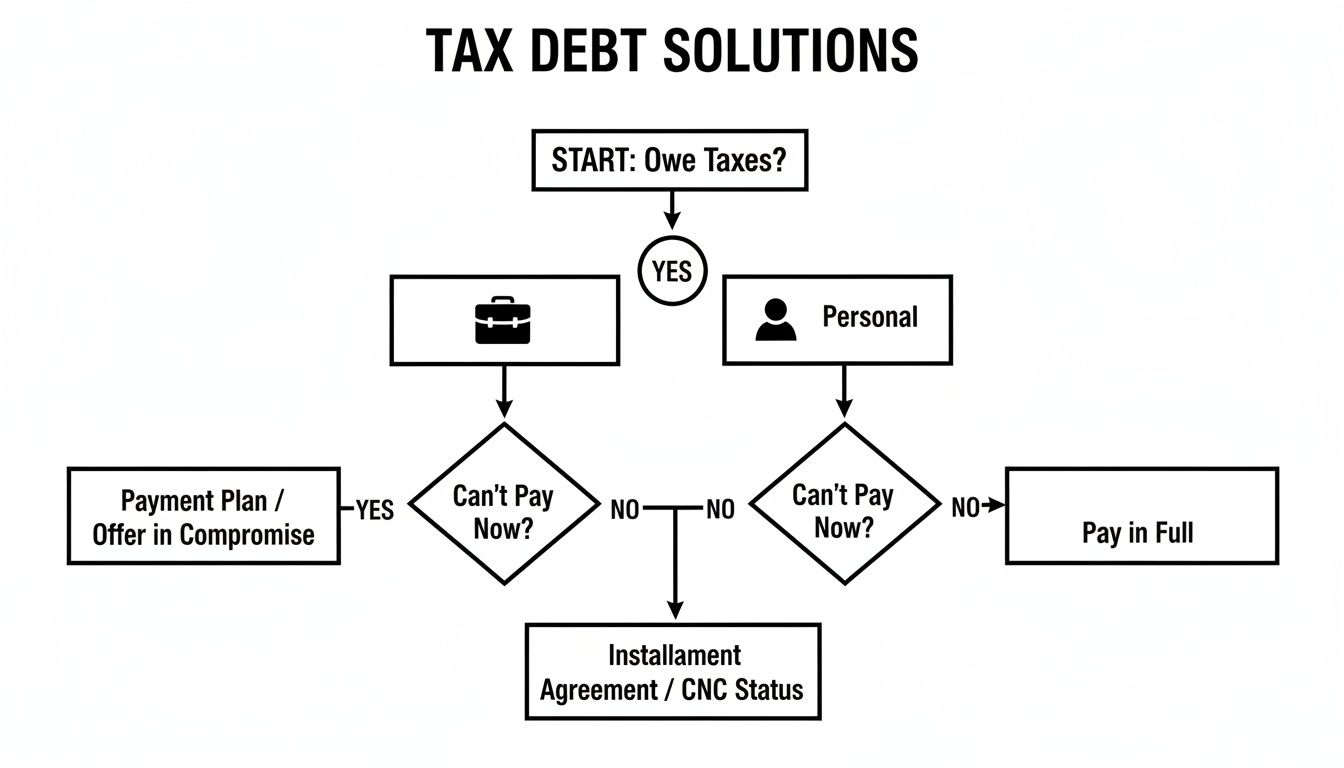
The biggest takeaway here is that there's no one-size-fits-all answer. Every situation is unique and leads to a different set of solutions.
Short-Term Extensions and Installment Agreements
If you can pay what you owe but just need a little more breathing room, a Short-Term Payment Plan is often the cleanest solution. This gives you up to 180 extra days to pay in full. It’s perfect for temporary cash flow crunches, like when you're waiting for a big client payment or a year-end bonus. Interest and penalties will still add up, but it keeps the IRS from escalating things to levies or liens.
For those who need more time, an IRS Installment Agreement (IA) is the most common path forward. If your combined tax, penalty, and interest bill is under $50,000, you can often set up a streamlined agreement right on the IRS website without having to turn over detailed financial statements. This lets you make monthly payments for up to 72 months.
Real-World Scenario: I once worked with a small business owner who fell behind on $35,000 in income taxes after a really slow quarter. We immediately got her set up on a streamlined installment agreement. This simple step gave her manageable monthly payments, stopped collection threats, and let her focus on rebuilding her business without the constant stress of a potential bank levy.
If you owe more than that or can't pay the full debt within the standard timeframe, there are still options. A Partial Payment Installment Agreement (PPIA) allows you to make monthly payments based on what you can actually afford, even if it won't pay off the debt before the collection statute runs out. To get a better sense of your options, it's worth learning more about how to make payment arrangements with the IRS.
Offer in Compromise: The "Fresh Start" Program
You've probably heard the late-night commercials promising to settle tax debts for "pennies on the dollar." They're talking about an Offer in Compromise (OIC). While it sounds like a dream come true, getting one approved is notoriously difficult. The IRS only accepts an OIC when there's serious doubt they could ever collect the full amount you owe.
To even be considered, the IRS does a deep dive into your entire financial life. They calculate your Reasonable Collection Potential (RCP), which is a specific formula based on:
- Your assets (think home equity, cash in the bank, cars, and investments)
- Your current and future income potential
- A strict budget of allowable monthly living expenses
If your RCP is less than your total tax debt, you might be a candidate. But be warned, the IRS is incredibly strict. They reject the vast majority of OIC applications, often due to incomplete paperwork or because a taxpayer's situation doesn't meet their rigid hardship criteria. It's not a magic wand, but for those who genuinely can't pay, it can be a true lifeline.
Currently Not Collectible: A Temporary Reprieve
But what if you can't afford to pay anything at all? If you're facing a genuine financial hardship—like unemployment, a serious illness, or an income so low it barely covers basic living expenses—you may qualify for Currently Not Collectible (CNC) status.
Let’s be clear: this is not debt forgiveness. CNC status is a temporary pause on all collection activity. The IRS agrees to stop sending threatening notices and levying your accounts because they recognize you simply don't have the ability to pay right now. Your debt still exists, and it will continue to rack up interest and penalties, but the immediate pressure is off.
The IRS will check in on your financial situation periodically, usually every year or two, to see if your ability to pay has improved. It’s a critical safety net for people in truly dire straits.
Navigating Hardship and Other Complex Scenarios
In recent years, the IRS has granted CNC status to over 100,000 accounts annually, putting billions in debt on hold for taxpayers who can prove legitimate hardship.
In some extreme cases, taxpayers might look at other legal routes. It's important to consider all possibilities, including understanding how bankruptcy affects tax debt. Certain tax debts can actually be discharged in a Chapter 7 or Chapter 13 bankruptcy, but only if they meet very specific criteria, like being over three years old and having been filed on time.
Choosing the right path forward requires a clear-eyed look at your finances and a solid understanding of the IRS rulebook. Each of these options comes with its own qualifications, benefits, and drawbacks. The most important thing is to stop ignoring the problem, take action, and pick a strategy that moves you toward a resolution.
How to Handle Aggressive IRS Collection Actions

That certified letter from the IRS can make your stomach drop. When the notices shift from simple reminders to outright threats of levies and liens, it’s easy to feel cornered. But this is the exact moment where knowing what to do—and doing it quickly—puts you back in the driver’s seat.
These more serious letters aren't just idle threats; they are official legal notices that start a ticking clock. If you want to protect your assets, understanding what they mean and how to respond is non-negotiable.
Decoding the Most Common IRS Notices
The IRS communicates through a series of formal notices, each one signaling a more serious stage in the collection process. Ignoring them is the absolute worst thing you can do, as every unanswered letter gets you one step closer to enforced collection, like a wage garnishment or a bank account seizure.
Two of the most alarming letters you can get are the CP504, Notice of Intent to Levy, and the LT11, Final Notice of Intent to Levy and Notice of Your Right to a Hearing.
- CP504 Notice: Think of this as the final warning shot. The IRS is officially stating its intent to take your state tax refund and apply it to your federal debt. It’s also a clear sign that they’re preparing for more aggressive actions, like hitting your bank account or wages.
- LT11 / Letter 1058 (Final Notice): This is the big one. It's the most critical notice you can receive because it formally states the IRS is preparing to seize your property. Crucially, it also triggers your legal right to an appeal.
Receiving a Final Notice is your cue to act immediately.
Expert Insight: The moment you get a Final Notice of Intent to Levy, a 30-day countdown begins. This isn't a suggestion; it's a hard legal deadline. If you miss this window, you lose your most powerful tool for stopping a levy before it happens.
This 30-day period is your one and only chance to formally request a Collection Due Process (CDP) hearing. Filing for this hearing immediately halts all collection activity, buying you the time you need to negotiate a real solution.
Using a CDP Hearing to Protect Your Assets
A CDP hearing is your legal right to challenge the IRS's proposed action in front of an impartial appeals officer. In my experience, it is without a doubt the most effective way to stop a bank levy or wage garnishment cold. I've guided countless clients through these hearings, and it's often the first real chance we get to have a productive conversation and work out a resolution.
During the hearing, we can present your full financial situation and argue for a less damaging alternative, like an Installment Agreement or an Offer in Compromise. The appeals officer's job is to review the case, determine if the levy is appropriate, and consider other options. This formal process takes your case out of an automated system and puts it in front of a real person who can analyze your specific circumstances. For a deeper look, you can learn more about how the IRS levies bank accounts and what your rights are.
A Real-World Business Scenario
Let's say a small business owner falls behind on her payroll taxes. She receives an LT11 notice threatening to levy her accounts receivable. This would be a business-killer. Her clients would be legally required to send their payments directly to the IRS, which would completely suffocate her cash flow and likely force her to close down.
Here’s what she needs to do, and fast:
- File Form 12153: Before that 30-day deadline is up, she absolutely must file Form 12153, Request for a Collection Due Process or Equivalent Hearing. This single action legally stops the IRS from contacting her clients or seizing their payments while the appeal is pending.
- Gather Financials: While waiting for the hearing, she works with her tax professional to get all her financial documents in order—profit and loss statements, balance sheets, and realistic projections.
- Propose a Solution: At the CDP hearing, instead of just playing defense, she proactively proposes a viable Installment Agreement to get caught up on the back taxes over time.
By using the CDP process, she turned a crisis that could have destroyed her business into a structured negotiation. She protected her company and created a clear, manageable path to resolve the debt.
When to Call a Tax Attorney for Help
Figuring out when to tackle an IRS problem on your own versus calling in a professional can feel like a tough judgment call. Honestly, many straightforward tax debts can be resolved directly with the IRS without any help.
But some situations are different. They carry a much higher risk and complexity, making expert legal help not just a good idea, but an essential shield for your financial future. Knowing the red flags that signal you're in too deep is the key.
The Clear Signals You Need an Expert
Some tax issues are simply too high-stakes to navigate alone. The moment your problem goes beyond a simple inability to pay a small balance, the potential for serious financial damage skyrockets. These are the scenarios that should have you immediately picking up the phone to get specialized help.
You should seriously consider hiring a tax attorney if you're facing:
- A Tax Debt Over $25,000: Once your liability crosses this line, the IRS collection process gets more aggressive, and the solutions get far more complicated.
- Multiple Years of Unfiled Returns: This isn't just about the back taxes. It's a pattern of non-compliance that the IRS views very seriously, sometimes leading them to file their own returns for you (which never work in your favor) or even open a criminal investigation.
- Complex Payroll Tax Issues: For business owners, unpaid payroll taxes are a massive problem. You could be hit with a Trust Fund Recovery Penalty (TFRP), which pierces the corporate veil and makes you personally liable for the debt, putting your home, car, and savings on the line.
- An IRS Audit or Criminal Investigation: An audit is a formal, invasive examination of your records. Facing down an IRS Revenue Officer or an agent from the Criminal Investigation Division without your own legal representation is a risk you just can't afford to take.
Attorney vs. CPA vs. National "Tax Relief" Chains
When you need help, you have a few options. A Certified Public Accountant (CPA) is fantastic for tax preparation and planning. But when you’re in a legal dispute with the IRS, a tax attorney brings unique and powerful advantages to the table. For a deeper dive, you can explore the many benefits of hiring a tax attorney.
The single biggest advantage is attorney-client privilege. This is a legal shield that keeps your conversations completely confidential. You can be brutally honest about every detail of your situation, knowing your attorney can never be forced to testify against you. This critical protection does not apply to CPAs or Enrolled Agents in criminal tax cases.
A Word of Caution: Be very careful with the big, national "tax relief" companies you see on TV. They often rely on high-pressure sales calls, demand huge upfront fees, and then pass your file to a junior case manager you’ll never hear from again. Their business is about volume, not strategy.
A dedicated tax attorney, on the other hand, should always start with a detailed analysis of your specific case to map out the best path forward before asking for a fee. This personalized approach ensures the strategy is built for your unique financial reality, not some cookie-cutter formula.
Why a Personalized Strategy Matters
Let’s look at a real-world example. Imagine a small business owner who owes $80,000 in payroll taxes and is facing a TFRP assessment. A national "relief" company might immediately sell them on an Offer in Compromise, collecting a fat fee while knowing the chances of the IRS accepting it are next to zero.
A skilled tax attorney takes a completely different approach. They start by digging into the details. They’ll investigate whether the owner was truly a "responsible person" under the law, challenge the "willfulness" element of the penalty, and explore every other possible solution—like a manageable Installment Agreement or proving hardship for Currently Not Collectible status—that might be more realistic and offer a better outcome.
This careful, methodical approach is designed to get the best possible result for you, not the quickest sale for them.
Common Questions I Hear About Owing the IRS
When you're staring down a tax bill you can't pay, your mind can race with a million questions and a good deal of fear. I've heard them all. Let's walk through some of the most pressing concerns I hear from clients to get you some clear, straightforward answers.
Can the IRS Really Take My House for Unpaid Taxes?
This is usually the first and biggest fear people have, and I understand why. The simple answer is yes, the IRS technically can seize and sell your primary home to cover a tax debt. But—and this is a big but—it is their absolute last resort and happens very, very rarely.
For the IRS to even get to that point, they have to navigate a long and difficult legal path. You would receive multiple notices, they would have to file a federal tax lien, and then, crucially, they must get a specific court order from a judge to approve seizing your home.
Honestly, they would much rather work something out with you. Seizing a family's home is a massive, politically charged headache that the IRS actively tries to avoid.
My Advice: The IRS has the power to seize your home, but it's a weapon they almost never use. The single best way to protect your property is to get in front of the problem and work with them on a payment solution. Don't wait for them to escalate things.
What Happens If I'm Self-Employed and Can't Pay?
For freelancers, consultants, and small business owners, tax debt is an all-too-common source of stress. If you're self-employed and fall behind, the consequences are largely the same as for any W-2 employee, but with a dangerous twist: your business and personal finances are usually one and the same.
The IRS will kick off its standard collection process, which for a business owner can be especially painful:
- Bank Levies: They won't just freeze your personal account; they can seize funds directly from your business accounts, crippling your operations overnight.
- Accounts Receivable Levies: This is a big one. The IRS can order your clients to send the money they owe you directly to the government instead. This not only cuts off your cash flow but can seriously damage your professional reputation.
- Federal Tax Liens: A lien clouds the title to your assets and tanks your credit score, making it nearly impossible to get a business loan, line of credit, or any other financing.
If you find yourself in this situation, the most critical thing you can do is start making your current estimated tax payments on time, even while we figure out the old debt. The IRS is far more willing to negotiate a reasonable solution when they see you're making a genuine effort to stay compliant now.
Does Tax Debt Just Go Away on Its Own?
This is a question I get a lot, and it's a vital one to understand. No, tax debt doesn't just vanish into thin air. But it also doesn't last forever. The IRS is bound by a strict deadline for collecting back taxes, known as the Collection Statute Expiration Date (CSED).
In most cases, the IRS has exactly 10 years to collect the debt, starting from the date the tax was officially assessed. Once that 10-year clock expires, the debt is legally gone for good. They can no longer pursue you for it.
However, certain actions can "toll" or pause that 10-year countdown. Things like filing an Offer in Compromise, requesting a Collection Due Process hearing, or filing for bankruptcy will stop the clock, effectively extending the time the IRS has to collect.
What's a Realistic Cost for a Tax Attorney?
The cost of hiring a tax attorney can be all over the map, and it really depends on how tangled your situation is. Be wary of the big national "tax relief" factories you see on TV. They often hook you with promises and demand a huge, non-refundable upfront fee—often $5,000 to $10,000—before they've even really dug into your case.
A reputable, independent tax attorney usually operates much differently. Many of us will start with an initial consultation or a deep-dive case analysis for a much smaller flat fee, or sometimes for free. This lets us properly assess your situation, map out a clear strategy, and give you a realistic quote for the work.
You can expect to see hourly rates anywhere from $300 to $600+, or flat fees for specific services like preparing an Offer in Compromise or representing you in an audit. The goal should be to find a professional who offers a transparent, customized plan, not a high-pressure, one-size-fits-all sales pitch.
At the law office of Attorney Stephen A. Weisberg, we believe in starting with a solid strategy, not a sales pitch. That's why we begin with a FREE Tax Debt Analysis to see exactly where you stand and lay out the best possible path forward for your specific problem. Contact us today to get started.


