What Is the State Sales Tax in Kansas? A 2026 Guide
What is the state sales tax in Kansas? Our 2026 guide explains the 6.5% state rate, local taxes, nexus rules, and business compliance for KS.
In this article
- Your First Sale and Your First Question
- The Foundation Kansas's 6.5% State Sales Tax Rate
- What the base rate actually means for compliance
- How Combined Sales Tax Rates Work in Kansas
- Why the combined rate changes
- Destination sourcing is the rule that drives the result
- What to do in practice
- Calculating Sales Tax Examples for Kansas Businesses
- Sample Sales Tax Calculation on a $100 Purchase (2026)
- Where calculation errors usually start
- Your Business Obligations for Collecting and Remitting Tax
- What compliance looks like in real life
- Where businesses get into trouble
- Controls that usually work
- Common Kansas Sales Tax Exemptions and Special Rates
- Exemptions that create the most filing risk
- The special rule for food
- Finding Official Kansas Tax Rates and Resources
- Frequently Asked Kansas Sales Tax Questions
- Common Questions
Kansas state sales tax is 6.5%. But that’s only the base rate, and the actual rate your customer pays is usually higher because Kansas adds local taxes on top of it.
That’s where many business owners get tripped up. You make a sale, pull a rate from memory, and assume you’re done. Then you learn that a customer in Wichita can owe a different rate than a customer in Olathe, even though both sales happen in Kansas. If you're asking what is the state sales tax in kansas, the short answer is simple. The compliance answer is not.
A lot of tax trouble starts with small sales tax mistakes. A business collects too little, files using the wrong local rate, or assumes one city’s rate applies statewide. Those errors don’t stay small for long, especially if the Kansas Department of Revenue reviews your records while the IRS is already looking at payroll or income tax problems. If you need a broader operating checklist, this small business tax checklist is a useful place to tighten up the basics before issues stack up.
Your First Sale and Your First Question
Your first sale feels good until the administrative part kicks in. You send an invoice, ring up a counter sale, or ship an online order, and then the practical question lands fast. What sales tax rate are you supposed to charge?
For Kansas businesses, the answer starts with the state rate, but it doesn’t end there. The number that matters on the transaction is the combined rate tied to the customer’s location. That’s why two customers buying the same item can owe different tax.
Practical rule: Don’t build your process around “the Kansas rate.” Build it around the correct rate for the specific sale.
That matters whether you run a coffee shop, a contracting business, a retail store, or an online operation shipping across the state. If you guess, round, or reuse one rate for every customer, you create exposure that often shows up later in an audit or collections notice.
The useful way to think about Kansas sales tax is this:
- Start with the base rate: Every taxable sale begins with the statewide rate.
- Add the local layer: Cities, counties, and sometimes special districts increase the final rate.
- Charge based on destination: The customer’s location controls the rate on many sales, not your office address.
- Treat compliance as cash management: Tax you collect isn’t business revenue. It belongs to the state.
A business owner who understands those four points avoids a lot of preventable mess.
The Foundation Kansas's 6.5% State Sales Tax Rate
Kansas starts with a 6.5% state sales tax rate. For a business owner, that number matters because it is the base amount the Department of Revenue expects you to build into every taxable sale before you deal with local additions and filing details.
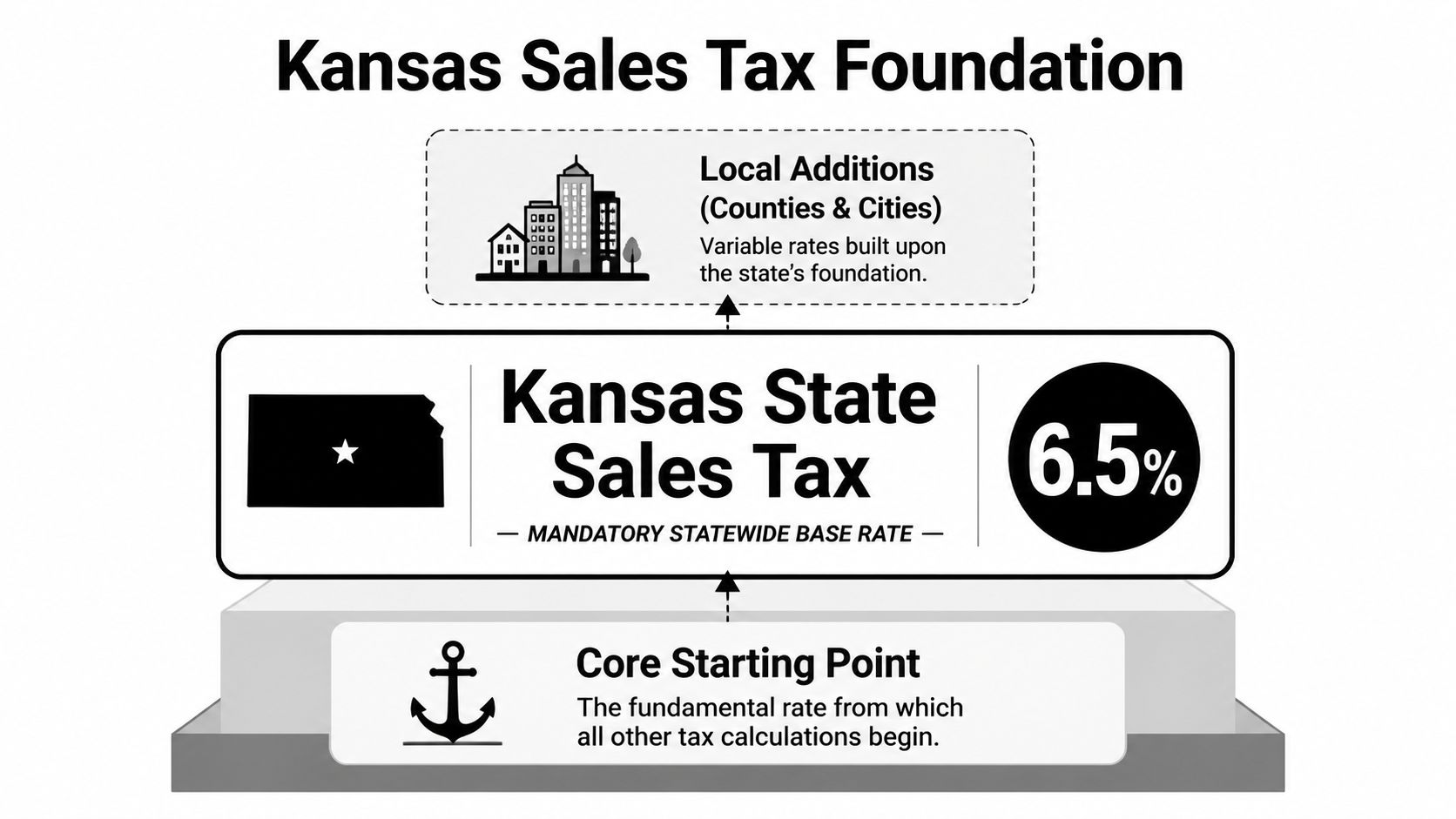
The legal risk is not usually confusion about the state rate itself. The actual problem is assuming the 6.5% figure answers the whole question. It does not. It only gives you the foundation for the tax calculation and for deciding whether your invoicing and point-of-sale setup are collecting enough tax to keep you out of trouble later.
Kansas applies sales tax broadly enough that many owners under-collect in the first year. Taxable transactions often include:
- Retail sales of tangible personal property
- Installation, repair, and maintenance labor tied to tangible personal property
- Admissions to entertainment and recreation venues
That scope matters in practice. A retailer usually expects to collect sales tax on products. A repair business or contractor may miss the tax treatment of labor charges. An event business may focus on ticket sales and overlook how Kansas treats admissions. Those mistakes do not disappear because a customer was charged too little. The state can still pursue the business for the shortfall, plus interest and penalties.
What the base rate actually means for compliance
The 6.5% rate works as the statewide floor for taxable sales in Kansas. If you sell a taxable item or service, this is the first layer in the calculation.
That is why business owners should treat the state rate as a compliance starting point, not a shortcut. If your bookkeeping system, shopping cart, or cash register is built around one flat rate without checking whether the sale is taxable in the first place, you are setting up a problem that often shows up during a state review.
A simple way to handle this is to separate two questions on every sale:
- Is the product or service taxable in Kansas?
- What total rate applies to this specific transaction?
Owners who answer only the second question often miss taxability issues. Owners who answer only the first often charge the wrong amount. Both errors can create tax debt.
How Combined Sales Tax Rates Work in Kansas
A shop in Wichita sells the same taxable item to two customers on the same day. One carries it out of the store. The other has it shipped to an address in Lenexa. The product did not change, but the total sales tax rate may. That is the part many owners miss when they rely on one default rate.
Kansas starts with the 6.5% state rate, then adds whatever city, county, or special district rate applies at the place of sale or delivery. For day-to-day compliance, the question is not just "what is the Kansas rate." The question is "what rate applies to this customer, at this address, on this transaction."

Why the combined rate changes
Local governments can add their own sales tax on top of the state rate. That means your total rate can change from one Kansas address to another, even if you sell the same item at the same price.
For a small business, this affects more than the receipt total. It affects quoting, checkout settings, invoice accuracy, exemption certificate handling, and the amount you report on your return. If you undercollect, the customer usually does not pay the difference later. The business does.
Destination sourcing is the rule that drives the result
Kansas generally applies sales tax based on destination. In plain terms, the delivery location often controls the local rate, especially for shipped orders. A pickup sale and a shipped sale can produce different tax results.
That creates a practical split inside many businesses:
- Counter sales need the correct rate for the selling location.
- Delivered or shipped sales need the correct rate for the customer address.
- Staff need a consistent rule for when the order becomes the invoice, because that is often where the wrong rate gets locked in. The operational handoff is easier to control if your team understands sales order vs sales invoice differences.
I see the same problem repeatedly. The owner knows Kansas has a 6.5% state rate, but the accounting system, cart, or POS is still set to charge one local rate on every transaction. That setup works until sales expand into other cities, then the filing numbers stop matching the actual locations of the sales.
What to do in practice
Use address-level rate determination for shipped orders and confirm the selling-location rate for pickup transactions. Do not rely on an old spreadsheet or a cashier's memory. Local rates change, and the state will expect your returns to reflect the correct combined rate.
It also helps to review sales tax as part of your broader tax exposure, especially if rates were set up incorrectly for months before anyone noticed. A simple step-by-step guide to calculating tax liability can help you estimate the size of a problem before interest and penalties grow.
Combined rates are where Kansas sales tax stops being a trivia question and becomes an audit issue.
Calculating Sales Tax Examples for Kansas Businesses
A customer places a $100 order, your system adds tax, and the receipt looks fine. The issue emerges later, when the rate charged does not match the location on the sale and your Kansas return is short.
The math is straightforward: multiply the taxable sales price by the combined sales tax rate. What causes trouble for Kansas businesses is using the wrong combined rate, especially when the same business sells in more than one city or fulfills orders by delivery, shipment, and pickup.
Sample Sales Tax Calculation on a $100 Purchase (2026)
| City | State Rate | Local Rate | Combined Rate | Total Tax on $100 |
|---|---|---|---|---|
| Wichita | 6.5% | 1% | 7.5% | $7.50 |
| Olathe | 6.5% | 2.98% | 9.48% | $9.48 |
| Lenexa | 6.5% | 3.98% | 10.48% | $10.48 |
These examples show why Kansas sales tax cannot be handled with one default rate.
For a Wichita sale, $100 × 7.5% produces $7.50 in tax. For the same $100 sale in Olathe, the tax is $9.48. In Lenexa, it becomes $10.48. The sale amount did not change. The tax did, because the local rate changed.
That difference matters in real dollars once the volume builds. If a business charges 7.5% on transactions that should have been taxed at 10.48%, the business usually owes the shortfall out of its own pocket if it cannot go back and collect from the customer.
Where calculation errors usually start
Kansas sales tax errors often begin before the invoice is issued. I usually see the problem in the handoff between the quote, sales order, fulfillment record, and final invoice. If your staff taxes the wrong document or locks in the wrong address too early, the books can still look organized while the return is wrong.
A simple control helps. Decide which document controls the tax point, train staff to use it the same way every time, and make sure your team understands the sales order vs sales invoice differences.
If you are reviewing past transactions, compare what you collected to what should have been collected by location and order type. This step-by-step guide to calculate tax liability is a useful starting point for estimating exposure before interest and penalties are added.
Your Business Obligations for Collecting and Remitting Tax
The first compliance mistake usually happens after a sale, not before it. A business makes taxable sales, collects money from customers, and treats the tax portion like general cash. By the time the return is due, that money has already been used for payroll, inventory, or rent, and the owner is trying to solve a tax problem with funds that are gone.
Kansas expects businesses with a filing duty to register, collect the right amount, file returns on time, and remit what they collected. Remote sellers also need to monitor whether their Kansas activity creates economic nexus, as noted earlier. Once that obligation starts, late registration can turn into back-tax exposure quickly.
What compliance looks like in real life
A workable Kansas sales tax process usually has five parts.
Register before charging Kansas sales tax
If you collect tax before the account is properly set up, you create cleanup work and filing risk from day one.Use the correct rate for the transaction
The right rate has to flow through the quote, cart, invoice, and return consistently. If staff override rates manually, errors spread fast.Keep exemption support before the audit starts
An exempt sale without a valid certificate often gets treated as taxable during an audit. Good records are part of the defense, not an afterthought.File every return assigned to you
If Kansas assigns monthly, quarterly, or annual filing, follow that schedule even during slow periods. Missing a “zero return” can still create notices and penalties.Remit tax from a separate tracking bucket
Sales tax is not operating revenue. Businesses that keep collected tax segregated are far less likely to fall behind when cash gets tight.
That last point matters more than many owners expect.
I often see sales tax trouble arrive alongside payroll problems. The same business that is behind on sales tax is often behind on withholding deposits or treating owner draws too loosely. If you need to tighten both systems, review these small business payroll tax basics, because state and federal tax debt tends to build in parallel.
Where businesses get into trouble
Kansas sales tax problems usually come from ordinary habits, not fraud. Staff use a default rate. Exemption certificates sit in email instead of a central file. Returns are filed only after the state sends a reminder. None of that feels dramatic at the time. It becomes expensive once the state reviews several periods at once and asks the business to prove why tax was not collected.
The practical trade-off is simple. Manual processes can work at low volume, but only if one person owns the process and reconciles it regularly. Once sales volume, locations, or online orders increase, the cost of a bad process usually exceeds the cost of better controls.
Controls that usually work
Use a short checklist and enforce it.
- Confirm the taxable status of the sale before the invoice goes out.
- Match the customer address used for shipping to the address used for tax calculation.
- Store exemption certificates in one retrievable system.
- Reconcile collected tax to filed returns on a set schedule.
- Review notices from Kansas immediately, not weeks later.
Businesses selling online into multiple states should also understand how Kansas fits into the broader remote-sales rules. This overview of 2026 sales tax regulations gives helpful context for multi-state sellers.
What fails is just as predictable. Using one default rate for every Kansas customer. Letting employees change tax treatment without review. Waiting until cash improves before remitting collected tax. Those choices often turn a manageable filing issue into tax debt, penalties, and an audit file that is harder to defend.
Common Kansas Sales Tax Exemptions and Special Rates
Exemptions are where many Kansas sales tax problems start. A business sees a sale that looks exempt, skips the tax, and moves on. During an audit, the issue is no longer whether the customer should have paid tax. The issue is whether your records prove why you did not collect it.
Kansas recognizes several common exemptions, but the rule is practical, not theoretical. If you claim an exemption, keep the support in your files. If you cannot produce it, Kansas may treat the sale as taxable and assess the tax against your business.
Exemptions that create the most filing risk
Two categories come up often: inventory purchased for resale and prescription drugs. As noted earlier in the article, Kansas also treats some food sales under a reduced or zero state rate, which creates a separate classification issue for retailers.
The resale exemption causes the most trouble because it depends on documentation. A customer may tell you they are buying for resale. That statement alone does not protect you. You need the right exemption certificate, completed correctly, and you need to keep it where your team can retrieve it quickly if Kansas asks for it.
Prescription drugs are another area where owners make bad assumptions. Medical use does not automatically make an item exempt. If your business sells health-related products, check the product category carefully before coding it as non-taxable.
A few practical rules help avoid preventable mistakes:
- Resale purchases: Obtain and retain a valid exemption certificate before treating the sale as exempt.
- Prescription drugs and medical items: Review the item itself, not just the general product line or customer description.
- Out-of-state shipments: Confirm whether the sale qualifies for exemption based on where delivery occurs and how the transaction is documented.
- Mixed baskets: Set up your POS or invoicing system so exempt, reduced-rate, and fully taxable items are coded separately.
The special rule for food
Kansas reduced the state sales tax rate on certain food and food ingredients in stages, and the state rate reached 0% in 2025 for qualifying items. That does not mean every edible product is tax-free, and it does not mean your system can rely on one broad "food" category.
Restaurants, convenience stores, grocers, and specialty retailers need clean product mapping. Candy, prepared food, soft drinks, and grocery items can be treated differently. If your inventory setup is sloppy, the register may undercharge tax on taxable items or overcharge customers on items that qualify for special treatment.
That is a compliance problem, not just a customer service issue.
The practical trade-off is straightforward. Tighter tax coding takes more setup time on the front end. It usually costs far less than fixing months of incorrect returns, refunding customers, or defending unsupported exemptions in an audit.
Finding Official Kansas Tax Rates and Resources
A wrong rate on a single invoice is usually a small problem. A wrong rate built into your checkout system can turn into months of undercollection, amended returns, customer refunds, and questions from the state. That is why rate research needs to start with official Kansas materials, not a third-party chart you found during a quick search.
Use unofficial summaries for orientation only. For billing, exemption support, and issue-specific guidance, confirm your position with Kansas forms, notices, publications, and the state’s address-based tools. That matters most when the sale is not straightforward, such as contractor transactions, mixed taxable and exempt invoices, or product categories that do not fit neatly into one tax code.
I tell business owners to verify three things before they finalize a process:
- The customer location tied to the sale: Local tax can change the final rate, so the billing or delivery address needs to match the sourcing rule you are applying.
- The document supporting any exempt treatment: If you are not keeping the certificate or other backup in your files, you are taking audit risk.
- The publication that fits the transaction type: Contractors, retailers, and businesses selling special-category items often need different guidance, including forms and publications such as KS-1510 for contractor issues.
Keep a simple internal rule. Check the rate in an official Kansas source, save the exemption paperwork before you treat a sale as exempt, and keep the publication or guidance you relied on with your tax file. That recordkeeping step is what helps you defend the return later.
If your facts are unusual, or sales tax problems are part of a broader state or IRS issue, review these Kansas tax FAQs for business owners and individuals.
Frequently Asked Kansas Sales Tax Questions
Some issues come up repeatedly in day-to-day practice. Here are short answers to the ones that cause the most confusion.
Common Questions
| Question | Answer |
|---|---|
| If Kansas state sales tax is 6.5%, can I just charge 6.5% on every sale? | No. The state rate is only the base rate. The final rate depends on the customer’s location and applicable local taxes. |
| Do I need to worry about sales tax if I sell online into Kansas from outside the state? | Yes, if your Kansas sales activity creates nexus. Remote sellers need to pay close attention to Kansas rules and registration obligations. |
| If a sale is exempt, is it enough to just mark it exempt in my accounting software? | No. You need supporting documentation, especially for resale transactions. Software labels don’t replace records. |
If your facts are unusual, such as mixed taxable and exempt sales, contractor transactions, or existing state balances, it helps to review a broader set of issues in these Kansas tax FAQs.
Attorney Stephen A Weisberg helps individuals, business owners, and professionals dealing with tax debt, audits, and state or IRS problems. If sales tax issues are mixing with payroll tax debt, income tax balances, or a pending transaction that can’t close until tax problems are resolved, he starts with a FREE Tax Debt Analysis to determine whether he can help and what the best path looks like before charging for representation.


