What Is Tax Resolution Services and How Can It Solve IRS Problems
Learn what is tax resolution services and how expert guidance can help you resolve complex IRS tax debt with proven strategies like Offer in Compromise.

In this article
- Your Guide Through the IRS Maze
- The Heavy Cost of Doing Nothing
- Exploring Your Options for IRS Debt Relief
- Which Tax Resolution Strategy Fits Your Situation
- An Offer in Compromise: A True Fresh Start
- Installment Agreements: Making Payments Manageable
- Penalty Abatement: Asking for Forgiveness
- Other Important Avenues for Tax Relief
- Navigating the Tax Resolution Process Step by Step
- Investigation and Building a Game Plan
- Negotiation and Getting to the Finish Line
- Who Really Needs a Tax Resolution Pro?
- The Self-Employed and Freelancers
- Business Owners with Payroll Tax Troubles
- Anyone in the IRS Crosshairs
- How to Choose the Right Tax Resolution Expert
- Steer Clear of These Red Flags
- Vetting Your Potential Representative
- Your Top Questions About Solving Tax Debt, Answered
- What's This Going to Cost Me?
- How Long Does It Take to Fix a Tax Problem?
- Can't I Just Do This Myself?
When the IRS comes knocking, it's more than just a little stressful—it can be downright terrifying. If you're facing a mountain of tax debt, aggressive collection letters, and the threat of liens or levies, you probably feel like you're navigating a storm without a compass.
This is where tax resolution services come in. They are your expert guide and advocate in the intimidating world of the IRS.
Your Guide Through the IRS Maze
Think of a tax resolution professional as a seasoned negotiator who not only speaks the IRS's language but understands their playbook inside and out. Instead of you spending hours on hold, trying to decipher complex tax codes under pressure, they step in and handle all communications for you.
Their entire focus is on finding a legal and, most importantly, workable solution to get you out from under the weight of your tax problem.
The Heavy Cost of Doing Nothing
Let's be blunt: ignoring the IRS is the worst thing you can do. The problem won't disappear. Penalties and interest stack up with alarming speed, and what might have been a manageable debt can quickly become an insurmountable one.
Getting professional help provides a clear, structured path forward. It all starts with a deep dive into your specific financial situation to figure out the best possible strategy. You can learn more about resolving tax issues in our detailed guide.
The reality is that tax problems rarely solve themselves. Interest and penalties continue to accumulate, collection actions can escalate, and the stress of unresolved tax matters can affect every aspect of your life.
This critical need for expert help has built a massive industry. The market for tax relief services was recently valued at USD 13 billion and is expected to balloon to USD 24.06 billion by 2032.
What’s driving this? It's a combination of increasingly complex tax laws and a serious ramp-up in IRS enforcement. In fiscal year 2024 alone, the IRS closed over 505,000 audits, recommending more than $29 billion in additional taxes. You can read more about the tax relief services market in this market research report.
Exploring Your Options for IRS Debt Relief
Staring down a significant IRS debt can feel overwhelming, almost like you're lost at sea with no land in sight. But you're not alone, and there are established routes back to shore. A tax resolution professional is like an experienced captain who knows these waters—they understand the programs the IRS has in place to help taxpayers get back on solid financial ground.
These aren't secret loopholes or shady tactics. They are official, legitimate strategies designed for people in tough spots. The first step is simply understanding what's available. The goal is to replace that feeling of panic with a clear plan of action, and that starts with matching the right solution to your specific financial situation.
This flowchart breaks down the fundamental choice you face when a tax problem arises.
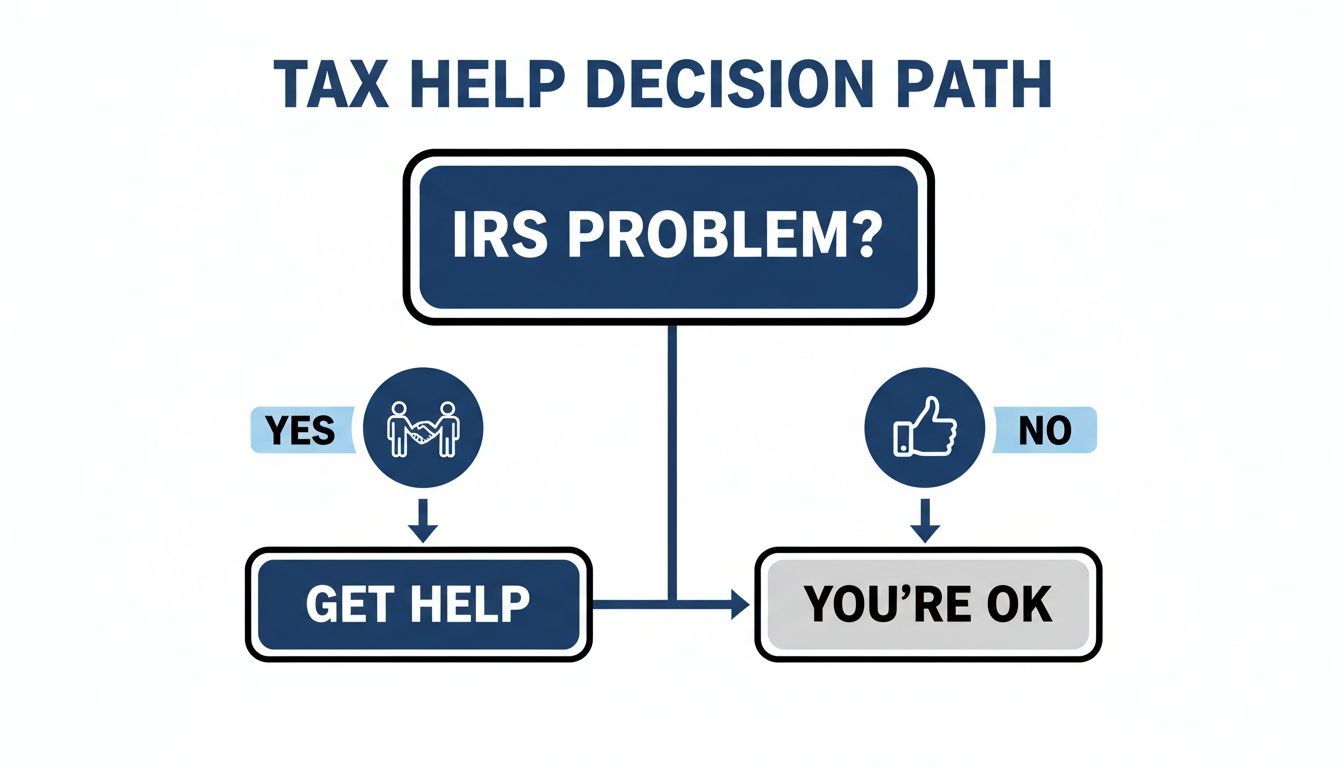
As you can see, when you're up against the IRS, trying to go it alone is rarely the best move. Getting expert help is the recommended path forward.
With so many options, how do you know which one is for you? This table provides a quick side-by-side comparison to help you see where you might fit.
Which Tax Resolution Strategy Fits Your Situation
| Resolution Method | What It Achieves | Best For Taxpayers Who... |
|---|---|---|
| Offer in Compromise (OIC) | Settles your tax debt for less than the full amount owed. | Have a low income, few assets, and can prove paying the full debt would cause severe economic hardship. |
| Installment Agreement (IA) | Sets up a manageable monthly payment plan to pay off the debt over time. | Can't pay in full now but have a steady income to make consistent payments over several years. |
| Penalty Abatement | Removes penalties assessed on your tax bill. | Had a valid reason for filing or paying late (like a serious illness) or have a perfect 3-year compliance history. |
| Currently Not Collectible | Temporarily pauses collection activities from the IRS. | Are experiencing extreme financial hardship and cannot afford any payments on their tax debt right now. |
Each of these avenues has its own strict set of rules and qualifications. A tax professional's job is to navigate the complex IRS code to find the best possible outcome for you.
An Offer in Compromise: A True Fresh Start
The Offer in Compromise (OIC) is probably the most well-known resolution program. It’s an agreement where the IRS accepts less than the full amount you owe to settle your tax liability completely. Think of it as a financial reset, but it's one the IRS reserves for taxpayers in truly difficult financial circumstances.
To even be considered, you have to prove that paying the full amount would create a legitimate economic hardship. The IRS scrutinizes everything—your income, expenses, assets, and overall ability to pay. It’s a demanding process, but for those who get approved, an OIC provides an incredible opportunity to start over.
Installment Agreements: Making Payments Manageable
What if you can pay your tax debt, just not all at once? That's where an Installment Agreement comes in. It’s a formal payment plan that allows you to pay off your balance in monthly chunks over an extended period, often up to 72 months.
This is a powerful tool because it immediately stops aggressive collection actions like wage garnishments and bank levies. As long as you make your payments on time, the IRS leaves you alone. It gives you breathing room and a predictable way to chip away at the debt without upending your entire budget.
Having an expert negotiate your Installment Agreement is a game-changer. They fight to ensure your monthly payment is an amount you can actually afford, not just the high number the IRS computers first spit out.
Penalty Abatement: Asking for Forgiveness
Sometimes, the original tax bill isn't the biggest problem—it's the penalties and interest that have ballooned the debt to an impossible size. Penalty Abatement is the process of formally requesting that the IRS remove certain penalties from your account for a good reason.
You can't just say you forgot. The IRS generally grants abatement for two main reasons:
- Reasonable Cause: You can show you tried to comply but couldn't due to circumstances beyond your control, like a death in the family, a natural disaster, or a serious illness.
- First-Time Abatement: If you have a squeaky-clean compliance record for the past three years, the IRS might forgive your first slip-up as a courtesy.
Other Important Avenues for Tax Relief
The options don't stop there. Tax resolution can also help with highly specific situations. For instance, Currently Not Collectible (CNC) status can put a temporary hold on all collections if you can prove you have no ability to pay right now. For those unfairly saddled with a spouse's tax bill, Innocent Spouse Relief can sever that liability.
There is a whole toolbox of strategies available. You can dig deeper into the full range of tax debt relief options to get a better sense of what might work for you.
Navigating the Tax Resolution Process Step by Step
Dealing with the IRS can feel overwhelming, but when you bring in a professional, there’s a clear, methodical path to getting things sorted out. It's not magic; it’s a step-by-step process designed to take you from a place of uncertainty and stress to one of control and clarity. Let's walk through what that journey actually looks like.
It all starts with a thorough consultation and financial deep-dive. This isn't just a quick chat. We need to get a complete handle on your financial picture and the history of your tax issue. We'll look at everything from where the debt came from to what your current financial situation allows you to do about it.

Investigation and Building a Game Plan
Once we're on board, the first official step is filing a Power of Attorney with the IRS. This immediately puts us between you and the agency. From that moment on, they talk to us, not you. This gives you immediate breathing room while we get to work.
Next comes the investigation phase. We pull your official IRS transcripts and records to see your tax situation exactly as the IRS sees it. No guesswork. With all the facts on the table, we shift into strategy development. This is where experience really counts. We analyze your compliance history, the type of debt you have, and your financial standing to pinpoint the best possible solution—whether that’s an Offer in Compromise, a payment plan, or another route.
The goal of a tax professional is not just to fix the immediate problem but to find a sustainable solution that aligns with your long-term financial health. The right strategy provides relief today and stability for tomorrow.
Negotiation and Getting to the Finish Line
With a solid plan in place, we move into the negotiation and implementation stage. This is the heavy lifting. We prepare and file all the complex paperwork required to make our case to the IRS. For example, many resolutions hinge on detailed financial statements; our guide on Form 433-F gives you a glimpse into the level of detail involved. Then, we get on the phone and advocate for you, negotiating the terms and ensuring your case gets a fair hearing.
Finally, we reach the compliance and closure phase. Once the IRS accepts our proposed resolution, we make sure the agreement is locked in correctly. Just as important, we'll give you a clear rundown of your obligations—like making timely payments or filing future returns on time—so you can stay on track and finally put this issue behind you for good.
Who Really Needs a Tax Resolution Pro?
Sure, anyone with tax debt could probably benefit from a little professional advice. But for some folks, it's less of a "nice-to-have" and more of a "need-it-now" situation. Think of it this way: you can handle a minor kitchen burn yourself, but for a severe one, you’re heading straight to the emergency room. Certain tax problems are just like that—they’re too complex or carry consequences so severe that calling in an expert is the only smart move.
Figuring out if your situation puts you in that high-risk category is the first critical step. Often, what starts as a small, manageable issue can quickly spiral into a full-blown financial crisis. This is especially true for people and businesses whose tax situations aren't as straightforward as a simple W-2.
The Self-Employed and Freelancers
The freedom of the gig economy is fantastic, but it comes with a major catch: you're your own payroll department. As a freelancer or independent contractor, you're on the hook for calculating and paying your own quarterly estimated taxes. It’s shockingly easy to miscalculate what you owe or just get behind when a client pays late.
A couple of missed quarterly payments can quickly morph into a massive tax bill, and that’s before the IRS tacks on underpayment penalties. If you don't file at all, the IRS might file a Substitute for Return (SFR) for you, and trust me, they won't be looking for deductions. Their version almost always results in a much higher tax bill.
Business Owners with Payroll Tax Troubles
For a small business owner, there’s almost nothing scarier than falling behind on payroll taxes. These are called "trust fund" taxes for a reason—you’re literally holding your employees' money in trust before sending it to the government. The IRS does not mess around when it comes to this money.
If your business gets into a jam with payroll taxes, the IRS can bring out the big guns with a Trust Fund Recovery Penalty (TFRP). This isn't just a penalty against your business; it allows them to come after you personally for the money. Your personal home, your savings, your car—it’s all on the table.
This isn't some ordinary business debt that you can discharge in bankruptcy. It’s a personal liability that will stick with you even if the company goes under. Fighting a TFRP assessment is serious business and requires a lawyer who knows this specific area of tax law inside and out.
Anyone in the IRS Crosshairs
The most obvious sign that you need immediate help is when you start getting official, threatening notices from the IRS. These aren’t friendly reminders; they are legal warnings with hard deadlines for action.
You need to call an expert, and fast, if you've received any of these:
- A Notice of Federal Tax Lien: This is a public claim the IRS files against your property. It craters your credit score and makes it nearly impossible to sell assets or get a loan.
- A Notice of Intent to Levy: This is the final warning before the IRS starts taking your stuff—they can garnish your paycheck, empty your bank accounts, and seize other assets.
- An Audit Notification: An IRS audit is a deep, often stressful dive into your finances. Having a professional representative manage the process is crucial to protect your rights and avoid costly errors under pressure.
These situations are incredibly time-sensitive. And if you're in one, you're not alone. A shocking 17% of federal taxes in the U.S. go unpaid each year, leaving millions of people, from contractors to S-corps, buried under IRS debt. This widespread problem is exactly why professional help is so vital, as you can see from these insights on tax resolution service alternatives.
How to Choose the Right Tax Resolution Expert
Let's be blunt: not all tax resolution firms have your best interests at heart. This industry, unfortunately, has its share of bad actors who prey on the fear and stress that come with having an IRS problem. Picking the right expert is easily the most critical decision you'll make, as it means finding a true partner to guide your financial recovery.
As you start looking, you’ll find three types of professionals who can represent you before the IRS: Tax Attorneys, Certified Public Accountants (CPAs), and Enrolled Agents (EAs). While all are qualified, a Tax Attorney brings something unique to the table: attorney-client privilege. This legal safeguard keeps your conversations confidential, which can be absolutely crucial if your case is complex or has sensitive details.

Steer Clear of These Red Flags
Your first job is to spot and avoid the scams. Predatory companies often use aggressive sales tactics and make promises they simply can't keep. A true professional will be upfront, realistic, and focused on the facts of your case. For a more detailed breakdown, our guide on finding a good tax attorney goes deeper into what separates the good from the bad.
Keep your guard up for these common warning signs:
- Guaranteed Results: If you hear phrases like "pennies on the dollar" or get a promise of a specific outcome before they've even seen your file, walk away. No one can guarantee what the IRS will do.
- Huge Upfront Fees: A demand for thousands of dollars before they’ve even looked at your IRS records is a massive red flag. A reputable expert always starts with an initial analysis.
- High-Pressure Sales Tactics: You should never feel cornered or rushed into signing anything. A legitimate professional will encourage you to take your time and weigh your options.
- Lack of Transparency: If they're cagey about their fees, their process, or who is actually handling your case, something isn't right.
A trustworthy tax resolution expert acts as an advisor, not a salesperson. Their first step should always be a thorough investigation to understand your situation, followed by a clear explanation of your available options—even if the best option is one that doesn't make them a lot of money.
Vetting Your Potential Representative
Once you’ve weeded out the obvious scams, how do you choose the right person? The first step is simple: check their credentials. Make sure your potential representative is a licensed Tax Attorney, CPA, or Enrolled Agent in good standing.
Don't be shy about asking direct questions. Ask about their experience with situations like yours and find out who will be your main point of contact. Since many tax experts are legal professionals, it's also smart to get comfortable with the engagement process, which includes understanding potential consultation fees.
A quality firm will have a clear, structured plan and will be happy to walk you through it. They want you to feel empowered to make a safe and informed decision.
Your Top Questions About Solving Tax Debt, Answered
When you're staring down a tax problem, the first step is often the hardest. It’s completely normal to have a ton of questions about what it will cost, how long it will take, and whether you can just handle it yourself. Let's cut through the noise and get you some straight answers to the most common questions we hear every day.
Getting a handle on these practical details is the best way to turn that feeling of uncertainty into a clear, confident plan.
What's This Going to Cost Me?
It’s the elephant in the room, isn't it? Let’s talk about it. The cost of hiring a pro to fix your tax problem can vary quite a bit, but any firm worth its salt will be upfront about how they charge. You'll generally see two common approaches.
- Flat Fees: This is our preferred model for most cases. You get a fixed price for a specific service, like negotiating an Offer in Compromise or an Installment Agreement. You know the exact cost from day one—no hidden fees, no surprises.
- Hourly Rates: Some attorneys and CPAs work on an hourly basis. This can make sense for really complex situations where the exact amount of work is hard to predict, like a detailed audit or an ongoing tax court case.
Here’s a major red flag: be very cautious of any company that demands a huge payment before they’ve even looked at your IRS records. A reputable professional will start with a small, reasonable fee for an initial investigation. Only after they've diagnosed the problem will they quote you the full cost to resolve it.
Think of the fee not as a cost, but as an investment. A well-negotiated resolution can literally save you thousands—sometimes tens of thousands—of dollars in back taxes, penalties, and interest. The right expert pays for themselves many times over.
How Long Does It Take to Fix a Tax Problem?
Dealing with the IRS is a lesson in patience. There's no magic wand to speed up their processes. While we can get simple things done pretty quickly, the more complex your case, the longer you can expect it to take. The timeline really depends on what we're trying to achieve and how backed up the IRS is at that moment.
Here are some ballpark timelines to set your expectations:
- Simple Installment Agreement: We can often get these locked in within 30 to 90 days.
- Offer in Compromise (OIC): This is a marathon, not a sprint. From the day we submit the offer, you should realistically expect it to take anywhere from 6 to 12 months for the IRS to give a final answer. Sometimes, it takes even longer.
- Penalty Abatement: Asking the IRS to waive penalties usually gets a response within 3 to 6 months.
A good tax pro can't make the IRS work faster. What we can do is make sure everything is filed perfectly the first time, so your case doesn't get kicked to the back of the line because of a simple mistake or missing document.
Can't I Just Do This Myself?
It's tempting to try and handle it on your own, and for some very simple situations, you might be able to. If you owe a small amount and just need to get on a standard payment plan, you can often set that up directly on the IRS website.
But when the stakes get higher, going it alone is a huge gamble. You absolutely need an expert in your corner if you're:
- Facing aggressive collection actions like a tax lien, a bank levy, or wage garnishment.
- Wrestling with a large tax debt, especially anything over $25,000.
- Trying to get an Offer in Compromise accepted (the rules are incredibly strict).
- A business owner dealing with payroll tax problems or the Trust Fund Recovery Penalty.
- Being audited by the IRS.
In these situations, one wrong move or missed deadline can have disastrous financial consequences. An experienced representative knows the playbook, understands how to negotiate with revenue officers, and can protect your rights to secure the best deal possible.
Don't let unanswered questions keep you stuck. At Attorney Stephen A Weisberg, we believe you deserve clarity before making any decisions. That's why we start with a FREE Tax Debt Analysis to look at your specific situation and lay out all your options. You won't pay a dime until you have a clear plan. Get your free analysis today and take the first step toward peace of mind.