What Is Tax Resolution and How Does It Work?
What is tax resolution? This guide explains how to solve IRS problems with options like OICs and Installment Agreements to manage and reduce tax debt.

In this article
- Untangling Your Tax Debt Problem
- The Goal Beyond Just Paying the Bill
- Core Concepts in Tax Resolution
- Core Tax Resolution Concepts at a Glance
- Decoding Your Tax Resolution Options
- Offer in Compromise: The Financial Fresh Start
- Installment Agreements: The Structured Payback Plan
- Penalty Abatement: Forgiving the Extra Charges
- Currently Not Collectible Status: Hitting the Pause Button
- Innocent Spouse Relief: When It Wasn’t Your Fault
- Comparing Tax Resolution Strategies
- A Step-by-Step Guide to the Resolution Process
- Phase 1: Initial Assessment and Information Gathering
- Phase 2: Strategy Selection
- Phase 3: Negotiation with Tax Authorities
- Phase 4: Resolution and Future Compliance
- Why Tax Disputes Are on the Rise
- The New Era of Digital Enforcement
- A Global Surge in Tax Scrutiny
- Why Small and Mid-Sized Businesses Are at Risk
- Choosing Your Professional Tax Ally
- Understanding Your Team of Experts
- When You Absolutely Need a Tax Attorney
- Questions to Ask Before You Hire
- Answering Your Biggest Questions About Tax Resolution
- How Much Does Tax Resolution Actually Cost?
- How Long Will This Process Take?
- What Happens If I Just Ignore IRS Notices?
- Can My Tax Debt Be Completely Erased?
When you're staring down a mountain of tax debt, the situation can feel hopeless. That's where tax resolution comes in. Think of it less as a single action and more as a strategic game plan for dealing with tax authorities like the IRS. It’s the formal process of using government-approved programs to negotiate a way to handle what you owe, often for less than the total amount.
Untangling Your Tax Debt Problem

Imagine your tax debt is a hopelessly tangled knot. The more you yank on random strings, the tighter and more complicated it gets. Tax resolution is about patiently finding the right threads to loosen, one by one, until the entire knot comes undone. It’s a methodical approach, not a brute-force one.
The whole point is to find a way forward that doesn't involve a single, crippling payment you simply can't make. For business owners especially, this process is about shifting from a state of crisis management to one of financial control.
The Goal Beyond Just Paying the Bill
True tax resolution is about more than just getting a check to the IRS. It’s designed to accomplish a few critical goals that protect your financial well-being now and in the future.
- Preventing Aggressive Collections: The immediate priority is to stop devastating collection actions. This means halting bank levies, wage garnishments, and property liens that can freeze your business operations and personal life.
- Achieving Compliance: It’s all about getting you back in good standing with the tax authorities. This is non-negotiable for securing loans, keeping professional licenses, and simply running your business without constantly looking over your shoulder.
- Finding a Manageable Solution: The endgame is a payment plan or settlement that actually works with your budget. The solution has to be based on what you can realistically afford, not what the IRS initially demands.
At its core, tax resolution provides a formal, recognized pathway out of tax debt. It replaces the fear of the unknown with a clear, actionable plan, acknowledging that financial hardships happen and offering structured programs to fix them. Depending on your situation, you have a number of tax debt relief options to explore.
The essence of tax resolution is transforming a confrontational situation with the IRS into a cooperative negotiation. It's about presenting your financial reality clearly and working within the system to find a mutually acceptable outcome.
Core Concepts in Tax Resolution
To really get a handle on this, it helps to know the lingo. These are the foundational concepts that pop up in nearly every tax resolution case, and understanding them is the first step toward taking control.
Here’s a quick breakdown of what these key ideas mean for you and your business.
Core Tax Resolution Concepts at a Glance
| Concept | What It Means for Your Business |
|---|---|
| Enforced Collection | This is the IRS's legal power to seize your assets. The goal of resolution is to stop these actions before they start. |
| Reasonable Collection Potential | This is the amount the IRS calculates it can realistically get from you. It's a critical number that heavily influences negotiations. |
| Financial Disclosure | You have to provide a completely transparent look at your income, expenses, and assets. For most programs, this is a non-negotiable requirement. |
| Future Compliance | Any deal you strike with the IRS depends on you staying current with all future tax filings and payments. If you don't, the agreement is off. |
By starting the tax resolution process, you’re the one taking charge of the situation—not just waiting for the IRS to make the next move. It’s a powerful, proactive step toward getting your financial life back on track.
Decoding Your Tax Resolution Options
When you’re facing a tax problem, the IRS isn’t just looking for a single solution; they have a whole toolkit of programs designed to help people get back on track. Think of it less like a one-size-fits-all penalty and more like a set of keys. The goal is to find the right key for your specific financial lock.
It can feel like you're trying to learn a new language, filled with acronyms and confusing terms. But once you cut through the jargon, the core ideas are actually pretty straightforward. Let’s walk through the most common strategies the IRS offers, translating them from government-speak into real-world plans.
Offer in Compromise: The Financial Fresh Start
This is the one most people have heard about—the idea of settling your tax debt for "pennies on the dollar." An Offer in Compromise (OIC) is exactly that: a formal agreement with the IRS to pay a smaller amount than what you originally owed.
But it’s not a free-for-all. The OIC is reserved for people in serious financial trouble. To even be considered, you typically need to prove one of the following:
- Doubt as to Collectibility: This is the most common path. You have to show the IRS, with hard numbers, that your income, expenses, and assets make it impossible for you to ever pay the full debt.
- Doubt as to Liability: You can demonstrate that the tax debt itself is wrong—that you were assessed incorrectly and don't actually owe it.
- Effective Tax Administration: This is a rare one. It means you technically could pay the full amount, but doing so would create an extreme and unfair economic hardship for you.
Getting an OIC approved is tough. The IRS acceptance rate usually hovers around 30-40%, so it requires a rock-solid case. It’s not a casual negotiation; it’s a deep dive into every corner of your finances. For a more detailed look, check out our complete guide to the IRS Offer in Compromise.
Installment Agreements: The Structured Payback Plan
What if you can’t pay your tax bill all at once, but you could handle it with monthly payments? That's where an Installment Agreement (IA) comes in. It’s the most common resolution by far—a simple, structured payment plan with the IRS.
Not all payment plans are created equal, though. A streamlined installment agreement is available for people who owe less than a combined $50,000. These can often be set up online with minimal fuss. But if your debt is larger, the process gets more complicated, often requiring a full financial disclosure to prove what you can afford to pay each month.
Penalty Abatement: Forgiving the Extra Charges
Sometimes, the penalties and interest piled on top of a tax debt are more brutal than the original tax itself. Penalty Abatement is the process of formally asking the IRS to remove those penalties.
You need a good reason, of course. Maybe you got bad advice, made an honest mistake, or a major life event kept you from filing or paying on time. The most straightforward path is the First-Time Abatement, a one-time get-out-of-jail-free card for taxpayers with an otherwise clean record. It’s a powerful tool if you qualify.
Understanding your options is the first step toward regaining control. Whether it's a payment plan or a settlement, each tax resolution strategy provides a structured path forward, turning a seemingly insurmountable problem into a series of manageable steps.
Currently Not Collectible Status: Hitting the Pause Button
What happens when your financial situation is so dire that you can't even afford basic living expenses, let alone a tax payment? The IRS might place your account in Currently Not Collectible (CNC) status.
This doesn't make the debt go away. Instead, it’s a temporary pause on all collection activities like levies and wage garnishments. The IRS will check in on you periodically to see if your financial situation has improved. It’s important to know that interest and penalties keep adding up, so CNC is a temporary lifeline, not a permanent solution.
Innocent Spouse Relief: When It Wasn’t Your Fault
Being on the hook for a tax debt created by your spouse (or ex-spouse) can feel incredibly unfair. Innocent Spouse Relief is designed for this very situation. It can free you from paying the tax, interest, and penalties stemming from a joint return where your spouse hid income or claimed improper deductions.
To qualify, you have to prove that you genuinely didn't know—and had no reason to know—about the tax understatement when you signed the return. It's a complex process that requires a close look at the circumstances of your marriage and finances.
Comparing Tax Resolution Strategies
It can be tough to keep these options straight. This table offers a side-by-side comparison to help you see which approach might fit your situation best.
| Resolution Method | Ideal Candidate | Key Benefit | Potential Drawback |
|---|---|---|---|
| Offer in Compromise | Someone with significant financial hardship and low future income potential. | Can settle debt for much less than the full amount owed. | Very difficult to qualify for; requires full financial disclosure. |
| Installment Agreement | Someone who can't pay in full now but can afford monthly payments. | Stops aggressive collections and provides a predictable payment plan. | Interest and penalties continue to accrue until the debt is paid off. |
| Penalty Abatement | A taxpayer with a good compliance history who made an honest mistake. | Can significantly reduce the total amount owed by removing penalties. | Only removes penalties, not the original tax or interest. |
| Currently Not Collectible | Someone facing extreme financial hardship (unemployment, illness, etc.). | Provides immediate relief by pausing all collection actions. | A temporary fix; the debt continues to grow with interest. |
| Innocent Spouse Relief | Someone whose ex-spouse or current spouse created the tax debt without their knowledge. | Can eliminate your legal responsibility for the joint tax debt. | Complex and requires proving you were truly unaware of the issue. |
Each path has its own set of rules and requirements. The key is matching the right strategy to your unique financial reality.
A Step-by-Step Guide to the Resolution Process
Dealing with a serious tax issue can feel overwhelming, like you're lost without a map. The tax resolution process is that map. It breaks the entire journey down into a series of clear, manageable steps that take you from that first scary notice to a final, workable agreement.
Understanding how this process unfolds is a game-changer. It puts you back in control. Instead of just reacting to whatever the IRS throws at you, you'll know what’s coming next and can prepare for it. Let's walk through the four phases of getting this done.
Phase 1: Initial Assessment and Information Gathering
Before you can fix the problem, you have to know exactly what you’re dealing with. The first step is to stop, take a breath, and gather all the facts. You simply can't negotiate a resolution without a crystal-clear picture of your financial reality.
This isn't just about digging up old tax returns; it's a full diagnostic of your situation. You'll need to pull together:
- All IRS and State Notices: Every single letter is a piece of the puzzle. They show what the government thinks you owe and why.
- Past-Due Tax Returns: The IRS won't even consider a deal until you're fully compliant. That means any unfiled tax returns have to be prepared and submitted, period.
- Current Financial Information: This is the big one. You’ll be filling out detailed financial statements like IRS Form 433-A, 433-B, or 433-F. These forms lay out all your income, expenses, assets, and liabilities, and they become the foundation for your entire case.
Think of it like preparing for a high-stakes business meeting. If you show up with incomplete or sloppy information, you’ll lose all credibility before you even start talking.
Phase 2: Strategy Selection
Once you have a complete financial snapshot, it's time to choose the right tool for the job. You wouldn't use a sledgehammer to fix a watch, and the same logic applies here. The right strategy has to fit your specific circumstances, which were uncovered back in Phase 1.
This is where the information from your Form 433 becomes so critical. The IRS uses that data to calculate your "Reasonable Collection Potential" (RCP)—a fancy term for the amount they believe they can realistically squeeze out of you. That number will dictate which options are actually on the table.
The infographic below gives you a good visual of how this decision-making process works for the most common resolution paths.
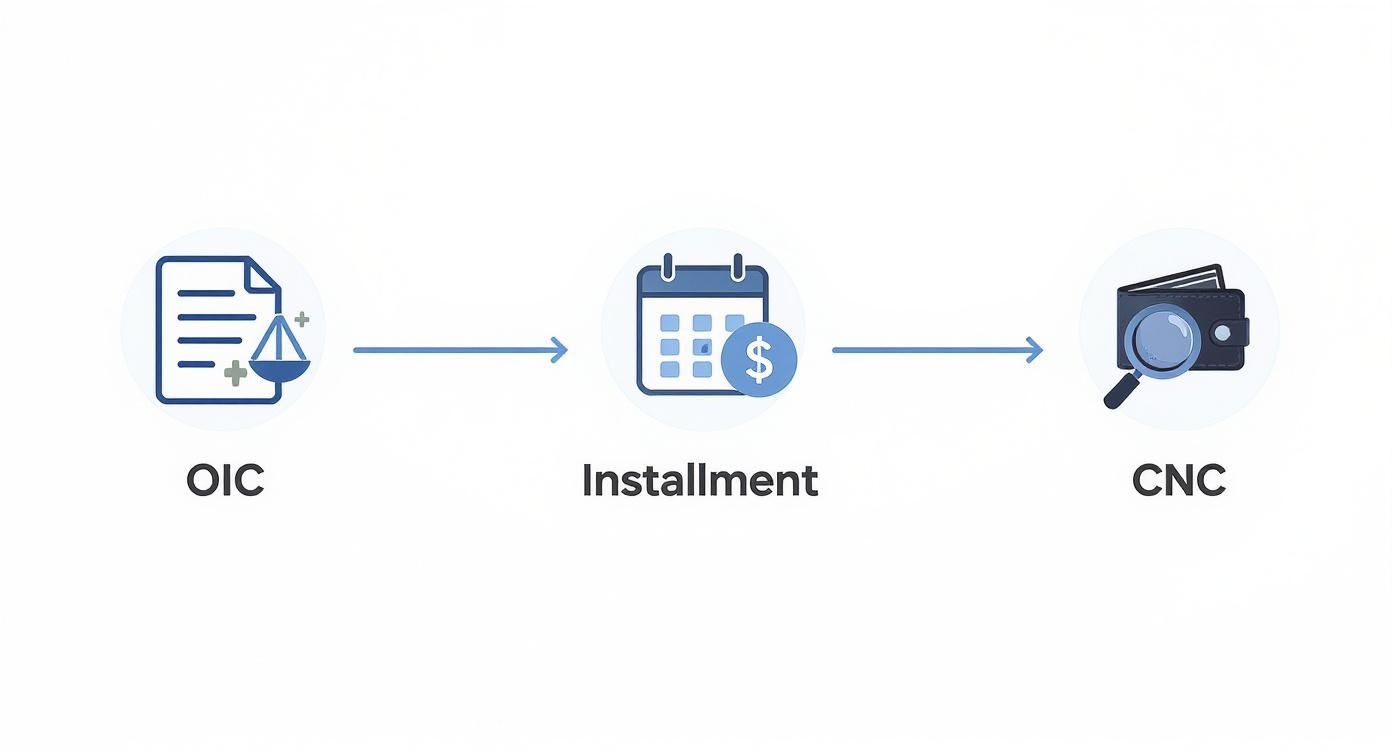
As you can see, different financial realities point toward very different solutions, each with its own set of rules and potential outcomes.
Phase 3: Negotiation with Tax Authorities
With a solid strategy chosen, it's time to engage. This isn't just a quick phone call; it's a formal, documented negotiation with the IRS. You or your representative will submit the formal proposal—whether it's an Offer in Compromise or an Installment Agreement request—along with all the financial proof to back it up.
This is the most hands-on part of the process. An IRS Revenue Officer is going to scrutinize your file. They will almost certainly ask for more information or clarification, and responding quickly and accurately is absolutely essential to keep your case from stalling out.
Slow responses or vague answers look bad. The IRS can interpret them as a lack of cooperation, which is a fast track to getting your proposal rejected and having collections ramp back up. For a deeper dive into this crucial stage, check out our guide on how to settle tax debt with the IRS.
Phase 4: Resolution and Future Compliance
Getting the IRS to accept your proposal is a huge milestone. You'll receive a formal agreement that spells out the terms, like your monthly payment amount or the final settlement figure. Sticking to that agreement is everything.
But the work isn't over just because you signed the papers. A non-negotiable part of every single tax resolution is future compliance. This means you absolutely must:
- File all your future tax returns on time.
- Pay all your future taxes in full and on time.
If you slip up, you’ll default on your agreement, and the whole deal is off. The IRS can, and will, bring back the original full tax debt—plus all the penalties and interest that had piled up—and restart aggressive collections immediately. Staying compliant isn't a suggestion; it’s a condition of your freedom from this tax problem.
Why Tax Disputes Are on the Rise
If it feels like tax authorities are breathing down your neck more than ever, you're not wrong. Understanding how to resolve tax issues has become absolutely essential, as businesses of all sizes find themselves under a much more powerful microscope.
This isn't just a hunch; it's a global shift. Tax agencies have moved far beyond random audits. They're now armed with sophisticated data analytics and AI that can pinpoint discrepancies and flag potential non-compliance with surgical precision.
The New Era of Digital Enforcement
In the past, a small business might have flown under the radar. Not anymore. Today, powerful algorithms cross-reference oceans of data—from bank transactions to 1099s and third-party payment reports—to find inconsistencies that were once impossible to spot.
This technological leap means even minor, unintentional errors can trigger an inquiry. It’s not personal; it’s programmatic. The system is built to find anything that looks out of place, and more and more businesses are getting caught in this automated net.
At the same time, governments everywhere are feeling the pinch of budget shortfalls. They’re aggressively trying to close the "tax gap"—the difference between what they're owed and what they actually collect. That pressure translates directly into more aggressive enforcement and collection tactics from agencies like the IRS. We recently broke down how the IRS is managing fewer employees with more enforcement in our newsletter.
The modern tax environment is data-driven and relentless. A proactive tax resolution plan is no longer just a good idea for businesses in trouble; it's an essential financial defense for every business owner.
A Global Surge in Tax Scrutiny
This intense focus is creating a very real increase in conflicts between taxpayers and tax authorities. The days of simple, straightforward tax administration are fading fast as the pressure mounts.
The numbers tell the story. A recent global survey revealed that a staggering 71% of businesses have seen a jump in tax inquiries. And this trend isn't slowing down, thanks largely to the growing technological power of tax agencies.
Even more concerning, 43% of these initial inquiries snowball into full-blown disputes. These can become long, drawn-out battles that drain a company's time, energy, and resources, with many lasting for three years or more. This reality makes expert guidance not just helpful, but critical.
This shift transforms tax resolution from a reactive emergency measure into a core strategic function for any modern business.
Why Small and Mid-Sized Businesses Are at Risk
While big corporate tax battles grab the headlines, it’s often the small and mid-sized businesses (SMBs) that are most vulnerable. They typically don't have the deep benches of in-house accountants and lawyers that large enterprises rely on to navigate these complex issues.
Here’s why SMBs need to be particularly on guard:
- Limited Resources: A prolonged tax dispute can be financially devastating for a smaller company. It siphons away cash that should be fueling growth and daily operations.
- Complexity Overload: Let's face it, tax codes are a tangled mess. A business owner busy running their company can easily make an honest mistake that ends up triggering an audit.
- Higher Stakes: For an SMB, a major tax lien or levy isn't just a headache—it can be an existential threat. It can freeze bank accounts, disrupt cash flow, and bring business to a screeching halt overnight.
The takeaway here is simple: the game has changed. Tax authorities have better tools, more motivation, and immense pressure to collect every dollar they can. For any business owner, having a plan for tax resolution isn't about planning for a disaster. It's about building a resilient financial foundation that can stand up to the very real pressures of modern tax enforcement.
Choosing Your Professional Tax Ally
Let's be blunt: going up against the IRS is not a DIY weekend project. It’s tempting to think you can save a few bucks by handling it yourself, but the maze of tax law and the sheer gravity of what’s at stake make professional help a must-have, not a nice-to-have. The right expert doesn’t just plug numbers into forms; they build a defensive strategy around your unique financial reality.
Trying to navigate this alone is like showing up to court to argue your own case. You don’t know the unwritten rules, the procedural tricks, or the negotiation tactics that can make all the difference. A seasoned pro has seen it all before and knows how to steer you clear of the common mistakes that get offers rejected and trigger even harsher collection actions.
Understanding Your Team of Experts
Not all tax professionals wear the same hat. Each one brings a different set of skills and legal authority to the table, and picking the right one is your first critical step toward getting out of this mess.
Enrolled Agents (EAs): Think of EAs as the tax specialists. They’re federally licensed by the IRS itself and have unlimited rights to practice, meaning they can represent any taxpayer on any tax issue. They are often masters of tax preparation and are fantastic at handling audits and collections.
Certified Public Accountants (CPAs): CPAs are licensed at the state level. While their world is often broader—including accounting and auditing—those who specialize in tax are powerhouses. They bring a deep understanding of financial records to the fight, which is absolutely vital when building your case for resolution.
Tax Attorneys: A tax attorney is a lawyer who lives and breathes tax law. They can do everything an EA or a CPA can, but they have a game-changing advantage: attorney-client privilege. This is a legal shield that keeps your conversations confidential, and in sensitive cases, that’s priceless.
When You Absolutely Need a Tax Attorney
For many straightforward tax problems, an EA or a CPA is an excellent, cost-effective choice. But some situations are so serious they demand the specialized skills—and legal protection—of a tax attorney. Their involvement is no longer optional when the stakes get this high.
You need to bring in a tax attorney if you:
- Are facing potential criminal charges for things like tax fraud or evasion.
- Need to take your case to U.S. Tax Court.
- Have a seriously complex tax debt, like one involving multiple businesses or tangled payroll tax issues.
- Want the ironclad legal protection of attorney-client privilege.
The decision to hire a tax attorney isn’t just about expertise; it's about legal protection. When your business or even your freedom is on the line, the confidentiality an attorney provides is something you can't afford to go without.
Questions to Ask Before You Hire
Finding the right firm is all about doing your homework. It can be helpful to understand how law office branding influences client choice to see which firms communicate their expertise clearly. Walk into any consultation armed with sharp questions to properly vet who you're trusting with your financial future.
- Who, specifically, will be working on my case? You need to know if you'll be working with a seasoned expert or handed off to a junior associate.
- What's your track record with cases like mine? Ask for real, specific examples of similar tax problems they've successfully resolved.
- How do you structure your fees? Demand a clear, written breakdown. Is it a flat fee, an hourly rate, or a retainer? No surprises.
- What's your initial strategy for my case? After a preliminary review, they should be able to walk you through a clear, logical plan of attack.
Watch out for red flags. Anyone promising a guaranteed outcome or using high-pressure sales tactics should be avoided. A true professional gives you a realistic assessment of your options, not a miracle cure.
Answering Your Biggest Questions About Tax Resolution
When you're staring down a tax problem, the a-ha moments about your options are quickly followed by a flood of practical questions. What's this really going to cost? How long will I be stuck in this mess? Let's cut through the noise and get you some straight answers to the questions we hear most often.
How Much Does Tax Resolution Actually Cost?
This is usually the first thing on everyone's mind, and for good reason. The truth is, there's no single price tag. The cost is tied directly to how tangled your tax situation is. Setting up a simple payment plan is a whole different ballgame than negotiating a complex Offer in Compromise that takes months of back-and-forth.
Most credible tax resolution professionals use one of a few fee structures:
- Flat Fees: Many firms will quote you a fixed price for a specific outcome, like preparing an Offer in Compromise. This gives you certainty, which is a massive relief when you’re already stressed about money.
- Hourly Rates: If your case is more unpredictable—maybe it involves a lengthy audit or litigation—an attorney or CPA might work on an hourly basis.
- Retainers: This is a common approach where you pay an upfront fee, and the professional bills their hourly time against that amount as they work on your case.
So, what's a realistic number? You can expect to invest anywhere from $3,500 to over $25,000, depending on the sheer amount of work required. Be very skeptical of anyone advertising a one-size-fits-all low price. Quality, expert help is an investment in your financial future, not a bargain-bin find.
How Long Will This Process Take?
Here’s where you’ll need a dose of patience. The timeline is largely out of your hands and depends almost entirely on how fast the IRS machine turns. A straightforward Installment Agreement can sometimes be wrapped up in just a few weeks. Anything more involved, however, is a different story.
An Offer in Compromise, for instance, isn't a sprint; it's a marathon. It can easily take 8 to 18 months from the day you file the paperwork to the day you get a final yes or no from the IRS.
During that long wait, it’s crucial that you and your representative stay on top of any and all communication from the IRS. Responding quickly to their requests is the only way to keep your case from getting bumped to the bottom of the pile. The government moves slowly, but your promptness matters.
What Happens If I Just Ignore IRS Notices?
Let me be blunt: burying your head in the sand is the absolute worst thing you can do. The IRS collection process is a well-oiled machine designed to escalate, and it won't stop until it gets a resolution. What starts as a formal-sounding letter will, without a doubt, turn into aggressive and legally-backed collection actions.
If you choose to ignore the notices, here’s the predictable path things will take:
- A Federal Tax Lien is Filed: The IRS puts a public, legal claim on your property and assets. This absolutely tanks your credit score and makes getting a loan or selling property nearly impossible.
- You Get a Notice of Intent to Levy: This is your last warning shot. The IRS is now officially authorized to start seizing your assets.
- Bank Levies and Wage Garnishments Begin: Without any further notice, the IRS can order your bank to freeze your accounts and hand over the funds. They will also legally require your employer to take a hefty chunk of your paycheck and send it directly to them before you ever see it.
Ignoring the IRS doesn’t make the problem go away. It just gives them the green light to forcibly take control of your financial life.
Can My Tax Debt Be Completely Erased?
While settling your debt for pennies on the dollar is possible with an Offer in Compromise, getting it wiped out completely is incredibly rare. Total forgiveness usually only happens in very specific situations, like qualifying for Innocent Spouse Relief or proving the tax was calculated incorrectly from the start.
There is one other way a tax debt can disappear: it can expire. The IRS typically has a 10-year window to collect a tax debt, starting from the day it was officially assessed. Once that Collection Statute Expiration Date (CSED) passes, the debt is gone for good. But be careful—actions like filing for bankruptcy or submitting an OIC can pause that 10-year clock.
Resolving tax debt is a massive priority for governments worldwide. The State of Tax Justice report revealed that over a six-year period, US-based multinational corporations cost other countries around $495 billion in lost corporate tax. This staggering figure underscores why tax agencies are so determined to collect what's owed.
Ultimately, it’s best to go into this process with realistic expectations. The goal is to find a manageable, affordable solution—not to hope for a magic wand to make it all vanish.
Facing down the IRS can feel overwhelming, but it’s not a fight you have to take on by yourself. At Attorney Stephen A Weisberg, we specialize in cutting through the complexity of tax problems for business owners and individuals just like you. We always start with a FREE Tax Debt Analysis to map out a clear plan before you ever pay a dime.
Take the first step toward resolving your tax debt—schedule your free analysis today.


