What Is Tax Audit Defense and How It Actually Works
Learn what is tax audit defense, how the IRS process unfolds, common defense strategies, when to retain counsel, and what outcomes taxpayers can realistically

In this article
- What Tax Audit Defense Actually Means
- How an IRS Audit Moves From Notice to Resolution
- The examination and proposed changes
- The 90-day notice and the court deadline
- Building the Evidence File That Wins Audits
- Representation, Interviews, and the Power of Attorney
- Decide who should speak
- Know what representation can't do
- Choosing Between the Examiner, Appeals, and Tax Court
- Why Audit Risk Now Looks Different Than It Did
- When to Retain Counsel and What the First 30 Days Should Cover
- Set up the case before responding substantively
- Expected Outcomes and a Post-Audit Defense Checklist
Tax audit defense is the structured process of responding to an IRS examination, challenging proposed adjustments, and protecting your rights through the examiner, Appeals, or Tax Court. The first key deadlines may be 30 days to protest proposed changes and 90 days to petition Tax Court after a notice of deficiency.
If you're self-employed, an IRS letter can make an ordinary workday stop cold. The notice may ask about a particular deduction or income item, but the response can affect what the IRS reviews next and which options remain available. The work starts as soon as the notice arrives, with identifying its deadlines and scope, not when a disagreement over tax becomes formal.
What Tax Audit Defense Actually Means
A self-employed taxpayer opens an IRS notice at the kitchen table and sees a request for records supporting business expenses. The immediate impulse may be to gather every receipt and send it all in. But effective defense starts with a more basic question: what exactly is the IRS asking, and what must happen by the response deadline?
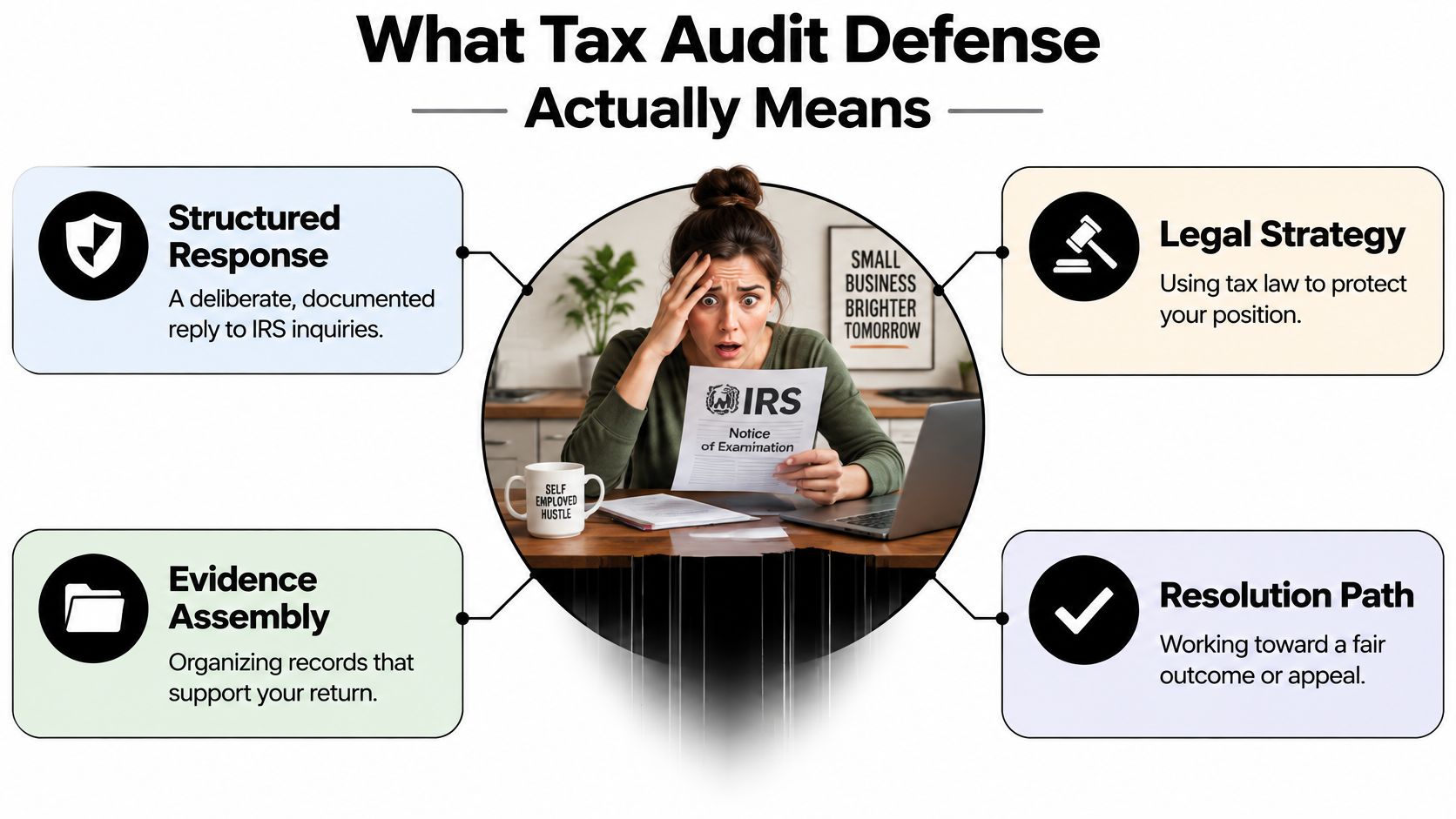
Tax audit defense is a structured, deadline-driven process for responding to an examination, challenging proposed adjustments, and preserving the taxpayer's rights through examiner-level resolution, IRS Appeals, and, when necessary, Tax Court. It isn't one action, such as submitting receipts or hiring someone to speak to an agent. It's a series of decisions about who communicates with the IRS, which evidence answers each issue, whether the examiner's position is supportable, and when to seek review by another decision-maker.
Practitioners tend to focus on four connected jobs:
- Control deadlines. Record response dates and identify any formal appeal or court-filing deadline. Missing a deadline can close off options even when the taxpayer has a reasonable position.
- Identify the issues. Separate what the notice questions from everything else on the return. A request about vehicle expenses doesn't call for a disorganized review of every business record.
- Develop evidence. Match the tax return and the law to records that substantiate the amount and explain how it was calculated.
- Choose the forum. Decide whether to resolve the issue with the examiner, ask the Independent Office of Appeals to review it, or seek judicial review if the dispute reaches that stage.
That's why defense isn't having a professional answer the IRS. Managing contact and timing can matter as much as the technical argument. A hurried response can create confusion or introduce unnecessary issues. A structured response helps the taxpayer preserve rights while addressing what the IRS raised.
How an IRS Audit Moves From Notice to Resolution
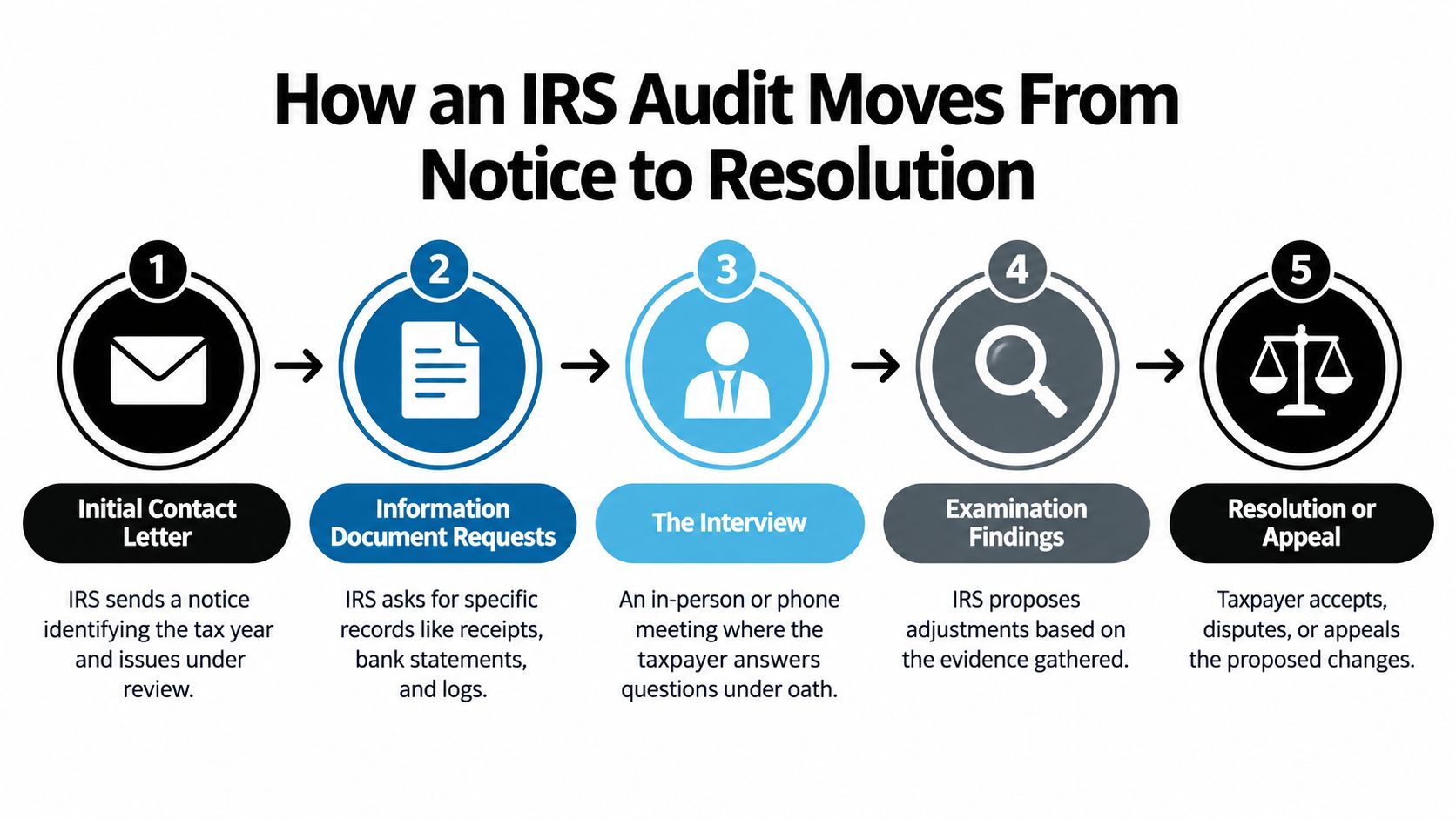
An examination generally begins with IRS contact identifying the return or issue under review. The notice may ask for documents or explain how to respond. For a correspondence audit, the exchange happens by mail or other specified remote means; in other examinations, the IRS may request a meeting or interview. The exact steps depend on the notice and the issues being examined.
The examination and proposed changes
The examiner reviews the taxpayer's return and the information provided, then may propose changes to income, deductions, credits, or other items. The taxpayer can agree, explain why an adjustment isn't correct, or provide additional supporting records. A clear explanation at this stage can resolve a dispute before it moves further.
If the taxpayer and examiner don't agree, a 30-day letter generally gives the taxpayer 30 days to accept the proposed changes or submit a written protest requesting review by the IRS Independent Office of Appeals. The letter's instructions matter: a protest needs to identify the issues in dispute and support the taxpayer's position. The IRS outlines this examination and appeal process in its Publication 556 guide to examination and appeal rights.
If you need a closer look at the examination stages, this overview of what happens during an IRS audit provides additional context.
The 90-day notice and the court deadline
If the taxpayer doesn't respond to the 30-day letter or the dispute remains unresolved, the IRS generally issues a statutory notice of deficiency, often called a 90-day letter. The taxpayer generally has 90 days from the notice date to petition the U.S. Tax Court without first paying the disputed amount. The period is generally 150 days when the notice is addressed outside the United States.
These deadlines have serious consequences. Requesting IRS reconsideration doesn't extend the Tax Court filing period. A taxpayer should read the notice immediately, distinguish its response date from any court deadline, and get advice promptly if the deadline is unclear. Silence or delay can leave fewer routes to challenge the proposed tax.
Building the Evidence File That Wins Audits
A strong response doesn't bury the examiner in paperwork. It connects each proposed adjustment to the filed return, the relevant tax treatment, and evidence that supports the taxpayer's position. In a correspondence audit, the IRS may ask for support for income, expenses, deductions, or credits, so organize the response around the issues named in the notice.
Start by making a simple reconciliation for each disputed item:
- Identify the amount. Locate the figure on the return and in the relevant schedule or workpaper.
- Show how it was calculated. Tie the total to invoices, statements, logs, payroll records, or other source documents.
- Explain why it belongs on the return. State the relevant facts and the basis for the tax treatment, without adding unrelated material.
- Check the submission. Follow the notice's instructions and deadline, and generally submit copies rather than original records.
The evidence depends on the question. Bank and credit-card statements can help trace payments; vendor invoices and receipts can support expenses; contracts can explain a business relationship or transaction. Mileage logs may substantiate vehicle use, while payroll records and depreciation schedules can help clarify other business items. Workpapers that tie supporting records to the amount reported on the return help the examiner follow the calculation.
Practical rule: Make it easy for the examiner to follow the path from the return entry to the original record.
A loose document dump can obscure the evidence that matters. By contrast, a late or incomplete response may leave an adjustment unsupported from the examiner's perspective. A precise, traceable file gives the IRS a factual basis to allow or reduce an adjustment. For vehicle deductions, a resource on maintaining tax-ready mileage records can help clarify what a useful log should capture.
For a step-by-step preparation overview, see this guide on how to prepare for an IRS audit. The practical goal is the same: address the IRS's specific questions with organized records and a written explanation of each disputed item. The IRS describes the use of supporting records and written responses in its guide to audit representation and taxpayer rights.
Representation, Interviews, and the Power of Attorney
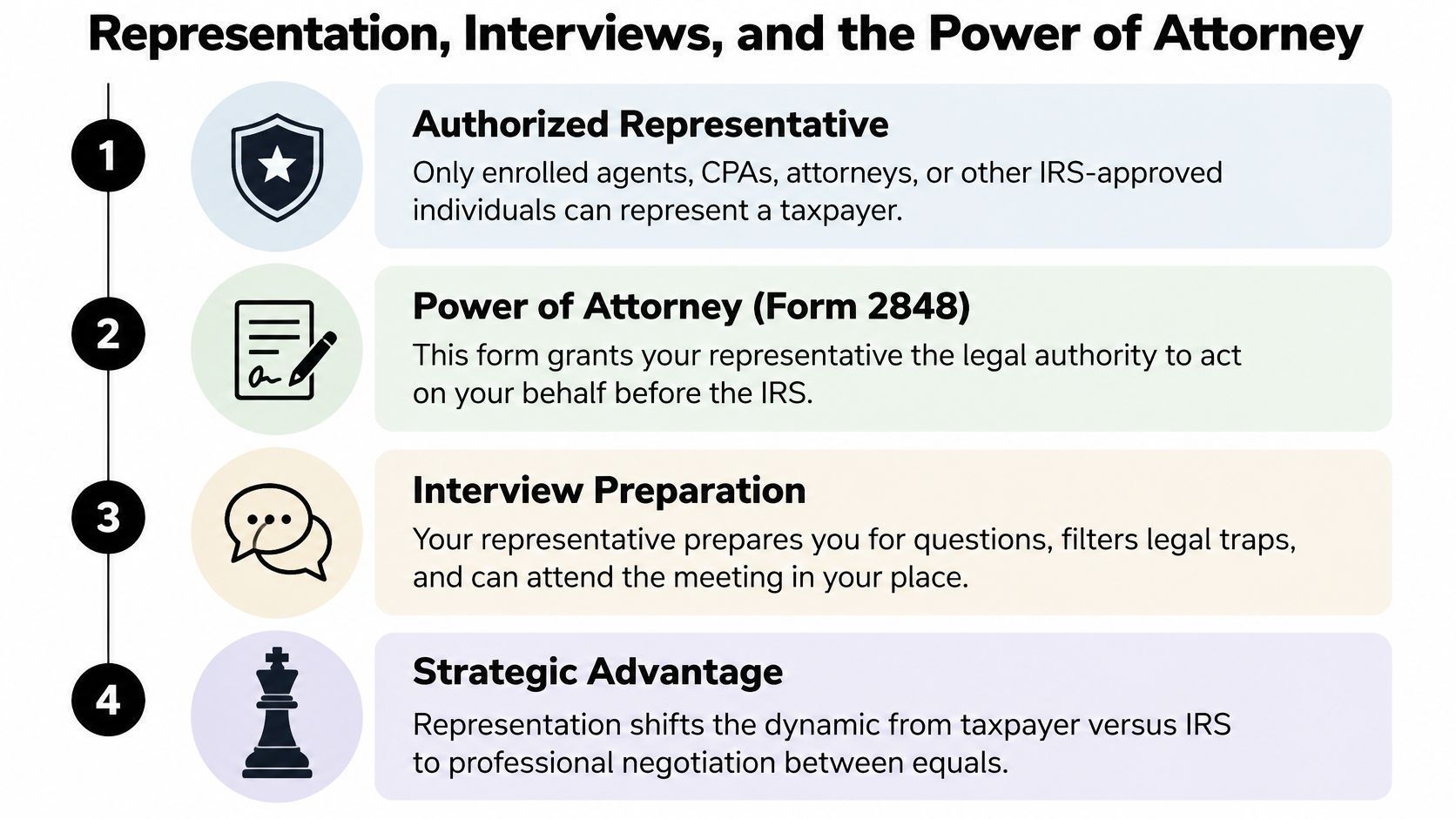
Representation changes who can deal with the IRS and how the taxpayer handles interviews and requests. An attorney, CPA, or enrolled agent can generally represent a taxpayer before the IRS through a written power of attorney. The authorization allows the representative to act within its scope, including handling communications covered by the form. It doesn't mean the taxpayer can ignore notices or assume every personal obligation disappears.
Decide who should speak
If an IRS interview is coming up and the taxpayer wants representation, say so and arrange for the representative to participate. A taxpayer who requests representation during an interview can require the IRS employee to stop the interview. The taxpayer usually doesn't need to attend unless formally summoned, but the representative should first review the notice and understand the issues before deciding how to handle the meeting.
A representative can also request records from the IRS file and review what the agency is relying on, subject to the authority granted and applicable procedures. That can help identify gaps between the IRS's information and the taxpayer's documents. For information on authorizing a representative, consult this guide to Form 2848 instructions.
Know what representation can't do
Representation doesn't excuse a taxpayer from responding to formal demands or appearing when required. If the IRS issues a summons or requires testimony, the taxpayer may have personal obligations that a representative can't take over. A representative should explain those limits before the taxpayer answers questions or agrees to produce records.
Asking for representation isn't a refusal to cooperate. It gives the taxpayer a chance to get advice before answering substantive questions.
The IRS recognizes a right to representation and says eligible taxpayers who can't afford private assistance may qualify for a Low Income Taxpayer Clinic. These clinics can represent eligible taxpayers in audits, appeals, and collection disputes. Read the IRS explanation of the right to representation when working with the IRS to understand the available protections and assistance.
Choosing Between the Examiner, Appeals, and Tax Court
The right forum depends on what's disputed and what the taxpayer wants to accomplish. Some matters can be resolved by explaining an error to the examiner. Others call for an independent administrative review or, if necessary, a court petition. The choices involve trade-offs in formality, time, and the work required to present the case.
| Forum | Best For | Cost Level | Time Horizon | Key Requirement |
|---|---|---|---|---|
| Examiner | Correcting a factual misunderstanding or substantiating an item with records | Usually the least formal and costly route | Often the most direct route, though timing depends on the case | Respond to the examiner's requests and explain the position clearly |
| IRS Independent Office of Appeals | Disputes that remain after examination and may be resolved administratively | More preparation than an examiner-stage response; generally less formal than court | Depends on the protest and Appeals process | Follow the notice instructions and provide a written protest or review request |
| U.S. Tax Court | Disputes that need judicial review before payment of the disputed amount | Formal, with legal and preparation costs that vary by case | Governed by court procedures and filing deadlines | Petition within the applicable statutory deadline |
At the examiner stage, focused documentation and clear explanations may settle a dispute without a more formal proceeding. But the examiner is the person who conducted or oversees the examination, not an independent Appeals reviewer. If the facts or legal position remain contested, the taxpayer may request review by Appeals using the notice instructions.
Appeals can consider the strengths and weaknesses of both sides' positions and may resolve cases without litigation. That doesn't guarantee a favorable settlement. The taxpayer still needs to identify disputed issues and present a supportable case. This guide to appealing an IRS decision offers further guidance on the administrative review route.
Tax Court is a real court, not another IRS meeting. It may be the appropriate forum when a taxpayer needs judicial review and meets the filing requirements, but court procedures require careful preparation. A case can move from one forum to another. The records and explanations assembled earlier become part of the foundation for later review, so a sound administrative record matters even when the taxpayer expects to appeal.
Why Audit Risk Now Looks Different Than It Did
Fewer traditional examinations don't necessarily mean less contact with the IRS. Enforcement can shift toward particular taxpayers, issues, or automated notices, so taxpayers who assume they're safe because audits are down may overlook a notice that requires a prompt response.
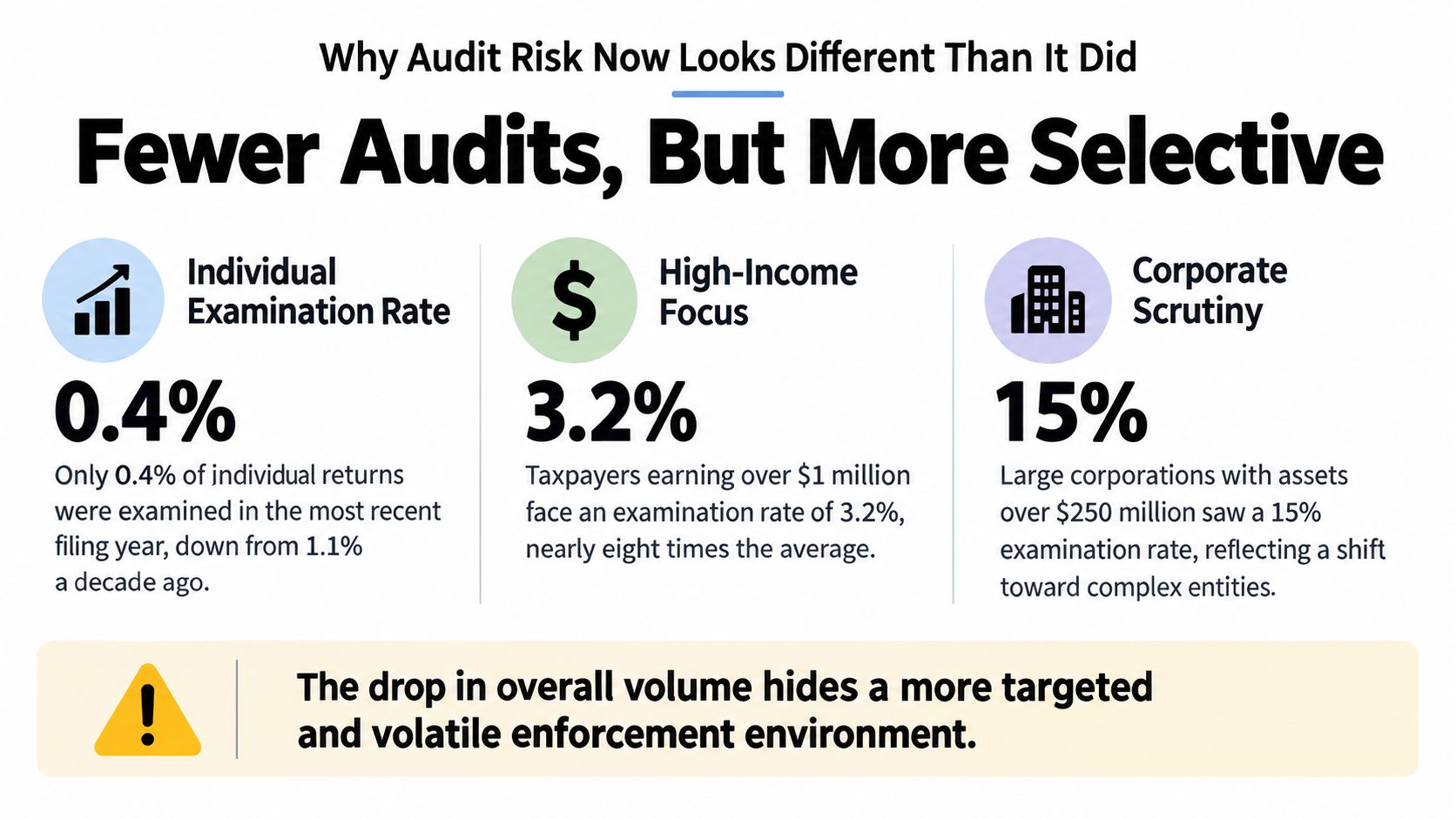
TIGTA reported that individual examinations initiated in fiscal year 2025 fell about 30% from the prior year. Examinations of taxpayers earning more than $400,000 fell 27%, and examination revenue declined 35%, while automated collection activity increased. At the same time, the IRS closed 497,621 audits and recommended $26.8 billion in additional tax. These enforcement figures are described in TIGTA's report on IRS examination and collection activity.
The same report says the IRS sent approximately 3.2 million notices to individual nonfilers in FY 2025, compared with none in FY 2023. That doesn't mean every recipient was selected for a traditional audit. It does show why defense planning should cover notices and IRS document matching, not just formal examinations with an assigned examiner.
For self-employed people, pass-through owners, and small businesses, return preparation should leave a clear trail between tax forms and records. Issue-based scrutiny can arise around mismatched information, but no single item guarantees an audit. Areas to review include:
- Income changes that need an explanation in the workpapers.
- Inconsistent 1099 or K-1 information that doesn't match what was reported.
- Payroll-tax questions that require accurate records and reconciliation.
- High-risk deductions that need support for both the amount and the business purpose.
- Business and personal filing differences that appear inconsistent without context.
A return with a well-documented explanation isn't immune from examination, but organized records can make responding to a notice more manageable. Treating every IRS contact as important, even when it's automated, helps prevent an administrative issue from growing into a larger dispute.
When to Retain Counsel and What the First 30 Days Should Cover
Not every examination requires a tax attorney. A narrow request for one missing record may be manageable with help from the preparer who filed the return. Consider professional representation when the dispute involves several years or multiple issues, business and personal transactions overlap, payroll trust fund exposure may exist, or the notice raises a concern such as fraud, a substantial understatement, or referral to a civil or criminal examiner.
The right professional depends on the problem. A CPA or enrolled agent may be a good fit for accounting records and return issues; an attorney may be needed when the matter involves legal strategy, potential penalties, or litigation. Ask what the professional will handle, who will communicate with the IRS, and whether the work includes Appeals or court proceedings if the examination doesn't resolve.
Set up the case before responding substantively
The opening work should establish the record and keep communications controlled:
- Collect the notice, prior IRS correspondence, filed returns, and supporting records.
- Put a power of attorney in place if you want the representative to act before the IRS.
- Ask for the IRS file when it would help clarify the agency's position.
- Map each proposed adjustment to the relevant facts, evidence, and tax treatment.
- Agree on a communication plan before anyone discusses the substance of the case with the examiner.
A representative should also review the notice's deadline and identify whether it's a routine response date or a more consequential appeal or court deadline. For context on examination timing, the Taxpayer Advocate Service reported an average audit completion time of 249.9 days in FY 2024, compared with 259.9 days in FY 2023 and 269.6 days in FY 2022. The report also says the IRS closed 444,258 individual audits and had 335,157 examination cases open at year-end in FY 2024. These figures appear in the Taxpayer Advocate Service's report on IRS audit activity.
Ask about fees before work begins, and be wary of a demand for a large commitment before anyone has reviewed the facts. A practitioner may offer an initial analysis to assess the notice, explain the available options, and define the proposed scope. The right professional is the one whose skills and services match the case, not necessarily the largest firm.
Expected Outcomes and a Post-Audit Defense Checklist
An examination can end with no change, an agreed adjustment, an unresolved disagreement, or no response from the taxpayer. Each result affects what happens next. A closed audit also may not be the last opportunity to address an incorrect assessment.
The IRS describes audit reconsideration as a process available in certain circumstances, including when additional tax remains unpaid, a credit was reversed, a substitute-for-return assessment is being contested by filing a delinquent return, or the IRS made a computational or processing error. A qualifying taxpayer generally needs to identify the disputed adjustments and provide new information the original examiner didn't consider. Repeating the same arguments may not be enough. Review the IRS's audit reconsideration procedures to understand the limits of this process.
When a notice arrives:
- Read the entire notice. Identify the tax year, issues, response method, and required documents.
- Calendar every deadline. Don't assume a request for more IRS review extends a court deadline.
- Gather the relevant records. Start with documents tied directly to the issues raised.
- Avoid guessing on the phone. Get the facts and, if appropriate, representation in place before discussing substantive details.
Audit defense is less about winning one argument than preserving choices at every step, from the first letter through final resolution.
Tax Attorney Stephen A Weisberg and his team represent individuals and businesses in IRS audits, handle communications under a power of attorney, and prepare appeals challenging examination findings. If you've received an IRS notice, visit Tax Attorney Stephen A Weisberg to learn about a free tax debt analysis and discuss whether representation fits your situation.


