What Is a State Tax Lien and what is state tax lien? How to Resolve It
Curious what is state tax lien and how it affects you? Learn the basics, property impact, and practical steps to resolve it efficiently in 2026.

In this article
- What a State Tax Lien Actually Means for You
- The Parties Involved and the Power of the Claim
- State Tax Lien vs Federal Tax Lien at a Glance
- The Path from Unpaid Tax to a Public Lien
- From Private Debt to Public Record
- The Real-World Impact of a State Tax Lien
- How a Lien Freezes Your Assets
- The Escalating Threat of a State Levy
- Why Your State's Tax Lien Rules Matter
- Tax Lien States vs. Tax Deed States
- The Critical Redemption Period
- Proven Strategies to Resolve a State Tax Lien
- Pay the Debt in Full
- Negotiate a State Installment Agreement
- Pursue an Offer in Compromise
- Other Strategic Options
- Your Guide to State Tax Lien Questions
- How Long Does a State Tax Lien Stay on Your Record?
- Can I Sell My House with a State Tax Lien?
So, you've heard the term "state tax lien," and it sounds intimidating. It should. But it’s not about the state immediately showing up to seize your belongings.
Think of a state tax lien less like a seizure and more like a public, legally-binding "dibs" on your property. When you owe taxes and don't pay, the state government files this claim. It’s a formal notice to the world—and especially to other creditors—that they get first priority on your assets to cover your unpaid tax debt.
What a State Tax Lien Actually Means for You
When you fall behind on your state taxes—be it income, sales, or payroll taxes—the state tax agency won’t just send letters forever. Eventually, they’ll take more serious steps, and filing a state tax lien is one of the first and most powerful.
This isn't just another bill. It’s a public legal action that attaches to everything you own. We're talking about your house, your car, your bank accounts, and even property you acquire after the lien is filed.
Let’s put this in a real-world scenario. Imagine you’re trying to sell your home. A title company will perform a routine search and—bam—they find the state's lien. That sale is now frozen. It cannot go through until the tax debt is settled, which usually means paying the state directly from the proceeds of the sale. That’s the lien doing its job: securing the state's financial interest above almost everyone else.
The Parties Involved and the Power of the Claim
The situation involves two main players: you (the taxpayer, whether an individual or a business) and your state’s tax authority (like the Department of Revenue or Franchise Tax Board). The lien itself is a public document, filed in your county's records, making your private tax problem a very public matter.
This is especially dangerous for small business owners and freelancers, whose income can be unpredictable. A sudden cash flow problem can lead to unpaid taxes, and a state tax lien can put personal and business assets at risk. If it goes unresolved, it can even set the stage for foreclosure.
A state tax lien transforms a private tax debt into a public legal matter. It officially establishes the government's right to your property, making it difficult to sell, refinance, or obtain new credit until the debt is resolved.
It's crucial to understand this first step. The lien itself doesn't take your property away. But it effectively locks it down, preventing you from selling it or using it as collateral. More importantly, it's often the precursor to more aggressive collection actions like a bank levy or wage garnishment. For a deeper dive into this legal tool, you can check out our comprehensive guide on tax liens.
State Tax Lien vs Federal Tax Lien at a Glance
While they operate on a similar principle, state and federal tax liens have some key distinctions. It's important to know which authority has filed a claim against you, as the rules, procedures, and even your rights can differ significantly.
This table breaks down the main differences.
| Feature | State Tax Lien | Federal Tax Lien |
|---|---|---|
| Filing Authority | State tax agency (e.g., Department of Revenue, Franchise Tax Board) | Internal Revenue Service (IRS) |
| Legal Basis | State-specific tax laws and codes | Internal Revenue Code (IRC) |
| Priority Rules | Generally follows "first in time, first in right," but state laws vary | Has "superpriority" over certain creditors, even if they filed first |
| Scope | Attaches to all property within the state; may require extra steps for out-of-state assets | Attaches to all property and rights to property nationwide |
| Statute of Limitations | Varies widely by state (can be 10, 20, or even more years) | Typically 10 years from the date of tax assessment |
| Resolution Options | State-specific programs (e.g., Offer in Compromise, installment plans) | IRS-specific programs (e.g., Offer in Compromise, Fresh Start Initiative) |
Understanding these differences is the first step in creating an effective strategy. An approach that works for an IRS lien might not be the right move for a lien from your state's Franchise Tax Board.
The Path from Unpaid Tax to a Public Lien
A state tax lien doesn't just show up on your doorstep one day. It’s actually the end of a very predictable process, one that starts with a simple unpaid tax bill. Knowing these steps is your best defense, as it gives you several chances to step in and fix the problem before it gets serious.
It all begins when you file a state tax return and have a balance due, or when a state audit finds you owe more than you paid. If you don't pay that debt, the state tax agency will send out its first official warning: a Notice and Demand for Payment. This isn't just another bill. It's a formal, legal document that lays out exactly what you owe and officially demands that you pay up.
From Private Debt to Public Record
This is where things can go wrong fast. Ignoring that notice is the worst thing you can do. Once the payment deadline on that demand letter passes, the state has the green light to file a Notice of State Tax Lien. They file this document in public record offices, typically with your local county recorder.
The moment that happens, your private tax problem becomes very public. The lien is now a legal claim against your property that’s visible to anyone who checks—lenders, credit bureaus, business partners, you name it.
The most important thing to remember is that you have options as long as you act. Ignoring official notices is the fastest way to turn a manageable tax debt into a damaging public lien that can affect your credit and property rights.
Think of a small business owner—let’s call her Sarah. Overwhelmed with running her shop, she missed a quarterly sales tax payment. A "Notice and Demand" arrived, but she set it aside to deal with later. "Later" never came. The state filed a lien. Now, when she applies for a small business loan to expand, the lender sees the lien on a public records search and immediately denies her application. Her growth plans are dead in the water.
This simple diagram shows how an unpaid tax bill can escalate into a formal, legal claim against everything you own.
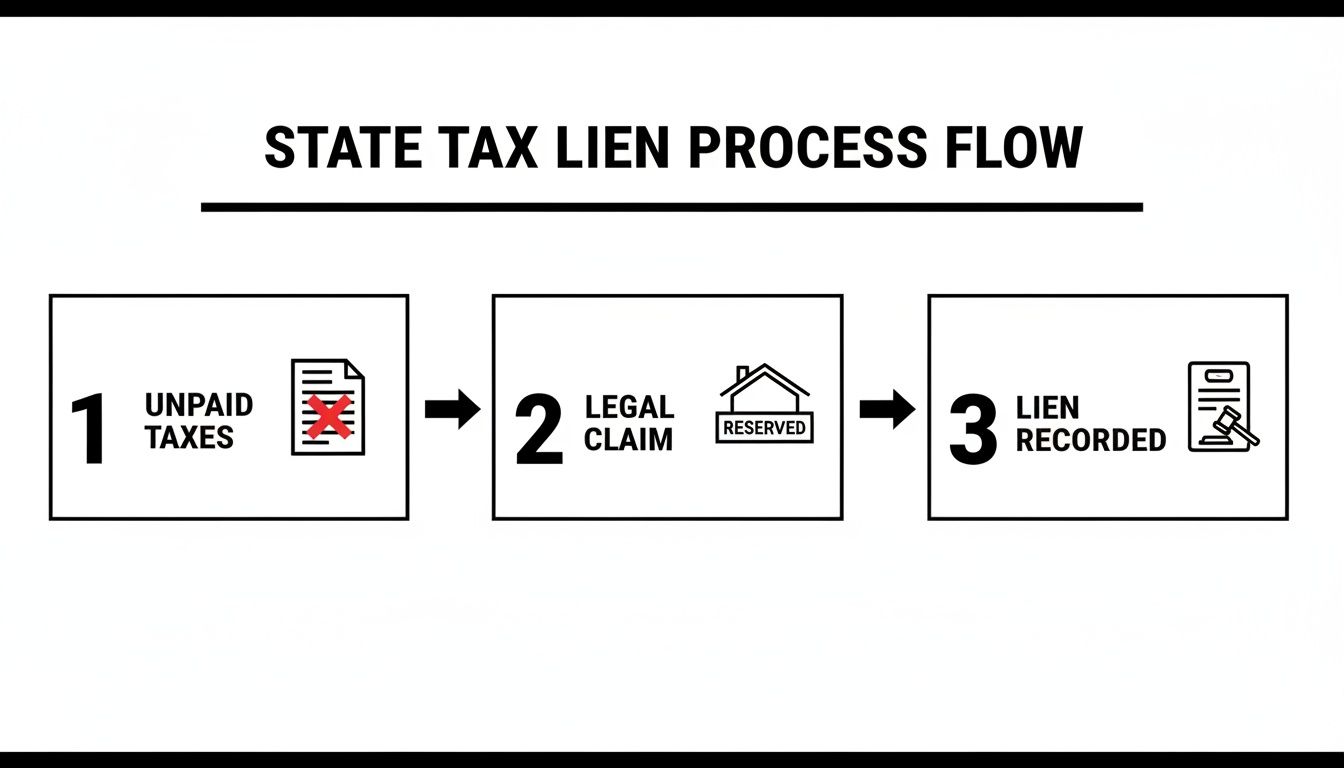
The flowchart makes it clear that a lien is a direct result of inaction. While every state's process has its own quirks, the general steps are quite similar to how the IRS operates. Reading up on the federal equivalent, the Notice of Federal Tax Lien, can give you even more insight. The lesson is always the same: being proactive is your best strategy to keep a tax debt from becoming a public mess.
The Real-World Impact of a State Tax Lien
A state tax lien isn't just some legal notice filed away in a dusty county office. It's a financial bombshell with a very real, and often immediate, blast radius that can stall your personal and business life. Once that lien goes public, its impact isn't a "someday" problem—it's a "right now" problem.
The first hit you'll probably feel is to your credit. Because tax liens are public records, the major credit bureaus scoop them up almost instantly. The lien then appears as a major black mark on your credit report, which can cause your credit score to nosedive. Good luck getting a new car loan, mortgage, or even a credit card.

How a Lien Freezes Your Assets
But the damage doesn't stop with your credit score. A state tax lien effectively encumbers all your property. Think of it as the state putting a legal clamp on everything you own now and anything you might own in the future.
This cloud of ownership extends to:
- Real Estate: Your home, vacation property, or any land you own.
- Personal Property: Cars, boats, and other high-value possessions.
- Financial Assets: Your checking and savings accounts, plus any investment portfolios.
- Business Assets: If you own a business, the lien attaches to your inventory, equipment, and accounts receivable.
This legal claim throws a wrench into any attempt to sell or transfer these assets. Let’s say you get a great job offer in another state and need to sell your house. When the buyer’s title company does its search, that lien will pop up, and the sale will screech to a halt. The deal can't close until the tax debt is settled, which often has to happen right out of the sale proceeds, completely upending your financial plans. While it can be complicated, you might be able to find a path forward; you can learn how to sell your home even when there's an IRS lien, and many of the same principles can apply to state liens.
The Escalating Threat of a State Levy
Here’s where things get truly scary. A lien is the legal groundwork that allows the state to take its next, more aggressive step: a state tax levy. A lien is just a claim on your property; a levy is the government actually taking it.
A tax lien is the state saying, "This property is ours if you don't pay." A tax levy is the state saying, "We're taking it now."
With a lien secured, the state can legally seize your assets to cover the debt. This isn't a polite request. They can take money directly from your bank account (a bank levy) or start taking a chunk of your paycheck before you ever see it (a wage garnishment). If you run a business, they could intercept payments from your customers or payment processors.
The lien is the silent threat that makes these much more painful, forceful actions possible. It turns a passive claim into a very active and potentially devastating collection process.
Why Your State's Tax Lien Rules Matter
If you think a tax lien is the same in Texas as it is in Florida, you could be in for a rude awakening. One of the costliest assumptions you can make is that every state plays by the same tax collection rules. They don’t.
Each state has its own playbook, and the local variations can have a massive impact on you and your property. The most important difference? Whether you live in a "tax lien state" or a "tax deed state." This single detail completely changes what happens when you have unpaid property taxes.
Tax Lien States vs. Tax Deed States
In a tax lien state, like Florida or Arizona, the government doesn't just swoop in and take your property. Instead, it sells the lien itself—basically, your debt—to an outside investor at a public auction.
That investor pays your tax bill to the county. In return, they get the legal right to collect that money from you, plus interest. And that interest can be steep. States like Illinois, for instance, allow for interest rates that can put incredible pressure on homeowners to pay up fast. The investor’s goal isn’t to own your home; it’s to collect on that high-interest debt.
On the other hand, a tax deed state takes a much more direct approach. After a certain period of non-payment, the state auctions off your actual property, not just the debt. The highest bidder gets the title to your home, often for just the cost of the back taxes. The path to losing your property here is much, much shorter.
The core difference is what’s being sold. In a lien state, an investor buys your debt. In a deed state, an investor buys your house.
These differences create unique opportunities for investors in over 20 U.S. states. Tax lien certificates can generate double-digit returns, with redemption periods (we'll get to that next) lasting anywhere from six months to four years. Florida is a huge market for this, where investors at auction can earn up to 18% annual interest. It's profitable for them, but incredibly stressful for the property owner. You can see how different states handle this process in more detail.
The Critical Redemption Period
No matter what kind of state you're in, there's a crucial window of time called the redemption period. This is your legally-guaranteed opportunity to pay back the entire tax debt, plus all interest and fees, to save your property.
This period varies wildly by state—it could be a few short months or last several years.
If you’re in a tax lien state, paying off the debt within this period makes the investor whole, and the lien is released. But if you miss that deadline, the investor can start foreclosure proceedings and take your property for good.
This is exactly why one-size-fits-all advice on tax liens is so dangerous. A strategy that works in a state with a long redemption period could be a disaster somewhere with a tight, unforgiving timeline. For business owners, the best defense is a good offense—namely, staying on top of your local tax obligations. Understanding topics like What Is Payroll Compliance? is a great start, as staying current on state payroll rules can help prevent the very tax problems that trigger liens.
Proven Strategies to Resolve a State Tax Lien
Discovering a state tax lien has been filed against you can be a gut-wrenching moment. It’s easy to feel cornered, but this is not a dead end. Instead of getting paralyzed by the problem, it’s time to focus on the solution. You have several clear, actionable strategies to resolve the debt and get your financial life back on track.
The absolute key is to act quickly and choose the path that best fits your financial reality. Ignoring the lien is the worst thing you can do—it just allows penalties and interest to pile up, digging you into a deeper hole. By addressing the debt head-on, you take back control and open up different pathways to a resolution.

Pay the Debt in Full
Let's start with the most direct approach. The simplest and fastest way to get a state tax lien released is to pay the underlying tax debt in full. Once the state receives every penny owed—including all penalties and interest—it will issue a lien release. This document is the official proof that the state's claim against your property is gone.
This is the ideal option if you have the funds available. It provides a clean break, immediately stops any more interest from piling on, and is the quickest route to being able to sell or refinance your property without complications.
Negotiate a State Installment Agreement
If paying in full just isn’t in the cards right now, the next best option is often an installment agreement. This is a formal payment plan you negotiate with the state tax agency, allowing you to pay off your debt in manageable monthly chunks over a set period.
Think of it like setting up a payment plan for a car. You agree on a fixed monthly payment and stick to it until the balance is zero. While interest and penalties will keep accruing until the debt is fully paid, this strategy makes the debt manageable and usually stops more aggressive collection actions in their tracks.
To get on a payment plan, you'll almost certainly need to:
- Be current on all your other tax filings.
- Provide financial information to prove what you can afford to pay.
- Agree to a monthly payment amount the state finds reasonable.
An installment agreement is a serious commitment. If you miss payments or fail to file future tax returns on time, the agreement will default. That puts you right back where you started, facing aggressive collections.
Pursue an Offer in Compromise
What happens if you can't afford to pay the full debt, even with a monthly payment plan? In some cases, you might be able to pursue an Offer in Compromise (OIC). An OIC is a formal proposal to the state where you ask to settle your tax liability for a lower amount than what you originally owed.
This isn't a get-out-of-debt-free card, though. States have very strict criteria and will only accept an OIC if they truly believe it's the most they can ever hope to collect from you. Expect them to put your finances under a microscope, analyzing your income, expenses, assets, and future earning potential.
Other Strategic Options
In specific circumstances, other creative strategies might be on the table. For instance, a lien subordination doesn't remove the lien, but it temporarily allows another creditor (like a mortgage lender) to jump ahead of the state in priority. This can be a game-changer if you need to refinance your home to get the cash to pay the tax debt.
It's also worth investigating whether you can clear tax debt through bankruptcy, but be warned—the rules are incredibly complex. For a deeper look at these and other advanced tactics, check out our guide on how to remove a tax lien.
Your Guide to State Tax Lien Questions
Once you get your head around the basics of a state tax lien, the "what if" questions usually start piling up. It's completely normal. Getting straight answers is the first step toward feeling in control again and building a solid plan.
Let's tackle a couple of the big questions I hear all the time from taxpayers.
How Long Does a State Tax Lien Stay on Your Record?
This is often the first thing people ask. The lien itself will stay on the public record until you’ve paid every last penny and the state officially files a "lien release." It doesn't just time out.
But what about your credit report? That’s a different story. Even after the lien is released, it can hang around on your credit report for up to seven years from when it was first filed. The good news is that its negative impact tends to fade over time, especially after it's been paid. Keep in mind, every state has its own rules for how long it can legally chase a tax debt, so knowing your state's specific statute of limitations is key.
Can I Sell My House with a State Tax Lien?
Technically, yes. But it's not a simple process. Think of the lien as a legal claim that attaches directly to your property.
Because of this, you absolutely have to settle the debt before or during the closing. A title company won’t let the sale go through otherwise—they’ll require the tax debt to be paid off with the proceeds from the sale. In some situations, a tax professional might be able to negotiate a lien subordination, which allows the lender's lien to take priority so the sale can proceed, but you'll still have to deal with the tax debt itself.
A huge misconception I see is that bankruptcy is a magic wand for tax liens. While filing for bankruptcy might wipe out your personal responsibility to pay certain tax debts, the lien itself often survives. It can remain attached to your property, meaning the state's claim on your house or car might still be there long after the bankruptcy case is closed.
The bottom line is the lien won't just disappear on its own, and navigating these waters requires a clear strategy.
If you're dealing with a state tax lien, you don't have to figure it all out alone. Here at Attorney Stephen A Weisberg, we begin with a free tax debt analysis to get a clear picture of your situation and find the right solution for you. Contact us today to get started.


