What Is Safe Harbor Rule: A Complete Guide 2026
Learn what is safe harbor rule in tax and how IRS safe harbors can shield you from penalties with key thresholds for 2026.

In this article
- What a Safe Harbor Rule Actually Means
- The part most people miss
- The Estimated Tax Safe Harbor Explained
- How to think about the math
- De Minimis and Tangible Property Safe Harbors
- What qualifies and what doesn't
- Small Business Accounting Method Safe Harbors
- Inventory and method elections
- Penalty Relief and Trust Fund Recovery Exposure
- Payroll tax debt is the danger zone
- Real Scenarios Where Safe Harbors Saved the Day
- What made the difference
- Common Mistakes When Claiming a Safe Harbor
- The traps that keep showing up
- When to Handle It Yourself and When to Call a Tax Attorney
A safe harbor rule is a defined zone of compliance that can shield you from penalties when you hit the stated conditions. It can still leave you owing tax at filing, so don't confuse penalty protection with tax forgiveness.
If you're staring at a quarterly estimate, a repair bill, or a payroll problem and wondering whether the IRS will give you room to breathe, you're asking the right question. The catch is that “safe harbor” isn't one rule. It's a label the law uses in different places, and choosing the wrong one is how people get burned.
What a Safe Harbor Rule Actually Means
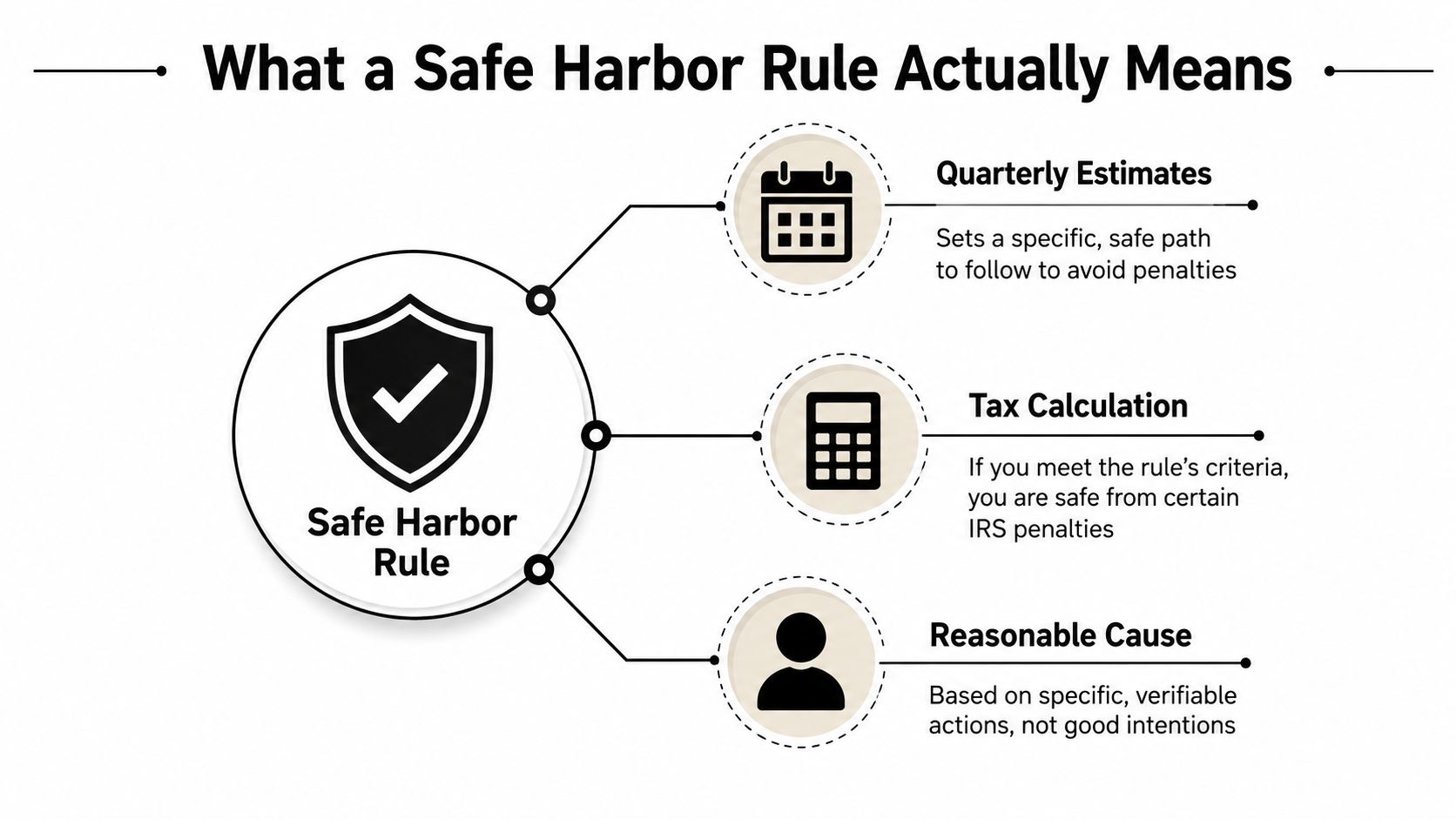
A safe harbor is a legal shortcut, not a loophole. It gives you a clearly defined path to follow so you can avoid penalties or liability when you meet the stated conditions, even if the underlying rule is otherwise broad or messy, as Cornell Law School's Wex explains in its definition of a safe harbor (Cornell Law School Wex on safe harbor).
That matters because tax and business rules are full of judgment calls. Regulators still keep the general rule in place, but they carve out a bright line for people who want certainty. In practice, that means you stop arguing about intent and start checking boxes.
The part most people miss
A safe harbor usually protects you from a penalty, not from the underlying tax or obligation itself. That's the trap. People hear “safe harbor” and assume they've escaped the bill, when the promise is narrower.
That's why the phrase shows up in different corners of the law. The IRS uses it for estimated taxes and tangible property deductions, healthcare regulators use it in anti-kickback rules, and other rules use the same label for very different compliance tests. If you're searching for what is safe harbor rule, the first question is not “Can I use it?” It's “Which safe harbor are we even talking about?”
Practical rule: If the rule says you qualify only when you meet specific conditions, treat it like a checklist, not a negotiation.
For small-business owners, that distinction matters every quarter. A truck driver sorting deductions, for example, can run into very different tax rules than a consultant with uneven income. If you want a practical side-by-side on vehicle write-offs, the guide to browse trucking tax deductions is useful context.
The Estimated Tax Safe Harbor Explained
The IRS estimated-tax safe harbor is the one most self-employed people need. It's a penalty-protection rule, not a tax-erasing rule. If you meet the payment test, you can still owe money when you file and still avoid the underpayment penalty.
The core thresholds are straightforward. For most taxpayers, the penalty is avoided if they pay at least 90% of current-year tax or 100% of prior-year tax. If prior-year adjusted gross income exceeded $150,000. or $75,000 for married filing separately. the prior-year test rises to 110%. A separate test can apply when the amount due after withholding and credits is less than $1,000 (H&R Block summary of the IRS underpayment penalty safe harbor).
How to think about the math
Take a sole proprietor who had a good prior year but a rough current year. If that owner paid enough through withholding and estimates to satisfy the prior-year test, the IRS generally won't hit them with the underpayment penalty even if the final return shows more tax due. The balance still gets paid, but the penalty stops.
That same logic applies to a single-member LLC taxed as a disregarded entity. If income swings hard during the year, the safe harbor gives the owner a clean compliance target instead of a guessing game. The trick is to use withholding and estimated payments intentionally, not randomly.
| IRS Estimated Tax Safe Harbor at a Glance | |||
|---|---|---|---|
| Safe Harbor Test | Threshold | Best For | Watch Out For |
| Current-year test | 90% of current-year tax | Taxpayers with strong year-end visibility | Hard to compute accurately if income is volatile |
| Prior-year test | 100% of prior-year tax | Stable earners and many small businesses | Prior-year return must actually support the test |
| Higher-income prior-year test | 110% when prior-year AGI exceeded $150,000 or $75,000 MFS | Higher-income filers with strong carryover income | The higher threshold is easy to miss |
| Small-balance test | Less than $1,000 due after withholding and credits | Taxpayers near break-even at filing | Only works when the final balance stays under the limit |
The clean way to document this is Form 2210, the IRS underpayment penalty form. You use it to compute the penalty, claim a waiver, or show the IRS you met a safe harbor. If you're unsure, that form is where the argument lives, not in your gut.
The worst move is skipping estimates and hoping the IRS won't care. It will. If quarterly payments are part of your routine, the piece at what happens when estimated tax payments are skipped makes the penalty risk plain.
De Minimis and Tangible Property Safe Harbors
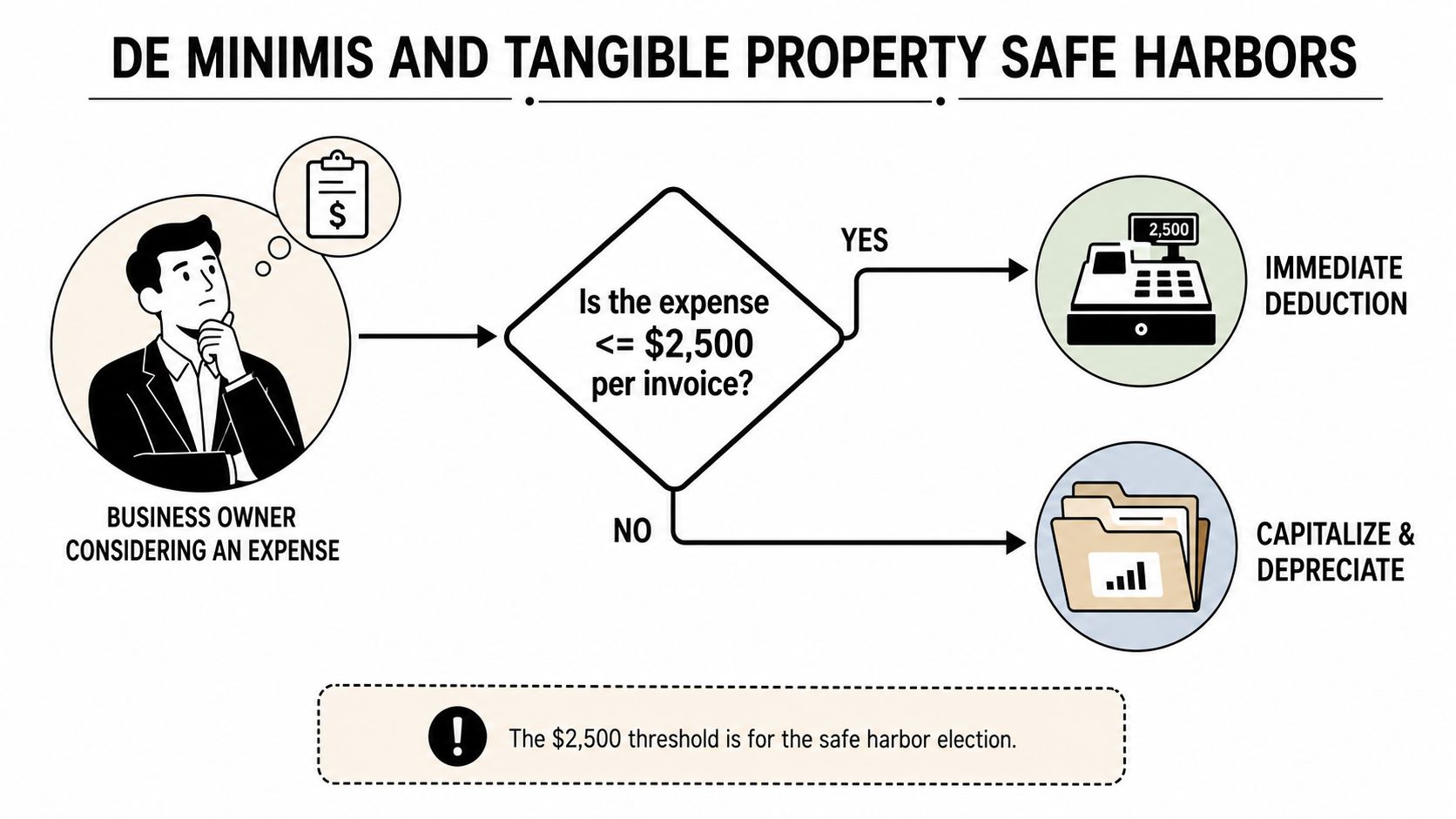
The de minimis safe harbor belongs in the small-business deduction toolbox, not the quarterly-payment toolbox. It comes from the final tangible property regulations, which generally apply to tax years beginning on or after January 1, 2014. Under the IRS rule, taxpayers with an applicable financial statement can deduct tangible property costs up to $5,000 per invoice or item if they substantiate the amount with an invoice and treat it consistently in their books and records (IRS tangible property final regulations).
That's the point of the rule. It gives you a practical line for smaller purchases so you don't turn every modest equipment buy into a depreciation project. For a lot of closely held businesses, that line can materially affect taxable income and audit exposure.
What qualifies and what doesn't
The rule is narrow enough to reward discipline. You need the invoice, you need the accounting treatment to match the position you're taking, and you need to know whether the property falls under the election you're using. If your bookkeeping is sloppy, the IRS can ignore your story and focus on your records.
There's also the separate repair-vs-capitalization framework under the tangible-property rules. Routine maintenance and ordinary repairs are often deductible when they fit the regulatory standard, while improvements that extend life or add value usually have to be capitalized. Don't treat “small” as the same thing as “deductible.” The true test is how the cost fits the rule.
Keep the invoice, book the expense consistently, and don't wait until audit season to decide what the transaction was.
If you want the operational side of this election, the instructions tied to Form 4562 guidance for depreciation and elections are a helpful companion. The form is where many businesses make the tangible-property position real.
The mistake I see most often is treating the cap like a vague annual budget. It isn't. The safe harbor turns on the invoice or item, so a business that buys several pieces separately has to analyze each one on its own facts.
Small Business Accounting Method Safe Harbors
Accounting method safe harbors matter because they decide when income and deductions hit the return in the first place. If you're a sole proprietor, S corporation, or multi-member LLC, this can change the shape of every tax year. A business can be technically profitable and still end up with very different tax timing depending on the accounting method.
The core distinction is cash versus accrual. Many small businesses stay on cash because it's simpler and easier to track in real time. Others move to accrual because inventory, contracts, or creditor demands make that method more practical. The point isn't which method sounds smarter. The point is whether your method matches the way your business operates.
Inventory and method elections
Small-business taxpayers may also qualify for the inventory safe harbor under §471(c). That rule can let a qualifying business treat inventory as non-incidental materials and supplies, or follow its financial method of accounting. For owners who hate ending-year inventory headaches, that can be a real administrative relief.
But the election choices ripple into everything else. If your method changes when income is recognized, your estimated-tax calculation changes too. The same is true for how cleanly you can rely on the de minimis election from the prior section. Bad method work makes good safe harbor work harder.
| Method issue | Why it matters | Common pressure point |
|---|---|---|
| Cash method | Simpler timing for many small businesses | Revenue can swing late in the year |
| Accrual method | Better fit for some inventory-heavy operations | More bookkeeping complexity |
| Inventory safe harbor | Can reduce inventory tracking burdens | Must fit the qualifying taxpayer rules |
| Form 3115 change | Used when changing accounting methods | Paperwork gets technical fast |
If you're running an entity with employees, vendors, and inventory, don't wing this. The small business tax checklist is the kind of organizing tool that keeps method elections from turning into year-end chaos.
Penalty Relief and Trust Fund Recovery Exposure
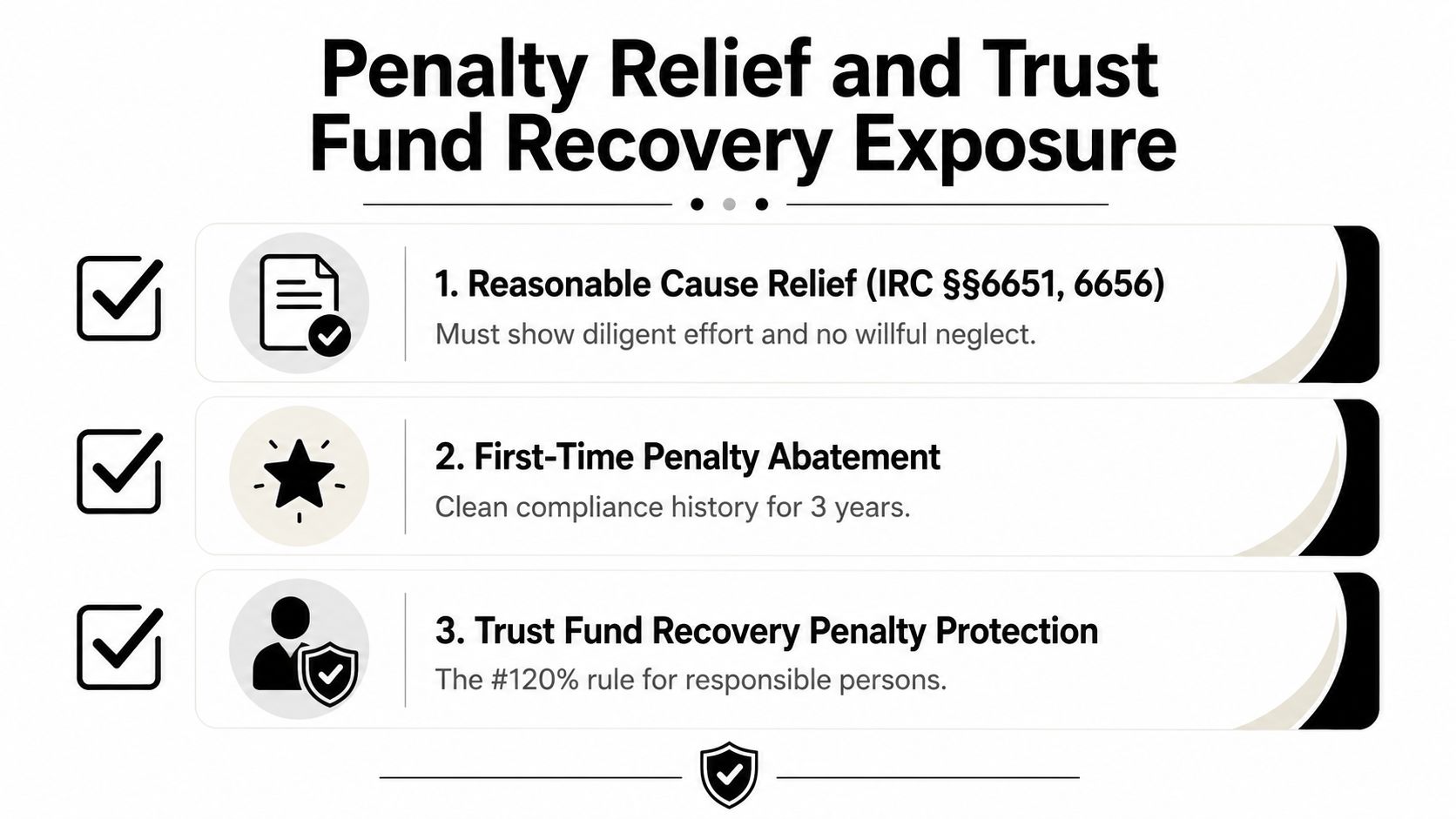
Safe harbor language gets messy here because not every protection is a true safe harbor. Some relief comes from reasonable cause, some comes from administrative abatement, and some comes from defenses against personal payroll-tax exposure. Those are different animals.
Reasonable-cause relief under IRC §§6651 and 6656 is about showing you exercised diligence and didn't engage in willful neglect. First-time penalty abatement is more administrative, and it usually fits taxpayers with a clean compliance history. If you need to ask for relief, the request often goes through Form 843 or a written response, depending on the penalty and the IRS posture.
Payroll tax debt is the danger zone
The biggest personal exposure in a small business is the trust fund recovery penalty under §6672. That penalty can be assessed against a responsible person for payroll taxes the business failed to remit. It's personal, not corporate, which is why owners and bookkeepers cannot treat payroll debt like an ordinary business liability.
The IRS looks at whether the person was responsible and whether the failure was willful. Those facts matter more than titles. If someone had authority over payments, knew taxes weren't being paid, and still allowed other creditors to get paid first, the IRS has a strong case.
The time to fight a trust-fund case is before the assessment hardens. After that, the room to maneuver shrinks fast.
If payroll taxes are already in play, the trust fund recovery penalty overview is the right place to understand why the IRS targets individuals, not just the entity. That issue is not something to “wait and see” on.
Real Scenarios Where Safe Harbors Saved the Day
A self-employed consultant lands a strong year, then gets hit with uneven cash flow the next spring. The quarterly estimates were light, but the prior-year numbers were high enough to satisfy the safe harbor. The penalty disappears, the balance due stays, and the consultant learns the right move is to manage payments earlier instead of fighting the IRS later.
A contracting LLC pays to fix a piece of equipment and throws the bill into fixed assets without checking the facts. The repair was ordinary, the amount was small, and the bookkeeping didn't match the treatment. On review, the business corrects the entry and uses the tangible-property rules to support an immediate deduction position instead of dragging the cost through depreciation.
A restaurant owner falls behind on payroll deposits while trying to keep staff paid and vendors current. The IRS starts looking at the owner personally under the trust fund recovery rules. Counsel pushes on responsibility, willfulness, and payment timing, because those are the facts that decide whether the case becomes a personal assessment or a reduced exposure.
What made the difference
In all three scenarios, the winning move was documentation. The taxpayer who had records, matching books, and a clean timeline had a stronger position. The one who tried to explain after the fact had a weaker story.
That's the part many people miss about safe harbors. They don't rescue sloppy records. They reward disciplined facts.
- Keep source documents: Invoices, bank records, and payroll reports need to line up with the position you're taking.
- Match the election to the facts: Don't force a prior-year tax rule onto a payroll problem or a repair bill.
- Act before the deadline passes: Safe harbor planning works best before the filing position is frozen.
Common Mistakes When Claiming a Safe Harbor
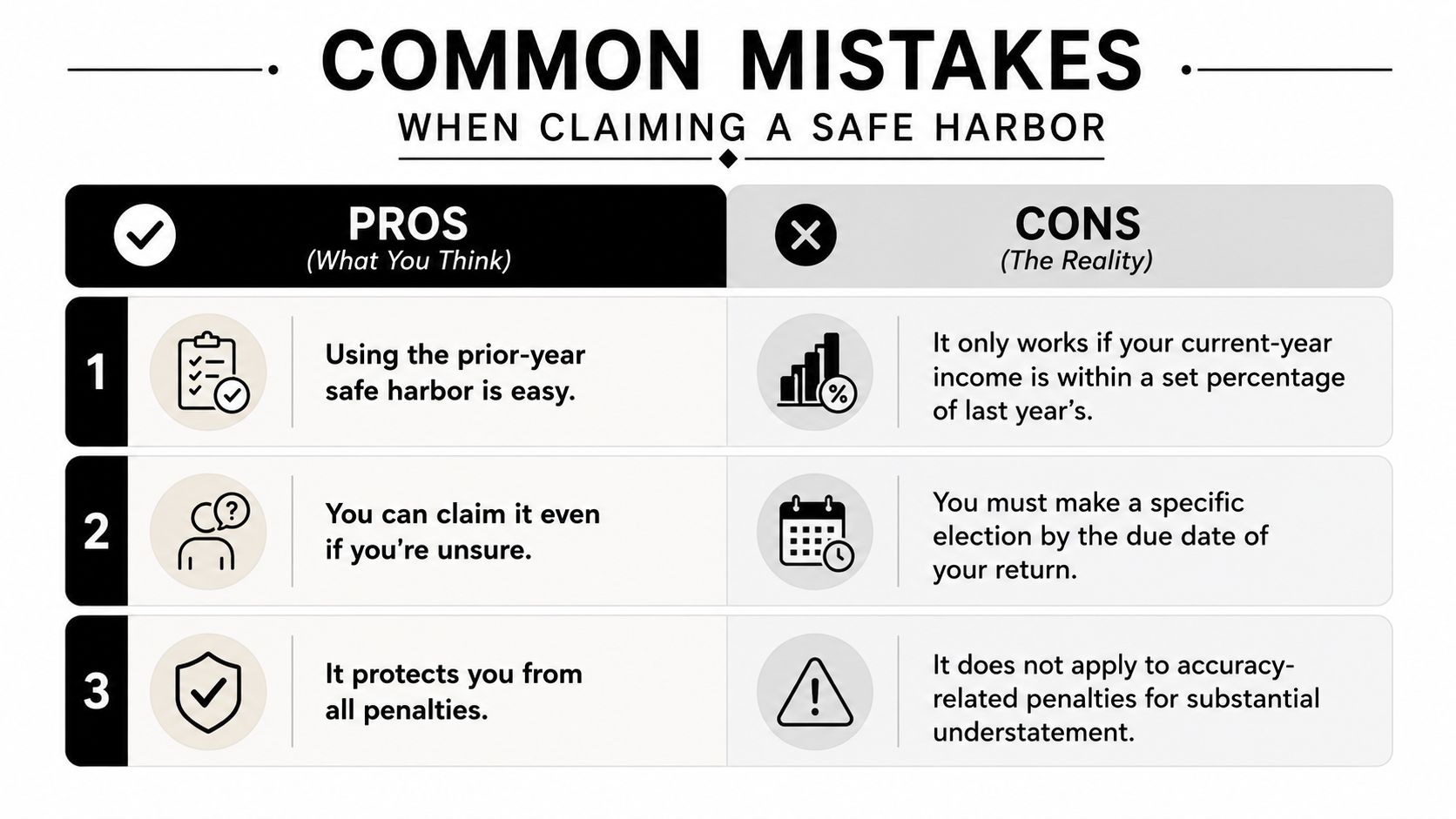
The most common mistake is assuming one safe harbor covers everything. It doesn't. Estimated taxes, property deductions, accounting methods, and payroll liability all live in different lanes, and each lane has its own rulebook.
The traps that keep showing up
A taxpayer thinks the prior-year estimated-tax safe harbor works after amending last year's return. That's dangerous because the benchmark may shift when the prior year changes. Another owner treats the de minimis threshold like a flat annual spending limit, which is wrong because the rule turns on the invoice or item.
The other classic error is confusing reasonable cause with an automatic safe harbor. Reasonable cause is an argument, not a guaranteed pass. You have to show facts, not wishful thinking.
If your defense depends on a story you can't document, it isn't a defense yet.
The final trap is ignoring payroll tax while focusing on the income-tax return. The IRS won't care that you filed a perfect return if the employment taxes weren't handled. If there's trust-fund exposure, handle that first.
When to Handle It Yourself and When to Call a Tax Attorney
Handle it yourself when the issue is clean and mechanical. A wage earner using the $1,000 balance test or the prior-year estimated-tax safe harbor can usually manage the filing without drama. A small business making a well-documented de minimis election with organized invoices can often do the same.
Call a tax attorney when the facts are messy or the IRS is already leaning in. Multi-year payroll debt, a proposed trust-fund assessment, an audit, an amended return that changes prior-year numbers, or any possible criminal issue needs real representation. Those cases turn on timing, strategy, and what you say first.
The smartest next step for self-employed taxpayers, small businesses, and professionals helping clients with tax trouble is a free Tax Debt Analysis. It's built to sort out whether a case is worth fighting, what kind of relief is realistic, and how to move before the IRS locks in its position.
Tax Attorney Stephen A Weisberg helps people with IRS penalty exposure, tax debt, audits, and trust-fund problems get clear answers before they make the wrong move. If this safe harbor issue is tied to payroll tax, quarterly estimates, or a messy filing history, visit Tax Attorney Stephen A Weisberg and get the practical help that fits the facts.


