What Is Realized Gain? A Guide to Tax & Your Assets
Understand what is realized gain and how it impacts your taxes. Learn to calculate it, avoid common pitfalls, and prevent unexpected IRS debt from asset sales.

In this article
- The Moment a Paper Profit Becomes a Tax Problem
- Realized Gain Versus Unrealized Gain Explained
- A simple way to think about it
- Why business owners get this wrong
- The IRS cares about the event, not your feelings about the deal
- The Critical Difference Between Realized and Recognized Gain
- Realization is the transaction
- Recognition is the tax consequence
- Where deferral enters the picture
- Why this matters in practice
- How to Calculate Your Realized Gain Correctly
- Start with the actual formula
- Amount realized is usually higher than owners expect
- Adjusted basis is where expensive mistakes start
- A clean calculation looks like this
- Do not guess on the tax forms
- Real-World Examples of Realized Gains
- Selling stock
- Selling a primary residence
- Selling business equipment
- Installment sale
- Common Pitfalls and Strategic Tax Planning
- The mistakes I see most often
- What smart planning looks like
- My recommendation
- When You Must Consult a Tax Attorney
You sold something important. Maybe it was a rental property, a piece of equipment, stock you've held for years, or part of a business. The sale closes, money moves, and the first reaction is relief.
The second reaction should be tax planning.
Many people get blindsided. Their focus rests on sale price, debt payoff, and cash left in the account. They overlook realized gain, which is the concept that often determines whether a profitable transaction becomes a tax problem.
If you're a business owner, self-employed, or advising clients who are, you need a working answer to what is realized gain that goes beyond a dictionary definition. You need to know when gain becomes taxable, how basis errors create bad returns, and why a sale can trigger IRS trouble even when the seller feels cash-poor after the deal.
The Moment a Paper Profit Becomes a Tax Problem
A rising asset value feels good. It also means almost nothing for tax purposes until you dispose of the asset.
A realized gain is the actual profit from an asset sale that becomes relevant for tax liability. Unlike an unrealized gain, which exists only on paper while you still own the asset, a realized gain comes into play when the transaction is completed. The basic formula is Realized Gain = Amount Realized – Adjusted Basis, as explained in this overview of realized gains.
That distinction matters more than most new owners think. You can watch the value of a warehouse, brokerage account, or machine climb for years and owe no current tax on that appreciation. Sell it, though, and you've crossed into a different category. You now have a transaction the IRS expects you to report correctly.
Practical rule: The sale is the moment tax planning stops being optional.
Here's the mistake I see too often. A seller uses the proceeds to pay vendors, clear debt, make payroll, or fund the next venture, then assumes the tax bill can be handled later. That's backwards. The gain may create a current-year obligation whether or not you kept the cash.
If you ignore that, tax debt starts fast. It can lead to penalties, collections, and eventually enforced action such as IRS levies on bank accounts. By then, the asset sale that was supposed to help your finances has made them worse.
Realized Gain Versus Unrealized Gain Explained
The cleanest way to understand this is to stop thinking like an investor reading a statement and start thinking like the IRS.
If your asset has increased in value but you still own it, you have an unrealized gain. If you sold or otherwise disposed of it and came out ahead over your basis, you have a realized gain.
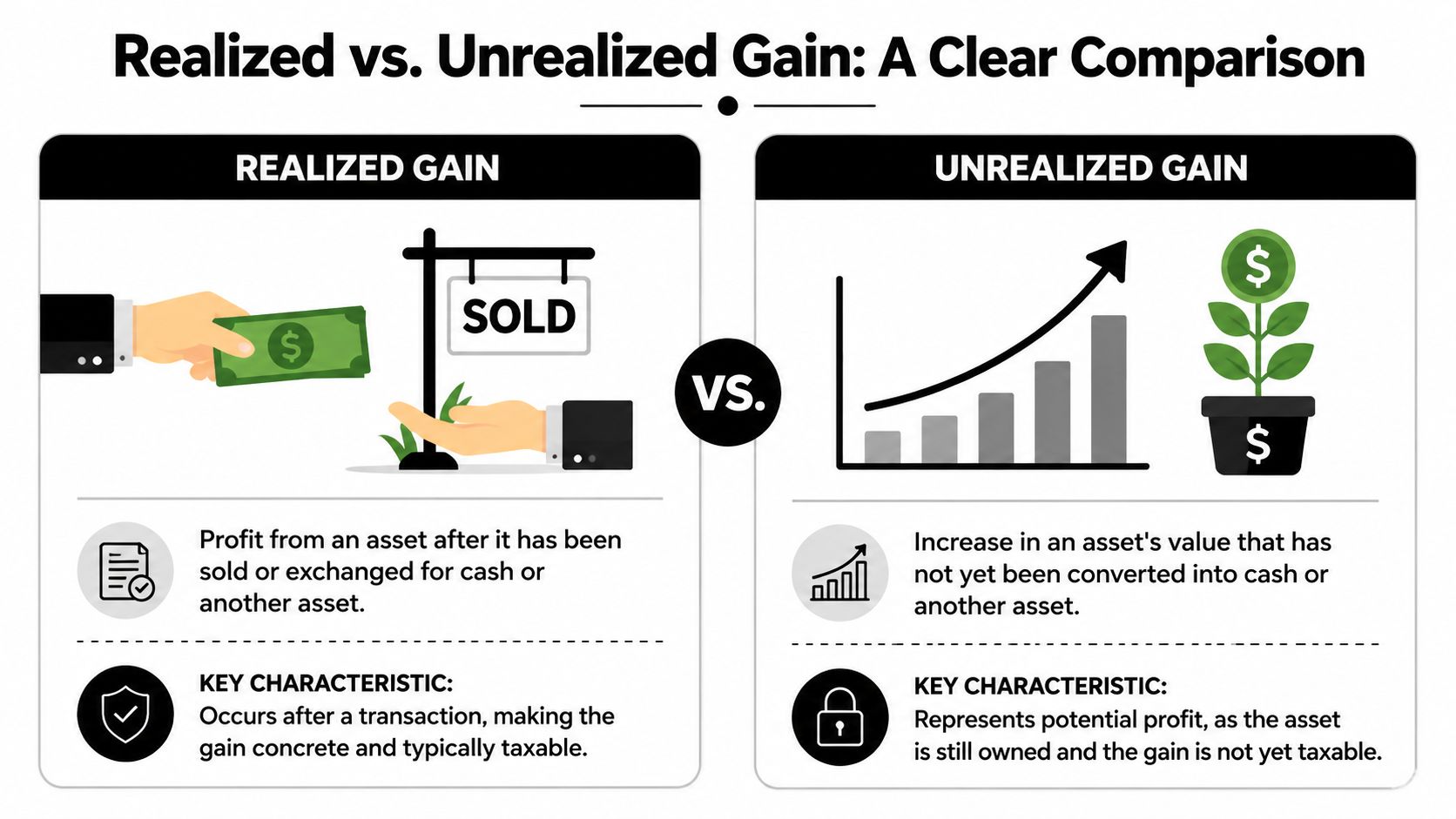
A simple way to think about it
Take real estate. You buy property and years later it's worth far more than what you paid. That's an unrealized gain. It's real in an economic sense, but it hasn't turned into a taxable sale event.
Close the sale and receive the proceeds, and the gain is no longer theoretical. It's realized.
Unrealized gain is potential value. Realized gain is transaction-based value.
The same logic applies to stock, crypto treated as property, business equipment, partnership interests, and other assets. Holding an appreciated asset doesn't usually trigger current tax by itself. Selling, exchanging, or otherwise disposing of it is what changes the posture.
Why business owners get this wrong
Owners often talk about gain as if it means "extra cash after the sale." That's not how tax law works. Tax law starts with basis and amount realized, not your subjective sense of whether the deal felt profitable.
This misunderstanding gets worse when someone has multiple moving parts in the same year. They may have business income, distributions, debt payments, and an asset sale all happening at once. If they don't have a clear framework for understanding capital gains tax, they often underestimate what the sale did to their return.
A good mental model is this:
- Unrealized gain means the asset has gone up in value while you still own it.
- Realized gain means a transaction happened and now the tax analysis starts.
- Tax owed is a separate question that depends on additional rules, which is where people often get surprised.
The IRS cares about the event, not your feelings about the deal
A client will sometimes say, "I didn't really make anything because I rolled the money into something else" or "most of it went to debt." That may matter for cash flow. It doesn't erase the realized gain analysis.
Your checkbook and your tax return aren't the same document. Treating them like they are is how taxpayers walk into avoidable trouble.
The Critical Difference Between Realized and Recognized Gain
Basic articles usually stop here, and it's here that real tax planning begins.
A gain can be realized without being fully recognized for current tax purposes. Cornell puts it plainly: realization occurs when the amount realized exceeds adjusted basis, yet not all gain realized is recognized because tax rules may defer or exclude current taxation, as described in Cornell's explanation of realization of gain.

Realization is the transaction
When you dispose of property and receive value above basis, you've realized gain. That's the economic event.
Recognition is the tax consequence
Recognition asks a different question. How much of that realized gain must be included in taxable income now?
That difference matters because taxpayers often assume every sale automatically creates an immediate tax bill in full. Sometimes it does. Sometimes it doesn't.
A realized gain tells you a gain occurred. A recognized gain tells you how much of it is currently taxable.
Where deferral enters the picture
Certain tax rules can postpone recognition. Two common concepts business owners hear about are like-kind exchanges and installment sales.
In a like-kind exchange context, the transaction may still involve realized gain, but the current year's recognized gain can be different because specific rules can defer taxation. In an installment sale, the deal may be closed, but recognition can unfold over time as payments are received, depending on how the rules apply.
That's why sloppy language causes expensive mistakes. If your CPA, broker, or deal team says, "You realized a gain," your next question should be, "How much of that is recognized this year?"
Why this matters in practice
This isn't technical trivia. It changes decisions.
If you wrongly assume every realized gain is immediately recognized in full, you may overreact and make bad business decisions. If you wrongly assume deferral applies automatically, you may underpay and create tax debt.
Common problem areas include:
- Asset exchanges where the owner thinks no cash means no current issue
- Installment deals where reporting doesn't match the payment structure
- Cross-border and entity transactions where the bookkeeping gain and taxable gain don't line up
- Reorganizations or restructurings where owners assume the transaction was "paper only"
Most tax debt around gains doesn't come from exotic fraud. It comes from ordinary taxpayers misunderstanding timing.
How to Calculate Your Realized Gain Correctly
A sale can look profitable and still blindside you at tax time.
That happens when a business owner tracks sale price but ignores basis adjustments, depreciation, and transaction details. The result is predictable. The return gets filed wrong, the gain gets understated, and the IRS comes looking for the difference.
Start with the actual formula
Use the rule under Section 1001:
Realized gain = amount realized - adjusted basis
That sounds simple. The risk sits in the two inputs.
- Determine the amount realized
- Determine the adjusted basis
- Subtract adjusted basis from amount realized
A positive result is a realized gain. A negative result is a realized loss.
Amount realized is usually higher than owners expect
Business owners often focus on cash left after debt payoff, broker fees, and other deal costs. That is a mistake.
For tax purposes, amount realized generally starts with everything you received for the asset, not just what hit your bank account. Depending on the transaction, that can include cash, the fair market value of property received, and liabilities the buyer assumed. IRS guidance on sales and other dispositions makes that framework clear in Publication 544.
If you sell an asset for enough to pay off a loan but walk away with less cash than expected, you can still have a sizeable realized gain. That is where many self-employed taxpayers create tax debt. They spend based on net proceeds and forget the tax law measures the transaction differently.
Adjusted basis is where expensive mistakes start
Adjusted basis begins with what you paid, then changes over time. It goes up for capital improvements and certain acquisition costs. It goes down for items that reduced your tax investment in the asset, especially depreciation.
That last point causes the most trouble.
If you claimed depreciation for years, your basis is lower. A lower basis means a larger gain on sale. Owners who deducted depreciation without keeping a clean schedule often understate gain because they calculate from memory or from original purchase price. Both approaches are reckless.
For background on the bookkeeping side, this explanation of how depreciation affects financial health is a useful primer. For tax purposes, the practical point is harsher. Depreciation reduces basis, and reduced basis increases exposure when you sell.
| Item | Cost/Value | Effect on Basis |
|---|---|---|
| Original purchase price | Initial acquisition amount | Increases basis |
| Capital improvements | Additional capitalized costs | Increases basis |
| Documentation or qualifying acquisition costs | Added to basis when appropriate | Increases basis |
| Depreciation claimed | Deductions taken during ownership | Decreases basis |
A clean calculation looks like this
Say you bought business property for $90,000. You later spent $350,000 on capital improvements and $60,000 on qualifying acquisition and documentation costs. Your adjusted basis is $500,000, assuming no other upward or downward adjustments apply.
If you then sell the property for $2,500,000, your realized gain is $2,000,000.
The lesson is not limited to real estate. The same calculation issues show up with equipment, vehicles, leasehold improvements, and other depreciable business assets. Small business owners get into trouble when they treat those records as bookkeeping clutter instead of tax evidence.
Keep purchase records, closing statements, invoices for improvements, and depreciation schedules in one file. If you cannot prove basis, you put yourself in a weak position fast.
Do not guess on the tax forms
I regularly see taxpayers reconstruct basis after the deal closes. By then, key records are missing, memories are wrong, and the return is already exposed.
Use source documents. Reconcile the sale details to your depreciation records and to the return. If you need a practical filing reference, these Schedule D instructions and reporting basics help you match the transaction to the proper reporting framework.
Real-World Examples of Realized Gains
The rule becomes easier to use when you see it in ordinary transactions.
Under Internal Revenue Code Section 1001, realized gain is the amount realized minus adjusted cost basis, and realization can be triggered by any disposition, not just a cash sale. That's why exchanges and other non-cash transactions can still create gain issues, as explained in this Section 1001 summary.

Selling stock
You buy shares, hold them, and later sell them for more than your basis. The sale creates a realized gain.
The tax treatment may differ depending on how long you held the shares and what account held them, but the core event is the same. The gain wasn't taxable while the shares rose in value. It became relevant when you sold.
Often, investors make a simple error. They track performance accurately but not basis accurately. Reinvested amounts, transfer histories, and partial sales can all complicate the reporting.
Selling a primary residence
Homeowners often assume every home sale creates a major tax bill. Not necessarily.
A home sale can involve realized gain, but separate tax rules may affect whether all of it is recognized currently. This is a classic example of why realized and recognized gain aren't the same thing. The transaction happened. The tax outcome still depends on the rules that apply to that sale.
Selling business equipment
Business owners get hit hardest when you bought equipment, claimed depreciation over time, and then sold it at a gain over adjusted basis. The gain is realized, but the character of that gain can be different than the owner expects.
Section 1245 depreciation recapture can convert what many taxpayers assume is capital gain into ordinary income. That means the sale of a truck, machine, or other depreciable business asset may produce a harsher tax outcome than the owner planned for.
If you depreciated it, don't assume the sale gets favorable capital treatment across the board.
Installment sale
An installment sale is one of the best examples of the gap between realization and recognition.
You may dispose of the asset in one year, which means the gain is realized. But if the structure qualifies and payments come in over time, recognition may also be spread over time under the applicable rules.
That's useful planning when done correctly. It's dangerous when documented badly. A poorly drafted agreement or inconsistent reporting can create confusion with the IRS quickly.
Common Pitfalls and Strategic Tax Planning
A small business owner sells a piece of equipment, sees cash hit the account, and uses it for payroll, vendors, or a loan payoff. Then tax season arrives and the return shows gain, recapture, and a balance due that was never set aside. That is how an ordinary sale turns into tax debt.
The pattern is predictable. Owners treat the transaction like an operations decision and leave the tax analysis for later. Later is expensive.
The mistakes I see most often
- Bad basis records. The owner cannot substantiate purchase price, improvements, fees, or prior depreciation, so the gain gets overstated and becomes harder to challenge.
- Ignoring asset character. A sale gets reported as capital gain by assumption, even though depreciation recapture or other rules can push part of it into ordinary income.
- Spending the proceeds immediately. Cash in the bank gets mistaken for spendable profit, even when a meaningful piece of it belongs to the IRS or the state.
- Missing estimated tax adjustments. One sale can change the entire year. If quarterly payments stay flat, penalties follow.
- Using deal terms as a tax shortcut. Paying off debt, splitting proceeds among owners, or labeling part of the price a certain way does not control the tax result if the reporting position lacks support.
Poor records and bad timing create the worst outcomes. By the time the return is prepared, the money is gone and the reporting position is harder to fix cleanly.
What smart planning looks like
Start before closing, not after. Confirm basis. Identify any depreciation recapture. Separate the business decision from the tax cost of the deal. Then decide whether the timing of the sale, the allocation of purchase price, or available losses can reduce the damage legally.
That kind of planning prevents surprise balances due. It also gives your CPA or attorney the documents needed to defend the reporting position if the IRS asks questions.
If you want a practical framework, review these strategies for reducing tax liability before problems compound alongside your gain analysis.
My recommendation
Do not wait for return preparation to figure out realized gain. Run the numbers before the deal closes if possible. If the sale already happened, rebuild basis, identify the character of the gain, and estimate the tax now.
For taxpayers who already see a debt problem forming, one option is a controversy-focused review, such as the free tax debt analysis we offer, along with review by your CPA or tax preparer. The right advisor depends on whether the issue is basic compliance, transaction planning, or an active IRS problem.
Tax debt usually starts at the sale, not when the notice arrives.
When You Must Consult a Tax Attorney
There are times when a general explanation of what is realized gain isn't enough. You need legal judgment.
Talk to a tax attorney if you're selling a business, selling multiple major assets in one transaction, handling a like-kind exchange, structuring an installment sale, dividing property in divorce, or dealing with inherited property and basis questions. Get legal help if the transaction involves multiple entities, unusual financing, disputed ownership, or a prior preparer who can't clearly explain the reporting position.
You also need counsel if the IRS has already sent a notice tied to asset sales, capital gains, depreciation, or underreported income. At that point, the issue isn't just education. It's defense, correction, and damage control.
If you're unsure where that line is, review these signs on when to hire a tax attorney. If one of them describes your situation, don't delay.
A gain transaction can be planned. A tax controversy has to be managed. Those are not the same job.
If you've sold property, business assets, or investments and you're worried the tax impact wasn't handled correctly, Attorney Stephen A Weisberg offers a free tax debt analysis for individuals and businesses dealing with IRS and state tax issues. It's a practical way to identify whether a realized gain issue is a filing matter or the start of a larger tax debt problem.


