What Is Multi Member LLC? Taxes, Liability and Setup
What Is Multi Member LLC? Learn how the IRS taxes it, where liability protection stops, how to manage it and when to choose it.

In this article
- What a Multi-Member LLC Actually Is
- Separate the legal structure from the tax label
- How the IRS Taxes a Multi-Member LLC
- An allocation isn't a cash distribution
- Federal filing path by tax classification
- Liability Limits and Payroll Tax Exposure
- Where personal exposure can arise
- Build controls around payroll
- Management Structures and Governance Basics
- Choose who manages, then limit their authority
- Plan for departures before anyone wants to leave
- Pros and Cons Against Other Business Structures
- Advantages worth weighing
- Trade-offs owners shouldn't overlook
- How to Form or Convert to a Multi-Member LLC
- Put ownership and authority in writing
- Complete the tax and banking setup
- Confirm Your Tax Classification Before You File
- A practical classification checklist
- Resolve debt issues separately
A multi-member LLC is a limited liability company with two or more owners, which the IRS taxes as a partnership by default unless the company files an election to change that treatment.
You might be opening a business with a friend, bringing an investor into an existing company, or wondering why your accountant needs information about every owner. The important distinction is that ownership, legal protection, and tax classification are separate questions. Getting them aligned helps you avoid unexpected tax bills and disagreements about who controls the business.
What a Multi-Member LLC Actually Is
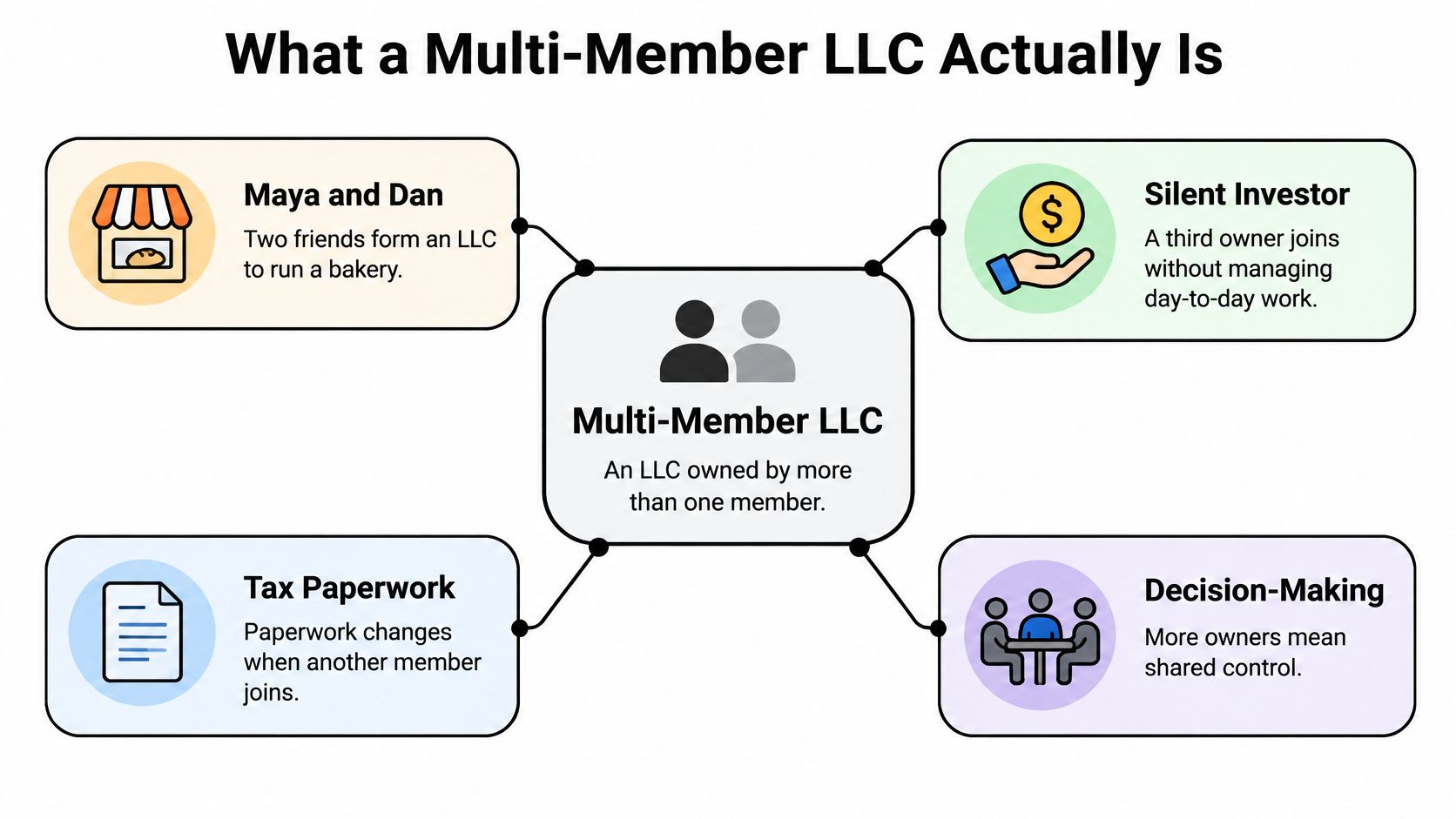
A multi-member LLC is a state-law business entity whose owners are called members. The IRS explanation of LLC classification confirms that a domestic LLC with two or more members generally receives partnership tax treatment unless it elects corporate treatment using Form 8832.
Say Maya and Dan form an LLC to run a bakery. They both contribute money, work behind the counter, and share responsibility for ordering ingredients. When a silent investor joins, they need to update ownership records, profit-sharing arrangements, and the rules for approving decisions.
They don't automatically become a different kind of legal entity. Nor does adding an investor necessarily change their federal tax classification. What changes immediately is whose financial interests and rights the company must account for.
Multi-member describes who owns the company, not how it is taxed.
Separate the legal structure from the tax label
Think of the LLC as a shared house. Its separate legal identity is like a front door between the household's obligations and each resident's personal affairs, although that door isn't an absolute barrier against every claim.
The ownership list tells you who lives there. The operating agreement sets the house rules. Federal tax classification determines how the household reports its financial activity.
State law governs formation, management rights, and the liability shield. Federal tax rules determine the income-tax reporting path. Changing the latter doesn't necessarily require replacing the former.
Before describing your own company, check:
- The ownership records: Identify the actual members, not just employees, contractors, or people authorized to use the bank account.
- The state filing: Confirm that the state accepted the LLC's formation documents and that the entity remains in good standing.
- The operating agreement: Look for a signed document explaining ownership, management, and financial rights.
You should then be able to say: Our business is an LLC under state law, owned by its members, with a separately determined federal tax classification.
How the IRS Taxes a Multi-Member LLC
Under the default partnership approach, the LLC generally doesn't pay federal income tax separately on ordinary business profit. Instead, it reports its activity, allocates taxable items among members, and supplies the information those members need for their returns.
For a hypothetical example, suppose Ava, Ben, and Chris own a consulting LLC in different proportions. Their agreement allocates profit in those same proportions, and the company has a profitable year. Each owner's tax reporting reflects the allocated share, even if the owners leave the cash in the business to fund hiring.
The filing sequence matters: the company prepares its partnership return, issues each member a Schedule K-1, and the members use those allocations on their own returns. If a member is another entity rather than an individual, the reporting continues through that entity's applicable filing process.
An allocation isn't a cash distribution
An allocation assigns income, deductions, or credits for tax purposes. A distribution transfers cash or property to an owner. They aren't interchangeable.
Ava can therefore owe tax even though she didn't receive enough cash from the LLC to cover it. Owners should discuss a tax-distribution policy before reinvesting all available money, while recognizing that cash availability, debt restrictions, and state law may constrain payments.
Practical rule: Don't use the amount withdrawn from the business bank account as a substitute for the income reported on your tax documents.
Active members commonly face self-employment tax on qualifying business earnings. A passive investor's treatment can require closer analysis, and referring to someone as a silent partner doesn't settle the issue.
Federal filing path by tax classification
| Classification | Federal form filed | What owners receive | Who pays income tax |
|---|---|---|---|
| Default partnership | Form 1065 | Schedule K-1 for each member | Members, on their applicable returns |
| Corporate election using Form 8832 | Form 1120 | Salary and dividends, if paid | The corporation, then owners on taxable dividends |
| S corporation election using Form 2553 | Form 1120-S | Schedule K-1 for each shareholder | Shareholders, on their applicable returns |
An S election requires eligibility and additional compliance. It isn't permission to replace all compensation with distributions, and an LLC can retain its state-law identity while using S corporation taxation.
The IRS instructions for Form 1065 also identify a useful exception: a domestic partnership generally needn't file that return when it receives no income and incurs no expenditures treated as deductions or credits for federal income-tax purposes. A newly formed business with deductible startup activity shouldn't assume that no sales means no filing.
For practical preparation, use our step-by-step guide to filing LLC taxes. If you need help comparing classifications or coordinating member information, HireAccountants' Hire CPAs resource can help you find accounting support.
Before selecting a return, check the election documents and IRS correspondence. Last year's filing is useful evidence, but it isn't a substitute for confirming the classification currently in effect.
Liability Limits and Payroll Tax Exposure
Limited liability doesn't mean no personal liability. Members generally aren't personally responsible for ordinary LLC contractual debts merely because they own the company, but their own actions and certain tax rules can create separate exposure.
For example, a bakery's unpaid supplier invoice ordinarily belongs to the business. If Dan personally guarantees the bakery's lease, however, the landlord may have a claim against him under that guarantee.
The IRS employment-tax analysis for a multi-member LLC distinguishes the company's pass-through income-tax treatment from its responsibility as an employer. The LLC remains responsible for employment taxes even though its business income flows through to members.

Where personal exposure can arise
- Personal guarantees: Signing as a guarantor creates an obligation beyond merely owning the LLC.
- Wrongful conduct: An entity doesn't erase responsibility for a person's own fraud or other actionable misconduct.
- Failure to respect separateness: Mixing personal and company finances can undermine the distinction owners expect to rely on.
- Certain tax liabilities: Responsible-person rules can reach individuals despite the ordinary business-debt shield.
The withheld portion of employee taxes is trust-fund money, not working capital available for equipment purchases. Under the Trust Fund Recovery Penalty, a responsible person who willfully fails to collect, account for, or pay over covered taxes can face personal collection exposure.
Suppose Dan controls payroll payments and knowingly diverts withheld taxes to buy a delivery van. The IRS may investigate his authority, knowledge, and payment decisions, and potentially assess the unpaid trust-fund portion against him personally. His LLC membership alone doesn't determine the result.
Build controls around payroll
Keep separate bank accounts, reconcile payroll reports to the accounting ledger, and verify deposits rather than assuming a payroll provider completed them. Document who authorizes payroll, who releases payments, and who reviews tax notices.
Use the deposit schedule applicable to the business, not a schedule chosen for convenience. Our explanation of S corporation payroll taxes is also useful when considering an election that introduces owner-employee payroll obligations.
A payroll service can perform tasks for the company. It doesn't make withholding money safe to spend elsewhere.
Unpaid payroll taxes or IRS collection letters warrant prompt review. Hiring a tax attorney is advisable when facing tax debt over $5,000, IRS revenue officer involvement, or large liability exposure over $1,000,000; criminal investigations, foreign account issues, and valuable assets at risk also require particular care.
Don't wait for a personal assessment before gathering payroll records and identifying who controlled the payments.
Management Structures and Governance Basics
An operating agreement works like the rulebook for a pickup game: everyone plays fine while things go well, and the first real argument reveals whether anyone wrote the rules down. Most state statutes give members broad default authority in a multi-member LLC, so the agreement's job is to narrow, divide, and check that authority before a dispute tests it.
| Element | What it decides | Common setup | Risk if left blank |
|---|---|---|---|
| Member-managed | Members participate in management and may have authority to bind the company | Owners who work in the business daily | One member signs a contract the others never approved |
| Manager-managed | Designated managers run daily operations | Investor groups with passive owners | Managers act beyond what the owners intended |
| Voting thresholds | Which decisions need majority or unanimous consent | Routine matters by majority; major changes by broader agreement | Deadlock or disputed authority |
| Buyout formula | Price and payment terms when a member leaves | Appraisal or an agreed valuation formula | Stalled negotiations or pressure to sell cheap |
The agreement should make authority understandable to someone who was not in the room when the founders shook hands. Who can order inventory? Who can borrow? Who can admit an investor? Those are different decisions, and they need not share one approval process.
State law supplies default rules when the agreement stays silent, and those defaults govern management rights. Federal tax classification is a separate question. An LLC that elects S corporation treatment keeps the same state-law management structure, because the election changes how the IRS taxes the entity while leaving governance under the operating agreement and state statute.
Choose who manages, then limit their authority
In a member-managed LLC, members generally participate directly in running the business, subject to the agreement and applicable law. In a manager-managed LLC, designated managers handle operations while other members can remain passive investors.
Neither label settles every voting question. An agreement might let a manager purchase supplies freely while requiring member approval for borrowing, selling substantial assets, or changing ownership. That layering is where governance lives.
Counting heads also fails as a dispute mechanism. Owners can hold unequal voting interests, and two opposing groups can hold equal voting power. A mediation process, a carefully designed tie-breaker, or a buy-sell provision gives a deadlocked company a way forward that a simple vote cannot.
Plan for departures before anyone wants to leave
A member wants out, and the agreement says nothing about valuation or payment terms. The remaining owners may all agree a buyout makes sense while disagreeing completely about what the business is worth. Without a formula, that disagreement stalls for months or ends in a forced sale.
Address death, divorce, disability, voluntary departure, and proposed transfers to outsiders. Specify whether the company or the remaining members may buy the interest, how the price gets set, and whether payments can spread over time.
Review these clauses together:
- Voting and deadlock: Identify approval rights and the process when owners cannot agree.
- Transfers and buyouts: Define permitted buyers, valuation method, and payment terms.
- Contributions and distributions: Explain who must contribute more money and when cash can leave the business.
- Dissolution: State how owners approve closure and wind down obligations.
A working agreement should help owners make an uncomfortable decision, rather than only recording that they once agreed to start a company.
Pros and Cons Against Other Business Structures
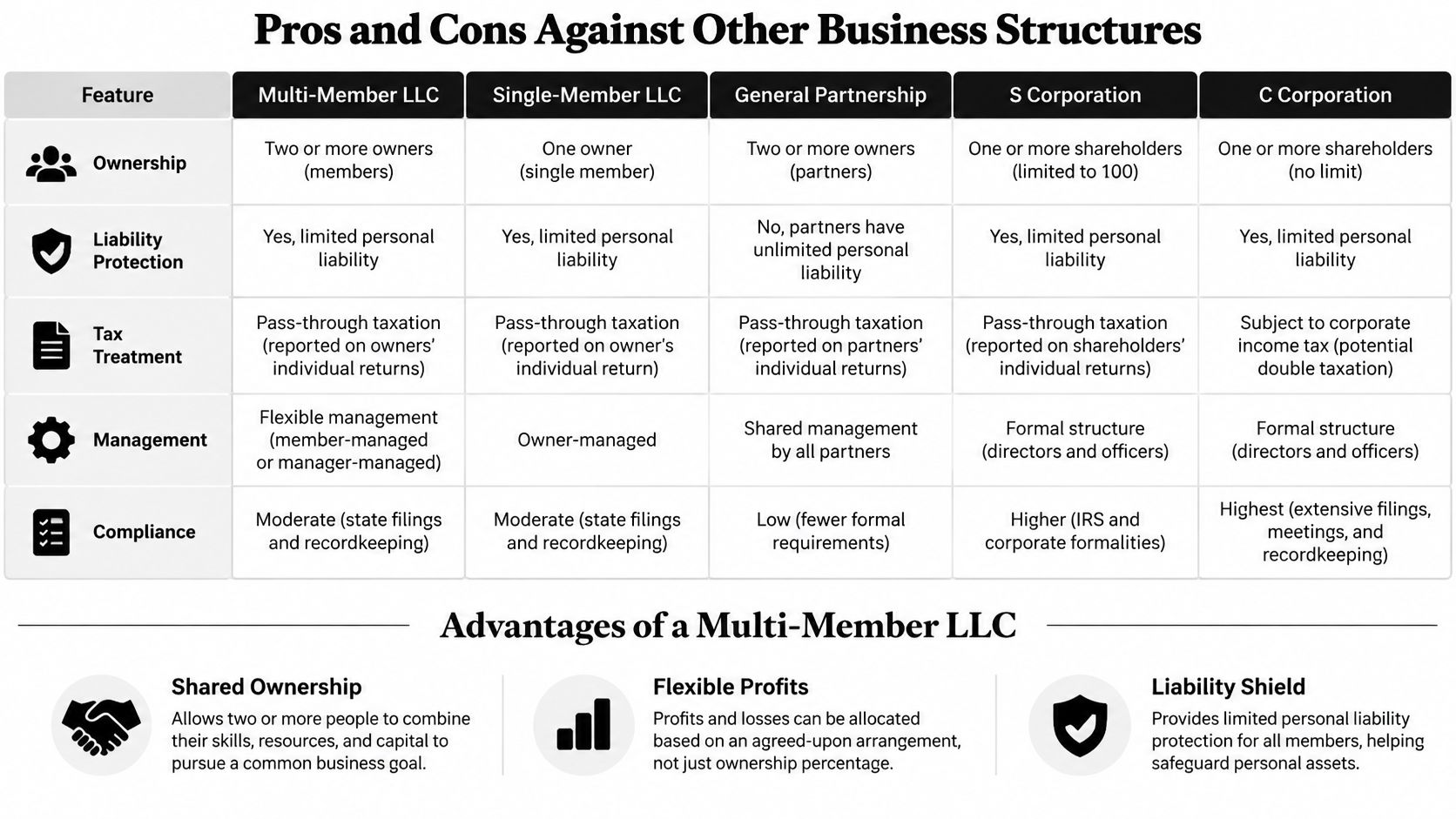
| Criteria | Multi-member LLC | Single-member LLC | General partnership | S corporation | C corporation |
|---|---|---|---|---|---|
| Maximum owners | Generally no fixed cap | Sole owner | Generally no fixed cap | Statutory shareholder cap and eligibility restrictions | Generally no fixed cap |
| Default federal tax | Partnership | Disregarded entity | Partnership | Pass-through by election | Corporate tax at entity level |
| Personal liability shield | Generally, under state law | Generally, under state law | Not for general partners' partnership obligations | Generally through the underlying entity | Generally |
| Formality required | Operating agreement recommended | Operating agreement recommended | Partnership agreement recommended | Corporate formalities if incorporated; LLC governance if an LLC | Bylaws, board governance, and corporate records |
The comparison requires an important qualification: an S corporation is a tax classification, not necessarily a different state-law entity. An LLC that elects it doesn't automatically acquire a corporation's bylaws or board structure.
A general partnership presents a different legal comparison. General partners ordinarily lack the LLC's entity-based liability shield, making the choice more than a question of which return is easiest to prepare.
Advantages worth weighing
- Shared ownership with a shield: Members can invest and participate through a separate legal entity.
- Flexible economic arrangements: A partnership-taxed LLC can structure allocations through its agreement, subject to partnership tax rules.
- Pass-through treatment: The default approach avoids a separate federal corporate income-tax layer on ordinary business profit.
- Adaptable governance: Owners can distinguish management roles from investment rights without automatically adopting corporate board procedures.
- Room for ownership changes: An agreement can establish how new investors join rather than leaving every admission to improvised negotiations.
Trade-offs owners shouldn't overlook
- Employment-related taxes: Active owners need to account for the tax treatment of their earnings.
- Coordinated reporting: The company must gather accurate information and deliver owner-level tax documents.
- State obligations: Annual reports, fees, and entity-level taxes may still apply.
- Election costs: Payroll-based planning introduces compensation decisions, filings, and administrative work.
For an owner operating alone, the single-member arrangement generally offers simpler default federal income-tax reporting. It doesn't, however, provide a way to give someone genuine ownership while continuing to treat the business as wholly owned.
For co-owners who want liability protection and flexible management, a multi-member LLC is often a strong candidate. It isn't an automatic recommendation for every investor group, particularly when outside financing, specialized tax requirements, or future ownership plans point elsewhere.
If you're adding a silent investor, reassess the agreement and reporting before transferring the interest. If you're considering S corporation treatment, compare reasonable compensation, payroll costs, state treatment, and ownership restrictions rather than assuming the election guarantees savings.
How to Form or Convert to a Multi-Member LLC
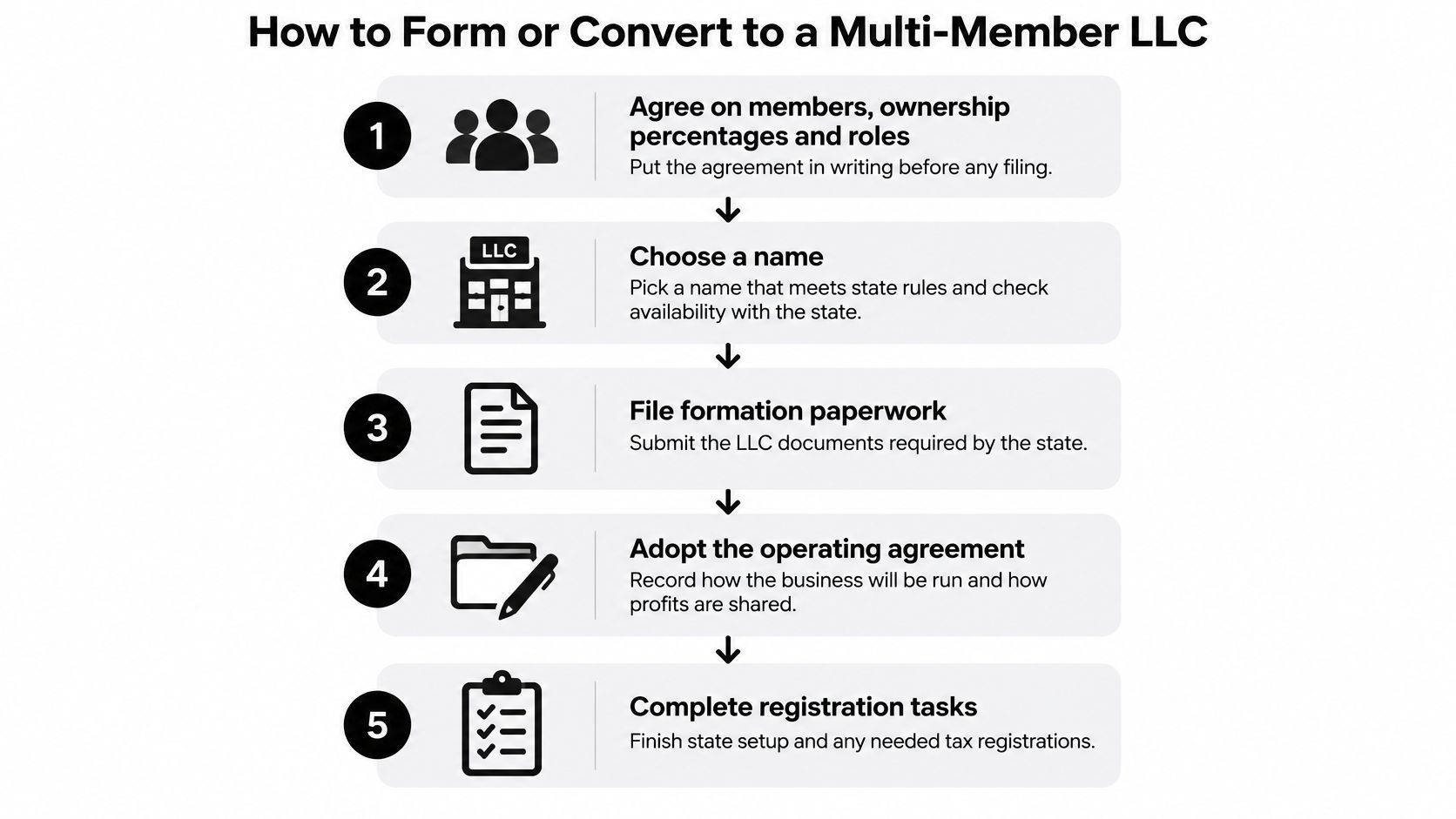
Formation is both a state filing project and an agreement among owners. Completing only the state paperwork leaves important financial and management decisions unresolved.
Put ownership and authority in writing
Agree on members, interests, and roles. Document what each person contributes and receives before anyone files. Separate money invested, work performed, voting rights, and profit rights so an informal promise doesn't become a later dispute.
Check the business name. Search the state business registry and follow the state's naming rules. A domain name or social media account doesn't establish that the state will accept the entity name.
File the formation documents. Submit articles of organization or the state's equivalent and designate a registered agent. Use consistent names and addresses across the filing, agreement, and tax records.
Sign the operating agreement. Include allocations, management authority, voting, transfers, and buyouts. An unsigned template won't reliably establish that the members accepted the arrangement.
Complete the tax and banking setup
Resolve the EIN requirement. Obtain an employer identification number from the IRS when required. When an existing LLC adds an owner, verify whether its existing EIN can continue rather than assuming every ownership change requires replacement.
Open or update the business bank account. Deposit contributions into the company account and record them accurately. Update authorized signers without confusing signing authority with ownership.
Confirm the tax path before the election deadline. Decide whether to retain partnership treatment, request corporate treatment using Form 8832, or pursue an eligible S election using Form 2553. Use the classification checklist below to organize that decision, and confirm the applicable effective-date rules before filing.
Register for applicable state and payroll accounts. Address employer registration before running payroll and identify sales-tax or other business registrations relevant to the activity. State formation doesn't automatically complete these tasks.
Converting an existing single-owner operation requires special attention to timing. Record the effective admission date, distinguish activity before and after the change, and have the preparer determine the resulting returns.
Also review contracts, leases, licenses, and financing documents for notice or consent requirements. The legal entity may continue, but a lender or landlord may still require updated ownership information.
Confirm Your Tax Classification Before You File
Treat the default classification as a starting point to evaluate, not a permanent verdict. The best choice depends on the owners, the business's economics, and the compliance work each path requires.
A practical classification checklist
- Confirm the ownership: List every member and identify corporations, trusts, or other LLCs holding interests.
- Verify elections: Find the submitted election, effective date, IRS correspondence, and previously filed returns.
- Model owner taxes: Compare the partnership outcome with an eligible S corporation scenario using defensible reasonable compensation.
- Include state costs: Add applicable fees, annual taxes, payroll administration, and preparation expenses.
- Reconcile the agreement: Make sure the allocation provisions and actual tax reporting are consistent.
Our guide to converting an LLC to S corporation taxation can help you identify the implementation questions behind that comparison.
Resolve debt issues separately
If unpaid taxes or collection activity are involved, apply the attorney-review triggers described earlier rather than treating the problem as routine return preparation. Bring IRS notices, account transcripts, payroll records, and election documents to the meeting.
Attorney-client privilege protects confidential attorney-client communications for legal advice, subject to applicable rules and exceptions. Sharing preexisting financial records doesn't automatically make those records privileged.
Write down your company's classification and corresponding filing form, then confirm both with a tax professional before the next return is due.
Tax Attorney Stephen A Weisberg offers a free Tax Debt Analysis to determine whether help is needed and how he can assist before charging for resolution work. If your LLC has unpaid income taxes, payroll debt, or possible personal exposure, visit Tax Attorney Stephen A Weisberg and bring your notices and entity records so the review starts with the company's actual obligations.


