What Is IRS Tax Transcript: Your 2026 Guide
Learn what is IRS tax transcript, its types, how to get one, & its uses for loans or tax issues in our 2026 guide. Get your answers here!
In this article
- Decoding the Request for Your IRS Tax Transcript
- Why people ask for transcripts
- The core trade-off
- The Five Main Types of IRS Tax Transcripts Explained
- The two transcripts most people confuse
- A side-by-side comparison
- What each one is for
- Choosing the Right Transcript for Your Specific Goal
- For a mortgage, student loan, or financial aid request
- For an IRS notice or active tax debt problem
- For unfiled returns or missing income documents
- For proving the IRS has no return on file
- For organizing records before you send them out
- A quick decision guide
- How to Get Your IRS Tax Transcript Step by Step
- Get Transcript Online
- Get Transcript by mail or phone
- When to use forms instead of the portal
- Which form does what
- Reading Your Transcript Understanding Key Fields and Codes
- Start with the high-value fields
- How to read account activity
- About transaction codes
- Security Privacy and Common Transcript Problems
- Why masking is a feature, not a flaw
- Common problems and what to do next
- When to Stop and Call a Tax Attorney
- Red flags that change the situation
- The practical dividing line
A lender asks for a tax transcript. A school financial aid office asks for one. Sometimes the IRS sends a notice and you realize you need to see what the IRS thinks happened before you respond. In all three situations, people often pull out a copy of the return they filed and assume that's enough.
Usually, it isn't.
If you're searching what is IRS tax transcript, the short answer is this: it's an official IRS record that summarizes return data or account activity, depending on the transcript type. That distinction matters. The right transcript can help you close a mortgage, verify income, or sort out a tax problem. The wrong one can waste time and send you back to square one.
Decoding the Request for Your IRS Tax Transcript
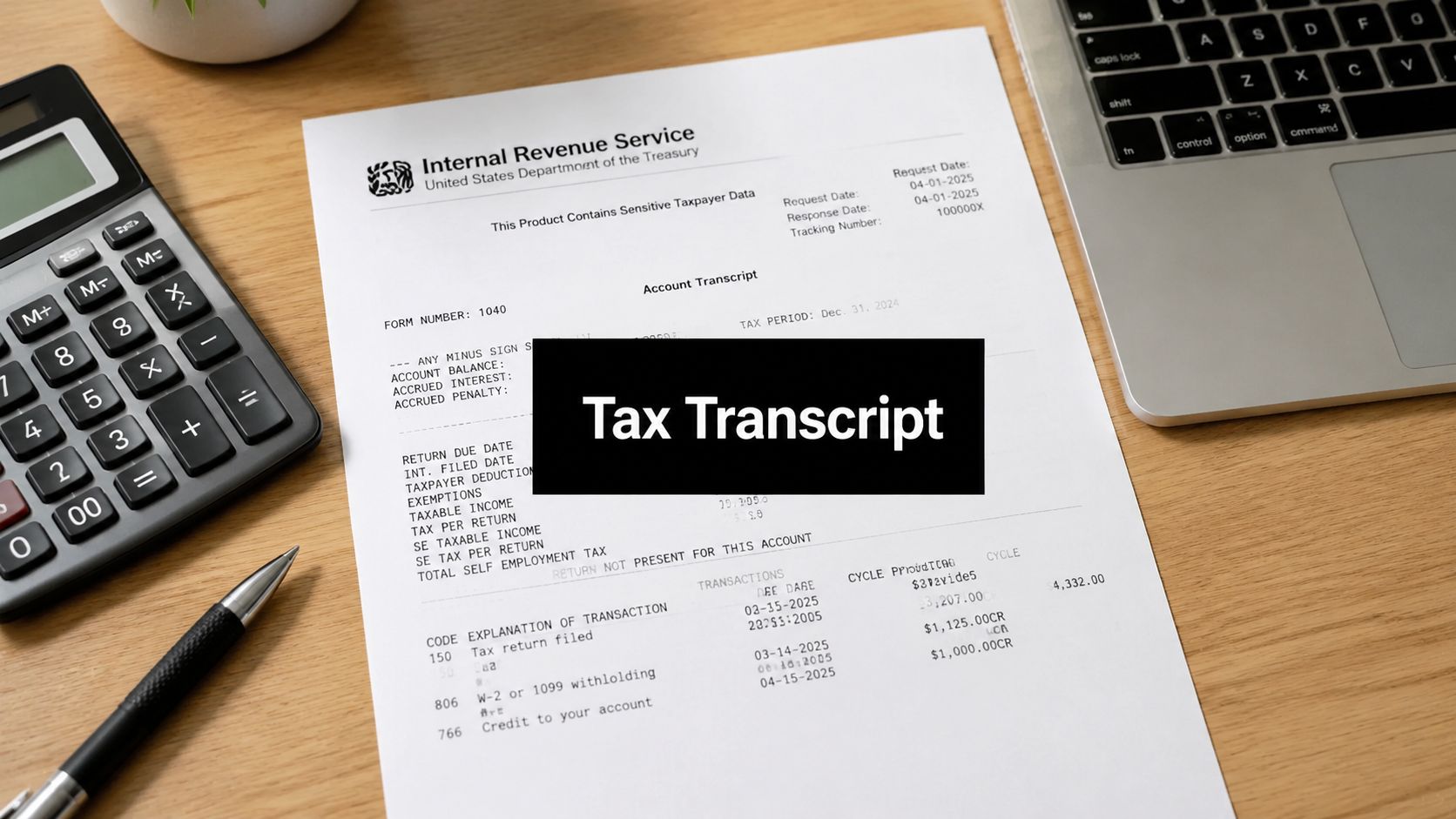
A tax transcript is not the same thing as the return you prepared in TurboTax, gave to your CPA, or saved as a PDF. The IRS treats a transcript as an official summary of your tax information.
According to TurboTax's explanation of IRS tax transcripts, an IRS tax transcript is a free, official summary of tax return line items and account activity available for the previous three tax years, while a full copy of a tax return requires a $43 fee and can take up to 75 days to process.
That's why third parties often ask for a transcript instead of your own copy of the return. A lender wants confirmation from the IRS, not just from the borrower. A tax professional wants to know what the IRS system shows, not what was intended to be filed.
Why people ask for transcripts
The request usually comes up in a few common settings:
- Loan underwriting where a lender wants IRS-verified income and filing data
- Financial aid review where a school needs confirmation of tax information
- IRS notices and disputes where you need to compare your records to the IRS account
- Amended return work where the original filed figures matter
If you're dealing with an IRS letter, it also helps to understand the notice itself before ordering records. This guide on responding to IRS letters is a useful starting point.
Practical rule: When someone asks for a “tax transcript,” don't assume any transcript will do. Ask what they need it for. The purpose determines the document.
The core trade-off
A transcript is faster, cheaper, and usually sufficient. A full copy of the return is slower, costs money, and is often unnecessary. But transcripts also come in different forms, and that's where many taxpayers get tripped up.
The biggest mistake I see is simple. People hear “transcript,” request the first option they recognize, and end up with a document that doesn't answer the actual question.
The Five Main Types of IRS Tax Transcripts Explained
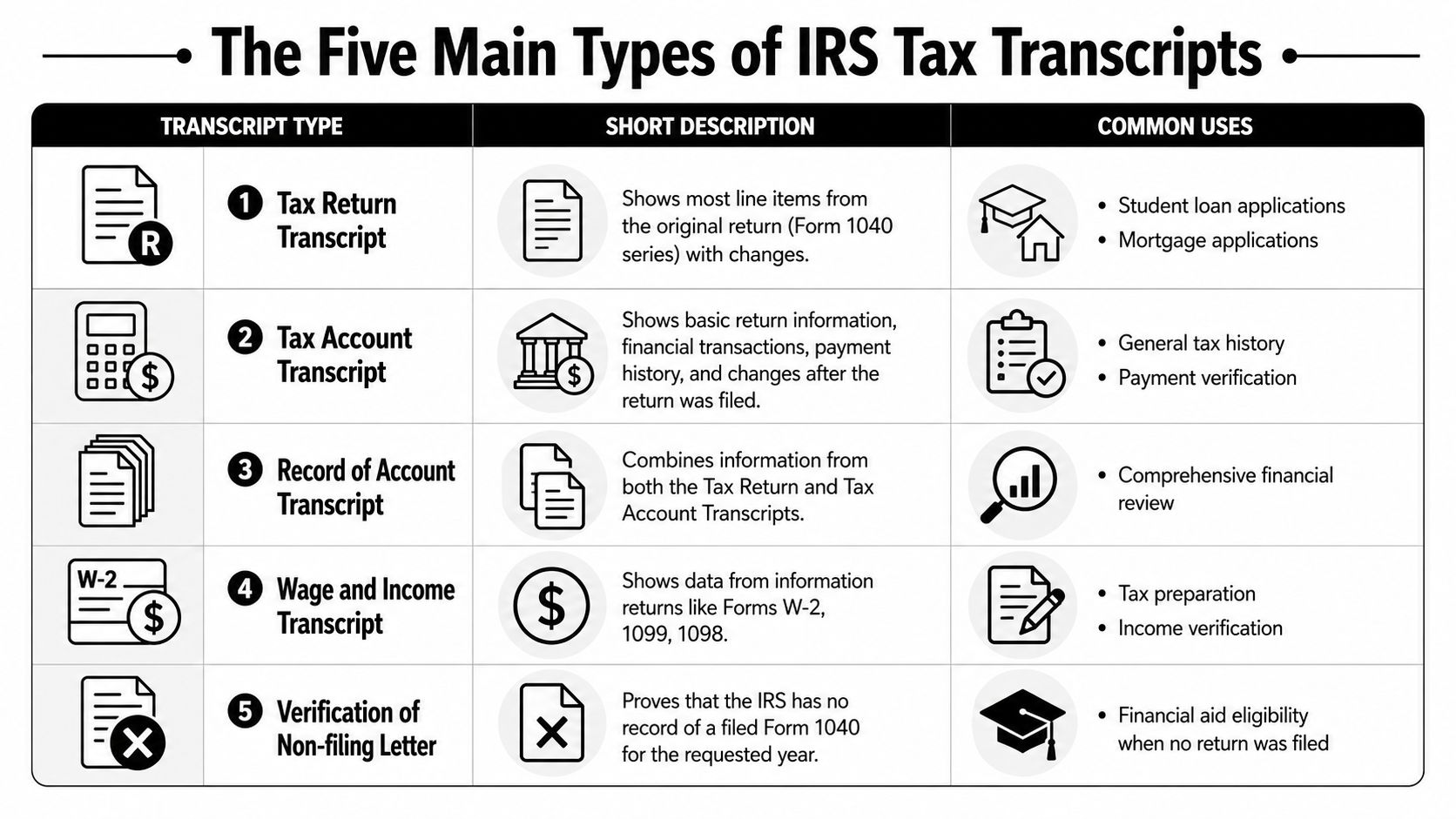
The IRS transcript system makes more sense once you stop treating “transcript” as one document. It's really a family of records. Each one answers a different question.
The two transcripts most people confuse
The IRS distinguishes between two primary transcript types. The Tax Return Transcript shows most line items from the originally filed Form 1040, and the Tax Account Transcript shows post-filing activity such as payments, credits, and adjustments, as described in this overview from My IRS Team.
That sounds straightforward, but the practical difference is huge. One shows what you filed. The other shows what happened after filing.
A side-by-side comparison
| Transcript type | What it generally shows | Best use |
|---|---|---|
| Tax Return Transcript | Original return line items as filed | Income verification, financial aid, some loan requests |
| Tax Account Transcript | Account activity after filing, such as payments and adjustments | Account history, payment review, IRS account changes |
| Record of Account Transcript | Combined return and account information | Broader tax review, disputes, resolution work |
| Wage and Income Transcript | Information returns such as W-2, 1099, and 1098 data | Return preparation, income matching |
| Verification of Non-filing Letter | IRS confirmation that it has no record of a filed Form 1040 for that year | Financial aid or agency requests when no return was filed |
What each one is for
Tax Return Transcript
This is the document most non-tax people mean when they ask for a transcript. It's commonly used when someone needs confirmation of income, filing status, AGI, and core return entries.
It works well when the issue is, “Did you file, and what did you report?”
Tax Account Transcript
This one matters when the question is, “What happened on the IRS account after the return was filed?” If you made payments, if the IRS applied credits, or if the balance changed, this transcript starts to matter more than the return transcript.
Record of Account Transcript
This is the hybrid. It combines return and account information into one record. For many practical disputes, this is the more useful transcript because it gives you both the original filing data and the account activity.
Wage and Income Transcript
This transcript pulls together third-party reporting. If an employer, bank, broker, or payer reported income to the IRS on a W-2, 1099, or similar form, you can find that information in this transcript.
That makes it useful when you're reconstructing a return or checking whether the IRS is relying on income data you haven't seen.
Verification of Non-filing Letter
This one does not prove you were not required to file. It only shows that the IRS has no record of a filed Form 1040 for that year. That distinction matters in financial aid and compliance settings.
For readers dealing with refund holds or IRS processing delays, this article on Tax Topic 152 may also help connect transcript review to refund status questions.
A transcript is useful only if it matches the question you're trying to answer.
Choosing the Right Transcript for Your Specific Goal
A borrower is three days from a mortgage closing. The lender asks for an IRS transcript. The taxpayer orders a Tax Return Transcript because the name sounds right, then learns too late that the file under review also needs account activity tied to an IRS adjustment. That mistake is common, and it costs time.
Many online guides list transcript types but do not tell you what to order when the stakes are real. The right request depends on the question you need answered. Income verification is one question. Penalties, interest, payment history, and IRS account changes are different questions entirely.
For a mortgage, student loan, or financial aid request
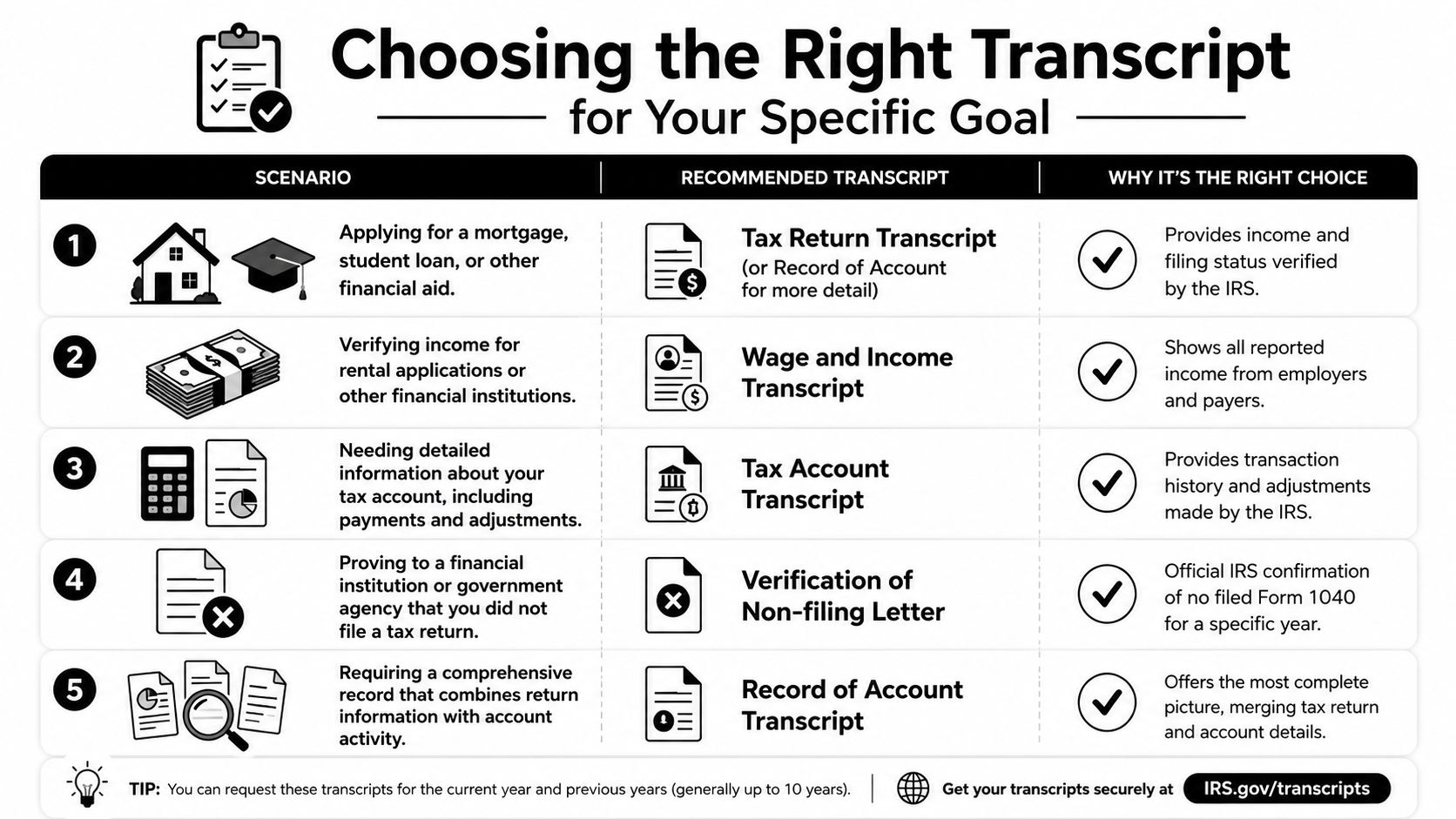
A Tax Return Transcript is often enough if the institution only wants to verify the numbers originally reported on the return. That usually covers income, filing status, and other core return data.
But lenders and aid offices do not always ask narrow questions. If there was an amended return, an IRS adjustment, or any concern about whether the tax account still shows a balance due, request a Record of Account Transcript instead. It gives the reviewer more context and reduces the chance of a follow-up request.
The trade-off is simple. A return transcript is shorter and often accepted faster. A record of account is usually the safer choice when the file has any irregularity.
For an IRS notice or active tax debt problem
Start with the Record of Account Transcript in most collection, penalty, and balance-due matters. A Tax Return Transcript does not show the account detail you usually need to resolve the problem.
The National Taxpayer Advocate explains in its discussion of IRS transcripts and account issues that a return transcript does not include the transaction-level information tied to account activity. If the issue involves penalties, interest, assessment dates, payment application, or collection history, the return transcript will leave out the facts that matter.
That is the mistake I see most often. Taxpayers order the document that sounds familiar, then find out it does not show why the balance grew or what the IRS posted to the account.
If the dispute is narrow, a Tax Account Transcript may also help. If you need the original return data and the account activity in one place, Record of Account is usually the better first request.
For unfiled returns or missing income documents
Order the Wage and Income Transcript. This is the transcript that helps reconstruct what employers, banks, brokers, payment processors, and other payers reported to the IRS under your Social Security number.
That matters in late-filed return work, substitute-for-return cases, and audit preparation. It also matters for self-employed taxpayers who received multiple Forms 1099 and do not have a complete set of records.
If you are gathering several years of records through a third-party request, this guide to what Form 4506-T is used for helps explain when the IRS requires a transcript request form instead of an online download.
For proving the IRS has no return on file
Request a Verification of Non-filing Letter. Use it when a school, lender, or benefits office asks for proof that the IRS has no Form 1040 on record for a given year.
Be careful with the wording. It does not prove you had no filing requirement. It only shows the IRS has no processed individual return on file for that period.
For organizing records before you send them out
Transcript work often involves multiple PDFs across several years. Before sending records to a lender, accountant, attorney, or trustee, it helps to combine them into one file so the recipient can review the years in order. A simple tool like Merge PDF can make that package easier to review.
A quick decision guide
- You need basic income verification. Request the Tax Return Transcript.
- You need payment history or account postings. Request the Tax Account Transcript.
- You need to see penalties, interest, adjustments, or collection-related entries. Request the Record of Account Transcript.
- You are rebuilding a return or checking third-party income reporting. Request the Wage and Income Transcript.
- You need proof the IRS has no Form 1040 on file. Request the Verification of Non-filing Letter.
Attorney Stephen A. Weisberg handles transcript-based tax debt review in practice, and the pattern is consistent. Cases move faster when the transcript request matches the actual problem, not the label that sounds closest.
How to Get Your IRS Tax Transcript Step by Step
A transcript request often becomes urgent when something else is already on the line. A mortgage underwriter wants proof of income. A revenue officer has started collection activity. An audit response is due, and the numbers on the IRS side do not match what you expected.
At that point, speed matters, but accuracy matters more. I regularly see people request a Tax Return Transcript because the name sounds right, then lose time because what they needed was a Record of Account Transcript showing penalties, interest, or later IRS adjustments.
Get Transcript Online
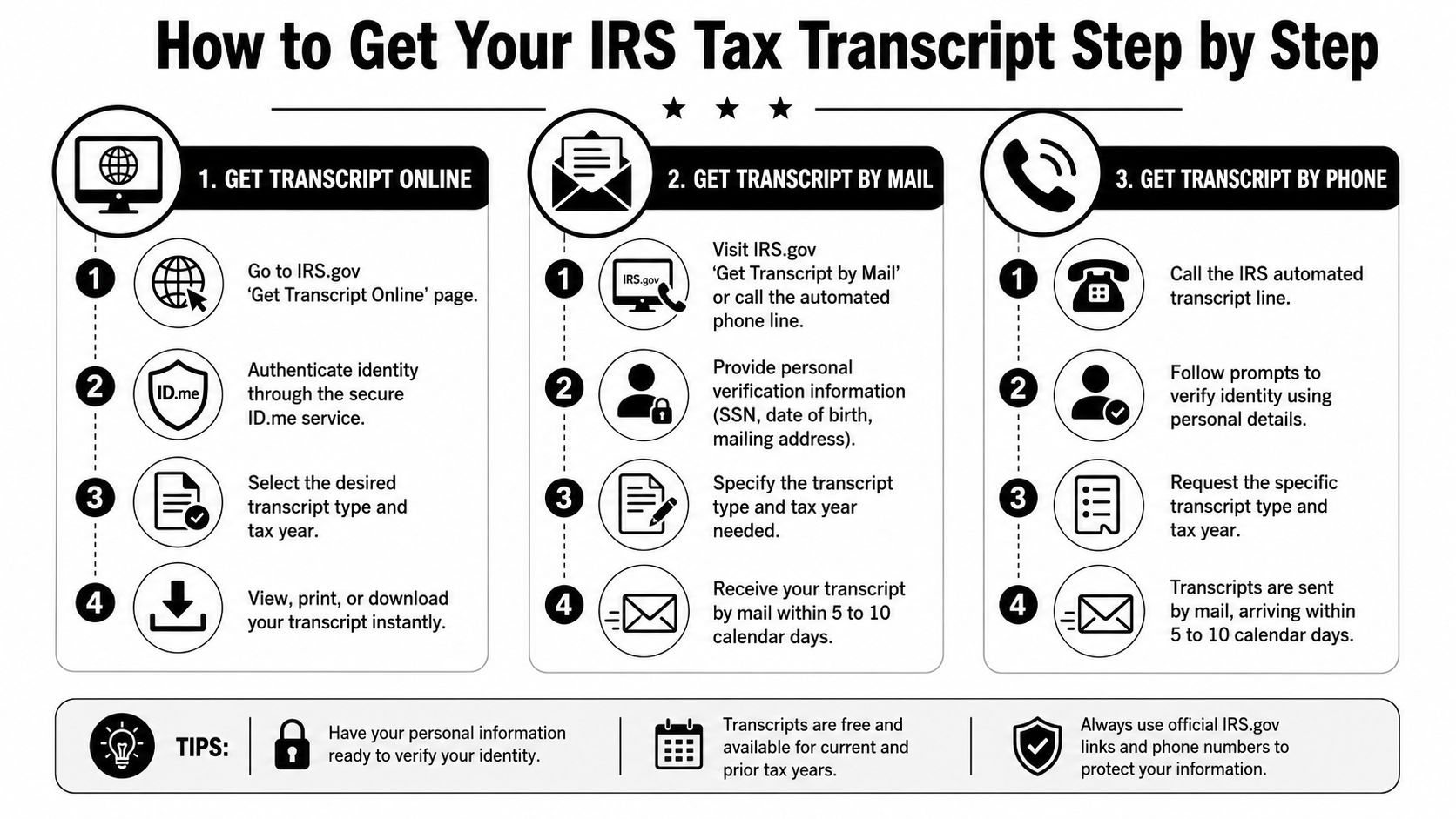
The IRS online portal is usually the fastest option if you can pass identity verification through ID.me. After you sign in, select the reason for the request, choose the transcript type, pick the year, and download the PDF.
The speed is useful, but the main point is to choose carefully before you click. If you are applying for a loan, a Tax Return Transcript may be enough. If you are trying to confirm what the IRS says you currently owe, online access should usually be used to pull the Account Transcript or Record of Account Transcript instead.
The basic sequence is straightforward:
- Go to the IRS Get Transcript portal.
- Sign in with an existing IRS or ID.me account, or create one.
- Complete the identity checks.
- Select the transcript type and tax year.
- Download or print the transcript.
If you are dealing with transcript request forms for a lender, accountant, or authorized representative, this guide on what a 4506-T form is explains when a signed form is required instead of a direct online request.
Get Transcript by mail or phone
Mail or phone requests are the fallback when online verification fails or the taxpayer does not want to use the portal. The IRS also allows transcript requests through its automated phone line at 800-908-9946, and mailed transcripts are sent to the address the IRS has on file.
This method is slower. It is often the better choice anyway if repeated ID.me errors are wasting time or if the taxpayer cannot complete the online verification process.
One practical limitation matters here. A mailed request sent to an old address usually creates delay, not a solution. If the IRS address on file is outdated, fix that problem first or work through a representative who can help choose the right request path.
When to use forms instead of the portal
Paper forms make more sense in specific situations, especially when another party is involved or the request goes beyond a basic taxpayer download.
Use a form request when:
- Online identity verification is not working
- A lender, trustee, or other third party needs authorized access
- You need transcript delivery handled through a signed request process
- You need an actual copy of the filed return rather than a transcript
This is also where taxpayers mix up the request itself. Form 4506-T is for transcripts. Form 4506 is for a copy of the actual return. Those are different records, different fees, and different use cases.
Which form does what
| Form | Typical use |
|---|---|
| Form 4506-T | Request a transcript |
| Form 4506 | Request an actual copy of the return |
| Form 4506-C | Commonly used for income verification by lenders and similar third parties |
If the goal is resolving a tax balance, do not assume the quickest document is the right one. Request the transcript that answers the question you have. For current account issues, that often means a Record of Account or Account Transcript, not a Tax Return Transcript.
Reading Your Transcript Understanding Key Fields and Codes
Individuals can obtain a transcript and still have no idea what they're looking at. That's normal. IRS transcripts are built for recordkeeping, not readability.

Start with the high-value fields
The first thing I look for depends on the transcript type, but several fields matter often:
- Adjusted Gross Income because lenders, schools, and agencies frequently ask for it
- Filing status because it affects both tax treatment and verification questions
- Reported wages because they help compare the return against third-party reporting
- Balance due or overpayment summary when reviewing account posture
The IRS explains in its transcript type guidance that a Tax Return Transcript shows most line items from the original Form 1040-series return, including Adjusted Gross Income and specific W-2 wage breakdowns, but it does not include changes, amendments, or calculations made after the original filing date.
That last point is why people misread return transcripts. They think they're looking at current IRS reality when they're only looking at the original filing snapshot.
How to read account activity
On account-based transcripts, don't try to decode everything at once. Read them like a timeline.
Look for these categories first:
- Return posting activity that confirms what year and filing event the IRS recorded
- Payments and credits that show whether money was applied
- Adjustments that may reflect IRS changes after processing
- Penalty and interest lines that show how the balance grew
- Refund entries if money was issued back out
Read top to bottom and ask one question on each line: did this increase the account, reduce it, or simply document a status change?
About transaction codes
Taxpayers often fixate on code numbers. Sometimes that's useful, but the code matters less than the line's function and date unless you're dealing with a contested assessment, collection action, or audit posture.
What matters in practice is the story the transcript tells. Did the IRS post the return? Did it assess tax? Did it add penalties? Did payments hit the right year? Did something change after filing? That narrative usually matters more than memorizing code charts.
If a code or entry appears tied to a notice, levy, lien, or unexplained adjustment, that's when transcript reading moves from clerical review into legal analysis.
Security Privacy and Common Transcript Problems
Some clients are surprised when they open a transcript and see masked personal information. They assume the document is incomplete or unusable. It isn't.
The IRS states in its transcript privacy overview that transcripts mask personally identifiable information by showing only the last four digits of SSNs or EINs and the first four characters of names, while leaving the financial entries fully visible. That design helps reduce identity theft risk without removing the money data professionals need to review.
Why masking is a feature, not a flaw
If you're sharing transcripts with a lender, CPA, attorney, bankruptcy counsel, or financial advisor, masked data lowers the exposure of your full identity while preserving the important tax information.
That approach makes sense as tax data leaks are a real concern. Public reporting on incidents like InsecureWeb's Taiwan data breach report is a reminder that tax records are valuable targets and should be handled carefully.
Common problems and what to do next
A few transcript issues come up over and over:
- Transcript not available. The IRS may not have processed the return yet, or the year you want may not be available through that request method.
- Information looks wrong. Compare it against the filed return, notices, payment proof, and wage records before assuming the IRS is right.
- Online access fails. Use the mail request route or work through an authorized representative.
- Masked information creates confusion. That's normal. The transcript can still be valid for most review purposes.
If identity theft is part of the problem, this piece on navigating IRS identity theft issues is worth reading before you send documents or respond to notices.
Don't ignore a mismatch on a transcript. Small discrepancies can turn into rejected loans, delayed refunds, or collection problems if nobody addresses them.
When to Stop and Call a Tax Attorney
A transcript is a tool. It's not a resolution strategy by itself.
You can usually handle transcript requests and basic review on your own if the issue is simple. Income verification, financial aid support, confirming whether a return posted, or checking basic account activity are all manageable for many taxpayers.
Red flags that change the situation
Call a tax attorney when the transcript points to a real controversy rather than a record request.
- Multiple years are missing or inconsistent. That often means the problem is broader than one notice.
- Penalty and interest entries keep building. Delay tends to make these cases harder, not easier.
- The account reflects liens, levies, or serious IRS adjustments. Those aren't paperwork problems.
- You're a business owner with payroll tax exposure or possible Trust Fund Recovery Penalty issues. Those cases can affect owners and responsible persons personally.
- A loan or closing depends on resolving the tax issue quickly. Timing starts to matter as much as substance.
The practical dividing line
If you can clearly identify the issue, gather the right transcript, and the requested use is routine, self-service is often fine.
If the transcript raises legal questions, collection risk, personal liability exposure, or conflicting account history, professional review usually saves time and reduces avoidable mistakes. That's especially true for self-employed taxpayers, single-member LLCs, S corporations, and businesses with payroll tax debt, where one transcript line can have larger consequences than it first appears.
If your transcript shows a growing balance, unexplained IRS adjustments, collection activity, or issues blocking a loan or business deal, Attorney Stephen A Weisberg can review the IRS record, identify what the transcript is saying, and determine whether there's a realistic path to fix the problem before it gets worse.


