What Is Individual Tax: Your 2026 Guide
Discover what is individual tax in 2026. Learn its components, filing requirements, and how self-employed & small business owners navigate federal & state

In this article
- Introduction to Individual Tax
- Why self-employed taxpayers struggle here
- What readers usually get wrong
- Understanding Core Concepts of Individual Tax
- What individual tax actually means
- Why the system is called progressive
- Average rate versus marginal rate
- What the burden looks like across income levels
- Components of Individual Tax
- Federal income tax
- State and local tax
- Withholding and estimated payments
- Self-employment tax and overlooked overlap
- Filing Requirements and Common Traps
- What determines whether you need to file
- Why taxable income confuses people
- Common traps that lead to notices
- A short prevention checklist
- Differences from Business Tax
- Where the lines split
- A nuance many guides skip
- Practical Examples with Guidance on Professional Help
- Example one, the sole proprietor with steady income
- Example two, the single-member LLC with uneven quarters
- What happens when an IRS notice arrives
- When professional help makes sense
- Conclusion and Next Steps
Tax season often starts the same way for self-employed people. You open your bookkeeping app, scan a pile of invoices, remember a few business purchases, and then hit the same question: how much of this money is yours to keep, and how much belongs to the IRS or your state?
That confusion gets expensive fast. A freelance designer, consultant, therapist, or contractor may have money coming in regularly but still feel unsure about deductions, quarterly payments, and whether personal tax rules or business tax rules apply. Many small business owners don't get in trouble because they ignored taxes. They get in trouble because they misunderstood individual tax in the first place.
Introduction to Individual Tax
When considering what is individual tax, you're probably not looking for a textbook definition. You want to know what it means for your bank account, your filing obligations, and your risk of getting a surprise bill.
Individual tax is the tax system that applies to income earned by a person rather than by a separate taxable corporation. That sounds simple, but the details are where confusion starts. If you're self-employed, your business income often flows onto your personal return. If you work a regular job and freelance on the side, both income streams can affect the same return. If you run a single-member LLC, the LLC may feel like a business entity, but for federal income tax purposes the income often still lands with you as an individual taxpayer.
That's why understanding this topic matters beyond April. It helps you manage cash flow during the year, set aside money before it disappears into operating expenses, and estimate what you'll owe before penalties or notices arrive. It also helps you understand your actual tax liability basics, which is different from just looking at what was withheld or what refund software predicts.
Why self-employed taxpayers struggle here
Employees usually have taxes withheld from each paycheck. Self-employed people often don't. That changes everything.
A small business owner may have:
- Irregular income: One strong month can create a false sense of security.
- Blurry expense lines: A phone, car, software subscription, or travel cost might be personal, business, or mixed.
- Multiple tax layers: Federal tax, state tax, and self-employment-related obligations can stack up.
Practical rule: If you earn money without an employer withholding taxes for you, you need a year-round tax system, not a once-a-year tax scramble.
What readers usually get wrong
People often assume individual tax means only wages from a W-2 job. It doesn't. It can include business income reported through your personal return, investment income that follows different rules, and credits or deductions that change what you ultimately owe.
The goal is to make that structure clear in plain language so you can tell where your money goes, where planning helps, and where self-employed taxpayers face hidden risks.
Understanding Core Concepts of Individual Tax
A freelance designer has a strong spring, lands three large clients, and assumes taxes will work the same way they did back when payroll withholding handled the hard part. By year end, the income is real, but so is the surprise. The tax bill is larger than expected, the bracket rules were misunderstood, and getting clear answers from the IRS can be slow when deadlines are close.
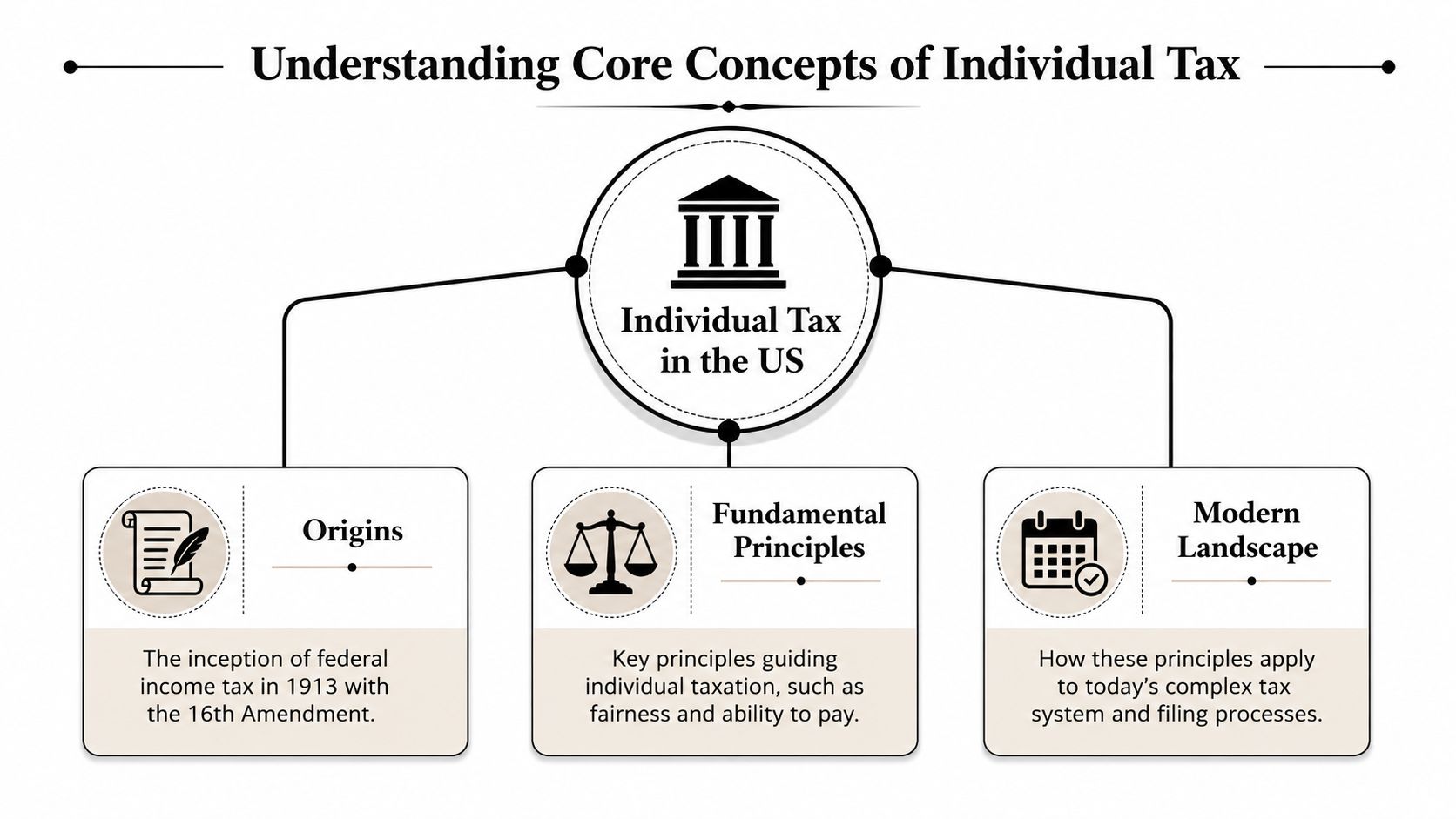
That problem starts with the core idea. Individual tax is the system the government uses to tax income earned by a person, then adjust that income through rules for filing status, deductions, credits, and special categories of income. For self-employed people and small business owners, the confusing part is that business activity often shows up on a personal return, even when the work feels like it belongs in a separate bucket.
What individual tax actually means
The modern federal income tax began in 1913 after the 16th Amendment. The IRS explains that the federal government taxes income from sources such as wages, salaries, tips, self-employment, and investment earnings under rules set by Congress in its IRS history overview.
A useful way to understand it is to treat your tax return like a series of filters.
Money comes in first. Then the tax system sorts it by type, adjusts it under the rules, and calculates what portion is taxed at which rate. Some income is taxed as ordinary income. Some is taxed under separate capital gains rules. Some tax benefits reduce taxable income, while others reduce the tax bill itself. Those are different tools, and mixing them up leads to bad estimates.
Self-employed readers often hit a hidden pitfall here. They focus on profit in the bank account, but tax law focuses on categorized income, timing, and documentation. If your records are messy, the math gets shaky before the return is even prepared.
Why the system is called progressive
The federal system uses progressive tax rates, which means higher slices of income are taxed at higher rates. For 2024, there are seven marginal rates ranging from 10% to 37%, as outlined by the Congressional Research Service.
A staircase comparison helps. Each band of income sits on its own step. Reaching a higher step does not pull all lower income up with it. It only changes the rate applied to the dollars that land in the new band.
That distinction matters more than many self-employed taxpayers realize. A strong quarter can push part of your income into a higher bracket, but it does not mean every dollar you earned is suddenly taxed at that top rate. Misunderstanding that rule often causes two opposite mistakes. Some people panic and overpay estimates. Others under-save because they assume the increase will be smaller than it is.
Average rate versus marginal rate
These two ideas sound similar, but they do different jobs.
Your marginal rate is the rate applied to your next dollar of taxable income. Your average tax rate is your total tax divided by your total income. One helps with planning. The other helps you understand your overall burden.
For a sole proprietor, that difference affects real decisions. If you are considering sending one more invoice in December, selling appreciated stock, or delaying equipment purchases, the marginal rate helps estimate the tax effect of that next move. The average rate does not.
What the burden looks like across income levels
The burden also changes sharply by income level. According to the Congressional Budget Office's distribution of household income report, federal taxes take a larger share of income as household income rises, although the mix of taxes differs across groups.
That broad pattern explains why tax planning becomes more valuable as income grows. More income creates more opportunities, but it also raises the cost of poor records, missed deductions, bad timing, and late estimates.
It also exposes a service gap many small business owners do not expect. IRS rules may be published, but getting fast, situation-specific guidance is another matter. Phone support delays, unclear notices, and generic software prompts can leave self-employed filers guessing about issues such as mixed-use expenses, uneven income, or how one tax move affects another. In practice, that means your own recordkeeping system and decision process often matter as much as the form itself.
Progressive taxation assigns higher rates to higher layers of income. Your actual bill depends on how your income is classified, adjusted, and documented. For self-employed taxpayers, that is where small misunderstandings turn into expensive ones.
Components of Individual Tax
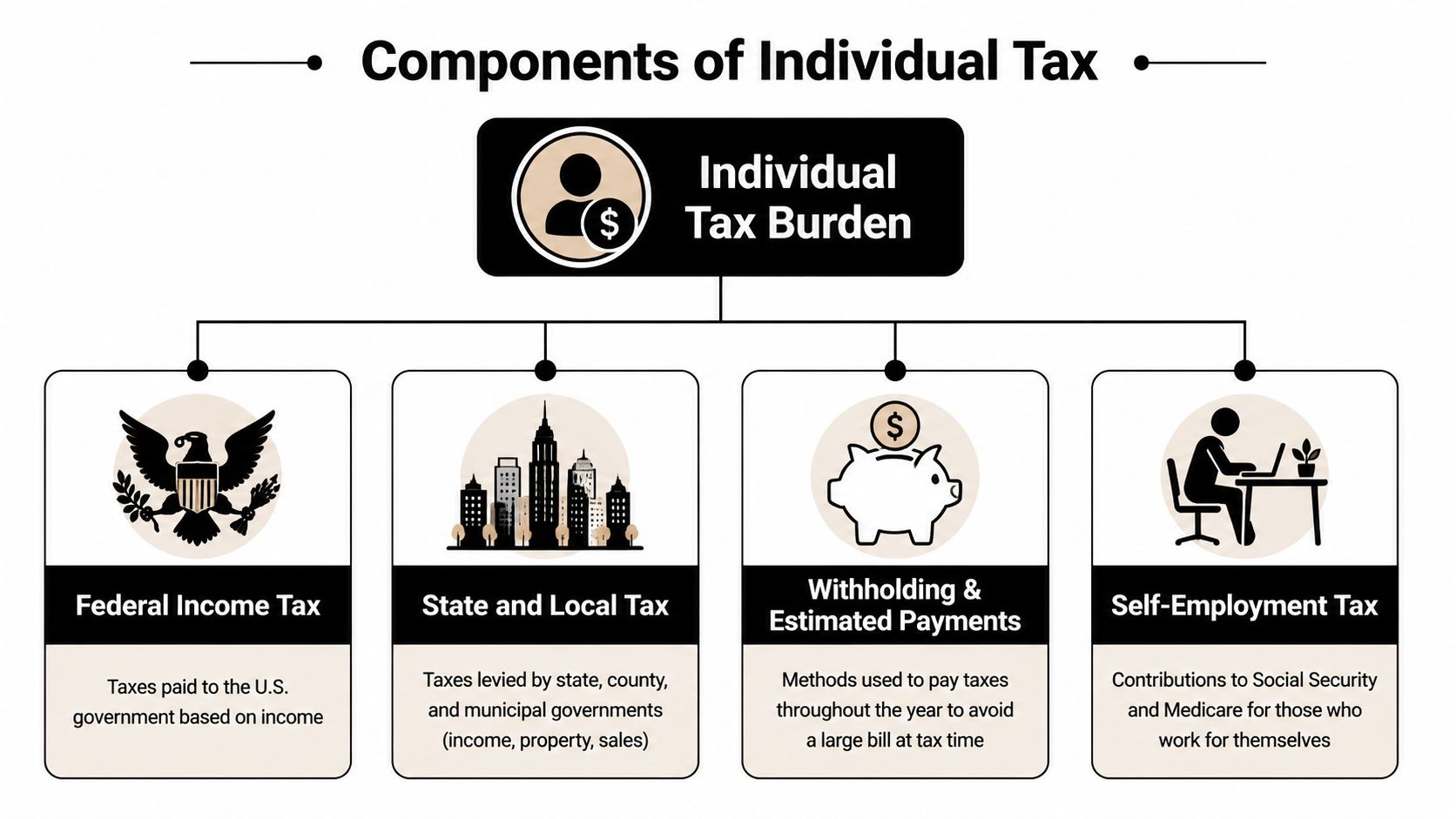
A useful way to read your tax bill is to treat it like a receipt with several lines, not one total at the bottom. A salaried employee may notice only the final number. A self-employed designer, consultant, or shop owner usually feels each layer separately because no payroll department is smoothing the process for them.
Federal income tax
Federal income tax is the part tied to your taxable income after adjustments and deductions. It uses marginal brackets, which means different slices of income can be taxed at different rates. The last dollar you earn may be taxed at a higher rate than the first dollars you earned, but that higher rate does not apply to everything.
That structure creates confusion for self-employed people with uneven income. One strong month can change the tax cost of the next sale, bonus, or asset sale. It also matters that ordinary income and some investment income do not always follow the same rules. The IRS page on capital gains and losses explains that long-term capital gains and qualified dividends can receive different tax treatment from ordinary income.
The practical risk is simple. If you treat every dollar as taxed the same way, you can overpay estimates, under-save for April, or make a year-end move that looks smart in business terms but costly after tax.
State and local tax
Federal rules are only one layer. States can define taxable income differently, limit deductions differently, and set their own payment rules. Some local governments also add income taxes or other obligations that are easy to miss if you only focus on your federal return.
This is one of the quiet service gaps small business owners run into. Software may carry numbers from one form to another, but it rarely explains why your state disallows a deduction the federal return accepted, or why moving midyear can split your filing duties. A clean federal return does not guarantee a clean state result.
Payroll-related items can add another point of confusion. If you have seen SDI on pay stubs or payroll records and want a clearer explanation of how withholding and tax treatment can differ, Benely's HR guide on SDI tax offers a practical example.
Withholding and estimated payments
Taxes are also shaped by how you pay during the year.
Employees usually prepay through withholding from each paycheck. Independent contractors, sole proprietors, and many owners often have to send estimated payments themselves. The amount of tax may be correct on the return, yet the timing can still create penalties or a cash squeeze.
That is why payment timing deserves its own place in the tax picture. The return calculates what you owe. Withholding and estimates determine whether you already covered enough of it.
A simple framework helps:
| Item | What it does | Why it matters |
|---|---|---|
| Gross income | Starting point | Shows total earnings before tax adjustments |
| Adjustments | Reduce the base | Can lower the income used for tax calculations |
| Deductions | Further reduce taxable income | Affect how much income is actually taxed |
| Credits | Reduce tax itself | Can cut the final amount due |
Credits work differently from deductions. A deduction lowers the income being taxed. A credit lowers the tax bill itself. That difference is small on paper and expensive in real life if you mix them up.
Self-employment tax and overlooked overlap
Self-employed taxpayers often discover a second federal layer after they start earning on their own. In addition to income tax, net earnings from self-employment can trigger Social Security and Medicare tax responsibilities. The IRS Self-Employed Individuals Tax Center explains the rules and reporting mechanics.
This overlap catches new freelancers because profit does two jobs at once. It can increase income tax and self-employment tax. A business expense does the reverse. It may lower both, which is why records matter far more than many first-year owners expect.
The hidden pitfall is poor category tracking. If you mix personal and business costs, guess at home-use expenses, or reconstruct numbers from bank statements months later, you are more likely to miss valid deductions or claim weak ones you cannot support. If part of your home is used for business, the home office deduction requirements are worth reviewing before you put that number on a return.
Some higher-income taxpayers also face a parallel calculation under the Alternative Minimum Tax. The IRS instructions for Form 6251 explain who may need to check it and how the calculation works. Many readers will never owe it, but owners with large deductions, incentive stock transactions, or other preference items should know it exists because tax software may flag it late, after key planning choices are already made.
The larger lesson is practical. Individual tax is a set of interacting parts. Federal income tax, state rules, payment timing, and self-employment obligations can all change the final result. For small business owners, the problem is not only the law itself. It is also the gap between a general rule and clear, timely guidance when your facts are messy.
Filing Requirements and Common Traps
A lot of taxpayers think filing is optional if they can't pay. That's one of the costliest mistakes in the system.
The filing question and the payment question are separate. You may still need to file even if cash is tight, records are messy, or you already know you can't pay the full amount. For self-employed people, filing triggers can arrive faster because business income often comes without withholding and may not feel as visible as wages on a W-2.
What determines whether you need to file
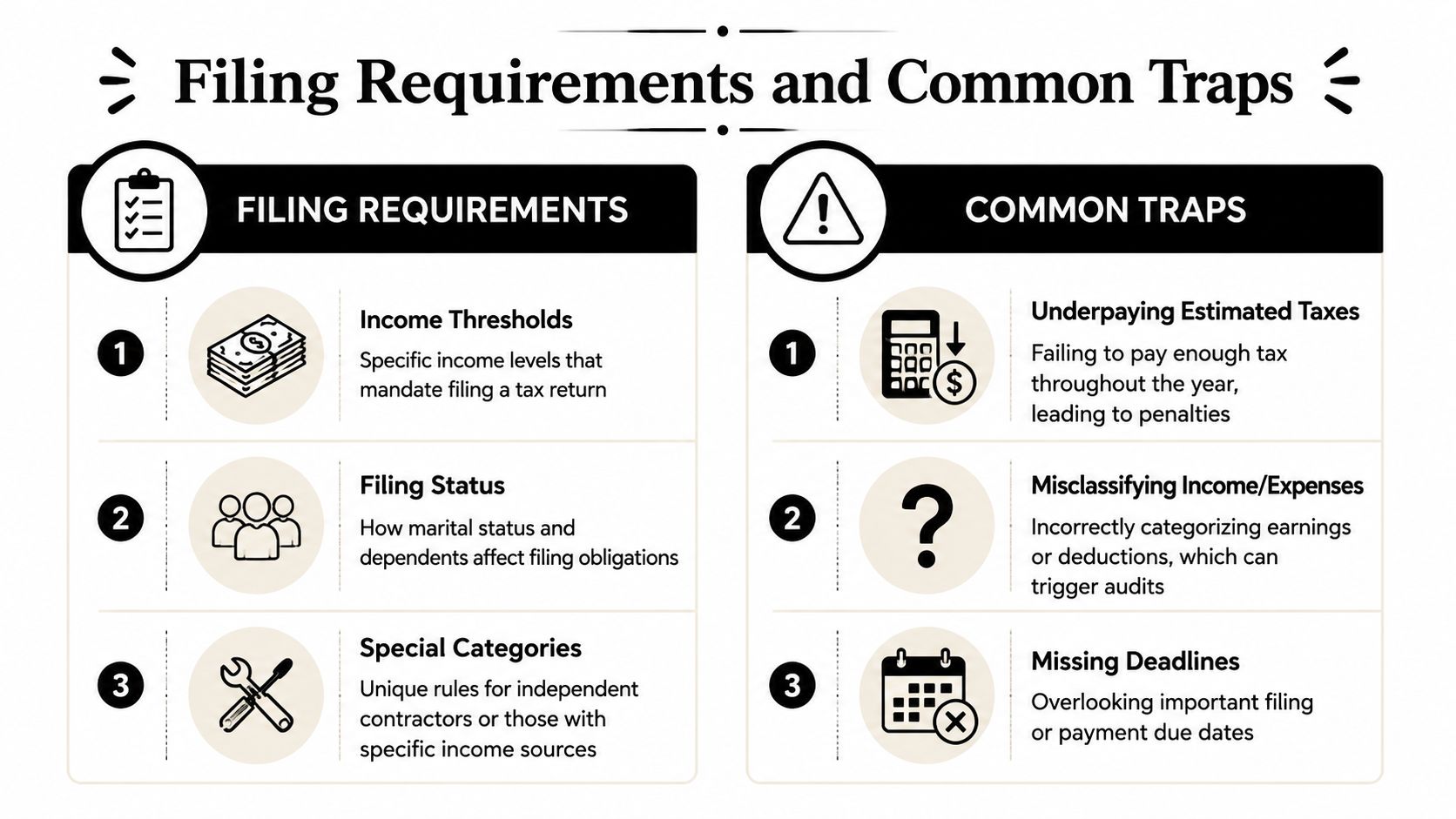
Filing duties usually depend on a mix of factors:
- Income level: Certain income thresholds trigger a filing requirement.
- Filing status: Single, married, and other statuses can change the rules.
- Type of income: Independent contractor income, side gig income, and investment income can complicate the answer.
The exact threshold question depends on the year and your situation, so it's better to verify the current rule than rely on memory. What matters most is recognizing that self-employment income creates obligations that many casual side-hustle earners underestimate.
Why taxable income confuses people
Many readers use “income” to mean whatever landed in the bank. Tax law doesn't work that way.
The St. Louis Fed explains that taxable income is based on Adjusted Gross Income minus deductions and credits, and that refundable credits such as the Earned Income Tax Credit can reduce liability below zero and create a refund beyond the taxes owed, as described in its individual income tax basics explainer. That's why two people with similar gross income can end up with very different tax outcomes.
Common traps that lead to notices
Here are the patterns that show up over and over:
- Underpaying during the year: Contractors often wait until filing season, then discover they were supposed to prepay.
- Mixing personal and business expenses: That makes deductions harder to defend and records harder to reconstruct.
- Ignoring state obligations: Federal compliance doesn't automatically solve state issues.
- Missing the return entirely: Some people don't file because they're afraid of what they owe, which usually makes the problem worse.
If you can't pay in full, file anyway. Non-filing creates a different category of problem than unpaid balance alone.
When someone has already fallen behind, it helps to understand the consequences before they escalate. A plain-language overview of what happens if you don't file a tax return can help connect missed filings to the notices and collection actions that follow.
A short prevention checklist
| Trap | Better move |
|---|---|
| Waiting until year-end | Review income and set aside tax money regularly |
| Poor records | Keep receipts, invoices, and account separation clean |
| Guessing on deductions | Document the business purpose before claiming |
| Skipping state review | Check state filing and payment rules separately |
The big idea is simple. Filing problems rarely come from one dramatic mistake. They usually come from several small assumptions stacked on top of each other.
Differences from Business Tax
People often use “business taxes” as a catch-all phrase, but that can blur a critical point. Many small business owners don't pay income tax through a separate corporation at all. Their business income flows through to them and becomes part of their individual tax picture.
Where the lines split
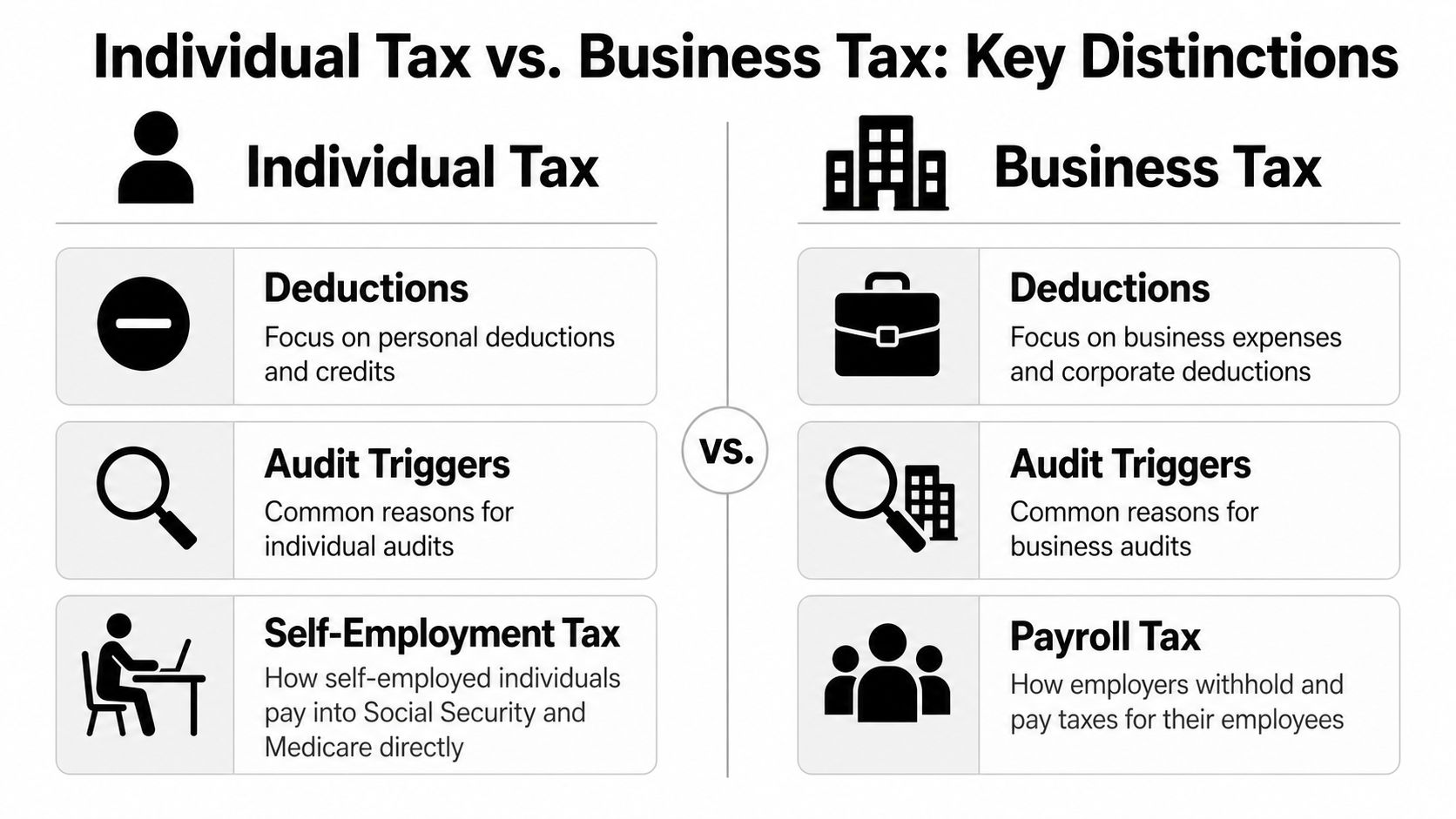
An individual return focuses on the person. A business return, when required, focuses on the entity. The difference affects deductions, forms, payroll treatment, and who the IRS sees as responsible.
Here's a quick side-by-side view:
| Individual tax | Business tax |
|---|---|
| Centers on personal income, deductions, and credits | Centers on entity income, business expenses, and business filings |
| Can include pass-through business income on a personal return | May involve separate entity returns depending on structure |
| Self-employed people often handle Social Security and Medicare-related obligations directly | Employers handle payroll withholding and payroll tax processes for workers |
For businesses with employees, payroll systems create a very different compliance workflow than solo work does. If you want a practical primer on that employer side, understanding PEO payroll helps explain how payroll administration differs from the tax experience of a sole proprietor or independent contractor.
A nuance many guides skip
Some tax advantages don't come from bracket rates at all. They come from exclusions and tax preferences built into the system.
The Tax Policy Center explains that racial disparities in the federal individual income tax system are driven not by bracket rates themselves, but by tax expenditures such as employer-health insurance exclusions and capital gains preferences that disproportionately benefit White families, while Black and Hispanic families rely more on refundable credits, as discussed in its guide to understanding racial disparities in the federal individual income tax system.
For self-employed taxpayers, that point matters in a practical way. A worker employed by a larger company may access tax-favored benefits through payroll and employer-sponsored coverage. A solo owner may not. So even when two people earn similar amounts, the path to taxable income can look very different.
Some of the biggest differences in tax outcomes come from access to exclusions and structures, not just from the published tax brackets.
That's one reason business owners shouldn't assume the rules were built around their exact situation. Many weren't.
Practical Examples with Guidance on Professional Help
The easiest way to understand individual tax is to walk through realistic situations. Not exact tax calculations. Just the sequence of decisions that creates either a manageable filing season or a painful one.
Example one, the sole proprietor with steady income
A sole proprietor earns $75,000 annually from client work. The money arrives directly, with no employer withholding. At first, the owner treats every deposit as available cash.
Midyear, the owner realizes a problem. Some expenses were tracked. Others were paid from a personal account. There's income from several platforms, no consistent estimated payment routine, and no clear distinction between gross receipts and taxable income.
The owner then rebuilds the picture in order:
- Total the incoming revenue from invoices, payment apps, and bank deposits.
- Separate legitimate business expenses from personal spending.
- Identify adjustments and deductions that may reduce the income base.
- Estimate tax exposure early instead of waiting for the return to deliver the news.
That sequence matters because tax is calculated from a refined number, not just raw revenue. A business owner who skips the cleanup step usually overestimates deductions, underestimates tax, or both.
Example two, the single-member LLC with uneven quarters
A single-member LLC has fluctuating quarterly revenue. One quarter is strong, one is weak, one is delayed by late-paying clients, and another includes a large catch-up payment.
This owner's mistake isn't bad bookkeeping. It's inconsistent planning. The strong quarter creates confidence, the weak quarter creates panic, and estimated payments never align well with actual income patterns.
The fix is practical:
- Review each quarter separately: Don't assume the next quarter will match the last.
- Hold tax money outside the operating account: That lowers the temptation to spend it on short-term business needs.
- Keep records ready for notices: If a mismatch appears later, organized records matter more than memory.
A fluctuating-income business doesn't need perfect forecasting. It needs a repeatable review habit.
What happens when an IRS notice arrives
Suppose either owner receives a notice. The instinct is often to freeze, especially if the letter uses unfamiliar language or references figures the taxpayer doesn't recognize.
A better response looks like this:
- Read the notice carefully: Identify the year, issue, and deadline.
- Compare it to your return and records: Notices often turn on missing forms, mismatched income reports, or unresolved balances.
- Respond on time: Silence usually narrows your options.
- Keep copies of everything sent: That includes proof of mailing or submission.
Some taxpayers face an extra layer of difficulty because IRS service is uneven. Reporting has noted that the IRS still hasn't clearly defined “underserved” taxpayers, and that rural taxpayers and people with limited English proficiency can face unexplained audit delays or debt collection issues, as discussed in this Tax Notes report on TIGTA's outreach findings. For self-employed people outside major metro areas, that service gap can make a routine issue harder to resolve.
When professional help makes sense
Not every tax question requires an attorney. Some need a CPA, EA, bookkeeper, or payroll specialist. But certain signs suggest the issue has moved beyond DIY territory:
- You've received multiple IRS notices
- You haven't filed for one or more years
- You owe more than you can pay
- Your records are incomplete and the IRS has already contacted you
- Your business and personal finances are mixed together
- You need representation in a dispute, audit, or collection matter
If you're trying to evaluate legal help, this guide on how to find a good tax attorney is a useful starting point because it helps separate real controversy experience from general tax preparation experience.
The practical rule is simple. If the problem is only about organizing records and filing a straightforward return, a tax preparer may be enough. If the problem involves notices, debt, enforcement risk, or strategy under pressure, professional representation can change the outcome and reduce costly missteps.
Conclusion and Next Steps
Individual tax is the system that taxes people on income after a series of adjustments, deductions, and credits shape what's taxable. For employees, that process can stay mostly invisible because withholding does much of the work in the background. For self-employed people and small business owners, it's much more hands-on.
That's why the underlying question behind what is individual tax isn't just definitional. It's operational. How do you track income correctly, separate business from personal spending, make timely payments, and respond before a manageable issue becomes a notice or tax debt problem?
A strong next step usually looks like this:
- Create one tax folder: Keep invoices, receipts, prior returns, and IRS letters in one place.
- Review income regularly: Don't wait until filing season to discover what you earned.
- Set aside tax money as revenue comes in: Treat it as unavailable cash.
- Check state obligations separately: Federal compliance isn't the whole picture.
- Get help early if notices start arriving: Early action usually creates more options.
Tax problems rarely improve through delay. They improve when you replace guesswork with records, timing, and a clear plan.
If you're dealing with tax debt, IRS notices, unfiled returns, or a situation that feels bigger than basic tax prep, Attorney Stephen A Weisberg offers a FREE Tax Debt Analysis to help determine whether he can help and what resolution path may fit your situation.


