What is Form 944? A Small Business Owner's Guide
Confused about what is Form 944? Our guide explains who files, deadlines, how it differs from Form 941, and how to avoid costly IRS penalties.
In this article
- What Is Form 944 and Who Is It For
- What the form actually reports
- Who usually fits this category
- Form 944 vs Form 941 Explained
- Form 944 vs. Form 941 at a Glance
- The real-world difference
- Why this comparison matters
- How the IRS Decides Your Filing Status
- What counts as proper authorization
- If your business changes
- Navigating Form 944 Deadlines and Deposits
- Annual filing and deposit timing are different rules
- Growth changes the rules faster than owners expect
- Payment method problems also cause penalties
- Costly Form 944 Mistakes and Their Consequences
- The mistakes I see most often
- Why nonpayment gets personal
- Practical consequences
- Resolving Form 944 Problems When to Call an Attorney
- Red flags that mean you shouldn't handle it alone
- What an attorney should evaluate
Form 944 is the Employer's Annual Federal Tax Return for the smallest employers, generally those with $1,000 or less in annual liability for Social Security, Medicare, and withheld federal income taxes. You don't choose Form 944 because it looks easier. The IRS decides whether you're allowed to file it.
If you're asking what is form 944, you're probably in one of two situations. You just hired your first employee and payroll taxes suddenly got real, or you already run payroll and you're trying to figure out why the IRS wants one annual form instead of quarterly filings.
Either way, the practical issue isn't just filing the right paper. It's avoiding a payroll tax problem that snowballs because you assumed “annual return” meant “I can deal with this later.” That assumption causes trouble fast. Payroll tax rules are procedural, rigid, and unforgiving when money is withheld from employees and not paid over correctly.
What Is Form 944 and Who Is It For
You hire your first employee, run a few small payrolls, and assume the annual return can wait until year-end. That is the mistake. Form 944 changes how often you file the return, not your duty to track, deposit, and account for payroll taxes as they arise.
Form 944 is the IRS's annual federal payroll tax return for a narrow group of very small employers. It is meant for employers with low annual liability for withheld federal income tax, Social Security tax, and Medicare tax. The IRS created it to reduce paperwork for businesses with minimal payroll, as explained in this overview of Form 944 filing rules.

What the form actually reports
Form 944 reports the same core payroll tax obligations that create serious IRS exposure if they are mishandled. That includes federal income tax withheld from employees' wages, Social Security tax, Medicare tax, additional Medicare tax, and certain adjustments and credits. The tax rates for Social Security and Medicare are set out in the IRS instructions for Form 944.
This matters for risk management. A business owner who treats Form 944 like a once-a-year administrative task misses the underlying issue. Part of the money reported on this form was withheld from employees. If that money is not paid over properly, the IRS can pursue the people responsible, not just the business. That is how payroll tax trouble turns into personal exposure.
Who usually fits this category
Form 944 is for micro-employers. A sole proprietor with one employee. A startup with limited payroll. A family business paying modest wages. It was not designed for every small business with a few workers, and it is not a shortcut you elect on your own.
Some employers with low payroll still do not qualify. The IRS decides who may file Form 944, and that decision controls unless the IRS approves a change. If you need a broader explanation of withholding, deposits, and employer obligations, review this guide to small business payroll taxes.
Practical rule: If the IRS has not told you to file Form 944, file the return the IRS assigned to you.
That rule saves people from preventable tax debt. Filing the wrong payroll return creates mismatched IRS records, missed notices, and payment application problems that are expensive to clean up later. If your payroll is changing, your deposits are behind, or you have received IRS letters you do not understand, get professional help early. Payroll tax problems are easier to fix before they turn into assessments, collection action, or Trust Fund Recovery Penalty exposure.
Form 944 vs Form 941 Explained
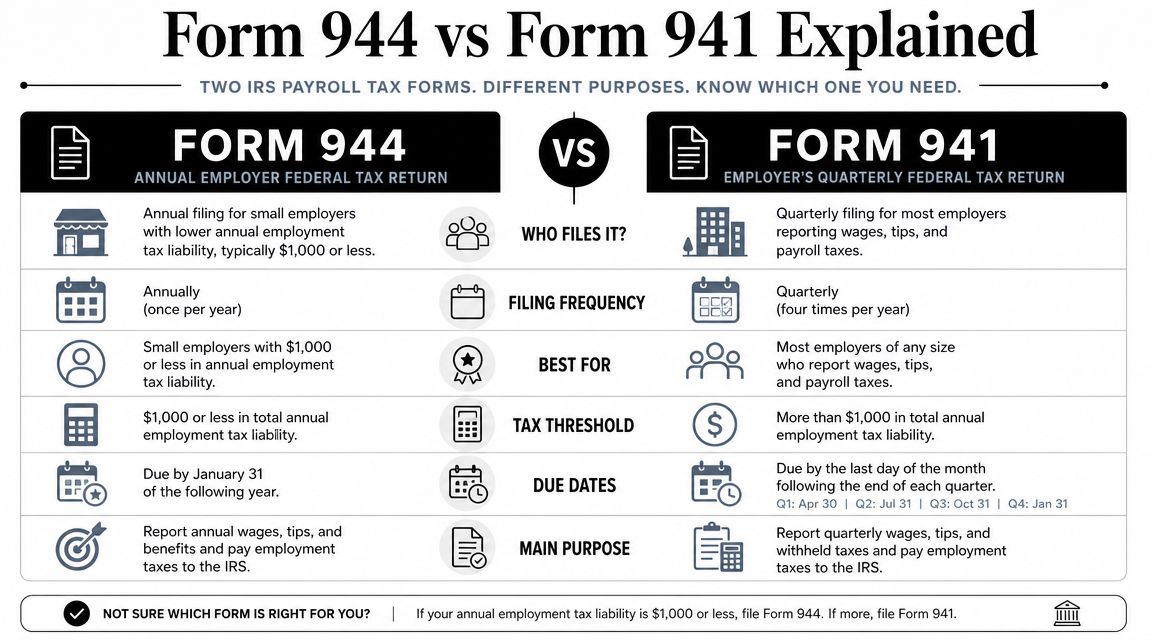
Most employers file Form 941. Form 944 is the exception. The forms cover the same general category of federal payroll taxes, but they differ where it matters most to a business owner: filing frequency and who is expected to use them.
Form 944 vs. Form 941 at a Glance
| Attribute | Form 944 | Form 941 |
|---|---|---|
| Filing frequency | Annual | Quarterly |
| Typical filer | Smallest employers | Most employers |
| Eligibility basis | IRS-authorized filer with very low annual payroll tax liability | Standard filing form for employers |
| Can employer choose it alone | No | Generally assigned as the default payroll return |
| Common misunderstanding | “Annual filing means annual payment” | “Quarterly filing is only for larger companies” |
The real-world difference
If you file Form 941, you report payroll taxes every quarter. If you file Form 944, you report them once a year. That's the headline difference, but not the only one.
The practical difference is workflow. Form 941 forces regular review, regular reporting, and fewer opportunities to ignore a payroll tax issue for months. Form 944 reduces paperwork, which is helpful, but it also creates distance between the act of paying employees and the act of filing the annual return. For owners who don't watch payroll closely, that distance can become a problem.
Here's my opinion. Many owners ask the wrong question. They ask, “Which form is better?” That's not the right lens. The better question is, “Which form am I legally required to file, and what payment obligations come with it?”
Why this comparison matters
A lot of confusion around what is form 944 comes from treating it as a smaller, easier version of Form 941 that anyone can elect. That's wrong. Form 944 is a controlled filing status, not a preference setting.
If you need a better grounding in the taxes behind these forms, this explanation of FICA payroll obligations helps connect the return to the taxes you're collecting and matching through payroll.
Annual reporting is simpler on paper. It is not more forgiving in practice.
If your records are messy, if your payroll provider changed mid-year, or if you're manually running payroll in QuickBooks, Gusto, ADP, or another system without reviewing the tax side, Form 944 can give you a false sense of control. Filing less often doesn't reduce the legal significance of the taxes involved.
How the IRS Decides Your Filing Status
You can't wake up, decide your payroll is small, and start filing Form 944. The IRS controls this.
The rule is straightforward: taxpayers cannot unilaterally elect Form 944 filing and must receive explicit IRS authorization based on estimated annual payroll tax liability projections. New employers can request Form 944 status when applying for an EIN, while existing businesses must formally petition the IRS for a conversion, as described in this guide on Form 944 authorization and conversion.
What counts as proper authorization
The important phrase is written IRS notification. If the IRS designated you as a Form 944 filer, keep that notice. Don't toss it with routine mail. That notice matters if your filing history later gets questioned.
Owners make these avoidable mistakes:
- They assume low payroll equals Form 944 eligibility. It doesn't, by itself.
- They switch forms without approval. That creates procedural problems immediately.
- They rely on a payroll service setup screen. Software settings do not override IRS classification.
If your business changes
Businesses don't stay static. A company can start tiny and then add staff. Or it can shrink and become a better fit for annual filing. Either way, your filing status should match your actual IRS classification, not your guess.
If you think you should be on Form 944, request the change properly. If you were assigned Form 944 and your payroll no longer fits that setup, address it before your filings drift out of sync. Don't wait until the IRS starts sending notices about missing quarterly returns or mismatched deposits.
Keep the IRS notice, your payroll records, and your filing history aligned. When those three don't match, cleanup gets expensive.
Household employers, agricultural employers, and employers instructed to file Form 941 aren't in the Form 944 lane. That exclusion matters because some owners focus only on business size and miss the category rules entirely.
Navigating Form 944 Deadlines and Deposits
A common Form 944 problem starts like this. The owner files one annual return, assumes payment can wait until year-end, then gets hit with deposit penalties because payroll tax liability crossed a threshold months earlier.
That mistake creates avoidable tax debt.
Annual filing and deposit timing are different rules
Form 944 is an annual return. Your deposit obligations still depend on how much employment tax liability you build during the year. If your liability stays very low, you may be allowed to pay with the return. Once liability increases, the IRS expects payments during the year, sometimes by quarter and sometimes under monthly or semiweekly deposit rules, as explained in the IRS overview of Form 944.
The practical point is simple. Do not treat Form 944 like a license to hold payroll taxes.
Those funds include amounts withheld from employees. If cash flow gets tight and you use that money for rent, inventory, or payroll itself, you are creating a payroll tax problem, not solving one. That is how a routine filing issue turns into a collection issue.
Growth changes the rules faster than owners expect
Form 944 works fine for a very small employer until it doesn't. A new hire, bonus payroll, catch-up wages, or corrected withholding can change your deposit pattern midyear. The form stays annual. The payment schedule does not.
Use this framework:
- Very low liability may allow payment with the return.
- Higher liability that stays below the deposit trigger for each quarter can require quarterly payments.
- A quarter that hits the trigger amount can move you into monthly or semiweekly deposits.
Review payroll tax liability every month. That is the safest habit for a small business with changing payroll.
If you use a payroll company, verify what it is doing. Software can process payroll and still miss a bad setup, a missed deposit, or a payment method problem. Owners stay responsible when the IRS account does not match the reports.
Payment method problems also cause penalties
The IRS instructs employers to review current filing and payment instructions each year, including electronic payment requirements and approved payment methods. Set up EFTPS before you need it. Test access. Confirm who in your business has login control. Keep proof of each scheduled payment.
Poor records make this worse. Use a checklist for business expense documentation and keep payroll tax records separate, current, and easy to trace. If a deposit is missed, you want clean documentation immediately, not a reconstruction project six months later.
Form 944 controls how you report for the year. Your liability controls when the IRS expects its money.
If you already missed deposits or used withheld taxes to cover operating expenses, get advice early. Penalties increase fast, and unpaid trust fund taxes can expose owners and other responsible parties to personal assessment. If that risk is on the table, read about Trust Fund Recovery Penalty relief and abatement options before the case gets harder to contain.
Costly Form 944 Mistakes and Their Consequences
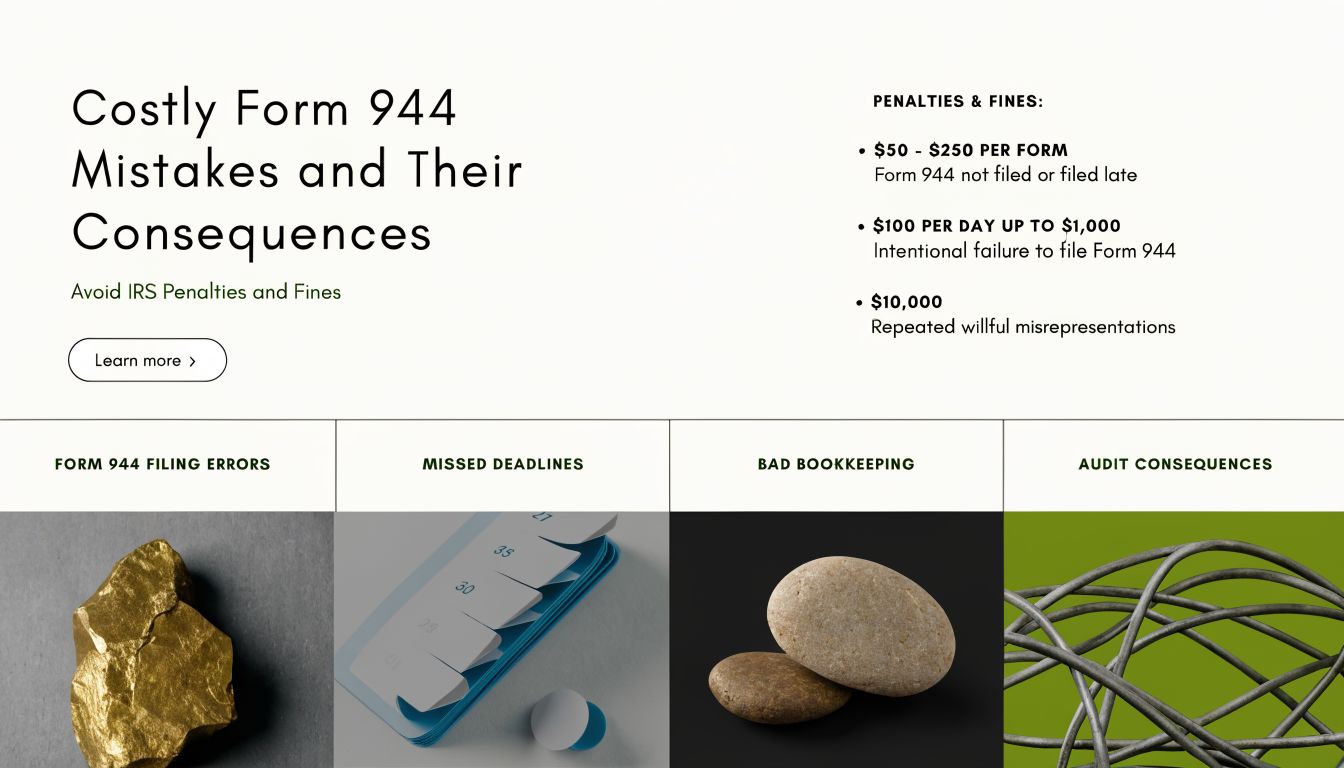
Payroll taxes are different from many other business debts because part of that money was withheld from employees. The IRS treats failures here far more seriously than owners expect.
The mistakes I see most often
Some errors are procedural. Some are cash flow decisions disguised as temporary fixes. Both create risk.
- Filing Form 944 without authorization means your filings may not match IRS expectations.
- Treating annual filing like annual payment flexibility leads owners to hold payroll taxes too long.
- Missing deposits during a growth phase is common when payroll increases but internal controls don't.
- Poor records make it harder to prove what was withheld, deposited, or corrected.
If your documentation is weak, fix that now. A solid checklist for business expense documentation can help organize records before a payroll issue turns into a broader IRS problem.
Why nonpayment gets personal
Here is the critical point. Form 944 filers who fail to pay often face Trust Fund Recovery Penalty assessments, which can attach personal liability to business owners and officers for unpaid trust fund taxes, as discussed in this article on Form 944 payment risks and TFRP exposure.
That means the problem may not stay with the company. If the IRS decides a responsible person willfully failed to collect, account for, or pay over trust fund taxes, personal exposure becomes a real issue. Owners of corporations and LLCs often assume the entity protects them automatically. It doesn't in this context.
If you use withheld payroll taxes to keep the lights on, you are borrowing from the IRS in the worst possible category.
Practical consequences
The consequences usually unfold in layers:
- Notices begin arriving. They may start as routine balance-due or filing discrepancy notices.
- Penalties and interest build. The longer the issue sits, the harder it gets to unwind.
- The IRS looks at responsible persons. That can include owners, officers, and others with authority over payroll decisions.
- Collection pressure increases. At that point, the issue is no longer just bookkeeping.
This is why I don't like casual advice that tells owners to “catch up later” on payroll taxes. Catch up with vendors if you must. Renegotiate with lenders if you must. But understand what you are doing if you delay payroll tax deposits.
If the IRS is already raising trust fund issues, learn how trust fund penalty abatement works and what kind of record development may matter. Don't wait for the business to close before dealing with it. Closing the entity doesn't erase payroll tax exposure.
Resolving Form 944 Problems When to Call an Attorney
Some Form 944 issues are fixable with good records and prompt correction. Others need legal strategy because the problem has shifted from tax compliance to tax exposure.
Red flags that mean you shouldn't handle it alone
If any of the following is true, stop trying to wing it:
- You received an IRS notice about unpaid payroll taxes.
- You realize you filed the wrong employment tax form.
- You fell behind on deposits and aren't sure when the problem started.
- You used withheld taxes to cover operations.
- The IRS mentioned personal responsibility, trust fund taxes, or a proposed penalty.
- Your business closed, but payroll tax notices kept coming.
These aren't routine filing questions anymore. They are controversy matters.
What an attorney should evaluate
A good tax attorney doesn't just look at the balance due. The right review asks different questions:
- Was the business even filing under the correct payroll tax classification?
- Are the IRS records matching the payments made?
- Is the exposure limited to the entity, or is a responsible person investigation developing?
- Are there penalty issues, procedural defects, or correction opportunities?
That's where legal analysis matters more than generic tax prep. A return preparer can help with forms. An attorney should step in when the IRS may assess liability personally, when years of filings are wrong, or when your records need to be marshaled defensively.
The moment payroll tax trouble threatens the owner personally, this stops being a filing problem and becomes a legal problem.
If you're unsure whether you've crossed that line, read this guide on when to hire a tax attorney. It's a practical filter for deciding whether your issue is still administrative or already serious enough to require representation.
Delay typically exacerbates payroll tax issues. This is not because every situation results in catastrophe, but because hesitation reduces your available choices. Records become more difficult to recreate. Payment histories turn unclear. Individuals lose track of who was responsible for specific decisions. The IRS file grows larger while your strategic advantage diminishes.
If you're dealing with Form 944 issues, clarity matters more than optimism. Find out what the IRS thinks your filing status is, what was paid, what wasn't, and whether the matter has crossed into trust fund territory.
Attorney Stephen A. Weisberg helps business owners, individuals, and responsible persons deal with IRS tax debt, payroll tax problems, audits, and Trust Fund Recovery Penalty issues. If you're facing Form 944 confusion, unpaid payroll taxes, or notices that suggest personal exposure, start with a free Tax Debt Analysis at Attorney Stephen A Weisberg to find out whether he can help and what the next move should be.


