What Is Form 540? A Guide to California's Tax Return
Unsure what is Form 540? Our guide demystifies California's resident tax return, helping you file correctly and avoid common, costly mistakes with the FTB.
In this article
- Your Guide to California Form 540
- Who Needs to File Form 540
- Breaking Down the Filing Requirements
- Form 540 At a Glance: Key 2026 Filing Thresholds for Single Filers
- Choosing the Correct California Tax Form
- Comparing Form 540, 540 2EZ, and 540NR
- The Standard: Form 540
- The Simple Option: Form 540 2EZ
- The Nonresident and Part-Year Form: 540NR
- How to Navigate Key Sections of Form 540
- Reporting Your Income and Adjustments
- Standard Deduction vs Itemized Deductions
- Calculating Your Tax and Claiming Credits
- Common Form 540 Mistakes for Business Owners
- Mismanaging Business Income and Expenses
- Underestimating Your Tax Liability
- Confusion Over Pass-Through Income and State-Specific Rules
- What to Do When You Have a Problem with the FTB
- Understanding Common FTB Penalties
- The FTB Audit Process and Your First Steps
- When to Seek Professional Help
- How a Tax Attorney Solves Complex Form 540 Issues
- Negotiating Your Tax Debt
- Defending You During an Audit
- Common Questions About California Form 540
- When Is the Deadline to File Form 540?
- Do I Still File Form 540 if I Already Filed a Federal 1040?
- What Should I Do if I Find a Mistake on My Filed Form 540?
- Is It Possible to File Form 540 for Free?
If you've ever filed a federal tax return with the IRS using Form 1040, think of California's Form 540 as its state-level sibling. It's the primary document California residents use to report their income, claim deductions and credits, and ultimately settle up with the state's tax authority, the Franchise Tax Board (FTB).
Your Guide to California Form 540
Essentially, Form 540 takes the key figures from your federal return and re-runs the numbers through the lens of California's unique tax laws. It's how the state determines your final tax bill or refund. This form isn't just a piece of administrative paperwork; it's the financial engine that keeps California running.
The taxes collected through Form 540 filings are what pay for public schools, highway maintenance, state parks, and public safety. Getting a handle on this document is the first step to confidently managing your state tax obligations each year.
Who Needs to File Form 540
So, do you actually need to file? For most California residents, the answer is yes. The requirement to file kicks in once your income crosses a certain threshold. This magic number isn't one-size-fits-all; it changes based on your filing status (like single or married), your total gross income, and how many dependents you claim.
The core purpose of Form 540 is to reconcile your total income with California's tax laws to determine if you owe additional tax or are due a refund. It's the primary tool the FTB uses to assess your annual tax liability.
This single form is the cornerstone of state tax filing for over 15 million Californians each year. The modern Form 540 became especially critical after Proposition 13 shifted the state's revenue-generating focus from property taxes to income taxes. Today, it helps fund about 50% of California's general budget—which topped $300 billion for the 2024-2025 fiscal year. You can dive into all the details by reviewing the complete tax booklet and instructions on the official FTB site.
Breaking Down the Filing Requirements
Not every single resident has to file. The FTB has specific income cutoffs, and if you fall below them and don't have any unusual tax situations, you might be off the hook.
However, even if you aren't technically required to file, you might want to. Here’s why:
- To Claim a Refund: Did your employer withhold too much state tax from your paychecks throughout the year? The only way to get that money back is by filing a Form 540.
- To Receive Tax Credits: California offers some valuable refundable credits, like the California Earned Income Tax Credit (CalEITC) and the Young Child Tax Credit. These can put money directly in your pocket, but you have to file a return to claim them.
To give you a clearer picture, here's a quick look at the income thresholds that trigger the filing requirement for a single individual in the 2026 tax season (for the 2025 tax year).
Form 540 At a Glance: Key 2026 Filing Thresholds for Single Filers
| Filing Status | Number of Dependents | Gross Income Exceeds |
|---|---|---|
| Single | 0 | $23,222 |
| Single | 1 | $39,114 |
| Single | 2 or more | $51,134 |
As you can see, the more dependents you have, the more you can earn before you're required to file. Remember, these numbers are specific to single filers under 65; the thresholds are different for other statuses like married or head of household.
The rules are designed to make sure everyone who owes tax pays their fair share, but they also create a clear path for people to get back money they're owed. Filing isn't just about paying up—it's about making sure your financial record with the state is complete and accurate.
Choosing the Correct California Tax Form
The very first step in tackling your state taxes is making sure you’ve got the right form in your hands. Think of it like a road trip—you need the right map for where you’re going. The California Franchise Tax Board (FTB) offers a few different "maps," and each one is built for a specific kind of taxpayer.
Picking the correct form from the start helps you claim every deduction and credit you're legally entitled to. On the flip side, grabbing the wrong one can mean leaving money on the table or, even worse, inviting unwanted attention from the FTB. This decision tree can help you get your bearings.
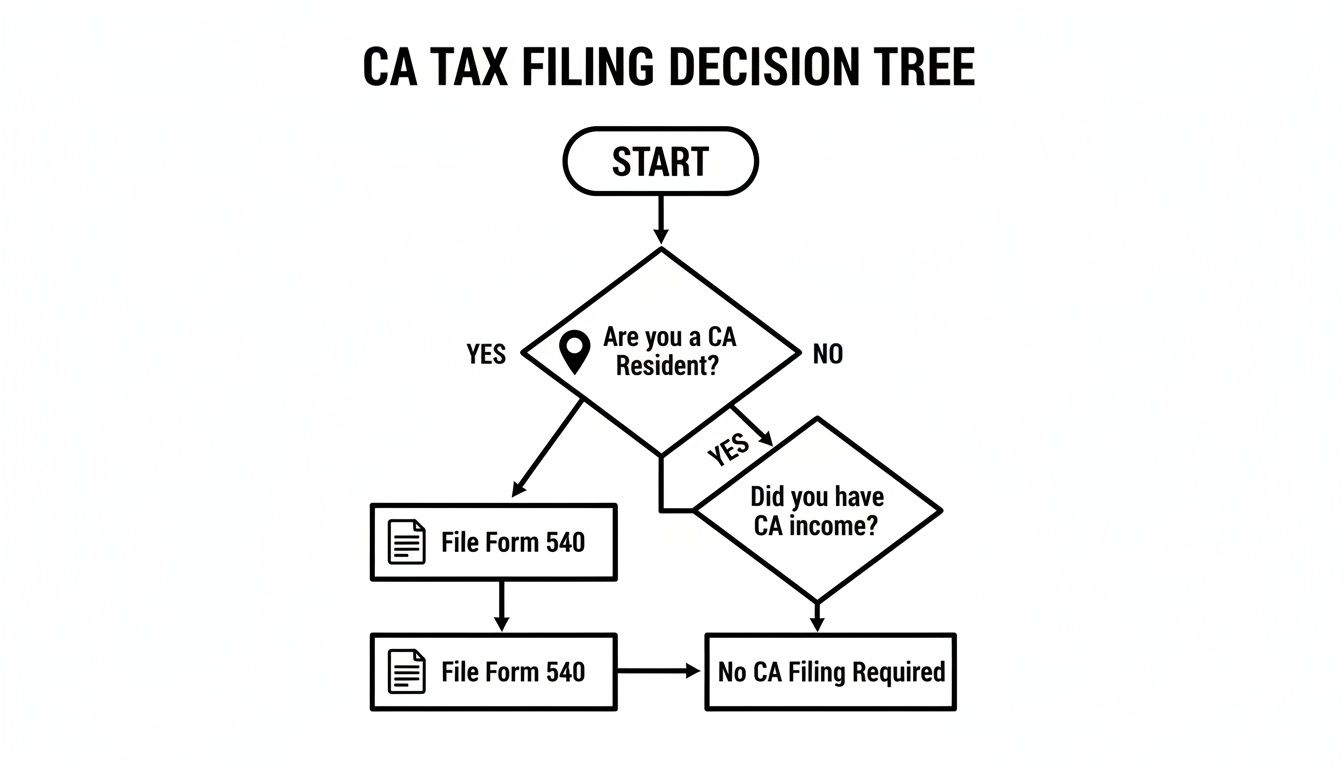
As you can see, everything hinges on one fundamental question: your residency. Your answer points you toward the right form, showing just how critical your residency status is to your California filing obligations.
To help clarify which form fits your situation, here's a quick comparison of the three main options.
Comparing Form 540, 540 2EZ, and 540NR
| Form Type | Primary User | Key Limitations and Features |
|---|---|---|
| Form 540 | Full-year California residents with more complex finances. | The "long form." Allows for itemized deductions, business income, capital gains, and all available credits. |
| Form 540 2EZ | Full-year California residents with very simple tax situations. | The "easy form." You cannot itemize deductions, claim dependents, or have complex income types. |
| Form 540NR | Nonresidents or part-year residents. | Used if you lived outside CA but had CA-source income, or if you moved into or out of the state during the year. |
This table gives you a bird's-eye view, but let's break down exactly what each of these forms is for so you can file with confidence.
The Standard: Form 540
Form 540 is the workhorse of California tax returns. It's the most comprehensive form, designed for full-year California residents whose financial picture is a little more detailed.
You'll almost certainly need to use Form 540 if your situation includes any of the following:
- Itemized Deductions: If you plan to write off expenses like mortgage interest, state and local taxes (SALT), or significant medical bills instead of taking the standard deduction, this is your form.
- Business or Self-Employment Income: This is a must for freelancers, independent contractors, and small business owners who need to report their business income and expenses.
- Other Income Sources: Did you sell stock? Have a rental property? Get income from a partnership or S-corporation? You'll be using Form 540.
Basically, if your financial life involves more than just a W-2 from a single job, Form 540 is the one you'll be working with.
The Simple Option: Form 540 2EZ
If Form 540 is the all-purpose tool, Form 540 2EZ is the simple screwdriver. It’s built for taxpayers with the most straightforward financial situations. The big benefit is that it's faster and far less intimidating, but that simplicity comes at a cost—it's very restrictive.
To use the 540 2EZ, you have to check every box on a long list of requirements, which generally means:
- You were a full-year California resident.
- Your only income came from wages, salaries, tips, interest, dividends, or unemployment.
- You must take the standard deduction; no itemizing allowed.
- You cannot claim any dependents.
Choosing the 540 2EZ is a trade-off. You get a much simpler filing experience, but you give up the ability to claim many valuable tax breaks. For instance, if you qualify for the Renter's Credit, you have to use the standard Form 540 to claim it.
The Nonresident and Part-Year Form: 540NR
Finally, there’s Form 540NR. This is the specialized form for people who weren't California residents for the entire tax year. It's primarily for two groups:
- Nonresidents: People who live elsewhere but earned income from California sources, like from a rental property in San Diego or a short-term work project in San Francisco.
- Part-Year Residents: Anyone who moved into or out of California during the tax year.
Form 540NR is inherently more complex. It requires you to carefully separate the income you earned while you were a California resident from the income you earned from California sources while you were a nonresident. This can get tricky fast.
When you're dealing with complex residency issues or have fallen behind on your obligations, you might need a bit more than just the instructions. You can learn more about how to navigate these challenges in our guide to handling https://www.weisberg.tax/articles/unfiled-tax-returns.
While popular software like TurboTax can be a good starting point for many, situations involving residency disputes or other complex tax problems often require professional guidance to ensure you get it right.
How to Navigate Key Sections of Form 540
Let's be honest: tackling Form 540 can feel like staring at a puzzle box with half the instructions missing. It's a dense document, full of lines, numbers, and jargon that can trip up even the most careful taxpayer. But we can demystify it by walking through the key sections together.
Think of the form as telling the financial story of your year. It starts with what you earned, then carves away adjustments and deductions to arrive at your taxable income. From there, it calculates the tax and, finally, applies credits to shrink your final bill. Once you understand that basic flow, the whole form becomes much more manageable.
Reporting Your Income and Adjustments
The first part of your journey is all about income. You’ll start with a key number from your federal return: your Adjusted Gross Income (AGI) from Form 1040. This figure is your starting point.
But California's tax rules aren't a carbon copy of the federal government's. This is where you'll make specific California adjustments. For instance, California doesn't tax your Social Security benefits, so you get to subtract that income. On the other hand, if you earned interest from another state's municipal bonds, that's taxable here, so you'll have to add it back in.
After your income is sorted out, you'll see a section for adjustments. These are often called "above-the-line" deductions because they lower your income before you have to make the big decision between the standard or itemized deduction.
Some of the most common adjustments include:
- Student Loan Interest Deduction: You can often deduct the interest you’ve paid on student loans, which directly lowers your taxable income.
- Alimony Paid: If you're paying alimony based on a divorce agreement dated before 2019, it's likely deductible.
- Health Savings Account (HSA) Deduction: Be careful here. California handles HSAs differently than the IRS, so this line requires close attention.
Each of these adjustments chips away at your total income, which is the first—and most important—step toward a smaller tax bill.
Standard Deduction vs Itemized Deductions
Next, you'll arrive at a major fork in the road. You have to choose between taking the standard deduction or itemizing your deductions. This decision can have a huge impact on your tax outcome, and the right choice depends entirely on your personal finances.
The standard deduction is a set dollar amount you can subtract from your income. No fuss, no receipts. The amount is based on your filing status, making it the simple and straightforward option.
Itemizing, on the other hand, is a bit more work. It means adding up all your specific, eligible expenses to see if the total beats the standard deduction. This is where you can deduct things like:
- Mortgage interest
- State and local property taxes (with limits)
- Large medical and dental bills
- Charitable donations
Pro Tip: Always run the numbers for itemizing, even if you assume you'll take the standard. You might be surprised. If your itemized expenses are higher than the standard deduction, you should absolutely itemize to get the lowest tax bill possible.
Calculating Your Tax and Claiming Credits
Once you have your taxable income (your AGI minus adjustments and your chosen deduction), it's time to figure out the actual tax. You’ll use the California tax tables or tax rate schedules from the FTB to find the amount you owe based on your income.
But you're not at the finish line yet! This is where tax credits come into play, and they are much more powerful than deductions. Think of it this way: a deduction reduces the amount of income you're taxed on, but a credit reduces your tax bill dollar-for-dollar.
California offers several fantastic credits that can make a real difference, including:
- Renter's Credit: A nonrefundable credit for eligible renters.
- California Earned Income Tax Credit (CalEITC): A refundable credit for working individuals and families with low to moderate income.
- Child and Dependent Care Expenses Credit: Helps with the high cost of childcare.
The impact of these credits is huge. In 2023, credits like the renter’s credit (worth $60-$120) and CalEITC (worth up to $3,644 for families) helped 1.1 million filers slash their taxes by a combined $1.2 billion. Just be aware that these benefits have limits for high earners; for example, credits begin phasing out for single filers with income over $347,808. You can find all the nitty-gritty details in the official FTB 540 instructions.
Getting these sections right is crucial. If you file and then realize you made a mistake, don't panic—it happens. You can fix it. Our guide on how to amend a tax return will walk you through filing a Form 540X to get everything corrected.
Common Form 540 Mistakes for Business Owners
For entrepreneurs, freelancers, and small business owners, California's Form 540 isn't just another tax document. It’s where your business and personal finances officially intersect, and unfortunately, it's a minefield for costly mistakes.
One small oversight when you're juggling business income, expenses, and confusing state-specific rules can quickly snowball, turning a straightforward filing into a serious headache with the Franchise Tax Board (FTB).
Mismanaging Business Income and Expenses
Probably the most common stumble for sole proprietors and single-member LLCs is getting the business profit and loss reporting wrong. It all starts with your federal Schedule C, which is where you calculate your net business profit. That final number is the bedrock—it flows directly to your federal Form 1040 and then gets pulled right into your California Form 540.
The real trap here is shoddy record-keeping. Guessing at your mileage, mixing personal expenses with business costs, or just forgetting to claim valid deductions can completely skew your net income.
Think of it like this: The numbers on your federal Schedule C create a domino effect on your California tax liability. An error there doesn’t just put you in the IRS’s crosshairs; it automatically triggers an error on your Form 540, potentially doubling your audit risk.
Meticulous records are your best defense. Every business owner needs to understand what receipts to keep for taxes—it’s the fundamental first step to avoiding overpayment and staying off the FTB’s radar.
Underestimating Your Tax Liability
Forgetting about estimated tax payments is easily the most painful mistake a business owner can make. Unlike a W-2 employee who has taxes neatly withheld from every paycheck, you’re on the hook for paying your income taxes to both the IRS and the FTB throughout the year.
If you fail to make those quarterly payments—or just severely underpay—you’re setting yourself up for a nasty surprise when you file. You won't just owe the tax, but you'll also get hit with underpayment penalties and interest. California is not known for being gentle with these penalties.
The financial consequences are staggering. In 2024 alone, California sent out over 1.2 million notices for underpayments, totaling a massive $5.8 billion. FTB data reveals that business owners are under a microscope; about 25% of audited small businesses have issues where payroll and income tax debts get tangled up with their Form 540 filings. For a closer look at the numbers, you can review the data from the California Franchise Tax Board.
Confusion Over Pass-Through Income and State-Specific Rules
If your business is an S-corporation or a multi-member LLC, your world revolves around pass-through income. This just means the business itself doesn’t pay income tax. Instead, the profits "pass through" to you and any other owners, and you report that income on your personal Form 540.
This is where a couple of common tripwires appear:
- Forgetting the LLC Fee and Tax: California LLCs must pay an annual tax of $800, no matter what. On top of that, there's a separate fee based on your total California income if it crosses certain thresholds. Forgetting these payments is an easy way to rack up penalties.
- Mismatching Federal and State Deductions: California tax law doesn't always copy the federal rules. For instance, California has its own depreciation rules and doesn't allow the generous bonus depreciation the IRS offers. If you claim a federal deduction that California disallows, it’s a bright red flag for the FTB.
Getting this wrong can be financially devastating. On average, audited multi-member LLCs with pass-through income mistakes on Form 540 have been hit with $45,000 in back taxes and penalties. Following a complete small business tax checklist is a smart way to stay organized and compliant with both sets of rules, helping you sidestep these expensive errors.
What to Do When You Have a Problem with the FTB
That official-looking envelope from the Franchise Tax Board (FTB) can certainly make your heart skip a beat. Your mind immediately jumps to worst-case scenarios. But take a deep breath. A notice from the FTB isn't a final judgment; it's simply their way of opening a conversation about your Form 540.
The key is not to panic, but to act promptly and strategically. Most of the time, the FTB is reaching out about late filings, late payments, or some kind of accuracy issue on your return. Knowing what to expect—and what your rights are—makes the whole situation feel much less intimidating.
Understanding Common FTB Penalties
The FTB has several penalties in its toolkit, and they can add up surprisingly fast. If you file your return late, they can hit you with a penalty of 5% of the unpaid tax for each month it’s overdue, up to a maximum of 25%. On top of that, there's a late payment penalty of 5% of the unpaid tax plus an extra 0.5% per month.
Another frequent headache is the accuracy-related penalty. If the FTB determines you significantly understated your income or were just plain negligent when you filled out your Form 540, they can tack on another 20% penalty. This isn't on your total tax bill, but on the specific portion that was underpaid because of the mistake.
The most important thing to remember is that you have rights as a California taxpayer. The FTB has to follow its own rules, and you have the right to appeal its decisions. Knowing your rights is your first line of defense.
The FTB Audit Process and Your First Steps
If the FTB decides to take a closer look at your Form 540, they'll start an audit. This could be something as simple as a letter asking you to mail in a few extra documents, or it could be a full-blown, in-person examination of your financial records.
No matter what kind of notice you get, your first moves should always be the same:
- Read the Notice Carefully: Pinpoint exactly what the FTB is asking about. Is it a specific deduction? A missing source of income? A simple calculation error? The notice will tell you.
- Gather Your Documents: Pull together all the paperwork that supports the numbers on your Form 540. This means W-2s, 1099s, bank statements, receipts—anything that proves your return is accurate.
- Respond by the Deadline: Ignoring the problem will only make it worse. Responding on time shows the FTB you're taking the matter seriously and are willing to cooperate.
You absolutely can represent yourself in a dispute with the FTB, and for a simple math error, that’s often a fine approach. But tax law is a maze of complexity. What starts as a seemingly small issue can quickly spiral into a major financial headache if you're not careful.
When to Seek Professional Help
This is where calling in a professional can be a game-changer. While you can go it alone, an experienced tax attorney lives and breathes this stuff. They understand the FTB's internal procedures, know how to navigate the bureaucracy, and can shield you from aggressive collection tactics like wage garnishments or bank levies.
If you're staring down a complex audit, dealing with significant tax debt, or feel the penalties are just plain unfair, it’s smart to get a professional in your corner. An attorney can dissect your situation, lay out your real options, and go to bat for you to get the best possible outcome. For many people, it's the fastest path to resolving the issue and getting their peace of mind back.
How a Tax Attorney Solves Complex Form 540 Issues
It’s a sinking feeling—an unexpected notice from the Franchise Tax Board (FTB) lands in your mailbox, or the sheer weight of tax debt becomes too much to handle. At moments like these, having a true expert in your corner can make all the difference. While you might be able to sort out a simple error on your own, the complex problems that can spring from a Form 540 filing often demand a professional to protect your financial future.
A tax attorney goes far beyond generic advice. They bring specific legal strategies to the table to resolve your case for good.

Think of them as a crucial buffer between you and the FTB. They take over all the stressful communications and negotiations. Right away, this puts a stop to the intimidating phone calls and formal letters, clearing the way to chart a path toward a real solution.
Negotiating Your Tax Debt
One of the most powerful things a tax attorney can do is negotiate a settlement directly with the FTB. This isn't just about asking for a bit more time to pay. It’s about fundamentally changing the amount you owe.
Their first move is to diagnose your financial situation and pinpoint the best possible resolution. This might involve a few key strategies:
- Offer in Compromise (OIC): This is an agreement with the FTB to settle your entire tax liability for less than the full amount you owe. An attorney knows how to build a persuasive case, proving that you genuinely can't pay the full debt. The goal is to show the FTB that accepting a reduced amount is the most practical way for the state to collect anything at all.
- Installment Agreement: If you can pay what you owe but just need more time, an attorney can negotiate a formal payment plan with manageable monthly payments. This is huge because it prevents the FTB from escalating to aggressive collection actions, like seizing your assets, while you get caught up.
- Currently Not Collectible (CNC) Status: For people experiencing true financial hardship, an attorney can demonstrate to the FTB that you have no disposable income to make payments. If CNC status is granted, the FTB has to pause all collection efforts, giving you critical breathing room.
Defending You During an Audit
An FTB audit can feel like your entire financial life is being put under a microscope. Every single line on your Form 540 is fair game for scrutiny. When you have an attorney representing you, you can be confident your rights are being protected every step of the way. They'll manage the entire audit—from gathering the right documents to handling the auditor's questions and pushing back on any incorrect findings.
A tax attorney’s involvement does more than just provide expertise; it levels the playing field. They understand the FTB's internal procedures and negotiation tactics, ensuring you are not intimidated into an unfavorable agreement.
This legal shield is also your best defense against the FTB’s most powerful collection tactics, like wage garnishments and bank levies. A skilled attorney can often stop these actions in their tracks, protecting your paycheck and your savings while they work out a permanent solution. You can learn more about the specific benefits of hiring a tax attorney to see just how valuable this partnership can be.
Ultimately, an attorney's job is to accurately diagnose your tax problem, lay out all your options, and execute a plan that resolves your debt and restores your peace of mind.
Common Questions About California Form 540
It's completely normal to have questions when you're dealing with state taxes. Let's walk through some of the most common things people ask about Form 540.
When Is the Deadline to File Form 540?
The big day for California taxes is the same as the federal one: April 15th. You need to file your Form 540 and pay whatever you owe by then.
If you're not quite ready, you can get an automatic extension to file, which pushes your deadline out to October 15th.
Important: An extension gives you more time to file your paperwork, not more time to pay your taxes. To avoid penalties and interest, you still have to estimate what you'll owe and send that payment to the state by the original April 15th deadline.
Do I Still File Form 540 if I Already Filed a Federal 1040?
Yes, you absolutely do. Think of it this way: your federal Form 1040 is for the IRS, while your California Form 540 is for the state's Franchise Tax Board (FTB). They are two separate returns for two different governments.
While your California return starts with numbers from your federal one (like your Adjusted Gross Income), filing with the IRS doesn't mean you're done. You still have to handle your state obligation separately.
What Should I Do if I Find a Mistake on My Filed Form 540?
It happens. If you spot an error after you've already filed, you'll need to correct it by filing an amended return. The form for this is Form 540X, Amended Individual Income Tax Return.
Don't just file another regular Form 540. You'd typically use a 540X if you need to fix your income, change your filing status, or adjust deductions or credits. It's always best to file the amended return as soon as you discover the mistake.
Is It Possible to File Form 540 for Free?
Yes, many Californians can. The FTB offers a free online filing service called CalFile. It's a great option if your tax situation is pretty straightforward—for example, if your income is mostly from W-2s and you plan to take the standard deduction.
The rules for who can use CalFile can change from year to year, so always check the FTB's website for the current eligibility requirements before you start.
If you're dealing with something more complicated than a simple filing—like a large tax bill you can't pay or a scary notice from the FTB—it’s smart to get a professional in your corner. At Attorney Stephen A Weisberg, we start every case with a FREE Tax Debt Analysis to get to the root of the problem and find the best solution. Contact us today to get started.