What Is Form 433 a? an Attorney's Guide to the IRS Form
Confused about what is form 433 a? Our expert guide explains why the IRS needs it, how to fill it out, and common mistakes that can cost you dearly.

In this article
- The IRS Letter That Demands Your Full Financial Picture
- What the letter usually means
- Form 433-A The IRS Financial X-Ray
- Why the IRS asks for more than one document
- The 433 family of forms
- Which one applies to you
- A Section-by-Section Walkthrough of Form 433-A
- Personal and household information
- Employment and income
- Cash and bank accounts
- Real estate, vehicles, and other assets
- Liabilities and monthly debt obligations
- Monthly living expenses
- Certification and supporting documents
- The IRS National Standards Your Budget Under Scrutiny
- Actual spending versus allowable spending
- Where disputes usually happen
- Why this matters to wage levies and payment demands
- Common Mistakes on Form 433-A and How to Avoid Them
- The mistakes that create the most trouble
- What to do instead
- Final review before submission
- How Your Form 433-A Determines Your Tax Resolution Outcome
- The three outcomes most taxpayers care about
- Installment agreement
- Offer in compromise
- Currently Not Collectible status
- Take Control with a Professional Tax Debt Analysis
Form 433-A is a detailed financial disclosure the IRS requires from individuals to assess their ability to pay back taxes. If you're asking what is Form 433 A, the practical answer is that it's the form the IRS uses to decide how hard it can press for payment, and what collection alternative you may qualify for.
If you've just opened an IRS notice and seen a demand for Form 433-A, the reaction is usually the same. Confusion first, then worry about whether you're about to lose a bank account, paycheck, or property.
That concern is justified, but the form itself isn't a penalty. It's a financial disclosure tool. The IRS wants a full picture of your income, assets, debts, and living expenses before it decides whether to push for an installment agreement, consider a settlement, or pause collection because payment would create hardship.
The important point is this. Form 433-A isn't just paperwork. It becomes the factual record the IRS uses to measure your collection potential. How it's prepared can shape the outcome of the entire case.
The IRS Letter That Demands Your Full Financial Picture
A common scenario looks like this. A taxpayer falls behind after a business slowdown, a divorce, a period of self-employment income that wasn't set aside for taxes, or several years of returns filed without enough money to pay. The IRS letters escalate. Then one arrives asking for Form 433-A, formally called the Collection Information Statement for Wage Earners and Self-Employed Individuals.
That letter usually lands at a bad time. Cash flow is already tight. The taxpayer may be trying to keep a business open, cover payroll, or avoid falling behind on rent or a mortgage. Then the IRS asks for bank balances, retirement accounts, vehicle information, pay records, and monthly expenses. It feels invasive because it is.
Still, there's a useful way to look at it. The IRS is telling you that it won't decide your case in the abstract. It wants documents.
Practical rule: The moment Form 433-A enters your case, stop treating the matter like a billing problem and start treating it like a financial evidence problem.
Clients often assume they should fill it out quickly and send it back to show cooperation. Cooperation matters, but speed without strategy causes damage. Once the IRS has your financial disclosures, it can compare them against wage records, prior returns, bank activity, public property records, and whatever else it already has.
Before you respond, it helps to understand how to respond to IRS letters effectively. The right response isn't always “complete the form today and hope for the best.”
Businesses also run into document-heavy compliance issues outside the collection context. If you handle contractor and vendor paperwork, it's worth taking a separate look at how firms learn about vendor tax form automation so collection problems don't get compounded by administrative gaps.
What the letter usually means
The IRS is generally trying to answer a few practical questions:
- What do you earn: Wages, self-employment income, rental income, and other incoming cash matter.
- What do you own: Real estate, vehicles, bank balances, investments, and retirement accounts influence financial options.
- What do you owe elsewhere: Mortgages, car loans, and other debts may reduce available equity.
- What can you realistically pay: This is the core issue behind every collection alternative.
If you understand that purpose early, the notice becomes less mysterious. It's still serious, but it's manageable.
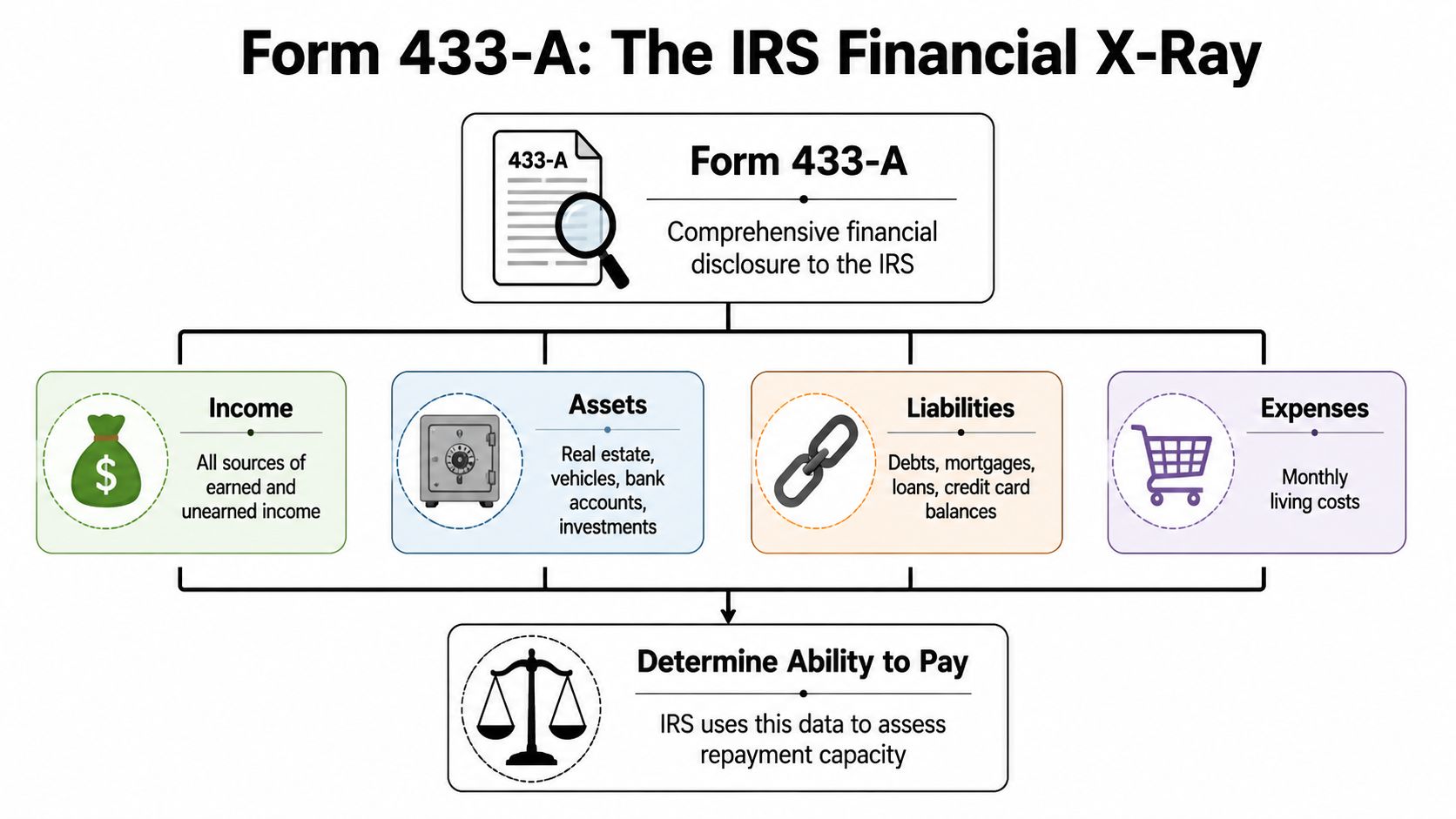
Form 433-A The IRS Financial X-Ray
Form 433-A is best understood as a financial X-ray. A bank statement shows one angle. A pay stub shows another. Form 433-A pulls those pieces together and asks for the whole picture at once.
The IRS uses that picture to judge your ability to pay. In practice, that means the agency is trying to estimate what it could collect from your assets, what it thinks you can pay from monthly cash flow, and whether you qualify for any collection relief.
Why the IRS asks for more than one document
Taxpayers sometimes ask, “Why isn't a bank statement enough?” Because the IRS doesn't evaluate collection cases from a single record. It wants to see whether the balances in your accounts line up with your reported income, whether your claimed expenses are supported, whether you have asset equity that could be tapped, and whether your household finances are as limited as you say they are.
A properly prepared Form 433-A answers those questions before the IRS starts making negative assumptions.
The form doesn't only reveal your finances. It reveals whether your story is internally consistent.
That consistency matters. A taxpayer who reports low income but shows regular transfers into savings, or claims hardship while omitting an asset, creates credibility problems immediately.
The 433 family of forms
Not every “433” is the same. Confusion here leads people to use the wrong form or rely on the wrong instructions.
| IRS Form 433 Family | Who Files | Purpose |
|---|---|---|
| Form 433-A | Individuals, including wage earners and self-employed taxpayers | Full financial disclosure for individual IRS collection matters |
| Form 433-B | Businesses such as corporations and partnerships | Financial disclosure for business entities in collection cases |
| Form 433-F | Individual taxpayers in more limited or preliminary collection review | Shorter financial statement often used in streamlined collection discussions |
Which one applies to you
If you are an individual taxpayer, a sole proprietor, an independent contractor, or someone with personal tax debt tied to self-employment income, Form 433-A is often the relevant form. If you've seen references to Form 433-F and aren't sure how it differs, this separate guide to Form 433-F in IRS collection cases can help you understand why the IRS sometimes requests the shorter version first.
The legal and strategic distinction is simple. Form 433-A is deeper. It gives the IRS more detail, and that means it gives your representative more opportunity to frame the facts carefully.
A Section-by-Section Walkthrough of Form 433-A
Most taxpayers get into trouble on Form 433-A for one of two reasons. They either rush, or they answer each line mechanically without understanding what the IRS is trying to infer from it.
That's where attorney review changes the process. Each section is not just a data-entry exercise. It's a chance to disclose accurately while avoiding avoidable harm.
Personal and household information
This section looks routine, but it has consequences. The IRS wants identifying details, household composition, marital status, and residence information. If you are married, separated, or living with someone who contributes to household expenses, those facts can affect how the IRS analyzes the household budget.
Documents to gather:
- Government identification: Driver's license or similar identification helps ensure exact matching.
- Proof of address: Lease, mortgage statement, or utility bill can support current residence.
- Household details: Information about who lives in the home and who pays what is often necessary.
A common mistake is oversimplifying the household. If another adult contributes to rent, utilities, or groceries, that may need to be addressed. If you ignore shared expenses, the IRS may decide your reported budget isn't believable.
Employment and income
For wage earners, the IRS wants employer details and take-home pay. For self-employed individuals, this part gets more involved because gross receipts don't tell the full picture. The IRS will want to understand business income, business expenses, and what remains available to the taxpayer.
Have these ready:
- Recent pay stubs: These show deductions and actual take-home pay.
- Bank statements: The IRS often uses them to test whether deposits line up with reported income.
- Profit and loss records: Self-employed taxpayers need organized records, not estimates.
- Tax returns: Recent filings provide context and let the IRS compare reporting across periods.
Attorney view: If you're self-employed, don't mix personal and business cash activity unless you're prepared to explain every transfer.
That issue appears constantly in practice. A taxpayer may think a transfer between accounts is harmless, but to the IRS it can look like undisclosed income unless the records tell a clean story.
Cash and bank accounts
This is one of the first places the IRS looks for immediate collection potential. The form asks about cash on hand and balances in checking, savings, and other financial accounts.
The strategic issue isn't to hide anything. It's to report balances accurately as of the relevant date and support them with records that match. If the number on the form and the number on the statement don't align, you need an explanation.
A good submission often includes concise clarifying notes when the timing matters, such as a payroll deposit hitting just before rent clears or a temporary balance spike caused by a transfer.
Real estate, vehicles, and other assets
Assets are where taxpayers often feel exposed. The IRS asks about homes, rentals, vehicles, retirement accounts, investments, insurance with cash value, and valuable personal property.
The key legal concept is equity, not just ownership. The IRS is looking at what value might be available after considering loans or encumbrances. In many cases, it also applies a more conservative view of value than a retail asking price.
What quick sale value means in practice
The IRS doesn't look at assets as though you have unlimited time to market them perfectly. It is evaluating what could realistically be collected if an asset had to be turned into cash in a collection context. That is why attorneys focus carefully on valuation support, payoff statements, condition issues, and title complications.
Useful documents include:
- Mortgage or lien statements: These show current balances that reduce equity.
- Vehicle loan statements: Necessary to evaluate whether there is any real collectible value.
- Account statements: Retirement and investment balances should be current.
- Property records or valuation support: Sometimes needed where fair market value is disputed.
Pro tip on retirement accounts
Don't assume a retirement account is irrelevant because you don't plan to touch it. If it exists, it generally needs to be disclosed. Failing to list it is usually worse than listing it and addressing its practical limits.
Liabilities and monthly debt obligations
This part ties directly to whether asset equity is available. Mortgages, vehicle loans, and other secured obligations may reduce the amount the IRS treats as collectible from property.
But not every debt carries the same weight in IRS analysis. Taxpayers often assume that credit card debt automatically offsets collection ability the same way a mortgage does. It usually doesn't work that neatly. The nature of the debt matters.
Monthly living expenses
This section is where many cases are won or lost. The taxpayer fills in actual household expenses, but the IRS does not automatically accept all of them as allowable for collection purposes.
Typical categories include:
- Housing and utilities: Rent or mortgage, utilities, maintenance, and related household costs.
- Food and personal care: Household necessities are evaluated against IRS standards.
- Transportation: Car payments, operating costs, insurance, or public transit may all come into play.
- Health care and court-ordered payments: These often require clear documentation.
If you claim an expense, expect to support it. If an expense is unusual, prepare to explain why it is necessary, not merely preferable.
Certification and supporting documents
The certification at the end matters. You are signing under penalties of perjury. That means guesses, omissions, and inconsistent figures are not harmless.
Before filing, review the package as a whole:
- Check internal consistency: Income on the form should align with pay records and deposits.
- Match balances to documents: Account balances and loan balances should track the attached statements.
- Explain anomalies: A short written explanation can prevent a long IRS dispute.
- Organize the file cleanly: A sloppy package invites more questions and delays.
When the form is being used in settlement discussions, precision matters even more because the IRS will often scrutinize the financial narrative line by line.
The IRS National Standards Your Budget Under Scrutiny
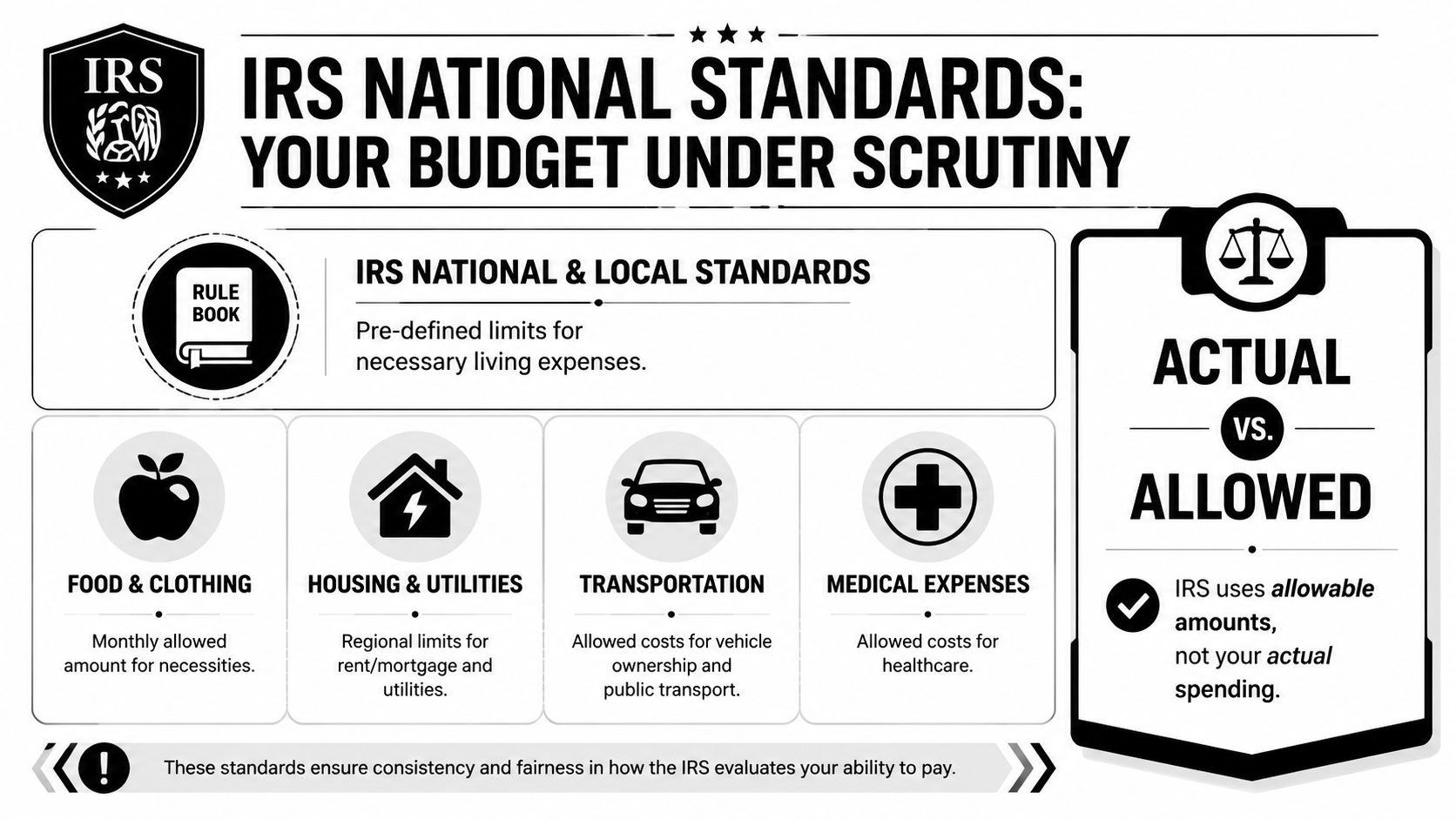
The hardest part of Form 433-A for applicants isn't listing assets. It's learning that the IRS may not care what you spend if it decides a lower amount is what you should be spending.
That's where IRS National Standards and Local Standards come in. The IRS uses its own framework for necessary living expenses when it evaluates collection ability. A taxpayer may have real, recurring household bills, but the agency may allow only part of them for collection analysis unless there is strong justification for more.
Actual spending versus allowable spending
This distinction frustrates taxpayers because it feels disconnected from reality. But in IRS collection practice, the question often becomes not “What did you spend?” but “What amount will the IRS recognize as necessary?”
Here is a simple illustration:
| Example: Actual Expenses vs. IRS Allowable Expenses | Actual Monthly Spend | IRS Allowable Amount | Difference |
|---|---|---|---|
| Food and household supplies | Higher than standard | Capped at standard unless justified | Potentially disallowed amount increases payment capacity |
| Housing and utilities | Above local allowance | Often limited to applicable standard unless special circumstances apply | Excess may not reduce IRS calculation |
| Transportation | Higher due to vehicle choice or commute pattern | Reviewed under IRS transportation allowances | Unallowed portion may be added back |
| Medical costs | Actual necessary costs may be allowed with support | Depends on documentation and category treatment | Weak proof can reduce allowance |
Where disputes usually happen
The biggest conflicts tend to appear in these areas:
- Housing costs: Taxpayers may be in a lease or mortgage they can't easily change, but the IRS may still apply a local cap.
- Vehicle expenses: A high car payment is often treated skeptically unless there is a clear necessity.
- Food and household spending: Families with unusual dietary needs or larger real-world costs often need stronger support.
- Medical expenses: These can be fully persuasive when documented well, or barely persuasive when documented poorly.
If an expense exceeds the IRS standard, the argument is never “this is what I spend.” The argument is “this expense is necessary, documented, and not reasonably avoidable.”
That distinction changes how a case is built. A parent caring for a family member with health needs, a taxpayer with high commuting costs required for work, or a household bound by a noncancelable obligation may have a valid case for higher allowable expenses, but only if the proof is organized and the explanation is precise.
Why this matters to wage levies and payment demands
The standards drive more than a paper exercise. They affect how the IRS calculates what it believes is available for payment each month, which is closely related to broader collection pressure. If you want more context on how collection calculations can affect enforcement, this discussion of the IRS wage levy formula and collection math is useful background.
For legal strategy, this is the lesson: don't submit expenses as a diary of spending. Submit them as a documented case for what the IRS should allow.
Common Mistakes on Form 433-A and How to Avoid Them
Most damaging Form 433-A mistakes are self-inflicted. They don't happen because the taxpayer is unwilling to cooperate. They happen because the taxpayer misunderstands what the IRS will do with the information after it's submitted.
The mistakes that create the most trouble
- Leaving out assets: An old retirement account, a life insurance policy with cash value, or a secondary bank account may seem insignificant. To the IRS, omission suggests either carelessness or concealment.
- Using rough estimates: Round numbers all over the form make the package look unreliable. If the records exist, use them.
- Claiming expenses without backup: Unsupported expenses are easy for the IRS to disallow.
- Ignoring inconsistencies: If bank deposits suggest more income than the form reflects, the IRS will notice.
- Undervaluing property casually: Unsupported low valuations usually invite pushback rather than acceptance.
What to do instead
A defensible Form 433-A package usually follows a few simple rules:
- Disclose first, frame second: List the asset, then explain why equity is limited, access is restricted, or liquidation is unrealistic.
- Use documents that tell the same story: Bank statements, pay records, loan statements, and tax returns should fit together.
- Separate preference from necessity: Expenses need to be framed as necessary and supportable.
- Explain unusual facts proactively: If there was a one-time deposit, temporary job change, or household contribution issue, address it before the IRS does.
Best practice: The IRS is more forgiving of a difficult fact than an unexplained fact.
Final review before submission
Before anything goes out, ask these questions:
| Review Point | What to Check | Why It Matters |
|---|---|---|
| Asset disclosure | Are all accounts and property listed? | Missing items hurt credibility |
| Income reporting | Do deposits and pay records match the form? | Inconsistencies trigger follow-up |
| Expense support | Can each major expense be documented? | Unsupported items may be disallowed |
| Valuation support | Do property values have a basis? | Casual estimates invite challenge |
| Signature review | Is every statement complete and accurate? | You are certifying the submission |
In practice, the IRS often gives taxpayers away through their paperwork. A careful review prevents that.
How Your Form 433-A Determines Your Tax Resolution Outcome
Once Form 433-A is complete, the IRS uses it to answer a practical question. After considering allowable expenses and asset equity, what does the agency believe it can collect from you?
That answer drives the collection path.
The three outcomes most taxpayers care about
| From Form 433-A to IRS Resolution | How the IRS generally views the form | Likely direction |
|---|---|---|
| Positive monthly disposable income | You appear able to make recurring payments | Installment Agreement |
| Limited future payment ability but low full-collection likelihood | Full balance may not be realistically collectible | Offer in Compromise may be considered |
| No meaningful ability to pay and little collectible equity | Collection would create hardship or yield little | Currently Not Collectible status may be appropriate |
Installment agreement
If the IRS sees room in your monthly budget after applying its allowable expense rules, it will usually focus on a payment arrangement. The legal fight here often isn't whether you owe the tax. It's whether the proposed monthly payment reflects a fair reading of your finances.
In these cases, small changes in expense treatment can matter a lot. A justified housing cost, medical expense, or business necessity can materially change the number the IRS says is available every month.
Offer in compromise
An Offer in Compromise becomes relevant when the taxpayer cannot realistically pay the full liability, but the IRS believes some amount could be collected through available assets and future income. The strategic issue is careful presentation. If the asset section is overstated or the income analysis is sloppy, the offer amount the IRS expects will rise.
Legal judgment holds paramount importance. Not every taxpayer who wants an offer is a strong offer candidate, and pushing the wrong resolution can waste time and expose the client to more scrutiny.
Currently Not Collectible status
If the form shows that collection would leave the taxpayer unable to meet necessary living expenses, Currently Not Collectible status may be the proper route. That doesn't erase the debt, but it can pause active collection.
For many taxpayers, CNC is not a failure. It is the legally correct result when the facts support hardship. The value of Form 433-A in that setting is that it converts stress into proof.
A strong collection case isn't built by asking the IRS for mercy. It's built by giving the IRS a financial record that supports the relief you're requesting.
The same raw facts can lead to different outcomes depending on how accurately and strategically they're presented.
Take Control with a Professional Tax Debt Analysis
Form 433-A is the foundation of your IRS collection case. If it's incomplete, inconsistent, or poorly documented, the IRS may use it to demand more than you can afford. If it's prepared carefully, it can support a realistic payment plan, a settlement position, or hardship status.
That's why this form should be approached as both a disclosure and a negotiation document. The law requires honesty. Good strategy requires precision.
Some taxpayers can gather the records and prepare a clean package on their own. Others benefit from working with a CPA, EA, or tax attorney who handles IRS collection matters regularly. One available option is reviewing the benefits of hiring a tax attorney for IRS matters before deciding how much help you need.
If you're dealing with levies, aggressive notices, self-employment income issues, or a disputed ability-to-pay calculation, professional analysis often prevents expensive mistakes. The right first step isn't guessing. It's getting a grounded assessment of your financial facts and your realistic resolution options.
If you need help with Form 433-A or any IRS collection issue, contact Attorney Stephen A Weisberg. He offers a free Tax Debt Analysis to review your situation, identify the resolution paths that fit your facts, and explain what the IRS is likely to focus on before you submit anything.


