What Is Considered Tax Fraud? Understand Evasion vs. Error
Find out what is considered tax fraud. Distinguish honest mistakes from criminal evasion, see examples, and know when to get legal help in 2026.
In this article
- The Fine Line Between a Tax Mistake and Tax Fraud
- What this means for a small business owner
- What Legally Constitutes Tax Fraud
- Tax due and owing
- Willfulness
- Materiality and falsity
- The practical takeaway
- The Spectrum from Honest Error to Criminal Evasion
- Intent is the dividing line
- Negligence vs. Civil Fraud vs. Criminal Evasion
- How this plays out in actual businesses
- What doesn't help
- Real-World Examples of Tax Fraud Red Flags
- Unreported cash and app income
- Personal expenses dressed up as business deductions
- Fake invoices and invented vendors
- Payroll games
- Complex structures with no real business reason
- Understanding the Severe Consequences of Tax Fraud
- Criminal exposure is not theoretical
- Civil consequences can be crushing even without prosecution
- Practical business consequences
- How Tax Fraud Allegations Can Be Defended
- Good-faith misunderstanding
- Reliance on a qualified professional
- Correcting the issue before the IRS forces the issue
- Evidence that helps
- Recognizing When to Stop and Call a Tax Attorney
- Red-line events
- Why an attorney matters early
- If you're outside the United States
- A simple rule for business owners
You're reconciling the books after a long week. One payment hit Venmo instead of the business account. A client's 1099 looks low. Your mileage log is incomplete. You claimed software, meals, travel, and home office expenses, but a few categories were messy. Then the thought hits: did I make a mistake, or did I just create a tax fraud problem?
That fear is common, especially for self-employed people, single-member LLCs, and small business owners who run lean and wear too many hats. Most tax returns aren't prepared from perfect records. They're prepared from bank statements, apps, receipts, spreadsheets, and whatever system was realistic during a busy year.
The law recognizes that reality. The IRS deals with errors all the time. What turns a bad return into tax fraud isn't sloppiness by itself. It's intent. The government is looking for deliberate deception, not ordinary human messiness.
The Fine Line Between a Tax Mistake and Tax Fraud
A lot of taxpayers ask the same question in different words. “I forgot income from one client.” “My bookkeeper put personal expenses into the business card feed.” “I filed late and guessed at numbers.” What they're really asking is whether the IRS will see carelessness as criminal conduct.
Usually, that's not how this works.
A mistake can lead to tax due, interest, and penalties. Fraud is different. Fraud means the government believes you knew the return was false in an important way and submitted it anyway. That's a much more serious accusation, and it requires much more than a rough set of books.
Brookings estimates that about 16% of federal taxes go unpaid, or roughly one out of every six dollars owed isn't collected, which helps explain why tax enforcement stays focused on deliberate evasion and underreporting (Brookings on the tax gap). But a large tax gap doesn't mean every inaccurate return is fraud. It means the government pays close attention to patterns that look intentional.
What this means for a small business owner
If you run a cash-heavy business, mix personal and business spending, or catch up on bookkeeping after the fact, you're operating in a riskier zone. Riskier does not mean fraudulent.
What matters is how the facts look when someone lines them up:
- One-off error: a missed form, duplicate expense, or bad classification that you fix when found
- Messy records: weak documentation, but no sign you created false records
- Deliberate concealment: hidden income, fake deductions, altered documents, or repeated false reporting
Practical rule: The IRS expects mistakes. It reacts very differently when it sees conduct that looks planned.
If your issue is late filing, missing documents, or a return that was wrong but not intentionally false, the conversation often moves toward correction, penalty relief, or explanation. That's where concepts like reasonable cause for penalty abatement can matter.
The question isn't “Was my return perfect?” It's “Do the facts suggest I was trying to deceive?”
What Legally Constitutes Tax Fraud
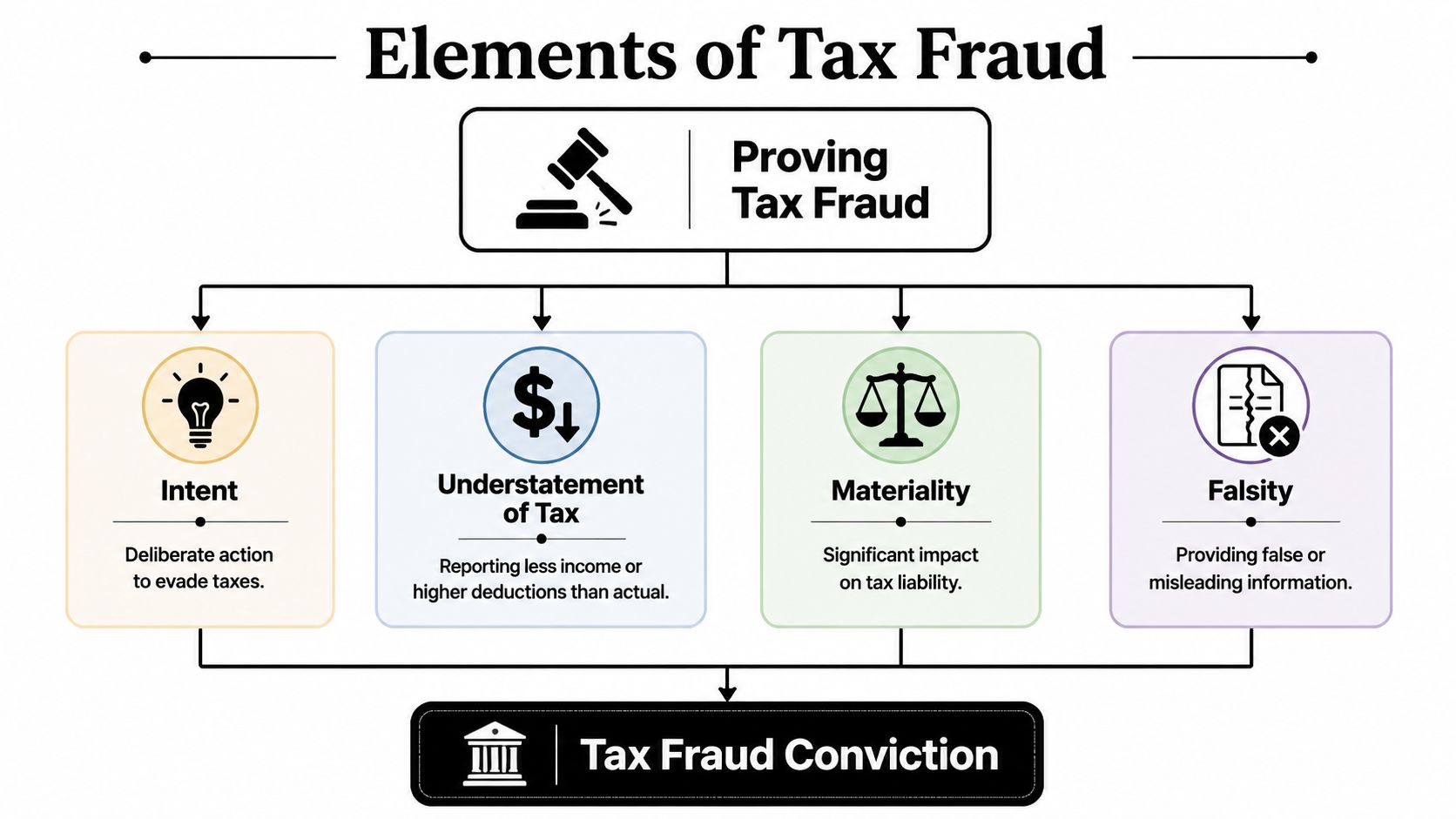
The legal definition is narrower than commonly perceived. If you want a practical way to understand what is considered tax fraud, treat it like a recipe. The government needs all the essential ingredients. Leave one out, and the fraud case gets much weaker.
Tax due and owing
First, there has to be an actual tax problem. Under IRS guidance, tax fraud requires a tax due and owing plus the willful and material submission of false statements or false documents. An inaccurate return by itself isn't enough if there was no real tax deficiency or no intentional deception (IRS Internal Revenue Manual definition of fraud).
This has practical implications. If a taxpayer makes a mistake that doesn't change the tax owed, that may still create a filing issue, but it doesn't fit the core fraud standard the same way.
“Tax due and owing” is the government's way of saying there must be a real tax loss, not just a technical error.
Willfulness
This is the hardest element for the government and the most important for the defense. Willfulness means the person knew the tax duty and intentionally violated it. That's very different from misunderstanding a rule, relying on flawed records, or making a poor judgment call.
For small business owners, this distinction shows up in ordinary scenarios. If you hand your CPA incomplete records because your bookkeeping was behind, that's a problem. If you create fake expenses to reduce profit, that's a different problem entirely.
Materiality and falsity
The false statement also has to matter. In other words, the lie must be significant enough to affect the tax outcome or the IRS's review of the return. A minor mistake in a nonessential detail isn't the same as inventing deductions, omitting income, or submitting false documents.
A helpful parallel is professional responsibility. If you advise clients, sign returns, or work with tax matters professionally, understanding Circular 230 compliance helps explain why accuracy, diligence, and candor matter so much when dealing with the IRS.
The practical takeaway
Fraud isn't a label for “the IRS disagreed with me.” It's a finding built on deliberate conduct, a real tax shortfall, and false information that matters. For worried business owners, that should be reassuring. The bar is high. But if someone crosses it, the consequences change quickly.
The Spectrum from Honest Error to Criminal Evasion
Not every bad return lives in the same category. In practice, tax noncompliance falls along a spectrum. At one end, you have mistakes. In the middle, you have civil fraud allegations. At the far end, you have criminal tax evasion.
The reason this matters is simple. Two taxpayers can have the same adjustment on paper and face very different outcomes depending on intent.
Intent is the dividing line
Tax authorities focus heavily on whether the conduct looks accidental, reckless, or deliberate. Indicators of intent can include underreporting income, falsifying documents, using a false Social Security number, or consistently overstating deductions over multiple years (discussion of intent indicators in tax fraud).
That doesn't mean any one fact automatically proves fraud. It means repeated conduct, false paperwork, and concealment change the legal analysis.
Negligence vs. Civil Fraud vs. Criminal Evasion
| Factor | Negligence (Error) | Civil Tax Fraud | Criminal Tax Evasion |
|---|---|---|---|
| Core conduct | Careless reporting, weak records, misunderstanding rules | Willful underpayment or false reporting in a civil tax case | Willful attempt to evade tax with criminal exposure |
| Intent | No deliberate deception proven | Deliberate deception alleged and supported by evidence | Deliberate violation treated as a crime |
| Typical examples | Misclassified expenses, missing paperwork, one-year reporting error | Repeated false deductions, concealed income, false documents | Structured concealment, fabricated records, intentional schemes |
| Government focus | Correct the return and assess tax | Prove fraud for civil penalties | Prove guilt for prosecution |
| Potential outcome | Additional tax, interest, and non-fraud penalties | Additional tax, interest, and civil fraud penalties | Charges, restitution, fines, and possible prison |
How this plays out in actual businesses
A contractor who loses receipts and estimates too aggressively may face an adjustment. A restaurant owner who skims cash and keeps a second set of books looks very different. An online seller who accidentally omits one platform's year-end statement isn't in the same position as someone who routes receipts through personal accounts to keep them off the return.
The same tax issue can look like an error or like fraud depending on what the records, emails, invoices, and reporting pattern show.
For self-employed taxpayers, this is where context matters. Mixed-use expenses, late bookkeeping, and app-based income can create confusion. Confusion can be defended. Fabrication is much harder to explain away.
What doesn't help
These explanations usually make things worse when the evidence is bad:
- “My preparer did it.” That won't carry much weight if you knew the numbers were false.
- “Everybody writes that off.” Common gossip isn't a legal defense.
- “I was going to fix it later.” If you filed a false return, later intentions may not solve the original problem.
The better approach is to evaluate where your facts fall on the spectrum before talking loosely to the IRS.
Real-World Examples of Tax Fraud Red Flags
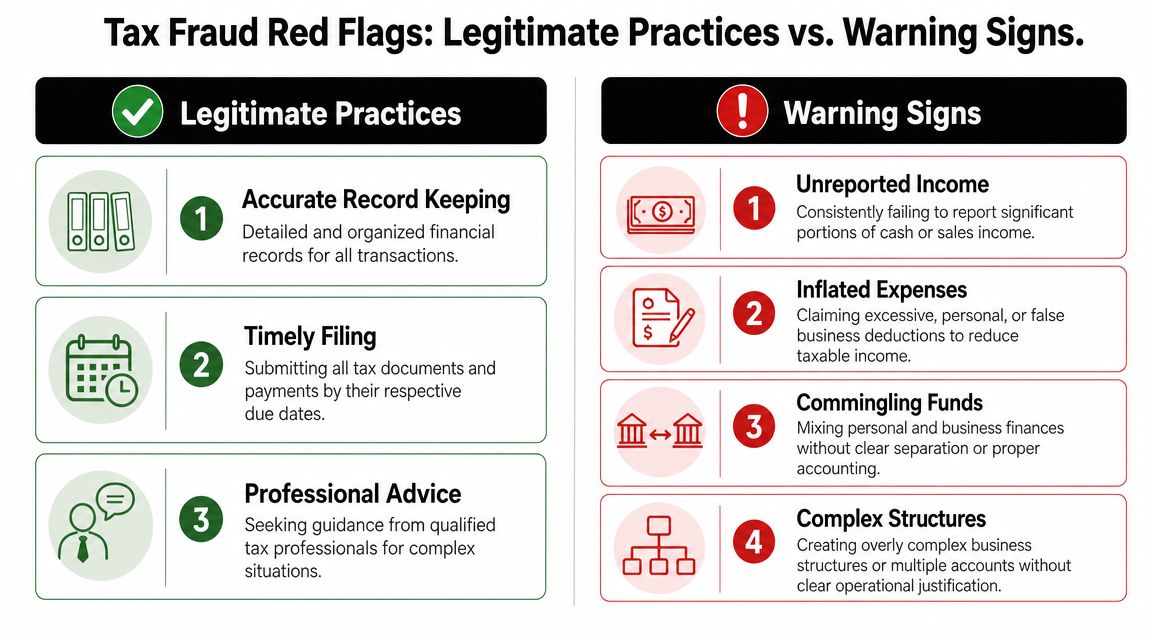
Small business tax fraud usually doesn't look dramatic. It often starts with ordinary transactions and bad decisions. The red flag isn't the category itself. It's the knowing misrepresentation of material facts to reduce tax liability.
Tax fraud can include fabricated deductions, falsified returns, identity misuse, or concealed income (overview of tax fraud methods).
Unreported cash and app income
A landscaper deposits some customer payments into the business account and keeps others in a personal account. At year end, the return reports only the income reflected in the bookkeeping software. If that happened because the owner didn't track all deposits and later corrects it, that may be an error. If the owner intentionally kept certain jobs off the books to lower taxable income, that's a classic fraud pattern.
Personal expenses dressed up as business deductions
A consultant takes a family trip, attends one client lunch, and deducts the whole trip as business travel. Or a business owner puts personal vehicle costs, groceries, and streaming services through the company card and calls them operating expenses. Sloppy classification is one thing. Re-labeling plainly personal spending as business spending after the fact is another.
Fake invoices and invented vendors
This one appears more often than people think. A business owner wants to reduce profit on paper, so the books show “consulting” or “marketing” payments that never happened. The invoices are self-created, unsupported, or tied to friends and relatives who didn't perform the work.
That's not aggressive tax planning. That's manufactured evidence.
Payroll games
A common pressure point for small businesses is labor. An owner pays workers in cash, avoids payroll setup, and calls everyone an independent contractor regardless of the actual relationship. Misclassification can be a real legal gray area. Paying wages off the books to avoid withholding and employment taxes is not gray.
If the reporting position only works because the records are false, altered, or incomplete by design, fraud becomes a live issue.
Complex structures with no real business reason
Multiple LLCs, nominee accounts, and family-member accounts aren't automatically improper. Some businesses have legitimate reasons for layered entities. But when accounts and entities exist mainly to hide income streams, obscure ownership, or move money away from reporting, investigators notice.
If you're trying to understand whether your own recordkeeping habits could attract scrutiny, this guide on what triggers a tax audit helps identify the kinds of reporting patterns that tend to draw attention.
Understanding the Severe Consequences of Tax Fraud
Once the government moves from “this return is wrong” to “this return was fraudulent,” the stakes change fast. The consequences are both financial and personal. Some are civil. Some are criminal. Often, both problems exist at the same time.
Criminal exposure is not theoretical
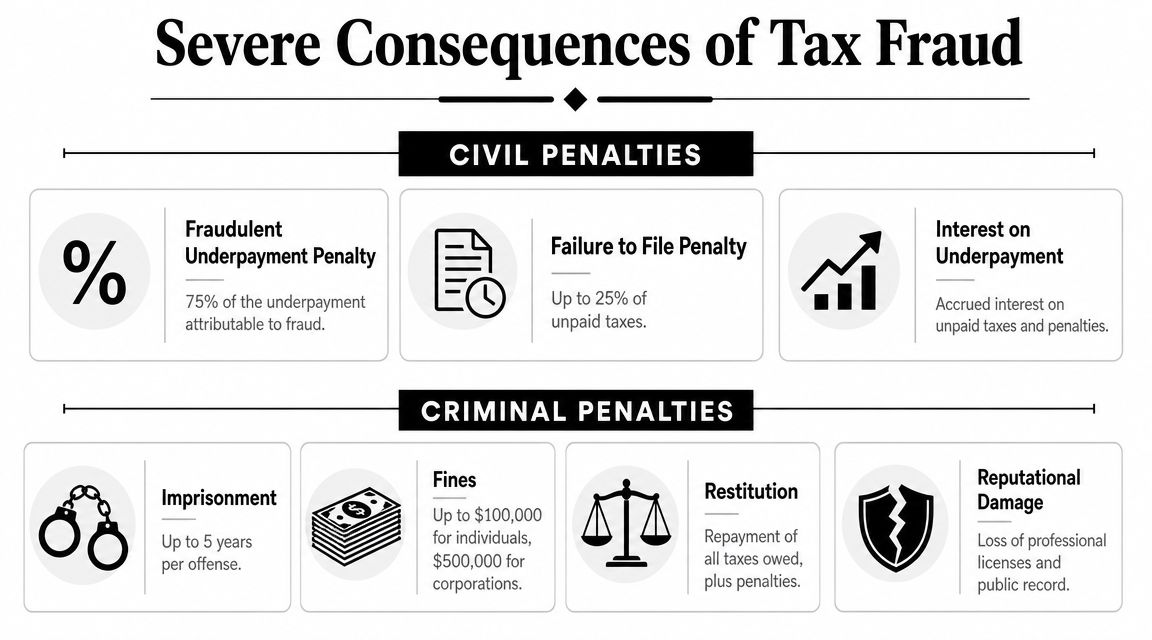
Criminal tax fraud convictions can lead to prison, and incarceration is common once a case reaches conviction. One summary citing U.S. Sentencing Commission data states that 68.7% of tax fraud offenders received prison sentences and the average sentence was 16 months (summary discussing sentencing outcomes).
That lines up with broader federal sentencing data. In fiscal year 2021, the U.S. Sentencing Commission reported 370 tax fraud cases out of 57,287 total cases, with an average sentence of 14 months and 63.3% of offenders sentenced to prison. More recent Commission data show 360 tax fraud cases out of 61,678 total cases in fiscal year 2024, which shows tax fraud remains a small but persistent part of the federal criminal docket (U.S. Sentencing Commission quick facts on tax fraud).
Civil consequences can be crushing even without prosecution
A civil fraud case can still be financially punishing. The tax has to be paid. Interest keeps running. Civil fraud penalties can be steep. State tax agencies may add their own layers of exposure.
For many business owners, the biggest shock isn't one number on one notice. It's the combined effect of:
- Tax due: the underlying amount the government says should have been paid
- Interest: added over time while the liability remains unresolved
- Fraud-related penalties: civil additions that can dramatically increase the balance
- Collateral fallout: financing problems, licensing concerns, contract issues, and stress inside the business
Practical business consequences
Fraud allegations can also disrupt the company itself.
- Lenders may hesitate: unresolved tax issues can interfere with loans, refinancing, and closings.
- Partners may lose trust: tax problems often become governance problems.
- Records come under a microscope: once fraud is alleged, ordinary explanations get tested much harder.
If you want a fuller look at the range of civil and criminal exposure, this article on penalties for tax fraud is a useful companion.
How Tax Fraud Allegations Can Be Defended
An accusation isn't a conviction. That's the starting point.
In many tax fraud matters, the defense centers on one issue: willfulness. If the government can't prove intentional deception, the case may shift from fraud to negligence, from criminal exposure to civil resolution, or from a contested allegation to a correctable compliance problem.

Good-faith misunderstanding
Tax law is full of technical rules that business owners misunderstand all the time. Basis, shareholder distributions, accountable plans, contractor classification, home office treatment, and mixed-use expenses can all create genuine confusion.
A good-faith misunderstanding doesn't erase tax due. It can matter a lot, though, if it shows you weren't trying to deceive anyone.
Reliance on a qualified professional
This is a real defense in the right facts, but it has limits. If you gave a CPA or EA complete and accurate information, asked for advice, and followed that advice, that can help show lack of fraudulent intent. If you hid income and then blamed the preparer, it usually won't.
The details matter. What documents did you provide? What questions did you ask? Did the preparer warn you about the position? Did you ignore that warning?
Correcting the issue before the IRS forces the issue
Timing matters in tax controversy work. Filing amended returns, reconstructing records, and addressing noncompliance early can improve your options. If serious exposure exists and the government hasn't started investigating, voluntary correction may be available depending on the facts and timing.
The best defense often starts before the case looks like a fraud case.
For taxpayers who need an attorney-led review of tax debt, filing history, audit exposure, and resolution options, Attorney Stephen A Weisberg offers a tax debt analysis designed to identify the problem and map out possible next steps.
Evidence that helps
If you're trying to show error instead of fraud, substance matters more than explanations. Helpful evidence can include:
- Contemporaneous records: bank statements, receipts, mileage logs, payroll files, emails, and invoices
- Correction history: amended returns, bookkeeping cleanup, and prompt responses once an issue was found
- Professional communications: messages showing you sought advice rather than tried to hide the issue
The worst move is often the first panicked one. Don't alter records. Don't create backup after the fact and pretend it existed before. Don't call the IRS casually and start guessing through facts that could later be used against you.
Recognizing When to Stop and Call a Tax Attorney
Some tax problems are fixable with bookkeeping cleanup and a competent preparer. Some are not. The hard part is knowing when you've crossed that line.
If there's any real chance the IRS could view the facts as intentional, you should stop trying to “just explain it” on your own.
Red-line events
These situations call for legal advice quickly:
- You receive contact suggesting criminal interest: if a notice, call, or visit points toward investigation rather than ordinary return processing, don't handle it casually.
- You discover major unreported income over multiple years: that raises a very different risk profile than a one-year adjustment.
- Your preparer refuses to sign or says you need counsel: listen to that.
- You're thinking about amending returns after years of false or incomplete reporting: strategy matters before you file anything.
- You used cash payroll, nominee accounts, false deductions, or fabricated documents: those facts need legal review, not improvised explanations.
Why an attorney matters early
A tax attorney's role isn't just to argue later. It's to protect your position now. Early counsel helps frame communications, preserve defenses, evaluate disclosure options, and keep a civil issue from getting worse through bad handling.
That's especially important if your accountant may be a witness, if more than one year is involved, or if your records are incomplete. An attorney can assess whether the issue is really about fraud, or whether it's a messy compliance problem that needs to be corrected carefully.
If you're outside the United States
The same practical principle applies in other tax systems. If a dispute starts to look deliberate rather than accidental, specialized representation matters. For readers dealing with Australian tax authorities, Nanak Accountants for ATO disputes is an example of the kind of focused dispute-resolution resource worth reviewing.
A simple rule for business owners
If the facts would sound bad when summarized in three sentences, don't self-diagnose. Get advice.
If you're not sure how to choose counsel, this guide on how to find a good tax attorney will help you evaluate experience, communication style, and whether the lawyer handles IRS controversy work.
If you're worried that bookkeeping problems, unreported income, payroll issues, or amended returns could raise fraud concerns, Attorney Stephen A Weisberg offers a free Tax Debt Analysis to determine whether he can help and how. It's a practical first step for individuals and business owners who need a clear assessment before deciding what to do next.


