Understand what is a trust fund recovery penalty and how it affects you
Discover what is a trust fund recovery penalty, who can be held liable for payroll taxes, how the IRS enforces it, and how to defend yourself.
In this article
- The Most Dangerous Tax Penalty You've Never Heard Of
- Think of it as a Locked Box
- Key Aspects of the Trust Fund Recovery Penalty at a Glance
- The Two Pillars of TFRP Liability
- Identifying the 'Responsible Person' in Your Business
- The Ultimate Test of Responsibility
- Who Is at Risk?
- Seeing It in the Real World
- What Does the IRS Mean By ‘Willful’? It’s Not What You Think.
- The Low Bar for Proving Willfulness
- The Trap of "Reckless Disregard"
- Willfulness in Action: A Real-World Example
- How the IRS Investigation and Assessment Process Unfolds
- The Revenue Officer Investigation
- The High-Stakes Form 4180 Interview
- The Proposed Assessment: Letter 1153
- Aggressive IRS Collection Actions
- Actionable Strategies to Defend Against the TFRP
- Arguing You Were Not a Responsible Person
- Proving You Did Not Act Willfully
- Using Procedural Defenses
- The Formal Appeals Process
- Common Questions About the Trust Fund Recovery Penalty
- Can a Trust Fund Recovery Penalty Be Wiped Out in Bankruptcy?
- Can the IRS Come After More Than One Person?
- What if I Can't Afford to Pay the TFRP?
- I Quit My Job. Does That Protect Me from a Past TFRP?
The Trust Fund Recovery Penalty, or TFRP, is one of the most aggressive tools in the IRS's collection arsenal. It's a civil penalty that holds you personally responsible for a business's unpaid payroll taxes.
Essentially, the IRS can bypass the corporate shield of an LLC or corporation and come directly after your personal assets—your home, bank accounts, and wages—to collect the "trust fund" portion of the business's tax debt. This is a 100% penalty, meaning the amount assessed against you personally will equal the exact amount of employee withholdings the business failed to turn over.
The Most Dangerous Tax Penalty You've Never Heard Of
Most entrepreneurs believe that incorporating their business creates a solid wall between their company's finances and their personal life. For most debts, like a supplier invoice or a business loan, that's absolutely true. But when it comes to payroll taxes, that wall crumbles.

This is precisely why understanding the Trust Fund Recovery Penalty is so critical for anyone with financial authority in a business.
Think of it as a Locked Box
Here’s a simple way to look at it. When you run payroll, you withhold federal income tax, Social Security, and Medicare from your employees' checks. That money isn't yours. It never was.
Imagine you're placing those funds into a locked box labeled "U.S. Treasury." Your only job is to act as a custodian and hand that box over to the government when it's due.
The TFRP is triggered when the business pries open that locked box and uses the money inside to pay other bills—rent, vendors, or even the net payroll for employees. Since those funds were held "in trust" for the government, the IRS considers this a profound violation.
The TFRP essentially pierces the corporate veil, allowing the IRS to hold individuals personally responsible for the business's failure to remit these sacred funds. It’s not a fine on the business; it's a direct transfer of the business's tax liability to an individual’s personal finances.
To help you quickly grasp the core concepts, here’s a breakdown of the penalty's key components.
Key Aspects of the Trust Fund Recovery Penalty at a Glance
| Component | Description |
|---|---|
| Penalty Type | Civil Penalty (not a criminal charge). |
| Penalty Amount | 100% of the unremitted "trust fund" taxes (employee income tax, Social Security, and Medicare withholdings). |
| Who is Liable? | "Responsible Persons" who acted "Willfully" in failing to pay the taxes. |
| Legal Basis | Internal Revenue Code (IRC) § 6672. |
| Corporate Protection | LLCs and Corporations offer zero protection against the TFRP. |
| Collection Reach | The IRS can seize personal assets, including bank accounts, real estate, and wages. |
This table shows just how serious the penalty is and why the IRS pursues it so aggressively.
The Two Pillars of TFRP Liability
Before the IRS can assess this penalty against you, they have to establish two fundamental elements. We'll dive deep into these concepts throughout this guide, but here's the quick version:
- You were a "Responsible Person": This isn't just about job titles. The IRS is looking for anyone who had the power, duty, and authority within the business to direct the payment of bills. They cast a very wide net that can catch officers, bookkeepers, and even certain employees.
- You acted "Willfully": This doesn't require evil intent. In the eyes of the IRS, "willfully" simply means you knew—or should have known—that the payroll taxes were due and you consciously chose to pay other creditors (including employees' net pay) instead of the government.
Payroll taxes are not just another line item on a budget; they are sacred funds held in trust for the government. The TFRP is a personal liability bombshell that has financially devastated countless business owners since it was codified in 1954 under IRC § 6672.
This penalty can haunt you for years, long after a business has closed its doors. You can learn more by navigating payroll tax debt in our comprehensive guide for business owners.
Identifying the 'Responsible Person' in Your Business
When the IRS comes knocking about unpaid trust fund taxes, their first order of business is to figure out who was the “responsible person.” This is a critical question, and the answer often surprises business owners, officers, and even certain employees.
The title "responsible person" isn't reserved for the CEO or the majority owner. It’s not about your job title at all, really.

Instead, the IRS casts a much wider net. They're looking for anyone who had meaningful control over the company’s finances—specifically, the power to decide which bills got paid and which didn’t.
The Ultimate Test of Responsibility
At its core, the IRS investigation comes down to a single, practical question: who had the authority to direct payments to creditors? It's a classic case of substance over form. What you did matters infinitely more than what your business card said.
This means the TFRP isn't a penalty that lands on just one person's shoulders. The IRS often finds multiple responsible persons inside a single business. And here's the kicker: each one can be held personally on the hook for 100% of the unpaid trust fund taxes. The IRS can only collect the total amount once, but they can pursue it from every single responsible individual.
A "responsible person" is anyone with the effective power to pay the taxes. This means having significant control over the company's money, even if it wasn't exclusive control. Being told by a superior not to pay the IRS doesn't get you off the hook if you had the authority to make the payment.
Who Is at Risk?
So, how does the IRS pinpoint who had this authority? They look for specific indicators and day-to-day functions. If you performed any of the following tasks, you could find yourself in their crosshairs. You can learn more about how liability for payroll taxes is not limited to the business for a deeper look at these scenarios.
Common roles and actions that attract IRS scrutiny include:
- Corporate Officers and Directors: This is the most obvious group. Presidents, CEOs, CFOs, and board members with financial oversight are prime candidates.
- Check Signers: If your name is on the signature card for the business bank accounts, that’s a major red flag for the IRS—even if you only signed checks when someone else told you to.
- Payroll Managers: The person who actually prepares, approves, or signs the payroll checks is often seen as having the necessary authority.
- Bookkeepers and Controllers: If your job involved managing accounts payable and deciding which vendors got paid, you could be deemed a responsible person.
- Business Partners and Majority Shareholders: Anyone with significant influence over the company's financial and strategic decisions is almost always considered responsible.
Seeing It in the Real World
Let's ground this in reality, because the IRS isn't looking at your employment contract; they're looking at your actions.
Scenario 1: The Office Manager An office manager, let's call her Sarah, has check-signing authority up to $5,000. When cash gets tight, the owner tells her, "Pay our biggest supplier and the rent, but let the IRS deposit slide for now." Even though Sarah was just following orders, the fact that she had the ability to sign the check that could have paid the IRS makes her a potential responsible person.
Scenario 2: The Silent Partner David is a partner who isn't involved in the daily grind, but he holds the power to hire and fire the managers running the show. He finds out about the unpaid taxes but doesn't use his authority to step in and fix it. The IRS could easily argue he had the ultimate control to ensure the taxes were paid, making him responsible.
These examples drive home the point: authority, not your title, is the only thing that matters. If you had the power to make sure that "locked box" of trust fund money made it to the government, the IRS can hold you personally accountable when it doesn't.
What Does the IRS Mean By ‘Willful’? It’s Not What You Think.
After the IRS decides you’re a "responsible person," they turn to the second key piece of their case: proving you acted “willfully.” This is a huge stumbling block for most people. The word “willful” sounds like it requires some kind of evil intent or a criminal plot to rip off the government.
That's a dangerous assumption. When it comes to payroll taxes, the IRS’s definition of willful is incredibly broad and surprisingly easy for them to prove.
The Low Bar for Proving Willfulness
In the world of the TFRP, “willful” simply means you made a conscious, voluntary choice to pay other bills before paying the U.S. Treasury. It wasn't an accident. If you knew the payroll taxes were outstanding and you still used company money to pay for anything else—literally, anything else—you've likely met the IRS's standard for willfulness.
This includes paying what feel like absolutely essential business expenses:
- Net Payroll: The classic example is paying your employees their take-home wages while not sending their withheld taxes to the IRS.
- Rent or Mortgage: Keeping the doors open by paying the landlord instead of Uncle Sam.
- Critical Suppliers: Paying a key vendor to keep raw materials coming in.
- Utilities: Keeping the lights and phones on.
The way the IRS sees it, the second you found out those trust fund taxes were unpaid, every penny in the company’s bank account essentially had a lien on it from the Treasury. Choosing to spend that money on another creditor is the textbook definition of a willful failure to pay.
The Trap of "Reckless Disregard"
But what if you didn't actually know the taxes weren't being paid? This is where the IRS pulls out another powerful tool: the concept of reckless disregard. It’s a wide net that catches many business owners and managers completely off guard.
You can be found willful even without direct knowledge of the unpaid taxes. If you were in a position where you should have known something was wrong and you didn't bother to look into it, the IRS can hold you personally liable.
Willfulness is established if a responsible person recklessly disregards an "obvious and known risk" that trust fund taxes might not be remitted. Turning a blind eye isn't a defense—it's practically an admission of guilt.
Think about it: if the company is clearly in hot water, bouncing checks, or struggling to meet payroll, a responsible person has a duty to ask, "Are the payroll taxes being paid?" Ignoring those giant red flags and just hoping things work out is considered reckless disregard. Legally, it's the same as knowing all along.
Willfulness in Action: A Real-World Example
The courts are full of stories that show how harsh this standard can be. Take a 2022 case from the 11th Circuit, where a business owner's daughter was personally hit with a $680,472 TFRP assessment.
Her defense was that she wasn't really in charge—she didn't own any stock and couldn't hire or fire anyone. But the court didn't care. It zeroed in on two facts: she had check-signing authority, and she knew the business was struggling financially. By continuing to sign checks to vendors while being aware of the company's financial distress, she showed a reckless disregard for whether the taxes were being handled. That was all it took to prove willfulness. You can discover more insights about how courts define willfulness and see how seemingly small actions can have massive consequences.
This case drives home the central point. Willfulness isn't about being a bad person. It's about a choice—the choice to pay someone else with money that, legally, already belonged to the government.
How the IRS Investigation and Assessment Process Unfolds
The Trust Fund Recovery Penalty doesn't just materialize out of nowhere. It's the painful final act of a methodical IRS investigation, a process designed with one goal in mind: to find the person they can hold liable for a business's unpaid payroll taxes. Knowing their playbook is your first line of defense.
The whole thing usually kicks off when a business starts missing its Federal Tax Deposits (FTDs). Each missed payment is like a flare shooting up, signaling a problem to the IRS. In fact, IRS data shows that around 70% of TFRP cases spring from businesses that have a track record of FTD violations. It's a clear sign that a deeper investigation is needed.
The Revenue Officer Investigation
Once your business is on the IRS's radar, your case lands on the desk of a Revenue Officer. Let's be clear: this isn't a friendly audit. It's a serious investigation aimed at collecting the trust fund taxes—either from the business or, if that's a dead end, from the individuals they deem responsible.
The Revenue Officer’s job is to become a financial archaeologist. They dig into your company's past, piecing together what happened during the periods the taxes went unpaid. They'll gather a mountain of evidence, including:
- Bank statements and copies of cleared checks
- Corporate bylaws and official meeting notes
- Payroll ledgers and tax returns
All this paperwork helps them map out who had their hands on the financial controls. This deep dive all leads to the most critical part of the investigation: the Form 4180 interview.
The High-Stakes Form 4180 Interview
The Form 4180, "Report of Interview with Individual Relative to Trust Fund Recovery Penalty," is not a casual conversation. It's a formal, recorded interview where the Revenue Officer will question anyone they suspect might be a responsible person. Every answer you give is a piece of evidence they can use to build a case against you. The questions are razor-sharp, designed to pin down both responsibility and willfulness.
They’ll ask about your specific job duties, who had check-signing authority, who could hire and fire employees, and what you knew about the unpaid taxes. Walking into this interview without understanding the legal minefield you're crossing is a huge mistake. This is the moment where many people unintentionally hand the IRS the exact admissions needed to slap them with the penalty. You can read more about what an IRS Revenue Officer does in our guide on the topic.
The Proposed Assessment: Letter 1153
If the Revenue Officer decides you fit the bill—that you were a responsible person who acted willfully—the next thing you'll see is Letter 1153. This is the "Proposed Assessment of Trust Fund Recovery Penalty," and it's the IRS officially telling you they plan to make the business's tax debt your personal problem.
This letter is your final warning shot before the penalty becomes a legally enforceable debt against you. It lays out the exact penalty amount, the tax periods in question, and—most importantly—your right to appeal. Ignoring this letter is the worst thing you can possibly do.
You have a strict 60-day deadline (75 days if the letter is mailed outside the U.S.) from the date on the letter to file a formal, written protest. If you miss that window, you lose your right to an appeals conference, and the penalty is assessed against you automatically.
This flowchart shows just how easily the IRS connects the dots to determine a willful action.
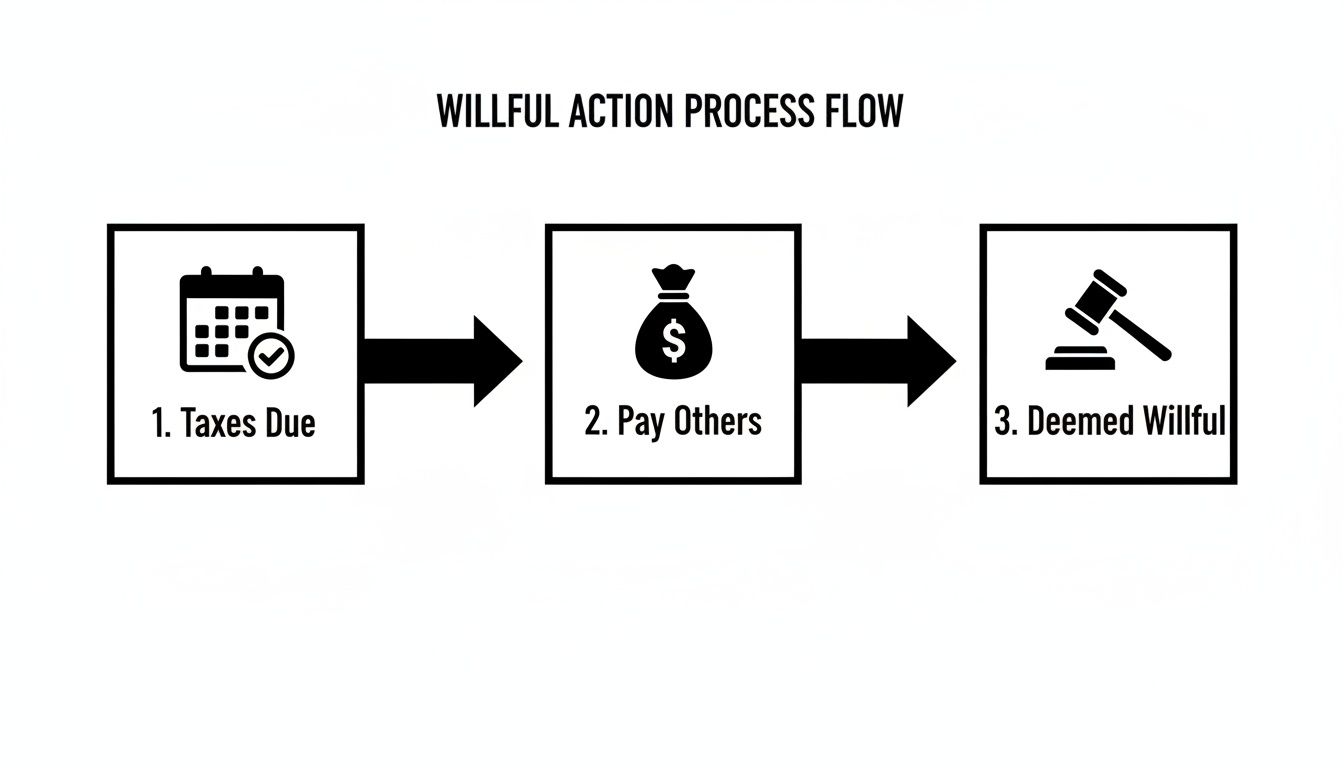
As you can see, the path from knowing taxes are due to paying other bills instead is a straight line to being found "willful."
Aggressive IRS Collection Actions
Once the penalty is officially on the books—either because you didn't appeal in time or you lost your appeal—it’s no longer the business's debt. It's your personal tax liability. From that moment on, the IRS can use its full arsenal of collection weapons against your personal assets. These tactics are aggressive and designed to get your attention fast.
Common IRS collection actions include:
- Filing a Notice of Federal Tax Lien: This public lien attaches to all your personal property, including your house. It crushes your credit score and makes it nearly impossible to sell or refinance assets.
- Issuing a Bank Levy: Without needing a court order, the IRS can seize money directly from your personal checking and savings accounts, often wiping them out overnight.
- Garnishing Your Wages: The IRS can force your employer to send a large chunk of every paycheck straight to them, week after week, until the debt is paid off.
This is the devastating endgame of a TFRP case, and it’s precisely why you have to fight it at the earliest possible stage.
Actionable Strategies to Defend Against the TFRP
Getting a proposed Trust Fund Recovery Penalty assessment (Letter 1153) in the mail can feel like a knockout punch. But it’s crucial to remember this isn't the end of the fight. The IRS has the burden of proving two things: that you were a responsible person and that you acted willfully. This is your opening. Your entire defense is built on challenging one or both of those claims.
A successful defense isn't about hoping for the best; it's about methodically dismantling the IRS's case with facts, documents, and a firm grasp of the law. You’re either proving you weren’t a responsible person, or you didn't act willfully. Let's break down how to do that.
Arguing You Were Not a Responsible Person
The IRS often casts a wide net, assuming anyone with a title like "President" or "CFO," or anyone with check-signing authority, is automatically a responsible person. Your job is to show that your title didn't match your true authority. The key is proving your power to direct payments was severely limited or controlled by someone else.
Evidence is everything here. You need to gather documentation that paints a clear picture of the company's real power structure.
- Corporate Bylaws and Resolutions: Do these official documents specifically name someone else—like the CEO or a majority owner—as having the final say on all financial matters?
- Board Meeting Minutes: Can you find records of meetings where you were overruled on financial decisions? Or better yet, minutes where another person was given sole discretion over which creditors got paid?
- Emails and Memos: This is often where you find the gold. An email from a superior explicitly telling you not to pay the IRS is a game-changer.
- Organizational Charts: A simple chart that shows you reported to a CFO or owner who controlled the purse strings can visually establish you weren't the one calling the shots.
The heart of this defense is simple: you can't be held "responsible" if someone else's control actively prevented you from paying the IRS. If a dominant owner held the checkbook and made all the decisions, you can effectively argue that you lacked the real power to act.
Proving You Did Not Act Willfully
If it's clear you were a responsible person, your defense pivots to the "willfulness" standard. This can be a tougher argument to win, but it’s far from impossible. Here, you must show that you didn't knowingly, intentionally, or recklessly disregard your duty to pay the trust fund taxes.
This defense often boils down to timing and knowledge. When did you actually learn about the unpaid taxes? If you can prove you were truly in the dark, you have a strong argument that your failure to pay wasn't willful.
For instance, if a bookkeeper or controller was actively hiding the tax delinquency from you, you have a solid case. But here’s the catch: once you become aware of the problem, every action you take is under a microscope. The IRS often defeats this defense by arguing "reckless disregard." Claiming ignorance when the company was bouncing checks left and right or struggling to make payroll is a losing strategy. The IRS will say you should have known something was seriously wrong.
Using Procedural Defenses
Sometimes, the best defense has nothing to do with who was responsible or willful. It’s about the IRS making a mistake. The agency must follow its own strict rules and timelines when assessing the TFRP. If they mess up, the entire penalty could be thrown out.
One of the most important rules is the statute of limitations. The IRS generally has a three-year deadline to assess the TFRP, which starts from the date the payroll tax return (Form 941) was filed. If they miss that window, they may be legally barred from coming after you. These defenses are highly technical, but a sharp tax professional can spot them. To learn more about challenging IRS oversteps, check out our guide on how to fight the IRS.
The Formal Appeals Process
When you receive Letter 1153, the clock starts ticking. You have a strict 60-day window to file a formal, written protest and request a hearing with the IRS Independent Office of Appeals. This is a critical deadline you cannot miss.
This isn't just a simple letter. Your protest needs to be a detailed, persuasive legal document that lays out your entire defense, complete with all your supporting evidence. A weak, half-hearted protest will be dead on arrival. A strong one, however, will systematically present your arguments and documentation, showing the Appeals Officer precisely why the Revenue Officer's initial proposal was wrong. This is your best and most cost-effective shot at resolving the TFRP issue without having to go to court.
Common Questions About the Trust Fund Recovery Penalty
When you’re staring down a Trust Fund Recovery Penalty assessment, it’s natural to have a lot of urgent, specific questions. Let's tackle some of the most common ones we hear from people in this tough situation.
Can a Trust Fund Recovery Penalty Be Wiped Out in Bankruptcy?
Unfortunately, the answer is almost always no. The government classifies the TFRP as a priority tax debt, which is a special category that makes it non-dischargeable in both Chapter 7 and Chapter 13 bankruptcy.
This is a critical point to understand—unlike many other business debts that can be left behind, this personal liability will follow you.
Can the IRS Come After More Than One Person?
Absolutely, and they often do. The IRS has the authority to identify every single person they believe was a "responsible person" who acted willfully and assess the full 100% penalty against each of them.
While the IRS can pursue multiple individuals for the entire amount, they are only legally entitled to collect the total tax debt once. This often creates complex situations where multiple parties must negotiate a payment strategy.
What if I Can't Afford to Pay the TFRP?
If the penalty has been assessed and you simply don’t have the funds to pay it off, don't panic. You still have options. Based on your personal financial circumstances, you might be able to qualify for a resolution with the IRS, such as:
- Installment Agreement: This sets you up with a structured plan to make manageable monthly payments over time.
- Offer in Compromise (OIC): This could allow you to settle the debt for less than the full amount owed, but you have to meet very strict financial criteria.
Getting one of these agreements in place requires a deep dive into your finances and is a process best handled with professional guidance.
I Quit My Job. Does That Protect Me from a Past TFRP?
Resigning from your position won’t get you off the hook for past actions. The TFRP is directly tied to the specific tax periods when the payroll taxes weren't paid.
If you were a responsible person who acted willfully during that time, quitting your job later on offers no defense. The liability for those past failures remains.
Facing a TFRP investigation can be incredibly stressful, but you don't have to figure it out alone. Attorney Stephen A Weisberg starts with a FREE Tax Debt Analysis to see if and how we can help before you ever commit to anything. Contact us today to understand your options and protect your assets.


