What Is a Tax Attorney and When Do You Need One?
What is a tax attorney? Our guide explains their role in handling complex IRS issues, audits, and tax litigation, helping you decide when to hire one.

In this article
- Defining the Role of a Tax Attorney
- Tax Attorney at a Glance
- Core Credentials and Legal Authority
- What Does a Tax Attorney Actually Do?
- Fighting Back: Dispute Resolution and Litigation
- Smart Planning and Getting Out of Debt
- Choosing Your Tax Professional Wisely
- Comparing Tax Professionals Tax Attorney vs CPA vs Enrolled Agent
- Key Differences and Specializations
- When to Choose Each Professional
- Red Flags That Mean You Need a Tax Attorney
- When Legal Counsel Is Non-Negotiable
- How to Hire and Work with a Tax Attorney
- Understanding the Engagement Process
- Your Questions About Tax Attorneys, Answered
- What Does a Tax Attorney Usually Cost?
- Will Hiring a Tax Attorney Make Me Look Guilty to the IRS?
- Can I Just Have a Tax Attorney Do My Regular Taxes?
When you hear the term "tax attorney," what comes to mind? For many, it's a hazy image of someone you call when things have gone seriously wrong with the IRS. While that's part of the picture, their role is much broader and more strategic.
A tax attorney is a lawyer who specializes in the incredibly complex and ever-changing world of tax law. They are your legal advocate in any matter involving federal, state, or local tax authorities, offering legal protections that other financial professionals simply can't. Think of them as a highly specialized legal expert for your most critical financial challenges, not the person who just prepares your annual 1040.
Defining the Role of a Tax Attorney

Let's use an analogy. Imagine your finances are a complex highway system. A CPA is like your trusted mechanic, handling the regular oil changes and tune-ups (tax preparation and accounting) to keep your car running smoothly. A tax attorney, on the other hand, is the specialist you call for a major collision or when you need to navigate a legally hazardous off-road path. Their expertise isn't just about crunching numbers; it's about deploying legal strategy to defend your rights and protect your assets.
This kind of specialization is more critical now than ever before. As tax codes get more tangled, the demand for true legal expertise has skyrocketed. A wide-ranging survey of over 1,100 finance and tax executives revealed that nearly 90% of multinational corporations now lean on tax attorneys for high-stakes compliance and dispute resolution. You can read more about these global tax policy trends from Deloitte to see just how complex the landscape has become.
For a quick overview, this table breaks down the essentials of a tax attorney's role.
Tax Attorney at a Glance
| Attribute | Description |
|---|---|
| Primary Credential | Juris Doctor (J.D.) degree and a state bar license to practice law. |
| Core Function | Legal representation, tax dispute resolution, and strategic tax planning. |
| Key Advantage | Attorney-client privilege, protecting client communications from disclosure. |
| When to Hire | IRS audits, tax court litigation, criminal tax investigations, significant tax debt. |
This snapshot helps clarify why they are the go-to experts for serious tax issues.
Core Credentials and Legal Authority
What truly sets a tax attorney apart from other tax professionals are two non-negotiable qualifications:
- Juris Doctor (J.D.) Degree: This means they've graduated from law school, where they were rigorously trained in legal reasoning, ethics, and courtroom representation.
- State Bar Admission: They are licensed and regulated by a state bar association, giving them the legal authority to represent you in court—including the U.S. Tax Court.
This legal background grants them a powerful tool: attorney-client privilege. This is a legal fortress that shields the conversations between you and your attorney from being disclosed to the IRS or used against you in court. It creates a safe harbor where you can be completely transparent about your situation, knowing your words are protected.
This privilege is something other tax professionals can't fully offer, and it’s absolutely essential for business owners navigating thorny tax issues. You can explore in our guide to small business tax lawyers just how vital this protection can be.
What Does a Tax Attorney Actually Do?
A tax attorney does a lot more than just offer legal theories. They roll up their sleeves and provide a range of hands-on services designed to solve complex, and often very stressful, financial problems. Their work generally falls into a few key areas, each tackling a different high-stakes challenge you might encounter.
By far, the most common reason someone calls a tax attorney is for representation during an IRS or state tax audit. Getting that official notice that your finances are being put under a microscope is intimidating. A tax attorney becomes your legal shield, handling every call and letter from the tax agency, building a case to defend your tax positions, and making sure your rights are protected through the entire process.
Fighting Back: Dispute Resolution and Litigation
What happens if an audit doesn't go your way? The fight isn't necessarily over. This is where a tax attorney’s courtroom and negotiation skills really shine.
- IRS Appeals: If you disagree with the auditor’s final report, your attorney can file a formal appeal. They'll present legal arguments to an independent appeals office within the IRS, aiming to get the decision reversed before it ever gets to court.
- Tax Court Litigation: If the appeal doesn't work out, a tax attorney is the only tax professional who is legally authorized to represent you in U.S. Tax Court. They'll argue your case directly in front of a judge.
- Criminal Tax Defense: In the most serious situations, like when the government alleges tax evasion or fraud, a tax attorney provides a critical criminal defense. In these cases, the protection of attorney-client privilege is absolutely essential.
Smart Planning and Getting Out of Debt
Tax attorneys aren't just for when you're in trouble. They also provide forward-looking advice and solutions for tricky financial situations. They can help with strategic tax planning for major business moves (like a merger or acquisition) or big personal life events (like an inheritance). Many also advise on maximizing tax incentives to ensure you’re not leaving money on the table.
For anyone drowning in tax debt, a good attorney can be a lifeline. They are expert negotiators who know how to work with the government to reduce what you owe.
This often means negotiating a formal settlement, like an Offer in Compromise, where the IRS agrees to accept less than the full amount you owe. For people facing a crippling tax bill, learning how to negotiate IRS debt with an experienced professional can clear a path back to financial health.
Choosing Your Tax Professional Wisely
When you're facing a tax issue, figuring out who to call can feel overwhelming. Do you need a tax attorney, a Certified Public Accountant (CPA), or an Enrolled Agent (EA)? Each professional plays a distinct role, and picking the right one is the first step toward a successful resolution.
Let's think of it like this: if your finances were your health, these professionals would be your medical team. An Enrolled Agent is like a paramedic—an expert in frontline tax care, like preparing and filing your returns. A CPA is your general practitioner, overseeing your overall financial health, from accounting to routine tax advice.
A tax attorney, on the other hand, is the specialist—the surgeon. You bring them in for the serious, high-stakes legal situations where your financial future is truly on the line.
To give you a clearer picture, here’s a breakdown of how these professionals stack up against each other.
Comparing Tax Professionals Tax Attorney vs CPA vs Enrolled Agent
| Aspect | Tax Attorney | CPA (Certified Public Accountant) | Enrolled Agent (EA) |
|---|---|---|---|
| Primary Qualification | Juris Doctor (J.D.) degree and a state bar license. | State-issued license requiring education, experience, and passing the CPA exam. | Passed a comprehensive IRS exam or has relevant IRS experience; licensed by the IRS. |
| Core Focus | Interpreting and applying tax law, legal representation, and litigation. | Financial accounting, auditing, business consulting, and tax preparation. | Tax preparation, compliance, and representing taxpayers before the IRS. |
| Legal Authority | Can represent clients in all legal forums, including U.S. Tax Court. | Can represent clients before the IRS but cannot provide legal advice or go to Tax Court. | Can represent clients before the IRS but cannot provide legal advice or go to Tax Court. |
| Client Privilege | Offers attorney-client privilege, protecting all communications. This is legally binding. | Offers limited confidentiality, which does not apply in criminal cases or federal court. | Offers limited confidentiality, similar to a CPA, which does not hold up in court. |
Ultimately, choosing the right professional boils down to the specific nature of your problem. A CPA is perfect for managing your books, while an EA is a great choice for straightforward tax filings. But when legal trouble is brewing, only a tax attorney has the credentials and authority to protect you.
Key Differences and Specializations
The biggest distinction comes down to qualifications and legal authority. Only a tax attorney has earned a Juris Doctor (J.D.) degree and is licensed by a state bar to practice law. This unique standing gives them two critical advantages: the ability to represent you in U.S. Tax Court and the protection of attorney-client privilege.
This legal shield is a game-changer. It means your conversations are completely confidential and cannot be used against you. This isn't just a minor detail—it's the foundation of a strong legal defense.
The ITR World Tax 2025 Guide, which reviews experts across more than 155 jurisdictions, highlights thousands of top tax lawyers who specialize in niche areas like tax controversy and litigation. This level of specialization shows just how crucial a lawyer's expertise is when a dispute goes beyond the numbers and into legal territory. You can see more about the top-ranked tax professionals on pplaw.com.
The decision tree below can help you see which professional best fits your situation.
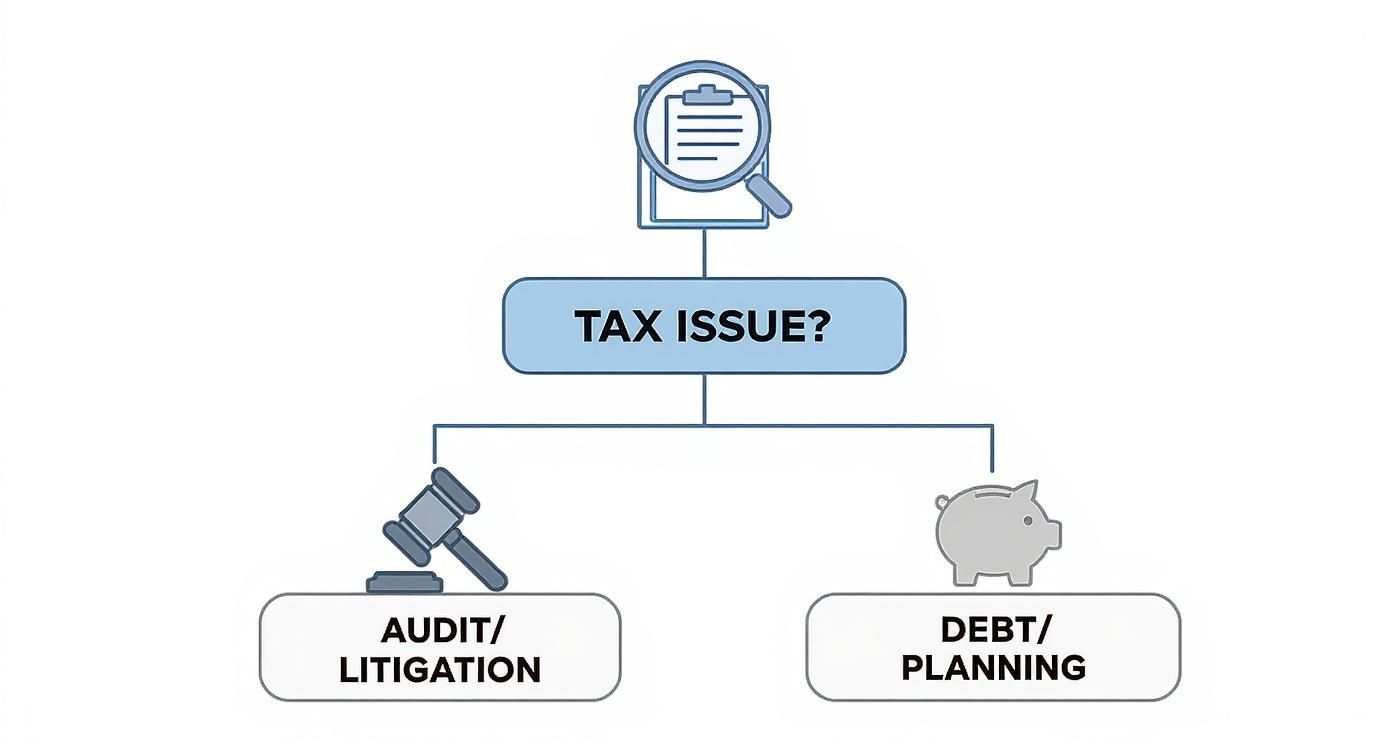
As the infographic makes clear, when things escalate to audits, litigation, or criminal investigations, a tax attorney's legal expertise becomes essential. For general tax planning or debt issues, the right professional really depends on the complexity of your case.
When to Choose Each Professional
While their roles can sometimes overlap, here’s a simple guide to help you make the right call:
- Enrolled Agent (EA): Your go-to for tax preparation, filing, and representation in basic IRS matters.
- CPA: Ideal for business accounting, financial planning, and handling more complex tax returns.
- Tax Attorney: Absolutely necessary for IRS audits, appeals, Tax Court litigation, criminal tax defense, and any situation where confidentiality is critical.
Bringing a purely financial expert to a legal battle is like bringing a calculator to a courtroom—it’s simply the wrong tool for the job. Choosing the right professional is the most important first step you can take.
If you're facing a serious problem with the IRS, you need an advocate who understands the law inside and out. You can learn more about why professional tax representation is crucial in our detailed article.
Red Flags That Mean You Need a Tax Attorney

It’s one thing to make a simple math error on your return; it’s another thing entirely when that mistake snowballs into a serious legal problem. Knowing how to spot the difference is critical. Some situations are more than just financial disagreements with the IRS—they’re giant, waving red flags telling you it’s time to get a tax attorney involved.
Think of it this way: a minor headache might just need some rest, but sudden, sharp chest pains mean you call 911 immediately. In the world of taxes, certain notices and actions from the IRS are the equivalent of those chest pains. They demand immediate, expert legal intervention.
When Legal Counsel Is Non-Negotiable
If you find yourself in any of the scenarios below, you need to stop and call a tax attorney right away. These aren't just bookkeeping issues; they carry severe legal risks, and trying to handle them on your own is a recipe for disaster. This is where attorney-client privilege becomes your shield—a protection that CPAs and EAs simply can't offer.
Don't hesitate if you're facing one of these critical red flags:
- Receiving a Criminal Investigation Notice: The moment you get a letter or visit from the IRS Criminal Investigation (CI) division, the game has completely changed. This isn't about a simple audit anymore; it means the government suspects you of a serious tax crime like fraud or evasion.
- Being Served a Summons: An IRS summons is a legally binding order for you to provide testimony or hand over documents. Ignoring it can lead to serious trouble. A tax attorney needs to review this immediately to protect your rights and determine the right way to respond.
- Needing to Go to U.S. Tax Court: If you've gone through the entire appeals process and still can't resolve your dispute, your next step is the U.S. Tax Court. A tax attorney is the only professional who can legally represent you in this arena. To get a better sense of what's involved, check out our legal guide on what happens when the IRS sues you.
When a tax issue escalates to the point of litigation or a criminal investigation, you are no longer in a financial negotiation. You are in a legal battle, and you need a lawyer to defend you.
In these high-stakes moments, bringing in a tax attorney ensures your conversations are protected by confidentiality and your case is managed with a sound legal strategy. Going it alone is a gamble you just can't afford to take.
How to Hire and Work with a Tax Attorney
Stepping into a lawyer's office can feel daunting, but finding the right tax attorney doesn't have to be. Think of it as a structured process, starting with the initial consultation. This first meeting is your chance to interview them—not the other way around—and see if they're the right expert for you.
To get the most out of that first conversation, you need to show up prepared. Pull together every relevant piece of paper you can find: IRS notices, the tax returns in question, and any financial statements that support your case. Having everything organized and ready means the attorney can get up to speed quickly and give you a solid initial take on your situation.
Understanding the Engagement Process
Once you're in the meeting, don't be shy. You need to ask direct questions about their track record and how they plan to tackle your problem. Tax disputes are getting tougher all over the world, so you can't afford to hire anyone but a seasoned pro. In fact, top-tier performance in this field gets noticed; just look at how DLA Piper was recently named Tax Law Firm of the Year for its stellar litigation work. You can read the full announcement from DLA Piper to see what sets the best apart.
Here are a few essential questions you should have on your list:
- Have you handled cases exactly like mine before? What happened?
- Based on what you see, what are the possible outcomes here?
- If I hire your firm, who will I be dealing with day-to-day?
Before you sign anything, insist on a clear, detailed engagement letter. This is your contract. It needs to spell out precisely what work they'll be doing, how the fees are structured (hourly, flat fee, or retainer), and how you'll communicate.
Finally, pay attention to how organized their practice seems. A professional who runs a tight ship is a good sign. Behind the scenes, many top attorneys rely on tools like advanced legal dictation software to stay efficient and responsive. By taking the time to carefully check out your options, you can move forward and hire a tax attorney you can truly trust.
Your Questions About Tax Attorneys, Answered
When you're thinking about hiring a tax attorney, a lot of practical questions naturally come to mind. Let's tackle some of the most common ones people ask.
What Does a Tax Attorney Usually Cost?
This is the big question, and the honest answer is: it depends. The cost really hinges on how complex your situation is, where you live, and the attorney's level of experience. Generally, you'll see fees structured in a few common ways:
- Hourly Rates: This is the most common model. You can expect to see rates anywhere from $200 to over $500 per hour.
- Flat Fees: For a very specific, well-defined task like preparing an Offer in Compromise, some attorneys will quote you a single, all-in price.
- Retainers: This involves paying a lump sum upfront. The attorney then deducts their hourly fees from that balance as they work on your case.
No matter the structure, always insist on a clear, written engagement letter that spells out the fees before you sign anything.
Will Hiring a Tax Attorney Make Me Look Guilty to the IRS?
Not at all. In fact, it’s quite the opposite. Hiring a tax attorney shows the IRS that you're taking the matter seriously and are committed to getting it right. IRS agents work with legal representatives every single day—it’s a normal and professional part of the process.
Engaging a lawyer doesn't signal guilt. It signals that you understand your rights and want to resolve the issue correctly and legally. It’s a proactive step toward compliance, not an admission of wrongdoing.
Think of it this way: having an expert who speaks the IRS's language can actually make the process smoother and more efficient for everyone involved, including the agent handling your case.
Can I Just Have a Tax Attorney Do My Regular Taxes?
Technically, yes, a tax attorney can prepare and file your annual tax return. But it's usually not the best use of their skills or your money. Their real value shines in navigating legal disputes, handling tax controversies, and structuring complex financial plans.
For routine, yearly tax preparation, you're almost always better off working with a CPA or an Enrolled Agent. They specialize in that area and will be a much more cost-effective choice.
Facing a complex tax issue can feel overwhelming, but you don't have to handle it alone. At the office of Attorney Stephen A Weisberg, I start with a FREE Tax Debt Analysis to determine exactly how I can help before you ever pay a fee. Visit my website to schedule your free analysis and take the first step toward resolving your tax problems today.