What Is a Notice of Deficiency from the IRS
Confused about what is a notice of deficiency? Learn what this critical IRS letter means, why you got it, and the exact steps you must take to respond.

In this article
- Demystifying the IRS 90 Day Letter
- Your Ticket To Tax Court
- What To Look For In The Notice
- Key Elements of a Notice of Deficiency at a Glance
- So, Why Did You Get a Notice of Deficiency?
- The Computer Caught a Mismatch
- You Just Finished a Tax Audit
- You Never Filed a Tax Return
- Your Three Critical Response Options
- Option 1: Agree with the IRS
- Option 2: Challenge the IRS in Tax Court
- Option 3: Do Nothing at All
- The Unforgiving 90-Day Deadline
- How the Clock Starts Ticking
- Proving You Filed on Time
- The Finality of the Deadline
- How to Prepare Your Tax Court Petition
- Gathering Your Essential Information
- Understanding the Burden of Proof
- Deciding Between a Small Case and a Regular Case
- Filing Fees and Waivers
- Common Questions About IRS Deficiency Notices
- How Is a Notice of Deficiency Different From Other IRS Letters
- Can I Get an Extension on the 90-Day Deadline
- Should I Hire a Tax Professional for This
No one likes getting a letter from the IRS. That little envelope in your mailbox can make your heart skip a beat. But if that letter is a Notice of Deficiency, take a deep breath. Understanding what it is—and what it isn't—is your first step toward getting back in control.
Think of it this way: it’s not a final bill. It’s a formal proposal from the IRS saying they believe you owe more in taxes. It’s often called the "90-day letter," and for a very good reason. This document is essentially your "ticket to Tax Court," giving you a powerful right to challenge the IRS's findings before you have to pay a dime.
Demystifying the IRS 90 Day Letter

A Notice of Deficiency isn't just another piece of mail; it's a critical legal document. It marks the end of the line for an IRS audit or review. When the IRS concludes you've underpaid, they can't just send you a bill or start collection actions. By law, they have to send you this formal notice first.
This letter is a cornerstone of your rights as a taxpayer. It lays out the IRS’s entire argument, giving you a detailed breakdown of their proposed changes to your tax liability. The notice serves as a crucial checkpoint, giving you a clear, defined opportunity to respond before the proposed debt becomes an actual, assessed tax. If you need help untangling the numbers, the principles for analyzing complex financial reports can be a useful guide.
Your Ticket To Tax Court
The most powerful feature of this notice is the legal right it gives you. That famous 90-day deadline—or 150 days if you're outside the U.S.—is your window to file a petition with the U.S. Tax Court.
Filing that petition puts an immediate legal stop to the IRS. They are legally barred from assessing the proposed tax and cannot begin collections while your case is being heard. It’s a powerful protection.
The Notice of Deficiency is a legal hurdle the IRS must clear. Without issuing it and waiting for the 90-day period to expire, the IRS generally cannot legally assess the additional tax or take collection actions like liens or levies.
This is why the document is so significant. The IRS is bound by Internal Revenue Code sections 6212 and 6213 to follow this process. It ensures taxpayers have a chance to dispute a finding in a neutral venue before the government can start trying to collect.
What To Look For In The Notice
When the letter arrives, the first rule is: don't panic. The second rule is to review it carefully. The document is structured to tell you exactly what the IRS is proposing and why.
It’s also important to distinguish this notice from other IRS communications. For instance, it’s very different from an IRS LT36 Notice. You can learn more about how to tell various IRS letters apart by checking out some of our other resources: https://www.weisberg.tax/newsletter/tag/IRS+LT36+Notice.
A Notice of Deficiency will always contain a few key pieces of information that will guide your next steps. Here’s a quick overview of what to find.
Key Elements of a Notice of Deficiency at a Glance
This table breaks down the essential components you'll find in an IRS Notice of Deficiency, helping you quickly locate and understand the most important information.
| Component | What It Means | Why It Matters |
|---|---|---|
| The Mail Date | The date the notice was sent. | This is the most critical date—it officially starts your 90-day or 150-day countdown. |
| Proposed Deficiency | The additional amount of tax, penalties, and interest the IRS claims you owe. | This is the core figure you'll be disputing or agreeing to. |
| Tax Year(s) in Question | The specific tax period(s) the IRS has adjusted. | It confirms the scope of the dispute, ensuring you focus on the correct return. |
| Explanation of Changes | A summary explaining why the IRS made changes (e.g., disallowed deductions). | This section forms the basis of the IRS's argument and is what you'll need to rebut. |
| Response Deadlines | The exact date by which you must file a petition with the U.S. Tax Court. | Missing this deadline means you forfeit your right to go to Tax Court before paying. |
Understanding these elements is the first step in formulating a successful response. Once you've identified these key details, you'll be in a much better position to decide on your next move.
So, Why Did You Get a Notice of Deficiency?
Getting a letter from the IRS can be unnerving, and a Notice of Deficiency is no exception. It might feel like it came out of the blue, but this letter is never random. It’s the final, official step in a process where the IRS has concluded you owe more tax than what you reported.
Think of it as the end of a chapter. To figure out your next move, you first need to understand how this particular story began. There are really only three common scenarios that lead to a 90-day letter landing in your mailbox.
The Computer Caught a Mismatch
By far the most common trigger is a simple data mismatch caught by the IRS's automated systems. The agency runs a massive computer program that constantly cross-references the information you put on your tax return with the data sent in by third parties—your employer, your bank, your broker, and so on.
When your W-2, 1099-NEC, or 1099-INT doesn't line up with the income you reported, the system automatically flags it. For example, say you earned $5,000 from a freelance gig, and the client filed a Form 1099-NEC. If you forgot to include that income on your return, the IRS computer will catch the discrepancy in a heartbeat.
This automated flag often results in a CP3219N notice, which is the formal Notice of Deficiency. It’s the IRS’s way of saying, “Hey, our records show more income than you reported.” For a deep dive into this specific process, there's a great guide on responding to IRS deficiency notices that breaks it all down.
You Just Finished a Tax Audit
The second major pathway is at the end of a tax audit. Whether it was a straightforward correspondence audit (handled entirely by mail) or a more complex field audit, this notice arrives when you and the IRS examiner can’t see eye-to-eye.
During the audit, the examiner might have disallowed deductions you claimed. Perhaps they decided your business meal receipts weren't adequate, or that your home office didn't pass the strict "exclusive use" test. If you stand by your numbers and refuse to accept the auditor's proposed changes, the IRS has to take the next formal step.
That step is issuing the Notice of Deficiency. It officially documents the auditor’s final position and, most importantly, starts the 90-day countdown for you to take your case to the U.S. Tax Court.
A Notice of Deficiency after an audit isn't a surprise attack. It's the formal, legally required step the IRS must take when you and the auditor have reached an impasse. It moves the dispute from an administrative level to a potential judicial one.
You Never Filed a Tax Return
What happens if you just don't file a return? The IRS doesn't let it slide. If they have records of you earning income—like W-2s from an employer or 1099s from clients—they will eventually file a return for you.
This is known as a Substitute for Return (SFR). The IRS uses the income information they have on hand to prepare a bare-bones return on your behalf. As you can imagine, this is rarely in your favor. Here’s why:
- Worst-Case Scenario: The IRS calculates your tax liability in a way that benefits them the most.
- No Deductions: It typically ignores any deductions or credits you might be entitled to (business expenses, dependents, education credits, etc.).
- Basic Filing Status: It usually defaults to a "single" or "married filing separately" status, which often results in a higher tax bill.
After creating this SFR, the IRS calculates the tax, penalties, and interest they believe you owe. The Notice of Deficiency they send you is their formal proposal of this assessment, giving you one last chance to either file your own, accurate return or take the fight to Tax Court.
Your Three Critical Response Options
When a Notice of Deficiency lands in your mailbox, the clock officially starts ticking. This isn't just another piece of mail to file away; it's a critical legal document that demands a decision. You're now at a crossroads with three very different paths forward, and the choice you make will have a major impact on your finances.
Your decision hinges on one simple question: do you agree with the IRS's proposed changes? Let's walk through each of the three options, what they really mean, and what happens next.
This infographic lays out the common events that trigger a Notice of Deficiency in the first place, giving you some context for the situation you're now in.
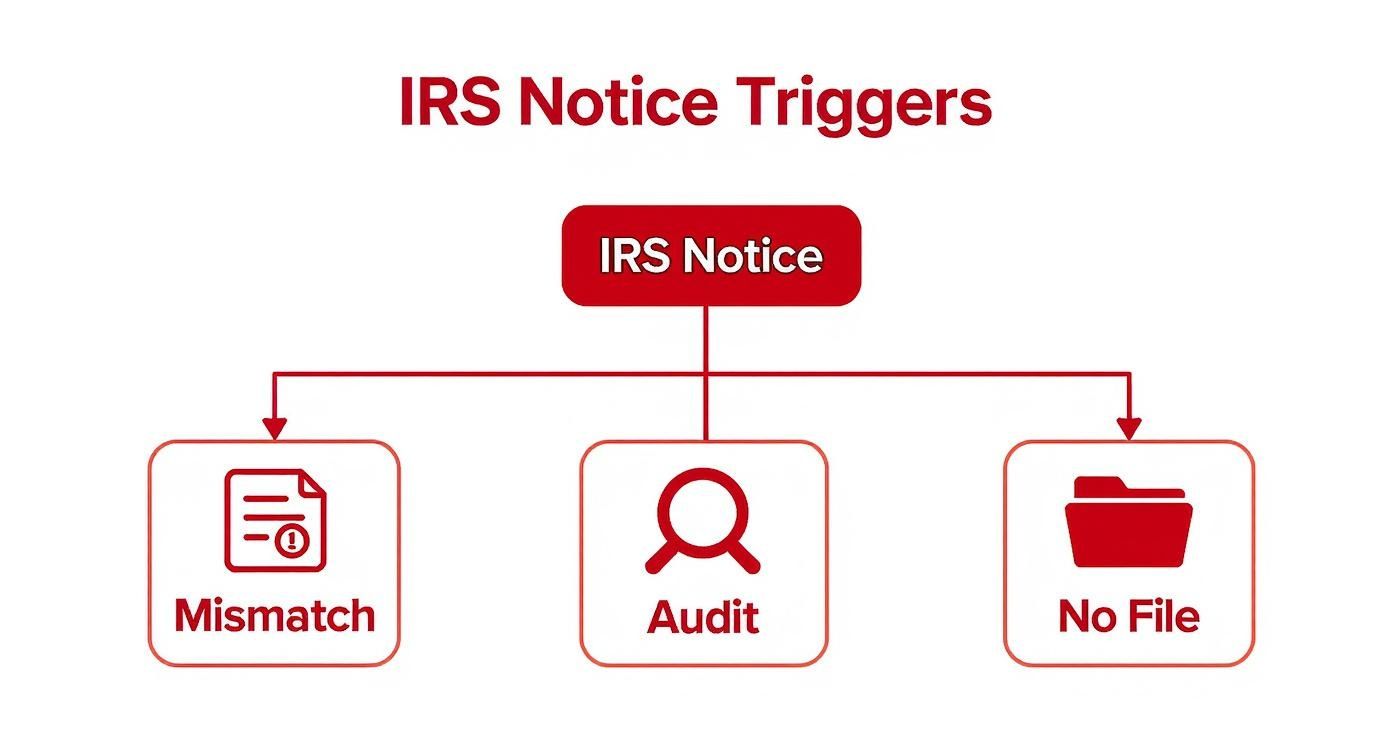
As you can see, this notice didn't just appear out of nowhere. It's the end result of a specific process, and your response needs to be just as thoughtful.
Option 1: Agree with the IRS
The most straightforward path is simply to agree with the IRS. After reviewing the notice and your own tax records, you might realize they're right—maybe you missed a 1099-INT from a savings account or made a simple math error on a deduction. It happens.
If that's the case, you'll sign and return the enclosed Form 4089 (or a similar waiver form that came with your notice). By signing, you are officially waiving your right to take the case to the U.S. Tax Court and accepting the proposed changes.
Once the IRS processes your signed form, they will formally assess the tax, along with any penalties and interest. A final bill will follow, and you can either pay the full amount or work with the IRS to set up a payment plan.
Option 2: Challenge the IRS in Tax Court
If you're convinced the IRS has it wrong, now is your chance to fight back. The Notice of Deficiency is literally your "ticket to Tax Court"—the only way to challenge the proposed tax before it's officially assessed and you have to pay it.
To do this, you must file a formal petition with the U.S. Tax Court before the 90-day deadline runs out. This is a big deal. The moment you file your petition, a legal stay is put in place, which means the IRS is legally barred from assessing the tax or starting collections. It gives you the breathing room you need to build your case without the immediate threat of liens or levies.
Filing a petition in Tax Court isn't just sending a disagreement letter. It's a formal legal action that moves the dispute to a neutral court. The IRS now has to defend its position, and you get to present your evidence to a judge who makes the final call.
You don't have to be a lawyer to file a petition, but the process has very strict rules and deadlines. For a closer look at what's involved, check out our guide on how to dispute a tax assessment. Many people find that getting a tax attorney involved at this stage is invaluable for navigating the legal system effectively.
Option 3: Do Nothing at All
The third option is inaction, and frankly, it's the worst one you can choose. Ignoring a Notice of Deficiency won't make the problem disappear. It actually sets off a chain of automatic, and often severe, consequences.
If you don't respond within the 90-day window, you give up your right to petition the Tax Court. Once that deadline passes, the IRS is free to act.
Here’s exactly what happens next:
- Automatic Assessment: The proposed tax liability is no longer a proposal. It becomes an official, assessed debt that you legally owe.
- Collection Actions Begin: The IRS's collection machine kicks into high gear. This can start with a Federal Tax Lien filed against your property, which is a major blow to your credit score.
- Levies and Garnishments: It can get worse. The IRS can then issue levies to seize money directly from your bank accounts or start garnishing a portion of your paycheck.
By doing nothing, you lose your best and easiest opportunity to make your case. While there might be other ways to dispute the tax later on, they're far more complicated and usually require you to pay the full amount first and then sue for a refund. While new AI tools for responding to tax notices can help organize your thoughts, they are no substitute for professional advice when facing legal deadlines.
The Unforgiving 90-Day Deadline

If the Notice of Deficiency is your ticket to Tax Court, the 90-day deadline is the non-negotiable expiration date stamped right on it. Let me be clear: this is the most critical and unforgiving part of the entire process. Getting this right isn't just important—it's everything.
Think of it as a countdown timer in a movie that simply can't be stopped or paused. Once that clock starts, it runs to zero. If you don't act in time, the consequences are severe, and your opportunity vanishes.
How the Clock Starts Ticking
The single biggest mistake I see taxpayers make is miscalculating their deadline. The 90-day countdown does not begin when you get the letter out of your mailbox or even when you finally open it.
The clock starts ticking on the mail date printed directly on the Notice of Deficiency. That date is absolute. If your notice is dated April 1st, your 90 days begin on April 1st, even if the letter sits on your kitchen counter for a week.
This isn't just some internal IRS policy; it's federal law. The U.S. Tax Court is legally barred from hearing your case if you file even one day late. There are no extensions, no do-overs, and no excuses the court can accept.
This is what makes the notice so powerful: it's a legal gateway with a hard, statutory time limit. For taxpayers living outside the United States, the law is a bit more generous, providing a 150-day deadline, but the same rigid rules apply.
Proving You Filed on Time
So, how do you prove you beat the clock? The U.S. Tax Court operates on what’s called the "timely mailed, timely filed" rule. This means your petition is considered on time as long as it's properly addressed and postmarked by the U.S. Postal Service on or before your deadline—even if it arrives at the court a few days later.
But this is where you can get into real trouble. Just dropping your petition in a regular mailbox is a huge gamble. If it gets lost or the postmark is smudged and unreadable, you have zero proof you mailed it on time.
Your absolute best practice is to use U.S. Certified Mail with a return receipt. Here’s why this method is your best friend:
- It Creates a Legal Record: The stamped receipt you get from the post office is your official proof of the mailing date.
- It Tracks Delivery: The return receipt confirms the Tax Court actually received your documents.
- It Provides Peace of Mind: You have concrete evidence to shut down any claim that your petition was filed late.
This one simple step can be the difference between having your day in court and having your case thrown out before it's even heard. To see how these rules impact real people, you can explore various cases and updates related to the IRS Tax Court on our newsletter archive.
The Finality of the Deadline
The case of Cano v. Commissioner really drives home how strict this deadline is. The IRS actually mailed the notice to the wrong address. Even though the taxpayer eventually got it, he filed his petition a staggering 400 days after the original mail date.
Initially, the IRS tried to get his case dismissed for missing the deadline. But the court sided with the taxpayer, dismissing the case for a different reason entirely: the IRS failed to send a valid notice to his last known address in the first place. This shows just how seriously the court takes procedural rules—for both the taxpayer and the IRS.
The takeaway here is crystal clear: the 90-day deadline is your number one priority after opening a Notice of Deficiency. Mark it on your calendar, double-check your math, and use certified mail to protect your right to fight back.
How to Prepare Your Tax Court Petition
So, you’ve decided to fight the IRS's findings. That’s a big step. Once you’ve made that call, the clock is ticking, and you need a solid plan for filing your petition with the U.S. Tax Court. This isn’t just some complaint letter; it’s a formal legal document that officially starts your case and forces the IRS to respond.
Think of the petition as the key that opens the courthouse doors. It has to include specific information, be filed the right way, and, most importantly, land on the court's desk before that 90-day deadline slams shut. Let's walk through how to do it right.
Gathering Your Essential Information
Before you write a single word, get your paperwork in order. The Tax Court has a strict checklist of what must be in a petition, and missing even one small detail can cause serious delays or even get your case thrown out before it begins.
Start by pulling together these essentials:
- Your Personal Details: This is the easy part—your full name, current mailing address, and your taxpayer ID number (which is usually your Social Security Number).
- A Copy of the Notice: You absolutely must attach a full copy of the Notice of Deficiency to your petition. This isn't optional.
- The Tax Years in Dispute: Be crystal clear about which tax year or years the notice is about.
- The Disputed Amounts: Spell out the exact dollar amounts of the tax, penalties, and interest that you are challenging.
Having all this ready to go will make filling out the actual petition form much less of a headache.
Understanding the Burden of Proof
Here’s a critical legal concept you need to get comfortable with: the burden of proof. In most Tax Court cases, that burden falls squarely on your shoulders. It’s up to you, the taxpayer, to prove that the IRS got it wrong.
The IRS's assessment is presumed to be correct until you prove otherwise. Just saying "they're wrong" won't get you anywhere. You have to back up your claims with hard evidence.
This is why gathering your proof is just as crucial as filing the petition on time. You need to start building your case from day one. Dig up every document that supports your position on the items the IRS challenged on your return.
This could be things like:
- Receipts and invoices for every business expense in question.
- Bank and credit card statements that show the flow of money.
- Signed contracts or other legal agreements.
- Detailed mileage logs if they challenged a vehicle deduction.
- Canceled checks or other proof of payment.
The better organized and more complete your documentation is, the stronger your case will be when it's time to argue it.
Deciding Between a Small Case and a Regular Case
The Tax Court has two different tracks for taxpayers, and the one you choose depends on how much money is on the line. This decision dramatically changes how formal and complex the process will be.
Small Tax Case (S Case): If the total tax and penalties in dispute for any single year is $50,000 or less, you can choose to have your case treated as a "small tax case." This route is designed to be simpler and less formal. The rules of evidence are relaxed, making it easier to represent yourself without a lawyer. But there’s a major trade-off: the judge's decision in an S case is final. You cannot appeal it.
Regular Tax Case: If your dispute is for more than $50,000 (or if you simply prefer the formal route), your case will be a regular tax case. This path is much more structured, with strict rules of evidence similar to other federal courts. The big upside here is that if you don't agree with the outcome, you have the right to appeal the decision to a U.S. Court of Appeals. For a deeper dive into these options, you can learn more about how to appeal an IRS decision in our comprehensive guide.
Filing Fees and Waivers
Finally, there's a cost to get your foot in the door. Filing a petition with the Tax Court comes with a $60 filing fee, which is due when you submit your paperwork.
If paying that fee would be a financial hardship, don't worry—you can ask the court to waive it. You’ll need to file a separate form called a Motion to Waive Filing Fee, where you explain your financial situation. The court will review your request and, if approved, will allow your case to move forward without the upfront payment.
Common Questions About IRS Deficiency Notices
Facing that 90-day letter can feel like stepping into a storm without an umbrella. Questions pile up the moment you open the envelope. We’re here to give you clear, concise answers so you can stay ahead of deadlines and avoid costly errors.
Below, you’ll find straightforward explanations to the issues taxpayers ask about most often. Think of this as your quick-reference guide through the Notice of Deficiency maze.
How Is a Notice of Deficiency Different From Other IRS Letters
Many people confuse this letter with a CP2000 or an audit notice. In reality, it’s in a category all its own.
- CP2000: A polite invitation to discuss proposed changes to your return.
- Initial Audit Letter: A heads-up that an administrative review is beginning.
- Notice of Deficiency: A formal declaration and your only ticket to the U.S. Tax Court before taxes are assessed.
This notice is the final administrative step before the IRS can legally assess the tax.
Without it, you have no right to petition the Tax Court. Recognizing this distinction is the first move toward defending your case.
Can I Get an Extension on the 90-Day Deadline
Here’s the hard truth: you can’t. That 90-day window (or 150 days if you live abroad) is written into federal law. It’s not a guideline the IRS or the courts can bend.
Miss that cutoff, and the Tax Court loses the power to hear your dispute. Once the deadline passes, your chance to challenge the tax bill in court vanishes.
To protect your rights:
- Identify the Mail Date: The clock starts ticking from the date on the notice, not when you find it in the mailbox.
- Act Immediately: Drop everything and begin your response plan the day the letter lands.
- Use Certified Mail: Filing via USPS Certified Mail gives you ironclad proof you met the deadline.
Should I Hire a Tax Professional for This
You’re free to represent yourself, but many taxpayers choose expert help. It’s like deciding between driving with a map versus using a seasoned GPS.
Your decision hinges on three factors:
- The Amount in Dispute: Large sums usually justify the cost of professional representation.
- The Complexity of Your Case: Simple documentation issues differ vastly from thorny legal arguments.
- Your Comfort Level: If legal filings and courtroom etiquette stress you out, a pro can handle it all.
Once you decide to seek help, you have three main options:
- Tax Attorney: Admitted to practice in the U.S. Tax Court, they excel at legal strategy, negotiation, and courtroom advocacy.
- Certified Public Accountant (CPA): Skilled in accounting and tax preparation; many represent clients before the IRS but check if they’re admitted to Tax Court.
- Enrolled Agent (EA): Federally licensed by the IRS, they specialize in tax matters and can represent you before the IRS, though not all practice in Tax Court.
Choosing a professional means gaining an advocate who knows the system inside out.
At Attorney Stephen A Weisberg, we specialize in representing taxpayers before the IRS and in Tax Court. Before you make any decisions, start with our FREE Tax Debt Analysis to understand your options and see how we can help. Schedule your free consultation today.


