What Is a Levy From the IRS? Your Complete Guide
What is a levy from the IRS? Understand how an IRS levy works, what assets are at risk, and the steps you can take to stop it and resolve your tax debt.

In this article
- Demystifying the IRS Levy Notice
- The Path to a Levy
- Understanding the Legal Authority Behind a Levy
- How Different Types of IRS Levies Affect Your Assets
- The Continuous Drain of a Wage Garnishment
- The One-Time Seizure of a Bank Levy
- Levies on Other Personal Assets
- Your Taxpayer Rights: A Shield Against the IRS
- The Power of a Collection Due Process Hearing
- Making Your Case to the Office of Appeals
- Practical Steps to Stop an IRS Levy Fast
- Set Up an Installment Agreement
- Submit an Offer in Compromise
- Request Currently Not Collectible Status
- Which IRS Tax Resolution Is Right for You
- How to Prevent an IRS Levy Before It Starts
- Always File on Time, Even If You Can't Pay
- Respond to Every IRS Notice Promptly
- When to Hire a Professional for IRS Levy Help
- Signs It’s Time for Expert Help
- Finding the Right Professional for Your Case
- Answering Your Questions About IRS Levies
- How Long Does an IRS Levy Last?
- Can the IRS Take My House?
- Will an IRS Levy Affect My Credit Score?
- Is There Anything That's Exempt From an IRS Levy?
An IRS levy is the government's legal way of seizing your property to pay off a tax debt. This isn't just a strongly worded request; it's a powerful enforcement tool that allows the IRS to take assets—like money from your bank account or a chunk of your paycheck—without first needing a court order. A levy is what happens at the end of a long, drawn-out collection process.
Demystifying the IRS Levy Notice

Getting an official-looking envelope from the IRS can make your heart sink, especially when it’s a Final Notice of Intent to Levy. This single piece of paper is the government's final warning before it starts taking your property. But here’s the most important thing to remember: a levy is never a surprise attack.
Think of it more like the final shutoff warning from the power company after you’ve missed several payments. The IRS has to follow a strict legal process before it can touch your assets, and that process includes sending you multiple notices over time.
The Path to a Levy
The road to an actual levy begins long before that final notice shows up. First, the IRS will send a series of letters demanding payment for the tax debt it says you owe. These early notices are your chance to get ahead of the problem—you can pay the bill, ask questions, or dispute the amount entirely. Ignoring them is what escalates the situation.
Eventually, the process leads to the IRS issuing its "Final Notice of Intent to Levy and Notice of Your Right to a Hearing." This is the one you absolutely cannot ignore.
This notice officially tells you that the IRS is about to start seizing your assets. More importantly, it kicks off a 30-day clock. You have exactly that much time to request a formal hearing and challenge the levy.
Understanding the Legal Authority Behind a Levy
The IRS wields serious power when it comes to collecting unpaid taxes. This authority comes directly from Internal Revenue Code Section 6331, which gives the agency the right to levy "all property and rights to property" belonging to a taxpayer. The scope of what they can take is incredibly broad and includes:
- Wages and salaries from your employer
- Funds sitting in your bank or brokerage accounts
- Social Security and retirement benefits
- Vehicles, boats, and in some cases, even your home
This is a powerful administrative tool that lets the government legally seize your property to settle a tax debt without needing a judge to sign off on it first. To fully grasp the extent of this power, it's worth taking a closer look at the details behind U.S. tax levy laws. Taking action within that 30-day window is your best shot at stopping the process in its tracks.
How Different Types of IRS Levies Affect Your Assets

It's a common misconception that an IRS levy is a single, one-size-fits-all action. In reality, the IRS has a whole toolbox of targeted levies designed to seize different kinds of assets. Knowing exactly which type you’re up against is the first step, because each one hits your financial life in a unique and immediate way.
The levies people encounter most often are the ones aimed squarely at their income and cash reserves. They're built for speed and efficiency in collecting the debt.
The Continuous Drain of a Wage Garnishment
A wage garnishment is relentless because it’s a continuous levy—it doesn't just happen once and go away. The IRS sends a notice directly to your employer, legally requiring them to withhold a portion of your wages from every single paycheck and send it to the government.
This process continues indefinitely until your entire tax debt is paid off or you negotiate an alternative solution with the IRS. For most people, losing a chunk of their regular income creates instant financial hardship, making it a struggle to cover rent, groceries, and other essential bills.
The One-Time Seizure of a Bank Levy
A bank levy works differently. Instead of a slow drain, it's a one-time, all-at-once seizure of the funds in your account. The moment the IRS issues the levy, your bank is legally obligated to freeze your money, up to the full amount you owe.
Your bank will hold onto those funds for a 21-day period. This is a critical window—it's your last chance to contact the IRS and resolve the debt before the money is gone for good.
If you don't act within those three weeks, the bank forwards the funds to the IRS, and your account is emptied. This can be a devastating blow, often happening without any final warning. We break down the specifics of this process in our guide on IRS bank levies provides critical details.
Levies on Other Personal Assets
The IRS doesn't just stop at paychecks and bank accounts. Their collection authority extends to a wide range of other personal assets, though some come with specific rules and protections.
- Social Security Benefits: Through the Federal Payment Levy Program, the IRS can take up to 15% of your monthly Social Security payments.
- Retirement Accounts: Money you've saved in a 401(k) or IRA isn't untouchable. While levying these accounts is a more involved process for the IRS, it's absolutely a possibility.
- Accounts Receivable: If you’re self-employed or work as an independent contractor, the IRS can go after the money your clients owe you by levying your accounts receivable.
- Property: In serious, long-standing tax debt cases, the IRS can escalate to seizing physical property. This includes your car, a boat, or even your home.
This last point is crucial. The principles behind a levy are closely related to what happens when you're selling a house with a lien, which is often a precursor to more aggressive collection actions. With hundreds of thousands of levies issued every year, it's one of the IRS's most-used enforcement tools. The legal limits, like the 15% cap on Social Security, are there to strike a balance between collecting taxes and leaving people with enough to survive.
Your Taxpayer Rights: A Shield Against the IRS
Getting a levy notice from the IRS can feel like you’re up against an unstoppable force. But it's so important to remember you are not powerless here. The entire American tax system is built on a foundation of taxpayer rights, and these are designed to make sure you get a fair shake—even when you owe money. Think of these protections as your shield, giving you the standing to challenge the IRS and protect your assets.
At the heart of these protections is the Taxpayer Bill of Rights. This isn't just some dusty government document; it’s a set of ten core principles that dictate how the IRS must treat you. Among the most critical are your right to be informed, your right to challenge the IRS’s position, and your right to an appeal.
The Power of a Collection Due Process Hearing
When the IRS issues a Final Notice of Intent to Levy, it kicks off your most powerful defensive tool: the right to request a Collection Due Process (CDP) hearing. This isn't just a quick phone call. It’s a formal, legal opportunity to stop the levy in its tracks and plead your case before an impartial appeals officer.
Think of the CDP hearing as your day in court with the IRS. It's the official venue where you can legally dispute the levy and work out a different way forward. This is your chance to argue your case and find a resolution that doesn't involve having your property seized.
A CDP hearing is your chance to make a case for why the levy would create an economic hardship or to propose a viable alternative, such as an installment agreement or an Offer in Compromise.
To lock in this right, you have to formally request the hearing by filing Form 12153, Request for a Collection Due Process or Equivalent Hearing. And this is where timing is everything. You have exactly 30 days from the date printed on your final notice to get this form filed. If you miss that deadline, you lose your automatic right to stop the levy.
Making Your Case to the Office of Appeals
Once your hearing request is in, your case moves over to the IRS Office of Appeals. This is a big deal because it’s a separate, independent division within the IRS. Their whole purpose is to settle tax disputes without dragging everyone through costly and lengthy court battles. This is your forum to present evidence, make your arguments, and negotiate a final resolution. To learn how to navigate this process for the best possible result, you need to master the art of the IRS Office of Appeals.
During your hearing, you can bring up several key points:
- Propose collection alternatives: This is your best shot to officially ask for an installment agreement, an Offer in Compromise, or to be placed in Currently Not Collectible status.
- Challenge the levy itself: You can argue that the IRS failed to follow the proper procedures or that the levy would create a significant economic hardship for you and your family.
- Dispute the tax liability (in some cases): If you never had a previous opportunity to question the amount of tax the IRS says you owe, you might be able to raise that issue during the CDP hearing.
By truly understanding and asserting your rights—especially the right to a CDP hearing—you can shift from being a passive recipient of an IRS notice to an active participant in solving your tax problem for good.
Practical Steps to Stop an IRS Levy Fast
When you get that final levy notice, the clock starts ticking. Fast. But panic isn't the answer, because you have real, powerful options to stop the process cold. The single most important thing you can do right now is communicate with the IRS. Ignoring them is a surefire way to have your assets seized; talking to them opens the door to a solution.
Think of this section as your action plan. We're going to walk through the most effective strategies to get a levy lifted, moving you from understanding the problem to actively solving it.
This decision tree breaks down the critical timeline you're facing and the immediate steps you can take to protect your rights and your property.
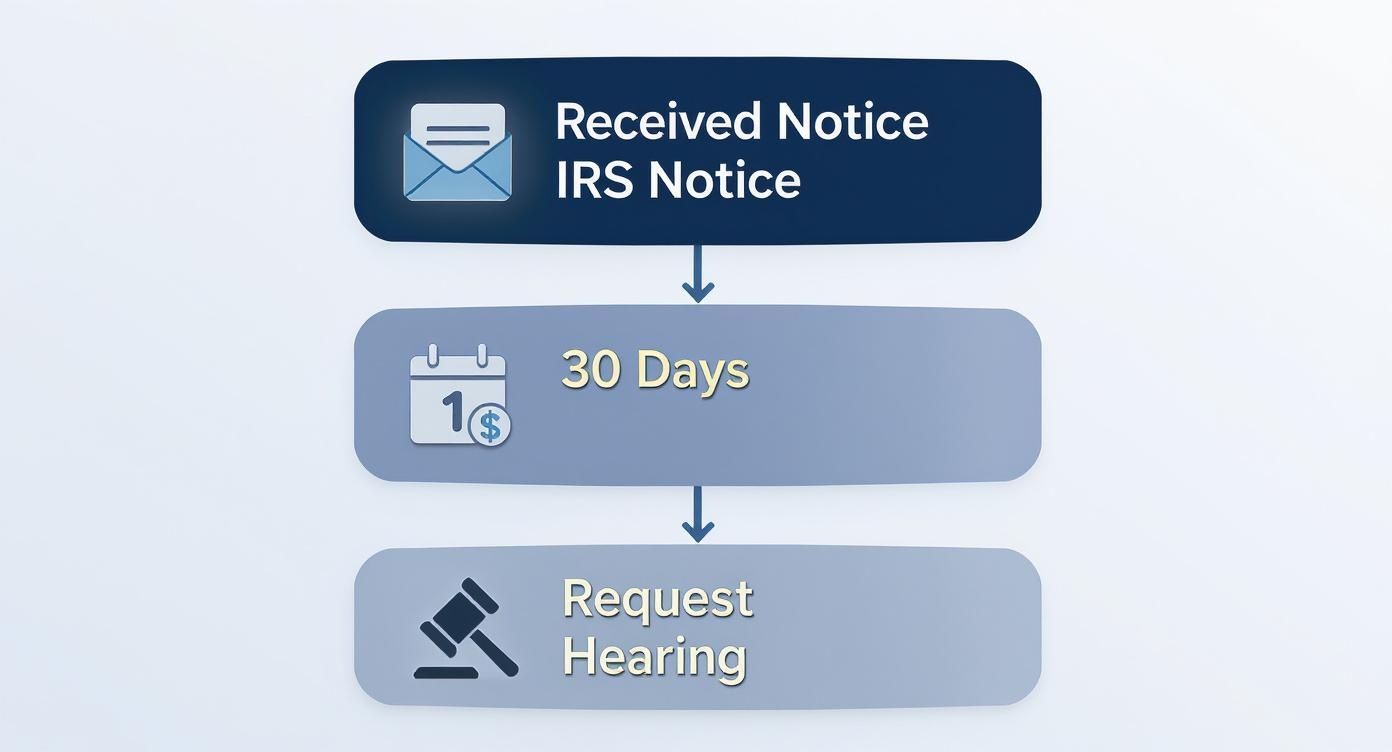
As you can see, those first 30 days are everything. That's your window to request a formal hearing and put a stop to the seizure before it even begins.
Set Up an Installment Agreement
Often, the most straightforward solution is an Installment Agreement (IA). It's exactly what it sounds like: a formal payment plan with the IRS. This lets you pay off your tax debt in manageable monthly chunks, typically for up to 72 months.
The beauty of an IA is that it immediately halts the levy process, as long as you stick to the payment schedule. It’s the perfect route for taxpayers who can afford to pay what they owe but just need some time to do it without crippling their finances. For smaller debts, you can often apply for an IA right on the IRS website.
Submit an Offer in Compromise
But what if you can't pay the full amount, even with a payment plan? That's where an Offer in Compromise (OIC) comes in. An OIC allows eligible taxpayers to settle their tax liability for less—sometimes much less—than the original amount owed.
Now, this isn't a simple negotiation. The IRS will only greenlight an OIC if they're convinced it’s the most they can ever hope to collect from you. You’ll need to provide a mountain of financial paperwork to prove that paying in full would cause you genuine economic hardship. Getting an OIC accepted can be life-changing, but be warned: the process is incredibly detailed and requires a perfectly prepared application.
An Offer in Compromise is based on your "reasonable collection potential"—what the IRS calculates it can collect based on your income, expenses, and asset equity.
Request Currently Not Collectible Status
For people facing truly dire financial straits, requesting Currently Not Collectible (CNC) status is a critical lifeline. If you can show the IRS that you can't even cover basic living expenses, let alone a tax bill, they can place your account in CNC status.
This puts a temporary stop to all collection activities, including levies. The IRS will check in on your financial situation down the road, but while you're in CNC status, your assets are safe. It gives you the breathing room you need to get back on your feet. A wage garnishment can be especially tough, and our complete guide to stopping IRS wage garnishment dives into more specific strategies for keeping your paycheck safe.
Navigating these options can feel overwhelming, but figuring out the best fit is the first step toward peace of mind.
Which IRS Tax Resolution Is Right for You
This table gives a quick overview of these common resolutions to help you see which path might make the most sense for your situation.
| Resolution Option | Best For Taxpayers Who... | Key Requirement |
|---|---|---|
| Installment Agreement | Can afford to pay their full tax debt, but need more time. | A steady income to make consistent monthly payments. |
| Offer in Compromise | Cannot afford to pay their full tax debt due to financial hardship. | Proving your "reasonable collection potential" is less than the total tax owed. |
| Currently Not Collectible | Are facing severe financial hardship and can't afford basic living expenses. | Demonstrating that paying anything toward the tax debt is currently impossible. |
Each of these solutions requires you to act quickly and communicate clearly. The right strategy hinges entirely on your unique financial circumstances, but they all start with one brave decision: to face the problem head-on.
How to Prevent an IRS Levy Before It Starts
The best way to handle an IRS levy is to make sure it never happens. This isn't about some secret trick; it's about being proactive, building good habits, and talking to the IRS when they reach out. Trust me, it’s a whole lot easier to stay on their good side than it is to claw your way back after they've started seizing your assets.
Think of it like taking care of your car. You wouldn't skip oil changes until the engine seizes, right? The same logic applies here. A little bit of consistent tax maintenance prevents a massive financial breakdown later on.
Always File on Time, Even If You Can't Pay
Here's one of the biggest mistakes people make: they can't afford their tax bill, so they just don't file. This is a huge misstep. The IRS has two separate penalties—one for failure to file and another for failure to pay—and the penalty for not filing is almost always much, much worse.
No matter what, get your tax return in by the deadline. Even if you don't have a penny to send with it, filing the return shows the IRS you know you owe the money. It keeps you compliant, stops the harshest penalties from piling up, and tells them you aren't trying to hide. That simple act is the first and most important step to keeping a levy off the table.
Proactively managing your tax obligations is key to avoiding future issues. For many, this includes utilizing tax preparation software like TurboTax to ensure accurate and timely filing, which forms the foundation of good tax health.
Respond to Every IRS Notice Promptly
Ignoring a letter from the IRS is like ignoring a small leak in your ceiling. At first, it’s just a little spot, but if you leave it alone, it will eventually bring the whole thing crashing down. The path to a levy is almost always littered with ignored notices.
When you get a letter from the IRS, open it. Right away. Read it carefully to figure out what they need.
Whether they're asking for more documents or telling you about a balance due, a quick response is everything. It shows the IRS you're paying attention and want to sort things out. That alone can stop the collection process from escalating to the final, most painful stage—a levy. Keeping good records all year makes this part way less stressful, because you'll have everything you need on hand to back up your return.
When to Hire a Professional for IRS Levy Help
It’s completely understandable to want to handle your own tax issues, but an active IRS levy is a whole different ball game. This isn't just another tax form; it's a clear signal that the situation has escalated, and your assets are now at risk. Trying to navigate the maze of IRS collections on your own at this stage is a gamble most people can't afford to lose.
Bringing in a qualified tax professional isn't admitting defeat—it's the smartest strategic move you can make to protect yourself.
Think of it like this: you wouldn't perform surgery on yourself, even if you had a detailed medical textbook. A tax pro—whether a CPA, an Enrolled Agent, or a tax attorney—is the surgeon. They have the specialized training and, more importantly, the hands-on experience to diagnose the core problem and fix it without causing more damage.
Signs It’s Time for Expert Help
So, when do you pull the trigger and call for backup? You should seriously consider hiring an expert if you find yourself in any of these situations:
- The Debt is Substantial: If you owe a significant amount of money, the financial stakes are simply too high to go it alone. One wrong move could be catastrophic.
- Your Finances are Complicated: Are you a business owner, a freelancer, or someone with complex investments? These situations come with unique tax challenges that require a specialist's touch.
- You Need to Negotiate a Deal: Trying to get an Offer in Compromise accepted or navigating a Collection Due Process hearing is an art. It demands a deep, practical understanding of IRS procedures and seasoned negotiation skills.
- You're Simply Overwhelmed: Let's be honest, this is stressful. If the anxiety and complexity have you frozen, a professional can lift that weight off your shoulders and start making progress immediately.
A great tax representative does more than just fill out paperwork. They become a critical buffer between you and the IRS, taking over all communications and making sure your rights are fiercely protected every step of the way.
Finding the Right Professional for Your Case
It’s important to know that not all tax professionals are created equal, especially when you're facing a levy.
A CPA is a master of accounting and financial planning. An Enrolled Agent (EA) is a pure tax specialist, focusing exclusively on tax matters. A tax attorney brings legal representation to the table and can offer attorney-client privilege, which can be crucial. For a levy situation, an EA or tax attorney is usually your best bet.
When you're interviewing potential help, ask direct questions. "How many levy cases have you actually handled?" and "What would your initial strategy be for my specific situation?" are great places to start. Be very wary of anyone promising guaranteed outcomes or demanding massive upfront fees.
You can find more insights on why professional tax representation is crucial when you're in the IRS's crosshairs. Investing in the right expert isn't just buying their knowledge; it's buying you invaluable peace of mind.
Answering Your Questions About IRS Levies
When you're dealing with the IRS, a lot of questions can come up fast. It's completely normal to feel overwhelmed. Let's walk through some of the most common concerns people have when they're facing a levy.
How Long Does an IRS Levy Last?
The answer really depends on what the IRS is targeting. Think of a bank levy as a snapshot in time. The IRS seizes whatever funds are in your account on that specific day, and that’s it. It’s a one-time event.
A wage garnishment, on the other hand, is more like a continuous process. It stays in place, taking a piece of every single paycheck, until one of three things happens: the tax debt is paid in full, the IRS officially releases the levy, or the debt expires under the 10-year statute of limitations.
Can the IRS Take My House?
Technically, yes, but it is incredibly rare and something the IRS views as an absolute last resort. The agency has the legal power to seize a personal residence, but there are a lot of internal hoops and legal procedures they have to jump through first.
Before ever getting to that point, the IRS will almost always go after easier-to-access assets like cash in your bank accounts or your wages.
Will an IRS Levy Affect My Credit Score?
An IRS levy itself won’t show up on your credit report. The IRS doesn’t report its collection activities to the big three credit bureaus—Equifax, Experian, and TransUnion.
But here’s the catch: the underlying tax debt can cause the IRS to file a Notice of Federal Tax Lien. That notice is a public record, and it can absolutely find its way onto your credit report. If it does, it will almost certainly drag your score down.
Is There Anything That's Exempt From an IRS Levy?
Yes, the law does protect some types of income and property from being seized, but these exemptions are quite specific and limited.
The IRS can’t touch certain income sources, like some unemployment and workers' compensation benefits, specific disability payments, and a portion of your wages. This exempt amount is calculated based on your filing status and how many dependents you have, ensuring you're left with a minimum amount for basic living expenses.


