What Is a Federal Tax Audit and How Does It Work
Learn what is a federal tax audit, how the IRS selects returns, the three audit formats, taxpayer rights, and practical steps if you receive a notice.

In this article
- Why a Federal Tax Audit Notice Can Feel Bigger Than It Is
- What a Federal Tax Audit Actually Is
- The legal authority behind the review
- Three formats, three levels of contact
- What Triggers a Federal Tax Audit
- Pre-audit the records the IRS will compare
- How the IRS Examination Process Works From Notice to Closure
- The request controls the first response
- How scope expands
- Your Rights as a Taxpayer During a Federal Tax Audit
- Possible Outcomes of a Federal Tax Audit
- Practical Steps if You Receive an IRS Audit Notice
- Getting Clear Answers Before You Respond
You open an IRS letter and see an examination notice, a list of requested records, and a deadline. The immediate fear is usually simple: “Does this mean I owe more money?” Not necessarily. An audit is a formal review, not a finding of wrongdoing, and the IRS may close it with additional tax, no change, or a refund.
The more important question is what kind of examination you're facing and how narrowly you should respond. The IRS uses correspondence audits by mail, office audits at an IRS location, and field audits at a taxpayer's home, business, or representative's office. Most examinations don't begin with an agent at your door. In fiscal year 2024, approximately 78% were correspondence examinations and 22% were field examinations, according to this federal income tax update.
This guide explains what the IRS is examining, why records matter, how an Information Document Request works, what rights you retain, and when representation changes the risk. By the end, you should be able to identify your audit format, organize the right evidence, and choose a response strategy based on the actual issues rather than the tone of the notice.
Why a Federal Tax Audit Notice Can Feel Bigger Than It Is
An IRS notice looks more final than it usually is. It may identify a deduction, income item, credit, or other return position and demand documents by a specific date. That language creates pressure, but the notice is generally the beginning of a verification process, not proof that the IRS has already decided the case.
Start with three tasks. Read the notice completely, including attachments and response instructions. Confirm the tax year and issues under review, because those boundaries control what the IRS initially has authority to ask about. Then calendar the response deadline and preserve the original letter. A missed deadline can turn a manageable documentation request into a proposed adjustment supported only by the IRS's available information.
The format matters. A correspondence examination happens through written requests and mailed responses. An office examination requires attendance or representation at an IRS location. A field examination takes place at a taxpayer's home, business, or representative's office and typically permits broader review of records and business operations.
Practical rule: Treat every notice as a deadline and scope problem before treating it as a tax-calculation problem.
A mail audit still deserves careful handling. If the IRS asks for support for one deduction, sending an unorganized box of unrelated records can obscure the answer and invite additional questions. A concise submission that ties each document to the specific return position is usually more defensible.
You don't need to panic, but you do need to control the file. Identify the examination type, isolate the requested issues, gather primary records, and decide whether you should communicate directly or through an authorized representative.
What a Federal Tax Audit Actually Is
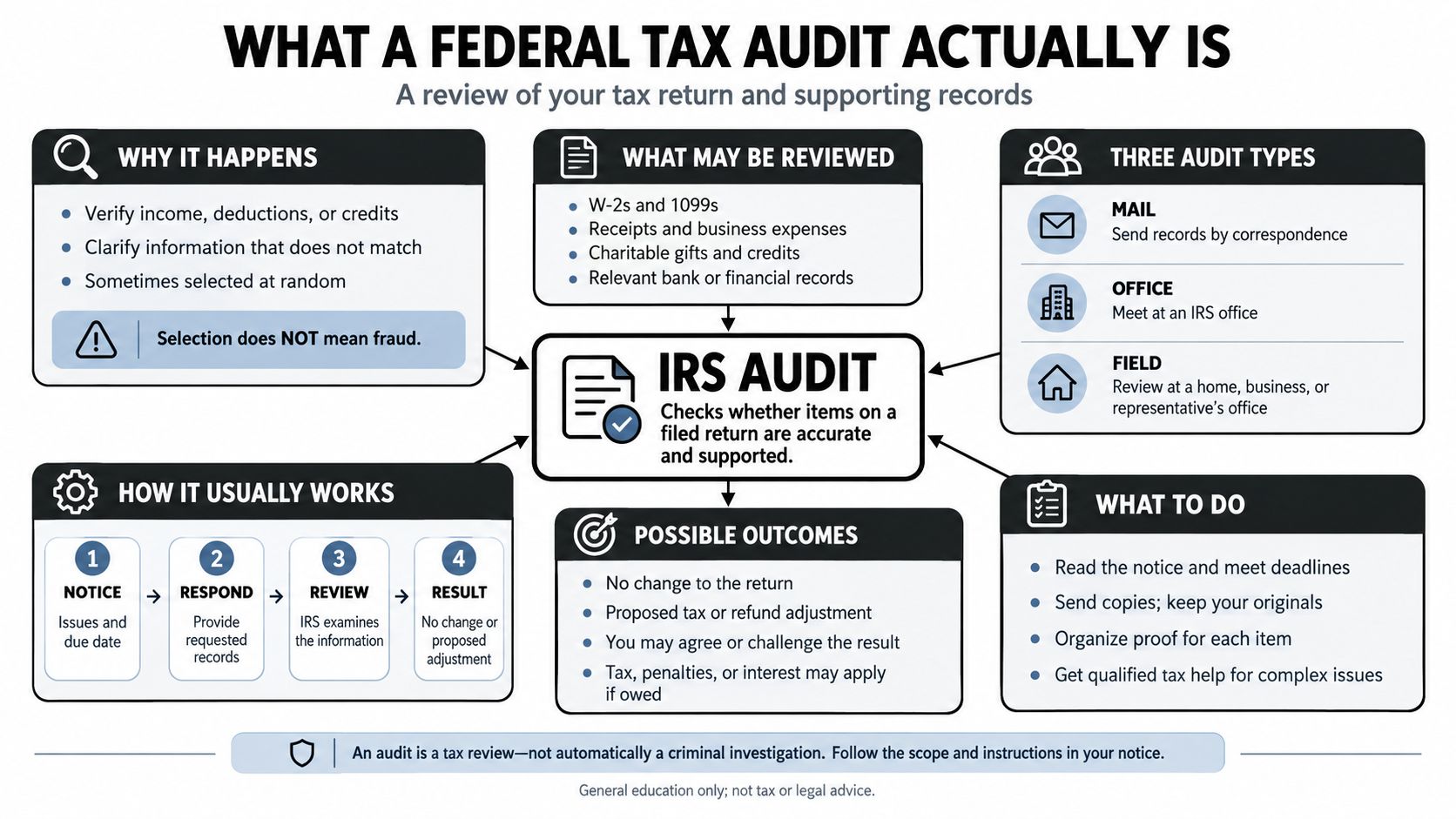
A federal tax audit, formally called an IRS examination, is a review of whether income, deductions, credits, basis, and other items reported on a federal return are accurate. The IRS may select a return when its systems identify discrepancies, including differences between the return and information reported on Forms W-2 or 1099. The IRS's examination procedures describe the review of books, records, and relevant information used to verify the return. See the IRS examination procedures.
The legal authority behind the review
Internal Revenue Code §7602 authorizes the IRS to examine books, records, and other relevant information to determine whether a return is correct, establish a tax liability when a return wasn't filed, and perform related enforcement functions. That authority doesn't give the examiner unlimited freedom to request anything without connection to the examination. The request should relate to the issues being developed, and the taxpayer retains procedural protections throughout the process.
For a self-employed person, the relevant evidence may include a general ledger, invoices, payment-processor records, bank statements, canceled checks, mileage records, asset documentation, and personal-account activity relevant to business receipts. For an employee or investor, the records may instead center on Forms W-2, 1099, brokerage statements, charitable contributions, basis records, or support for credits.
Three formats, three levels of contact
Correspondence audits are handled by mail. The IRS typically asks for documentation supporting specific items and reviews the response without requiring an in-person meeting.
Office audits take place at an IRS location. The examiner may interview the taxpayer, review records, and ask follow-up questions about the return.
Field audits occur at a taxpayer's home, business, or representative's office. They commonly involve business records, transaction testing, interviews, and a closer look at how the taxpayer's books connect to the filed return.
An audit doesn't automatically mean additional tax is owed. The examination can result in additional tax, no change, or a refund. The right response is therefore not to concede or fight reflexively. It is to identify the disputed position, prove the correct treatment, and avoid creating unsupported issues through careless explanations.
What Triggers a Federal Tax Audit
The IRS selects returns for examination through several channels. Computer systems can identify discrepancies between a return and third-party information. The agency may also pursue issues revealed through related examinations, referrals, or information suggesting that reported income or deductions don't match the underlying records.
Common pressure points include:
- Information mismatches: A Form W-2, 1099, K-1, or 1098 may not match the amount reported on the return. The response should reconcile the third-party form to the taxpayer's books, corrected forms, account statements, and any explanation for timing or classification differences.
- Business reporting gaps: A Schedule C or business return may report gross receipts that don't reconcile to bank deposits, payment processors, invoices, or sales records. Assemble a deposit analysis and explain transfers, loans, refunds, and nonbusiness deposits before the IRS asks.
- Large or unusual deductions: A significant deduction, round-number expense, or category that lacks ordinary supporting records attracts scrutiny because the examiner must verify both amount and business purpose. Receipts alone may not prove why the expense was deductible.
- Related-party activity: Transactions involving owners, family members, shareholders, or controlled entities require documentation showing the payment, business purpose, classification, and tax treatment.
- Follow-up examinations: An issue identified in one taxpayer's return may lead the IRS to examine another party's related reporting. Keep agreements, invoices, ownership records, and payment trails together.
The IRS reported that in fiscal year 2025 it closed 497,621 audits and recommended $26.8 billion in additional tax, as stated in its fiscal year 2025 annual report. That figure doesn't predict your result. It does show why a notice should be handled as an evidence exercise, not answered with general assurances.

Pre-audit the records the IRS will compare
For a small business, compare the filed return against the general ledger, bank deposits, payment-processor reports, invoices, expense subledgers, payroll records, and fixed-asset schedules. Trace selected transactions from the return to the source document and then to the bank account. If the numbers don't reconcile, identify the reason before submitting anything.
The guide to what triggers a tax audit can help organize that risk review, but no checklist replaces a transaction-level reconciliation. The IRS is looking for support that connects the reported number to the underlying activity.
How the IRS Examination Process Works From Notice to Closure
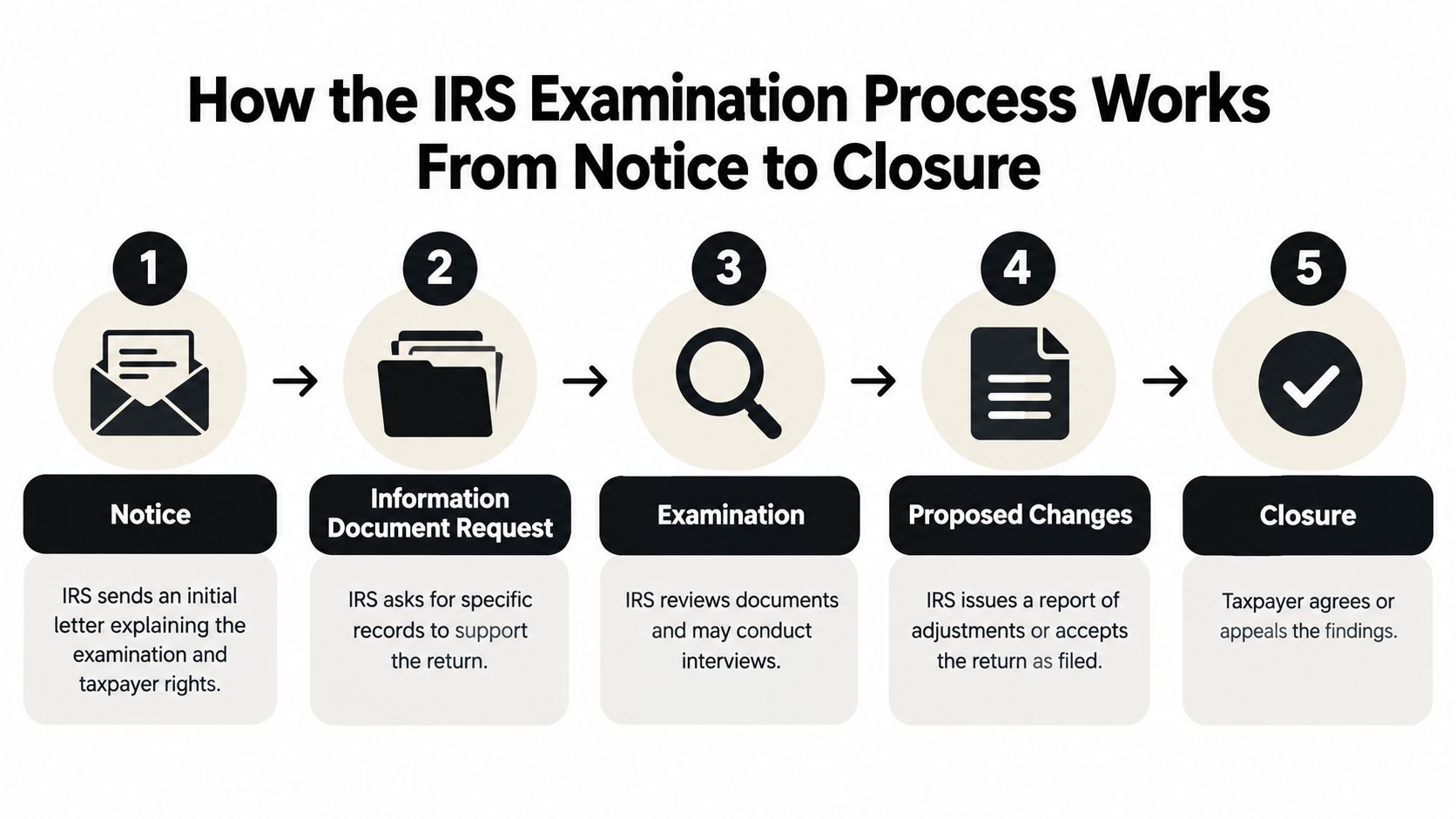
An examination follows a sequence, even when the correspondence feels improvised. The initial letter identifies the return or issues under review and explains the examination process and taxpayer rights. The IRS then develops facts through document requests, interviews, sampling, and testing.
The request controls the first response
An Information Document Request, or IDR, is generally issued on Form 4564. The IRS examination manual describes the audit as an evidence-development process and generally targets completion within its 26/27-month examination cycle. See the IRS guidance on information document requests.
An IDR should be focused on the issue being developed. Your response should mirror that structure:
- Identify the return line or transaction involved.
- Match each requested item to a specific document.
- State when a requested record doesn't exist or isn't available.
- Explain discrepancies with a short factual narrative.
- Keep copies of the submission and proof of timely delivery.
Don't send every document you possess. Excess production can bury the controlling evidence, while an incomplete response leaves gaps the examiner may fill with assumptions or third-party data. The goal is not volume. The goal is a traceable record that supports the filed position.
A practical audit-ready checklist from MyOfficeOps can help establish a repeatable records process before and during an examination. Use it to inventory documents, not as a substitute for analyzing the particular IDR.
How scope expands
The examiner may sample transactions, reconcile accounting records to the return, analyze adjusting journal entries, test classification and tax periods, and trace selected expenses to receipts. For a business owner, personal accounts may become relevant when they contain business deposits or expenses. Weak bookkeeping can therefore expand the examination beyond the line item named in the first letter.
Newly identified material issues may justify additional development or a related-year review. That doesn't mean every question is improper. It means you should understand why the request was made and whether the requested records relate to a defined issue.
The detailed account of what happens during an IRS audit is useful for preparing for interviews, sampling, and proposed adjustments. At each stage, answer the question asked, preserve relevant objections, and avoid unsupported speculation.
Your Rights as a Taxpayer During a Federal Tax Audit
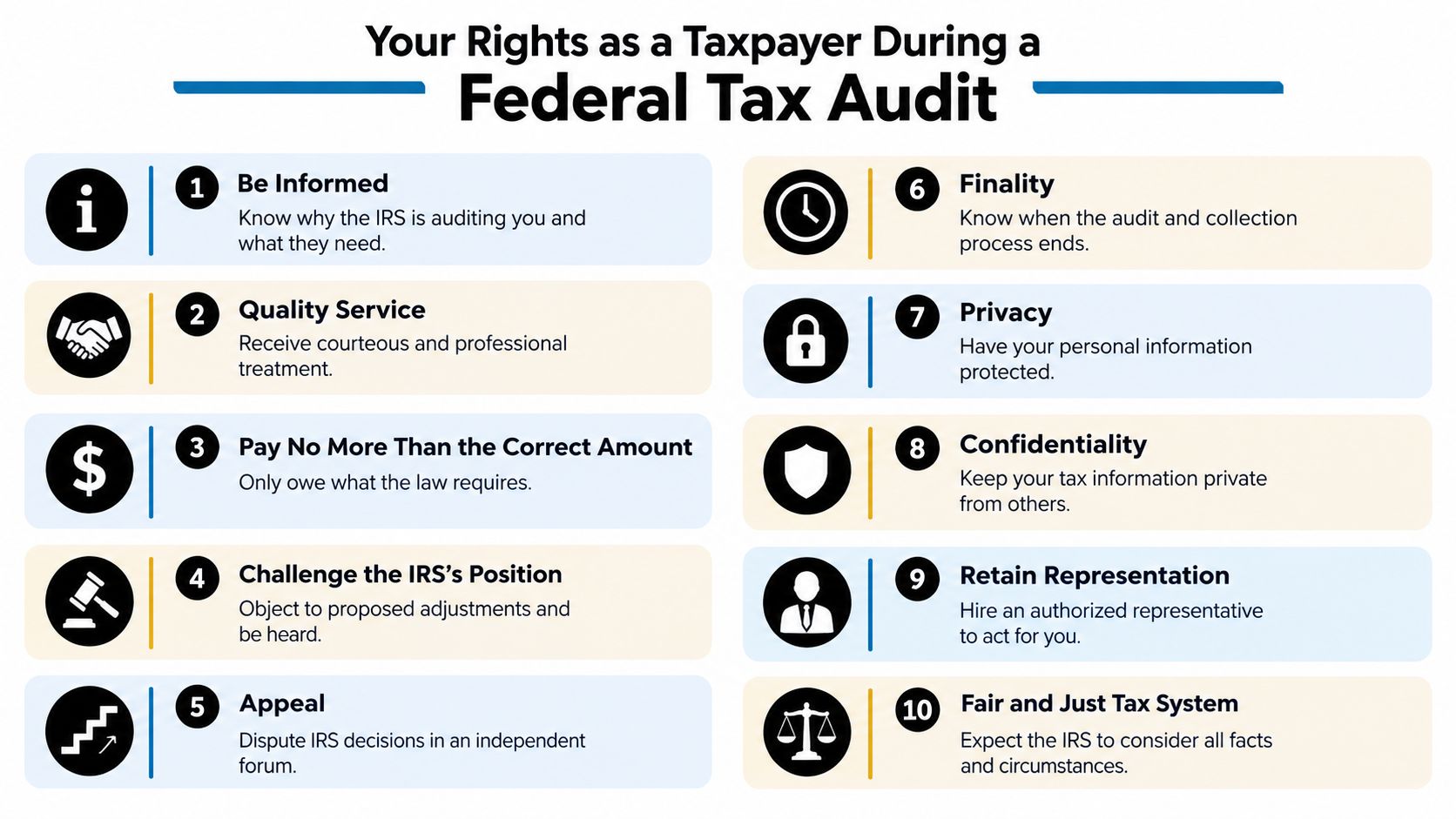
The Taxpayer Bill of Rights groups statutory protections into 10 fundamental rights, including the right to pay no more than the correct amount of tax and the right to a fair and impartial tax system. The Taxpayer Advocate Service assessment provides the statutory framework.
Those rights are practical tools, not decorative language:
- The right to be informed: Ask why the IRS needs a document, how it will be used, and what may happen if you don't provide it.
- The right to quality service: Expect clear, courteous, and professional communication.
- The right to pay no more than the correct amount: Require the examiner to identify the legal and factual basis for a proposed adjustment.
- The right to challenge the IRS's position and be heard: Submit objections and supporting records before the IRS finalizes its position.
- The right to appeal an IRS decision: Use the administrative Appeals process when the facts or law remain disputed.
- The right to finality: Ask what remains open, what deadlines apply, and when the examination will close.
- The right to privacy: The examination should use appropriate procedures and relevant requests.
- The right to confidentiality: Tax information should be protected from unauthorized disclosure.
- The right to retain representation: An authorized representative can communicate with the IRS on your behalf through a power of attorney, commonly Form 2848.
- The right to a fair and impartial tax system: The IRS must consider relevant facts and timely objections rather than treating its initial position as conclusive.
Representation changes the communication channel. An attorney can help preserve privilege where applicable, separate factual investigation from legal conclusions, and prevent a taxpayer from making an unnecessary admission. If the IRS proposes changes, most disputes can proceed through administrative Appeals, and eligible taxpayers may seek judicial review.
Possible Outcomes of a Federal Tax Audit
An audit ends with a position, a document, and a decision about what happens next. Don't sign anything until you understand whether the document closes the examination, records an agreed adjustment, or preserves your ability to challenge the result.
| Outcome | Document | Taxpayer Response | Next Step |
|---|---|---|---|
| No change | Closing documentation confirming the return remains unchanged | Review the covered tax year and issues, then retain the file | Preserve the examination records and confirmation |
| Agreed adjustment | An examination report, such as Form 4549, or an agreement such as Form 870 | Confirm the calculations and sign only after understanding the consequences | Pay, arrange resolution of the balance, or address related filing obligations |
| Unagreed adjustment | A report reflecting proposed changes and potentially a statutory notice of deficiency | File a timely protest or petition when required | Use IRS Appeals or seek review in the U.S. Tax Court |
A no-change result means the IRS accepted the examined positions after reviewing the evidence. It doesn't mean every possible tax issue received a permanent ruling, so retain the notice, submissions, workpapers, and closing correspondence.
An agreed adjustment usually means the taxpayer accepts the proposed change. Before signing, verify income, deductions, credits, penalties, interest, and tax periods. If the resulting liability can't be paid immediately, address payment options separately rather than ignoring the balance.
An unagreed adjustment requires deadline discipline. A statutory notice of deficiency, commonly called a 90-day letter, can create a path to the U.S. Tax Court. Administrative Appeals may also be available, depending on the procedural stage. The correct route depends on the notice, the date it was issued, and whether the taxpayer has already agreed to an adjustment.
Practical Steps if You Receive an IRS Audit Notice
Your first response should be orderly, not emotional.
- Read the notice and identify the format. Determine whether the IRS wants mailed documents, an office meeting, or access to business records in a field examination.
- Calendar every deadline. Use the date on the notice, and preserve proof of mailing or electronic submission.
- Freeze casual contact. Don't call the examiner before you understand the issues and decide whether an authorized representative should speak for you.
- Build an issue-to-document map. For every IDR item, identify the return line, source record, explanation, and unresolved gap.
- Reconcile before producing. Compare bank deposits, sales records, payment processors, ledgers, and the filed return.
- Explain missing records accurately. Never replace unavailable evidence with guesses. State what is missing, why, and what substitute records support the position.
- Submit a controlled package. Use an index, consistent labels, and a short factual explanation. Keep the complete copy.
The quiet mistakes are predictable. Commingled personal and business funds make gross receipts harder to prove. Unexplained bank-deposit differences invite broader questions. A disorganized production forces the examiner to search for the answer. A missed deadline can allow a proposed adjustment to move forward without your evidence.
Self-employed taxpayers, business owners with payroll issues, and anyone facing potential Trust Fund Recovery Penalty exposure should seriously consider representation before responding. Counsel costs money, but so can an avoidable admission, an incomplete bank analysis, or a failure to preserve an appeal position. A client representation letter signing guide can help clarify the scope of an engagement before documents are exchanged.
Use this guide to preparing for an IRS audit as a starting point, then adapt the process to the actual notice. The strongest response is specific, timely, and supported by records that an examiner can follow without guessing.
Getting Clear Answers Before You Respond
A federal tax audit has three formats, but the response principle is the same: define the issue, prove the number, and protect the deadline. You retain ten fundamental taxpayer rights, and the IRS must develop its position through relevant evidence rather than relying on the intimidation of its letterhead.
A narrow correspondence request may be manageable without counsel when the records are complete and the issue is clear. A field examination, business-income reconciliation, payroll-tax matter, or disputed legal position deserves a professional strategy. If you're unsure where your notice falls, review when to seek IRS audit help before sending an informal explanation.
A free Tax Debt Analysis can help you assess whether representation is appropriate, what exposure requires immediate attention, and whether the next step is documentation, negotiation, or appeal.
Tax Attorney Stephen A Weisberg helps individuals and businesses respond to IRS audits, organize evidence, protect taxpayer rights, and address related tax debt issues. If you have an audit notice or expect an examination, visit Tax Attorney Stephen A Weisberg to request a free Tax Debt Analysis before committing to paid representation.


