What If I Miss Tax Deadline? what if i miss tax deadline and penalties explained
what if i miss tax deadline: This guide explains penalties, interest, and the exact steps to file and resolve the issue quickly.

In this article
- The First 24 Hours After a Missed Tax Deadline
- Understanding the Two Main Penalties
- Why Filing Late Is More Costly Than Paying Late
- The Math Behind the Penalties
- A Real-World Example
- Your Immediate Three-Step Action Plan
- Step 1: File Your Return Immediately
- Step 2: Pay Whatever You Can
- Step 3: Explore Your Payment Options
- Finding a Path Forward with IRS Relief Programs
- An Installment Agreement
- An Offer in Compromise
- Penalty Abatement
- Higher Stakes for Business Owners and the Self-Employed
- The Dangers of Payroll Tax Debt
- The Added Weight of State and Local Taxes
- When You Need to Call a Tax Attorney
- Signs You Need Professional Tax Help
- Beyond Forms to Strategic Solutions
- Your Questions Answered: Dealing With a Missed Tax Deadline
- What If I'm Actually Owed a Refund?
- Is It Too Late to Get a Tax Extension?
- How Does the IRS Calculate Interest on My Debt?
So, you just realized you missed the tax deadline. That sinking feeling is normal, but before you panic, take a deep breath. Here’s the single most important thing to understand right now: what happens next depends entirely on whether you owe the IRS money or if they owe you a refund.
If you’re due a refund, you can relax a bit. There’s actually no penalty for filing late in this situation. Just keep in mind that you only have three years to file that return and claim your money before it's gone for good.
The First 24 Hours After a Missed Tax Deadline

That heart-in-your-stomach moment when you realize the deadline has passed is tough. But the worst thing you can do is nothing. Think of a missed deadline like a small leak in a pipe—it’s a manageable problem if you fix it right away, but ignoring it can lead to a flooded basement.
The first step is to figure out exactly what you're dealing with. If you owe the IRS, two separate problems have just been created, each with its own penalty:
- Failure-to-File Penalty: This is for not getting your tax return submitted on time.
- Failure-to-Pay Penalty: This is a separate penalty for not paying the tax you owe by the deadline.
Understanding the Two Main Penalties
Believe it or not, the IRS is much more concerned about you filing than you paying. They can’t collect what they don’t know you owe. This is why the Failure-to-File penalty is so much more severe.
It’s a painful 5% of your unpaid tax bill for each month (or part of a month) your return is late, and it can max out at a staggering 25% of your total tax debt. This penalty racks up quickly and can turn a small tax bill into a huge problem.
And it gets worse. If your return is more than 60 days late, the minimum penalty skyrockets. You'll be on the hook for either $525 or 100% of the unpaid tax, whichever is less. That's a massive jump designed to get your attention.
The Failure-to-Pay penalty, on the other hand, is much smaller at just 0.5% per month. The takeaway here is crystal clear: even if you don't have a penny to send the IRS, file your return immediately. Filing stops that big 5% penalty in its tracks.
Soon after the deadline passes, you can expect to start receiving official mail. Knowing how to interpret these IRS letters and notices is the critical next step in getting things sorted out.
Why Filing Late Is More Costly Than Paying Late
When you miss the tax deadline, it’s easy to panic and lump everything into one big, messy problem. But the IRS actually sees two separate issues: failing to file your return and failing to pay your tax bill.
Knowing the difference is critical, because one of these mistakes will cost you far, far more than the other.
Here’s the thing: the IRS’s top priority is knowing what you owe. The actual payment, while obviously important, comes second. That’s why the Failure-to-File penalty is so severe—it's designed to be a powerful motivator to get that return submitted, even if you can’t pay a single dollar yet.
The Math Behind the Penalties
Let's break down the penalties side-by-side. The numbers make it crystal clear why filing your return has to be your number one priority.
Failure-to-File Penalty: This one hurts. It’s 5% of your unpaid tax bill for every month or part of a month your return is late. This penalty keeps adding up until it hits a cap of 25% of your total tax debt.
Failure-to-Pay Penalty: This penalty is much more manageable. It’s calculated at just 0.5% of your unpaid taxes each month. It also maxes out at 25%, but it takes a whole lot longer to get there. It accumulates ten times slower.
If you’re late on both, the IRS has a rule where the Failure-to-File penalty is reduced by the amount of the Failure-to-Pay penalty for that month. But don't be fooled—the combined charge is still almost entirely driven by the penalty for not filing.
A Real-World Example
Let's say you're a freelancer who owes the IRS $15,000, and you are five months late on both filing and paying.
Scenario 1: You Don't File and Don't Pay The 5% Failure-to-File penalty kicks in immediately, costing you $750 per month. After five months, that’s a whopping $3,750 in penalties just for not filing. This doesn't even touch the smaller Failure-to-Pay penalty and the interest that's been piling up.
Scenario 2: You File on Time but Can't Pay You filed your return (or an extension), so that brutal 5% penalty never even starts. Instead, you only face the 0.5% Failure-to-Pay penalty, which comes to $75 per month. After five months, your total penalty is only $375.
The difference is staggering: $3,375.
Simply by getting the paperwork in, you stop the most aggressive IRS penalty cold. This is why it's so vital for businesses to stay on top of deadlines, which includes understanding corporate tax registration deadlines and potential penalties.
Even if you can't pay, filing the return demonstrates good faith to the IRS and immediately opens up more options for relief. It’s also the very first step in determining if you have reasonable cause for penalty abatement.
Your Immediate Three-Step Action Plan
That sinking feeling you get when you realize you've missed the tax deadline is a familiar one for many. But don't let anxiety paralyze you. It's time to shift from panic to a clear, productive action plan.
Think of this as your emergency checklist. Following these three steps immediately will help you regain control, minimize the financial fallout, and show the IRS that you're taking this seriously.
Step 1: File Your Return Immediately
This is, without a doubt, the most critical thing you can do. File your tax return now. Even if you can't pay a single penny of what you owe, get that return submitted.
Why? Because filing stops the clock on the brutal Failure-to-File penalty, which racks up at a staggering 5% per month on your unpaid tax bill. Modern tax software makes it simple to e-file even after the deadline, getting your return officially on record with the IRS and stopping that expensive penalty in its tracks.
The difference between the two main penalties is huge.
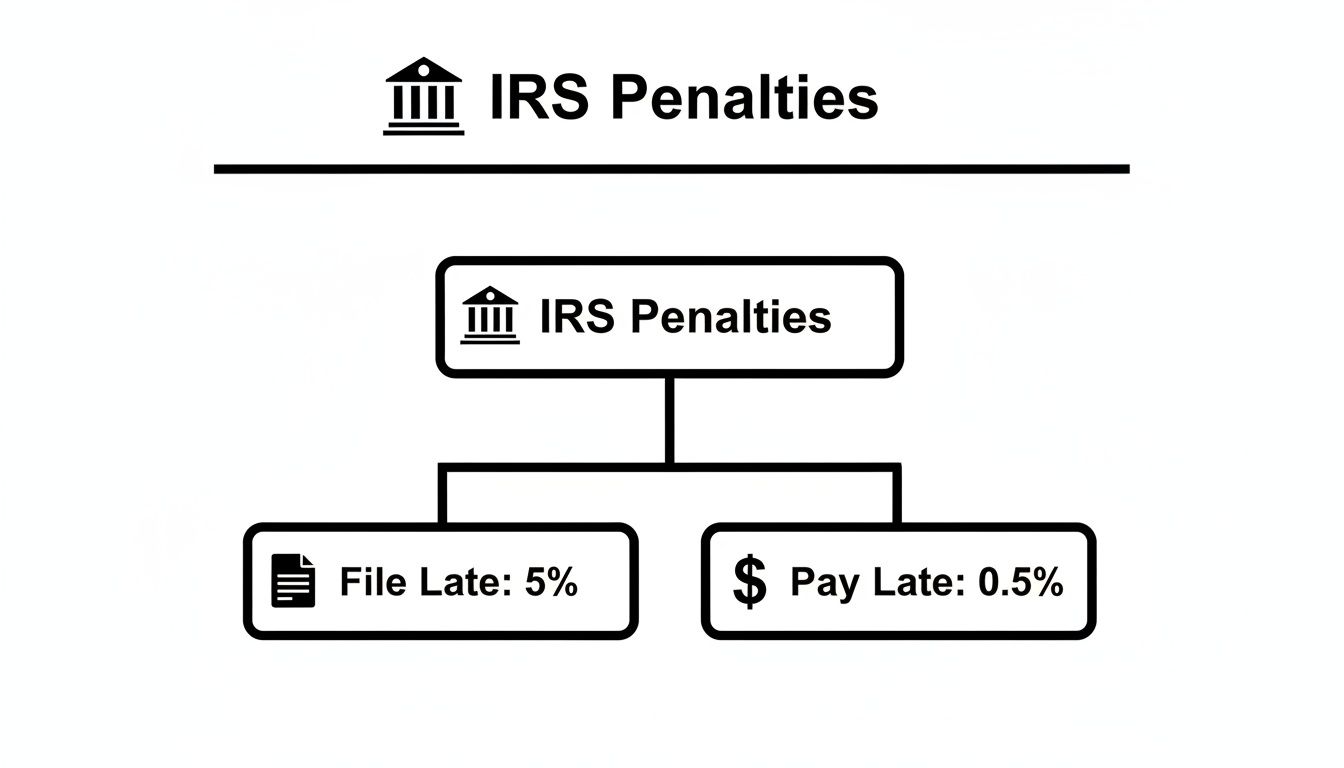
As you can see, the penalty for not filing is ten times worse than the penalty for not paying. That’s why filing is your absolute first priority.
Step 2: Pay Whatever You Can
Once your return is filed, the next move is to chip away at the balance. Every dollar you can pay right now is a dollar that won't be subject to the ongoing Failure-to-Pay penalty of 0.5% per month and compounding daily interest.
Even a small, partial payment makes a real difference. You can pay directly and easily on the IRS website using their Direct Pay tool. Paying something—anything at all—demonstrates good faith and immediately shrinks the balance that's accumulating more debt.
Key Takeaway: Your goal is to stop the financial bleeding. Filing halts the biggest penalty, and paying what you can slows the growth of the remaining penalties and interest.
Step 3: Explore Your Payment Options
Finally, don't assume you have to come up with the entire amount at once. The IRS has several programs designed to help people who genuinely can't afford to pay their tax bill in full. Knowing these options exist is the first step toward moving forward.
Common relief programs include:
- Installment Agreements: This is a formal plan that lets you make manageable monthly payments over time, much like a loan.
- Offer in Compromise (OIC): If you're facing significant financial hardship, an OIC might allow you to settle your tax debt for less than you originally owed.
- Penalty Abatement: If you had a reasonable cause for filing or paying late, you might be able to get certain penalties removed entirely.
Each of these avenues has its own set of rules and application procedures. The best way to navigate them is to get professional guidance when you make payment arrangements with the IRS. This ensures you choose the right strategy and present your case in the strongest possible light.
Finding a Path Forward with IRS Relief Programs
Once you’ve stopped the bleeding from a missed tax deadline, the real work begins: finding a long-term solution that you can actually live with. The good news is, the IRS isn’t just out to get you; they have structured programs specifically designed to help people get back on their feet. Knowing what these are is the first step to getting out from under that stress.
Think of these programs as different tools in a toolbox. The right one for you will depend entirely on your financial picture and why you fell behind in the first place. Let’s break them down.
An Installment Agreement
The most common and straightforward route is the Installment Agreement. It’s exactly what it sounds like: a payment plan. If you owe a chunk of money but can't possibly pay it all right now, this lets you break that debt down into manageable monthly payments.
This is usually the best fit for taxpayers with a steady income who can realistically pay off their debt over a set period. The IRS has made this pretty easy for many people, even allowing them to set up a plan online. It’s a key piece of the broader IRS Fresh Start Program, which was created to make repayment less daunting.
An Offer in Compromise
What if your financial situation is truly dire? That’s where an Offer in Compromise (OIC) comes in. An OIC is a formal program that allows some taxpayers to settle their tax liability for less than the full amount they owe. This isn't just a simple negotiation—it's an intense process where the IRS scrutinizes your income, expenses, assets, and overall ability to pay.
To even be considered, you have to prove that paying the full amount would cause you significant economic hardship. The IRS will only agree to an OIC if they determine it's the most they could ever hope to collect from you. It's a high bar, but for those who qualify, it’s a genuine fresh start.
Penalty Abatement
Sometimes, the original tax bill isn't the killer—it's the mountain of penalties piled on top. Penalty Abatement is the formal process of asking the IRS to remove those penalties. The key here is being able to show you had a "reasonable cause" for not filing or paying on time.
So, what counts as a reasonable cause? We're not talking about just forgetting or being disorganized. This is for situations like a severe illness, a death in the family, a natural disaster, or another circumstance that was genuinely beyond your control. It’s an appeal to fairness, not an excuse.
You might be surprised how often this works. In a recent fiscal year, the IRS hit taxpayers with $73.6 billion in civil penalties but also agreed to abate $50.9 billion of them. That's over two-thirds of the penalties forgiven. You can see more details on these IRS penalty and abatement trends.
Each of these programs requires specific forms, strict deadlines, and a boatload of documentation. Getting it right often means having a clear strategy to present your case in the strongest possible light.
Higher Stakes for Business Owners and the Self-Employed
For someone with a regular W-2 job, a missed tax deadline is a personal headache. But if you’re a business owner or self-employed, it’s an entirely different ballgame. The stakes are infinitely higher. A missed deadline isn’t just a personal tax issue; it's a direct threat to your business, your livelihood, and even your personal assets in a way most employees never have to worry about.
When you're running a business, you're not just filing your own income tax return. You're also a collector for the government, responsible for things like payroll taxes. This money, often called "trust fund" taxes, is cash you withhold from your employees' paychecks that legally belongs to the U.S. Treasury. It was never your money in the first place.
The Dangers of Payroll Tax Debt
Failing to hand over these trust fund taxes is one of the biggest mistakes a business can make. The IRS comes after unpaid payroll taxes with a vengeance because, in their eyes, you didn't just fail to pay a bill—you essentially stole from the government. This is where things get uniquely dangerous for business owners.
The IRS has a powerful weapon called the Trust Fund Recovery Penalty (TFRP). This tool lets them bypass your business's legal structure, or "pierce the corporate veil," to hold the people in charge personally responsible for the debt.
What does that mean? Even if your business is set up as an LLC or a corporation to protect you, the IRS can seize your personal bank accounts, put a lien on your house, and go after your other personal assets to get that money back. The TFRP can be used against any "responsible person," which could be an owner, a company officer, or even a bookkeeper who had the authority to send in the payments.
The Added Weight of State and Local Taxes
And the pressure doesn't just come from the federal government. As a business owner, you have a completely separate set of rules and deadlines for state and sometimes even local tax agencies. They have their own penalty calculations and their own aggressive collection methods.
Missing a state sales tax payment or an unemployment insurance deadline can set off a whole new chain reaction. Suddenly you're dealing with state-level liens and levies that are piling up right alongside your problems with the IRS. Juggling multiple tax agencies makes it far too easy for one small mistake to snowball into a full-blown crisis that could sink your business.
This multi-layered responsibility is why staying on top of your finances is absolutely critical. To prevent these kinds of oversights, many business owners are leveraging AI in accounting to automate key processes and get deadline reminders. For any business owner wondering what to do if they miss a tax deadline, the potential consequences are so severe that getting professional help isn't just a good idea—it's essential for survival.
When You Need to Call a Tax Attorney

Look, sometimes missing a tax deadline is an honest mistake you can fix yourself. A simple amended return, a quick payment online—problem solved. But when a small oversight snowballs into a genuine tax problem, going it alone can dig you into a much deeper hole.
Knowing when to wave the white flag and bring in a professional is the single most important decision you can make. It’s about protecting yourself, your family, and your financial future.
Signs You Need Professional Tax Help
Certain situations are clear red flags. If you see any of these, it's time to stop what you're doing and get an expert on the phone. These aren't just suggestions; they're high-stakes scenarios where one wrong move could have devastating consequences.
- You Owe Over $10,000: The moment your tax debt crosses that five-figure threshold, the IRS playbook changes. Their collection efforts ramp up significantly, and the solutions become far more complex than simply writing a check.
- You're Facing Payroll Tax Issues: This is a big one for business owners. Unpaid payroll taxes can trigger the Trust Fund Recovery Penalty, a nasty tool the IRS uses to pierce the corporate veil and come after your personal assets. Your home, your savings—it's all on the line.
- You've Received an IRS Notice of Lien or Levy: Don't ignore these letters. A lien is a legal claim against your property to secure the debt, and a levy is the actual seizure of that property to satisfy it. These are the IRS's final moves, and they require an immediate, expert-led response.
A tax attorney does more than just fill out paperwork. They bring a strategic mind to the table, analyzing your entire financial picture to find the best possible resolution. This shifts you from a place of fear and reaction to a position of control and action.
Beyond Forms to Strategic Solutions
An experienced tax attorney knows the system inside and out. They understand the unwritten rules, the negotiation tactics, and the relief options you've probably never heard of. Navigating an Installment Agreement, an Offer in Compromise, or a Penalty Abatement request is more art than science, and they’ve mastered it.
Instead of drowning in confusing forms and threatening notices from the IRS, a professional gives you a clear, actionable plan. It starts with a comprehensive analysis to pinpoint the exact strategy needed to solve your problem for good—before you waste time and money on a solution that won't work.
Your Questions Answered: Dealing With a Missed Tax Deadline
When you realize a tax deadline has come and gone, a flood of questions usually follows. Let's cut through the noise and get you some straight answers to the most common concerns.
What If I'm Actually Owed a Refund?
This is the best-case scenario if you've missed the deadline. You can relax a bit, because there is no penalty for filing a late return when the government owes you money. The Failure-to-File penalty is based on unpaid tax, so if you don't have any, the penalty is zero.
But don't wait forever. The IRS gives you a three-year window from the original tax due date to file that return and claim your refund. If you let that deadline slip, the money is gone for good—it officially becomes the property of the U.S. Treasury.
Is It Too Late to Get a Tax Extension?
Yes, unfortunately, it is. A request for an extension to file, done with Form 4868, has to be submitted by the original tax deadline (usually April 15th). You can't go back in time and ask for one after the date has passed.
At this point, forget about the extension. Your one and only priority should be to get the actual tax return filed immediately. Every day you wait, the potential Failure-to-File penalty gets bigger and bigger.
How Does the IRS Calculate Interest on My Debt?
The IRS is like any other creditor—it charges interest. This interest applies to your original unpaid tax bill and to any penalties that have been tacked on. The rate is the federal short-term rate plus three percentage points.
What really makes it sting is that the interest compounds daily. This means you’re not just paying interest on the principal; you're paying interest on the interest. This can make a tax debt snowball surprisingly fast, which is why it's critical to stop the clock by paying what you can, as soon as you can.
Feeling overwhelmed by IRS notices or a growing tax bill? The rules are complex, but you don't have to face them alone. At Attorney Stephen A Weisberg, I provide a free, no-obligation Tax Debt Analysis to identify the best path forward for your specific situation. Find your solution at https://weisberg.tax.


