What If I Don't File My Taxes A Guide to IRS Rules
What if I don't file my taxes? Discover the serious penalties, IRS actions, and long-term consequences. Learn how to resolve unfiled returns today.
In this article
- The Immediate Penalties for Not Filing Your Taxes
- Understanding The Failure To File Penalty
- The Double Hit With Failure To Pay And Interest
- Initial Penalties For Unfiled Taxes At A Glance
- How the IRS Discovers Unfiled Tax Returns
- The Information Trail You Can't Erase
- How The IRS Connects The Dots
- The Substitute for Return: A Bad Deal For You
- The IRS Enforcement Action Timeline
- IRS Enforcement Action Timeline
- The Federal Tax Lien: A Public Claim On Your Assets
- From Lien To Levy: Seizing Your Property
- How The IRS Can Take Your Assets
- Long-Term Damage from Unfiled Taxes
- Wrecking Your Credit and Financial Future
- Jeopardizing Your Social Security Benefits
- Career and Travel Complications
- Immigration Status at Risk
- A Practical Plan to Get Back on Track With the IRS
- Step 1: Gather Your Financial Puzzle Pieces
- Step 2: Prepare and File Your Past-Due Returns
- Step 3: Tackle the Tax Bill Head-On
- The IRS Installment Agreement
- The Offer in Compromise Program
- When Does a Mistake Become a Crime?
- The "Badges of Fraud" That Signal Intent
- The Staggering Price of Tax Evasion
- Common Questions About Unfiled Taxes
- What Happens If I'm Owed a Refund but Didn't File?
- Can I Go to Jail for Not Filing My Taxes?
- How Many Years of Back Taxes Do I Need to File?
Blowing off your tax filing deadline is a seriously expensive mistake. The moment that deadline passes, the clock starts ticking on some pretty hefty penalties and interest charges that grow every single day.
This isn't a problem that just fades away—it snowballs, getting bigger and more stressful the longer you let it slide.
The Immediate Penalties for Not Filing Your Taxes
So, what happens if you don't file your taxes? The first answer is money. The IRS starts adding financial penalties to your bill right away, and they don't mess around.
Think of it like a loan shark's version of a credit card. The balance you owe starts growing immediately, and it grows fast. This isn't just about the tax you originally owed; it's about all the extra costs that pile up on top of it.

The two big penalties you need to know about are the Failure to File and Failure to Pay penalties. They're separate, but the IRS can—and often does—hit you with both at the same time, which is how a manageable tax bill can quickly become a mountain of debt.
Understanding The Failure To File Penalty
Of the two, the Failure to File penalty is the real bruiser. It’s calculated as 5% of your unpaid taxes for each month (or even part of a month) that your return is late.
This penalty maxes out, but not until it hits 25% of your total unpaid tax bill. To put that in perspective, if you owe the IRS $10,000, this penalty alone adds another $500 to your debt every month it goes unfiled. It will keep climbing until it tacks on an extra $2,500.
The penalty is deliberately severe because the government’s top priority is getting people to file their returns. From their perspective, not even bothering to file is a much bigger offense than filing but being unable to pay right away.
And this isn't some small-time issue. The IRS estimates that non-filing contributed a staggering $63 billion to the U.S. tax gap in 2022 alone.
The Double Hit With Failure To Pay And Interest
On top of the Failure to File penalty, you're also looking at the Failure to Pay penalty. This one is smaller, usually 0.5% of your unpaid taxes per month, and it also caps out at 25%. While it might seem minor in comparison, it's just another layer of debt being added to the pile.
Here’s a quick breakdown to see how these initial penalties work.
Initial Penalties For Unfiled Taxes At A Glance
This table gives you a snapshot of the two main penalties you'll face right out of the gate for not filing and paying on time.
| Penalty Type | Penalty Rate | Maximum Penalty |
|---|---|---|
| Failure to File | 5% of unpaid tax per month | 25% of unpaid tax |
| Failure to Pay | 0.5% of unpaid tax per month | 25% of unpaid tax |
These two penalties can run simultaneously, making it crucial to act quickly to stop the financial bleeding.
But the real kicker is the interest. The IRS charges interest not only on your original unpaid tax but also on the penalties themselves. This is where things get out of control, creating a compounding effect that can make your debt grow exponentially.
While every country has its own approach to navigating penalties for late tax returns, the U.S. system is particularly unforgiving. If you think you had a legitimate reason for filing late, you might be able to request relief. You can learn more about how the IRS reviews cases for penalty abatement based on reasonable cause.
How the IRS Discovers Unfiled Tax Returns
A lot of people who get behind on their taxes cling to one hope: maybe, just maybe, they can fly under the radar. It’s a nice thought, but unfortunately, it’s a dangerous myth. The IRS has a powerful, mostly automated system that's incredibly good at spotting people who earned income but never filed a return.
Think of it like a financial paper trail. Every time you get paid for a job, earn interest, or make money as a freelancer, it creates a data point. Your employer, your clients, and your bank are all legally required to report those payments to the IRS. Piece by piece, they build a surprisingly detailed picture of your financial year.
This system leaves very little room to go unnoticed. The IRS isn't relying on random audits or someone reporting you; it's using a massive data-matching program that works around the clock to connect the dots.
The Information Trail You Can't Erase
The whole discovery process kicks off with what are called "information returns." These are the forms that third parties send to both you and the government, and they're the bedrock of the entire tax system.
You've probably seen most of them before:
- Form W-2: This is the big one from your employer, showing your total wages for the year and how much tax was withheld.
- Form 1099-NEC: If you're a freelancer or independent contractor, you'll get one of these from any client who paid you $600 or more.
- Form 1099-K: This form reports payments you received through platforms like PayPal, Stripe, or online marketplaces. Even with changing thresholds, these companies report huge volumes of transactions directly to the IRS.
- Form 1099-INT & 1099-DIV: Your bank and brokerage firms send these to report any interest or dividends you earned on your accounts.
Every single one of these forms is a piece of the puzzle. You get a copy, but so does the IRS.
How The IRS Connects The Dots
The IRS takes all of this third-party data and feeds it into its sophisticated computer system. From there, it performs a simple but incredibly effective check: it compares all the income reported under your Social Security Number (SSN) against the tax returns it has on file.
When the system finds income linked to your SSN but no matching tax return, an immediate red flag goes up. This mismatch is exactly what triggers the first IRS notice asking why you didn't file. It's really not a question of if they will find out, but when. As technology improves, understanding potential tax authority compliance crackdowns is more important than ever for anyone with unfiled returns.
This automated dragnet is stunningly accurate and catches the vast majority of non-filers. The days of being "invisible" to the tax man are over. The IRS is laser-focused on closing the "tax gap," and a huge part of that strategy is going after those who fail to file. In fact, the IRS is cracking down on non-filers and unfiled returns more than ever before. https://www.weisberg.tax/newsletter/the-irs-is-cracking-down-on-nonfilers-and-unfiled-returns-96nxe-mg8c9-s754p
The Substitute for Return: A Bad Deal For You
Once the IRS is confident you had income and should have filed, it won’t just sit around and wait for you. Instead, the agency will often create what’s called a Substitute for Return (SFR) on your behalf.
An SFR is the IRS's version of your tax return, and it's almost always prepared in a way that benefits the government, not you. It's a worst-case-scenario calculation.
Here’s why an SFR is such a problem for taxpayers:
- It Ignores Your Deductions and Credits: The IRS only uses the income data it has on hand. It makes no effort to include any of the deductions (like business expenses for a freelancer) or credits (like the Child and Family Tax Credit) you were rightfully owed.
- It Assumes the Worst Filing Status: The SFR almost always defaults to "Single" or "Married Filing Separately." These statuses have the smallest standard deductions and highest tax rates, leading to a much larger tax bill than if you had filed as "Married Filing Jointly" or "Head of Household."
- It Kicks Off the Collection Process: The tax debt created by the SFR is 100% legally enforceable. Once it's on the books, the IRS will assess the tax, tack on penalties and interest, and immediately start the collection process. This is what leads to bank levies and federal tax liens.
Don't mistake an SFR for a helpful gesture. It's a powerful enforcement tool designed to create a tax debt that the IRS can then aggressively collect.
The IRS Enforcement Action Timeline
Think of those first few IRS notices like a slow, annoying drip from a small leak in your roof. It's easy to ignore at first, maybe you just put a bucket under it. But if you don't get up there and fix the problem, that small drip will eventually lead to a full-blown ceiling collapse. The IRS enforcement process works a lot like that—it starts small but escalates into a major problem if you don't take action.
When you fail to file a tax return, the process kicks off with a series of automated letters. These notices, like the CP515 or CP518, are the IRS's initial, polite way of asking, "Hey, where's your return?" As time goes on, the tone of these letters gets a lot firmer, often culminating in a proposed tax bill based on what they think you owe.
This is how the IRS typically discovers non-filers and starts the enforcement clock.
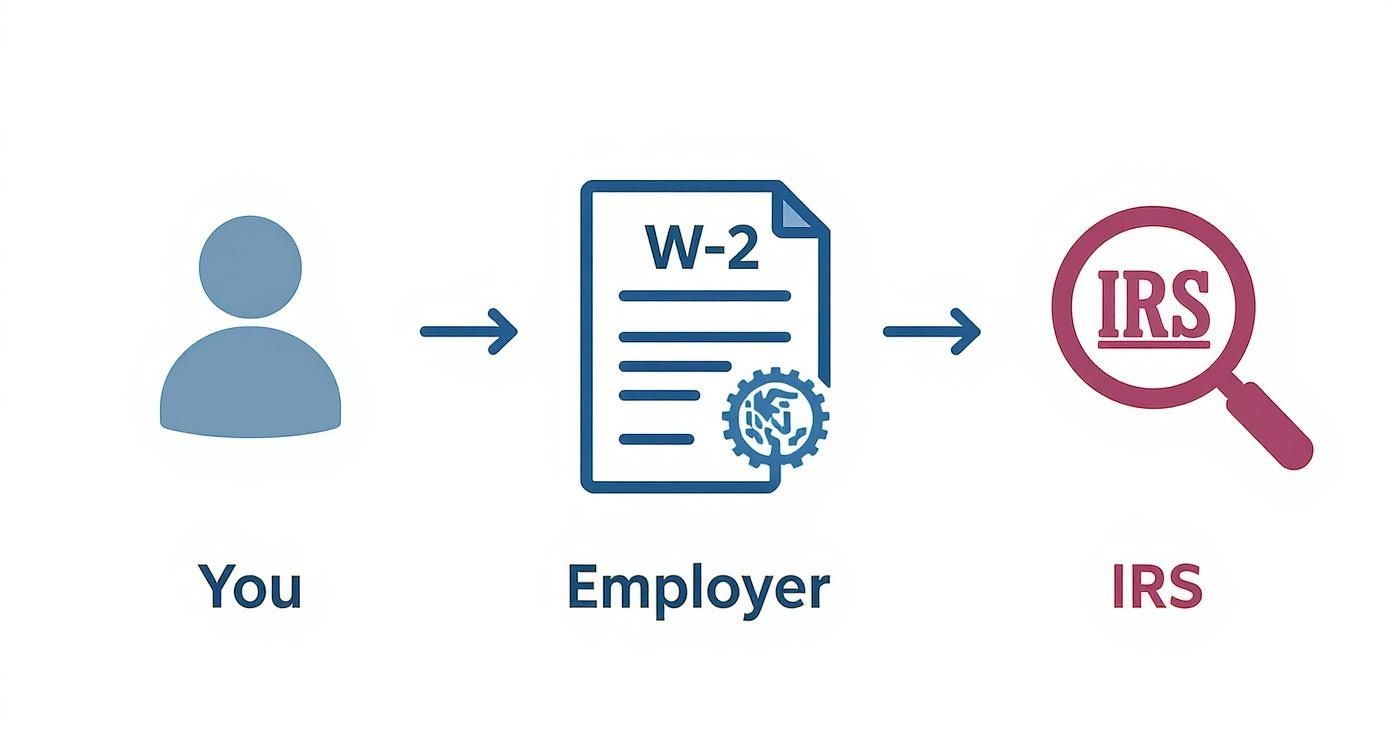
As you can see, it's a straightforward process. Your employer, your bank, and other financial institutions send your income data to the IRS. Their systems then cross-reference that information with the returns they've received, and any gaps—like a missing return—stick out like a sore thumb.
To give you a clearer picture of how things progress, here’s a breakdown of the typical IRS enforcement timeline.
IRS Enforcement Action Timeline
This table outlines the typical progression of IRS actions against non-filers, from initial notices to severe collection measures.
| Phase | IRS Action | Impact on Taxpayer |
|---|---|---|
| Phase 1: Initial Contact | IRS sends automated notices (e.g., CP515, CP518) requesting the missing tax return. | These are warnings. No immediate financial impact, but the clock is ticking on penalties and interest. |
| Phase 2: Proposed Assessment | If you don't respond, the IRS creates a Substitute for Return (SFR), calculating tax based on third-party info. | You receive a proposed tax bill (CP3219N), which is often higher than what you actually owe. You have a limited time to challenge it. |
| Phase 3: Formal Assessment | The tax is officially assessed, and the IRS sends a formal bill (Notice and Demand for Payment). | The debt is now legally established. This is the official starting point for serious collection efforts. |
| Phase 4: Lien Filing | A Notice of Federal Tax Lien is filed, making your tax debt a public record. | Your credit score plummets. Securing new loans becomes extremely difficult. The lien attaches to all your property. |
| Phase 5: Levy Action | The IRS sends a Final Notice of Intent to Levy. After 30 days, they can begin seizing assets. | Your wages can be garnished, funds can be seized from your bank accounts, and physical property can be taken and sold. |
This sequence shows how a simple failure to file can spiral into a serious financial crisis. Each phase is a direct consequence of inaction in the previous one.
The Federal Tax Lien: A Public Claim On Your Assets
If you continue to ignore the notices after a tax debt has been officially assessed, the IRS will likely file a Notice of Federal Tax Lien. This is a massive escalation. Your private tax problem has just gone public.
A federal tax lien is a legal claim against all of your property—both what you own now and what you acquire in the future. We're talking about your house, your car, your investments, everything. The lien secures the government's interest, essentially putting them first in line to get paid if you sell any of your assets.
The most immediate and painful hit from a tax lien is to your credit. Because it's a public record, credit bureaus find it almost instantly, and your credit score will nosedive. This can make it nearly impossible to get a car loan, a mortgage, or even a simple credit card.
It's critical to understand the full weight of a lien. For anyone in this situation, it's vital to learn more about how a Notice of Federal Tax Lien works and what it really means for your financial health.
From Lien To Levy: Seizing Your Property
While a lien is a claim on your property, a tax levy is the IRS actually taking your property. This is the point where the consequences become unavoidable and frankly, quite painful. A levy is the government's way of forcibly collecting what you owe.
The IRS is required to send you one final warning shot: a "Final Notice of Intent to Levy and Notice of Your Right to a Hearing." You have 30 days from that notice to make arrangements. This is your last real chance to get ahead of the problem before they start taking things.
How The IRS Can Take Your Assets
Once that 30-day window closes, the IRS has sweeping power to seize your assets to pay off the debt. They don't even need a court order to do it.
Here are the most common ways the IRS will levy you:
- Wage Garnishment: This is a favorite tool of the IRS. They'll send a notice to your employer, who is then legally required to send a large chunk of your paycheck directly to the IRS. This continues until the debt is paid in full.
- Bank Levy: The IRS can freeze your bank accounts and simply take the money out to satisfy what you owe. Any funds in your checking or savings are vulnerable.
- Property Seizure: In the most serious cases, the IRS can seize and sell your physical property. This can include your car, a boat, real estate, or other valuable assets.
This progression—from letters to liens to levies—is the standard IRS playbook. It's a system designed to get your attention and force you to resolve the issue. The single most important thing to remember is that this problem will not go away on its own. It only gets worse, and more expensive, the longer you wait.
Long-Term Damage from Unfiled Taxes
The immediate hits from not filing your taxes—penalties and levies—are bad enough. But the real pain often shows up down the road, creating financial and personal roadblocks that can stick around for years, long after you've finally squared things away with the IRS. This isn't just a government problem; it's a life problem that can infect nearly every corner of your world.
Think of an unfiled tax return like a small crack in your home's foundation. At first, you might ignore it. But over time, that crack widens, threatening the stability of everything you've built on top of it and making it impossible to add anything new.
Wrecking Your Credit and Financial Future
One of the most destructive long-term consequences is the dreaded federal tax lien. The moment the IRS files a lien against you, it becomes a public record, and your credit score plummets. This isn't a small dip; it's a catastrophic drop that can slam the door on major life goals.
With a tax lien on your record, getting approved for almost any kind of financing becomes a monumental task.
- Mortgage Loans: For most lenders, a tax lien is an automatic deal-breaker. Buying a home becomes next to impossible.
- Auto Loans: Need a car? You’ll struggle to find financing, and if you do, expect to be hit with punishingly high interest rates.
- Credit Cards: Even getting a simple credit card becomes a challenge, stripping you of a basic financial tool.
And this isn't a short-term headache. A tax lien can haunt your credit report for years, acting as a constant scarlet letter that holds back your financial future, even after you’ve paid the debt.
Jeopardizing Your Social Security Benefits
Ever wonder, "What if I don't file my taxes?" The answer can directly impact your retirement. The Social Security Administration (SSA) calculates your future benefits based on your reported earnings history—and where do they get that information? From your filed tax returns.
If you don't file, particularly if you're self-employed, there’s no official record of what you earned. To the SSA, it's as if you made $0 that year.
This results in "zero-income" years on your earnings record. A few of those can drastically slash the monthly benefit you receive in retirement, potentially costing you tens of thousands of dollars over your lifetime.
Career and Travel Complications
The fallout from unfiled taxes can easily spill into your professional life and even curb your freedom to travel. Many state licensing boards check for tax compliance before they'll issue or renew a professional license. Failing to file could stop you from working in fields like:
- Law
- Medicine
- Real Estate
- Accounting
On top of that, a serious tax debt can ground you. The IRS has the power to report your debt to the State Department, which can then refuse to issue you a new passport or even revoke the one you have. That dream vacation or essential business trip? Suddenly, it’s not an option.
This isn’t just a personal issue, either. On a global scale, tax evasion drains public coffers. An estimated $500 to $600 billion is lost every year in corporate tax revenue alone. For a deeper dive into how this affects economies worldwide, check out the insights from the International Monetary Fund.
Immigration Status at Risk
For anyone who isn't a U.S. citizen, the stakes are even higher. A history of unfiled taxes is a huge red flag when you're applying for a green card or U.S. citizenship. Immigration officials look at tax compliance as a fundamental measure of "good moral character." If you don't meet that standard, your application can be denied, placing your entire future in the country in jeopardy. It’s a stark reminder that this is far more than just a tax problem—it’s a life problem.
A Practical Plan to Get Back on Track With the IRS
Staring down the consequences of unfiled taxes—from snowballing penalties to the threat of a property seizure—is understandably overwhelming. But no matter how deep the hole feels, there's always a clear, structured path back to solid ground. The trick is to stop avoiding the problem and start taking small, manageable steps to get back in control.

This process isn't about suddenly finding a pile of cash to pay the IRS. It's about getting back into compliance, which is the first and most powerful step you can take to stop the enforcement actions we’ve talked about.
Step 1: Gather Your Financial Puzzle Pieces
Before you can file anything, you have to know what you earned. Your first mission is to collect all your income and expense records for the years you missed. This means digging up documents like W-2s from employers and any 1099 forms you received from clients or financial institutions.
If you’re missing some of these key documents, don't sweat it. The IRS keeps its own records of everything reported under your Social Security Number. You can simply request a free "Wage and Income Transcript" directly from the IRS website for any of the past tax years.
This transcript is your roadmap. It shows you exactly what income the IRS is aware of, so you can prepare a return that matches their records and avoids any instant red flags.
Step 2: Prepare and File Your Past-Due Returns
With your documents in hand, the next move is to prepare and file those overdue returns. To get back into good standing, the IRS generally wants to see the last six years of returns filed, though this isn't a hard-and-fast rule. It's absolutely critical to prepare these returns accurately, making sure you claim every single credit and deduction you were entitled to.
This is the complete opposite of what the IRS does when it files a Substitute for Return (SFR) on your behalf. By filing yourself, you get to include things they ignore, like:
- Business Expenses: A must if you were a freelancer or ran a small business.
- Family Credits: Things like the Child and Family Tax Credit can make a huge difference.
- Itemized Deductions: For expenses like mortgage interest or major medical bills, if they apply to you.
Filing your own accurate return officially replaces any SFR the IRS might have cooked up, which almost always slashes what you owe. For a detailed walkthrough, check out this guide on how to file back taxes and get compliant again.
Remember, filing your return is a totally separate act from paying the tax. The IRS wants you to file even if you can't pay a single penny right now. Just filing stops that nasty Failure to File penalty and shows you’re ready to fix the problem.
Step 3: Tackle the Tax Bill Head-On
Once your returns are filed and the IRS has processed them, you'll finally know the exact amount you owe. Now you can move to the last step: figuring out how to pay it. The good news is the IRS has several programs designed specifically for people who can't pay their entire bill at once.
Two of the most common and effective solutions are an Installment Agreement and an Offer in Compromise.
The IRS Installment Agreement
Think of this as a straightforward payment plan. If your debt is below a certain threshold, you can often set one up online in a matter of minutes. An Installment Agreement lets you make affordable monthly payments over a long period—often up to 72 months.
The moment you set up a payment plan, the most aggressive collection actions, like bank levies and wage garnishments, come to a halt. It gives you immediate breathing room and a predictable way to chip away at your debt.
The Offer in Compromise Program
For those facing serious financial hardship, the Offer in Compromise (OIC) program is a potential lifeline. An OIC allows certain taxpayers to settle their tax debt with the IRS for less—sometimes much less—than what they originally owed.
This isn't a simple negotiation, though. The IRS will do a deep dive into your entire financial life, scrutinizing your income, expenses, assets, and overall ability to pay. They only accept an OIC if they're convinced it's the most they can ever hope to collect from you. While the bar is high, a successful OIC can give you a true financial fresh start.
It’s easy to lump all tax problems together, but the IRS sees things very differently. There's a massive, critical line separating two distinct situations: "failure to file" and "willful tax evasion."
One is a civil issue—a costly financial mistake. The other is a federal crime with consequences that can follow you for life. Getting your head around this distinction is the first step to understanding what you're truly up against.
When Does a Mistake Become a Crime?
Simply falling behind or forgetting to file, while serious, doesn't automatically brand you a criminal in the eyes of the government. The entire situation hinges on a single, powerful word: intent.
For a tax problem to escalate into criminal evasion, prosecutors have to prove—beyond a reasonable doubt—that you acted willfully. This means they have to show that you knew you had a legal obligation to file and pay, but you deliberately and intentionally decided not to.
Think of it this way: it’s the difference between accidentally merging into the wrong lane versus intentionally swerving into oncoming traffic to avoid a red light. One is a mistake; the other is a conscious, dangerous choice.
The "Badges of Fraud" That Signal Intent
The IRS isn’t looking for disorganized people; they’re looking for deception. They build criminal cases by identifying what they call "badges of fraud"—specific, deliberate actions designed to mislead them.
These are the red flags that can flip a civil case into a criminal investigation:
- Using a fake Social Security number to conceal your identity.
- Stashing money in offshore accounts or titling assets in someone else's name.
- Keeping two sets of books to deliberately underreport income.
- Lying directly to an IRS agent during an inquiry.
- Breaking up large cash transactions into smaller amounts to fly under reporting thresholds.
The moment you take active steps to hide income or deceive the government, you've crossed a line. You’re no longer just someone who failed to file—you're potentially committing tax fraud. This is how a manageable tax problem can spiral into a fight for your freedom.
The Staggering Price of Tax Evasion
The government doesn't take willful evasion lightly. The penalties are harsh, designed to be a strong deterrent. If convicted, an individual can face fines of up to $250,000 and spend up to five years in federal prison.
Interestingly, research suggests a link between how people feel about their tax burden and their compliance. One study found that for every 1% increase in tax rates, evasion activities could jump by as much as 3%. You can learn more about the correlation between tax rates and evasion and see how policy decisions can influence behavior.
This is exactly why getting ahead of the problem is your best move. When you come forward voluntarily to file your back taxes, you're sending a clear signal that your actions weren't willful. You’re keeping your issue in the civil arena and, most importantly, away from criminal investigators.
Common Questions About Unfiled Taxes
When you're staring down a pile of unfiled tax returns, a lot of specific, often stressful, questions pop into your head. Let's tackle some of the most common ones head-on.
What Happens If I'm Owed a Refund but Didn't File?
This is a scenario more common than you might think. The good news is, if the IRS actually owes you money, there's no penalty for filing your return late.
But there's a catch: you don't have an unlimited amount of time to claim your cash. The IRS gives you a strict three-year window from the original due date to file and get your refund. Miss that deadline, and your money is permanently forfeited to the U.S. Treasury. Filing is the only way to get it back.
Can I Go to Jail for Not Filing My Taxes?
The short answer is that it's extremely unlikely. While it's technically on the books, jail time is reserved for clear-cut cases of criminal tax evasion or fraud. To get a conviction, a prosecutor would have to prove you intentionally and willfully tried to deceive the government.
For the overwhelming majority of people who have simply fallen behind, the consequences are financial—think penalties and accumulating interest. The single best way to take any remote possibility of criminal charges off the table is to come forward voluntarily and get your returns filed.
How Many Years of Back Taxes Do I Need to File?
This is where things can get a bit nuanced, but there's a solid rule of thumb. Generally, the IRS requires you to file the last six years of tax returns to be considered compliant and get back into good standing.
It's important to remember this six-year policy is an internal IRS guideline, not a hard-and-fast law. In certain situations—like if the amount owed is very high or there are red flags for fraud—they can require you to go back even further. The only way to know for sure is to have a tax professional assess your specific circumstances.
Feeling overwhelmed by unfiled returns? You don't have to face the IRS alone. Attorney Stephen A Weisberg starts with a FREE, no-obligation Tax Debt Analysis to determine the best path forward for your unique situation. Find out how we can help you achieve peace of mind by visiting https://weisberg.tax today.


