what if i don t file my taxes: penalties explained
what if i don t file my taxes: learn penalties, deadlines, and steps to file back taxes with expert guidance.

In this article
- The Immediate Cost of Not Filing Your Taxes
- Failure to File vs. Failure to Pay
- Understanding Initial IRS Penalties for Non-Compliance
- How Unpaid Taxes Grow Over Time
- The Mechanics of Compounding Interest
- A Real-World Example of a Growing Tax Debt
- When Does Not Filing Your Taxes Become a Crime?
- The Line Between a Mistake and a Crime: Defining "Willful"
- The Heavy Price of Tax Evasion
- How The IRS Identifies And Pursues Non-Filers
- The Digital Trail That Leads Straight To You
- When The IRS Files A Return For You
- The IRS's Powerful Collection Tools
- Common IRS Enforcement Actions Explained
- Your Step-By-Step Guide to Getting Back on Track
- Step 1: Gather Your Essential Documents
- Step 2: Prepare and File All Delinquent Returns
- Step 3: Explore Your Payment Options
- Got Questions About Not Filing Your Taxes? We’ve Got Answers.
- What Happens If I Don't File, but I'm Pretty Sure I'm Owed a Refund?
- Is There a Statute of Limitations on Unfiled Taxes?
- Can I Still Get My Old Stimulus Checks If I Never Filed?
- How Does Not Filing Taxes Affect My Social Security Benefits?
- What If I Can’t Afford a Tax Attorney to Help Me?
So, what happens if you just don't file your taxes? Let's get straight to it. Ignoring your tax return isn't a passive act; it triggers an immediate and automatic series of financial penalties from the IRS. These penalties start adding up the very day after the filing deadline passes.
Think of it as the initial price tag for non-compliance, a cost that only gets heavier the longer you put it off.
The Immediate Cost of Not Filing Your Taxes
The moment the tax deadline comes and goes without a return from you, the IRS system kicks into gear. It’s not personal, it’s automatic. A set of penalties begins to accrue, much like a late fee on a credit card, but with far more serious consequences that compound over time.
This isn't a small problem in the eyes of the government. It's a major contributor to what's known as the "tax gap"—the massive shortfall between what taxpayers owe and what the government actually receives on time. For Tax Year 2022, the IRS estimated this gap was a staggering $696 billion. Out of that, a whopping $63 billion was due to people simply not filing their returns.
To close this gap, the IRS has two primary tools at its disposal: the Failure to File penalty and the Failure to Pay penalty.
Failure to File vs. Failure to Pay
It's absolutely critical to understand that the IRS penalizes two separate things: the failure to file a return and the failure to pay the tax you owe. And they are not treated equally. The Failure to File penalty is deliberately much harsher because the government’s first priority is simply knowing what you owe.
To help you see the difference, here’s a quick breakdown of how these initial penalties stack up.
Understanding Initial IRS Penalties for Non-Compliance
This table compares the two primary penalties the IRS can apply right away. It helps clarify the distinct costs associated with each type of non-compliance.
| Penalty Type | How It's Calculated | Maximum Penalty Cap |
|---|---|---|
| Failure to File | 5% of your unpaid taxes for each month (or part of a month) your return is late. | 25% of your total unpaid tax bill. |
| Failure to Pay | 0.5% of your unpaid taxes for each month (or part of a month) your tax remains unpaid. | 25% of your total unpaid tax bill. |
As you can see, the Failure to File penalty is ten times higher than the Failure to Pay penalty. This fact leads to one of the most important pieces of advice for anyone in this situation.
Even if you cannot afford to pay your tax bill right now, you should always file your return on time.
Filing on time, even without payment, stops that massive 5% monthly penalty from ever starting. This single action can save you a huge amount of money while you work out how to handle the bill itself.
Getting a handle on these penalties is your first step toward getting back on track. For a deeper dive, our complete guide to unfiled tax returns can walk you through strategies to minimize or even avoid these costs.
Remember, tax deadlines are strict across the globe. For example, missing the HMRC tax return deadline in the UK comes with its own set of penalties. This initial financial hit is just the beginning of a process that can escalate significantly, which we'll cover next.
How Unpaid Taxes Grow Over Time
Think of an unpaid tax bill like a small snowball at the top of a very long hill. At first, it doesn't seem like a big deal. But once it starts rolling, it picks up more and more snow—in this case, penalties and compounding interest—getting bigger, heavier, and faster with every passing day.
That’s exactly what happens when you don't file your taxes or let a debt sit with the IRS. A manageable problem can quickly spiral into a crushing financial burden that feels impossible to escape. The two main culprits driving this rapid growth are penalties and, even more powerfully, interest.
The Mechanics of Compounding Interest
The IRS doesn’t just charge you simple interest on the tax you originally owed. They use compounding interest, which is a whole different beast. It's calculated on your initial tax debt plus all the penalties that have been tacked on. To make matters worse, this interest is compounded daily.
This means every single day, the interest is calculated on a slightly larger number than the day before. You're not just paying interest on the tax; you're paying interest on the penalties, and then you're paying interest on that interest. It’s a relentless cycle designed to make you pay up, and pay up fast.
The infographic below really highlights the difference between the two main penalties, showing just how quickly the Failure to File penalty can balloon your debt.
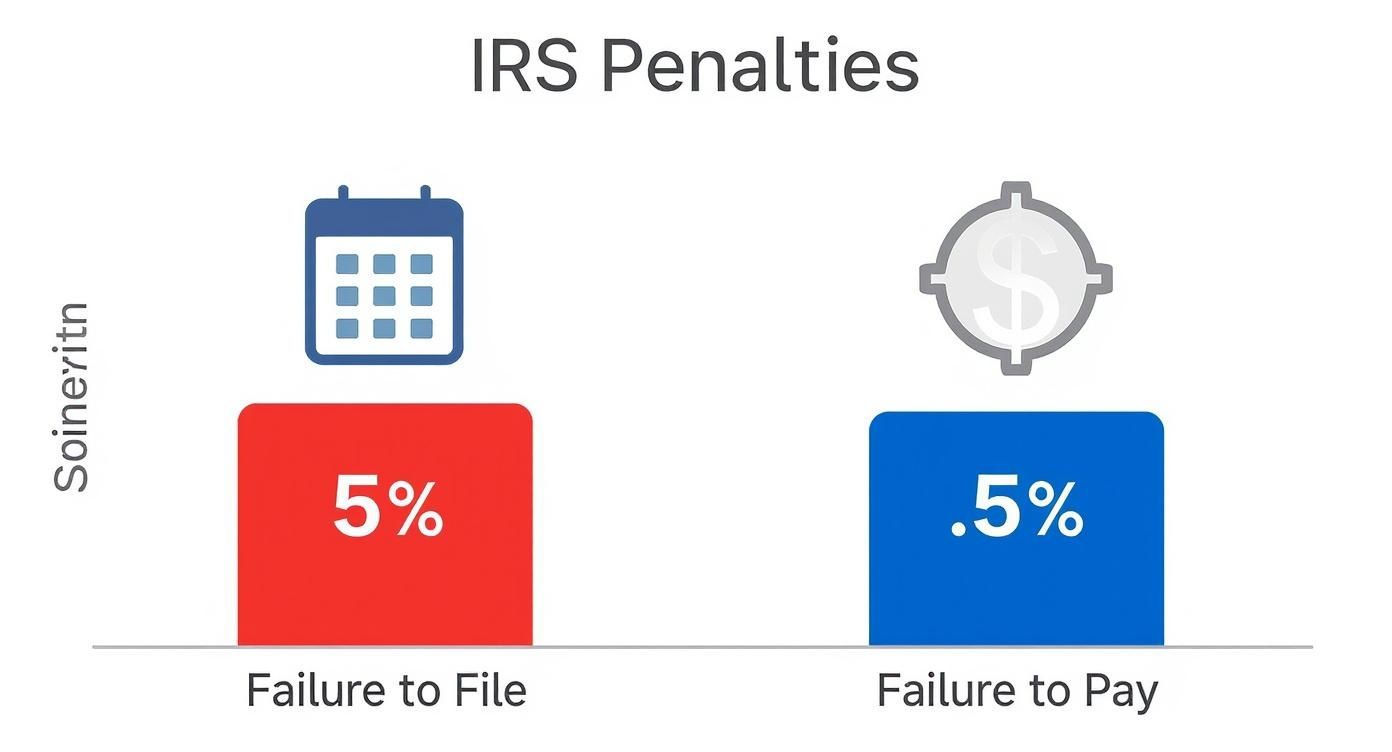
As you can see, the Failure to File penalty is ten times more aggressive than the Failure to Pay penalty. This one penalty alone can dramatically accelerate how fast your total balance grows.
A Real-World Example of a Growing Tax Debt
Let's break this down with a real-world scenario. Imagine you didn't file and you owe the IRS $5,000. We'll factor in an average interest rate and the maximum penalty for failing to file.
- Year 1: The Failure to File penalty maxes out at 25% ($1,250). Add in daily compounding interest, and your initial debt could easily shoot past $7,000.
- Year 3: The daily interest keeps piling up on that new, higher balance. By now, the debt could swell to over $9,000. The growth rate slows a bit once the penalties are maxed out, but that interest never stops climbing.
- Year 5: At this point, your original $5,000 problem could be well over $11,000—more than double what you owed in the first place.
And this example doesn't even touch on potential state penalties, which would add a whole other layer of debt. This snowball effect is precisely why it's so critical to deal with unfiled taxes immediately. The problem only gets bigger and more expensive the longer you wait.
The most damaging part of not filing is the compounding effect. As the debt grows, the government's collection tools become more aggressive, increasing the risk of serious actions like a Notice of Federal Tax Lien.
The longer a tax debt sits, the more power the IRS has to come after it. You can learn more about the severe impact on your financial life by understanding how a Notice of Federal Tax Lien works. Ignoring the problem won't just cost you money; it can end up costing you your assets and your peace of mind.
When Does Not Filing Your Taxes Become a Crime?
Let's get straight to the big fear lurking behind every unfiled tax return: can you actually go to jail? It's a valid question, and the answer requires drawing a sharp line between a civil mistake and a criminal act.
For the vast majority of people who haven't filed, the issue remains a civil matter. The IRS isn't looking to put you behind bars; they just want the money you owe. Life happens—financial struggles, health problems, or just plain old procrastination can lead to unfiled returns. In these cases, the consequences are purely financial: penalties, interest, and aggressive collection actions.
The game changes entirely with one little word: willful.
The Line Between a Mistake and a Crime: Defining "Willful"
In the world of tax law, "willful" means you knew you had a legal obligation to file a tax return, and you deliberately chose not to. This isn't about forgetting a deadline or making an honest error on a form. It’s about a conscious, voluntary decision to ignore the law.
The burden of proof is on the government to show you acted willfully. To do this, they don't just look at the fact that you didn't file. They hunt for patterns of behavior—what they call "badges of fraud"—that reveal an intent to deceive.
Here are a few red flags that can turn a non-filing case into a criminal investigation:
- A pattern of defiance: Not filing for several years in a row while earning a good income is a major red flag.
- Active deception: Using a fake Social Security number to hide your identity from employers.
- Hiding money: Stashing assets in offshore accounts, using shell corporations, or insisting on being paid in cash to keep your income off the books.
- Lying to the IRS: Making false statements to an IRS agent during an audit or inquiry.
It's that combination—not filing and taking active steps to conceal your actions—that escalates the situation from a debt collection problem to a potential felony.
The Heavy Price of Tax Evasion
When the IRS has enough evidence to prove you acted willfully, the charge is no longer "failure to file." It becomes the much more serious crime of tax evasion. And the penalties are severe.
A conviction for tax evasion can lead to:
- Up to five years in prison for each offense.
- Fines of up to $250,000 for an individual (or $500,000 for a corporation).
- The responsibility to pay for the full cost of your own prosecution.
And remember, all of this is on top of paying back the original taxes you owed, plus all the accrued penalties and interest.
The core difference lies in intent. An accidental oversight results in a bill from the IRS; a deliberate scheme to avoid that bill can result in a criminal conviction.
This distinction is absolutely critical. In these more serious situations, understanding basic criminal law principles becomes essential. If you have any reason to believe your actions could be interpreted as willful, getting professional legal help immediately is non-negotiable. To get a clearer picture of the charges you could be facing, it's worth learning about the specific penalties for tax fraud.
It's also interesting to see the economic behavior behind this. Research has shown that a mere 1% increase in tax rates can correspond to an estimated 3% rise in tax evasion. This highlights why willful non-filing is such a massive contributor to the "tax gap"—the trillions of dollars in taxes that are owed but never collected.
How The IRS Identifies And Pursues Non-Filers
It’s a common—and dangerous—myth that you can just fly under the radar if you don't file your taxes. The truth is, the IRS has one of the most sophisticated data-matching systems on the planet, making it virtually impossible to hide income from them.
Think of it like this: every time you get a paycheck, land a freelance gig, or earn a little interest from your bank, you leave a digital footprint. These financial breadcrumbs don't just go to you; they go straight to the IRS, painting a crystal-clear picture of your financial life, with or without a tax return from you.

The Digital Trail That Leads Straight To You
The IRS doesn't need you to tell them you earned money; other people and companies are already required to. Their system automatically cross-references billions of third-party information reports against its master list of who has filed a tax return. When income shows up under your Social Security number but there's no return to match, a red flag goes up on your account.
This whole process is kicked off by some very common tax forms, many of which you might not even handle directly:
- Form W-2: Your boss sends one to you and one to the IRS, laying out exactly what you earned and what taxes were withheld.
- Form 1099-NEC: If a client paid you $600 or more for contract work, they have to report it to the IRS. No exceptions.
- Form 1099-K: Payment platforms like PayPal or Venmo and online marketplaces are now required to report transactions, and the reporting thresholds are getting lower, catching more and more people every year.
These documents are the backbone of the IRS's non-filer program. Once your file gets flagged, an automated process begins, and it only escalates from there.
When The IRS Files A Return For You
If you ignore the initial friendly reminders about your missing return, the IRS doesn't just give up. They take matters into their own hands and create a tax return for you, which is known as a Substitute for Return (SFR). And trust me, while that might sound convenient, it's the last thing you want.
An SFR is the worst-case scenario for any taxpayer. The IRS builds this return using only the income information they have, and they apply the least favorable filing status possible—usually "Single" or "Married Filing Separately." Most critically, they don't give you a single deduction or credit you might have been entitled to. No business expenses, no student loan interest, no child tax credits. Zero.
An SFR isn't a courtesy; it's a collection tool. It establishes a legally enforceable tax debt—often far higher than what you actually owed—and gives the IRS the green light to start seizing your assets.
This inflated tax bill becomes your official debt, and the IRS will immediately begin using its formidable collection tools to get what it's owed. The agency is only getting more aggressive about this, as the IRS is cracking down on nonfilers and unfiled returns.
The IRS's Powerful Collection Tools
Once a tax debt is officially on the books—either through an SFR or a return you eventually file late—the IRS has an arsenal of aggressive methods to collect it. These aren't just strongly-worded letters; they are legal actions that can have a direct and devastating impact on your financial stability.
The table below breaks down the most common tools the IRS uses to collect from people who owe back taxes.
Common IRS Enforcement Actions Explained
| Enforcement Action | What It Is | How It Affects You |
|---|---|---|
| Federal Tax Lien | A legal claim against all your current and future property, including your home, car, and other assets. | It demolishes your credit score, making it nearly impossible to get a loan or sell property. The government essentially has first dibs on your assets. |
| Wage Garnishment | A formal order sent to your employer, legally requiring them to withhold a large chunk of your paycheck and send it straight to the IRS. | Your take-home pay can be slashed dramatically, leaving you with far less money for essentials like rent, food, and bills. |
| Bank Levy | A one-time seizure of the funds in your bank accounts. The IRS can take money right out of your checking or savings without any further warning. | Your accounts can be frozen and emptied up to the amount you owe, causing checks to bounce and cutting off your access to your own money. |
These aren't just scare tactics or idle threats. They are the standard operating procedure for the IRS when it comes to collecting delinquent taxes, showing just how severe the real-world consequences are for not filing.
Your Step-By-Step Guide to Getting Back on Track
Knowing the consequences of unfiled taxes can be overwhelming, but that's only half the battle. The most important thing you can do now is move from anxiety to action. Think of this as your roadmap—a clear, manageable process for resolving your tax issues and getting back on solid financial ground.
Let's put a stop to those compounding penalties and interest right now. Taking these steps shows the IRS you're making a good-faith effort to get compliant, which is always the best first move toward a resolution.

Step 1: Gather Your Essential Documents
Before you can even think about filing, you have to collect the paperwork that details your income and any potential deductions. This is the bedrock of an accurate tax return.
Think of it like gathering ingredients before you start cooking. Without the right components, the final dish just won't come out right. The key documents you'll likely need include:
- Form W-2: If you were an employee, you’ll need a W-2 from every employer for each year you didn't file.
- Form 1099: This covers a lot of ground, from the 1099-NEC for freelance income to the 1099-INT for interest you earned from a bank.
- Records of Deductions: Dig up receipts and statements for any potential business expenses, medical costs, or charitable donations you made.
But what if you can't find these forms? Don't sweat it—you have options. The easiest route is to request an IRS Wage and Income Transcript online. This official document lists all the income information the IRS has on file for you, tied to your Social Security number for a specific year. It’s an invaluable tool for piecing together your financial history.
Step 2: Prepare and File All Delinquent Returns
With your documents in hand, the next job is to prepare a tax return for every single year you missed. It's vital to file all past-due returns, not just the most recent one. The IRS generally expects you to be current on the last six years of filings before they’ll even consider a payment arrangement.
A word of caution: when preparing old returns, you must use the tax forms and laws that were in effect for that specific year. Tax laws are always changing, so you can't just use today's forms for a return from five years ago.
You should always file your own return, even if the IRS has already filed a Substitute for Return (SFR) on your behalf. An SFR is the IRS’s best guess, and it never includes the deductions and credits you're entitled to. Filing your own return will almost certainly result in a lower tax bill.
Key Takeaway: Filing your overdue returns is non-negotiable. It officially stops the Failure to File penalty, establishes what you actually owe, and opens the door to resolution options with the IRS.
Step 3: Explore Your Payment Options
Once you've filed, you'll eventually receive a notice from the IRS detailing precisely how much you owe—including the original tax, penalties, and interest. If the total number makes your stomach drop and you can't pay it all at once, don't panic. The IRS has several programs designed to help people manage their tax debt.
It’s important to realize you aren't alone. Unfiled taxes are a widespread issue with serious economic consequences. Globally, governments lose an estimated $492 billion every year just from corporations shifting profits, a problem detailed by the Tax Justice Network. When you take steps to resolve your debt, you're doing your part to re-engage with the system.
Here are the most common paths forward:
- Installment Agreement: This is simply a monthly payment plan. If you owe less than $50,000 (including tax, penalties, and interest), you can often set one up online in just a few minutes.
- Offer in Compromise (OIC): An OIC allows certain taxpayers to settle their tax liability with the IRS for less than the full amount they owe. This option is reserved for those facing true financial hardship, and the IRS has very strict eligibility rules.
- Currently Not Collectible (CNC) Status: If you can prove to the IRS that you can't afford to pay your basic living expenses and your tax debt, they may temporarily pause collection efforts. They’ll review your account periodically, and collections will resume if your financial situation improves.
Choosing the right path depends entirely on your personal financial situation. The most important thing is to be proactive. Ignoring those letters from the IRS will only lead to more aggressive collection actions. By gathering your documents, filing your returns, and engaging with the IRS about payment, you can finally put this stressful chapter behind you and move forward with a clean slate.
Got Questions About Not Filing Your Taxes? We’ve Got Answers.
After digging into the penalties, risks, and ways to get right with the IRS, you probably have some specific questions buzzing around. That’s completely normal. Let's tackle some of the most common "what ifs" that I hear from clients every day.
What Happens If I Don't File, but I'm Pretty Sure I'm Owed a Refund?
This is a great question, and the answer is a rare bit of good news. If the government actually owes you money, you won't get hit with the Failure to File penalty. That penalty is a percentage of the tax you owe, so if your balance due is zero, the penalty is also zero.
But don't celebrate just yet. The IRS won't send you a check automatically. You have a three-year window from the original due date to file that return and claim your refund. If you let that deadline slip by, the money is gone for good—it officially becomes property of the U.S. Treasury.
Is There a Statute of Limitations on Unfiled Taxes?
This is a huge misconception that gets a lot of people into trouble. While the IRS generally has ten years to collect a tax debt, that clock doesn't start ticking until the tax has been officially "assessed." And that assessment only happens when you file a return.
In other words, if you never file, the statute of limitations never begins. The IRS can legally pursue you for a return from a decade ago—or even longer—along with all the penalties and interest that have piled up since.
Filing the return is what puts a limit on their look-back period. Ignoring it leaves the door open forever.
Can I Still Get My Old Stimulus Checks If I Never Filed?
Absolutely. Many people who weren't required to file during the pandemic missed out on the Economic Impact Payments (a.k.a. stimulus checks). These weren't just free handouts; they were advance payments of a tax credit called the Recovery Rebate Credit.
The good news? You might still be able to claim it.
- For the first and second stimulus checks (from 2020), the deadline to file a 2020 return was May 17, 2024.
- For the third stimulus check, you need to file a 2021 tax return. The deadline for that is typically in April 2025.
Filing those late returns is the only way to get that money. It will either increase your refund or be applied to any tax you owe for that year.
How Does Not Filing Taxes Affect My Social Security Benefits?
This is a critical one, especially if you're self-employed. Your future Social Security benefits are calculated based on your earnings history. The Social Security Administration (SSA) learns about your self-employment income from one place: your tax return.
When you don't file, here's what happens:
- Your income isn't reported: As far as the SSA is concerned, you earned nothing that year.
- You earn no credits: That year of hard work doesn't count toward your retirement benefits.
Skipping returns year after year can drastically slash your future Social Security checks or even prevent you from qualifying for benefits at all. You're effectively erasing your own work history.
What If I Can’t Afford a Tax Attorney to Help Me?
This is the number one reason people stay stuck in a cycle of fear and inaction. But here's the thing: many experienced tax professionals, myself included, offer a free initial consultation. It’s a chance to look at your specific situation and map out a plan without you spending a dime.
In that first conversation, we can figure out:
- Exactly which tax years are causing the problem.
- What documents we'll need to get started.
- What kind of resolution, like an Installment Agreement or an Offer in Compromise, you might realistically qualify for.
That initial analysis turns a massive, terrifying problem into a series of clear, manageable steps. You’d be surprised how often a solution is more straightforward and affordable than you think. Please don't let the fear of cost keep you from getting the help you need.
If you're dealing with unfiled tax returns, you don't have to face the IRS by yourself. At Attorney Stephen A Weisberg, I start with a FREE Tax Debt Analysis to see exactly where you stand and explain your options before you ever pay a fee. Contact me today to get your free, no-obligation analysis and take the first step toward a solution.


