What Happens When You Get Audited by irs: A Step-by-Step Guide
Wondering what happens when you get audited by irs? This concise guide walks you through the process from notice to conclusion and tips to prepare.

In this article
- That IRS Notice Just Arrived: What It Means and What to Do First
- Your Initial IRS Audit Action Plan
- Putting the Odds in Perspective
- Why Did the IRS Single Me Out for an Audit?
- The Red Flags That Catch the Computer's Eye
- It's Not Always About a High Score
- The Three Types of IRS Audits and What to Expect
- The Correspondence Audit: An Inquiry by Mail
- The Office Audit: A Visit to an IRS Location
- The Field Audit: The Most In-Depth Review
- Navigating the Audit Process From Notice to Resolution
- Preparing Your Documentation Package
- The Examination and Final Report
- Know Your Fundamental Taxpayer Rights
- Possible IRS Audit Outcomes and Your Next Steps
- Outcome 1: No Change
- Outcome 2: Agreed
- Outcome 3: Disagreed
- When You Need to Hire a Tax Attorney for Your Audit
- Key Moments to Call for Professional Help
- An Attorney's Role in Your Audit
- Frequently Asked Questions About IRS Audits
- How Far Back Can the IRS Go When Auditing?
- What Happens if I Can't Find My Receipts for an Audit?
- Can a Normal IRS Audit Turn into a Criminal Investigation?
So, that dreaded envelope from the IRS has landed in your mailbox. Your heart might be pounding, but let's cut through the noise. Getting audited simply means the IRS wants to take a closer look at your tax return to make sure everything lines up.
It almost always kicks off with an official letter, not a phone call or email. This notice is a request for more information, not a guilty verdict.
That IRS Notice Just Arrived: What It Means and What to Do First

Seeing that IRS logo can send a jolt of anxiety through anyone. But reacting with panic is the worst thing you can do. Think of an audit notice less as an accusation and more as a fact-checking assignment from the world's most detail-oriented accountant. How you handle these first moments can set the stage for the entire process.
Your first instinct might be to grab the phone and start explaining yourself. Don't. Your best move is to simply stop, take a breath, and read the entire notice, front to back. It will spell out exactly which tax year is under review and what specific items the IRS is questioning—be it deductions, income, or tax credits. Knowing the precise scope of the audit is your biggest advantage right now.
Before you dive into a mountain of paperwork, it’s crucial to have a clear, calm plan. The table below outlines your immediate dos and don'ts to get you started on the right foot.
Your Initial IRS Audit Action Plan
| Action Item | Why It's Important | First Step |
|---|---|---|
| Don't Panic or Assume the Worst | Stress leads to mistakes. Most audits are routine and many end with no change to your tax bill. | Read the notice completely in a calm environment. |
| Carefully Analyze the Notice | The letter tells you the type of audit—mail, office, or field—which dictates your next steps. | Identify the specific information, documents, and tax year the IRS is asking about. |
| Gather Documents Before Responding | You need to have your facts and figures straight before communicating with the IRS to avoid misstatements. | Create a folder and start collecting all relevant receipts, statements, and records mentioned in the notice. |
| Do Not Call the IRS Immediately | An unprepared phone call can lock you into answers or provide information you aren't required to give. | Review the notice and your documents. Consider consulting with a tax professional to plan your response. |
Following these initial steps helps you move from a place of stress to one of control. A methodical response is always better than a rushed one.
Putting the Odds in Perspective
It helps to know that you're not alone, but you're also in a fairly exclusive club. The chances of being audited are much lower than most people think.
In the 2023 fiscal year, the IRS audited just 0.40% of all individual tax returns. And of those, a whopping 77.3% were simple correspondence audits handled entirely by mail. For a deeper dive into current audit risks, you can explore the different types of IRS letters and notices to better understand what you've received.
Generally, audits break down into three main types, each with its own level of intensity:
- Correspondence Audit: This is the most common and least intimidating audit. The IRS sends you a letter, you mail back the requested documents, and that's usually the end of it.
- Office Audit: A step up in seriousness, this requires you to visit a local IRS office to meet with an auditor and go over specific items in your return.
- Field Audit: This is the most comprehensive type. An IRS agent comes to your home or place of business to conduct a thorough review of your records.
By understanding what the notice really means and mapping out your first steps, you can turn a moment of fear into a manageable, organized task.
Why Did the IRS Single Me Out for an Audit?
Getting that dreaded audit letter in the mail can feel incredibly personal. It’s easy to imagine some agent poring over your tax return with a magnifying glass, looking for a reason to cause you trouble. But that’s almost never how it happens.
The truth is, the process is far less about you and far more about data. The IRS relies on a powerful computer system to do the initial heavy lifting, and your return was likely flagged by an algorithm, not a person.
Think of it this way: the IRS uses a program called the Discriminant Inventory Function (DIF). It's basically a credit score for your tax return. The system scans your numbers and compares them to millions of returns from people in similar financial situations. If something on your return looks statistically out of the ordinary, it gets a high DIF score, which is what puts it on an auditor's desk.
The Red Flags That Catch the Computer's Eye
So, what makes a return look "out of the ordinary"? While the IRS keeps its exact formula under wraps, decades of experience have shown us what tends to attract attention. It usually boils down to numbers that just don't seem to add up.
Here are some of the most common triggers we see:
- Claiming Huge Deductions: If your deductions seem way out of proportion to your income, the system will notice. For example, someone earning $60,000 a year who claims $30,000 in charitable giving is almost guaranteed to get a second look.
- A Business That Never Makes Money: Running a business is tough, but the IRS expects it to eventually turn a profit. If you file a Schedule C showing major losses for three or more years in a row, they might start wondering if it’s a real business or just a hobby you’re trying to write off.
- Deducting 100% Business Use of a Vehicle: This is a classic red flag. The IRS knows it's nearly impossible for a vehicle to never be used for a personal trip—not even once to the grocery store. Claiming 100% use is just asking for an audit.
- Large Home Office Deductions: The rules for this deduction are incredibly strict, requiring "exclusive and regular use." If you claim a massive chunk of your home as office space, especially as a W-2 employee, the IRS will want to verify you’re following those rules to the letter.
The main thing to remember is that an audit is often just a numbers game. It's not personal. Your return simply contained figures that stood out from the statistical average, and the IRS just wants to double-check them.
It's Not Always About a High Score
Beyond the DIF system, there are a few other common reasons for an audit. One of the biggest is a simple information mismatch.
Your employer sends the IRS a W-2. Your clients send 1099-NEC forms. Your bank sends forms for interest earned. All this data goes directly into the IRS's system. If the income you report on your return doesn't perfectly match what those third parties reported, an automated system will flag the discrepancy instantly. If a client says they paid you $15,000 but you only reported $12,000 from them, you can bet you’ll be getting a letter.
And sometimes, it’s just plain old bad luck. The IRS runs a program that selects a small number of taxpayers for audits completely at random. This helps them gather data to refine their formulas. While it’s the least likely scenario, it means even a perfectly prepared return can be chosen.
Want to dig deeper? You can learn more by exploring our detailed guide on what triggers a tax audit and what you can do to lower your risk profile.
The Three Types of IRS Audits and What to Expect
When you hear the word “audit,” it’s easy to picture a team of stern-faced IRS agents showing up at your door. The reality, thankfully, is far less dramatic. Most IRS examinations are much more routine and fall into one of three main categories.
Knowing which type of audit you're facing is the first step toward taking control of the situation. Each one has a different level of intensity and requires a specific kind of preparation.
The Correspondence Audit: An Inquiry by Mail
This is, by far, the most common type of audit. In fact, the correspondence audit accounts for the vast majority of all IRS inquiries. Think of it less as a full-blown audit and more as a request for clarification. The entire process is handled through the mail.
Typically, the IRS has a question about one or two specific items on your tax return. You’ll get a letter asking you to mail them documents to back up a claim you made. For example, they might want to see:
- Receipts for the charitable donations you deducted.
- Invoices and proof of payment for significant medical expenses.
- Records proving someone qualifies as your dependent, like a birth certificate.
The scope is very narrow. You simply gather the specific documents they’ve asked for, mail them in by the deadline, and wait. If your records are clear and complete, that's often the end of it.
The Office Audit: A Visit to an IRS Location
A step up from the mail-in audit is the office audit. As the name implies, this one requires you to go to a local IRS office for a face-to-face meeting with an auditor. While it’s more involved, it’s still not a free-for-all investigation. The auditor will have a specific list of items they want to go over with you.
An office audit usually gets triggered by things that are a bit too complicated to sort out through the mail, like:
- Income and expenses for a small business (Schedule C).
- Deductions related to a rental property (Schedule E).
- Claims for unreimbursed employee business expenses.
Good preparation is your best friend here. You’ll need to bring all the relevant paperwork for the items in question—think bank statements, ledgers, receipts, and mileage logs. Your goal is to show up with an organized file that directly answers the auditor's questions.
An office audit isn't an open-ended fishing expedition into your finances. It's a focused look at specific parts of your return. Stick to the script and only provide the information they've requested.
The Field Audit: The Most In-Depth Review
The field audit is the most serious and comprehensive type of examination. This is when an IRS revenue agent comes to you—either at your home, business, or your representative's office—to conduct a thorough review of your books and records.
Field audits are generally reserved for more complex situations, like those involving businesses, corporations, or individuals with complicated financial lives. Unlike the other two types, a field audit can be incredibly broad. The agent might look at multiple tax years and examine everything from your business's gross receipts to your inventory and assets.
Because it's so intensive, a field audit is where professional help becomes non-negotiable. Having an experienced tax attorney on your side is critical. They can manage the entire process, handle all communications with the agent, and make sure your rights are protected from start to finish.
Navigating the Audit Process From Notice to Resolution
That letter from the IRS is just the first step. Getting an audit notice can feel overwhelming, but the process itself follows a clear, predictable path. Knowing what to expect ahead of time can turn that knot in your stomach into a manageable plan of action.
From the moment you open that envelope to the final resolution, you can stay in control by making smart, strategic decisions. The key is to start strong.
The very first thing you need to do is respond promptly and precisely. Never, ever ignore an IRS notice. Your response should be a direct answer to their letter, providing clear, organized copies of exactly what they’ve asked for—and nothing more. This isn’t the time to over-explain or volunteer extra information about other parts of your tax return. Just stick to the script.
Preparing Your Documentation Package
Once you know what the IRS is looking for, it's time to gather your documents. Think of it like building a case file for a judge. You're not just dumping a shoebox of receipts on their desk; you’re creating a professional package that makes it easy for the auditor to see that your numbers are correct.
A great way to stay on track is to use a guide. For example, The Ultimate Checklist for Auditors provides a solid framework for getting your records in order before anyone even sees them. A simple cover letter that summarizes your response and lists the documents you've included can also work wonders in guiding the auditor through your submission.
A well-organized package should always include:
- A brief and polite cover letter.
- Copies of the specific bank statements, receipts, or logs they requested.
- A table of contents if you're sending a large number of documents.
This flowchart gives you a simple visual of how an audit can progress from a basic letter to a more hands-on examination.
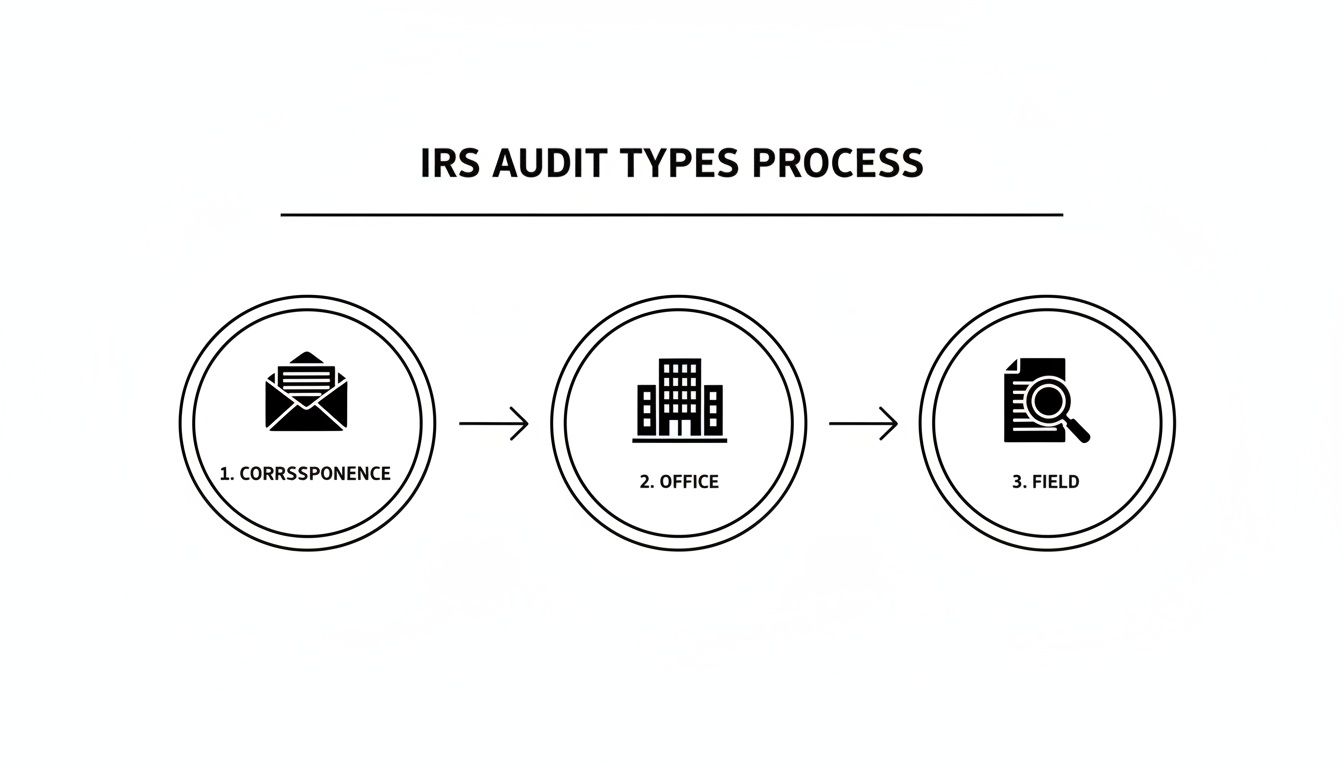
As you can see, things can escalate. That's why a strong, organized, and professional initial response is so important—it can often stop the process from going any further.
The Examination and Final Report
After you’ve sent your documents, the auditor gets to work reviewing everything. They might reach out with a few follow-up questions during this phase. It’s absolutely critical to keep all communication brief, professional, and laser-focused on the specific questions they ask. This is often where having a tax pro in your corner is a lifesaver, as they can handle these interactions for you.
The good news? Most audits don't have to end in disaster. The bad news? The process can drag on for months. In fact, 77.3% of all exams in FY2023 were simple correspondence audits, but even those can lead to confusing and stressful back-and-forth notices.
Patience is a virtue here, because the system can be slow. In FY2023, the IRS took an average of over 13 months to process business amended returns. Individual amendments weren't much faster, averaging over 5 months. Even though most audits of small businesses earning under $400,000 result in no changes, just getting through the system can be draining.
Once the review is finally done, the IRS will send you an "examination report." This document lays out their findings and details any proposed changes to what you owe. You'll get a chance to review it and decide whether you agree or disagree, which kicks off the final steps toward resolution.
An IRS audit can feel incredibly intimidating, almost like you’re being backed into a corner with no way out. But that’s simply not the case. From the moment you receive that notice, you are protected by a powerful set of rules: the Taxpayer Bill of Rights. These aren't just polite suggestions—they are legally mandated protections.
Knowing these rights is your first and best line of defense. They guarantee you’re treated fairly and have a say throughout the audit. So, before we get into what happens at the end of an audit, let's cover the ground rules the IRS has to play by.
Know Your Fundamental Taxpayer Rights
At its core, the Taxpayer Bill of Rights ensures you have access to a fair and just tax system. That means you should always be treated with professional courtesy by IRS employees. But it also gives you several key protections that are absolutely vital during an audit.
- The Right to Representation: You never have to face the IRS alone. You can hire an authorized professional—like a tax attorney, CPA, or Enrolled Agent—to represent you and handle communications on your behalf.
- The Right to Privacy: The IRS can’t just go on a fishing expedition. They are only allowed to ask for information directly related to the tax year and items under audit, and they are legally required to keep your financial information confidential.
- The Right to Appeal: If you don't agree with the auditor's findings, you have the right to an independent appeal. If that doesn't work, you can even take your case to court.
These rights give you leverage and help level the playing field. Once the auditor finishes their review, the audit will conclude with one of three possible outcomes.
An audit doesn't automatically mean you owe more money. The outcome depends entirely on what the auditor finds (or doesn't find) when they review your records. Here’s a quick breakdown of the three ways an audit can end and what you should do in each scenario.
Possible IRS Audit Outcomes and Your Next Steps
| Audit Outcome | What It Means | What You Should Do |
|---|---|---|
| No Change | The auditor reviewed your return and accepted it as filed. You don't owe any additional tax. | Breathe a sigh of relief! Keep the "no-change" letter with your tax records and continue your good record-keeping habits. |
| Agreed | The auditor proposed changes (e.g., disallowed a deduction), and you agree with their assessment. | Sign the examination report to formalize the agreement. You will receive a bill for the additional tax, plus any penalties and interest. |
| Disagreed | You do not agree with the auditor’s proposed changes and believe their findings are incorrect. | Do not sign the report. Request a meeting with the auditor's manager and, if necessary, file a formal appeal to contest the findings. |
Let's dig a little deeper into what each of these outcomes really means for you.
Outcome 1: No Change
This is the best-case scenario and the one we always aim for. A "No Change" audit means the agent reviewed your return and all your supporting documents and found everything to be in order.
You’ll get an official letter confirming your return was accepted as filed, and that’s the end of it. This outcome is a huge win—it validates your careful record-keeping and proves your return was accurate all along. A professional, well-organized response from the start dramatically increases the odds of getting here.
Outcome 2: Agreed
The next possibility is an "Agreed" outcome. This happens when the auditor finds something they believe is an error—maybe they disallow a business expense or adjust your reported income—and after reviewing their reasoning, you agree with the change.
In this situation, you’ll sign an examination report that officially confirms you accept the changes. The IRS will then send you a bill for the additional tax owed, along with any penalties and interest that have built up. From there, you can work on a plan to pay what you owe.
Outcome 3: Disagreed
The third and most challenging outcome is "Disagreed." This is what happens when you get audited by the IRS and you’re certain their findings are wrong. You have an absolute right to challenge the auditor’s conclusions.
This is precisely when your Right to Appeal becomes so important. Disagreeing isn't the end of the line—it's just the start of the next step. You are never forced to accept a conclusion you know is incorrect.
If you disagree, the first move is usually to request a conference with the auditor's direct manager. If you still can't find common ground, you can file a formal appeal. This sends your case to the IRS Independent Office of Appeals, which is a separate department designed to mediate disputes and find a resolution without having to go to court. For a complete walkthrough, check out our guide on the IRS tax appeals process.
Understanding these three paths prepares you for any possibility. It ensures you know exactly what to do to protect yourself and your finances, no matter which way the audit goes.
When You Need to Hire a Tax Attorney for Your Audit

Legally, you have every right to represent yourself in an IRS audit. But just because you can doesn't mean you should. It’s a bit like trying to fix the plumbing in your house—you might manage to change a washer, but you wouldn’t want to be the one replumbing the whole system. The real question is: when does a tax issue cross the line from a simple DIY task to a job for a professional?
For a basic correspondence audit asking for a few receipts for charitable donations, you might be perfectly fine handling it yourself. The minute the audit gets more complex, however, the stakes shoot up.
Key Moments to Call for Professional Help
If the IRS wants an office or field audit, the alarm bells should be ringing. These in-person examinations are far more intense than a simple letter and can spiral into a much wider investigation if you're not careful. This is where an experienced tax attorney becomes your first line of defense, acting as a critical buffer between you and the auditor.
Hiring an attorney isn't an admission of guilt. It's a smart, strategic move to protect your rights and your finances. It's time to call in an expert if you find yourself in any of these situations:
- You're facing an office or field audit. These are serious, in-person audits that demand professional management.
- The potential tax bill is substantial. If thousands of dollars are on the line, the cost of an attorney is a smart investment to protect your assets.
- The IRS suspects fraud or tax evasion. If a Revenue Agent or, even more seriously, a Criminal Investigation special agent gets involved, you need a lawyer immediately.
- You feel completely overwhelmed. An attorney brings clarity and confidence when you're in over your head.
When an audit gets tangled up in complex issues, having someone with deep tax law expertise is indispensable. A skilled attorney can navigate the labyrinth of tax code and build a strong defense for you.
The single biggest reason to hire a tax attorney is attorney-client privilege. This is a powerful legal shield that keeps your conversations completely confidential—a protection you don’t get with a CPA or Enrolled Agent. You can be totally candid without worrying that what you say could be used against you.
An Attorney's Role in Your Audit
Once you hire a tax attorney, they step in and handle all communication with the IRS. This is huge. It stops you from accidentally saying something that could make your situation worse or open you up to a broader investigation. Their job is to make sure the auditor gets only the specific information they are legally entitled to receive, and nothing more.
Your attorney will review every detail of your case, develop a strategy, and negotiate for the best possible outcome. That could mean a "no change" result, where you owe nothing, or a fair and manageable settlement.
To get a better handle on your next steps, it's worth learning how to find a good tax attorney who can provide the right kind of support. With an expert in your corner, you’re no longer just reacting to the audit—you’re taking control of it.
Frequently Asked Questions About IRS Audits
Even with a good roadmap, you're bound to have more questions about what an IRS audit really looks like. Let's tackle some of the most common worries that pop up when that letter arrives.
How Far Back Can the IRS Go When Auditing?
As a general rule, the IRS has three years from the date you filed your tax return to start an audit. Think of this three-year period as the standard statute of limitations.
But that timeline isn't set in stone. If you've substantially understated your gross income (we're talking by more than 25%), the IRS gets six years to dig into your return. And in the most serious cases, like when the IRS suspects fraud or if you never filed a return at all, there is no time limit. They can go back as far as they need to. This is precisely why holding onto your tax records for at least seven years is such a smart move.
What Happens if I Can't Find My Receipts for an Audit?
A missing receipt can send anyone into a panic, but it's not automatically game over for your deductions. While the original receipt is always the gold standard, the IRS will often accept other proof to back up your expenses.
You might be able to use things like:
- Bank or credit card statements that clearly show the transaction.
- Canceled checks proving you made the payment.
- Contemporaneous written logs—basically, detailed notes you took at the time the expense occurred.
There's a legal principle called the "Cohan Rule" that can sometimes allow for reasonable estimates if you can prove an expense was real but the records are gone. Be careful, though. Relying on this is a bit of a gamble, as it's ultimately up to the auditor's judgment.
Don't assume a lost receipt is a lost cause. You can often prove the expense through other records, but this is where having a tax professional on your side makes a huge difference. They know how to present your alternative documents in the most persuasive way.
Can a Normal IRS Audit Turn into a Criminal Investigation?
Let's be clear: it is incredibly rare for a standard civil audit to lead to criminal charges. That's a huge leap reserved for situations where an auditor finds strong evidence of willful tax evasion or outright fraud.
The IRS calls these "badges of fraud," and they are serious red flags indicating someone was trying to deceive them on purpose. We're talking about things like keeping two separate sets of books, using a fake Social Security number, or intentionally destroying records to hide something. If an auditor stumbles upon this kind of evidence, they have to halt the civil audit immediately and pass the case over to the IRS's Criminal Investigation (CI) division.
If you ever get a call or visit from a CI Special Agent, the game has changed completely. You should stop all communication with the IRS right away and hire a seasoned tax defense attorney to protect your rights.
An IRS audit is a complicated and nerve-wracking process, but you don’t have to go through it by yourself. At The W Tax Group, we kick things off with a FREE Tax Debt Analysis so you know exactly how we can help before you ever spend a dime. Contact us today to get the expert guidance you need.