What Happens If You Owe Taxes: Your Guide to Penalties, Liens, and Options
What happens if you owe taxes? Learn about IRS notices, penalties, liens, and levies, and explore options to resolve debt and protect your finances.

In this article
- The First Letter: What Really Happens When You Owe Taxes
- From a Simple Notice to Serious Consequences
- The IRS Collection Timeline: From First Notice to Final Warning
- When You Haven't Filed a Tax Return
- The Final Notice and Impending Enforcement
- The True Cost of Unpaid Taxes: Penalties and Interest Explained
- The Two Big Penalties to Know
- The Crushing Weight of Compounding Interest
- Don't Forget About Estimated Tax Penalties
- When The IRS Gets Serious: Liens, Levies, and Asset Seizures
- Understanding The Federal Tax Lien
- The Reality Of An IRS Levy
- Unique Risks for Businesses: The Trust Fund Recovery Penalty
- Who Is a "Responsible Person"?
- The Personal Financial Fallout
- Your Path To Resolution: Choosing The Right Tax Relief Option
- Making Payments With An Installment Agreement
- Settling For Less With An Offer In Compromise
- Pausing Collections With Currently Not Collectible Status
- Finding Forgiveness With Penalty Abatement
- Comparing Tax Debt Resolution Options
- Common Questions About Owing the IRS
- Can I Go to Jail for Owing Taxes?
- How Long Does the IRS Have to Collect Unpaid Taxes?
- Will the IRS Forgive My Debt After 10 Years?
If you owe the IRS, the collection process doesn't start with a knock on the door. It’s a predictable, step-by-step escalation that begins with simple notices but can grow into costly penalties, mounting interest, and forceful actions like seizing your assets.
The key is realizing this process isn't random. You have opportunities to resolve the issue long before it reaches a critical stage, but you have to know what's coming.
The First Letter: What Really Happens When You Owe Taxes
Getting an official-looking envelope from the IRS is enough to make anyone’s heart skip a beat. Your mind might immediately jump to worst-case scenarios—frozen bank accounts or agents showing up unannounced.
While those things can happen eventually, the reality of what happens when you owe taxes starts much more quietly: with a single, automated letter.
Think of this first notice less as an accusation and more as the start of a conversation. The IRS is simply flagging a discrepancy their records show a balance due that needs your attention. This initial contact is your cue to act, not panic. Ignoring it is what kicks the more serious consequences into gear.
From a Simple Notice to Serious Consequences
The path from that first letter to a full-blown financial crisis is a clear one. Understanding this progression is the first step toward getting back in control. At first, the process is purely administrative and handled by mail. It's only when you don't respond that the tone of the letters gets more urgent and the financial stakes get much higher.
This escalation typically follows a set pattern:
- Automated Notices: You'll get a series of letters, usually starting with a bill like a CP14 notice, demanding payment. You can learn more about this common first step in our guide on the IRS Notice CP-14.
- Intensifying Penalties: The failure-to-pay penalty and interest kick in right away, causing your debt to grow every single day it goes unpaid.
- Enforcement Actions: If the debt continues to sit, the IRS can shift to more aggressive tactics. This includes filing a Federal Tax Lien against your property or issuing a levy to seize funds directly from your bank account or paycheck.
The core principle is simple: proactive communication can prevent escalation. The IRS is far more willing to work with taxpayers who respond to notices and explore resolution options than with those who ignore their obligations entirely.
Even before that first notice arrives, certain financial activities can act as red flags. These are essentially signals that attract tax agency scrutiny, putting you on the radar long before a bill is even generated.
Acknowledging this reality and taking control is your best defense. This guide will walk you through every stage of the process, replacing fear with the knowledge you need to find a solution.
The IRS Collection Timeline: From First Notice to Final Warning
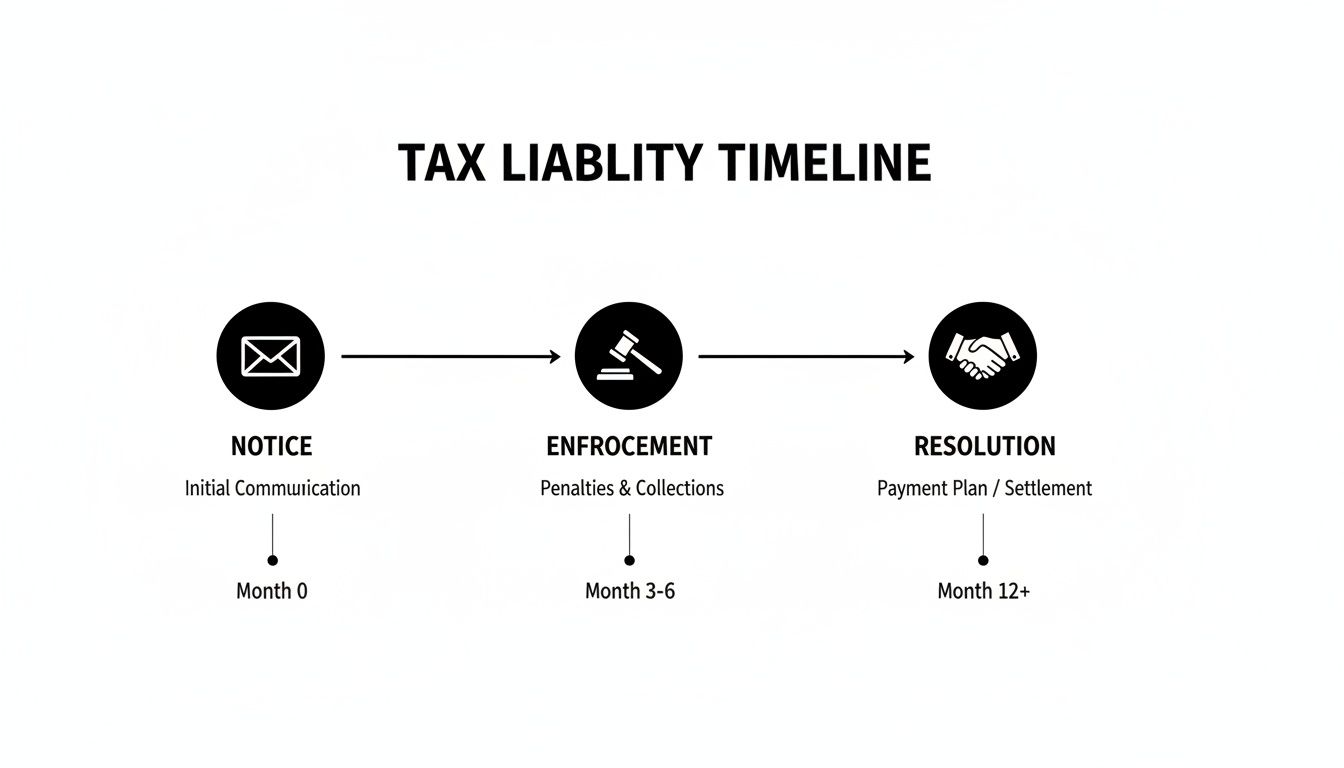
The IRS collection process doesn't just happen overnight. It’s a slow, predictable march that follows a clear timeline, starting with a simple letter and only getting serious if you ignore the signs. Knowing how this plays out is the key to stepping in at the right time.
Think of it this way: the journey begins with the very first notice, which is usually a CP14, Notice of Unpaid Tax. This is just an automated heads-up from the IRS computers saying you have a balance due. It lays out what you owe, including initial penalties and interest, and gives you a deadline—typically 21 days—to pay up. This is your best and easiest chance to fix the problem.
If you let that first notice slide, the letters will keep coming. Each one will sound a little more serious than the last, like a warning drumbeat getting louder. These reminders are designed to get your attention before the agency has to pull out the big guns.
This simplified timeline breaks down the typical progression from that first polite letter to potential enforcement.
| Stage | Typical IRS Action | What It Means For You | Recommended Action |
|---|---|---|---|
| Initial Notice | CP14 Notice of Unpaid Tax is mailed. | The IRS has identified a balance due on your account. | Pay the balance in full or contact the IRS immediately to set up a payment plan. |
| Reminder Notices | A series of letters (CP501, CP503, CP504) are sent. | The language becomes more urgent, and penalties/interest continue to grow. | Do not ignore these. The problem is not going away. It's time to engage. |
| Final Warning | Letter 1058/LT11 (Final Notice of Intent to Levy) is issued. | This is the last stop before the IRS can legally seize your assets (levy). | You have 30 days to request a Collection Due Process (CDP) hearing. Act now. |
| Enforcement | The IRS can now issue levies on bank accounts, garnish wages, and file federal tax liens. | Your financial life is now at risk. Assets can be seized without further warning. | It's not too late, but you need professional help immediately to stop the collections. |
As you can see, the process moves from simple communication to forceful collection, but you always have opportunities to step in and find a solution.
When You Haven't Filed a Tax Return
So, what if you owe taxes but never even filed a return? The IRS won’t just forget about you. Instead, they can file for you by creating what’s called a Substitute for Return (SFR). They use the information they have from third parties—like your W-2 from an employer or 1099s from clients—to piece together a return on your behalf.
Here’s the catch: an SFR is almost never in your favor. It’s built to include your income but leaves out all the good stuff, like deductions and credits you’re entitled to. Forget about claiming business expenses, mortgage interest, or charitable giving. The result is almost always a tax bill that's way higher than what you actually should owe.
An SFR is not a courtesy; it's a collection tool. It establishes a legal tax debt, allowing the IRS to begin the formal collection process even without your signature on a tax form.
Once that SFR is created, the IRS will send you a Notice of Deficiency, often called a 90-day letter. This gives you a 90-day window to either file your own, correct return or petition the U.S. Tax Court. Ignoring this notice is a massive mistake—it gives the IRS the green light to start coming after you.
The Final Notice and Impending Enforcement
After a few unanswered notices, things get real. You’ll receive the final, most critical letter in the series: the Letter 1058/LT11, Final Notice of Intent to Levy and Notice of Your Right to a Hearing. This is the last warning shot before the IRS can legally start seizing your assets.
This notice isn't a suggestion; it’s a legal requirement. It officially tells you the IRS plans to take your property and spells out your appeal rights, specifically the right to request a Collection Due Process (CDP) hearing within 30 days. This hearing is your last formal opportunity to negotiate before levies can start.
This is where the sheer scale of the issue comes into focus. In the United States, the IRS assesses over $500 billion in individual income tax debt every year. Once a taxpayer ignores a Notice of Deficiency, the agency’s power is immense. In 2022 alone, the IRS issued over 3.5 million levies, seizing $15 billion from bank accounts and paychecks. To understand the fiscal realities driving these actions, you can review the full research about tax debt collection.
The True Cost of Unpaid Taxes: Penalties and Interest Explained
An overdue tax bill from the IRS is never just the original amount. It’s more like a small leak; if you ignore it, you’ll soon find yourself dealing with a costly flood. The real financial pain comes from the penalties and interest that start piling on immediately, causing that initial debt to swell at a shocking rate.
To really understand what happens when you owe the IRS, you have to get a handle on these extra costs. The IRS has a whole menu of penalties designed to make sure people file and pay on time, and each one has a specific job. Getting to know how they work is the first step toward realizing just how urgent the situation is.
The Two Big Penalties to Know
The IRS mainly uses two penalties for late or unpaid taxes: Failure to File and Failure to Pay. They sound almost the same, but the difference in how they affect your bottom line is huge.
- Failure to File Penalty: This one hits you if you don't file your tax return by the due date (including any extensions). It's a painful 5% of the unpaid taxes for each month or part of a month that your return is late. It keeps adding up until it hits a maximum of 25% of your unpaid tax bill.
- Failure to Pay Penalty: This penalty applies when you don't pay the taxes you reported on your return by the deadline. It’s much smaller, at 0.5% of the unpaid taxes per month, but it also caps out at 25%.
The math tells a critical story here: the penalty for not filing is ten times more severe than the penalty for not paying. This is why every tax pro on the planet will tell you the same thing: file your return on time, even if you can't afford to pay a dime. Just getting that return filed stops the brutal Failure to File penalty dead in its tracks, which can save you a ton of money right from the start.
The Crushing Weight of Compounding Interest
On top of those penalties, the IRS charges interest on your entire unpaid balance. And this isn't simple interest—it's a relentless financial force that works against you every single day.
The IRS calculates interest not just on your original unpaid tax, but also on the penalties that are piling up. Then, it charges interest on the interest that has already been added. This is daily compounding, and it's how a manageable debt can quickly spiral into something that feels impossible to overcome.
The interest rate is adjusted every quarter and is calculated as the federal short-term rate plus 3%. That might not sound like a lot, but with daily compounding, your debt grows exponentially.
Think about it: the failure-to-pay penalty of 0.5% per month, combined with interest that compounds daily, can cause your total debt to double in less than five years. Ignoring tax debt is a mistake that cost Americans a staggering $100 billion in penalties just last year. For more insights on tax debt costs, you can see how these numbers fit into the bigger economic picture.
Don't Forget About Estimated Tax Penalties
If you're self-employed, a freelancer, or a business owner, there’s another common penalty you need to have on your radar: the underpayment of estimated tax penalty. This one gets you if you don't pay enough tax throughout the year through your quarterly estimated payments.
Our tax system is "pay-as-you-go," which means the IRS expects to get its money throughout the year, not in one lump sum on April 15. If you don't meet those quarterly obligations, you can get hit with a penalty, even if you eventually pay your entire tax bill when you file.
These combined costs—multiple penalties plus compounding interest—are the true financial consequences of owing the IRS. But it's important to know that penalties aren't always set in stone. In certain situations, you might be able to get them reduced or even completely removed. You can learn more about the requirements by reading about IRS penalty abatement options.
When The IRS Gets Serious: Liens, Levies, and Asset Seizures

When the letters and notices stop getting a response, the IRS changes its tactics. This is the point where ignoring a tax debt moves from a paperwork problem to a full-blown financial crisis. The agency's two most powerful collection tools are the Federal Tax Lien and the IRS Levy, and they are designed to get your undivided attention.
Many people toss these terms around as if they mean the same thing, but they are fundamentally different. Knowing that difference is crucial to understanding just how serious your situation has become.
Think of a lien as the government laying public claim to your property. A levy, on the other hand, is the government actually taking that property.
Understanding The Federal Tax Lien
A Federal Tax Lien is a legal claim the government files against everything you own when you fail to pay your taxes. It’s a powerful tool that attaches to your house, your car, and even assets you acquire in the future. Essentially, it serves as a public notice to all other creditors that the IRS has first dibs if you sell your property.
But the impact of a lien goes far beyond a simple claim on your assets.
- Credit Damage: A lien absolutely devastates your credit score. Getting a mortgage, a car loan, or even a basic credit card becomes incredibly difficult, if not impossible.
- Asset Encumbrance: Forget about selling or refinancing major assets like your home. The title won't be clear until you settle with the IRS first.
- Public Record: Because the lien is a public document, it’s out there for anyone to see—potential lenders, business partners, and even employers.
This isn't a small-scale issue. In the U.S. alone, the IRS collected a staggering $20 billion through levies and offsets in 2023. A tax lien can linger on a credit report for seven years, which can be the reason an estimated 60% of loan applications are denied.
The Reality Of An IRS Levy
If a lien is the government planting its flag on your property, a levy is them coming to collect it. A levy is the actual, legal seizure of your assets to satisfy your tax debt. The IRS doesn't need to ask for permission. Once they've sent the Final Notice of Intent to Levy and the 30-day waiting period is up, they can act.
This is where the financial pain becomes immediate and very real. While the IRS can go after many different assets, some are far more common targets than others.
A levy isn’t a suggestion; it's a forced collection action. It’s the IRS reaching directly into your financial life to take what it is owed, often without any further warning.
The most common forms of IRS levies include:
- Bank Levy: The IRS can command your bank to freeze your account on the spot and send them the funds, up to the full amount you owe. This happens without warning, causing checks to bounce and triggering a cascade of other financial problems.
- Wage Garnishment: The IRS can legally require your employer to send a significant portion of your paycheck directly to them. This isn't a one-time thing; it's a continuous levy that stays in place until the debt is fully paid.
- Property Seizure: In the most severe situations, the IRS has the authority to seize physical assets—your home, car, or business property—and sell them at auction to cover your tax bill.
The real-world impact is devastating. A bank levy can mean you can't pay your rent or mortgage. For a business, it can mean failing to make payroll. If you're worried about this, our guide on what to do when the IRS levies bank accounts can help. These actions are designed to force your hand, highlighting just how critical it is to find a solution before the IRS takes control of your finances.
Unique Risks for Businesses: The Trust Fund Recovery Penalty
When you’re a business owner with employees, some tax debts are in a league of their own. Most tax issues are either personal or corporate, but payroll taxes are different. They carry a unique kind of risk that can slice right through the legal protections you think your corporation or LLC provides.
We’re talking about the money you withhold from an employee’s paycheck for Social Security and Medicare. These are called "trust fund taxes" for a reason—you're literally holding them in trust for the U.S. government. The IRS sees failing to hand over this money as more than just an unpaid bill; they see it as you spending the government's money.
To come after this money, the IRS has a powerful weapon called the Trust Fund Recovery Penalty (TFRP). And believe me, it's what makes payroll tax debt so dangerous for anyone running a business.
Who Is a "Responsible Person"?
The TFRP gives the IRS the authority to make individuals personally liable for the business's unpaid trust fund taxes. This is how they "pierce the corporate veil," sidestepping the business entity to go directly after the personal assets of anyone they consider a "responsible person."
This is where things get tricky. The IRS’s definition of a responsible person is incredibly broad and goes far beyond the owner's name on the paperwork. They’re looking at who really had the power to control the company’s finances. This could be:
- An officer or employee of the company
- A partner or partnership employee
- A corporate director or even a shareholder
- A board member of a nonprofit
- Anyone else with the authority to decide how company funds were spent
Basically, if you could sign checks or decide which bills to pay, you’re in their sights. If you paid a supplier or even the rent instead of the IRS, you could be on the hook personally. I've seen this apply to bookkeepers, controllers, and even silent partners who had check-signing authority but weren't involved in the daily grind.
The test is simple: Did you have the responsibility to collect and pay the taxes, and did you willfully fail to do so? "Willfully" doesn't mean you acted with evil intent. It just means you knew the taxes were owed and you consciously chose to pay another bill first.
The Personal Financial Fallout
Once the IRS pins the TFRP on you, the business’s tax debt is now your personal debt. This is a complete game-changer. Suddenly, your personal assets—your home, your savings, your car, your investments—can all be seized to pay off the company's payroll tax liability.
The consequences are devastating. In the United States, the IRS sent out 1.8 million notices for unpaid employment taxes in fiscal year 2023 alone. When a TFRP is in play, the collection process becomes hyper-aggressive. For example, a wage garnishment can take up to 100% of an individual's disposable income after essential deductions—a far cry from a standard garnishment. You can explore insights on tax enforcement data to see just how serious these collections can get.
This is precisely how a business problem spirals into a full-blown personal financial disaster.
Your Path To Resolution: Choosing The Right Tax Relief Option

When you're staring down a stack of IRS notices and the threat of enforcement, the best thing you can do is shift your focus to the solution. The good news is the IRS has several formal programs designed to help taxpayers get back on track. These aren't just last-ditch efforts; they are structured pathways back to compliance that won't leave you financially ruined.
The right path forward really comes down to your specific financial circumstances. Whether you just need a bit more time to pay or you need a significant reduction in the total amount, there's likely an option that fits. Getting a handle on these programs is the first step toward putting this problem behind you.
Making Payments With An Installment Agreement
The most common and direct approach is the Installment Agreement (IA). Think of it simply as a payment plan. It lets you pay your tax debt over time in manageable monthly chunks, usually for up to 72 months. This is the perfect option if you know you can pay the full amount but just can't come up with it all at once.
Getting an IA in place immediately stops most collection actions, like wage garnishments or bank levies, as long as you keep up with your payments. It gives you some breathing room and a clear finish line. Just remember, interest and penalties will keep adding up on the unpaid balance until it's cleared.
Settling For Less With An Offer In Compromise
For taxpayers in a truly tough spot financially, an Offer in Compromise (OIC) can be a lifeline. This program allows you to permanently settle your tax debt for less—sometimes much less—than the full amount you owe. The IRS evaluates your ability to pay based on a deep dive into your income, expenses, and the value of your assets.
An OIC is essentially the IRS acknowledging that getting a smaller, guaranteed amount from you now is better for them than getting nothing later if your financial situation gets worse. It offers a genuine fresh start.
Qualifying for an OIC is a high bar. You'll need to provide exhaustive financial documentation to prove you simply cannot pay the full debt. While not everyone is approved, the relief for those who qualify is life-changing. You can explore a variety of tax debt relief options to see if this path makes sense for you.
Pausing Collections With Currently Not Collectible Status
What if you can't even afford a small monthly payment? If you're dealing with a severe financial hardship—like being unemployed or having an income that only covers basic living costs—you may qualify for Currently Not Collectible (CNC) status. This is a temporary pause. The IRS agrees you can't afford to pay right now, and they will stop active collections, including notices and levies.
CNC isn't forgiveness. The debt is still on the books, and interest and penalties continue to pile up. The IRS will also check in on your finances periodically. If your income goes up, they’ll expect you to start paying again.
Finding Forgiveness With Penalty Abatement
Sometimes, it's the penalties that make a tax bill feel insurmountable. A Penalty Abatement is a request to have certain penalties removed from your account after they've been assessed. To qualify, you have to show you had a "reasonable cause" for not filing or paying on time, such as a serious illness, a death in the family, a natural disaster, or even relying on bad advice from a tax professional.
If your request is approved, the IRS will erase those specific penalties, which can dramatically lower what you owe. You'll still have to pay the original tax and any interest that has accrued. For those with more complex finances, looking into advanced high net worth tax strategies is also crucial for preventing future tax issues and managing long-term wealth.
Here is a high-level comparison of these programs to help you see which one might be the best fit for your situation.
Comparing Tax Debt Resolution Options
| Resolution Option | Best For... | Key Requirement | Potential Outcome |
|---|---|---|---|
| Installment Agreement | Taxpayers who can afford to pay the full debt over time. | A steady income to make consistent monthly payments. | Debt is paid in full over a set period (up to 72 months). |
| Offer in Compromise | Those with significant financial hardship who cannot pay the full debt. | Proving inability to pay based on assets, income, and expenses. | Settle tax debt for a lower amount than originally owed. |
| Currently Not Collectible | Individuals with no disposable income to pay basic living expenses. | Demonstrating severe financial hardship. | IRS temporarily pauses collection efforts until your finances improve. |
| Penalty Abatement | People who had a legitimate reason for filing or paying late. | Showing "reasonable cause" for the failure to comply. | Removal of specific penalties, reducing the total amount due. |
Choosing the right option requires a careful look at your finances and an understanding of the IRS's rules. While this table gives you a starting point, every case is unique.
Common Questions About Owing the IRS
Finding out you owe the IRS can be a stomach-dropping moment. Suddenly, a million questions start racing through your mind. Let’s tackle some of the most common worries people have, one by one.
Can I Go to Jail for Owing Taxes?
For almost everyone, the answer is a firm no. There's a huge difference between owing taxes and committing tax evasion. Owing money because you can't pay is a civil matter; the IRS just wants to get paid.
Criminal charges are reserved for intentional, willful acts of deception—things like hiding income, falsifying documents, or deliberately not filing returns to cheat the system. As long as you're being honest, filing your returns, and making a good-faith effort to resolve the debt, the threat of jail time is practically zero.
How Long Does the IRS Have to Collect Unpaid Taxes?
The IRS generally has a ten-year window to collect what you owe. This countdown, known as the Collection Statute Expiration Date (CSED), starts on the date the tax is officially assessed.
But here’s the critical part: this ten-year clock isn't always ticking. Certain actions, like filing for bankruptcy or submitting an Offer in Compromise, can pause the countdown, giving the IRS more time.
Because these rules can get tricky, you should never just assume the statute of limitations is about to expire without professional confirmation. It's a calculation you don't want to get wrong.
Will the IRS Forgive My Debt After 10 Years?
Technically, yes. Once that ten-year CSED clock officially runs out, the IRS loses its legal authority to collect the debt. It's effectively gone for good.
But trying to "wait out" the IRS is a terrible strategy. They are incredibly persistent and have a whole decade to use powerful tools like liens, levies, and wage garnishments. More often than not, trying to outlast them just results in a lot of financial pain and, frequently, actions that accidentally extend the collection period anyway.
Facing IRS issues can feel overwhelming, but you don't have to navigate it alone. Attorney Stephen A Weisberg offers a FREE Tax Debt Analysis to assess your situation and determine the best path forward before you ever pay a fee. Get professional help with your tax debt today at weisberg.tax.


