What Happens If You Owe IRS Money A Guide to Your Options
Stressed about what happens if you owe IRS money? This guide demystifies the process, from penalties and liens to your resolution options like payment plans.

In this article
- The First Domino to Fall: Penalties and Interest
- How Penalties Compound Your Debt
- IRS Penalties at a Glance
- The IRS Collection Playbook: What to Expect When You Owe
- From Polite Notices to Serious Threats
- Tax Liens: The Public Claim on Your Property
- Tax Levies: The Actual Seizure of Your Assets
- How Unpaid Tax Debt Can Derail Your Life
- Professional and Business Consequences
- Personal Life and Financial Hurdles
- Finding Your Path to Tax Debt Resolution
- Option 1 The Installment Agreement
- Option 2 The Offer in Compromise
- Option 3 Penalty Abatement
- A Quick Look at Your Options
- Comparing IRS Tax Debt Resolution Options
- When Bankruptcy Might Be an Option
- When You Need a Tax Attorney in Your Corner
- The Red Flags Demanding Professional Help
- Why a Tax Attorney Makes the Difference
- Common Questions About Owing the IRS
- How Long Does the IRS Have to Collect a Tax Debt?
- Can the IRS Take My Social Security Benefits?
- Will I Go to Jail for Owing the IRS Money?
- What Is the First Step If I Get an IRS Notice?
When you have a tax bill you can't pay, the IRS doesn't just sit back and wait. Their collection process kicks off almost immediately, starting with a one-two punch of penalties and interest that automatically inflates what you owe.
If that balance goes ignored, things get much more serious. The IRS can escalate to placing a lien on your property, levying your bank accounts, garnishing your wages, and even blocking your passport renewal. It’s a methodical, escalating system designed to get your attention and ensure you pay what you owe.
The First Domino to Fall: Penalties and Interest
The moment your tax deadline passes with an unpaid balance, the clock starts ticking. The IRS doesn’t hesitate to add penalties and interest to your debt.
Think of it like a small leak in your financial roof. Ignoring it won’t make it go away; it just guarantees a much bigger, more expensive problem later on. This initial phase is automated and relentless, quickly turning what might have been a manageable tax bill into a genuinely intimidating debt.
Understanding this first step is so important because it’s where you have the most power to limit the damage. Acting quickly can put a stop to these compounding costs before they spiral out of control.
How Penalties Compound Your Debt
The IRS has a whole menu of penalties, and they can stack on top of each other, creating a snowball effect. For most people, especially small business owners, the two big ones are for failing to file and failing to pay.
Failure-to-File Penalty: This is what you get for not filing your tax return on time. It's a steep 5% of the unpaid taxes for each month (or even part of a month) that your return is late. This penalty keeps adding up until it hits a cap of 25% of your total unpaid tax bill.
Failure-to-Pay Penalty: This one kicks in if you file but don't pay the taxes you owe by the deadline. The rate is typically 0.5% of your unpaid taxes for each month they remain unpaid, and it also maxes out at 25%.
If you get hit with both penalties in the same month, the IRS reduces the failure-to-file penalty by the failure-to-pay amount. Still, these charges add up shockingly fast. To get a better handle on this, it's worth reviewing the common IRS penalties for late tax filing.
To make this clearer, let's break down the most common penalties in a simple table.
IRS Penalties at a Glance
Here’s a quick summary of the most common penalties the IRS assesses for unpaid or unfiled taxes, so you can see how they work.
| Penalty Type | Typical Rate | When It Applies |
|---|---|---|
| Failure to File | 5% of unpaid tax per month | When you don't file your return by the due date. |
| Failure to Pay | 0.5% of unpaid tax per month | When you don't pay the tax shown on your return on time. |
| Failure to Pay Proper Estimated Tax | Varies (based on interest) | When you don't pay enough tax throughout the year via withholding or estimated payments. |
These penalties are just one part of the equation; the IRS also charges interest on top of them, which makes the problem grow even faster.
Ignoring an IRS debt is the single costliest mistake a taxpayer can make. The combination of penalties and daily compounding interest is designed to make doing nothing far more painful than taking steps toward a solution.
On top of the penalties, the IRS charges interest on everything you owe—the original tax, plus the penalties. And it compounds daily. The interest rate changes quarterly and is set at the federal short-term rate plus 3%.
This means you're paying interest on the tax debt, and you're also paying interest on the penalties. For anyone facing a significant tax liability, exploring options like an IRS penalty abatement can be a lifeline. The key takeaway is simple: the longer you wait, the more you will owe. Period.
The IRS Collection Playbook: What to Expect When You Owe
When you owe the IRS, what happens next isn't random. The agency follows a well-defined and escalating process to collect that debt, starting with a series of automated letters. Knowing how this playbook works is your single best defense—it turns a stressful, confusing situation into a predictable timeline, showing you exactly when and how to take action.
Think of the first few notices as warning shots. The initial letter, often a CP14, is really just a formal heads-up that you have a balance due. It’s the IRS equivalent of a polite tap on the shoulder. But ignoring it is a mistake, because it triggers a sequence of increasingly serious letters, each one moving you further down the collections path.
This is a great visual of how quickly things can escalate. The moment the tax deadline passes, penalties and interest start piling up—and they compound daily.
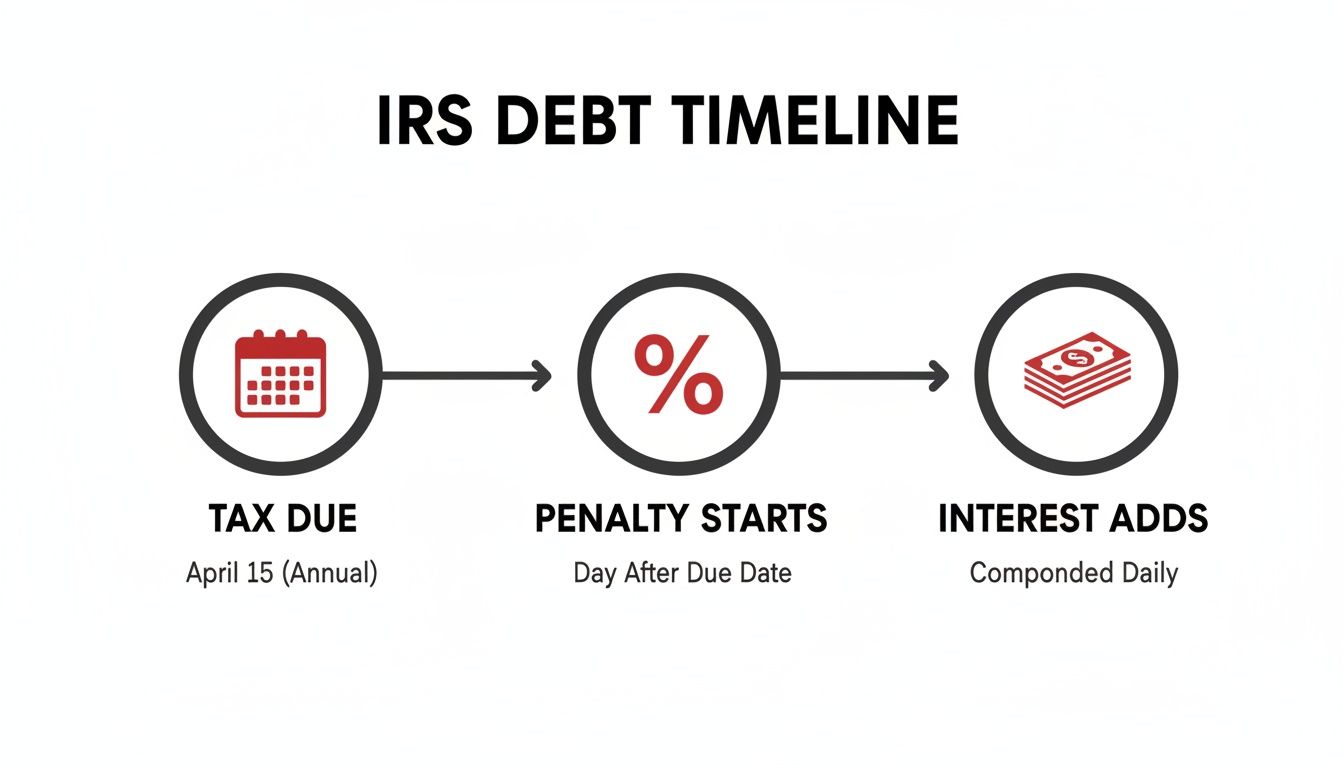
As you can see, waiting is expensive. The longer the debt goes unpaid, the bigger the financial hole gets, which makes taking quick, decisive action incredibly important.
From Polite Notices to Serious Threats
If you don't respond to the first few letters or make payment arrangements, the IRS playbook gets a lot more aggressive. You'll start getting mail with more intimidating titles, all leading up to one critical document: the Final Notice of Intent to Levy and Notice of Your Right to a Hearing.
Pay close attention to this one. It's no longer a suggestion; it's a formal, final warning that the IRS is legally authorized and preparing to seize your assets.
This notice gives you a 30-day window. In that time, you have to either pay up or formally request a Collection Due Process (CDP) hearing to challenge the action. Ignoring this letter is like ignoring the final boarding call at the airport—the plane is taking off, and the IRS won't hold it for you.
To get a better feel for what you're up against, it's worth reviewing a detailed guide to understanding an IRS notice of levy, which breaks down the specific legal language and strict deadlines you'll be facing.
Tax Liens: The Public Claim on Your Property
Still no response? The next move for the IRS is often to file a Notice of Federal Tax Lien. This is a public document that stakes a legal claim against all your property—everything you own now and everything you acquire in the future. It doesn't mean the IRS has taken your house, but it does mean they get first dibs if you try to sell it.
Imagine putting your home on the market. A tax lien is like the government planting a giant sign on your front lawn that tells every bank, lender, and potential buyer that the IRS gets paid first. You won't see a penny from the sale of your assets until they get their money.
A federal tax lien is a powerful collection tool. It crushes your credit score and makes it almost impossible to sell property or get new financing until the tax debt is resolved. It attaches to your home, your car, your business inventory—everything.
For a small business owner, a lien can be a death sentence. It can stop you from getting a line of credit, financing new equipment, or even securing a simple business loan. It effectively puts your operations in a financial stranglehold.
Tax Levies: The Actual Seizure of Your Assets
If a lien is the threat, a levy is the IRS making good on that threat. A lien is a claim on your property; a levy is the actual seizure of it. This is the point where the consequences of owing the IRS become painfully real. Without needing a court order, the IRS has the power to start taking your money and property to settle your debt.
This isn't a theoretical risk. It happens every day in several ways:
- Bank Levies: The IRS can instruct your bank to freeze your accounts. The bank is legally obligated to hold your money for 21 days and then send the funds (up to the amount you owe) directly to the IRS.
- Wage Garnishment: The IRS can send a notice to your employer, forcing them to divert a large portion of your paycheck directly to the government. This continues until the debt is paid off.
- Asset Seizure: In serious cases, the IRS can physically seize and sell your property, including real estate, vehicles, and business equipment.
- Refund Offset: Forget about getting a tax refund. Any future federal or state refunds you’re due will be automatically intercepted and applied to your debt.
The distinction is critical: a lien is a public claim, but a levy is the IRS actively taking what's yours. Understanding this progression—from notice to lien to levy—is the key to knowing exactly when you need to step in to protect yourself.
How Unpaid Tax Debt Can Derail Your Life

Understanding what happens when you owe the IRS goes far beyond the dollar amount on a notice. A federal tax debt isn’t a neat, contained financial problem. It’s an invasive issue that can seep into nearly every corner of your professional and personal life.
I often compare an unpaid tax liability to a dye pack in a bank bag. Once it goes off, the stain gets on everything. It can poison your business credit, put major life events on hold, and create a staggering amount of personal stress. For most people, this is the point where the abstract threat of owing money to the government becomes a series of very real, daily roadblocks.
Suddenly, resolving the debt isn't just about paying what you owe. It’s about reclaiming your financial freedom and getting your peace of mind back.
Professional and Business Consequences
For self-employed professionals and small business owners, an unresolved tax debt can bring everything to a grinding halt. The primary weapon in the IRS's arsenal is often the federal tax lien, which is essentially a public announcement of your debt that torpedoes your financial reputation.
This isn't just a black mark on a report; the consequences are immediate and tangible. A business owner with a tax lien will find it nearly impossible to secure a new loan or line of credit. Lenders see the lien and immediately flag you as a high-risk borrower. This effectively freezes your ability to invest in growth, manage cash flow, or cover unexpected expenses.
A tax lien can also blow up client relationships and business deals. If you're a realtor or mortgage lender, discovering your client has an undisclosed tax lien can derail a closing at the eleventh hour. This doesn't just impact your client—it damages your own professional credibility.
Personal Life and Financial Hurdles
The disruption doesn't stop at your business. An IRS debt can create significant barriers in your personal life where none existed before, making simple financial steps feel complicated and long-term goals seem completely out of reach.
Here’s a snapshot of how an IRS debt can hit you personally:
- Real Estate Transactions: A tax lien has to be settled before you can sell or refinance a home. The IRS gets paid its share from the proceeds before you see a dime, which can completely wipe out your equity.
- Credit Score Damage: A Notice of Federal Tax Lien can absolutely devastate your credit score. This makes it much harder and more expensive to get a car loan, mortgage, or even a basic credit card.
- Passport Restrictions: If your tax debt is considered "seriously delinquent" (around $59,000, though the figure is adjusted for inflation), the IRS can notify the State Department. They, in turn, can deny your passport application or even revoke your current one, grounding you from all international travel.
The IRS also has the power to seize assets or income directly. For instance, a wage garnishment is one of the most direct ways the agency can disrupt your financial stability, taking money right out of your paycheck or your client's payments.
An IRS tax debt complicates everything. It can become a major point of contention in a divorce, create roadblocks when you apply for a professional license, and add a layer of constant stress that impacts your health and relationships.
The agency’s collection methods are backed by serious enforcement power. Just to give you an idea, the IRS collected $77.6 billion in unpaid assessments in a single recent year. This data shows just how effective the IRS is at collecting what it's owed, which is why it's so critical to address the debt proactively instead of hoping it will go away.
Finding Your Path to Tax Debt Resolution

Knowing what the IRS can do is one thing. Figuring out what you can do is another. Facing down a tax debt feels like standing at the bottom of a mountain, but the good news is there are several established trails to the top.
The trick is to stop reacting to IRS notices and start acting. When you take the lead, you get to choose the strategy that actually fits your life and your finances, instead of having one forced on you through a levy or lien. This is your roadmap back to solid ground.
Option 1 The Installment Agreement
The most common and straightforward route is the Installment Agreement (IA). Think of it exactly like it sounds: a payment plan. You and the IRS agree on a set monthly payment to chip away at your debt until it’s gone, including all the accrued interest and penalties.
This is the perfect fit if you can eventually pay the full amount but just don't have it all right now. An IA puts an immediate stop to aggressive collection actions, giving you the breathing room you need to get things handled without the constant threat of a bank levy.
There are a few different types, and some are easier to get than others. For smaller debts, the IRS even offers a Guaranteed Installment Agreement for anyone who owes less than $10,000 in tax (not counting penalties and interest) and meets a few other simple requirements.
Option 2 The Offer in Compromise
But what if you genuinely can’t pay it all back, no matter how much time they give you? That's where the Offer in Compromise (OIC) comes in. An OIC is a formal agreement where the IRS accepts less than the full amount you owe to settle the debt completely.
Think of it this way: if your debt is a mountain you can’t possibly climb, an OIC is the IRS acknowledging that getting something is better than getting nothing. They agree to meet you partway.
This isn’t a simple negotiation, though. Qualifying for an OIC requires opening up your entire financial life to the IRS. They need to be convinced that paying in full would cause you legitimate economic hardship. They’ll look at everything:
- Ability to Pay: What you earn versus what you need to live.
- Income: Both your current earnings and what you could realistically make in the future.
- Asset Equity: The real value of things you own, from your house and car to your savings accounts.
The OIC process is incredibly detailed and tough to get through on your own. Only a small fraction of applications get approved, so putting together a perfect, professional submission is everything.
The Offer in Compromise is a powerful tool for those with legitimate financial hardship. However, it's not a loophole for avoiding taxes. The IRS will analyze your entire financial picture to determine if you truly cannot pay what you owe.
This is just one of several approaches to managing what you owe. You can learn more about a full range of tax debt relief options to see which path might be right for you.
Option 3 Penalty Abatement
Sometimes, the original tax bill has ballooned into something monstrous because of the penalties tacked on. If that’s the case, Penalty Abatement—a formal request to have those penalties removed—might be your best move.
To get penalties waived, you typically have to prove you had a reasonable cause for the mistake. Life happens. A sudden serious illness, a death in the family, a natural disaster, or even getting bad advice from a tax preparer can all qualify.
There’s also a much simpler route called the First-Time Abatement (FTA). If you've kept your nose clean with the IRS for the last three years (filed and paid on time), they will often waive the penalties for one tax year as a one-time courtesy. It’s a fantastic tool for an otherwise diligent taxpayer who just had one bad year.
A Quick Look at Your Options
Choosing the right path depends entirely on your financial reality. Here’s a simple breakdown of the most common solutions.
Comparing IRS Tax Debt Resolution Options
| Resolution Option | Who It's For | Key Benefit | Main Drawback |
|---|---|---|---|
| Installment Agreement | Taxpayers who can afford the full debt over time. | Stops collection actions; provides a predictable payment schedule. | Interest and penalties continue to accrue until the debt is fully paid. |
| Offer in Compromise | Those with significant financial hardship who cannot pay in full. | Allows you to settle your tax debt for a fraction of what you owe. | Very difficult to qualify for; requires full financial disclosure. |
| Penalty Abatement | People with a valid reason for failing to file or pay on time. | Removes penalties, significantly reducing the total amount owed. | You must prove "reasonable cause" or meet strict criteria. |
| Bankruptcy | Individuals with very specific types of older income tax debt. | Can completely discharge certain tax debts (Chapter 7) or restructure them (Chapter 13). | A complex legal process with strict eligibility rules; doesn't apply to all tax types. |
Each of these options serves a different purpose. The key is aligning the solution with the problem—something an experienced tax professional can help you navigate.
When Bankruptcy Might Be an Option
Most people think of bankruptcy as the absolute last resort, and for good reason. But in certain situations, it can be a surprisingly effective tool for discharging old income tax debt. The rules are incredibly strict—often called the "three-year, two-year, 240-day" rules—and determine exactly which tax debts can be included.
A Chapter 7 bankruptcy might eliminate qualifying income tax debts entirely, while a Chapter 13 could roll them into a more manageable repayment plan. One critical exception: payroll taxes and the associated Trust Fund Recovery Penalty are almost never dischargeable. This is a complex intersection of tax and bankruptcy law, and you absolutely need an attorney who is an expert in both fields to even consider it.
When You Need a Tax Attorney in Your Corner
Trying to navigate the IRS collection process on your own can feel a lot like performing your own surgery. Sure, it's technically possible, but the risk of making a critical, and very painful, mistake is incredibly high. For a simple payment plan on a small balance, you might be able to handle it yourself. But there are definite moments when the stakes are too high and the rules too complex to go it alone.
Knowing when to call for backup is one of the most important decisions you'll make. It’s the difference between taking control of the situation and letting the IRS dictate every single term. The goal is to shift from a defensive, reactive posture to a strategic, proactive one. Sometimes, that means bringing in an expert who speaks the IRS’s language fluently.
The Red Flags Demanding Professional Help
Certain situations are just too complex or carry too much risk to handle without a pro. These aren't just friendly suggestions; think of them as critical trigger points signaling it's time to stop guessing and get expert legal advice. If any of the following sound familiar, it's a clear sign you need a tax attorney.
- Your Debt Is Over $50,000: Once your tax bill crosses this line, the IRS collection playbook changes. The process becomes far more aggressive, the rules for resolution get stricter, and the chances of facing liens, levies, and even passport revocation go up dramatically.
- You're Dealing with Payroll Tax Issues: This is a non-negotiable red flag. The IRS views payroll taxes—the money you withhold from employee paychecks—as funds you are holding "in trust" for the government. They pursue these debts with a vengeance and often hold business owners personally liable through the Trust Fund Recovery Penalty.
- You Received a Final Notice of Intent to Levy: This is the IRS's last warning shot before they start seizing your assets. You have a very small window to respond, and an attorney can often step in immediately to halt the levy and negotiate a solution.
- You Want to File an Offer in Compromise (OIC): The OIC program is notoriously tough, with a notoriously low acceptance rate. A skilled tax attorney knows how to build a compelling case, properly calculate your "reasonable collection potential," and present your financial story in the most favorable light possible.
Attempting to navigate complex tax issues like payroll debt or a Final Notice of Levy without representation is like walking into a courtroom without a lawyer. You are at an immediate disadvantage because you don't know the rules, procedures, or your full range of rights.
Why a Tax Attorney Makes the Difference
Hiring a tax attorney isn't just about paying someone to fill out forms. It’s about leveraging their specific legal authority and deep expertise to protect your rights and secure a much better outcome. Unlike a CPA or an Enrolled Agent, a tax attorney brings unique protections and strategic advantages to the table.
One of the biggest is the attorney-client privilege, which shields your conversations. This legal protection means you can be completely open and honest about your situation without worrying that your words could be used against you. This confidential space is absolutely crucial when dealing with sensitive financial details or potential criminal exposure. For more on this, you can read our detailed guide on the benefits of hiring a tax attorney.
A seasoned tax attorney does more than just negotiate. They analyze your entire financial picture to find the best legal path forward. They can stop wage garnishments, get bank levies released, and represent you in IRS appeals or even in Tax Court if it comes to that. They know the nuances of the tax code inside and out and use that knowledge to your advantage. This strategic, hands-on approach is a world away from the impersonal, one-size-fits-all tactics you often see from huge national tax resolution companies. The right expert ensures your case gets the personalized attention it truly needs.
Common Questions About Owing the IRS
When you’re staring down a tax problem, a flood of questions can hit you all at once. It's completely normal to feel overwhelmed. Let's cut through the noise and get straight to the answers for some of the most pressing concerns people have when they owe the IRS.
How Long Does the IRS Have to Collect a Tax Debt?
It’s a common misconception that a tax debt just vanishes after a few years. The truth is a bit more complicated. The IRS generally has a 10-year window to collect what you owe, and that clock starts ticking from the date your tax was officially assessed.
But—and this is a big "but"—that 10-year clock isn't set in stone. Certain actions can hit the pause button on the collection period, a process known as "tolling." Things like filing for bankruptcy, submitting an Offer in Compromise, or even living outside the U.S. for a significant time can extend that deadline.
The key date you need to know is your Collection Statute Expiration Date (CSED). A tax attorney can pull your official IRS transcripts to pinpoint this exact date for you, so you're not left guessing.
Can the IRS Take My Social Security Benefits?
Yes, they absolutely can. The IRS has unique powers that most other creditors don't, including the ability to levy your Social Security benefits through the Federal Payment Levy Program (FPLP). This is an automated system, meaning they don’t need a judge’s permission to do it.
The IRS can take up to 15% of your monthly Social Security payment and will continue to do so until the debt is paid off. This makes tackling tax debt incredibly urgent, especially for retirees who count on that income to cover their living expenses.
While the idea of the IRS touching your Social Security is scary, it's usually a later-stage collection tactic. By proactively contacting the IRS to work out a solution, you can almost always prevent it from ever getting to this point.
Will I Go to Jail for Owing the IRS Money?
This is probably the number one fear people have, so let me put it to rest: for the vast majority of people, the answer is no. You will not go to jail simply for owing the IRS money you can't afford to pay.
Jail time is reserved for criminal tax offenses, like intentionally hiding income, committing tax fraud, or willfully refusing to file returns year after year. Owing money is a civil matter. The IRS is a collection agency, not a law enforcement agency in that sense. Their main goal is to get the money you owe, not put you behind bars. As long as you're communicating with them and trying to find a solution, the risk of criminal charges is virtually zero.
It’s also important to remember that tax debt isn't just a federal issue. State tax agencies can be just as aggressive, and sometimes they have even longer to collect. States like California, New York, Texas, and Florida consistently rank among those with the highest tax debt. You can discover more insights about state-level tax debt on jdavidtaxlaw.com to see how your state stacks up.
What Is the First Step If I Get an IRS Notice?
Whatever you do, do not ignore it. That's the single most important rule. Open the letter as soon as you get it and figure out three things: why they sent it, how much they think you owe, and the deadline to respond.
Take a deep breath. The next step isn't to panic—it's to pull out your tax records for that year and see if their numbers match yours. Before you pick up the phone to call the IRS, it is always a smart move to speak with a tax professional. They can confirm whether the debt is even accurate, explain your rights, and help you map out a strategy. This keeps you from accidentally agreeing to something that isn't in your best interest.
Facing the IRS can feel like a lonely battle, but you don't have to go through it alone. At Attorney Stephen A Weisberg, we start by building a clear strategy before you ever have to commit to a plan. That’s why we offer a FREE Tax Debt Analysis to see exactly how we can resolve your issues with the IRS or state. Take the first step toward peace of mind and schedule your analysis today at https://weisberg.tax.


