What Happens If You Never Filed Taxes? A Complete Guide
Discover what happens if you never filed taxes, including penalties, interest, and steps to resolve your tax issues with the IRS.

In this article
- The Escalating Consequences of Unfiled Taxes
- From Notices to Legal Action
- Summary of IRS Actions for Unfiled Taxes
- How Penalties and Interest Can Turn a Small Tax Bill Into Crushing Debt
- The One-Two Punch of IRS Penalties
- How Compounding Interest Creates a Financial Snowball
- A Real-World Example: Watching Debt Spiral
- When the IRS Gets Serious About Collecting
- The IRS Unleashes Its Collection Tools
- Losing Your Passport
- The Hidden Costs of Unfiled Tax Returns
- Locked Out of Financial Milestones
- Forfeiting Your Own Money
- Your Step-by-Step Path to Tax Compliance
- Step 1: Gather Your Essential Documents
- Step 2: Figure Out How Many Years to File
- Step 3: Prepare and File Your Overdue Returns
- Step 4: Deal With the Tax Debt That Follows
- Answering Your Top Questions About Unfiled Taxes
- Is There a Statute of Limitations on Unfiled Taxes?
- What if I Can't Afford to Pay What I Owe?
- Should I Hire a Tax Professional for Help?
- What Is the IRS Voluntary Disclosure Program?
So, what really happens if you just... never file your taxes? It's a question a surprising number of people ask, often out of fear or simple procrastination. The short answer is: nothing good. The consequences don't just appear overnight; they build up over time, starting with polite letters and escalating to serious financial and legal problems. Ignoring the IRS is one of the worst financial decisions you can make. It doesn't make the problem go away—it just starts a clock on a process that gets more expensive and stressful by the day.
The Escalating Consequences of Unfiled Taxes
Failing to file a tax return isn't just a minor oversight in the eyes of the IRS. They see it as a significant failure to comply, and it kicks off a very predictable, and very costly, chain of events. A lot of people hold onto the myth that if they just lay low, the IRS will eventually forget about them. That couldn't be further from the truth. Their powerful automated systems are specifically designed to flag people who haven't filed, and once you're on their radar, they don't let go easily.
The process often begins quietly, maybe with a notice or two in the mail. But don't be fooled by the calm start. Ignoring these early warnings is like hitting the accelerator on a car heading toward a cliff.
From Notices to Legal Action
The path from a missed deadline to serious legal trouble is a well-worn one. The IRS doesn't just show up and seize your bank account out of the blue; they give you chances to fix the problem. But their patience is finite. The longer you wait, the worse it gets, and the fewer options you have.
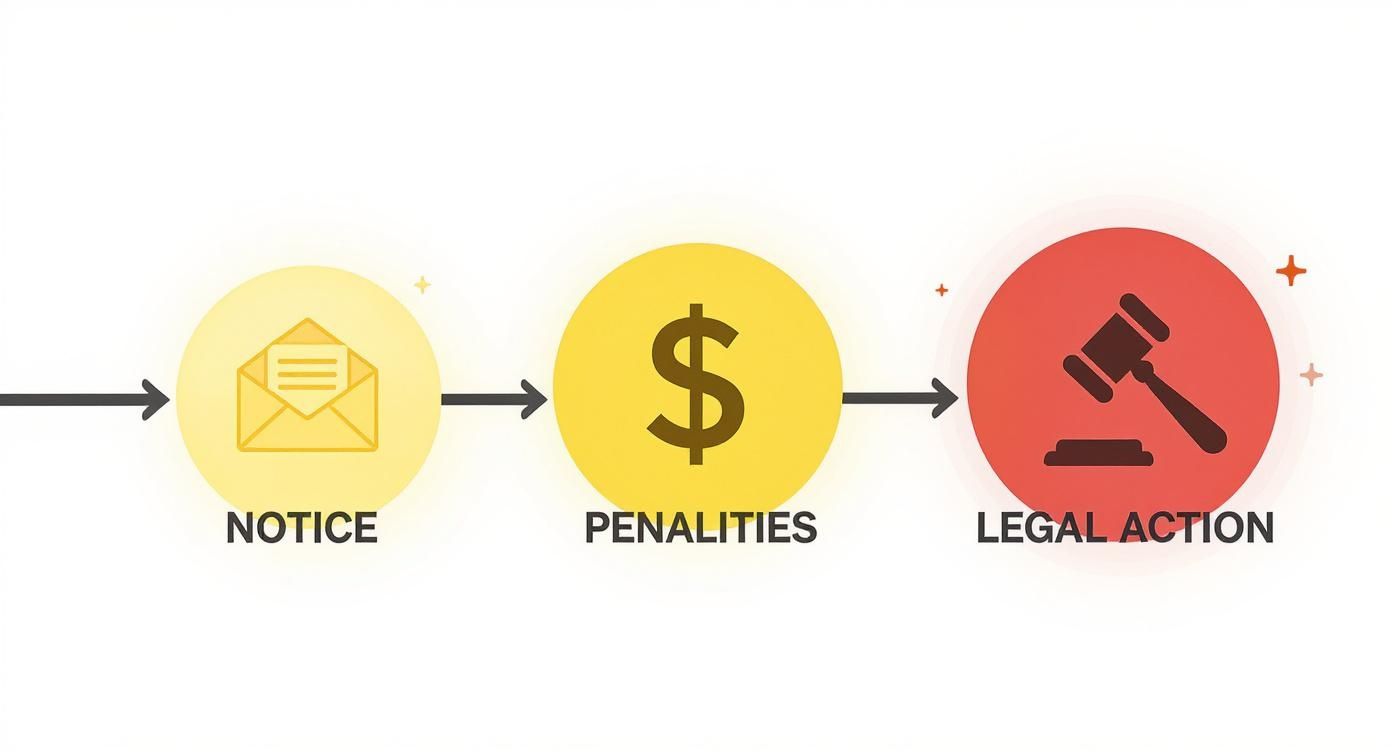
As you can see, what starts with a simple letter can quickly escalate into the IRS having a legal claim on your property and income. This is exactly why tackling unfiled returns head-on is always the smartest move.
The biggest mistake you can make is thinking the IRS won't notice. Their entire system is built for enforcement, and their one and only goal is to ensure compliance. Every day you delay just digs the hole deeper, adding penalties and closing doors on potential resolution options.
One of the IRS's first major moves is to file a Substitute for Return (SFR) for you. This sounds almost helpful, but trust me, it’s not. The IRS creates this return using only the income information they have from third parties (like your W-2 or 1099s). Crucially, they give you zero deductions or credits you might be entitled to.
The result is a massively inflated tax bill, what many of us in the field call a "phantom tax bill," which then becomes the official amount you owe—and the basis for all the penalties and interest that follow.
The table below gives you a quick snapshot of how the IRS typically escalates its enforcement actions when a taxpayer fails to file or respond.
Summary of IRS Actions for Unfiled Taxes
| Stage | IRS Action | Potential Outcome for Taxpayer |
|---|---|---|
| Initial | Automated notices (e.g., CP59) are sent requesting a tax return. | A chance to file voluntarily with minimal initial penalties. |
| Escalation | The IRS files a Substitute for Return (SFR) with a high tax assessment. | A much larger tax bill is created, forming the basis for collections. |
| Enforcement | A Notice of Federal Tax Lien is filed, making your debt public. | Credit score damage; difficulty selling property or getting loans. |
| Aggressive Collection | A Final Notice of Intent to Levy is issued. | Bank accounts, wages, and other assets can be seized without a court order. |
| Severe | The case may be referred for criminal investigation in cases of willful evasion. | Potential for felony charges, fines, and even prison time. |
Understanding these stages is the first step. The good news is that even if things have progressed, there is almost always a path back to compliance. This guide will walk you through those risks in more detail and, more importantly, give you a clear roadmap to getting this resolved for good.
How Penalties and Interest Can Turn a Small Tax Bill Into Crushing Debt
Ignoring a tax return you should have filed doesn't just put you on the IRS's radar. It starts a financial clock ticking in the background—a clock that can turn a manageable problem into a full-blown crisis. The two main drivers behind this are penalties and interest, and the IRS uses them very effectively to make not filing far more painful than just getting it done.
The second you miss that filing deadline with a balance due, the meter starts running. These aren't just little slap-on-the-wrist fees; they are significant charges designed to get your attention and inflate your debt fast. Understanding how they work is the first step to appreciating the financial quicksand you're in.
The One-Two Punch of IRS Penalties
When you don't file and don't pay, the IRS usually hits you with two separate penalties. Yes, they can be charged at the same time.
- Failure to File Penalty: This is the big one. The IRS charges 5% of the unpaid taxes for each month (or even part of a month) your return is late. It’s a steep price for procrastination, and it keeps climbing until it hits a cap of 25% of your unpaid tax bill.
- Failure to Pay Penalty: This one is smaller but it adds up. The penalty is 0.5% of your unpaid taxes for each month the tax isn't paid. Just like the Failure to File penalty, it also maxes out at 25% of what you owe.
When both penalties are applied in the same month, the IRS reduces the Failure to File penalty by the amount of the Failure to Pay penalty. But don't get too comfortable—the combined effect is still a rapid and expensive escalation of your debt.
Critical Alert: If your return is more than 60 days late, a nasty minimum penalty kicks in. The penalty becomes the lesser of 100% of the tax you owe or a specific dollar amount that’s adjusted for inflation ($485 for returns due in 2024). For a lot of people with smaller tax bills, this rule can instantly double what they owe.
How Compounding Interest Creates a Financial Snowball
On top of all those penalties, the IRS charges interest on your entire outstanding balance. This is where a bad situation gets truly dangerous. The interest isn't just charged on the original tax you owed—it’s also charged on the penalties themselves.
Think of it as a credit card with the worst possible terms. The interest compounds daily, meaning every single day, you're being charged interest on a slightly larger amount than the day before. It creates a snowball effect that can cause a modest tax debt to grow exponentially over just a few years.
This isn't a rule you can escape by moving. Whether you live in the U.S. or abroad, these consequences follow you. The IRS compliance regime is strict, and the relentless growth of penalties and daily compounding interest will find you. You can find more details on penalties for expats at TaxesForExpats.com, but the core principle is the same for everyone: the debt just keeps growing.
A Real-World Example: Watching Debt Spiral
Let's walk through how this plays out in the real world. Imagine you owed $5,000 in taxes for a return due on April 15th, but you just never filed it.
- Year 1: In just five months, the Failure to File penalty maxes out at its 25% cap, tacking on $1,250. The Failure to Pay penalty adds another $300. Meanwhile, interest has been compounding daily on the tax and on those new penalties. Your initial $5,000 problem is now well over $6,550 and getting bigger every day.
- Year 3: By now, that daily compounding interest has been working against you for more than 1,000 days. The debt, which started at a manageable $5,000, has likely swelled to over $8,000, and that’s assuming the IRS hasn't taken any other collection actions.
- Year 5: At this point, it’s not uncommon for the accumulated penalties and interest to match or even exceed the original tax you owed. Your $5,000 problem has become a $10,000+ crisis, making it infinitely harder to finally resolve.
This simple example isn't an exaggeration—it's the devastating mathematical reality of ignoring the IRS. Putting it off isn't just a delay; it's a decision that actively multiplies your financial burden.
The good news is that even if penalties have piled up, you might not be stuck with them. The IRS can sometimes remove penalties if you had a good reason for filing or paying late. We cover this in detail in our guide on the standards for reasonable cause for penalty abatement.
When the IRS Gets Serious About Collecting
If you ignore the mail and the penalties keep piling up, the IRS eventually changes its tune. The problem stops being a stack of letters and becomes a very real threat to your money, your property, and your peace of mind. This is when they move from just assessing taxes to actively collecting them.
The whole process usually kicks off when the IRS files a Substitute for Return (SFR) for you. Don't let the name fool you; they're not doing you a favor. They simply take the income data they have from W-2s and 1099s and create a bare-bones return. The catch? They don't include any of the deductions or credits you're entitled to. This means the tax bill they calculate is almost always way higher than what you actually would have owed. That inflated number is what they'll use to come after you.

The IRS Unleashes Its Collection Tools
Once that SFR is on the books, the IRS has a legal debt to collect, and they have some powerful tools to do it. These aren't suggestions—they are legally enforceable actions designed to take your assets and force you to get back in line. At this point, burying your head in the sand is no longer an option.
The IRS usually follows a clear escalation path, starting with claims on your property and moving to outright seizure of your money.
- Federal Tax Lien: This is their opening move. A tax lien is a legal claim the government places on all of your property—your house, your car, your investments. It’s a public record, which tells the world the IRS gets paid before anyone else. This absolutely tanks your credit score and makes it next to impossible to sell property or even get a car loan.
- Bank Levy: A levy is the actual seizure. One day you’ll go to use your debit card and find it declined. That's because the IRS can order your bank to freeze your accounts and hand over every last cent, up to the amount you owe. It happens suddenly and without any final warning.
- Wage Garnishment: This is one of the most stressful enforcement actions. The IRS instructs your employer to take a big chunk of your paycheck and send it directly to them. You never even see the money. Unlike other creditors who need to sue you first, the IRS doesn't need a court order. They can leave you with just enough to scrape by.
These aren't empty threats. Every year, the IRS sends millions of these notices. If you've received one, it’s crucial to understand what’s happening. You can review our ultimate guide to understanding an IRS Notice of Levy for a deeper dive into the mechanics.
An IRS levy isn't a starting point for a conversation. It's a direct seizure of your property, fully authorized by federal law. Once they send that Final Notice of Intent to Levy, they have the power to take your assets, and they will.
Losing Your Passport
One of the more shocking consequences of a large tax debt is losing your ability to travel internationally. If your tax debt is deemed "seriously delinquent," the IRS can notify the State Department.
Once that happens, the State Department can refuse to issue you a new passport or, even worse, revoke your current one. This is a serious measure reserved for significant tax debts, but it shows just how far the IRS can go.
This is a huge problem for U.S. citizens living abroad who might think they're out of sight, out of mind. Thanks to international agreements, the IRS has more visibility than ever into foreign bank accounts and income. Suddenly finding yourself unable to renew your passport can leave you stranded in another country or unable to return to the U.S.
When the IRS starts taking these aggressive steps, it's a blaring alarm bell. The time for waiting and hoping it goes away is long gone. You need to act fast and get professional help to protect what's yours and figure out a way back into good standing.
The Hidden Costs of Unfiled Tax Returns
Sure, the most obvious threats from unfiled taxes are IRS penalties and aggressive collection tactics. But the real damage often runs much deeper, creating a ripple effect that can quietly sabotage your financial life for years. These hidden consequences have a nasty habit of popping up at the worst possible moments, putting major life goals completely out of reach.
Many people only grasp this reality when they apply for a loan. Whether you’re trying to buy a house, get financing for a small business, or even apply for federal student aid, there’s one non-negotiable requirement: copies of your recently filed tax returns. It’s the universal proof of income, the document that verifies you are who you say you are financially. Without it, your application is dead in the water.
Locked Out of Financial Milestones
Imagine you’ve finally found your dream home. You’ve got the down payment ready, but the bank rejects your mortgage application flat out. Why? Because you can’t produce two years of tax returns. Or think about the entrepreneur with a brilliant business plan who can’t get a startup loan for the exact same reason. These aren't just hypotheticals—they happen all the time.
This lack of paperwork puts a solid wall between you and the financial products you need to move forward. This includes:
- Mortgage Loans: Lenders simply won't approve a home loan without verified income from filed tax returns.
- Business Financing: Banks and the Small Business Administration (SBA) see tax compliance as a basic entry ticket to even consider a loan application.
- Student Financial Aid: The Free Application for Federal Student Aid (FAFSA) pulls data directly from filed tax returns to figure out eligibility.
- Professional Licenses: In some states, you can't get or renew certain professional licenses without proving you're up-to-date on your taxes.
Forfeiting Your Own Money
Here’s the real kicker: by not filing, you might be giving the government an interest-free loan with money you’ll never see again. If the IRS actually owes you a refund, you only have a three-year window from the original due date to file that return and claim your cash.
Once that three-year deadline passes, the U.S. Treasury gets to keep your money. Legally. It's gone for good. And we're not just talking about overpaid income tax—this also includes valuable refundable credits like the Earned Income Tax Credit (EITC), which can put thousands of dollars back into the pockets of eligible families.
This isn't just a personal loss; it's part of a much bigger economic story. Worldwide, individual tax non-compliance and offshore evasion cost governments around $200 billion in lost tax revenue every single year. When some taxpayers don't pay their share, it shifts a heavier burden onto everyone else and shrinks the budget for essential public services. You can get a better sense of the global scale of tax evasion from research by the International Monetary Fund. Staying compliant isn’t just about protecting your own financial future—it's a fundamental civic duty.
Your Step-by-Step Path to Tax Compliance
Staring down years of unfiled tax returns feels like standing at the bottom of a mountain. It’s intimidating, but the good news is there’s a clear path to the top. This is where the anxiety stops and the action begins.
Instead of getting bogged down by what’s past, let’s build a practical, step-by-step roadmap to get you back into good standing with the IRS. Think of it less as a confrontation and more as a structured process for taking back your financial life. The key is to break it down into smaller, manageable tasks. You don’t have to fix everything overnight.
Step 1: Gather Your Essential Documents
First things first, you can't file without the right paperwork. For many people who’ve fallen behind, this is the biggest hurdle. Records get lost, misplaced, or were never kept in the first place. You'll need documents that prove your income and any deductions or credits you might be eligible for.
But don't panic if that shoebox of receipts vanished years ago. The IRS can actually be your biggest ally here. You can request a Wage and Income Transcript for every year you need to file. This official record lists all the income information that was reported to the IRS on your behalf, such as:
- Forms W-2 from your employers
- Forms 1099-NEC or 1099-MISC for any freelance or contract work
- Forms 1099-INT for interest you earned from bank accounts
- Forms 1099-DIV for investment dividends and distributions
You can get these transcripts directly from the IRS website, by phone, or through the mail. This is single-handedly the most powerful tool for piecing together your financial history and ensuring your old tax returns are filed accurately.
Step 2: Figure Out How Many Years to File
Okay, so just how far back do you need to go? While the IRS technically has an unlimited amount of time to come after you for unfiled returns, their internal policy offers a much more reasonable starting point.
In most non-filing cases, the IRS will consider you back in compliance if you file the last six years of tax returns. This isn't a hard-and-fast law but a general practice that gets most people back into the system. Keep in mind, this can change depending on your specific situation, like if you owe a very large amount or if the IRS suspects fraud.
The real goal here is to show a good-faith effort to get compliant. Filing the past six years proves to the IRS that you’re serious about fixing the problem, which is a massive first step, especially when it comes to negotiating payment options later on.
Step 3: Prepare and File Your Overdue Returns
With your documents in hand and a target number of years, it's time to prepare the returns. You'll need to use prior-year tax software or fill out the old paper forms, which are all available for download on the IRS website.
It is absolutely crucial to file these returns correctly, claiming every single deduction and credit you are legally entitled to. This is your chance to correct the record. Remember, if the IRS filed a Substitute for Return (SFR) for you, it was calculated with zero deductions, resulting in the highest possible tax bill. By filing an accurate return yourself, you replace their inflated version with one that reflects your reality, which almost always drastically lowers what you owe.
For a more detailed walkthrough, our guide on how to file back taxes breaks down the entire process.
Step 4: Deal With the Tax Debt That Follows
Once your returns are processed, the IRS will send you a bill for the total tax, penalties, and interest. For many, that final number is far too big to pay off all at once. The good news is the IRS knows this and has several programs to help people manage their debt. You have options.
- IRS Installment Agreement (Payment Plan): This is the most straightforward solution. If you owe less than a certain amount, you can often set up a monthly payment plan online in just a few minutes. It allows you to pay your debt over several years in manageable amounts and stops the most aggressive collection actions, like wage garnishments.
- Offer in Compromise (OIC): An OIC is a program that lets certain taxpayers with significant financial hardship settle their tax debt for less than the full amount they owe. Qualifying is tough and requires a complete financial disclosure, but for those who are eligible, it can be a lifesaver.
- Currently Not Collectible (CNC) Status: If you can prove to the IRS that you can't afford to pay your basic living expenses and your tax bill, they may place your account in CNC status. This essentially hits the pause button on collections until your financial situation improves. Penalties and interest will continue to grow, but it provides immediate relief from levies.
For anyone trying to get a better handle on their obligations, understanding the fundamentals of proper personal tax filing is a great place to start. By taking these steps, you shift from a position of stress and uncertainty to one of control. You can stop worrying about the "what ifs" and start building a solid path back to financial stability.
Answering Your Top Questions About Unfiled Taxes
When you're facing a pile of unfiled tax returns, your mind starts racing with questions. It's easy to get overwhelmed by the "what-ifs" and worst-case scenarios. Let's cut through that noise and tackle some of the most common—and urgent—questions people have when they fall behind.
Think of this as your straight-talk guide to the realities of dealing with the IRS.
Is There a Statute of Limitations on Unfiled Taxes?
This is probably the biggest and most dangerous myth out there. People often assume that after a certain number of years, the IRS just writes off old tax debt. That couldn't be further from the truth.
The IRS generally has 10 years to collect a tax debt, but here’s the critical detail they don't tell you in commercials: that 10-year clock doesn't start until you actually file the tax return.
If you never file, the clock never starts. Period. That gives the IRS a nearly infinite window to come after you, assess what they think you owe, and tack on years of penalties and interest. In their view, the debt simply never expires.
On the flip side, the clock is definitely ticking for you.
You only have three years from the original tax deadline to file a return and claim a refund. If you wait longer than that, any money the government owed you is gone forever—forfeited to the U.S. Treasury.
What if I Can't Afford to Pay What I Owe?
This is the fear that paralyzes so many people, causing them to dig an even deeper hole by not filing. But here’s what you need to understand: the IRS considers filing and paying to be two completely separate obligations.
Letting your inability to pay stop you from filing is the single worst mistake you can make. Filing your overdue returns immediately stops the bleeding from the brutal Failure to File penalty, which can balloon to 25% of your total tax bill.
Once the returns are in, you can pivot to dealing with the debt itself. The IRS has several programs designed for people who can't pay everything at once:
- Installment Agreement: This is a straightforward payment plan that lets you pay down your debt in manageable monthly chunks, often over 72 months.
- Offer in Compromise (OIC): If you're in serious financial hardship, you may be able to settle your tax debt for a fraction of what you originally owed.
- Currently Not Collectible (CNC) Status: This is a temporary hardship status that pauses IRS collection efforts if you can prove you can't afford basic living expenses.
Should I Hire a Tax Professional for Help?
That really depends on how deep you're in. If you just missed a year or two, have all your W-2s, and your financial life is pretty simple, you might be able to catch up on your own using prior-year tax software.
But you should seriously consider calling in an expert—like an Enrolled Agent, CPA, or tax attorney—if any of these sound familiar:
- You haven't filed returns for many years.
- You're self-employed or run a business with complex records.
- You have foreign bank accounts or other overseas assets.
- The potential tax bill is massive and intimidating.
- You've received a scary letter from the IRS threatening a lien or levy.
A seasoned pro does more than just fill out forms. They know how to reconstruct records, find every possible deduction, and can represent you directly before the IRS to negotiate the best outcome. That kind of expertise buys you both a better result and invaluable peace of mind.
What Is the IRS Voluntary Disclosure Program?
The IRS Voluntary Disclosure Practice is a very specific program for a very specific type of person: someone who willfully and intentionally broke tax laws and could be looking at a criminal investigation.
This isn't for the person who got busy and forgot to file. It's for situations involving deliberate tax evasion—think hiding offshore accounts, creating fake business expenses, or intentionally underreporting large amounts of income.
By coming forward through this formal program, a taxpayer can get right with the law, pay their back taxes and civil penalties, and—in nearly all cases—receive a pass on criminal prosecution. This is a high-stakes legal process that absolutely requires the guidance of an experienced tax attorney to navigate correctly.
Finding your way out from under years of unfiled taxes is a tough journey, but you don't have to walk it alone. At Attorney Stephen A Weisberg, we specialize in helping individuals and businesses get back on solid ground with the IRS. We always start with a FREE, no-obligation Tax Debt Analysis to map out the best path forward before you ever pay a fee. Learn how we can help you find a solution at weisberg.tax.


